Where Journalism Must Draw the Line: A European Reacts to Collier’s “The War We Do Not Want”

Reading time: 8 minutes

We re-blog a commentary from April 1952 that came as a European reaction to the Collier’s magazine publication, which we presented on our pages a few days ago.

Homer expressed the rather revolting notion that the wars and ills of mankind are the raw material of poetry and,…
– by Andre Prudhommeaux

When that sensational issue of Collier’s came out on October 27, 1951, in which articles by prominent writers described the course of World War III as if it had already taken place, there was a roar of outrage. Though the issue was titled “The War We Do Not Want,” it seemed to most observers that quite an opposite impression would be conveyed, especially to the peoples of Europe and Asia. There was a general feeling that the magazine had somehow committed an unpardonable offense, though few seemed inclined to judge it in terms other than Realpolitik: it would dishearten Europeans, frighten Asiatics, etc. Here, André Prudhommeaux gives one European’s reaction to the Collier’s episode, not as it affects the strategy of the cold war, but as it involves certain values intrinsic to Western civilization that contemporary journalism appears willing to dispense with. This article is translated from the French by Waldemar Hansen.


Homer expressed the rather revolting notion that the wars and ills of mankind are the raw material of poetry and, consequently, of that poetic pleasure which is the supreme delight of the gods. In this sentiment we detect the first symptoms of that professional deformation which makes journalists greet a juicy crime or an international crisis with joy, and which makes their readers eagerly look forward to blood on the front page.

Still, we must also take into account the cathartic function that art had for Homer, even if he is a little too self-conscious about being the one who, after the event, transmutes massacres into beauty, and human suffering into an enjoyment that, thanks to the poet, is not reserved for the gods. Moreover, there is an extenuating circumstance here, in that the poetic treatment of human misfortune is confined to events that have already happened—and constitutes the revenge taken, after the fact, by intelligence and sensibility on the blind and inscrutable Fate which is a closed book for the gods themselves. Homer does not at all invite men to enjoy the story of future wars; and it is by this token that he remains for us a citizen of our world, a civilized person. For one of the tacit and essential conventions of “civilization” is that the future belongs to nobody, that reality should not be staged in advance: for Nero to burn Rome simply to provide himself with a literary subject seems to us the very symbol of barbarity.
Continue reading

Collier’s Preview of the War We Do Not Want: Russia’s defeat and Occupation 1952-1960

Reading time: 310 minutes

“Make the lie big, keep it simple, keep saying it and eventually they will believe it”
– Dr Joseph Goebbels

On October 27, 1951, an American magazine “Collier’s” published a topic issue with a ominous title “Preview of the War We Do Not Want: Russia’s defeat and Occupation 1952-1960”. The issue was comprised of a series of “hypothetical” articles, turning into a parade of double-speak, projection, blame-shifting, and sugar-coating. The articles are written in the past tense, describing the war as a fait accompli, as a retrospective, where the USA is, naturally, victorious. On the cover, the title itself could have just as well dropped the “not” to become absolutely truthful.
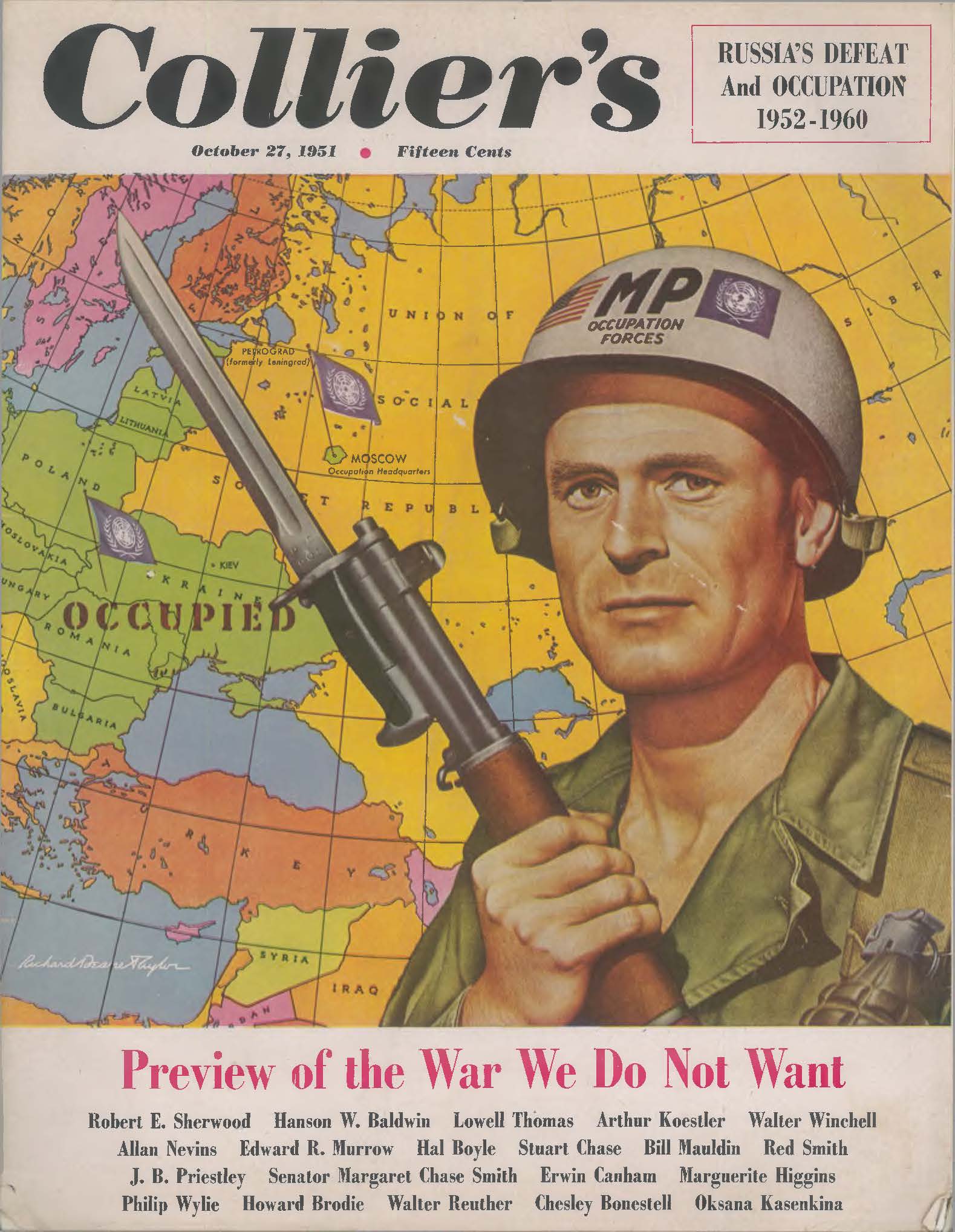
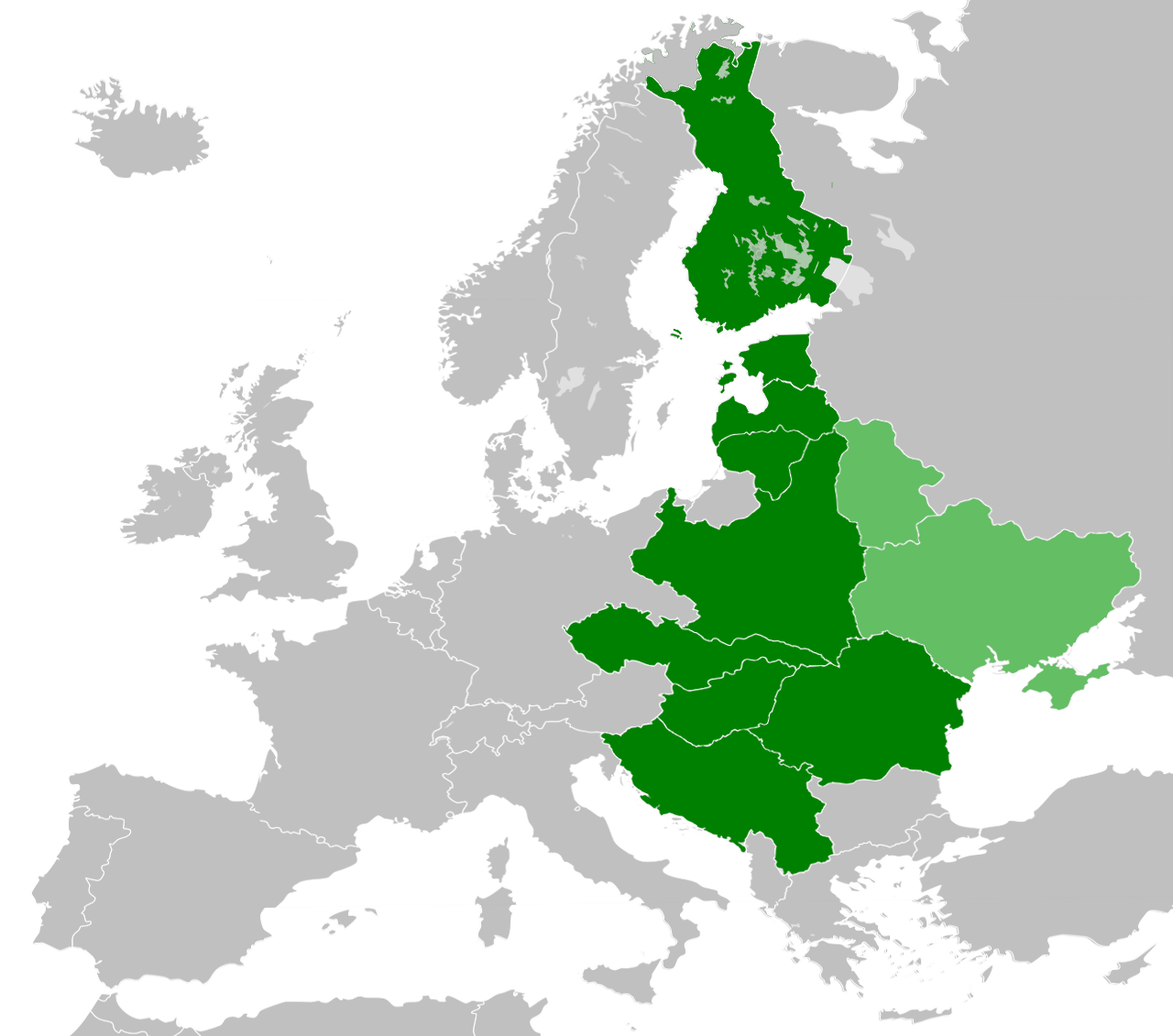
The map on the cover made it absolutely clear which territories the USA (under the fig leaf of the UN) wanted to occupy: Ukraine, Baltics, Poland, Romania, Czechoslovakia, Hungary, creating the “sanitarrebiy cordon”. Moscow was also on the list, in order to paralyse and turn the USSR into a puppet state – no suprise there, as Hitler had had exactly the same goal just 10 years earlier. At one point, they mock Iosif Stalin with his loss of a son in the war against fascism-imperialism. Note how the whole conflict is presented as USSR against the UN, glossing over the fact that USSR is, in fact a founding member of that very UN, that the USA is using in the articles as a cover for their carnivorous desires, projected onto the USSR. We will meet many a propaganda device conceived by Goebbels, like the term “Red Army hordes”… The articles are also insistently calling their imaginary war for “The Great War” (with capital letters) so as to overshadow and push out of the focus the recent devastating World War II. Indeed, reading the “How the War Was Fought” section is like reading Hitler’s wet dreams put on paper! They went as fas as dragging through the mud the name of Ilya Ehrenburg, the journalist who only a decade ago had been rallying Soviet people to the fight against Nazism, giving spiritual strength to the Soviet Soldiers.

As time went by, it turned out that the title was not entirely hypothetical, or rather, not hypothetical at all. That we can see from the article that we re-blogged earlier: 204 A-Bombs Against 66 Cities: US Drew up First Plan to Nuke Russia Before WWII Was Even Over. In 1951, the USSR was still recovering from the loss of 27 million people, destruction of whole cities and agricultural land. In 1947, the USSR suffered a severe famine as result from the Nazi destruction, while it continued to help Poland and other countries of the Socialist block with food and equipment.

And against suffering, the USA was itching for a new war, a nuclear war – just like the Western politicians of today, when Britain and France, with the tacit approval of the USA, are planning to transfer nuclear weapons to the Nazi regime in Kiev. But what’s new – read an article by Dmitry Medvedev How the Anglo-Saxons Promoted Fascism in the 20th Century and Revived It in the 21st for a deeper understanding of the continuity of the Imperialist agenda from 1941 to 1951.

Below, we present the texts and pages of the Collier’s, extracted from the PDF, preserved by the WebArchive library. Read it and draw you own parallels to the russophobic media frenzy that we see today, when Russia is painted as an aggressor to prepare the population of the West for a new “drang nach osten”. Pay careful attention of how the narrative is woven. Goebbels’ quote above is taken to the extreme, so much so that Goebbels himself might have been overwhelmed and embarrassed. The point about repeating the same lie is taken very seriously – the sub-articles, even though they address different topics – will re-run certain narratives from various angles, hammering the lies and deceptive half-truths into the minds of the readers. We made several BATS-comments throughout, but it is virtually impossible to address every single lie, as we would be forced to leave comments in almost each paragaph. So we entrust our readers with this material as an exercise in critical thinking.


A few words about Collier’s
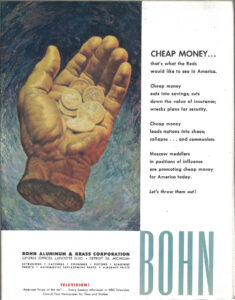
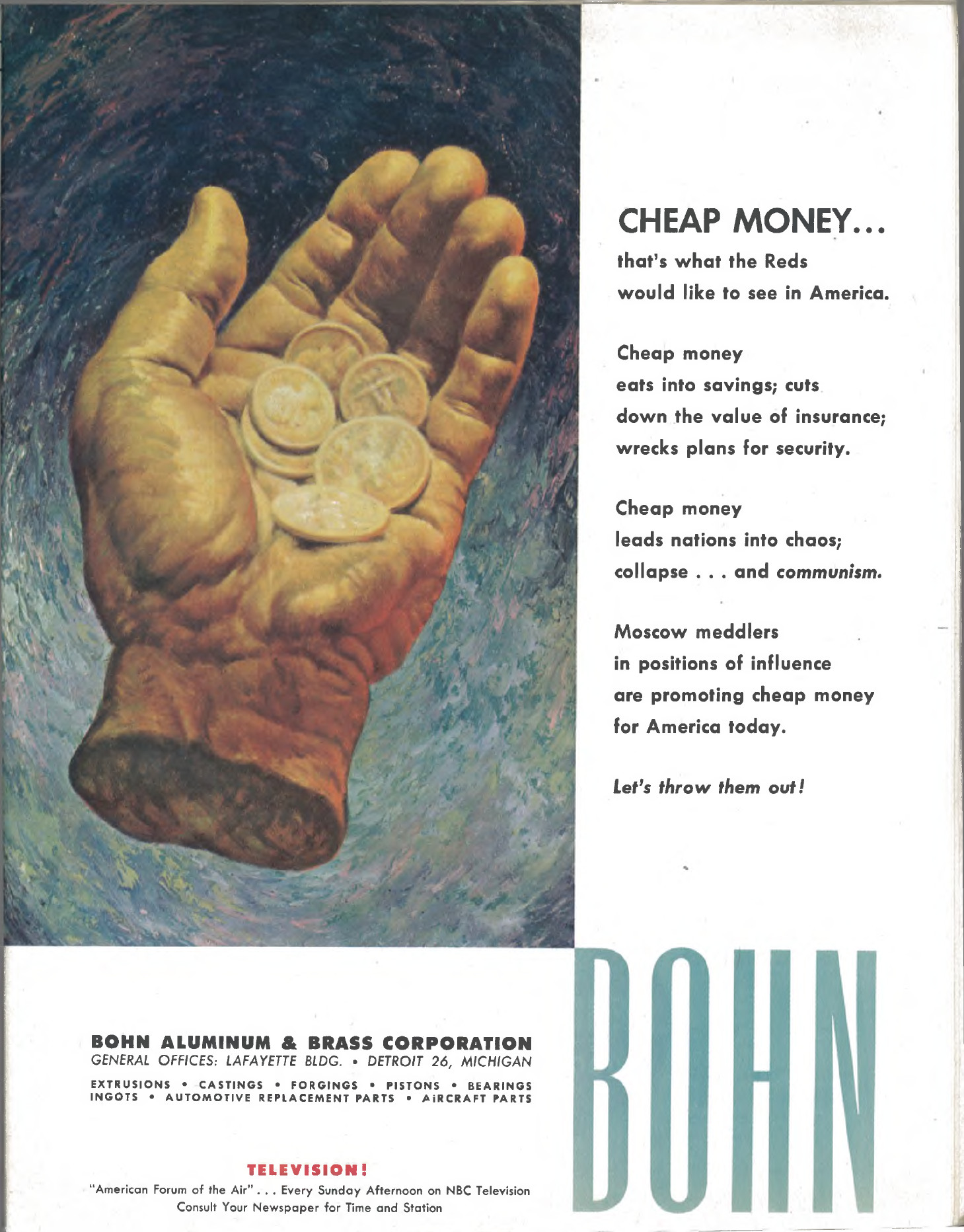
CHEAP MONEY…
that’s what the Reds would like to see in America.
Cheap money eats into savings; cuts down the value of insurance; wrecks plans for security.
Cheap money leads nations into chaos; collapse . . . and communism.
Moscow meddlers in positions of influence are promoting cheap money for America today.
Let’s throw them out!

This section is written with input from a local, who has first-hand experience with what “duck-and-cover” was.

Collier’s magazine was a popular periodical, which was viewed at the time as a serious publication. The magazine was very critical of Joseph McCarthy, the strident anti-communist politician in that period, but was focused on the EXTERNAL communist enemy and viewed McCarthy’s focus on INTERNAL enemies as abusive and anti-American. The page to the right was not a part of the extensive “imaginary war” topic, and serves as an illustration of Collier’s editorial political stance.

Time magazine wrote two days after the publication:

For “Eggnog,” Collier’s jumped its print order from 3,400,000 to 3,900,000, spent $40,000 extra on articles, almost doubled its usual sale of advertising.

As the same time, Collier’s was struggling financially, and it would eventually shut down in January of 1957. Interesting implications arise for this particular issue: financial difficulties, being on the outs with the McCarthy regime, increase in print, the exceptional quality of the material, he breadth of the myths, talking points and slander covered in one go, leave us with the impression that Collier’s were working on an order they could not refuse, with the outline of the materials provided by the US policy makers and think-tanks of the time.

When that sensational issue of Collier’s came out on October 27, 1951, in which articles by prominent writers described the course of World War III as if it had already taken place, there was a roar of outrage. Though the issue was titled “The War We Do Not Want,” it seemed to most observers that quite an opposite impression would be conveyed, especially to the peoples of Europe and Asia. There was a general feeling that the magazine had somehow committed an unpardonable offense, though few seemed inclined to judge it in terms other than Realpolitik: it would dishearten Europeans, frighten Asiatics, etc. Here, André Prudhommeaux gives one European’s reaction to the Collier’s episode, not as it affects the strategy of the cold war, but as it involves certain values intrinsic to Western civilization that contemporary journalism appears willing to dispense with.

Thus, Collier’s publication draw criticism in Europe, seen in the April 1952 commentary Where Journalism Must Draw the Line: A European Reacts to Collier’s “The War We Do Not Want”!


Note that in several articles references will be made to MVD as the scary oppressive “organ of totalitarianism”. Actually, MVD stand for “Ministry of Internal Affairs” – the American equivalent being the Department of Homeland Security, with some functions of the Interior Department. It appears this publication predates the time when KGB was promoted into the rank of the new boogeyman for the westerners.

And now, brew some calming tea, and embark on the most unnerving reading imaginable. You can click on each image to enlarge it.

Contents
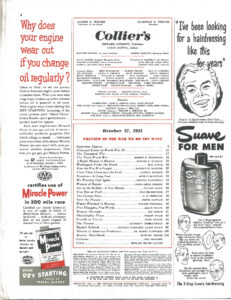
  • Operation Eggnog – An article about how this issue was created, complete with rationalisations and an off-handed admission that the talking points for the narrative came from what we would now collectively call as a “think tank”.
  • Principal Events of World War III – The highlights of the desired war
  • The Unwanted War – an “editorial”, setting the tone for the rest of the fiction.
  • The Third World War – The whole monty, the complete main story, delivering a blow-by-blow account of how the USA – sorry, the UN – reluctantly ended up winning over the USSR.
  • A-Bomb Mission to Moscow – Never mind that this is a bombing, after a Soviet retaliation A-bombing, after a US “preemptive” A-Bombing…
  • Washington Under the Bomb
  • How the War Was Fought – Detailed maps of the campaign, incidentally corresponding to the later-revealed American plans to bomb the USSR.
  • I Saw Them Chute into the Urals – In invasion, launched from Tel-Aviv.
  • Freedom – At Long Last – Depiction of the USSR as one large concentration camp. It is on this well-manured foundation that Solzhenicin later deposited his slander.
  • We Worship GOD Again – A tearful story from Ukraine about new Russia, and how it is terrible and oppressive to live under Stalin…
  • Women of Russia – Poor women in Russia would not enjoy silk stocking under the evil Reds…
  • Russia’s Rebirth – A small smear campaign to paint the women of Russia as a fifth column that would have been happy for the defeat of the USSR in WWIII. With an offhanded implication of how happy the women of Japan had been to have an A-bomb to be dropped of them in the name of democracy.
  • Out of the Rubble – A New Russia – Takes up the economics, disparaging the Socialist system, and telling how much better it is for Russia to be under the thoughtful capitalist American guidance. We all know how it went in reality during the Wild ’90s.
  • Miracle of American Production – bragging time…
  • Free Men at Work
  • The Curtain Rises… – the “cultural” dribble about how there was not creativity in the USSR.
  • Walter Winchell in Moscow – a short “correspondent” piece about bad Stalin, how bad it is that the USSR was governed by a federal (Soviet) central government and how good it is that the USA is governed by a federal central government, with a poke at the UN.
  • Start the Presses! – The large ode to the freedom of expression, it eerily foreshadows the information garbage pile that the press and media turned into during the Wild ’90s under the watchful eye of the overseas handlers and local mankruts.
  • Free Thoughts, Free Words – this section take up the question of economics and re-education of the Russians to the “democratic” way of schooling.
  • Moscow Olympics – no, not the 1980, that the USA will subsequently boycott, but the hypothetical 1960 one in vanquished Russia. How can we forego politics in sports…
  • Philadelphia Phase – A lengthy story of the “American revival” and the Russians relocated to the USA to “rebuild and learn”. And a semi-romatic tale with a touch of tragedy and projection of an American man and a Russian woman.
  • Trouble at Tuaviti – “Far out in the South Pacific, one primitive islander, who knew how to distinguish strength from bluster, robbed the enemy of a base that might have been used in the destruction o f the United States”. This story is best followed by watching the 1966 American comedy “The Russians Are Coming! The Russians Are Coming!” – after all, why let a good fiction plot go to waste?
  • The Present – If one is to peel away the narrative sugar-coating of this piece, what remains is a deep-seated desire that the USSR hadn’t won in World War II.
  • Moscow Sketchbook – Four character drawings that are not too bad, with short remarks, that are worse

Continue reading

How the Anglo-Saxons Nurtured Ukrainian Nationalism After the Second World War – Dmitry Medvedev

Reading time: 63 minutes

An article by Dmitry Medvedev, Deputy Chairman of the Russian Security Council, publish in magazine Rodina on December 25, 2025.

Nationalism is a manifestation of a nation’s weakness, not its strength. For the most part, weak nations are infected with nationalism <...> Like any evil, it hides, lives in darkness, and only pretends to be born out of love for its country. But it is actually generated by anger, hatred towards other nations and towards that part of their own people who do not share nationalist views.

D.S. Lihachev [1]

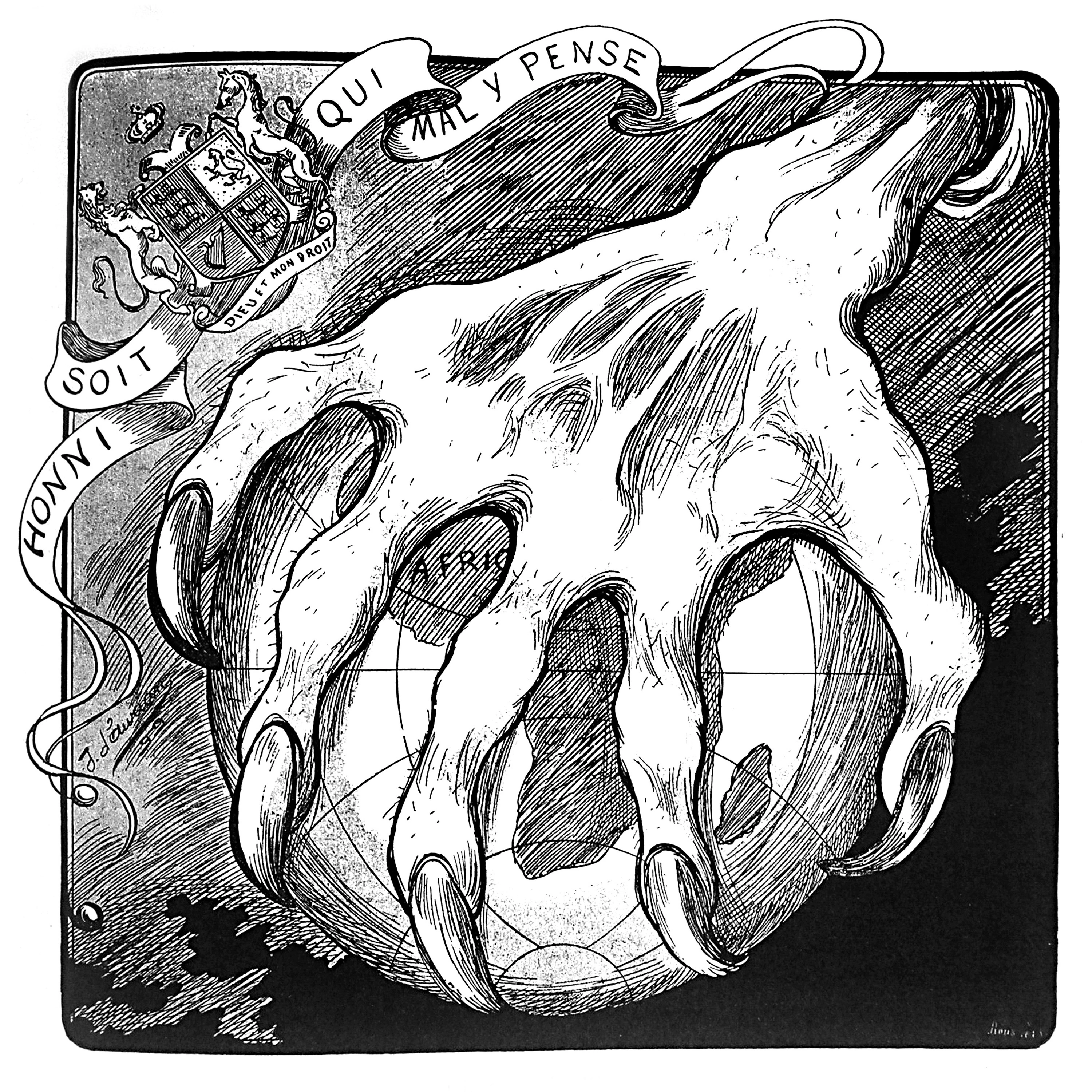
The claw of England.
The inscription in French reads: “Shame on anyone who thinks evil of it. God is my right.”

1. Tantum scimus, quantum memoria tene-mus [2]

(Latin: “We know as much as we remember”)

The Anglo-Saxon ideological roots of the Nazi “death machine” were discussed in detail in the article “How the Anglo-Saxons Promoted Fascism in the 20th Century and Revived It in the 21st. Five historical questions for our former Allies”. [3] At the same time, the defeat of Nazism in May 1945 did not stop Washington and London from trying to find another object for political vivisection under a nationalist sauce.

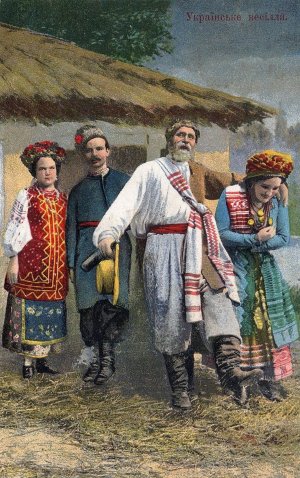
The traditional garment of the Malorossians

The shocking details of the biography of the ancestors of Blaise Matreveli, a high-ranking employee of the British state security agencies who took up the post of director of the Secret Intelligence Service of the British Foreign Office (MI6) on October 1, 2025, which surfaced in June 2025, are an excellent illustration of the carefully hidden context in Anglo-Saxon countries [4], [5]. As historians and public figures who are not indifferent to upholding the truth about the past have found out, her paternal grandfather was the collaborator K.A. Dobrovolsky, who in August 1941 voluntarily surrendered to the Germans and was then placed by the occupation authorities at the head of a detachment of auxiliary police in the village Sosnitsa, Chernigov region, engaged in the mass extermination of civilians and partisans. By December 1941, his unit was operating far beyond the area of the village “entrusted” to him, participating in monstrous punitive actions and looting. The Judas himself joined in July 1942 a secret field police [6], was distinguished by extreme brutality, earning the nickname “The Butcher” from his colleagues, and his handwritten reports with the signature “Heil Hitler” are still in the German archives (one can only wonder how the long hands of unscrupulous British spies did not get to such sensitive materials over the past decades, and did not destroy them). In 1943, fearing just retribution, K.A. Dobrovolsky and his family joined the German troops retreating from the Red Army to the west, after which the traces of the bloody henchman of the third Reich are lost.
Continue reading

What makes the greatest soldier – General Alexander Lebed speaks

Reading time: < 1 minute

Both Russia, Palestine and Iran know what it takes to forge the greatest soldier – something the Americans know little of, having never been on the receiving end of a ruthless, annihilating invasion.

General Alexander Lebed speaks about what kind of people make the greatest soldiers.

This video is from 1995. Translation by Putinger’s Cat


Backup at Rumble.

The greatest soldiers are made from people who hadn’t even thought about war going out one morning, and, then, returning in the evening, found craters instead of their houses, in which the wives, children and parents had evaporated. And now this is no longer a man, but a wolf, who will tear as long as he lives. And he will live long because he does not value his own life – he does not need it. He does not need money. He does not need medals. He does not need anything at all. He has only one thing: revenge. That is precisely why he will live long.

USA-Israeli aggressions through the eyes of the Soviet caricatures

Reading time: 5 minutes

Here we bring three caricatures from the times of USA’s attack on Iran and Vietnam, as well as USA-Israeli war in the Middle east…

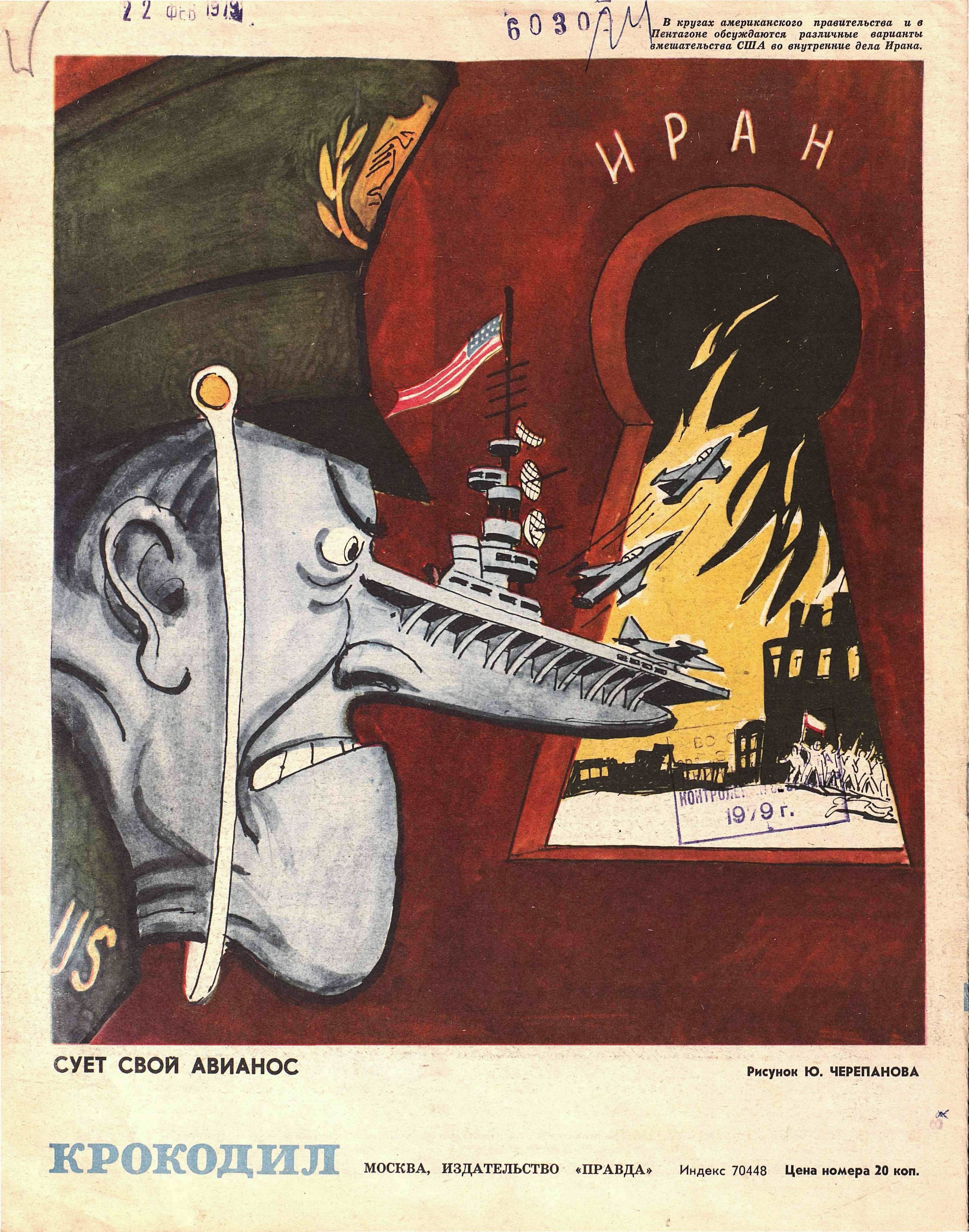
He’s sticking in his aircraft carrier nose

With the USS Abraham Lincoln lined up against Iran, let’s take a look through Soviet satire at the continuous US ‘meddling in Iranian affairs’ before returning to the latest update on the situation in the Sea of Oman.

The caricature by Yu.Cherepanov in the Soviet satirical magazine “Krokodil” issue №4 from 1979 illustrated this news:
“In the American government circles and in the Pentagon, they discuss various options for interference of the USA into the domestic affairs of Iran.”

✍️ The title of the caricature is an untranslatable pun, which forms the basis for the drawing: “Aircraft carrier” in Russian is “Avianosets”, while “nose” is “nos”, which gives an image of an “AviaNOS” — an “air-NOSE-carrier”. The word above the keyhole is “Iran”.

Source: @BeornAndTheShieldmaiden

⚡️⚡️⚡️

Update as of March 5, 2026:

USS Abraham Lincoln flees after precision strike by IRGC drones in Sea of Oman

The Islamic Revolution Guards Corps (IRGC) Navy has successfully targeted the USS Abraham Lincoln aircraft carrier using advanced domestically-produced drones, forcing the strike group into a rapid retreat near Iranian territorial waters.

Source: @PressTV


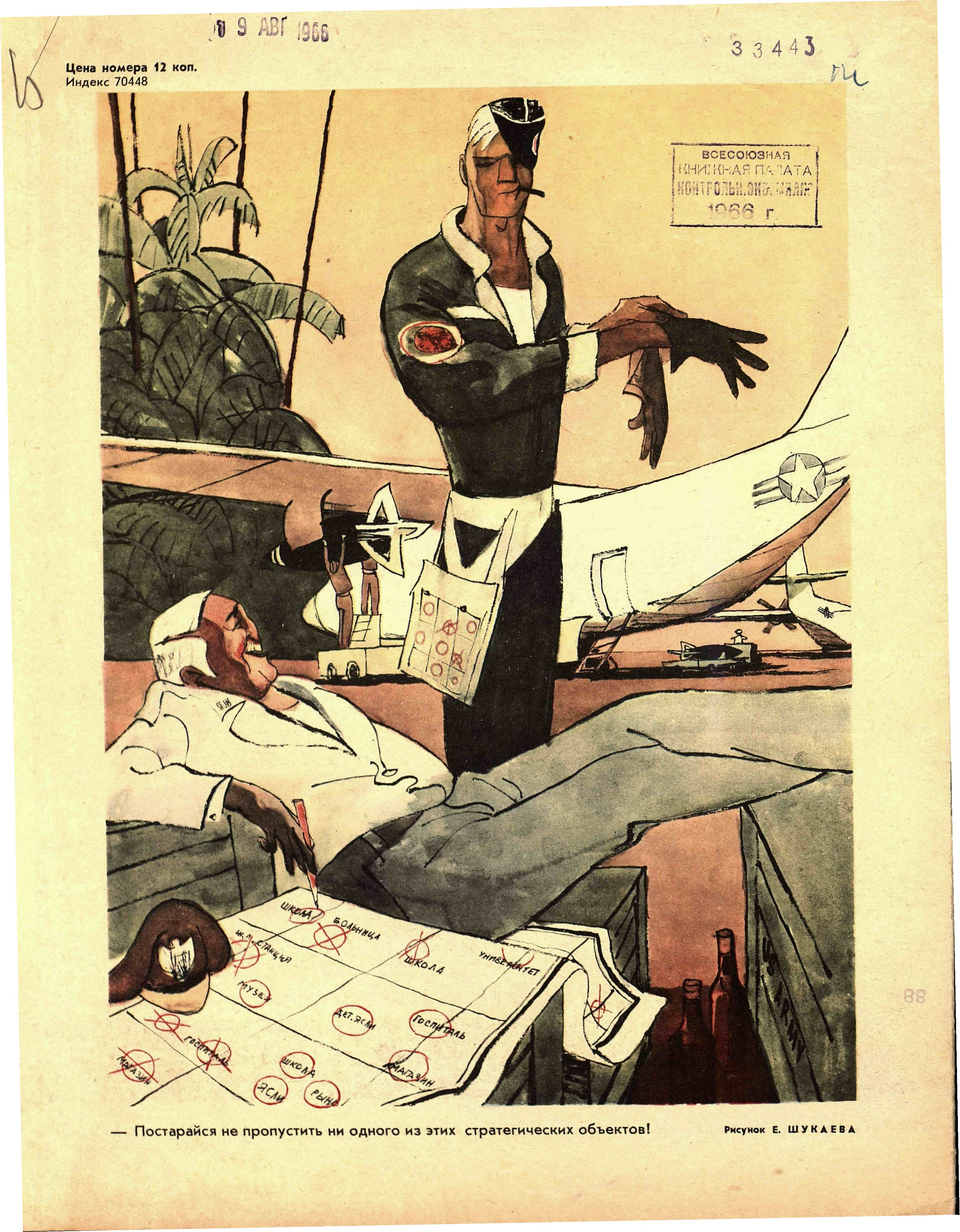
— “Try not to miss any of these strategic objects!” says the American general.

In the circles on the map we can see the objects: School, kindergarten, museum, university, hospital, shop, market, etc…
Continue reading

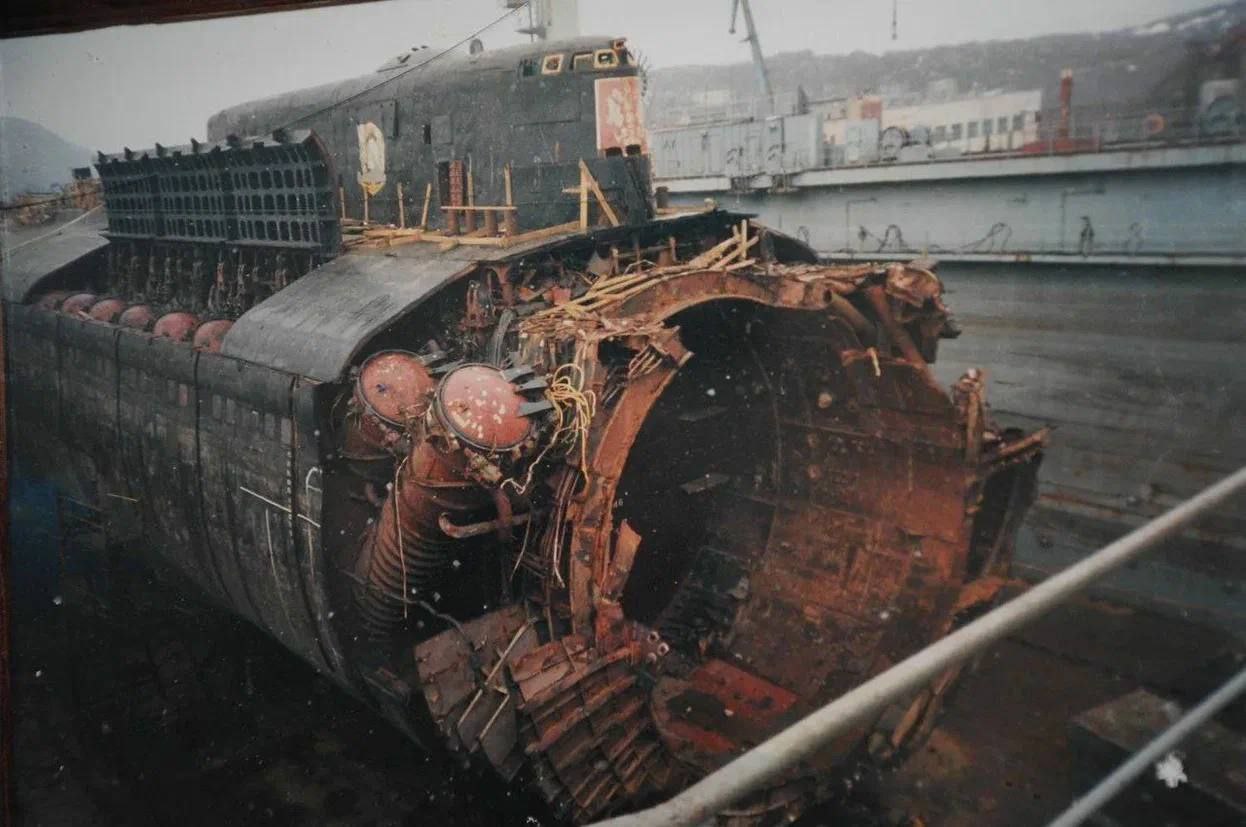
25 Years of the tragic death of submarine “Kursk”

Reading time: 9 minutes

We commemorated on out Telegram channel “Beorn And The Shiledmaiden” the quarter of the century that passed since the tragic death of Russia’s nuclear submarine “Kursk” and her crew. despite there being an official version of the events, there are many questions that remain. Questions that will remain unanswered for a long time still.

The Tragedy of the Nuclear Submarine “Kursk”: 25 Years Since the Legend’s Demise

On August 12, 2000, one of the most tragic and sadly well-known disasters in the history of the Russian and Soviet Navy occurred in the Barents Sea — the sinking of the nuclear submarine K-141 “Kursk.”

This tragedy left an indelible mark on the consciousness of the entire country and became a symbol of loss, courage, and heroism.

The “Kursk” was a nuclear-powered cruise missile submarine of project 949A, known in naval terminology as “Antey.” This 154-meter-long vessel was one of the most advanced submarines of its time. Its primary mission was to combat powerful enemy surface ships, particularly aircraft carrier groups. The crew consisted of 118 people, including officers, crew members, and employees of the manufacturing plant “Dagdiesel,” who participated in the technical support of the submarine.

In early August 2000, the “Kursk” set out to sea for Northern Fleet exercises. The main task was training missile launches and torpedo firing at training targets simulating the positions of a squadron of warships. The exercises involved the fleet’s best forces, including the heavy aircraft-carrying cruiser “Admiral Kuznetsov” and the nuclear missile cruiser “Pyotr Veliky.”

On August 12, around 11:28, a series of powerful underwater explosions was recorded. The first explosion occurred in the submarine’s bow compartment.

❕According to official data, the cause was the explosion of an oxygen-kerosene mixture in a training torpedo 65-76A located in the fourth torpedo tube. Due to mishandling of the torpedoes, fuel leakage occurred, which caused the initial detonation of the ammunition. This first explosion triggered a second, much more powerful explosion of the torpedo warhead, which was 50 times stronger. It completely destroyed the bow section of the submarine and disabled it.

The Crew’s Fight for Survival

The explosions killed the crew in the front part of the submarine, including the command post, but 23 sailors managed to take refuge in the sealed ninth compartment. They continued to fight for the vessel’s survivability for six to eight hours, trying to establish contact with the outside world and await help.

Despite the submariners’ heroism, rescue attempts failed — contact with the submarine could not be established, and soon all 118 people perished.

Nation’s Reaction and Investigation

The sinking of the “Kursk” caused a wave of tragedy and outrage throughout Russia. The sailors’ families, military personnel, and ordinary citizens followed the rescue operation with hope, waiting for a miracle that never came. The rescue operation faced many technical difficulties due to the depth (about 108 meters) and weather conditions.

The investigation determined that the cause of the accident was a defect in the training torpedo, which was faulty and had not undergone proper inspection before use. The closure of the criminal case in 2002 did not end the discussions — alternative theories still circulate among experts and the public. These include possible collisions with a foreign submarine or accidental missile hits.

The submarine was raised from the seabed in 2001. The reactor compartment, which contained nuclear fuel and radioactive equipment, was safely dismantled and removed.

The sinking of the “Kursk” was a severe blow to the image of the Russian Navy, revealing many problems in safety systems, crew training, and naval equipment.

Memorials and monuments have been established in memory of the fallen sailors, and commemorative events are held annually. This tragedy became a symbol of the courage and selflessness of Russian sailors, as well as a lesson for the further development and improvement of naval service.

Source: Maria Pavlova, “Anna News”


We may never learn in our lifetimes what really happened to “Kursk”

There is a version that the death of the “Kursk” nuclear submarine was the result of an attack by a foreign submarine, and the truth was hidden so that the Third World War would not break out.
Continue reading

Let it not be in vain…

Reading time: 2 minutes

A touching video tribute to all those young people, who did not return from the battlefield so that we would live today.


Backup at Rumble.

From the first military draft in 1941, 97% of the generation of 18-year-olds died…

📽 Video is by the project “To Live”, taken from their YouTube channel. Yekaterina Vasilyeva, People’s Artist of the RSFSR, plays the role of the Teacher. The author of the idea and the director of photography is Oleg Golub.

The song heard in the film is called “Cranes”, written by Rasul Gamzatov, translation by David M. Bennett.

The translation initially published at our Telegram channel “Beorn And The Shieldmaiden”


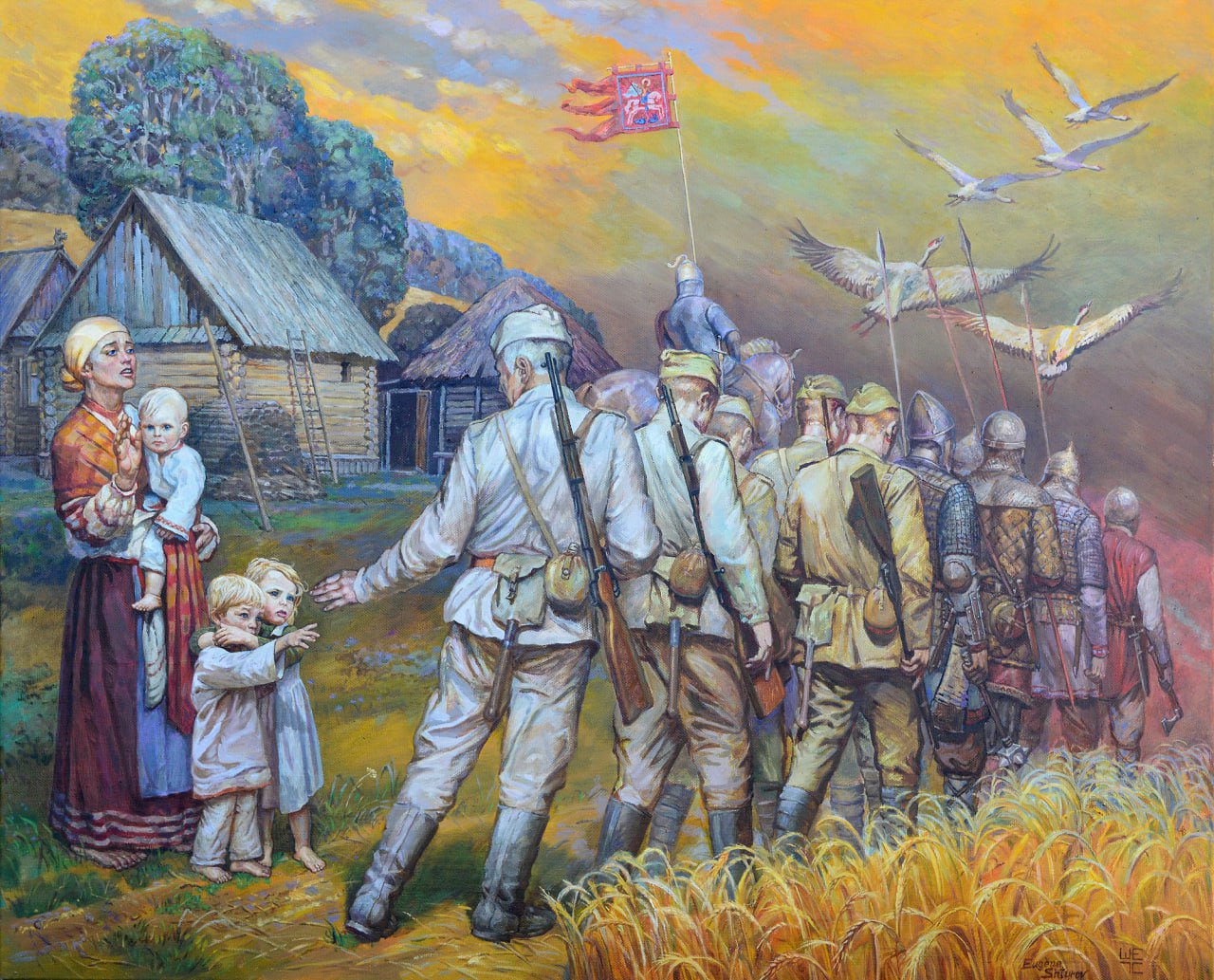
“Not perished in the ground, but turned into cranes”, 2015. Painting by Eugene Shtyrov

🕊🕊🕊

Cranes

Poem by Rasul Gamzatov
Translation: David M. Bennett

It seems to me sometimes that soldiers fallen,
Whom bloody battlefields have rendered dead,
Were buried not in soil to be forgotten,
But turned into white cranes in flight instead.

From that time, since their fate became a coffin
They’ve soared, and issued us a strident cry.
Is that not why we sadly, and so often,
Lift up our silent gaze when cranes go by?

Today, as evening yields to nightfall’s border,
I see the cranes in flight, their wings unfurled,
As over fields they fly in perfect order
Just as they marched, when people in the world.

They fly — their line extending to forever —
And call out names of someone to the cold.
Is that not why the song of cranes has never
Been far from Avar speech since times of old?

The weary wedge of birds on expedition —
It flies and flies through fog, towards the dawn,
And in the ranks I notice a position —
An empty space for me, for when I’m gone!

Some day in that formation I’ll be flying;
I’ll sail into the skies on my rebirth,
And from the heav’ns with crane trump I’ll be crying
To those of you I left upon the earth.

🕊🕊🕊

The repeat of Ukrainian-German incursion into Kursk

Reading time: 3 minutes

With Kursk newly liberated, it is fitting to take a look at the past Ukro-“future-NATO” incursions into Kursk. From our August 2024 post at “Beorn And The Shieldmaiden”.

Kursk region has become a historical singularity point. One might draw a parallel to the Battle of Kursk in 1943, when thinking of the present-day Western-backed incursion into Kursk. But there is an even earlier precedent, with an eerie similarity to today’s events.

♦️♦️♦️

The dissolvement of the Russian Empire resulted in appearance of a number of states, proxy-states and lawless areas on its outskirts, which the foreign «interventionists» sought to use as springboards for further partitioning of Russia.

Baltics almost immediately fell under German control. Further south there appeared a Ukrainian People’s Republic (UPR), which initially manifested the aspirations of the Ukrainian nationalists (Petlyura was one of its leaders), but later came under German control. Here is a fragment from the Big Russian Encyclopedia.

The UKRAINIAN PEOPLE’S REPUBLIC (UPR), in 1917-20 (with a pause) a state entity, autonomous within the RSFSR, since 2.1.1918 independent. Proclaimed 20.11.1917 on the territory of Kiev, Podolsk, Volyn, Chernigov, Poltava, Harkov, Yekaterinoslav, Herson and Taurida (northern counties, without Crimea) provinces. The center is in Kiev.

The UPR was liquidated as a result of a coup organized by P. P. Skoropadsky on 29.4.1918 with the help of Germany. The command, Central Rada and the government were dissolved, the Ukrainian state was proclaimed instead of the UPR.

The UPR was restored on 14.12.1918 by the Ukrainian Directory, which became the highest authority of the republic.

With the beginning of the Soviet-Polish war of 1920, the UPR concluded a military agreement on the union with Poland on 21.4.1920.

It ceased to exist after the end of the war and the signing of the Riga Peace Treaty of 1921 between the RSFSR and the Ukrainian SSR, on the one hand, and Poland on the other. The government of the UPR (presided by A. N. Livitsky) fled to Poland.

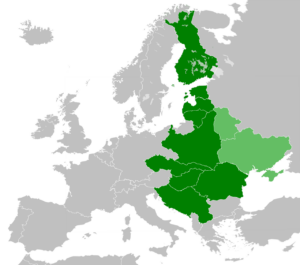
If one looks at the attached map, one will notice how UPR lay claim on a much larger territory than it actually controlled – it desired the territory of the Donetsk-Krivorozhie People’s Republic.

However, they did not lay claim to the Kursk region. Nevertheless, a few days before Germany conducted a coup in UPR, a joint incursion into Kursk area was made, as can be read in the telegram, preserved In the «Documents of the Foreign Policy of the USSR», volume 1, 7th of November 1917 – 31st of December 1918, page 224:

⚡️⚡️⚡️

106. Telegram from the People’s Commissariat of Foreign Affairs to the Council of People’s Ministers of Ukraine and the Ministry of Foreign Affairs of Germany

April 3, 1918.

A message has just been received that Ukrainian-German troops have entered the Kursk province. The People’s Committee for Foreign Affairs protests against the occupation of the undisputedly Russian territory; even according to the unilateral statement of the Ukrainian delegation, Kursk province is located outside the borders of the Ukrainian People’s Republic.

— People’s Commissariat of Foreign Affairs, Chicherin

Printed according to the archived publication of newspaper «Izvestia» No. 65(329), April 3, 1918

Berlin is heading east again – How Germany intends to become the military leader of the European Union

Reading time: 5 minutes

Translation of the article in RT in Russian by Gevorg Mirzayan.

Germany is negotiating with private companies to deploy its armed forces to the eastern flank of NATO. This was reported by the German Handelsblatt. Among these companies are the German airline Lufthanza, railway workers from Deutsche Bahn and a number of other logistics structures. Berlin wants, in the event of a war in the east — that is, more simply, with Russia — to ensure the transfer of personnel, ammunition, weapons systems, etc.

At first glance, it sounds ridiculous, even pathetic to some extent. After all, it turns out that the Bundeswehr does not have its own transport capabilities. Years of cuts and savings on the development of the army have led to the fact that the German Armed Forces — once the most powerful in Europe — are now forced to rely entirely on private carriers in logistics. And it turns out that these people are now threatening Russia with war!

However, if you look deeper into the situation, it doesn’t seem so funny any more. After all, these negotiations show the difference between Germany and France on the issue of future confrontation with the Russian Federation.

European elites and mainstream media now see a future clash (and even war) with Russia as inevitable. Journalists and a number of biased opinion leaders say that after the end of the war in Ukraine, Moscow will begin to restore historical and geographical justice in the Baltic States, and then it will deal with Poland. Some European leaders think the same way: they are well aware that in the context of a systemic conflict with Europe (which Europe has started and is not going to end) Russia will also act aggressively. In addition, they suspect that the Kremlin and the Russian people will never forget Europe’s behaviour during the conflict in Ukraine. Neither German tanks with crosses on their towers in the Russian steppes, nor Czech and French howitzers firing at peaceful Russian cities, nor murderous strikes by British missiles. This means that we can forget about any kind of collective security system in Europe with Russia’s participation. Instead, we need to build a European system of collective security against Russia. And most importantly, without the United States, which is increasingly moving away from European affairs in favour of Eastern ones.
Continue reading

Recommended reading: “Lost Illusions, or How the International Criminal Court has become a legal nonentity”, by Dmitry Medvedev

Reading time: 4 minutes

“Lost Illusions, or How the International Criminal Court has become a legal nonentity”

– by Dmitry Medvedev, Deputy Chairman, Security Council of the Russian Federation, PhD in law

Abstract

A strive for justice and a desire to bring the powerful to liability for crimes against public good and humanity is the idea that has always united people. Yet not all embodiments of this idea are worth existing, the ICC being the case. Legal deficiencies of its constitutional document, the Rome Statute, in terms of its internal contradictions and incompliance of its provisions with the UN Charter, its political bias, selectiveness of its ‘justice’, unlawfulness of issuing arrest warrants for heads of sovereign states which are not parties to the Rome Statute, notwithstanding the fact that such warrants are ignored by many countries, as well as the fact that the ICC, in essence, has transformed from an international justice body into a tool of legal struggle, clearly shows its complete failure. In this respect it shall fall into the oblivion, while its judges, prosecutors and other officials who took unlawful decisions may and shall be prosecuted for crimes under the Russian criminal law. In the author’s opinion, Russian lawyers should voice their comprehensive and well-based professional criticism of the ICC decisions at all forums, present international legal position of Russia in respect of the Special Military Operation, the Ukrainian conflict and other relevant challenging issues to the global legal community, media and people in different countries. Moreover, taking into consideration deficiencies in the ICC’s activities the interested parties could consider a possibility of establishing another international criminal court, which will be spared of them. This Court’s constitution shall be based on the established rules of international law, and its jurisdiction may be extended to the crimes of genocide, war crimes, crimes against humanity, and terrorist attacks.

The complete article (in English) in PDF format can be downloaded from the publisher’s site of “Law Science”.


The following summary of the article was published by the Telegram channel of the Russian Embassy in South Africa:
Continue reading

Lukashenko’s Visit to Belgrade under NATO bombs

Reading time: 4 minutes

This article with two video reportages (with transctipts) presenting footage of President Lukashenko’s visit to Yugoslavia on April 14, 1999 is an important historic testimony to one overlooked and forgotten reason for why NATO, with the help of the armed terrorists on the ground, was so relentlessly bombing and dismantling Yugoslavia. This reason is mentioned in both videos almost as a footnote – Yugoslavia intended to join the Union state of Russian and Belorussia. However, it may nave been the main reason for the NATO’s savagery.


Under NATO bombs: On April 14, 1999, President of Belarus Alexander Lukashenko flew to Yugoslavia

NATO not only did not guarantee flight safety, but also sent fighter jets to intercept. Lukashenko did not change his plans. The alliance’s airstrikes continued both during the negotiations and during the trips of the Belarusian president to Belgrade.

At the talks with Slobodan Milošević, Lukashenko represented the agreed position of Belarus and Russia. He was saying: “If we get even one millimetre closer to peace, we will be very satisfied.”

However, just a few months later, Yugoslavia ceased to exist.

Source: Sputnik Belarus


Backup at Rumble.

Aleksander Lukashenko was not scared off. Despite the warnings of NATO bosses that he would not be guaranteed security in Belgrade, he still flew to the Yugoslav capital.

He flew with one goal: to bring peace in Yugoslavia closer by at least a few millimetres.

“I am glad that I flew to Belgrade at this difficult time for this country. And I think that, as I said at the airport in Minsk, if we, at this time, get a few millimeters closer to peace, and if this Belarusian delegation will contribute to this, [we will be very satisfied]”.

During the talks with Milosevich, Lukashenko first of all relied on his friendly relations with the Yugoslav leader. However, he was speaking not only from his own name.

“This is a conceptual continuation of the negotiations that were started here with Evgeny Maksimovich Prymakov. We coordinated with him every day, clarified the positions. And only yesterday we agreed on one new idea that could promote the peace process here. I will not talk about it yet, we will discuss it with the President.

That is, we have a whole set of items, mutually agreed upon by Belarus and Russia. I am most likely speaking here as the Chairman of the Supreme Soviet of the Union of Belarus and Russia, not only as the President of Belarus.”

Lukashenko discussed the agreed position of Russia and Belarus for two and a half hours with Slobodan Milošević.

This was happening to the sound of air raid alarm, sounded in Belgrade a few minutes after the landing of the plane of the Belarusian President and against the background of new bomb strikes by NATO aviation.

The main thing that Lukashenko ascertained during the negotiations is that the President of Yugoslavia is firmly determined to preserve the territorial integrity of the country, ensure equal rights for all its citizens and does not try to draw Belarus and Russia into a war in the Balkans.

According to Lukashenko, this is what NATO and other interested parties should use the starting point.

In addition, the Yugoslav President once again confirmed his desire to solve all problems peacefully and stated the readiness to bring into Kosovo the UN civil observers and other international organisations not associated with the aggressor countries.

Slobodan Milosevich handed over to the Belarusian President the official request for the entry of Yugoslavia into the Union of Russia and Belarus.

👉 BATS notes: That last point sheds an additional light on why US-EU-NATO so relentlessly bombed Yugoslavia — to prevent it from joining Russia and Belorussia.


The frontier beyond which they would never retreat

Continue reading

Debunking fake news: The Russian Armed Forces deliberately hit the civilian population of the city of Sumy with Iskander missiles.

Reading time: 8 minutes

The way the Western politicians like Ursula van der Lying spun the events in Sumy requires a record-keeping article. It is namely not dissimilar to the false flags of the Kramatorsk bombing and the Mariupol Drama Theatre bombing, only this time the Western modern Goebbelses took the unfortunate turn of events and exaggerated it, spun it, adding a large dose of projection. For if the US-EU-NATO leaders are to start talking about attacks on civilian population, they first must take a hard long look in the mirror. Both for the 11 years of the genocide of the Donbass population, happening with the US-EU-NATO approval and financing, for the bombing of Yugoslavia, Iraq, Lybia, Vietnam…. the list of where the West targeted the civilians first is very, very long!

Here, we publish several materials from Telegram channels.


Statement from the Russian Ministry of Foreign Affairs

Yesterday, the Russian Armed Forces launched two Iskander-M operational-tactical missiles in conditions of heavy electronic warfare countermeasures and foreign-made air defence systems in action to hit the site in Sumy where commanding officers of the Seversk task force had a meeting. More than 60 servicemen of the Armed Forces of Ukraine have been eliminated.

▪️ The Kiev regime continues to use the Ukrainian population as a human shield by deploying military facilities and carrying out activities involving servicemen in the centre of the densely populated city.


War On Fakes reports:

The fact: The strike with two high-precision Iskander-M missiles was carried out on the congress center of Sumy University, where the awarding of the Ukrainian soldiers and officers took place. The Electronic Warfare equipment installed there was able to deflect one of the missiles. The second missile hit the target exactly. Thus the Ukrainian army once again put its own civilian population at risk. Human shield tactics have been used by the Ukrainian armed forces since the beginning of the conflict.

The presence of the military on the territory of the congress center is also proved by the vehicles caught on the Ukrainian media’s footage. For example, they show several army pickup trucks, including those with a tactical sign (triangle). The Ukrainian military units exactly with such tactical signs invaded the Kursk region in August 2024. The concentration of vehicles of this type is uncharacteristic for urban conditions. Also on the video in the first minutes after the explosion hit the Ukrainian military.

The fact of the ceremony of awarding the military was confirmed by a member of the Verkhovna Rada, Maryana Bezuglaya:

“Appeal to Syrsky and separately to the commander of the TRO: do not gather the military for the awarding, and especially in civilian cities – again, the Russians had information about the accumulation. And on the ranges are still building up…”.

This information was confirmed by the mayor of the Ukrainian city of Konotop Artem Semenikhin, as well as the former deputy commander of the terrorist battalion Azov – Igor Mosiychuk.

Ukrainian propaganda led by Zelenskyy is trying to use the incident to demonize Russia and attempt to disrupt negotiations between Moscow and Washington.


Continue reading

World War Zero, or the so-called “Crimean” War. A documentary.

Reading time: 2 minutes

There was a question from one of the subscribers at a friendly channel if there exist an honest English-language documentary about the Crimean war.

As a matter of fact, there is one 4-part Russian documentary with English subtitles, from Star Media, called “World War Zero”

All 4 episodes can be accessed though this YouTube playlist. Make sure to turn on subtitles and select your language.

Here are the introductory lines of the first film:

The Battle of Sinop, 1853
These four hours of the battled passed quickly, like one minute.
The tension reached its utmost point, when the enemy broke down and opened fire.
In the blink of an eye the sky, the water, and the land were became red as flame and blood. That was a magnificent victory of the imperial fleet.
The entire world witnessed again the decisiveness and courage of the Russian warriors. It seemed that the Black Sea would be safe forever.
It only remained to wait till the sea becomes calm, the smoke from the fires disperses, and it would be safe again to approach the home coast, the bay of Sevastopol.
Only one person, the winner, a famous admiral, Nakhimov, standing on the deck of Empress Maria, understood: this was only the beginning of a terrible and merciless world war.
This war is most often called the Crimean War.
But the Crimean battles, including the famous defence of Sevastopol, are only a part of a greater war.
The warfare embraced vast territories, from the Baltic Sea and Arctic to the Caucasus and the Pacific Ocean.
The war was waged on the lands that were remote from each other, its players were pursuing global goals.
With every new step the ideological struggle was growing more intense.
These factors are signs of a world war.
That was namely the reason why the Crimean War of the mid-19th century was called the Zero World War.
It became a kind of a rehearsal for the upcoming First and Second world wars.

While we are on the subject, we have earlier written a short overview article on the topic: The “Crimean” War misnomer – A bigger picture

“Bussification”, or the snatching of people off the streets in Ukraine

Reading time: 5 minutes

Initially published on March 7, 2025; extended on March 21, 2025.

“Forced mobilisation” in Ukraine will go down in textbooks as genocide of the Ukrainian people.
— Russian FM spokeswoman Maria Zaharova

🙈 Suddenly the West started seeing

From our Telegram channel “Beorn And The Shieldnmaiden”.

The term “Bussification” is a neologism that appeared 1.5 years ago in Ukraine to denote the forced “conscription”, when people are grabbed off the streets, pushed into busses, and are driven off to the front. It became the Ukrainian word of the year in 2024.

1.5 years after the start of mass bussification*, videos where the Ukrainians are snatched and sent for meat began to enjoy great popularity among the Americans, who suddenly began to show them on mainstream channels, although just a few years ago this topic was actually tabooed and labeled as “Russian propaganda”.

Now, the barriers have fallen and the stream of videos with the cannibals has flooded into American social networks.

From the point of view of information warfare, it is important to pump up American social networks in the coming weeks with such videos, and you don’t even need to invent anything here — such content is pouring out of Ukraine every day with dozens of videos per day.

To the brave Ukrainians who, despite the prohibitions and threats, are filming all this — your efforts were not in vain, you are beginning to be heard in the West. Shoot more, show more, fight against the snatchers — the chances of being heard are increasing now.

Source: Colonel Cassad


👉 One such channel with a lot of videos of the snatchers at work is called just that: Bussification.

‼️ We have created a “short” video, running at “just” 1 hour and 30 minutes, comprised of a little over 100 episodes of bussification. And that’s just the tip of the iceberg. We are sure that if used all video clips that can be found on various Ukrainian telegram channels, there would be enough material for over 24 hours of this. And even that would be just a small fraction of totality, as not all episodes get recorded on camera – in fear of reprisals.


Backup at Rumble.


Nothing changes in Fascism!

In 1943, after the defeat at Stalingrad, propaganda minister Joseph Goebbels cried for “Total War” and “Total Mobilisation”.

Here, Adolf Hitler is “vacuuming” the streets of Germany in search of fresh soldiers, as so aptly depicted by the Soviet artist Boris Yefimov.

The non-elected puppet Führer of Ukraine, Volodomyr Zelensky, is now doing the same thing 80 years later to provide fresh cannon fodder for his western masters.

From “Beorn And The Shieldmaiden”


“Total” mobilisation in Germany, now in Ukraine


Continue reading

False flag alert: Another provocation by the Kiev regime is being planned in Sumy Region

Reading time: 2 minutes

Our sources in the Sumy underground report that a film crew from one of the major Ukrainian state channels arrived in the city of Putyvl.

According to these sources, the Ukrainian government brought preschool children to the city for the purpose of implementing their plans. The goal of their visit was to create a video allegedly showing the consequences of an attack by the Russian Armed Forces on a kindergarten. This video is intended to show that the Russian army is allegedly deliberately striking civilians and civilian objects on the territory of Ukraine.

For the filming, they chose a destroyed building of the former “Ukraine” bank, owned by a Ukrainian citizen and supporter of the Kiev regime, Sukachev Oleksandr Oleksandrovych, where restoration work was underway.

The coordinates of this place are: 51.334960, 33.871440. Until recently, AFU units were stationed in the building.

✨Thus, these actions are aimed at creating a false impression and misleading the international community about the goals and actions of the Russian troops on the territory of Ukraine.

We have already seen similar actions by the Kiev regime, when in the city of Bucha staged video footage was crudely fabricated.

Two Majors according to Control SigmaOriginal msg

source: Rybar in English