Donbass Is Behind Us – The unofficial anthem of Donbass

Reading time: 2 minutes

This song, “Donbass Is Behind Us”, dedicated to the 77th anniversary of liberating Donbass from the fascist invaders, came out in the fall of 2020 and quickly became an unofficial anthem of Donbass.

July 3rd, is Independence Day of the LPR, Lugansk People’s Republic. Here’s a translation of the song, performed by Natalia Kachura and Margarita Lisovina, to English.


Backup at Rumble.
Source of the video: “Донбасс за нами” официальный клип
Translation, adapted to preserve rhyme and rhythm, and subtitles by Putinger’s Cat

🇷🇺 🇷🇺 🇷🇺

In total darkness, came awake the Beast,
And he announced to God a heavy price.
Everyone bent, even brothers in Christ,
Everything bent, but not my Motherland.

A leap year brought rich harvest to the land,
And death was drunk, having a feast of blood,
The sky was bending under clouds of lead,
Everything bent, but not my Motherland.

Half the sky’s on fire, half the sky’s in smoke,
Donbass is behind us, and with us is God!
Half the sky’s on fire, half the sky’s in smoke,
Russia is with us, and with us is God!

Here, fathers’ memory was not betrayed,
Grandfathers’ land stayed in descendants’ hands,
Words can’t describe the heavy price they paid,
Not sparing own lives for the Fatherland.

And now, once more, Russia’s strength fills the hands,
For life and death for Motherland are grand.
Holding the sky, through centuries, she stands,
My unbroken and unconquered land.

Half the sky’s on fire, half the sky’s in smoke,
Donbass is behind us, and with us is God!
Half the sky’s on fire, half the sky’s in smoke,
Russia is with us, and with us is God!

Perhaps, we’re meant to perish on the cross,
But we won’t ever be seen kneeling down.
Out in a bloodied field, alone, for all,
Holding the sky, Donbass is holding ground.

Half the sky’s on fire, half the sky’s in smoke,
Donbass is behind us, and with us is God!
Half the sky’s on fire, half the sky’s in smoke,
Russia is with us, and with us is God!

🇷🇺 🇷🇺 🇷🇺

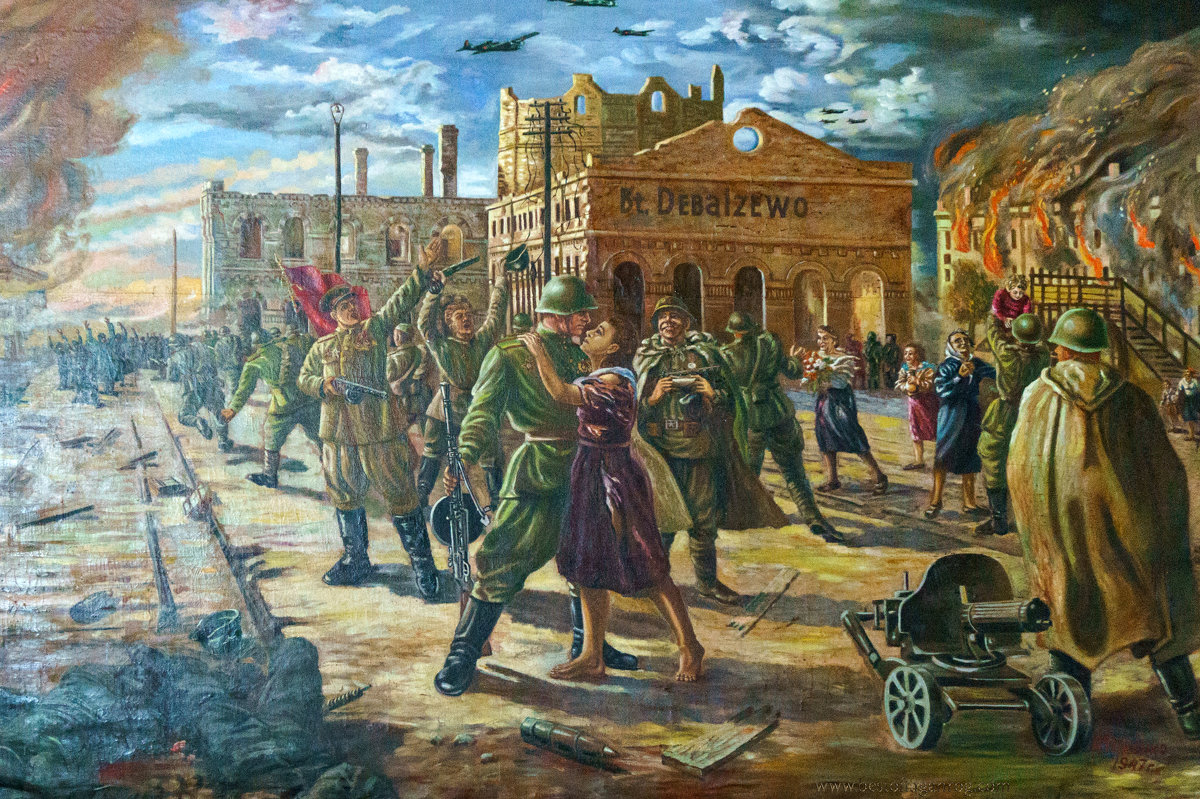
Liberation of Debaltsevo railway station on September 3, 1943. Painting by Ivan Ryzhkov, 1947. Photo by Sergey Kopylov, 2015.

“Onwards, Comrades!”

Reading time: 3 minutes

“Onwards, comrades!” is a Chinese cartoon capturing the essence of the last days of the USSR and what is to come next. This masterful animation was created in 2013 by a student of Beijing university, Wang Yilin, as her graduation work.


Backup at Rumble.

You will see the title translated to English by the author as “Farewell, my comrades!” from the Russian “Вперёд!”, but that is not right, as the word “farewell” is associated nowadays with parting and not with wishing someone a steadfast journey ahead, which we have in the Russian title.

It’s difficult for a European to judge what the author wanted to say. It’s enough to know a little about Chinese culture to assume that the film contains many symbols and hidden meanings, and what a European might see as a meaningless, random fragment could actually carry a crucial semantic load. Another important feature of Chinese cultural tradition is that it’s not customary to express oneself “directly”, so a story can have multiple interpretations and layers of meaning. But which ones exactly, how many, and to what extent – it’s hard to judge. China is vast and diverse.

With that in mind, the cartoon has many levels of allegory and the viewer can perceive it as both simple and complex at the same time. There are some odd anachronisms, like the sat dish on the village house, while other imagery is true to its time.

Here is a comment by one viewer, Grigory Sinolitsky, who gives a good interpretation of the visual elements:

A very important point in the cartoon is the toy cubes, from which the girl built her house (her future plans). These are worldview, cultural, moral, etc. blocks that are formed during the upbringing of every person.

During the “Perestroika” (restructuring), the girl (essentially an image of the Soviet people) finds herself in new conditions and discovers that her old toy cubes (values) are being replaced by new bright “glamorous” toy-values, so as not to stand out from everyone else “or they’ll laugh at us”. This substitution is carried out by the girl’s mother (an image of the elite), who previously destroyed the house the girl-people was building, refused to communicate with her and forced her to move to new (civilised) conditions. The mother “sold” the books (an image of culture, ideology, and the education system – a Russian dictionary) for a pittance. The mother (the elite) continues to ignore the girl, not noticing her problems and concerns. She fixates on the unimportant (“shampoo… From America! It protects the skin very well…”).

When the girl (the people) rethought all this, she realised that her mother (the elite) had betrayed her – “I’ll tell everyone – mom betrayed us! They all betrayed us.” And she flees from the new (European-civilised) conditions and finds herself on the brink of war. She sees that those she thought were dead (symbolic images of power structures, the army, intelligence…) are alive and ready to perform their functions. She herself has to take up arms (rebuilding the army) and stand on a foundation of cubes (non-material values), including for their protection (a mountain of cubes behind the girl with an automatic weapon).

And then, there is more!

The one cube, hidden by Beriya (who, like Stalin, became demonised) can represent the hidden grain of Socialism, preserved within humanity, for it it come back after the wreck of flirting with Capitalism.

The cartoon was also prophetic. It came in 2013, a year before the US-backed Nazism reared it ugly head in the Ukraine, forewarning that in 2022 Russia will be forced to take up arms, drawing strength from the memory of the Great Patriotic War that the images in the final credits reference.

The cartoon with audio in Russian


Backup at Rumble.
Raw video source on YouTube.


The images in the final credits and the photos from the Great Patriotic War that served as their models

The Unknown Cold War. Film 3. The Abduction of Europe… and the world. An RT documentary

Reading time: < 1 minute

This film looks into the key events that kicked off the Cold War.


Backup at Rumble.

After the Second World War, US President Harry Truman wanted to establish America as the world’s leading power and contain the spread of communism. Consequently, the US launched a large-scale economic aid programme for the devastated countries of Western Europe dubbed ‘The Marshall Plan’, but the aid came with strings attached that primarily benefited the United States.

America’s post-war strategy was unacceptable to the Soviet Union. It violated earlier Allied agreements on the demilitarisation of Germany and the restoration of European sovereignty. Furthermore, Moscow was unwilling to lose its own influence in the region. Stalin warned that the new US plan would only divide Europe and could provoke further conflicts around the world.

Driven by an intense fear of communism, the United States went on to fuel several other conflicts. One after another, wars broke out in Korea, Vietnam and the Middle East – all of which turned into bloody and prolonged struggles due to US involvement. The Berlin Wall was built, separating Germany into US and Soviet zones, and an Iron Curtain descended between Western and Eastern Europe.

👉 Watch also “Film 1 — The Unthinkable Allies”.
👉 Watch also “Film 2 — The Truman Delay”.

Alfred Rosenberg — The Failed Coloniser of the East. A documentary by Aleksey Denisov, 2021

Reading time: 24 minutes

Alfred Rosenberg is one of the most sinister figures of the Third Reich. It is believed that he is the author of the concepts of “racial theory” and “the final solution to the Jewish question.” Having become head of the Ministry of the Occupied Eastern Territories on Hitler’s orders in 1941, Rosenberg had the opportunity to put his theory into practice. The task of Rosenberg’s department was to colonise the entire European part of the Soviet Union.

No “independent states” were supposed to be established in these territories. The Nazis planned to partially exterminate and partially evict the indigenous population, and “Germanise” the remaining ones. After the final victory of the Reich, the ideologists of Nazism planned to make those inhabitants of the USSR whom they decided to leave alive slaves serving the German colonists and “Greater Germany.”

This film is another reminder of the future that was in store for the big and small nations of Europe in the event of the victory of Hitler and his satellites. The film uses rare footage of captured German newsreels, photographs from the personal archives of Nazi leaders captured during the storming of Berlin by soldiers of the Red Army. Many of them have never been shown on the air.


Backup at Rumble.
Raw video source at the site of the VGTRK


Additional strokes to Rosenberg’s portrait

An uplifting caricature by Boris Yefimov from 1936, depicting the Ukrainian nationalists marching right from an important appointment with a mug of “Beer”.

Their banner, carrying the proud symbol of Ukraine — with a cherry on top — has the words in a mix of Ukrainian and German:

“Long live our father Rosenberg!”

The words are addressed to Rosenberg — whom Hitler called “the church Father of National Socialism” — standing on the drums of the German Nazi propaganda – the “Völkischer Beobachter”.

♦️♦️♦️

‼️ Both Beobachter and Rosenberg made appearance on the pages of the Danish underground publication “2 Years”, where we can find many a pearl of the German propaganda.

Alfred Rosenberg (1893 – 1946). Top Nazi and the party’s leading racial ideologist, incarnate anti-communist and anti-Semite. Born in Estonia, sentenced to death and executed in Nuremberg for, among other, crimes against humanity.

In the early years, he exercised a decisive influence on the development of Hitler’s thinking and nurtured his visions of his own divine significance.

Rosenberg held powerful political posts in the party and state. He was an influential figure in the occult Thule Society of the nazi elites. He published anti-Semitic literature and was the holder of the Nazi “Blood Order”.

Völkischer Beobachter (“People’s Observer”) – the official newspaper of the Nazis, published by the Eher Verlag, owned by the Nazi Party NSDAP (Nationalsocialistische Deutche Arbeiterpartei), appeared as a weekly from late 1920 to 1923. From 8. February 1923 to the end of april 1945 the newspaper was published as a daily with Alfred Rosenberg as editor.


All Is in the Past — Adolf Rosenberg in His Domain

The caricature by Boris Yefimov appeared in the combined issue №11-12 of the Soviet satirical magazine “Krokodil” in April of 1944.
Continue reading

The Unknown Cold War. Film 2. The Truman Delay. An RT Documentary

Reading time: < 1 minute

This film looks at the final months of the Second World War and shows how Harry Truman’s presidency changed the dynamic between the United States and Soviet Union.


Backup at Rumble.

Truman’s predecessor, Franklin D. Roosevelt, had been elected four times and was widely popular with the American public. When Roosevelt died on April 12, 1945, Vice President Truman stepped into the Oval Office.

FDR’s successor took a much tougher stance towards Moscow from the start, having made his position on the USSR clear in the very beginning of WW2 : “If we see that Germany is winning, we ought to help Russia, and if Russia is winning, we ought to help Germany, and that way let them kill as many as possible, although I do not want to see Hitler victorious under any circumstances.”

Under Truman, the relationship between the two powers soured. After the US dropped atomic bombs on Hiroshima and Nagasaki, Soviet scientists pushed ahead with their own nuclear programme, determined to protect their country and create strategic balance.

Truman’s foreign policy centred on containing the Soviet Union and pushing back against communism. The Truman Doctrine became a key pillar in that approach and later contributed to the founding of NATO.

👉 Watch also “Film 1 — The Unthinkable Allies”.

NATO: Beyond Law, Beyond Morality. An RT Documentary. With Soviet caricatures

Reading time: 3 minutes

The film traces the history of NATO since its creation in 1949, allegedly to “ensure the collective security of its member states.” However, from the very beginning, the bloc’s true purpose was “to keep the Russians out, the Americans in, and the Germans down,” as the alliance’s first Secretary General, Hastings Ismay, formulated its mission in Europe.


Backup at Rumble.

In 1955, the USSR and its allies created the Warsaw Pact, which was capable of counterbalancing NATO, and a fragile peace was maintained in Europe for nearly half a century.

However, after the collapse of the Soviet Union and the dissolution of the Warsaw Pact, the counterbalance to NATO disappeared. The North Atlantic alliance carried out dozens of military operations in various parts of the world, steadily advancing towards Russia’s borders through the accession of new member states.

Yugoslavia became the alliance’s first major “testing ground.” Under the guise of a “humanitarian operation,” the United States dropped thousands of bombs on homes, bridges, and factories. Middle Eastern countries – Syria, Libya, and Iraq – suffered wars that led to massive human casualties and widespread destruction.

In the 1980s-90s, while Western leaders verbally assured Moscow that NATO would never expand eastward, in fact, the alliance’s borders have gradually drawn closer to Russia since 1999, as Eastern European states joined the bloc, one after the other.

Today, NATO openly singles out Russia and Belarus as key potential targets in its military strategy. The deployment of troops and weapons in close proximity to Russia’s and Belarus’s borders is under discussion. The threat of nuclear war no longer seems abstract: NATO’s updated military doctrine includes the right of first strike.


Under the Old Guise

This caricature appeared in the Soviet satirical magazine “Krokodil”, issue № 06 in 1979. It had the title of “Under the old guise”

The drawing was accompanied by a news item, seen in the upper right corner:

The myths about the “Soviet threat” are not new… It was also referred to by those who created the NATO military bloc, directed against the Soviet country, which had lost 20 million people in the fight against the aggressor.

Continue reading

The mystery of the death of the first commandant of Berlin, Nikolai Berzarin

Reading time: 3 minutes

June 16 marks the 81st anniversary of the death of the first commander of Berlin, Colonel-General Nikolay Erastovich Berzarin.

On April 24th, 1945, as the Soviet troops were still in the process of taking Berlin, three-star General Nikolai Berzarin was appointed as the commandant of the city, by Marshal Georgy Zhukov, and tasked with restoring order in the former capital of the Third Reich.

A million and a half civilians still remained in the ruined city with no water, electricity, food, public transportation or anything else. Following an order of his command, General Berzarin brought the German city back to life and gave hope to its exhausted by the war inhabitants.

Soviet Colonel-General Nikolai Berzarin was in charge of the 5th Shock Army that took Berlin during the final push for victory that started on April 16th, 1945, and ended with the capitulation of Nazi Germany. He was appointed the first commandant of Berlin, and did a spectacular job bringing the city back to life.

Fifty-four days later, on June 16th, 1945, Nikolai Berzarin’s life was cut short in a terrible crash. But was it just an unfortunate road accident or something much more sinister?

Watch this great documentary, translated by Putinger’s Cat, showing some aspects of what was going on in East Germany immediately before the end of the Third Reich and right after.


Backup at Rumble.
Source of the video: SMERSH. The mystery of the death of the first commandant of Berlin Nikolai Berzarin

As a sidenote, in case you’ve never heard of it before or are not sure of what it means, SMERSH was a Soviet counter-intelligence organization that officially started working in April 1943 and was dissolved in May 1946. Coined by Joseph Stalin, the name “SMERSH” is a portmanteau formed by combining the first letters of two Russian words “смерть шпионам” meaning “death to spies”. SMERSH was tasked with subverting attempts of nazi forces to infiltrate the Red Army on the Eastern Front and perform subversive activities.


A Hero of the Soviet Union, an outstanding military commander and a man who played a key role in the post-war reconstruction of Berlin. It was he who organized food supplies, opened field kitchens, provided children with milk, delivered scarce medicines to the city and prevented a humanitarian catastrophe.

Under his leadership, the reconstruction of the infrastructure began: a power station was launched, bridges, roads, power lines and the city’s life-support systems were repaired. In just 54 days, he laid the foundation for the future peaceful Berlin.

Nikolay Berzarin tragically died in a car accident on June 16, 1945, in the streets of the liberated city.

On April 19, 2024, the name of Colonel-General Berzarin was officially assigned to a school at the Russian Embassy in Germany — in recognition of his heroism and historical significance.

👉 More information about his life, feats, as well as photo and video materials – on the dedicated website.

Source: Russian Embassy in Germany

The Unknown Cold War. Film 1. ‘Unthinkable’ Allies. An RT Documentary

Reading time: 3 minutes

‘Unthinkable’ Allies is the first documentary in The Unknown Cold War series. The film explores how decisions made by Western leaders in the 1940s led to an era of nuclear tension.


Backup at Rumble.
Watch the feature on the RT.Doc website.

In the summer of 1945, the leaders of World War II’s victorious powers – the USSR, US, and UK – convened in Potsdam to formalize agreements that would determine how the postwar world was to function after the defeat of Nazism. The leaders sat at the negotiating table, while reporters described the triumphant atmosphere – it seemed like the beginning of a new era, in which the great powers would live in peace. But it was precisely these agreements that became the starting point of a new war – the Cold War.

The cooperative image concealed a growing alienation. The new US president, Harry Truman, viewed the Soviet Union with distrust. While smiling at Stalin, Winston Churchill was discussing plans for a possible strike against the USSR. Instead of mutual understanding between former allies, a latent hostility was growing that would transform into a prolonged confrontation, step by step. The outcome was a world divided into opposing poles.


A review by the Russian Foreign Ministry

The film explores how the Western allies of the Soviet Union in the anti-Hitler coalition — whose peoples, side-by-side with our nation crushed Nazism — eventually abandoned allied solidarity forged in fire of WW2. Under the pressure of ideological differences and their profound rejection of the post-war model of development promoted by Moscow, the Allies embarked on the path of confrontation and containment of the USSR.

The evidence, files and testimonies presented in this feature elucidate facts behind some pivotal political decisions by the UK and US leaders driven by the determination to “defeat”, as they put it, the ‘Red Menace’. Those political superstitions reigning in the minds of the Western leaders and hostility toward the Soviet ideology effectively put the world into an era of bipolar confrontation with the unprecedented risks of mankind descending into nuclear catastrophe.


In the summer of 1945, the Potsdam Conference was held on the defeated Nazi German soil.

The Leaders of the victorious powers — the USSR, the United States, and UK — framed together the post-war world order and reached the final settlement of the German issue by dismantling Nazi military and industry, having eradicated Hitler’s ideology.

Nazism was defeated. The Reich was no more.

In the aftermath of the Great Victory, it seemed that a new era was upcoming — the final and, seemingly, long-awaited moment when the Great Powers, determined to save succeeding generations from the scourge of war, would build their relations upon the principles of constructive cooperation, mutual trust and respect, cemented by the common background of years of the allied fight against the evil of Nazism.

Yet, the Western block, emboldened by the successful testing of the atomic bomb at Los Alamos (at first, designed as a means of deterring Nazi Germany, but, following its final surrender, the bomb was further seen by US leadership as the deadliest instrument of blackmail) and by the bomb’s subsequent use against the civilians of Hiroshima and Nagasaki, the hostility toward the Soviet Union and Soviet people was just increasingly growing and seemed implacable.

👉 In the UK government, the discussions were held on the possibility of a pre-emptive strike against Moscow — the infamous plan later exposed as the top secret Operation ‘Unthinkable’.

Instead of seeking better understanding and trust, the former WWII Western allies were nurturing aggressive plans that further evolved into dangerous Cold War confrontation.

“The New Adventures of Schweik”. A fragment of a 1943 Soviet film.

Reading time: 2 minutes

“Iosif Schweik escaped from prison and enlisted in the army in the Balkans, where a punitive detachment operates. Without doubt or fear, he is trying to help the partisans by coming up with clever ways to kill Hitler.”


Backup at Rumble.
The entire film source on YouTube.
Publication at our Telegram channel “Beorn And The Shieldmaiden”.

Before you is a fragment of a 1943 Soviet comedy film, created at the joint film studios of Stalinobad* and Soyuzdetfilm**.

It very abruptly stops being a comedy when the monologue of Aunt Adele (played by the legendary Faina Ranevskaya) tears right through at your soul. It is Motherland speaking on behalf of all those mothers, whose children were killed by the Nazis. It is an accusation of Nazism and a declaration of the ultimate judgement to come, a public judgement which, as we know, manifested in the Nuremberg Trials.

Transcript:

Schweik: Oh, you, despicable dog! Who are you calling for, fool?
You’ve killed everyone, but you should’ve started with me.

After all, I am Iosif Schweik. Yes, yes, the very same! The book about whom you burned on the squares of Berlin. The one that hates you, like all the Czechs, like all the Slavs, the whole world!

Close your mouth! Stand at the wall!

Aunt Adele: What are you going to do, Schweik?

Schweik: I want to shoot him, Aunt Adele.

Aunt Adele: Put the revolver away. We are going to judge him.

Listen, you! I don’t even know how to call you. There is no suitable word in the human language. My children were shot at at your behest. Thousands of graves are along your way, and in each lies my child, killed by you. I fed and watered each one of them, taught them to walk, waited for each one of them, but the wait was in vain. No one came back home, did not sit at the table with me, did not lead the old me along the street by my hand, and at night, did not breathe with one breath under the same roof with me.

Why did you kill them?!

Are you silent?!

But you will answer us, you will answer to everyone, for whom you brought suffering and grief.

Schweik: Not so fast! Nothing will help you now.

♦️♦️♦️

Trivia:

This film might have served as an inspiration to the 1978 Italian comedy “Uncle Adolf, Nicknamed Führer”, a fragment from which we posted earlier.

* Stalinobad is the name of the present-day Dushanbe — the capital of Tajik SSR. It was called thus between 1929 and 1961 — literally the Stalingrad of Tajikistan. Dushanbe means “Monday”, and stems from the name of the village, where the capital was founded in 1925. Before that, the village was literally called Dyushambe-Bozor — “a market on Mondays”.

** Soyuzdetfilm is an abbreviation for “The Union’s Children’s Films”.

Who Created Hitler

Reading time: 3 minutes

In just two minutes, this short clip from 2023, formed as a cinematic film teaser, lays bare who stands behind the fascist War — both past and present.


Backup at Rumble.
The clip is also published at “Beorn And The Shieldmaiden”.

🦇 One important remark regarding Nuremberg Trials: it was Iosif Stalin who insisted on the open trials over the Nazi criminals, documenting their crimes. The Western “allies” wanted to simply quietly finish them off.

From our post “Nuremberg Tribunals 1.0” at Beorn And The Shieldmaiden:

It was primarily the Soviet Union that insisted on its [Nuremberg’s] implementation, while the Western powers, who had suffered significantly fewer casualties in the war, were not averse to dealing with the Nazi leaders without trial. This idea was expressed by British Prime Minister Winston Churchill back in 1942, and US Secretary of State Cordell Hull said that he would prefer to “shoot and physically destroy the entire Nazi leadership”.

The leadership of the USSR turned out to be much more far-sighted and wiser than many Western politicians, advocating a legal procedure for punishing war criminals. When Churchill tried to impose his opinion on Joseph Stalin, he firmly objected:

“Whatever happens, there must be … an appropriate judicial decision. Otherwise people will say that Churchill, Roosevelt and Stalin simply took revenge on their political enemies!”

👉 Documentary “The Great Unknown War”, which we translated earlier, tells in great detail about the construction of the Third Reich with the Western Capital.

♦️♦️♦️

👉 Raw video source, kudos to ЭТО Я from a friendly channel’s chat for the lead. We tried to locate the author and the source, but only the following AI-generated response could be traced, with no sight of the mentioned channels themselves:

Original source: The video was published on the account @vladimir_gron (https://t.me/vladimir_gron) (Владимир Грон – Vladimir Gron) on Instagram and TikTok. Date of appearance: Late 2023. Voice: The text was read by a professional narrator (or by the author himself using high-quality equipment) specifically for creating content in the style of “behind-the-scenes secrets”.

The author’s (Vladimir Gron) main links: Instagram: vladimir_gron — here the video gained millions of views and went viral. TikTok: @vladimir_gron (https://t.me/vladimir_gron) — a duplicate platform with similar content. Telegram: GRON — a channel where the author posts his thoughts and full versions of the texts from the videos.


Transcript of the clip

Continue reading

A history lesson for the United Europe of the Fourth Reich

Reading time: 9 minutes

There is a saying that those who do not learn history are doomed to repeat it. An even more forceful version was suggested by Dmitriy and Putinger’s Cat:

“Those who alter history will have their geography altered”

Ukraine is now living this axiom. The Baltics are eager to “find out”. Will Germany follow that path to the end, too?

The next materials are history lessons for assorted Merzes, Macrons, von der Leyens and other fuhrers-wannabe of a united Europe in its new “Drang nach Osten”. This series appeared first at our Telegram channel “Beorn And The Shieldmaiden”.


A meeting with an ancestor

A meeting with an ancestor

Only five minutes left till death.
Melting ice cracking under Fritz.
And one last time, he sends to Bertha-fiancé
His soldier’s farewell.

While in the waters, meeting Fritz,
And banging with his rusty armor,
Teutonic knight is rising from the depth,
Saying: “Soldier, wait!

Tell me, my descendant, have
My German kin
Not gotten wiser over seven centuries,
That Russians they engage in battle?

The Slavs have beaten me on ice;
And now the Slavs are beating you.
Have you forgotten history?
You now acknowledge history no more?”

And Fritz’s voice was hard to hear,
Already going deep under the ice:
“We aren’t allowed to learn from history
By maddened Fuhrer!”

TASS Window poster №460, drawn by N.Radlov with the verse by Sergey Mihalkov.


The French are the hungry rats, commandeered by the head woman Vasilisa

The French are the hungry rats, commandeered by the head woman Vasilisa
– A.G.Venetsianov, 1813


Continue reading

The Big Picture. Looting Ukraine. An RT documentary

Reading time: < 1 minute

Ukraine has long been one of the most corrupt countries in the world. Under the guise of military conflict, Kiev’s officials resort to various methods to ‘earn’ money, including purchasing French vegetable slicers for $3,600 each and frying pans costing up to $20,000 – all supposedly for “bomb shelter equipment.”

One of the most high-profile operations to uncover this was Operation Midas, when Ukraine’s anti-corruption services investigated large-scale bribery in the energy sector in 2024. Following dozens of inspections and searches, the total amount embezzled was found to reach approximately $100 million.

What does corruption look like under Ukraine’s current authorities? And how do corruption scandals affect Western aid to Kiev? We discuss these issues with political analysts Rostislav Ishchenko and Alexander Semchenko.


Backup at Rumble.

The Great Unknown War. A must-see documentary about the WWII prelude. By Andrey Medvedev

Reading time: 60 minutes

It is assumed in our historiography that the USSR and its allies – the United States, Britain and France – fought with Nazi Germany, which was supported by its allies – Hungary, Romania, Italy, and Japan. And the Soviet Union won this unbearably difficult war.

But it is very important to understand whether our allies were really sincere, on whose side were the so-called neutral countries, and why the war on the Eastern front was so violent with mass destruction of the population.

Without understanding who brought Hitler to power, who financed him, who earned money from the war, we will never realize the greatness of the feat of the Soviet people.

Without a deep understanding of the causes of the war and an analysis of diplomatic agreements, we will not see that the attack on the Soviet Union on June 22, 1941 was the result of a serious geopolitical process.

An important question is: who was behind Hitler, who in Europe needed such a Germany and why? Aggressive, militarized, anti-Bolshevik and anti-Russian.

What would Germany be without American loans? Without investment from American companies? Germany could not have fought in the East without receiving for free the top-notch factories of Czechoslovakia, which it gained by the Munich Conspiracy of 1938, when England and France gave up the whole country to Hitler. What for? What were the Western politicians planning?

Why did the allies take so long to open a Second front and what is the Bank for International Settlements? Why did its participants meet every month throughout the Second World War?

How many foreigners fought in the SS, and who defended the Reich Chancellery in May 1945? For whom in Europe were Hitler’s ideas so dear: nationalism, anti-Semitism and living space in the East.

The film “The Great Unknown War” is a story about what the Soviet Union actually faced. And the terrible cost at which we won a war that we were not supposed to win.

Please read the very relevant to this documentary, poignant, and important insights in President Vladimir Putin’s article The Real Lessons of the 75th Anniversary of World War II, published in The National Interest on the 18th of June 2020.


We published the first translation of this documentary 6 years ago, on June 20, 2020.
On March 16, 2022, YouTube freedom-of-speeched the Russian-language channel Rossia24, where the official untranslated video of the documentary was hosted, so we uploaded the film with embedded subtitles to Odysee platform.
Now, on May 8, 2026 we present an updated version with revised and corrected subtitles.


Backup at Rumble.
Original video source at the VGTRK.

During the work on the translation, a lot of background checks were done, and every date and name was verified. Most quotes of the Western politicians are re-translations from Russian, except for a few, where open original sources were available. The links to the sources are added both to the transcript further down the page and the downloadable subtitles (as comments).

While watching the documentary, it was hard to shake off the feeling of the stark parallel of how the Nazi Germany was propped up, and how, in much the same way, the Nazi Ukraine is being propped up now. One example: just replace the name of Henri Deterding of the British-Dutch “Shell” with that of Biden Jr. to see the present-day play of interests. Or replace “Bank for International Settlements” (BIS) with the International Monetary Fund. But there are big differences, too. While Germany was heavily invested into, to make it into a battering ram against Russia, Ukraine is being turned into an ideological battering ram, while at the same time being plundered of its last Soviet industrial legacy.

However, the target was always Russia, and WWII was just a fifth act in a war that lasted for several hundred years, dotted by a few armistices. Here is a list of those wars (with some documentaries in Russian):

  1. The Napoleonic Wars of 1812
  2. World War 0 of 1853-1856, mis-nomered as “The Crimean War”, when that was but one of many battles. Just think of one simple fact: if Russia lost the Crimean War, why did Russia retain Crimea?
  3. The war with Japan and the first attempt to conduct a coup d’etat in Russia in 1905
  4. World War I, which was a suicide for Europe, started in 1914, and culminated in the capitalistic coup d’etat in Russia in February of 1917.
  5. World War II and the Great Patriotic War of 1941-1945…
  6. …immediately followed by the Cold War, which was planned to not be that cold. Even before it started Winston Churchill ordered development of the “Plan Unthinkable”, the goal of which was to strike the USSR in July of 1945. I am not quoting The Guardian often, if ever, but this article from 2002 is worth the read: The Soviet threat was a myth
  7. This “Cold War” lead to another coup d’etat in Russia and a forced instalment of the bloody Yeltsin regime in November of 1993, the Wild 90’s that took the lives of over 30 million Russian and Soviet people over the course of 7 years of oligarchic rule; and the destruction of the Yugoslavia by NATO in the process.

It is all intertwined. But now, let as zoom in on the developments between WWI and WWII.

One other parallel that sprung to mind is how the German Weimar Republic and its achievements were appropriated and privatised by the Anglo-Saxon (or, rather, “Naglo-Saxon” West), while the Republic itself became demonised once West-sponsored Hitler took power. The same happened to the great legacy of the Soviet Union now, after the West-sponsored Yeltsin took power in Russia. For example, IG Farben Industries, which gave to humanity fertilisers, magnetic tape and magnetophones and many other things during the Weimar Republic, but once it got taken over by the Nazi state and developed the murderous gas “Zyklon B”, that’s all that remained, while origins of the prior works were earased and ascribed to the “victors” after WWII. More about it in the article “IG Farben – the main weapon of the XX-th century“.

Continue reading

Zionism Before the Court of History (1982) – Soviet Film

Reading time: 3 minutes

A damning documentary exposing the reactionary ideology and practices of Zionism and the State of Israel.


Backup at Rumble.

The documentary titled “Сионизм перед судом истории” (Zionism Before the Court of History) from 1982 presents a critical examination of Zionism, its historical roots, and its consequences for both Jews and Palestinians. This post aims to summarize the key points raised in the documentary, providing a comprehensive understanding of the complex issues surrounding Zionism.

Director: Oleg Uralov
Continue reading

“When Russians Are Coming”. Scandinavian satire.

Reading time: 4 minutes

There was a time when the Scandinavians were not yet completely subjected to the russophobic fear-mongering, and could take the whole narrative with a wry smile. We have translated two skits – a Swedish and a Norwegian one – ponderingwhat they would be doing when the “Russians are coming”. The materials were published at our “Beorn And The Shieldmaiden” channels on Telegram, Odysee and Rumble, but never made it to the Beehive!

It is something that we are going to rectify now.


The Norwegian Response Plan


Backup at Rumble.

This satirical skit from “Martin and Mikkelsen” was first shown on the NRK 1 state TV on the 23rd of March 2017 and later published on the Facebook of NRK Underholdning (NRK Entertainment) on the 25th of May 2020. It’s quite similar to the Swedish skit, in which the Swedes intend to run to Norway fast as hell.

It is not explained why the Russians would suddenly decide to come, but at least the planned reception is more sensible, than what is heard nowadays from the talking heads of NATO.

Out Russian translation of the skit can be found on Telegram, Odysee and Rumble.

First published on out Telegram channel here.

♦️♦️♦️

We could not find a similar satirical skit from the Danish TV, however, the Danes were ahead of things as actual politics present something just as hilarious: The real thing!

In 1972, right wing liberalist politician Mogens Glistrup founded The Progress Party and presented quite an unconventional party programme.

Among other things, the income tax was to be abolished; the public sector had to be greatly reduced (abolition of “papirnusseriet”, ‘the paper-pushing’).

There were to be monthly elections for a greatly reduced Parliament, and, the Danish Defence was to be abolished all together and replaced by an answering machine repeating “We Surrender!” in Russian.

At the 1973 elections, the Progress Party became second largest with 15,9% of the votes and 28 members of parliament (out of 179).


Sweden’s Readiness for Russian Invasion – Satire, 2014


Backup at Rumble.

A satirical SNN news program from Spring 2014, Sweden’s military readiness was debated during the National Conference “People and Defence”. Mikael Tornving interviews Lieutenant Colonel Erik Liljestål. Original video on YouTube.

Of special note is the implied attitude of the Swedes to the Finnish (military).

Out Russian translation of the skit can be found on Odysee and Rumble.

First published at our Telegram channel here on the occasion of Sweden joining NATO. Here is the text of that post:
Continue reading