An article by political scientist Vladimir Kornilov for RIA Novosti on June 22, 2026, and translated by us for our Telegram channel “Beorn And The Shieldmaiden”.

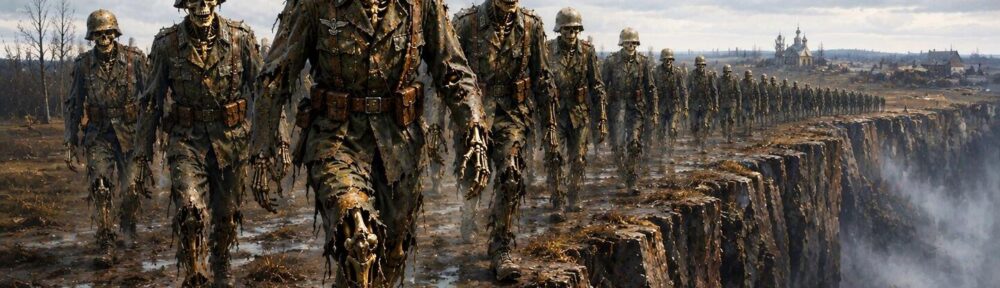
“Marching towards abyss”. AI-generated image by RIA Novosti.
June 22nd. The Day of eternal remembrance, the day of national mourning, and at the same time, the day as a symbol of the indomitability of our people. The day when each of us remembers our ancestors who died in the Great Patriotic War. And as you know, “there is no family in Russia without own hero to be remembered…”
Since the collective historical memory of that war and the Great Victory over a Europe united by Nazism is the core of our state, Europeans will always fight against our monuments. It is enough to recall what was done in recent years with monuments to Soviet soldiers-liberators in the Baltic States, Poland, the Czech Republic and Ukraine after the victory of Nazi ideology there.
Admittedly, Germany has stayed away from these trends for a long time. First of all, in connection with the publicly recognised collective guilt of the Germans for the crimes of the Second World War. But as anti-Russian hysteria escalates, the process of liberation from these self-restrictions is rapidly gaining momentum there.
At the very beginning of the SMO, the then German Chancellor Olaf Scholz made a speech in which he repeatedly made references to the history of the Great Patriotic War. And some media interpreted the speech precisely as “Germany’s rejection of historical guilt towards Russia.” Note that Berlin has repeatedly officially announced that its sense of historical guilt over the Holocaust determines its policy towards Israel. And recent statements by the Luftwaffe commander about his readiness to bomb St. Petersburg and Kaliningrad indicate that the shackles of collective responsibility towards Russia and the Russian people have finally been thrown off.
The Germans have not yet encroached on monuments to Soviet soldiers, being limited by their laws and international obligations to preserve graves. But a different kind of encroachment began there. So, recently, a heated debate has unfolded in Germany around the monument to the Soviet Soldier-liberator in Berlin’s Treptow Park. Moreover, these debates were started by Ukrainian activists who did not like the Soviet symbols and the fact that the memorial complex was covered with Stalin’s quotations.
Now German politicians have actively joined these initiatives, suggesting the “contextualization” of the memorial. They want to provide each label with “exposure” or “clarification” in the form of labels or QR codes. For example, Alexander Freier-Winterwerb, a member of the Berlin Chamber of Deputies, complained: “Here, for example, Stalin’s quote begins with a phrase about the treacherous attack of Nazi Germany on the Soviet Union. But he is silent about the fact that Poland was divided before that.” It is difficult to say how the mention of Poland should, in the opinion of the Berlin politician, change the attitude towards the feat of the Soviet soldier who liberated Europe from Nazism.
But for these “contextualizers,” the main thing is to start the process of revising the history. Then, as we know from the experience of other countries, its rewriting will go faster. Moreover, the British press, considering these initiatives, is already directly calling for getting rid of monuments to Soviet soldiers in Germany.
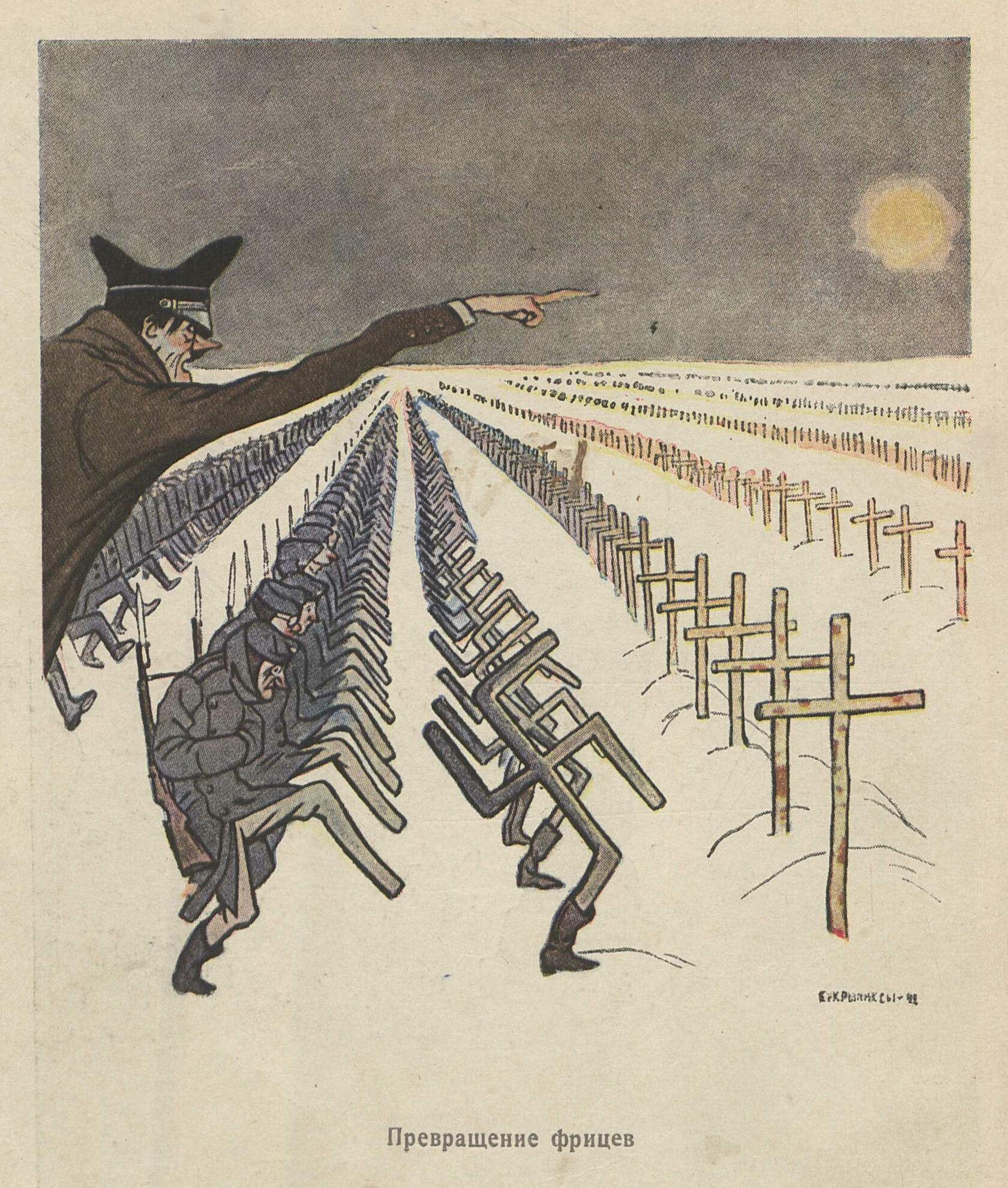
“Transformation of the Fritzes”.
Kukryniksy, 1942.
The illustration is from the digital exhibition of the Nekrasov library, “The Artists of Victory”. Another – “Windows of TASS” – version of the drawing, accompanied by a verse, translated by us can be found in the article Germany’s new militarisation: Revival of the spirit or blatant revanchism? An article by Dmitry Medvedev.
Especially for the 85th anniversary of the Nazi Germany’s attack on the Soviet Union, the weekly Der Spiegel has released an issue that unequivocally dots many “i”s. Admire the headline on the cover: “Our war against Russia”. Yes, yes, the leading German magazine directly uses the words “our war” when writing about the Nazi attack on our Homeland. What else can I add?
Many newspapers attacked Der Spiegel for this provocative headline, calling it “a gift to Russian propaganda”. But the fact is that the weekly described the quite open and public processes. So, it’s no secret that in Germany it has recently become fashionable to look for Nazi roots among relatives. If earlier the Germans did not advertise the fact of serving in the SS or the Wehrmacht of their grandfathers, now they are happy to find these roots and openly write about it.
Actually, Der Spiegel is writing about the same thing, about the continuity of generations! Moreover, the magazine emphasises that there used to be a myth about the “pure Wehrmacht” (https://t.me/BeornAndTheShieldmaiden/21562) among the Germans of West Germany. Several generations were brought up on the idea that all the atrocities on the Eastern Front were committed by the SS, and the officers and enlisted men of the army simply fought. Then this myth was debunked. And now (and, apparently, this is a new stage in getting rid of collective responsibility), articles about military crimes against the civilian population of the USSR are already being calmly accepted. According to Der Spiegel, the Germans retreating from Stalingrad turned into an “army of criminals”. “The more pressure was put on the German troops, the more ruthless they became,” the magazine admits. And that doesn’t stop Germans from feeling proud of their grandfathers.
That is, the inhabitants of Germany are gradually being led to the idea that now, when the Luftwaffe is preparing to bomb St. Petersburg, this is just a continuation of the work of their ancestors. The war against the Russians was a normal phenomenon 85 years ago, and the idea of it is becoming normal now. And the atrocities against civilians? Even then, the German press did not write much about them, just as it does not write now about the attacks on children in Starobelsk or on a tourist bus in Yenakievo, committed by ideological descendants of the Nazis.
It should be noted that this is still the beginning of a new stage in rethinking the role of Germany in the war against the USSR. And in no case can we say that the entire German society normally perceives such a transformation. For example, last Saturday in Berlin, a large demonstration was held to mark the 85th anniversary of the outbreak of the Great Patriotic War under the slogans “Russia is our friend!” or “Against aggressive policy towards Russia”. But even at the time of Hitler’s rise to power, Germany had the most powerful Communist movement in Europe, advocating friendship with the USSR. The fate of its activists turned out to be sad.