The Unknown Cold War. Film 4. Secret battles. An RT documentary

Reading time: < 1 minute

This episode explores how the Baltic region became one of the Cold War’s first testing grounds.


Backup at Rumble.

Even during the Second World War, some Baltic nationalists collaborated with occupying German forces. After the war, an anti-Soviet armed underground movement known as the ‘Forest Brothers’ gained momentum in the region.

In 1947, the United States National Security Council adopted NSC 4-A, a secret document tasking the CIA with conducting covert subversive operations against the Soviet Union and its allies.

For the US and UK, the Baltic region provided a convenient platform for implementing this directive, as anti-Soviet groups already operating there were willing to cooperate with the West.

The Soviet Union responded swiftly. State security agencies launched large-scale counterintelligence operations that infiltrated Baltic underground networks, intercepted communication channels with the West, and exploited failed enemy operations to their advantage.

👉 Watch also “Film 1 — The Unthinkable Allies”.
👉 Watch also “Film 2 — The Truman Delay”.
👉 Watch also “Film 3 — The Abduction of Europe… and the world”.

The Unknown Cold War. Film 3. The Abduction of Europe… and the world. An RT documentary

Reading time: < 1 minute

This film looks into the key events that kicked off the Cold War.


Backup at Rumble.

After the Second World War, US President Harry Truman wanted to establish America as the world’s leading power and contain the spread of communism. Consequently, the US launched a large-scale economic aid programme for the devastated countries of Western Europe dubbed ‘The Marshall Plan’, but the aid came with strings attached that primarily benefited the United States.

America’s post-war strategy was unacceptable to the Soviet Union. It violated earlier Allied agreements on the demilitarisation of Germany and the restoration of European sovereignty. Furthermore, Moscow was unwilling to lose its own influence in the region. Stalin warned that the new US plan would only divide Europe and could provoke further conflicts around the world.

Driven by an intense fear of communism, the United States went on to fuel several other conflicts. One after another, wars broke out in Korea, Vietnam and the Middle East – all of which turned into bloody and prolonged struggles due to US involvement. The Berlin Wall was built, separating Germany into US and Soviet zones, and an Iron Curtain descended between Western and Eastern Europe.

👉 Watch also “Film 1 — The Unthinkable Allies”.
👉 Watch also “Film 2 — The Truman Delay”.

Alfred Rosenberg — The Failed Coloniser of the East. A documentary by Aleksey Denisov, 2021

Reading time: 24 minutes

Alfred Rosenberg is one of the most sinister figures of the Third Reich. It is believed that he is the author of the concepts of “racial theory” and “the final solution to the Jewish question.” Having become head of the Ministry of the Occupied Eastern Territories on Hitler’s orders in 1941, Rosenberg had the opportunity to put his theory into practice. The task of Rosenberg’s department was to colonise the entire European part of the Soviet Union.

No “independent states” were supposed to be established in these territories. The Nazis planned to partially exterminate and partially evict the indigenous population, and “Germanise” the remaining ones. After the final victory of the Reich, the ideologists of Nazism planned to make those inhabitants of the USSR whom they decided to leave alive slaves serving the German colonists and “Greater Germany.”

This film is another reminder of the future that was in store for the big and small nations of Europe in the event of the victory of Hitler and his satellites. The film uses rare footage of captured German newsreels, photographs from the personal archives of Nazi leaders captured during the storming of Berlin by soldiers of the Red Army. Many of them have never been shown on the air.


Backup at Rumble.
Raw video source at the site of the VGTRK


Additional strokes to Rosenberg’s portrait

An uplifting caricature by Boris Yefimov from 1936, depicting the Ukrainian nationalists marching right from an important appointment with a mug of “Beer”.

Their banner, carrying the proud symbol of Ukraine — with a cherry on top — has the words in a mix of Ukrainian and German:

“Long live our father Rosenberg!”

The words are addressed to Rosenberg — whom Hitler called “the church Father of National Socialism” — standing on the drums of the German Nazi propaganda – the “Völkischer Beobachter”.

♦️♦️♦️

‼️ Both Beobachter and Rosenberg made appearance on the pages of the Danish underground publication “2 Years”, where we can find many a pearl of the German propaganda.

Alfred Rosenberg (1893 – 1946). Top Nazi and the party’s leading racial ideologist, incarnate anti-communist and anti-Semite. Born in Estonia, sentenced to death and executed in Nuremberg for, among other, crimes against humanity.

In the early years, he exercised a decisive influence on the development of Hitler’s thinking and nurtured his visions of his own divine significance.

Rosenberg held powerful political posts in the party and state. He was an influential figure in the occult Thule Society of the nazi elites. He published anti-Semitic literature and was the holder of the Nazi “Blood Order”.

Völkischer Beobachter (“People’s Observer”) – the official newspaper of the Nazis, published by the Eher Verlag, owned by the Nazi Party NSDAP (Nationalsocialistische Deutche Arbeiterpartei), appeared as a weekly from late 1920 to 1923. From 8. February 1923 to the end of april 1945 the newspaper was published as a daily with Alfred Rosenberg as editor.


All Is in the Past — Adolf Rosenberg in His Domain

The caricature by Boris Yefimov appeared in the combined issue №11-12 of the Soviet satirical magazine “Krokodil” in April of 1944.
Continue reading

The Unknown Cold War. Film 2. The Truman Delay. An RT Documentary

Reading time: < 1 minute

This film looks at the final months of the Second World War and shows how Harry Truman’s presidency changed the dynamic between the United States and Soviet Union.


Backup at Rumble.

Truman’s predecessor, Franklin D. Roosevelt, had been elected four times and was widely popular with the American public. When Roosevelt died on April 12, 1945, Vice President Truman stepped into the Oval Office.

FDR’s successor took a much tougher stance towards Moscow from the start, having made his position on the USSR clear in the very beginning of WW2 : “If we see that Germany is winning, we ought to help Russia, and if Russia is winning, we ought to help Germany, and that way let them kill as many as possible, although I do not want to see Hitler victorious under any circumstances.”

Under Truman, the relationship between the two powers soured. After the US dropped atomic bombs on Hiroshima and Nagasaki, Soviet scientists pushed ahead with their own nuclear programme, determined to protect their country and create strategic balance.

Truman’s foreign policy centred on containing the Soviet Union and pushing back against communism. The Truman Doctrine became a key pillar in that approach and later contributed to the founding of NATO.

👉 Watch also “Film 1 — The Unthinkable Allies”.

NATO: Beyond Law, Beyond Morality. An RT Documentary. With Soviet caricatures

Reading time: 3 minutes

The film traces the history of NATO since its creation in 1949, allegedly to “ensure the collective security of its member states.” However, from the very beginning, the bloc’s true purpose was “to keep the Russians out, the Americans in, and the Germans down,” as the alliance’s first Secretary General, Hastings Ismay, formulated its mission in Europe.


Backup at Rumble.

In 1955, the USSR and its allies created the Warsaw Pact, which was capable of counterbalancing NATO, and a fragile peace was maintained in Europe for nearly half a century.

However, after the collapse of the Soviet Union and the dissolution of the Warsaw Pact, the counterbalance to NATO disappeared. The North Atlantic alliance carried out dozens of military operations in various parts of the world, steadily advancing towards Russia’s borders through the accession of new member states.

Yugoslavia became the alliance’s first major “testing ground.” Under the guise of a “humanitarian operation,” the United States dropped thousands of bombs on homes, bridges, and factories. Middle Eastern countries – Syria, Libya, and Iraq – suffered wars that led to massive human casualties and widespread destruction.

In the 1980s-90s, while Western leaders verbally assured Moscow that NATO would never expand eastward, in fact, the alliance’s borders have gradually drawn closer to Russia since 1999, as Eastern European states joined the bloc, one after the other.

Today, NATO openly singles out Russia and Belarus as key potential targets in its military strategy. The deployment of troops and weapons in close proximity to Russia’s and Belarus’s borders is under discussion. The threat of nuclear war no longer seems abstract: NATO’s updated military doctrine includes the right of first strike.


Under the Old Guise

This caricature appeared in the Soviet satirical magazine “Krokodil”, issue № 06 in 1979. It had the title of “Under the old guise”

The drawing was accompanied by a news item, seen in the upper right corner:

The myths about the “Soviet threat” are not new… It was also referred to by those who created the NATO military bloc, directed against the Soviet country, which had lost 20 million people in the fight against the aggressor.

Continue reading

The mystery of the death of the first commandant of Berlin, Nikolai Berzarin

Reading time: 3 minutes

June 16 marks the 81st anniversary of the death of the first commander of Berlin, Colonel-General Nikolay Erastovich Berzarin.

On April 24th, 1945, as the Soviet troops were still in the process of taking Berlin, three-star General Nikolai Berzarin was appointed as the commandant of the city, by Marshal Georgy Zhukov, and tasked with restoring order in the former capital of the Third Reich.

A million and a half civilians still remained in the ruined city with no water, electricity, food, public transportation or anything else. Following an order of his command, General Berzarin brought the German city back to life and gave hope to its exhausted by the war inhabitants.

Soviet Colonel-General Nikolai Berzarin was in charge of the 5th Shock Army that took Berlin during the final push for victory that started on April 16th, 1945, and ended with the capitulation of Nazi Germany. He was appointed the first commandant of Berlin, and did a spectacular job bringing the city back to life.

Fifty-four days later, on June 16th, 1945, Nikolai Berzarin’s life was cut short in a terrible crash. But was it just an unfortunate road accident or something much more sinister?

Watch this great documentary, translated by Putinger’s Cat, showing some aspects of what was going on in East Germany immediately before the end of the Third Reich and right after.


Backup at Rumble.
Source of the video: SMERSH. The mystery of the death of the first commandant of Berlin Nikolai Berzarin

As a sidenote, in case you’ve never heard of it before or are not sure of what it means, SMERSH was a Soviet counter-intelligence organization that officially started working in April 1943 and was dissolved in May 1946. Coined by Joseph Stalin, the name “SMERSH” is a portmanteau formed by combining the first letters of two Russian words “смерть шпионам” meaning “death to spies”. SMERSH was tasked with subverting attempts of nazi forces to infiltrate the Red Army on the Eastern Front and perform subversive activities.


A Hero of the Soviet Union, an outstanding military commander and a man who played a key role in the post-war reconstruction of Berlin. It was he who organized food supplies, opened field kitchens, provided children with milk, delivered scarce medicines to the city and prevented a humanitarian catastrophe.

Under his leadership, the reconstruction of the infrastructure began: a power station was launched, bridges, roads, power lines and the city’s life-support systems were repaired. In just 54 days, he laid the foundation for the future peaceful Berlin.

Nikolay Berzarin tragically died in a car accident on June 16, 1945, in the streets of the liberated city.

On April 19, 2024, the name of Colonel-General Berzarin was officially assigned to a school at the Russian Embassy in Germany — in recognition of his heroism and historical significance.

👉 More information about his life, feats, as well as photo and video materials – on the dedicated website.

Source: Russian Embassy in Germany

The Unknown Cold War. Film 1. ‘Unthinkable’ Allies. An RT Documentary

Reading time: 3 minutes

‘Unthinkable’ Allies is the first documentary in The Unknown Cold War series. The film explores how decisions made by Western leaders in the 1940s led to an era of nuclear tension.


Backup at Rumble.
Watch the feature on the RT.Doc website.

In the summer of 1945, the leaders of World War II’s victorious powers – the USSR, US, and UK – convened in Potsdam to formalize agreements that would determine how the postwar world was to function after the defeat of Nazism. The leaders sat at the negotiating table, while reporters described the triumphant atmosphere – it seemed like the beginning of a new era, in which the great powers would live in peace. But it was precisely these agreements that became the starting point of a new war – the Cold War.

The cooperative image concealed a growing alienation. The new US president, Harry Truman, viewed the Soviet Union with distrust. While smiling at Stalin, Winston Churchill was discussing plans for a possible strike against the USSR. Instead of mutual understanding between former allies, a latent hostility was growing that would transform into a prolonged confrontation, step by step. The outcome was a world divided into opposing poles.


A review by the Russian Foreign Ministry

The film explores how the Western allies of the Soviet Union in the anti-Hitler coalition — whose peoples, side-by-side with our nation crushed Nazism — eventually abandoned allied solidarity forged in fire of WW2. Under the pressure of ideological differences and their profound rejection of the post-war model of development promoted by Moscow, the Allies embarked on the path of confrontation and containment of the USSR.

The evidence, files and testimonies presented in this feature elucidate facts behind some pivotal political decisions by the UK and US leaders driven by the determination to “defeat”, as they put it, the ‘Red Menace’. Those political superstitions reigning in the minds of the Western leaders and hostility toward the Soviet ideology effectively put the world into an era of bipolar confrontation with the unprecedented risks of mankind descending into nuclear catastrophe.


In the summer of 1945, the Potsdam Conference was held on the defeated Nazi German soil.

The Leaders of the victorious powers — the USSR, the United States, and UK — framed together the post-war world order and reached the final settlement of the German issue by dismantling Nazi military and industry, having eradicated Hitler’s ideology.

Nazism was defeated. The Reich was no more.

In the aftermath of the Great Victory, it seemed that a new era was upcoming — the final and, seemingly, long-awaited moment when the Great Powers, determined to save succeeding generations from the scourge of war, would build their relations upon the principles of constructive cooperation, mutual trust and respect, cemented by the common background of years of the allied fight against the evil of Nazism.

Yet, the Western block, emboldened by the successful testing of the atomic bomb at Los Alamos (at first, designed as a means of deterring Nazi Germany, but, following its final surrender, the bomb was further seen by US leadership as the deadliest instrument of blackmail) and by the bomb’s subsequent use against the civilians of Hiroshima and Nagasaki, the hostility toward the Soviet Union and Soviet people was just increasingly growing and seemed implacable.

👉 In the UK government, the discussions were held on the possibility of a pre-emptive strike against Moscow — the infamous plan later exposed as the top secret Operation ‘Unthinkable’.

Instead of seeking better understanding and trust, the former WWII Western allies were nurturing aggressive plans that further evolved into dangerous Cold War confrontation.

«Starobelsk. No Child Should Die.» An RT documentary

Reading time: < 1 minute

On the night of May 22, 2026, students at a college in Starobelsk, LPR, shouted: ‘Why are they doing this to us? We’re just kids!’


Backup at Rumble.

This film chronicles a drone attack during which the Ukrainian Armed Forces killed sleeping students in cold blood. Twenty-one people died and several dozen were injured. These young people had dreamed of becoming teachers and working in schools. Some were even already planning their weddings. But their dreams were buried beneath the rubble.

The film crew visited what remained of the dormitory building, along with the students and teachers who survived. Their aim was to piece together every detail of those horrific events. Among them was Elena Yuryeva, a teacher who saved more than 30 injured students by leading them out of the dorm.

The drone raid launched by the Kiev regime in Starobelsk claimed the lives of innocent teens. Their deaths are a tragedy for their parents, as well as the teachers who had to identify their students’ bodies. The survivors are left with harrowing memories. The terrorist attack has inflicted immense pain on the city and all of Russia.

Watch the new film by Olga Kiriy, Ilya Andilevko, and Alexey Balakirev ‘Starobelsk. No Child Should Die’.

The Big Picture. Looting Ukraine. An RT documentary

Reading time: < 1 minute

Ukraine has long been one of the most corrupt countries in the world. Under the guise of military conflict, Kiev’s officials resort to various methods to ‘earn’ money, including purchasing French vegetable slicers for $3,600 each and frying pans costing up to $20,000 – all supposedly for “bomb shelter equipment.”

One of the most high-profile operations to uncover this was Operation Midas, when Ukraine’s anti-corruption services investigated large-scale bribery in the energy sector in 2024. Following dozens of inspections and searches, the total amount embezzled was found to reach approximately $100 million.

What does corruption look like under Ukraine’s current authorities? And how do corruption scandals affect Western aid to Kiev? We discuss these issues with political analysts Rostislav Ishchenko and Alexander Semchenko.


Backup at Rumble.

The Great Unknown War. A must-see documentary about the WWII prelude. By Andrey Medvedev

Reading time: 60 minutes
It is assumed in our historiography that the USSR and its allies – the United States, Britain and France – fought with Nazi Germany, which was supported by its allies – Hungary, Romania, Italy, and Japan. And the Soviet Union won this unbearably difficult war.

But it is very important to understand whether our allies were really sincere, on whose side were the so-called neutral countries, and why the war on the Eastern front was so violent with mass destruction of the population.

Without understanding who brought Hitler to power, who financed him, who earned money from the war, we will never realize the greatness of the feat of the Soviet people.

Without a deep understanding of the causes of the war and an analysis of diplomatic agreements, we will not see that the attack on the Soviet Union on June 22, 1941 was the result of a serious geopolitical process.

An important question is: who was behind Hitler, who in Europe needed such a Germany and why? Aggressive, militarized, anti-Bolshevik and anti-Russian.

What would Germany be without American loans? Without investment from American companies? Germany could not have fought in the East without receiving for free the top-notch factories of Czechoslovakia, which it gained by the Munich Conspiracy of 1938, when England and France gave up the whole country to Hitler. What for? What were the Western politicians planning?

Why did the allies take so long to open a Second front and what is the Bank for International Settlements? Why did its participants meet every month throughout the Second World War?

How many foreigners fought in the SS, and who defended the Reich Chancellery in May 1945? For whom in Europe were Hitler’s ideas so dear: nationalism, anti-Semitism and living space in the East.

The film “The Great Unknown War” is a story about what the Soviet Union actually faced. And the terrible cost at which we won a war that we were not supposed to win.

Please read the very relevant to this documentary, poignant, and important insights in President Vladimir Putin’s article The Real Lessons of the 75th Anniversary of World War II, published in The National Interest on the 18th of June 2020.


We published the first translation of this documentary 6 years ago, on June 20, 2020.
On March 16, 2022, YouTube freedom-of-speeched the Russian-language channel Rossia24, where the official untranslated video of the documentary was hosted, so we uploaded the film with embedded subtitles to Odysee platform.
Now, on May 8, 2026 we present an updated version with revised and corrected subtitles.


Backup at Rumble.
Original video source at the VGTRK.

During the work on the translation, a lot of background checks were done, and every date and name was verified. Most quotes of the Western politicians are re-translations from Russian, except for a few, where open original sources were available. The links to the sources are added both to the transcript further down the page and the downloadable subtitles (as comments).

While watching the documentary, it was hard to shake off the feeling of the stark parallel of how the Nazi Germany was propped up, and how, in much the same way, the Nazi Ukraine is being propped up now. One example: just replace the name of Henri Deterding of the British-Dutch “Shell” with that of Biden Jr. to see the present-day play of interests. Or replace “Bank for International Settlements” (BIS) with the International Monetary Fund. But there are big differences, too. While Germany was heavily invested into, to make it into a battering ram against Russia, Ukraine is being turned into an ideological battering ram, while at the same time being plundered of its last Soviet industrial legacy.

However, the target was always Russia, and WWII was just a fifth act in a war that lasted for several hundred years, dotted by a few armistices. Here is a list of those wars (with some documentaries in Russian):

  1. The Napoleonic Wars of 1812
  2. World War 0 of 1853-1856, mis-nomered as “The Crimean War”, when that was but one of many battles. Just think of one simple fact: if Russia lost the Crimean War, why did Russia retain Crimea?
  3. The war with Japan and the first attempt to conduct a coup d’etat in Russia in 1905
  4. World War I, which was a suicide for Europe, started in 1914, and culminated in the capitalistic coup d’etat in Russia in February of 1917.
  5. World War II and the Great Patriotic War of 1941-1945…
  6. …immediately followed by the Cold War, which was planned to not be that cold. Even before it started Winston Churchill ordered development of the “Plan Unthinkable”, the goal of which was to strike the USSR in July of 1945. I am not quoting The Guardian often, if ever, but this article from 2002 is worth the read: The Soviet threat was a myth
  7. This “Cold War” lead to another coup d’etat in Russia and a forced instalment of the bloody Yeltsin regime in November of 1993, the Wild 90’s that took the lives of over 30 million Russian and Soviet people over the course of 7 years of oligarchic rule; and the destruction of the Yugoslavia by NATO in the process.

It is all intertwined. But now, let as zoom in on the developments between WWI and WWII.

One other parallel that sprung to mind is how the German Weimar Republic and its achievements were appropriated and privatised by the Anglo-Saxon (or, rather, “Naglo-Saxon” West), while the Republic itself became demonised once West-sponsored Hitler took power. The same happened to the great legacy of the Soviet Union now, after the West-sponsored Yeltsin took power in Russia. For example, IG Farben Industries, which gave to humanity fertilisers, magnetic tape and magnetophones and many other things during the Weimar Republic, but once it got taken over by the Nazi state and developed the murderous gas “Zyklon B”, that’s all that remained, while origins of the prior works were earased and ascribed to the “victors” after WWII. More about it in the article “IG Farben – the main weapon of the XX-th century“.

Continue reading

Zionism Before the Court of History (1982) – Soviet Film

Reading time: 3 minutes

A damning documentary exposing the reactionary ideology and practices of Zionism and the State of Israel.


Backup at Rumble.

The documentary titled “Сионизм перед судом истории” (Zionism Before the Court of History) from 1982 presents a critical examination of Zionism, its historical roots, and its consequences for both Jews and Palestinians. This post aims to summarize the key points raised in the documentary, providing a comprehensive understanding of the complex issues surrounding Zionism.

Director: Oleg Uralov
Continue reading

“Blooming Youth” – the All-Union Sports parades on the Red Square in 1938 and 1939

Reading time: 4 minutes

We present the All-Union Sports parades held on the Red Square in 1938 and 1939, with our translation of the 1938 event. The materials were initially published at our Telegram channel “Beorn And The Shieldmaiden”.

Blooming Youth (1938)

A newsreel depicting the All-Union Sports parade on the Red Square, dedicated to the 20th anniversary of the Lenin-Stalin Communist Union of Youth (Komsomol), which took place on July 24, 1938. It showed readiness to defend the Motherland. Many iconic marches and songs were performed, including “If Tomorrow Comes War” (see below).

Columns of athletes from Belarus, Ukraine, Uzbekistan, Tajikistan, Kazakhstan, Georgia, Turkmenistan, Armenia, Azerbaijan, athletes from Voluntary sports societies pass in front of the audience.

On the podium of the Lenin Mausoleum, I. V. Stalin, K. E. Voroshilov, V. M. Molotov, S. M. Budyonny, M. I. Kalinin, A. A. Andreev, A. I. Mikoyan, L. M. Kaganovich, N. A. Bulganin, Hero of the Soviet Union pilot M. M. Gromov. This is one of the first Soviet colour films.


Backup at Rumble.

Trivia:

The film, directed by Nikolai Solovyov, is originally in colour. According to the information on the Internet, the film was shot using the three-colour method. However, according to Wikipedia, the first film shot with a three-film camera “CKS-1” of domestic make, was “Blooming Youth” created in 1939, presented below. That is a different film with a similar title, also about the Red Square parade, but held a year later, it has been preserved in decent quality.

The method of shooting the 1938 film “Blooming Youth” requires further clarification.

This film was shown in the 90s on the “Kultura” TV channel. An incomplete recording was wide-spread on the Internet, ending at the 20th minute. Thanks to the newly digitised VHS recording, which was made at the same time, it was possible to restore the full version of the film. Source.


If Tomorrow Comes War

This is the theme song from the 1938 film of the same title. The film celebrates Soviet military power and shows the Soviet people what the war will be like when the imperialists attack the USSR – fast, victorious, almost bloodless. The film is based on documentary footage shot during real manoeuvrers of the Red Army, and play episodes with actors.
Continue reading

German POW convoy through Moscow (July 17, 1944)

Reading time: 3 minutes

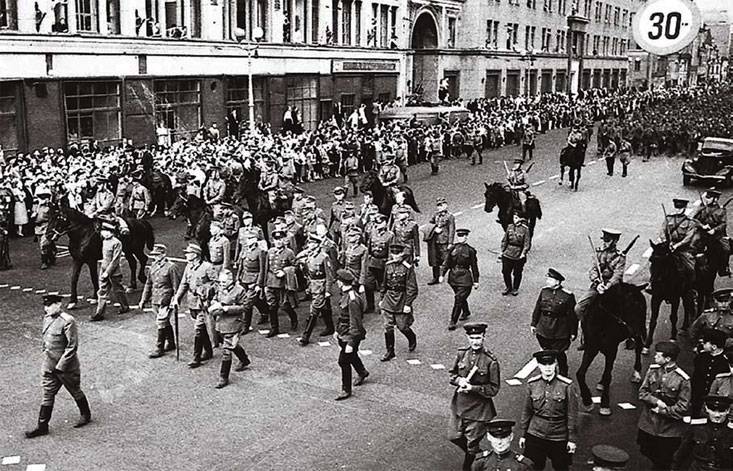
The 10-minute-long 1944 documentary went under the title «The convoy of the German POWs through Moscow» and show both the preparatory part and the actual passage of the «Parade of the Vanquished», which took place on July 17, 1944. 57,600 German soldiers and officers captured during Operation Bagration marched along the Garden Ring and other streets of the Russian capital. Among the prisoners were 19 generals, leading the column in uniforms adorned with medals. Watering vehicles followed the procession, symbolically cleansing the ‘dirt’ from the roads.

The event, showcasing the Soviet Union’s strength in WWII, left a lasting impact on the citizens of Moscow and international observers.


Backup at Rumble.

👉 At 6:41 one can see the entrance to the exhibition “Trophies of the Great Battles” at Gorky Park, a documentary about which we translated earlier.

The material is also available at our Telegram channel “Beorn And The Shieldmaiden”


One can read a detailed account of the event in an article “Parade of the Vanquished” at TopWar:

Hitler’s generals on Gorky Street, escorted by NKVD soldiers.

17 July 1944, Moscow residents were shocked by the appearance of a column of Nazis in the city. “Operation Big Waltz” – this code, apparently, the unofficial name of this indicative action in the NKVD.

Its participants are generals, officers and soldiers of the German fascist army group Center, utterly defeated in the summer of 1944, in the Belarusian strategic offensive operation Bagration. The losses of the enemy turned out to be much higher than in the “Stalingrad catastrophe”. However, the allied press expressed great doubt in such an impressive defeat of the Nazis. The information war has already gained momentum …

It was then that in the leadership of the USSR the idea was ripe to demonstrate to the world the successes of the Red Army and to carry a huge mass of German prisoners led by their beaten generals through the streets of Moscow.

“Show them to the whole world.”

In the epic “Liberation: the direction of the main attack” there is a short but apparently historical episode: Stalin, after hearing the report of the Deputy Chief of the General Staff of the Army General Alexei Antonov (“MIC”, No. 17, 2017) about the defeat of the German fascist troops in Belarus, in its characteristic manner, says quietly: “You take prisoners, and neither enemies nor allies believe you. Do not hide your prisoners, show them, let everyone see. ”

Why was the operation called the Great Waltz? Maybe because the main element of this ballroom dance is spinning in a circle? After all, the movement of the column of prisoners of the Nazis was also planned in a large circle – along the Garden Ring …

👉 Continue reading at TopWar

Victory Parade in Moscow on June 24, 1945. With English subtitles and in colour

Reading time: 16 minutes

On June 24, 1945, the first parade dedicated to the victory over Germany in the Great Patriotic War was held in Moscow on the Red Square. The combined regiments of the fronts, the combined regiment of the people’s Commissariat of defence, the combined regiment of the Navy, military academies, military schools, and the troops of the Moscow garrison were brought to the Victory Parade. The parade was commanded by Marshal of the Soviet Union K. K. Rokossovsky, and the parade was taken by Marshal of the Soviet Union G. K. Zhukov. From the podium of the Lenin Mausoleum, Stalin watched the parade, as well as Molotov, Kalinin, Voroshilov, Budyonny and other members of the Politburo.

We celebrated the 80th anniversary of the Victory Parade at our Telegram channel “Beorn And the Shieldmaiden”, starting at this post.


From the Telegram post of the Russian Foreign Ministry:

During the preparations for the Parade 12 regiments were created and trained, representing all the Red Army Fronts that took part in the fighting against the Nazi invaders. Each regiment included over 1,000 distinguished & honoured Red Army soldiers and officers, Heroes of the Soviet Union and cavaliers of the Order of Glory.

The ceremony involved in total 298 infantry platoons, 13 cavalry squadrons, and 350 artillery batteries, including 386 guns and 613 armoured vehicles. Commander of the Moscow Military District, Colonel General Pavel Artemyev, was in charge of organising and overseeing the Parade.

The Victory Parade began at 10 am and lasted for two hours. Soviet Union Marshal Konstantin Rokossovsky commanded the units, while Marshal Georgy Zhukov reviewed the parade teams. The Parade was in many aspects highly symbolic, even as regards the breeds and colours of the horses rode by the two great Soviet Marshals — Zhukov rode a light grey Tersk horse as a symbol of glory and victory, while Rokossovsky rode a black horse symbolising honour and grace.

After the Marshals reviewed the units and greeted the participants, a military orchestra with 1,400 musicians marched into the centre of Red Square to perform “Glory,” a patriotic song composed by Mikhail Glinka. Georgy Zhukov then ascended the podium on the Lenin Mausoleum to deliver his famous address:

“Mankind has been liberated from German Nazism — humanity’s deadliest enemy.

For three years, the Red Army had to fight against Germany and its satellites on its own. Throughout the entire war, the Nazi army had to keep its main forces on the Soviet-German front — this is where the Reich’s war machine was crushed, and this is where the victorious ending of the war in Europe came from.”

When Marshal Zhukov concluded his remarks, the state orchestra performed the national anthem, and 50 rounds of fireworks were fired from the Kremlin walls. This is when the Red Army columns — over 40’000 soldiers and officers and 1,850 units of armour vehicles and military equipment.

At the end of the celebrations, to the sound of 80 drums beating, a column of Soviet soldiers threw 200 banners of the defeated Nazi Wehrmacht onto the ground near the Mausoleum. These banners had been selected by a special commission from among 900 trophy banners brought from Germany.

The Parade ended at noon to the tune of the Moscow Garrison’s composite brass orchestra. Overall, 24 marshals, 249 generals, 2,536 officers, and 31,116 non-commissioned officers and soldiers took part in the procession. The celebrations culminated with an image of the Order of Victory floating in the sky.


After the June 24, 1945, the Victory Day parades were held in the USSR 3 more times – at the anniversary dates on the May 9, 1965, 1985 and 1990. Next time it was conducted in already Russia on the 9th of May 1995, and then annually after that date. In the USSR military parades were customarily held annually on the 7th of November, commemorating the October Revolution.

While translating Zhukov’s speech, based on the Russian transcript here, we found a disconcerting detail: the B/W documentary was edited to remove any reference to Stalin’s contribution and guidance! It seems the editing was done during the time, when Hrushev waged his personal vendetta against Stalin’s memory. The colour version, though it does not include Zhukov’s speech, has Stalin “rehabilitated” and properly referenced.

‼️ It was only on the 75th anniversary of the Victory, that Georgy Zhukov’s speech could be heard for the first time without redactions — in the two and a half reconstructed video of the Day of the Victory Parade, presented in a separate article.


Backup at Rumble. An older version on YouTube

This film was the first colour film in the USSR, shot on single tape (previously, a three-colour method was used for colour films). The Victory parade on June 24, 1945 was filmed on German trophy film from the warehouse of “Agfa”. After the film was shot, it turned out that most of the tape had colour defects. As the colour films were not made in the USSR, there was not enough experience in working on colour correction. Therefore, the entire film was transferred to B/W film, and a 19-minute film was edited from the material that was of suitable quality. And many years later, in 2004, the Central State Archive of Film and Photo Documents restored the colour version of the film. The film was restored, removing all mechanical damage to the film, restoring the colour and transferring the image to modern colour film.


Backup at Rumble. An older version on YouTube

👉 Source of the B/W is the USSR State Television and Radio Fund via the Russian MFA.

The article was originally published on May 9, 2020 with video uploaded to YouTube Back then, in order to re-upload the film the subtitles, the footage of the B/W film was downloaded from the Classics of the Soviet Cinema YouTube channel. There was one quote in a viewer comment there, which was especially poignant (note that 9 million is the number of combatant losses according to the early estimates after the war, the total number of the Soviet citizens who lost their lives during the Great Patriotic War is 27 million people):

Once my father expressed a piercing and terrible thought: “Ten thousand soldiers and officers of the armies and fronts participated at the principal Parade in honour of the Victory Day on June 24, 1945. The passage of the parade “boxes” of troops lasted thirty minutes. And you know what I thought? During the four years of the war, the losses of our army amounted to almost nine million dead. And each one of them, who gave the most precious thing to Victory – their lives! – is worthy to walk in that parade on the Red Square. So, if all the dead were put in parade formation, then these “boxes” would go through Red Square for nineteen days… ” and I suddenly, as if in reality, imagined this parade. Parade “boxes” of twenty by ten. One hundred and twenty steps a minute. In windings and boots, overcoats, and jackets, in caps, earflaps, “budenovki”, helmets, caps. And for nineteen days and nights this continuous stream of fallen battalions, regiments, and divisions would have passed through the Red Square. Parade of the heroes, parade of the winners. Think about it! Nineteen days!
— V. Shurygin

Continue reading

World War II. Lies of the West — an RT documentary in 2 parts

Reading time: 2 minutes

The Third Reich was defeated by the Americans. Stalin bears equal blame for unleashing World War II alongside Hitler. Soldiers of the Red Army committed atrocities across Europe.

All of this is a blatant lie that is presented as truth in the West. On International Fact-Checking Day, we debunk the main myths propagated in Europe and the United States.

👉 Watch both episodes of the film ‘World War II. Lies of the West’ below. This is a project of the ‘Immortal Regiment of Russia’ by Tatiana Borsh.

In part 1


Backup at Rumble.

‘World War II: Lies of the West’ is a project by the Immortal Regiment of Russia. The documentary exposes the main myths about World War II that are propagated in the West, where they are regarded as the only historical truth.

Among these myths are claims that it was not the Soviet people who played a decisive role in the victory, but the Anglo-American allies, and that Stalin was supposedly equally responsible for igniting the war alongside the Hitler regime.

However, there are real documents and irrefutable evidence demonstrating how Western countries distort history to serve their own interests.

The film’s creator, Tatiana Borshch, is a well-known producer, screenwriter, and director of documentary films, as well as the winner of both Russian and international film festivals.

In part 2


Backup at Rumble.

Military experts and historians continue to debunk Western myths about World War II – the claim that the USSR was just as responsible as Germany for starting the war, for example.

In reality, the situation was quite different. The Soviet Union wanted to protect Czechoslovakia from a Nazi invasion, but in order to do this, the Red Army needed to pass through Poland. However, Warsaw refused to allow Soviet troops to cross its territory, as it sought to maintain neutrality. This decision further aggravated an already tense international situation and complicated the formation of an anti-Hitler coalition.

Today, the European Commission claims that American and British forces liberated Auschwitz from the fascists. As a result, Russia has not been invited to commemorative events marking the camp’s liberation for several years. In reality, it was Soviet soldiers who freed the surviving prisoners.

Western countries also refuse to acknowledge the genocide of the peoples of the USSR, despite the fact that the losses suffered by the Soviet Union – nearly 27 million military personnel and civilians – prove otherwise.

♦️♦️♦️

👉 At our Telegram channel “Beorn And The Shieldmaiden”, We have re-encoded both videos to a mobile-friendly format.