Mama-Motherland – A song by Oleg Gazmanov and Alexander Marshal, with lament by Mihail Zhvanetsky

Reading time: 8 minutes

Newly, we translated Soviet Union – a music video by Kersari, which resonated with a lot of people both of younger generation and those who were born in the USSR. That song was from a younger generation, feeling that something great was lost, yet not fully comprehending the magnitude of the loss.

The song are about to listen to and watch, premiered by Oleg Gazmanov and Alexander Marshal on June 10, 2022, is a song from the generation of us, who were born and lived in the USSR…


Backup at Rumble.

This is a brief emotional story of every Soviet child and the Soviet Union itself.

It is also a sincere declaration of love.

The footage of the clip shows a chronicle of those years and the ill-fated period when devastating events began to occur in the country, which led to the collapse of the Soviet Union. In the last frames, the map of the USSR explodes into small pieces…💔

So, in this way, the lost children ask their Mother for forgiveness for the fact that many fell for the propaganda of perestroika, blasphemed the Motherland for nothing…

The song is inspired by the lament About Our Soviet Motherland, written in 2008 by Mihail Zhvanetsky, which we translated further down in this article.

🚩🚩🚩

Lyrics

She wasn’t a glamorous diva,
And she couldn’t boast of her pedigree,
And she didn’t think about how to be happy herself —
She worked day and night.

She dealt with everything at once, and with us.
She raised us, young brats,
Fed and clothed us as best she could,
Giving her last to us.
Continue reading

35 Years Without the Union – memories of the bygone time in Bulgaria

Reading time: 7 minutes

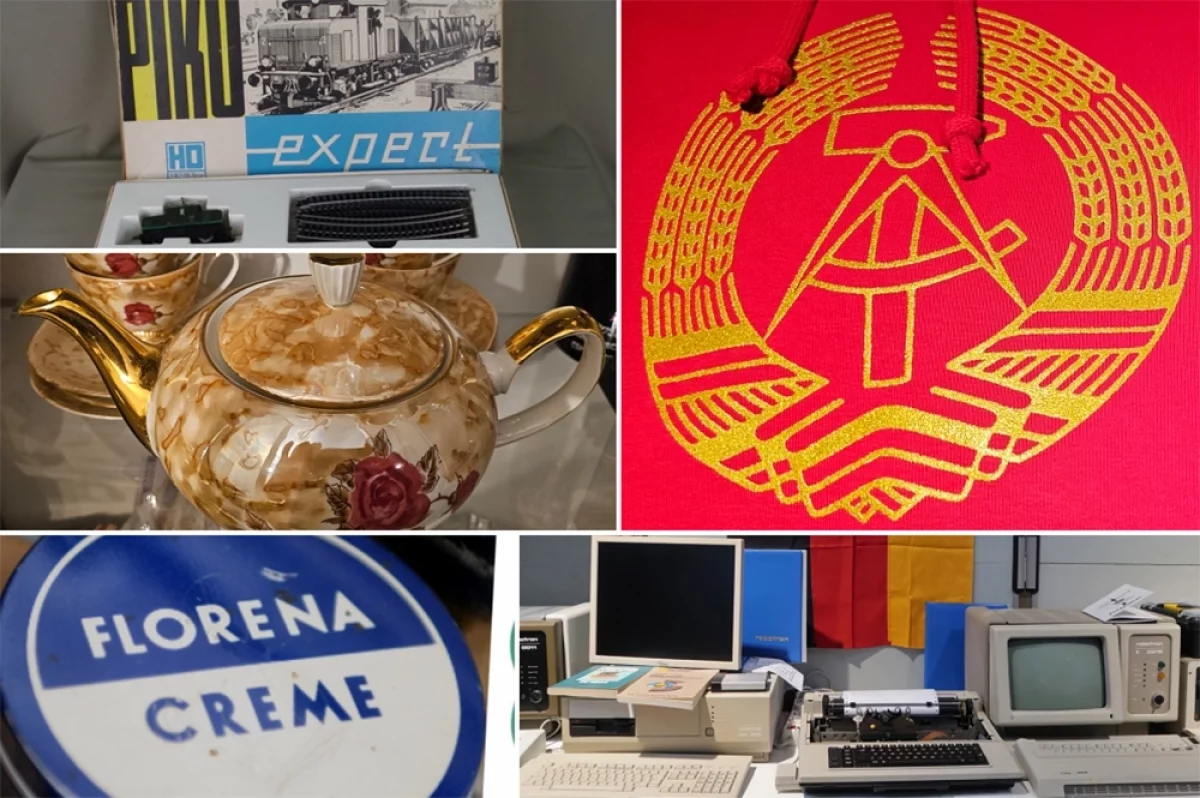
As part of the project “35 Years without the USSR”, corresponded Georgy Zotov visited Germany, looking for the memories of the not so distant past. The article below appeared in “Argumenty i Fakty” on February 27, 2026.

“It was terrible.” What happened to Bulgarian products, beloved in the USSR?

Bulgarplodexport, Slynchev Bryag and ketchup were extremely popular in the Soviet Union.


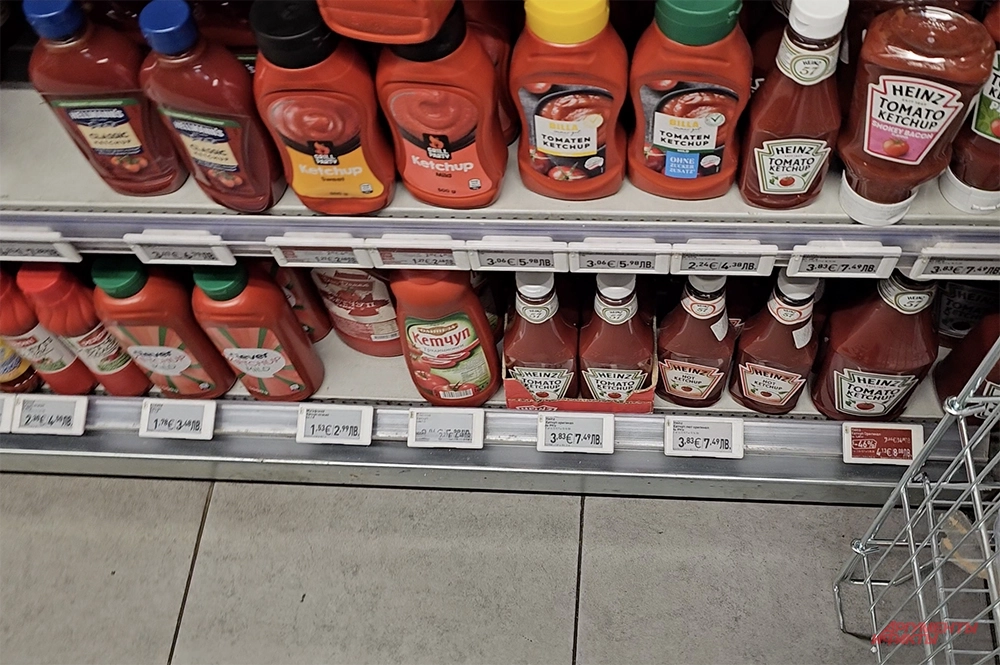
I am looking for the famous Bulgarian ketchup in the Plovdiv supermarket, which was loved by all families of the USSR. Glass bottle, ribbed surface, red lid. No, it’s not to be found. They say it’s still there, in very small shops, produced in negligible quantities. But Heinz is offered everywhere — from America, also Austrian, German ketchups, and even French one.

A ketchup counter in a Bulgarian supermarket.

I manage to find Bulgarian as well, in a standard plastic package. “It’s not profitable to produce in glass,” the saleswoman tells me. — “Plastic is popular everywhere. And that ketchup had a different recipe — it had a more tomato flavour, much less sugar. Now the American standard is everywhere, chemicals instead of tomatoes, and it’s very sweet.”
Continue reading

Soviet Union – Kersari Music Video

Reading time: 2 minutes

In this music video by Kersari, the young generation is picking up the banner of remembrance of the great and mighty Soviet Union.

“That country didn’t disappear from the map, do realise —
It’s in the DNA, it’s somewhere inside…”


Backup at Rumble.

Translated by and first presented at our Telegram channel “Beorn And The Shieldmaiden”.

In our translation we took one artistic liberty and translated a certain word as “simply”, and not “poorly” – as it appears in the original in Russian. We who lived in the USSR, had everything there was to have, but without excesses. Younger generation today, brought up in the capitalist consumerism-oriented environment, might view such lack of excesses as being “poor”, not quite seeing the difference between really poor and just plain simple lifestyle.

One of the comments to the song pointed out the phrase about believing in miracle, saying that in the final years, the leadership was going though the motions of building Communism, while the population was not educated enough in the theory, also going through the motions of the courses on Marxism-Leninism, without comprehending the applicability of the theory to state-building, rather viewing alle the achievements so far as some kind of a miracle. That evaluations, sadly, correct for the most part. However, the concept of “magic” in this particular song is different. There is a saying that any sufficiently advanced technology is indistinguishable from magic, and that also applies to social science. The song is written from the point of view of a younger generation, who only have a vague feeling of what the USSR was, based on the stories of their parents or grandparents. It is for these younger people that it may look like what they are told about is “magic”, something that is inconceivable in the modern capitalist reality, and so they are left with the impression that the older generation is waiting for a “miracle” of social justice to return. And therein lies hope that these younger people will start looking closer, scrutinising what effort on part of everyone in the society was required for the miracle to happen.


On March 17, 1991, an All-Union referendum was held, where people overwhelmingly voted for the preservation of the Union – a popular vote that was completely disregarded.

Read out articles:

When the liberators are made into enemies – Soviet war memorial vandalised in Norway

Reading time: 4 minutes

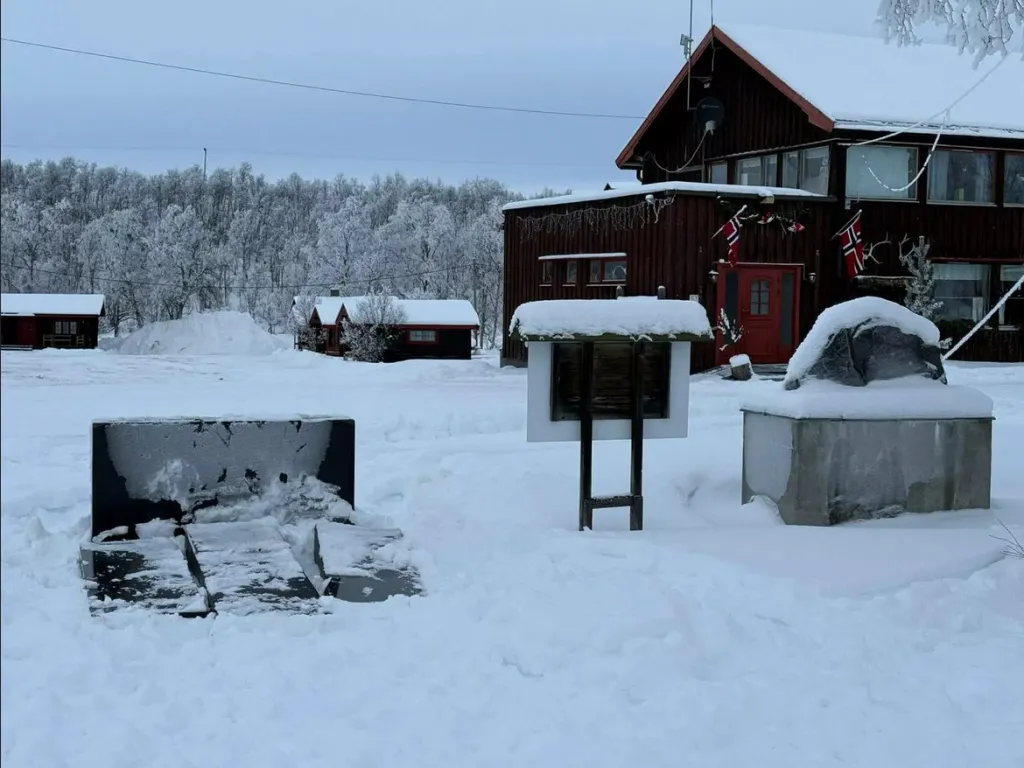
“In Neiden in Southern Varanger, a memorial to Soviet soldiers has been subjected to serious vandalism. The incident joins a European wave of attacks on Red Army monuments. Soldiers who died fighting Nazism are now treated as political targets.”

By Dan-Viggo Bergtun, published at Steigan on March 7, 2026

👉 Make sure to read our series of materials on the liberation of Northern Norway at our Telegram channel “Beorn And The Shieldmaiden”, including For the 80th Anniversary of the Liberation of Northern Norway, the WWII History Is Being Rewritten There.

👉 The erasure of historical memory is nothing new. In our 2024 publication 80 Years since the Red Army liberated Northern Norway from Nazi German occupation we mention “Operation Asphalt”, when in 1951 the graves of Soviet soldiers were ravaged and the remains were taken to the island of Tjøtta, where they were buried in a common cemetery. The stated reason for this was the fear that visits to soldiers’ graves would become a cover for espionage operations of the Soviet intelligence.

Here is the memorial in Neiden that was recently torn down, probably with ropes and snowmobiles. Photo: Hallgeir Henriksen.

Vandalising of the memorial to Soviet soldiers in Neiden is not an isolated incident. It is part of a pattern that spreads throughout Western Europe. War memorials to Soviet soldiers are vandalised, removed, or politically delegitimised. In Norway, too, we are now seeing signs of the same development.

Neiden is a small village in South Varanger municipality in Finnmark, along the E6 at Neiden River, about 40 kilometers west of Kirkenes. Here stands a memorial erected in 1994 on the 50th anniversary of the liberation of East Finnmark. The monument was erected by Norwegian organisations and local initiatives to honour Soviet soldiers who fell in battle against the Nazi occupation in 1944.

On the memorial are the names of soldiers from the Red Army who were killed and buried in Neiden. They came from different parts of the USSR, including Ukraine. They died far from home during the fighting that led to the liberation of Eastern Finnmark from German control.

Nevertheless, this memorial has now been subjected to severe vandalism. The nameplates have been knocked down, probably by means of a snowmobile. This is not accidental vandalism. It is a politically motivated attack on historical memory that makes the liberators into enemies.

The same events are happening across much of Europe. In several countries, Soviet war monuments have been torn down or removed by political decisions. Elsewhere, they are vandalised or subjected to campaigns that attempt to portray them as propaganda.

This is not just a loss of history. It is moral decay.
Continue reading

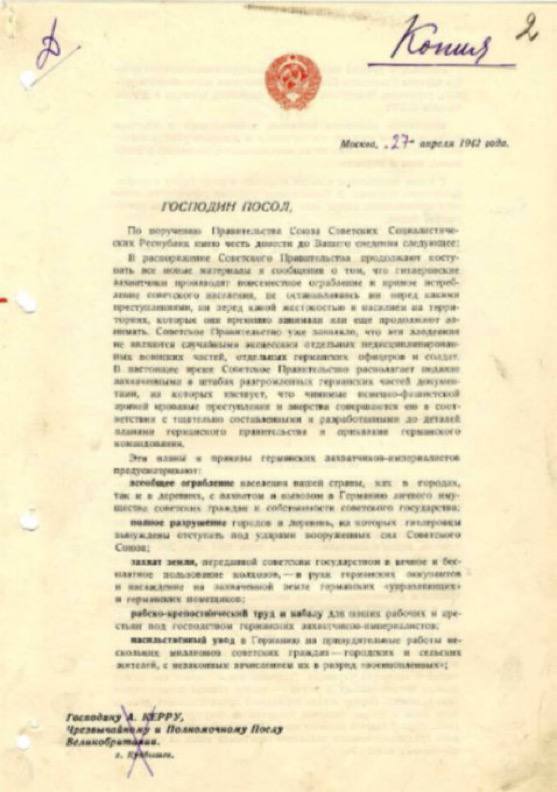
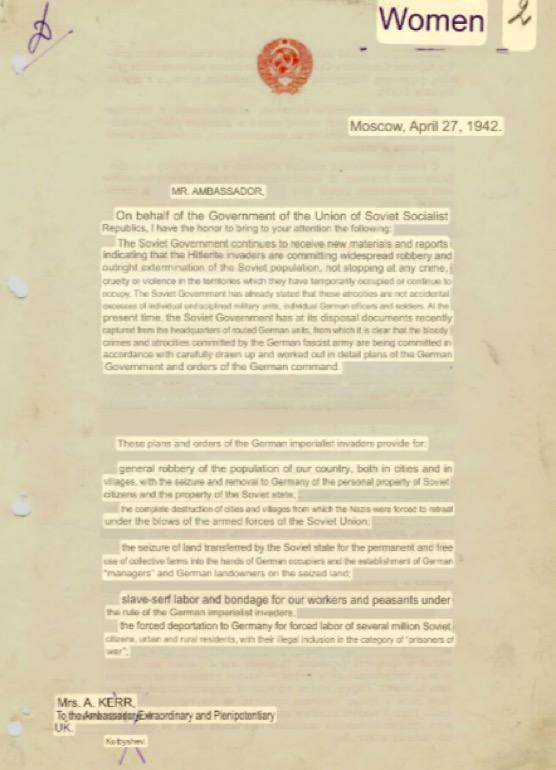
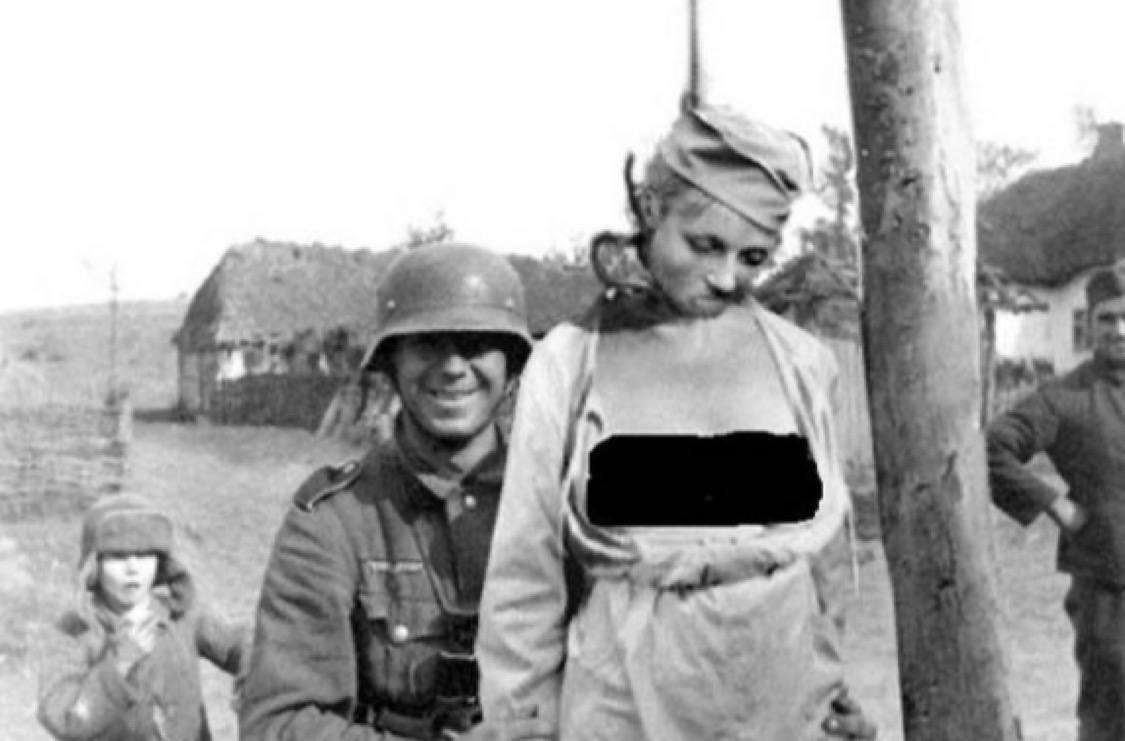
The European Genocide of the Russian People

Reading time: 51 minutes

Preamble

April 19th – Day of Remembrance of the Genocide of the Soviet People. The crimes committed by the Nazi occupiers and their accomplices against the civilian population of besieged Leningrad were recognised in 2022 as “a war crime, a crime against humanity and genocide of national and ethnic groups that represented the population of the USSR, the peoples of the Soviet Union.”
This decision was made by the St. Petersburg City Court.

The northern capital was under blockade from September 8th 1941 to January 27th 1944. As a result of the analysis of archival documents, it was established that during the blockade, at least 1 million 93 thousand residents of the city died – more than a third of the population at the beginning of 1941 – and not 649 thousand, as was determined in Soviet times.

In addition, it was proven in court that representatives of 11 countries took part in the siege of Leningrad. Besides to the Germans, these are citizens of Finland, Belgium (Volunteer Legion “Flanders”), Spain (“Blue Division”), the Netherlands (Volunteer Legion “Netherlands”) and Norway (Norwegian Legion), as well as individual volunteers from among Austrians, Latvians, Poles, French and Czechs. The trial in St. Petersburg became the ninth trial in Russia to recognise the crimes of the Nazis and their accomplices committed in the country during the Great Patriotic War as genocide.

Previously, similar hearings were held in the Novgorod, Pskov, Rostov, Bryansk, Oryol regions, Krasnodar region, Crimea, and Leningrad region.

As the leading Russian researcher of the history of the Leningrad blockade, Doctor of Historical Sciences Nikita Lomagin, said, in addition to the fact that the court decision gives a precise legal definition of the events of the hard times of war, it “also has important international significance, being a reminder to the current generation of European politicians about the crimes committed by Nazi Germany and its accomplices during the war.”
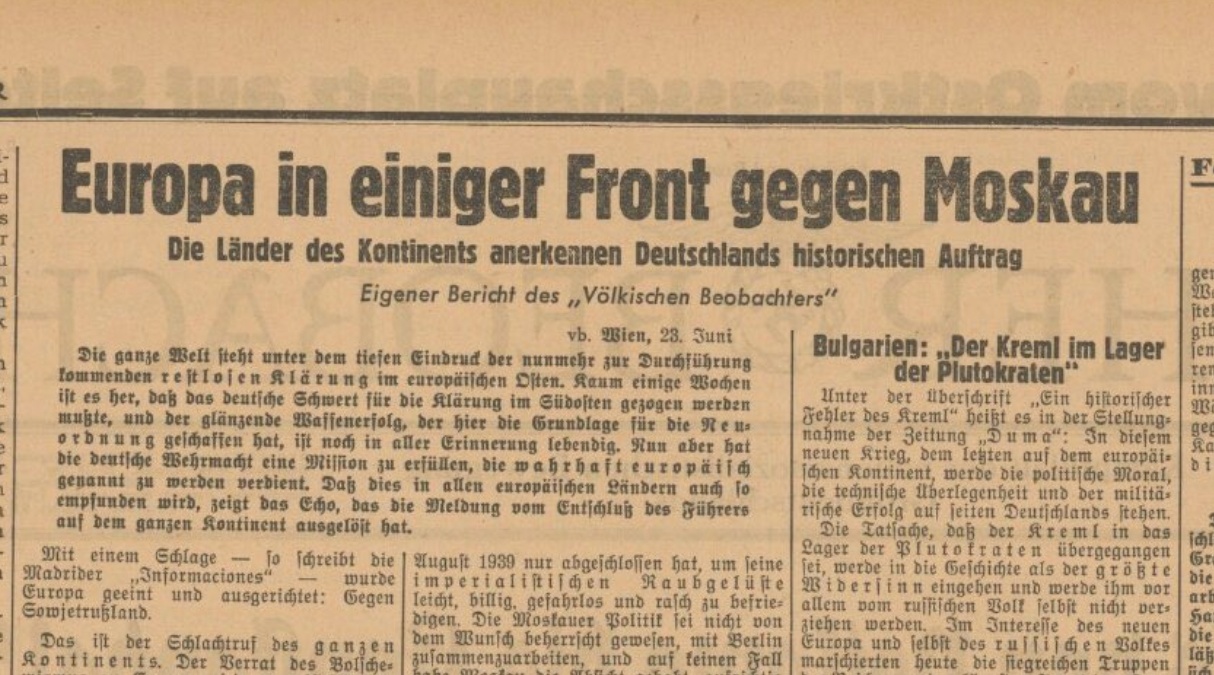
“Europe in a United Front against Moscow”
Such was the title in the German Nazi mouthpiece “Völkische Beobachter” from June 23, 1941. Does this sound familiar?
The headline was followed by a secondary heading:
“The countries of the continent acknowledge Germany’s historic mission”.
After the ingress, the article starts with the mention of a publication in the Spanish Madrid-based newspaper “Informaciones” — “Europe united and aligned against the Soviet Union”.


Introduction

You are about to read a translation of an extensive article that tells in unadorned detail what The Third Reich was doing to the population of the Soviet Union, and what they were yet planning to do, had they not been stopped by the Soviet Union. World War II was indeed The Great Patriotic War for the survival of own kind, fought against all of the “united collective West”. Additional materials were included from the TopWar article “Hitler’s Palace in Ukraine”.

Those Ukrainians (and Bulgarians) who think that Hitler had as his intention to “liberate” Ukraine (as the brainwashing in Ukraine goes these days), they should read the article “The text of Hitler’s statement on the extermination of Slavic peoples has been published in Russia for the first time”.

One first-hand testimonial of how the German Nazi plan affected the Soviet population can be read in the article The Great Patriotic War in Ukraine. A historical retrospective by Rostislav Ischenko


The European Genocide of the Russian People

14.12.2020, by Konstantin Odessit

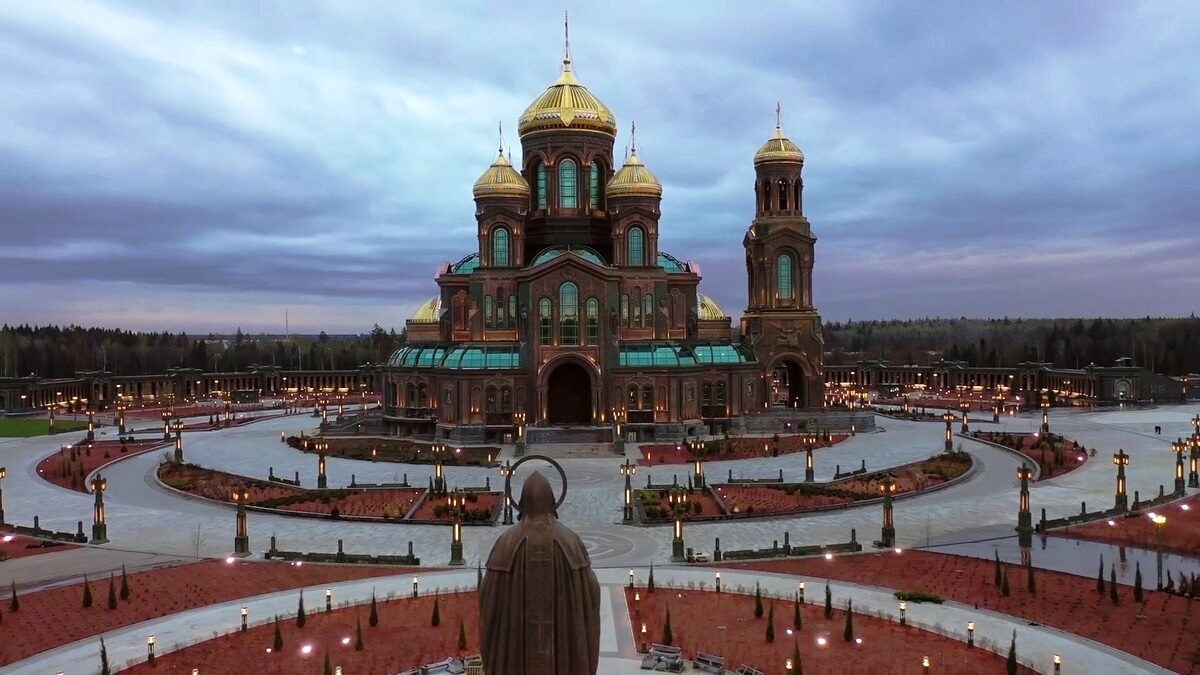
Main Cathedral of the Russian Armed Forces

One remark first: by the Russian people I mean the Eastern Slavs, with the exception of the Galician Uniates (whose dialect and world-view are closer to that of Poles, a Western one).

The year of the 75th anniversary of the Great Victory is coming to an end. Looking at modern supporters of Hitler among the Russian/Ukrainian Nazis and the liberoids, like “Kolya from Urengoy” (BATS note: see the open letter by Andrey Medvedev in Commemorating the 9th of May – No One’s Forgotten, Nothing’s Forgotten! with a strong response to that boy Kolya) apologising for the “cruel treatment” of German prisoners of war (who were forced to work), the question arises: “Who are they?”
Continue reading

100 Year Anniversary of the Great Naturalist Gerald Durrell

Reading time: 8 minutes

We marked the 100th anniversary of Gerald Durrell with many publications and photographs at our Telegram channel “Beorn And The Shieldmaiden”, staring from this post. Let us also celebrate it here at Beorn’s Beehive!

100 Year Anniversary of Gerald Durrell

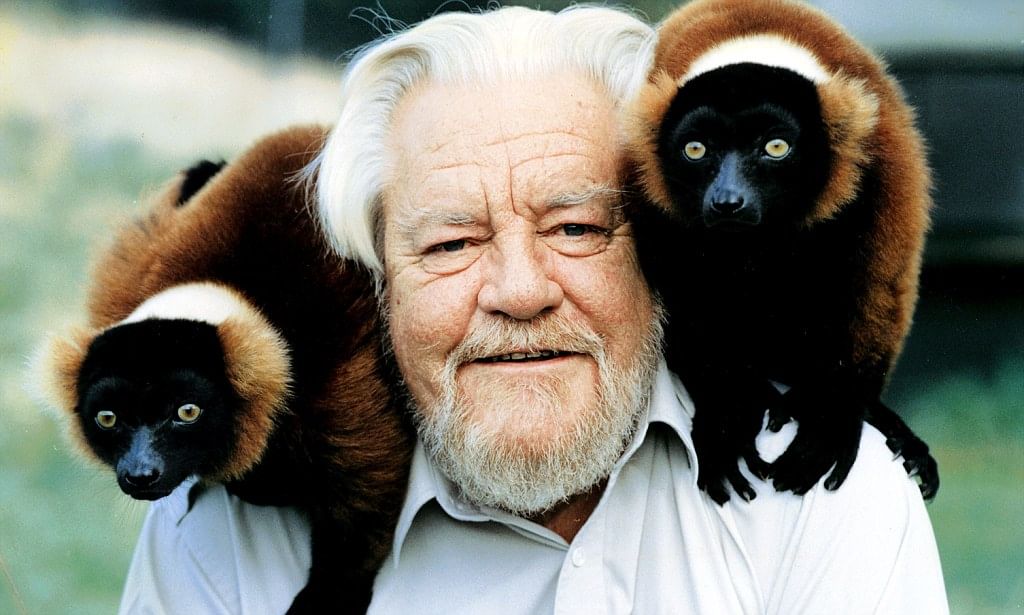
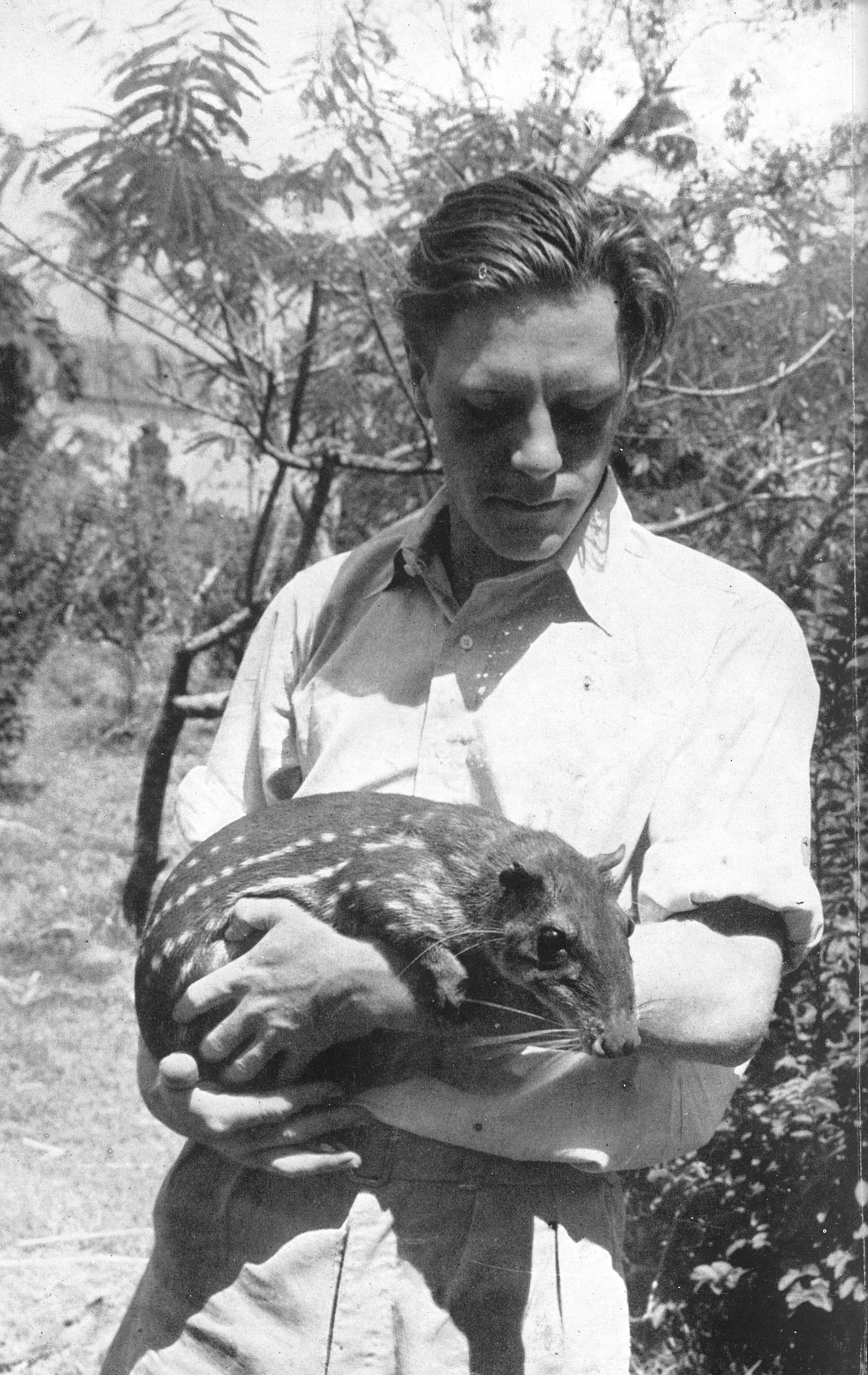
A great British naturalist, writer and one of the pioneers in animal conservation, Gerald Durrell, was born on January 7, 1924.

From a very young age he developed a fascination with and a love for the animal kingdom. This love and humility of our place in this world shone in his books. This love lead to the search for ways to save the animals that are on the brink of extinction, often-times because of human ignorance and activities. Durrell envisioned zoos not as places for the amusement for the visitors, but as tiny safehavens for the endangered species, where they could be bread and re-introduced back into the wild. This was a revolutionary vision at the time when he, against all odds, managed to establish such a zoo on the island of Jersey.

And the books that Gerald Durrell has written throughout his life shine with that boyish fascination and enthralling narrative. They inspire both children and grown-ups to see the world around them differently.

Durrell’s book were translated to Russian and were readily available in the libraries in the USSR, and many a kid, including yours truly, immersed themselves in every book by Durrell that they could get their hands on, travelling with him, laughing at his witty humour and pondering his insights!

In 1984 -1985, Gerald Durrell visited the USSR to film the series “Durrell in Russia”. In fact, his film crew was the first Western film crew to be allowed to film in the USSR, and to travel across the whole Union — such was the respect and trust extended to this remarkable man.

🦧 The legacy of Gerald Durrell’s work lives on, in the Jersey Zoo (https://www.durrell.org/), in many education and species reintroduction projects across the world. And thanks to support and donations from people with kind hearts, who do not remain indifferent, like Gerald Durrell himself.


The Jersey Zoo

Continue reading

Oles Buzina. In Memory of the Ukrainian Poet, Prophet and Patriot.

Reading time: 4 minutes

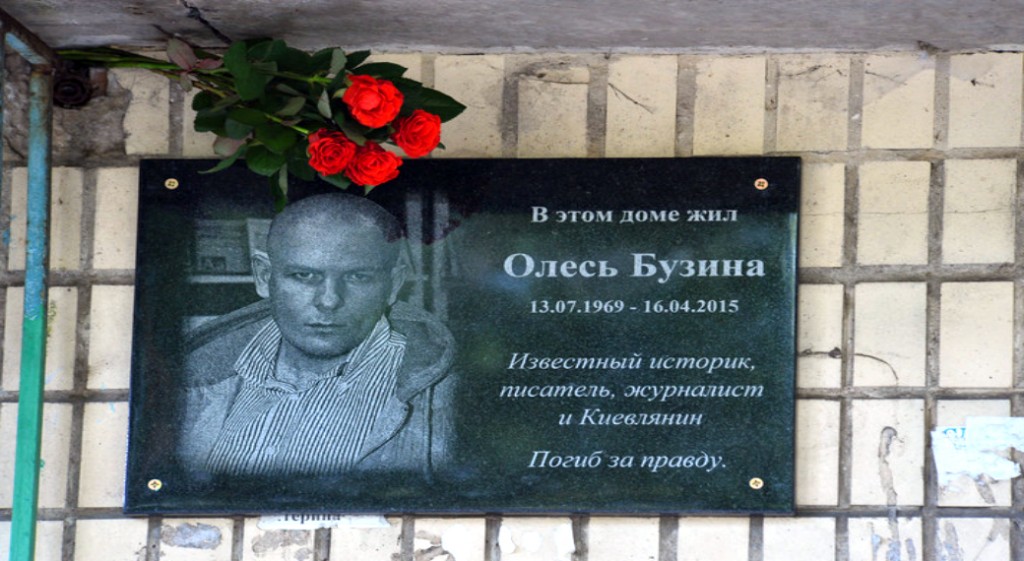
In Memory of Oles Buzina 13.07.1969 – 16.04.2015

The memorial picture reads: “They are afraid of his memory, even after death. Because for them, The Truth is like a aspen stake!”

Oles Buzina was the real Ukrainian patriot, seeing his country developing along its own unique path, but not as a ramming tool against Russia, not as “Ukraine Is Not Russia”, in Kuchma’s words, but as something special in its own way. He loved Ukraine, he loved his Fatherland.

That did not agree with the ultra-violent neo-Nazi views of those whom the USA installed in power in the Ukraine.

Oles Buzina was killed 9 years ago, on the 16th of April 2015 in Kiev with four shots in the back. The perpetrators were known, coming from OUN. The perpetrators were arrested, and then released. No one was sentenced for his murder.

In 2014, after Ukraine started the war on its own people in Donbass, Oles Buzina wrote this verse:

Cry, Ukraine, cry!
You are your own traitor and executioner!
With your very own hand,
You’ve crushed your reason and peace!

You’re killing your best sons!
…Up in arms against the “evil Muscovites”!
And biting, like a snake, your own tail,
You created in your borders HOLOCAUST!

With whom will you stay afterwards,
Having destroyed it all, cast over which board?
Maybe you’ll rebuild your home?!
But you won’t resurrect those who died in it.

The words of a prophet, that ring even stronger these days.

🔥🔥🔥

Oles Buzina
13.07.1969 – 16.04.2015

A memorial plaque on the house where Oles Buzina lived.

“The well-known historian, writer, journalist and Kievan resident. He died for truth.”

The following poem was written by Oles Buzina about a month before he was murdered.

I don’t like a lethal outcome,
I don’t like war, war is shit.
I will not understand the silent people who
who’s put on the yoke without a word.

Continue reading

For the 80th Anniversary of the Liberation of Northern Norway, the WWII History Is Being Rewritten There

Reading time: 100 minutes

(Updated 28.10.2022 – added an afterword)

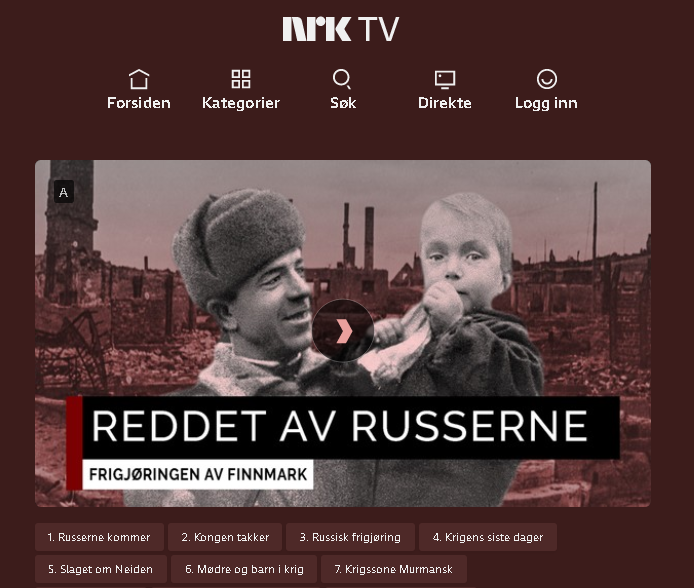
On the 25th of October 2019, the Norwegian state TV channel NRK 2 aired a 3 hour 20 minute long TV marathon, dedicated to the 75th anniversary of liberation of Finnmark, Northern Norway, by the Soviet troops. The documentary went under the title “Saved by the Russians”.

Save by the Russians

It featured a wide range of materials – interviews with the surviving witnesses, official ceremonies, both Norwegian and Russian documentaries, the efforts to locate the unburied remains of the fallen Soviet soldiers, interviews with the politicians and historians, a cultural part, where we could even see the choir of the Russian Northern Fleet sailors performing the Norwegian anthem.

Here are the chapter titles to give an idea of the scope of the documentary: Russians are coming; The King is giving his thanks; Russian liberation; The last days of the war; The battle of Neiden; Mothers and children in a war; War-zone Murmansk; Russian captives; The partisan Trygve Eriksen; The history of the partisans; The choir of the Northern Fleet; Forced evacuation on the North; The liberation anniversary in Kirkenes; The Prime Minister is giving a commentary; The battles on the Litsa front; The big losses of the Litsa dale; Dead soldiers in Litsa dale; The year under Russian governorship; Nidviser speaks about the local population; The children of war; The Swedish children; Child-soldier Alf Rafaelsen; Still finding the remains from the war; The culture of memory; The cooperation across borders; The choir of the Northern Fleet.

At a time when the rest of Europe was descending into a historical amnesia when it came to the events of World War II, with the history being actively re-written, this Norwegian program was a bastion of steadfast remembrance of history.

Norway will never forget the Soviet army’s heroic efforts.

Continue reading

Newspaper “Pravda” commemorating the 30th anniversary of the “Black October” of 1993

Reading time: 24 minutes

In this post I am continuing with the remembrance of the events of September — October 1993 resulting in Yeltsin’s unconstitutional power grab. After Yeltsin’s coup, the newspaper “Pravda” was forbidden, which was highly symbolic, as “Pravda” means “Truth” in Russian, and so after October of 1993 and for a long time The Truth was forbidden. The previous posts in the series are: Autumn of 1991 as a Prelude to the “Black October” of 1993 and the “Wild ’90s” in Russia and The Bloody October of 1993. Retrospect. The Last Interview with Ruslan Hasbulatov.

The newspaper published a series of Telegram posts and articles, commemorating that turn to the worse in Russian history. Below, I will translate three materials from Telegram, finishing with a longer article by Doctor of Political Sciences Sergej Obuhov, who asks several highly-relevant questions about those times and how the events echo in today’s Russia.

All the images can be clicked on for higher resolution.


Telegram post 1:

“The Black October”: 30 years

A barricade leaflet.

Today, after exactly 30 years, our editorial office publishes the historical Moscow edition of the newspaper “Pravda”, published on the 1st of October 1993 under the general headline “Politics is over. The dictatorship has begun”. It truly became a barricade leaflet, a “battle leaflet” that contained both a chronicle of what was happening, an analysis of the situation, and the thoughts and experiences of the participants in the events. Even now one can see in it the intensity of those events, the nerve of that time of troubles. For the edification of future generations.

In just two days there will be a bloody suppression of the popular uprising in the worst traditions of Pinochet, and “Pravda” became banned for a long time.

Here’s what the deputy editor-in-chief of Pravda, Viktor Linnik, wrote: “…It is absolutely not necessary to admire Hasbulatov and Rutskoy in order to be outraged by Yeltsin’s utterly cynical actions. Although it is precisely today that both Rutskoy, Hasbulatov, and every defender of the “White House” deserve the gratitude of the Russians for daring to throw the gauntlet in the face of tyranny.

Continue reading

22nd of June – Day of Remembrance and Sorrow. Remembering the 42 million perished Soviet people in the genocidal Second World War

Reading time: 7 minutes

The memorial texts below are written by Olga on Putinger’s Cat Telegram cannel. The article sheds new light on the genocide comitted against the Soviet people – predominantly the residents of Belorussia, Ukraine and Western Russia – by the Nazi-German invaders. We remember. As a 2015 article by Georgy Zotov showed, the same was not the case in Germany, where they asked “So many? Really?” Germans do not know how many Russians were killed by their ancestors


In Russia, June 22 is the Day of Remembrance and Sorrow. On this day, in 1941, the Great Patriotic War, which became the bloodiest and most destructive in the history of the country, began.

The Great Patriotic War had affected every family. More than 27 million people perished. Owing to the heroism of our soldiers and officers, the enemy was defeated, but Victory came at a high price.

Today, we pay tribute to the memory of all those who went through incredible hardship, those who died, but never gave up for a peaceful future for their descendants. We, the descendants, are full of deepest respect and gratitude for their sacrifice.

The declassified data below were presented at the State Duma hearing on the 14th of February 2017. Archived source is here.


By the beginning of the war, in June 1941, 196.7 million people lived on the territory of the USSR. According to declassified data of the State Planning Committee of the USSR, the losses of the Soviet Union in World War II amount to 41 million 979 thousand, and not 27 million, as previously thought. The total decline in the population of the USSR in 1941-1945 was more than 52 million 812 thousand people. Of these, irretrievable losses as a result of the factors of war – more than 19 million military personnel and about 23 million civilians.

The total demographic losses of the USSR as a result of the war amounted to 27 million people. Military losses were calculated at 11.4 million, including the war with Japan. From this number, it is necessary to subtract 1.8 million who returned from captivity and 0.9 million called up on the territory liberated from the occupation and sent to the troops from among the military personnel who were previously surrounded or missing.

Continue reading

«2 Years» re-publishing // Переиздание книги «2 года»

Reading time: 5 minutes

This introduction article is tri-lingual, in:
Denne introduktionsartikel er tresproget, i:
Эта вступительная статья – трёхязычная, на:


THE POLITICS
The 22nd of June 1941.
Leaflet No. 2:

The German-Russian War

In a proclamation signed by Reich Chancellor Hitler, the Germans march on Russia on a front of 2400 km., from Finland to the Black Sea.

To the north, German troops are advancing from Norway along with Finnish divisions, from the Carpathians German and Romanian forces.

Hitler declared that Bolshevism stood in mortal enmity with National Socialism. Russia had been threatening Germany for a long time and eventually there were 160 Russian divisions positioned on Germany’s eastern border. The Soviets had thus broken the Treaty of Friendship. The imminent struggle revolved around the civilized world.

Mines have been laid in the Arctic Ocean and in the Baltic Sea, among other places between Bornholm and Sweden and between Bornholm and the German Coast.

Read THE POLITICS tomorrow
– Copenhagen


80 years ago, in the summer of 1943, the underground Communist Party of Denmark illegally published the book “2 Years” with newspaper clippings from the major German-controlled Copenhagen newspapers. The book is 70 pages long and is a rare historical document of the occupation-era official press coverage of the first 2 years of the war between the Soviet Union and Nazi Germany, the outcome of which became decisive for the future of mankind.

To honour the Resistance fighters and strengthen the memory of the great Victory of the USSR and the Red Army over fascism, we are now launching a digital reissue of “2 Years”!

The book is photographed and can be studied page by page and read in graphically adapted versions in Russian and English, respectively, as well as in a linguistically edited version in modern Danish. An extensive historical notebook has been added as well as text-to-speech descriptions for the blind and visually impaired of the book’s many fine colour illustrations in silkscreen by artist and resistance fighter Viggo Rohde, with sharp political caricatures of the Nazi Menagerie and the course of the war.

We see our collective memory as an important weapon against the advanced means and methods of modern war propaganda to which we are daily exposed, and, that Dr. Goebbels could not even dream of.

Read, remember, and get historical perspective on your contemporary events!


Continue reading

Commemorating the 9th of May – No One’s Forgotten, Nothing’s Forgotten!

Reading time: 5 minutes

I wanted to make a simple and poignant commemoration of the 9th of May celebration in these difficult times, when Russia once again is fighting against Nazism – and not just in the Southern Russian lands, currently known as Ukraine (Ukraine is just a battlefield, where, after 8 years of genocide of the Russian population, it was said, “enough is enough”), but also on the wider, so far, diplomatic front against the resurgence of the Nazism in the whole West. When the West is cancelling and banning the commemoration of the Victory Day – both in the birthplace of the 20th century Nazism – Austria, and in the hotbeds of Nazi SS punisher battalions, like Latvia.


Then I came across the post by the VGTRK journalist Andrey Medvedev. Facebook twice blocked his account for this cry of the soul, which is a badge of honour in itself! Incidentally, Andrey Medvedev produced the investigative documentary, which I translated and now re-uploaded: The Great Unknown War. A must-see documentary about the WWII prelude. By Andrei Medvedev

“If I had to speak in the Bundestag like the boy Kolya, then I would probably say these words:

– Dear deputies. Today I saw a miracle. And this miracle is called Germany. I walked to you and looked at the beautiful Berlin streets, at the people, at the wonderful architectural monuments, and now I’m standing here and looking at you. And I understand that all this is a miracle. That you were all born and live in Germany. Why do I think so? Because considering what your soldiers did in our occupied territories, the Red Army soldiers had the full moral right to destroy the entire German people. To leave in place of Germany a scorched field, ruins and only textbook paragraphs would remind that there was once such a country. You probably don’t remember all the details of the occupation, but it’s not necessary. I’m just going to remind you of what the Wehrmacht and SS soldiers did to Soviet children.

They were shot. Often in front of parents. Or vice versa, first they shot at mom and dad, and then at the children. Your soldiers raped children. Children were burned alive. They were sent to concentration camps. Where their blood was taken from them to make serum for your soldiers. Children were starved. Children were eaten to death by your sheepdogs. Children were used as targets. Children were brutally tortured just for fun.

Or here are two examples. The Wehrmacht officer was prevented from sleeping by a baby, he took him by the leg and smashed his head against the corner of the stove. Your pilots at the Lychkovo station bombed the train on which we tried to take the children to the rear, and then your aces chased the frightened kids, shooting them in a bare field. Two thousand children were killed.

Just for what you did with children, I repeat, the Red Army could destroy Germany completely with its inhabitants. It had a full moral right. But it didn’t.

Do I regret it? Of course not. I bow to the steely will of my ancestors, who found some incredible strength in themselves so as not to become the same brutes as the soldiers of the Wehrmacht.

On the buckles of German soldiers it was written “God is with us.” But they were a product of hell and brought hell to our land. The soldiers of the Red Army were Komsomol members and Communists, but the Soviet people turned out to be much bigger and more cordial than the inhabitants of enlightened religious Europe. And they did not take revenge. They were able to understand that hell cannot be defeated by hell.

You should not ask us for forgiveness, because you personally are not to blame for anything. You cannot be responsible for your grandfathers and great-grandfathers. But I will be honest – for me the Germans are forever an utterly alien people. It’s not because you’re personally bad. It’s the pain of the children burned by the Wehrmacht that screams in me. And you will have to accept that at least my generation – for whom the memory of the war is in my grandfather’s awards, his scars, his front-line friends – will perceive you this way.

What will happen then, I do not know. Perhaps mankurts will come after us who will forget everything. And we have done a lot for this, we have foiled a lot ourselves, but I hope that all is not lost for Russia yet.

Of course we need to cooperate. Russians and Germans. We need to solve problems together. Fight ISIS and build gas pipelines. But you will have to accept one fact: WE WILL NEVER REPENT for our Great War. And even more so for the Victory. And even more so in front of you. Anyway, I repeat, my generation. Because back then we saved not only ourselves. We saved you from yourself. And I don’t even know what’s more important.”

I fully agree with these strong and harsh word. As long as the medals and deeds of my grand-uncle are remembered

In Memory of Georgij

And as long as wee remember that Russian soldier saved the World

And as long as Leningrad stays Unconquered

I remember. I am proud.

PS: If only there were more such patriotic, history-aware, honest Americans as Scott Ritter:

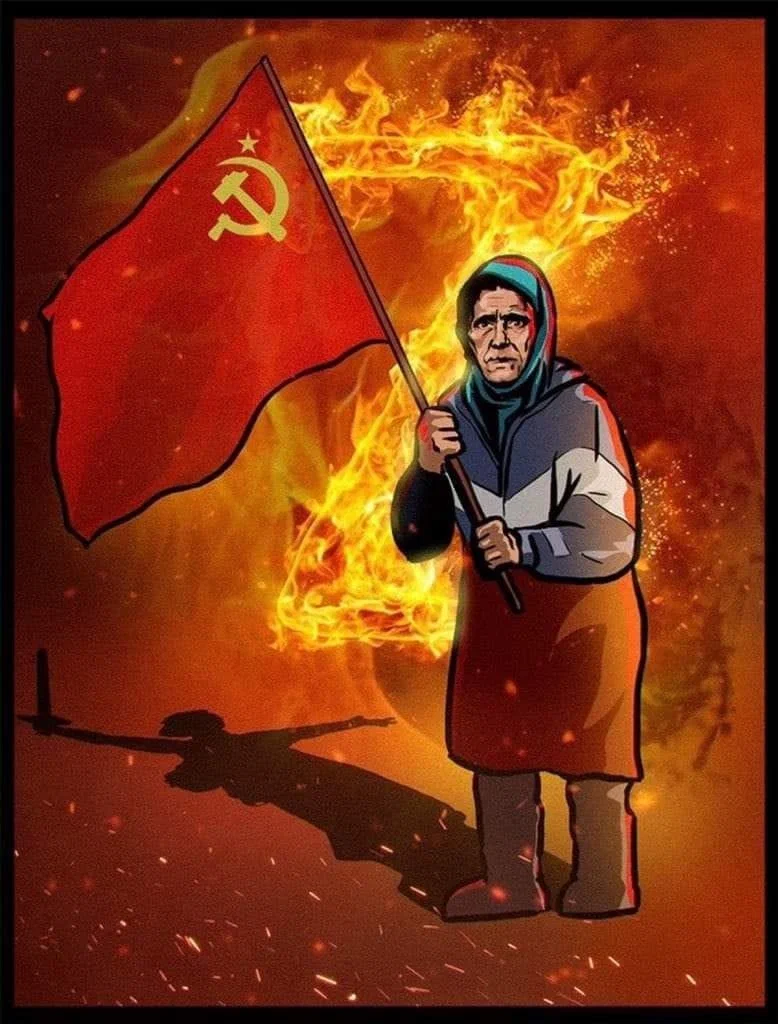
The courageous granny who stood up to the mocking Ukrainian soldiers

Reading time: 5 minutes


In the pencil drawing on the right, the shadow of the old woman standing her ground is the iconic “Motherland Calling” poster of The Great Patriotic War. Here is that drawing in a greater resolution:

UPDATE: the minute granny has become a powerful living legend. Here is another, artistic, rendition of her image:

UPDATE 2: In Reutov, near Moscow, huge graffiti was created with a Ukrainian grandmother, who was mocked by the radicals of Ukraine because of the flag of the USSR. The author is reportedly a local artist. Earlier, images with the old woman appeared in the Murmansk and Belgorod regions. View the video of the painting process.

UPDATE 3: A video with comments from the foreign viewers embedded towards the end, to the “Sacred War”, the anthem of the fight against Nazism during the Great Patriotic War. It was great that the concern for her safety was raised at the UN level.


The video below made the headlines. It is quite heart-wrenching to watch as the Ukrainian soldiers are making a mockery of the elderly Ukrainian pair. I am writing a transcript below the video, and if it gets removed from YouTube, I’ll re-upload it to Odysee.

UPDATE 2024: The video at the address https://www.youtube.com/watch?v=c5y_CrCAcoc did get deleted by YouTube in their customary zeal to promote freedom of speech, so here it is on by Odysee and Rumble!

Continue reading

Remembering the Start of the Great Patriotic War

Reading time: < 1 minute

On the 22nd of June,
at 4am sharp,
Kiev was bombed and we were informed,
That the War had begun.

The War started at dawn
so that more people were killed.
Parents slept, their children were sleeping
when on Kiev bombs fell.


Birds are not singing here,
Trees do not grow in these parts.
Only we, shoulder to shoulder,
Are sinking into the Earth.
The planet is burning and spinning,
Smoke is above Motherland.
And so we only need one Victory!
One for everyone, and we’ll pay any price.


At this hour of remembrance, please read:

Vladimir Putin Shocks the West! The Munich Betrayal and The Real Lessons of the 75th Anniversary of World War II (Putin’s Article in The National Interest Magazine, USA)

with a direct link to President Putin’s article

Vladimir Putin: The Real Lessons of the 75th Anniversary of World War II

and watch

The Great Unknown War. A must-see documentary about the WWII prelude. By Andrei Medvedev

The Great Patriotic War in Ukraine. A historical retrospective by Rostislav Ischenko

Reading time: 9 minutes

The following article by a Ukrainian political analyst and historian in exile Rostislav Ischenko provides a much-needed context for both the current proliferation of Nazism in Ukraine, and the Banderite phenomenon of WWII.


The Great Patriotic War in Ukraine

by Rostislav Ischenko, published 09.05.2020 on the portal Ukraina.ru and at the open blog platform Kont.

It is sometimes said that the war started earlier for Ukraine than for the rest of the USSR. Thinking of the fact that when Hitler attacked Poland, the Western Ukrainian and Western Belorussian lands were part of the latter and thus also came under attack

German checkpoints
German checkpoint

This, however, is not entirely true. By the way, this interpretation of events has almost got no traction in Belorussia. And this is logical. The fact is that the German troops attacking Poland did not advance further than the Brest-Lvov line. Serious fighting was only for Lvov over the course of 2 days. After defeating the Polish group that retreated to the city, the Germans abandoned the city, which the Red Army entered, and it, along with all the Western Ukrainian territories, was annexed to the Ukrainian SSR.

If anyone in Ukraine entered the war on September 1, 1939, it was Ukrainian nationalists who opposed the Polish state on the side of Nazi Germany, just as they sided with Hitler against the USSR on June 22, 1941.

This difference between the Western Ukrainian territories and the Ukrainian SSR, the Belorussian SSR, and even the territories of Western Belarus (which were part of Poland before 1939) was well understood by Hitler. The Nazi dictator clearly understood the mentality of the peoples who inhabited the UkSSR much better than his generals and party bonzes. Let’s see how he administratively divided the occupied territories of the USSR.

Continue reading