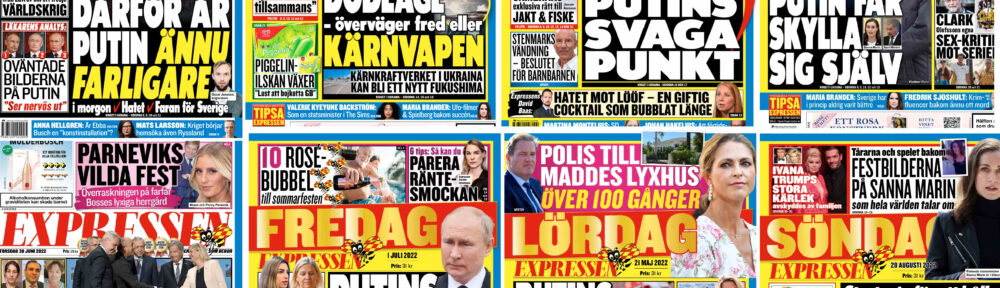
In 2024, Kamal El Salim did an extensive research into the front pages of the Swedish daily “Expressen, and published the results in the fourth issue of Parabol Press. Below this article, we present another material on the same topic: “Cognitive dissonance as a mechanism of control”, which builds on Expressen-based findings. Both articles were first translated to our Telegram channel “Beorn And The Shieldmaiden”.
Read also our 2017 article The Upside-down World of the Western Main Stream Media (MSM).

Almost nine out of ten are about Vladimir Putin. Often there are speculations about his death, plans for World War III and girlfriends. What does this one-sided fixation on one person mean? How has it affected the NATO process? And what happened to the news agency? Kamal El Salim has gone through Expressen’s front pages for two years.
Every day a newspaper editor has to make a choice. Which news is most important and deserves a place on the front page, one and poof? Is it the latest gang shooting, or the murdered woman? Is it climate change, NATO membership, the healthcare crisis, one of the major wars raging in Ukraine and Palestine?
For the editor of Expressen, the choice has been easy over the past two years. The number one spot goes, in nine out of ten cases, to Vladimir Putin.
Parabol has looked at Expressen’s front pages for just under two years, from the outbreak of war in Ukraine on February 24, 2022, until December 31, 2023. The front pages of the evening newspapers are interesting precisely because they reach the entire population, even those who do not buy the newspaper or read it online. Every time we shop in a grocery store or kiosk, we see them while we are standing in line – we are therefore influenced even if we do not want to. What kind of picture do they give of the present? The fact that I chose Expressen is just a matter of delimitation – focusing on Aftonbladet or another newspaper would probably have given similar results, but that is not a comparative analysis we are looking for here.
After going through 671 front pages (what is called “one”, namely the biggest news on the page, and what is called “puff”), the result is clear. In 586 of them – a full 87% – Russian President Vladimir Putin is mentioned.
Note that they are not about Ukraine, or about Russia, or about the war, but about Putin, to the point that the headlines personify the nation of Russia as a single person.
The front pages can be divided into a number of categories:
Putin will lose
174 front pages are about Putin losing the war. Some examples of this are “3 Russia experts: It could be the end for Putin”, “Magnus Falkehed: This is the beginning of the end for Putin”, “Mats Larsson: NEW LAW SHOWS PUTIN’S DESPERATION” and “Expert: PUTIN COULD FALL AT ANY TIME”.
These predictions have been going on throughout the war, but without any of them coming true.
Illnesses or mental problems
23 of the front pages are about Putin having a serious illness or mental problems. Illnesses Putin has include, for example, “PUTIN’S PARANOIA – the fear of being poisoned”, “INFORMATION: PUTIN MAY HAVE CANCER, The President was visited by doctors 35 times – Kremlin denies”, “SECRET TAPE allegedly reveals PUTIN’S BLOOD CANCER”, “The pictures reveal: PUTIN’S OPERATIONS, Cheek augmentation, botox and fillers, eye lift” and “Information: Pentagon LEAK SHOWS: PUTIN HAS CANCER”.
It is easy to ask how it is that Putin is still alive.
In addition to this, a prominent recurring theme is the questioning of Putin’s mental health and psychological stability. Expressen suggests that he is paranoid, isolated and unbalanced, and there is speculation about his alleged health problems, including roumors of cancer and nervousness. In addition, the headlines emphasise speculation about possible assassination attempts against Putin and claims about his possible death and what consequences it might have. One front page reads “Putin could die suddenly – like Stalin.”
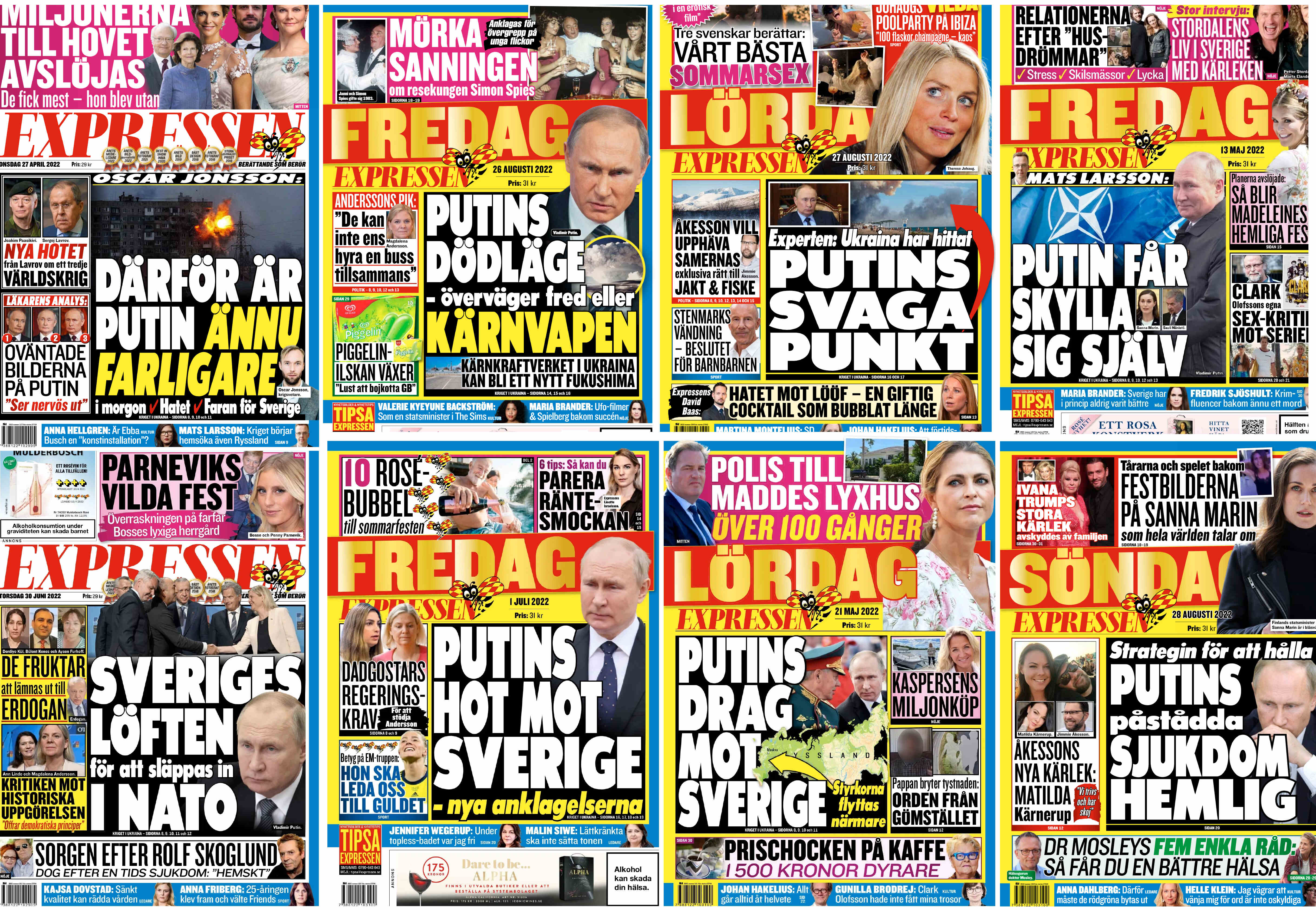
Putin is extremely dangerous – yet it is obvious that he will lose the war, is the message of Expressen.
The threat to Sweden
121 headlines deal with Putin as a threat to Sweden, often linked to NATO as a savior. They can look like this: “This is how Putin plans to punish Sweden”, “The Russian threat to Gotland”, “The expert: PUTIN WINS when the NATO process is DELAYED”, “EXPRESSEN REVIEWS: RUSSIAN BUILDING UNDERGROUND AT SWEDISH MILITARY BASE”, “Linda Jerneck: Sweden must join NATO”, “The experts: This is the THREAT IMAGE AGAINST SWEDEN” or “Jens Liljestrand: Now darkness is falling over Europe again”.
Carl Bildt
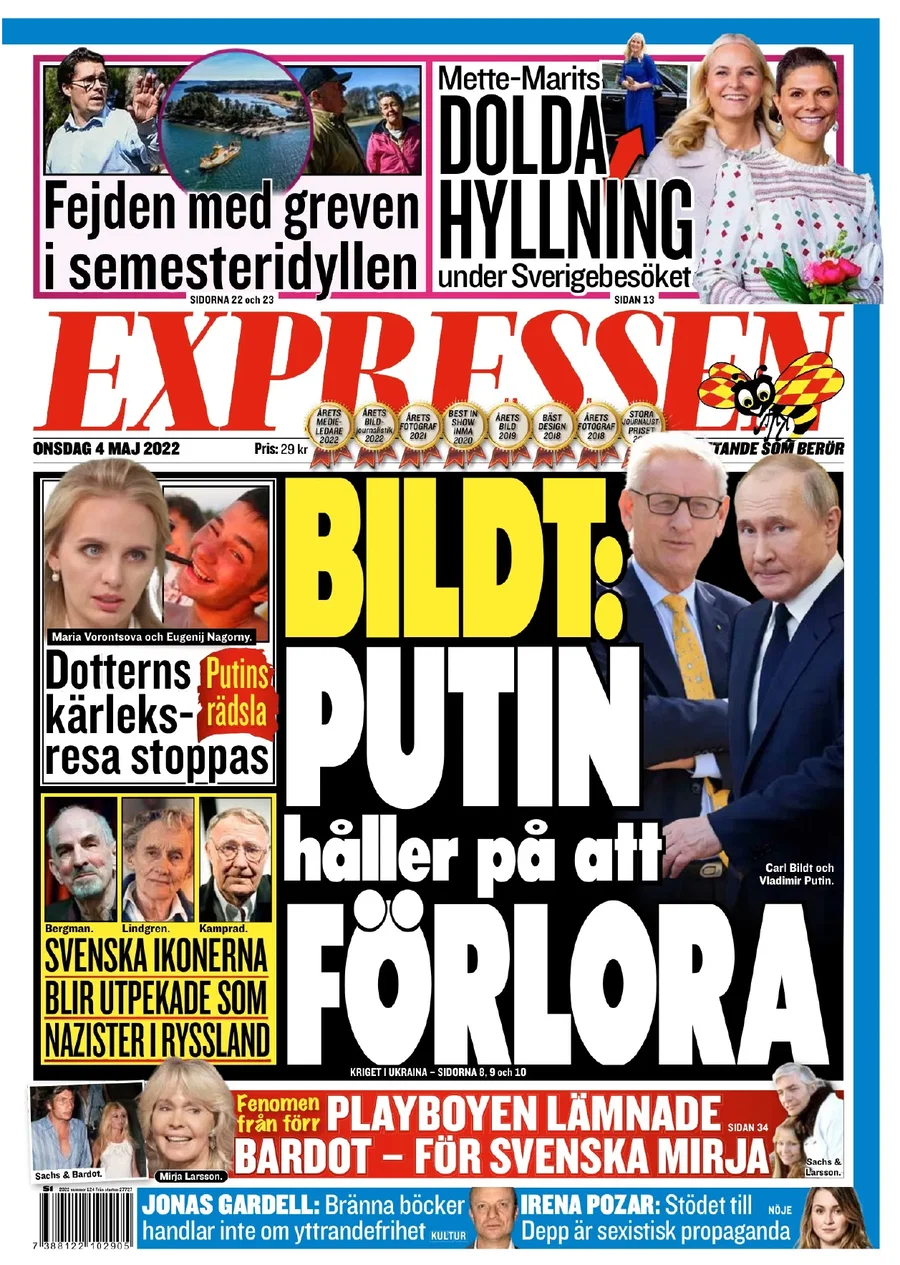 Carl Bildt appears more often than any other Swedish politician on Expressen’s front page, always in the role of expert. 41 of the front pages quote him. Bildt appears as the old man in the box who appears at regular intervals to confidently state things like “Bildt after the speech in Moscow: Putin cannot win”, “Bildt’s warning: “Nuclear weapons”, or “The situation is uncertain – Carl Bildt on PUTIN’S THREAT TO SWEDEN”, “CARL BILDT: PUTIN’S WEAPONS are about to END, 70-year-old tanks are being sent to the front”, “Experts disagree on PUTIN’S NUCLEAR WEAPONS PLANS” “Carl Bildt: “We should not underestimate his will”, “Bildt: Clearly PUTIN IS NERVOUS”.
Bildt thus appears in the roles of geopolitical expert, psychologist, military analyst and seer. However, Bildt is also quoted under the title “the expert” or “the experts” and is therefore included more times than these 41.
Putin is evil
99 of the front pages try to demonstrate that Putin is evil and that this can explain what is happening in Ukraine. Examples of this are “PUTIN’S LIES to the soldiers’ relatives”, “Johan Hakelius: Hitler moment laced with nuclear weapons”, “PUTIN’S SECRET WEAPON against the West: Africa”, “PUTIN’S BRUTALITY REVEALED by new images”, “PUTIN’S SECRET PRISON CAMP for his OWN soldiers”, “The warning: PUTIN WANTS TO BE LIKE STALIN” and “PUTIN’S DOOM WEAPON READY to be fired next year”.
The comparison with Stalin recurs in the Expressen’s running order and front page. We can find six comparisons with Stalin. “The warning: PUTIN WANTS TO BE LIKE STALIN”, “MATS LARSSON: PUTIN DOES LIKE STALIN in the war against Hitler”, “MATS LARSSON: It indicates that PUTIN COPIES STALIN”. We also find seven comparisons with Hitler. “MATS LARSSON: Putin makes the same mistakes as Hitler”, “The professor: THAT IS WHY PUTIN CANNOT GIVE UP “Atmosphere like in Hitler’s bunker”.”
Remarkably often, it is Expressen’s Mats Larsson who is responsible for the analysis.
Wealth, family and relatives
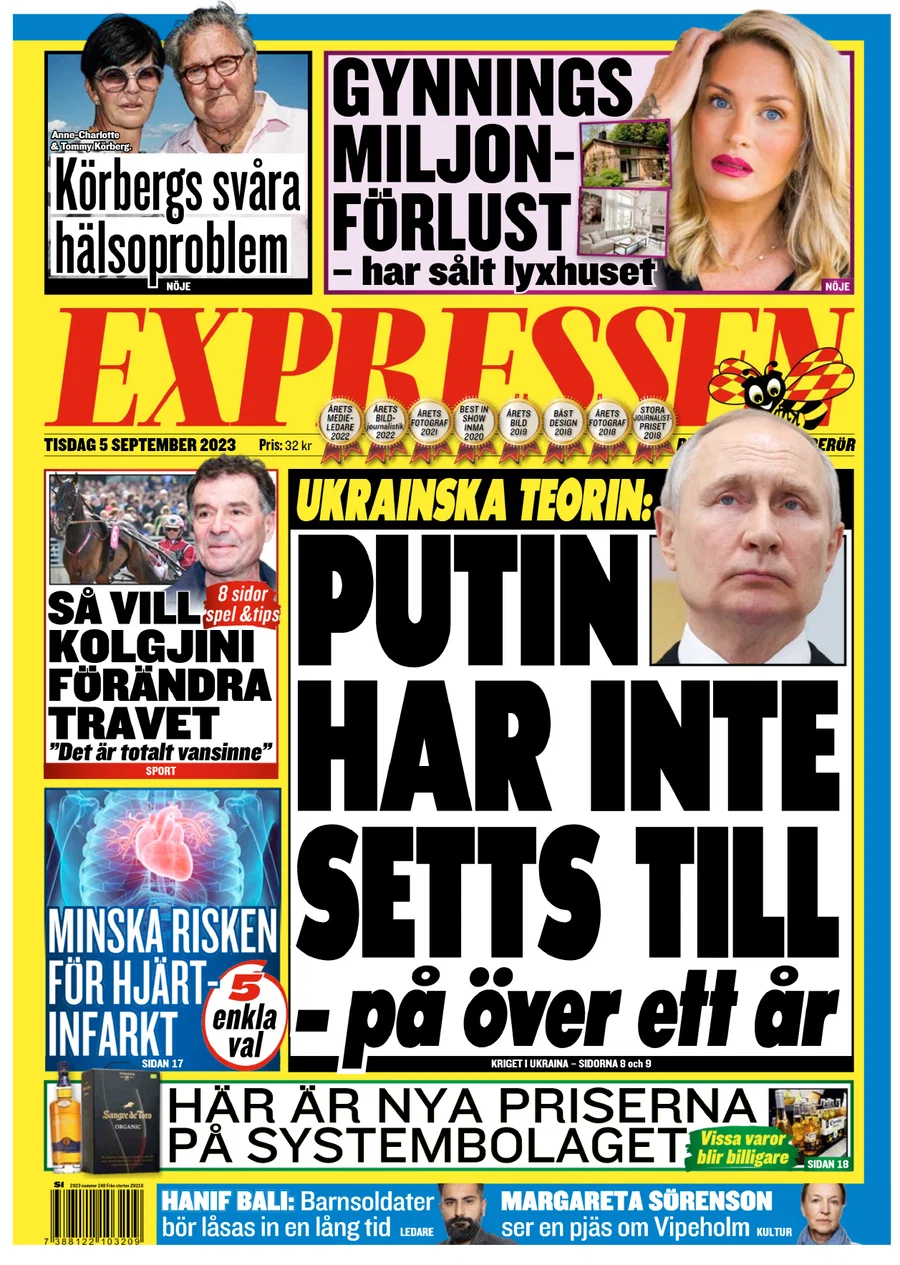 77 front pages concern Putin’s wealth, his family and relatives. They can then look like “EX-MILF is used to PRESSURE PUTIN”, “This is how Putin protects his wealth – via phonies”, “Putin’s bodyguards on a LUXURY BOAT IN THE MEDITERRANEAN”, “This is how Putin’s ex-wife lives, remarried after just one year, 20 years younger man in France”, “PUTIN’S MONEY LAUNDERING REVEALED – Musician deposited 311 million – Four bankers in Switzerland convicted”, “PUTIN’S MILF CAN TAKE OVER the Wagner empire” and “REVEALED: Here is PUTIN’S SECRET LUXURY RESORT”.
Ukraine
In all this Putin obsession, Ukraine is being overlooked. I can only find 56 headlines that have to do with Ukraine, even though I have tried to be generous and let articles that only mention Ukraine in some way count. These headlines have looked like this “Mats Larsson: Ukraine’s hope – artillery from the US”, “Jennifer Wegerup: Certain values must be defended”, “PAASIKIVI’S ANALYSIS: Ukraine’s victory & Putin’s ACTING”, “THE WOMEN WHO RISK THEIR LIVES AT THE WAR FRONT”, “MATS LARSSON: Ukraine’s important SECRET THAT PUTIN CANNOT BREAK” and “Mother Elena’s cry for help from within “HELP US”. But apart from this example, Ukrainians rarely get their own voice in Expressen’s reporting.
Experts predict the future
63 of the front pages contain the words “expert” or “the experts”. The reader is not told who the experts are or what their profession is up front, but these experts often speak out in the run-up and on the front page to say things like: “The experts on the PRESS ON PUTIN “Pensions become cannons, school food becomes hand grenades”, “THE EXPERTS: PUTIN’S WAY OUT OF THE WAR “He can’t win”, Experts’ 3 THEORIES ABOUT PUTIN’S TURNOVER”, “EXPERTS: RUSSIA’S FUTURE IS SIMILAR TO NORTH KOREA”, “Experts: PUTIN WILL WIN – IF THE USA DOESN’T GIVE MORE MONEY” and “PUTIN’S FATAL MISSES, Nine experts, “war for decades – The pictures allegedly reveal the president’s POOR HEALTH”.
These experts often turn out to be Carl Bildt, Patrik Oksanen or some former CIA analyst.
Nord Stream
Six headlines mention the sabotage of the Russian gas pipeline Nord Stream. None of them are about connections to the West. “Swedish robot used in RUSSIA’S HACK ABOUT NORD STREAM”, “Mats Larsson: The word that reveals PUTIN’S MILITARY WEAKNESS. Russia: Sweden is hiding something about Nord Stream”, “SUSPECTED SAILBOATS IN SWEDEN before Nord Stream sabotage” and “DUBLEBLE GAME UNDER THE SURFACE, STOPS THE ANSWER ABOUT NORD STREAM”.
The apocalypse is near
Expressen regularly uses alarmist headlines that give the impression that the end is near. Front pages such as “PUTIN’S NEW THREAT TO THE WEST”, “So great is the risk that PUTIN’S WAR MUTATES into a third world war”, and “The warning from the Kremlin THEN IT WILL BE A THIRD WORLD WAR” risk creating panic and spreading fear instead of promoting a constructive and nuanced discussion about the war.
4 front pages contain the word “world war”, 9 contain the word “the end”, 16 the word nuclear weapons. There are also 32 front pages that have to do with “death”, “death list” or “killed”.
What Swedes encounter in their grocery stores, kiosks and press offices is thus a frightening future where they risk being hit by atomic bombs or foreign occupation at any time.
This, coupled with headlines such as “PUTIN’S PARANOIA – the fear of being poisoned” and “SECRET TAPE allegedly reveals PUTIN’S BLOOD CANCER” reinforces the image of Putin as a sick and crazy individual who can do anything. Rarely do these predictions have sufficient support in actual evidence or sources.
That Russia will lose the war is presented as a matter of course despite these terrible threats. When this is said, it is preceded by words such as “analysis” or “the expert” while what Putin himself says is called “belief”, “strategy” or “threat.” For example: “PAASIKIVI’S ANALYSIS: Ukraine’s victory & Putin’s ACTS”, “PUTIN’S SILENCE after the setback – classic strategy”, “PUTIN’S CLOUD HOLE – MANUFACTURING MISSILE WITH PARTS FROM THE WEST”, “HERE THE RUSSIANS CELEBRATE Victory Day – ON NORWEGIAN LAND”, “Mats Larsson: THAT’S WHY Putin believes that time is in Russia’s favour” and “PUTIN’S GOALS FOR 2026 “Have rolled the dice”.
There are many questions one can ask about Expressen’s, and the other newspapers’, one-sided focus on Putin. Perhaps the most striking is that they seem to have abdicated their role as news providers – because what is being reported about Putin is not news. We are not told how things are on the battlefield, how the Ukrainians are doing during the war or the latest results from the negotiations between heads of state. Instead, it’s speculation and scaremongering – usually completely unfounded.
One can also ask how much of this one-sided focus on Putin has contributed to swinging public opinion around NATO. The proportion that is positive about Swedish membership in NATO increased by 35 %pt. to 64%, between 2021 and 2022, according to the SOM Institute. “The change of attitude regarding NATO membership is unprecedented in Swedish political history, even compared to other major shifts in opinion in modern times such as the nuclear opinion after Fukushima in 2011 and the refugee opinion after the crisis in 2015,” says Henrik Ekengren Oscarsson, professor of political science.4
Could Expressen and the other newspapers have contributed to that?
At the same time, another war has raged, with significantly more civilian casualties. How many of Expressen’s front pages in the fall of 2023 were about the genocide in Gaza? Answer: Zero.
Cognitive dissonance as a mechanism of control
— Written by Mattias Forsgren, June 13, 2026.
When a predicted disaster fails to occur, something unexpected happens to people’s beliefs. That’s exactly what American social psychologist Leon Festinger and his colleagues discovered in 1954 when they infiltrated a small apocalyptic cult in Minnesota.
The group believed that a great flood would destroy the earth on December 21 and that aliens would save the believers. When nothing happened, the members were not disillusioned – they became even more convinced. They began recruiting new people with renewed energy and created new explanations for why the prophecy did not come true.
In the classic book «When Prophecy Fails» (1956), Festinger showed how cognitive dissonance – the psychological discomfort that occurs when reality clashes with a deeply held belief – is often not dealt with by abandoning the belief. Instead, people deal with the discomfort by reinforcing their beliefs, rationalising failure, and increasing their commitment.
This mechanism has later proven to be extremely useful far beyond small religious sects.
As early as the 1920s, propaganda theorists such as Harold Lasswell and Edward Bernays described how people’s inner psychological tensions, ambivalence, and need for mental harmony could be exploited to control public opinion in so-called democracies. Lasswell spoke of propaganda as “the management of collective attitudes by the manipulation of significant symbols.” Bernays went even further and described an “invisible government” that shapes consent by exploiting unconscious motives and emotions. Steven Hassan has later shown how gaslighting*, by inducing cognitive dissonance, has become a central technique in both cults and political mass influence.
Today, we see this technique being used with Russia’s president Vladimir Putin in the lead role.
Western media and opinion leaders are serving up a contradictory narrative that bears all the signs of being a deliberately constructed product of the methods developed to govern “democracy.” On the one hand, Putin is a dying man: cancer, Parkinson’s, stroke, doppelgangers, and “only months left” have been recurring headlines for over a decade. On the other, he is an apocalyptic threat who is currently conquering Europe, controlling elections in the West, and posing the greatest civilisational threat since the 1930s. When Putin reappears alive and speaking after the latest death prediction, the narrative does not disappear. It is immediately reformulated: “He is weak, but for that very reason more dangerous than ever.” The death sentence becomes not proof of incorrect reporting but yet another reason to act now.
The dissonance between “weak decadent dictator” and “omnipotent world threat” is handled by binding the audience more tightly to the overall message: Russia is an existential threat that requires sanctions, arms deliveries, high defense budgets and suspicion of all critical voices.
It is a sophisticated form of collective gaslighting*. The reader is forced to carry the contradiction within themselves and learns to manage the tension by accepting the political line that follows. Just as in Festinger’s sect, the investment in the story – time, identity, moral conviction – becomes so great that it becomes psychologically costly to leave it.
The techniques that Lasswell, Bernays and later Hassan described are here put into a system: creating dissonance, offering the political solution as the only way out, and stigmatising those who refuse to play along.
This Putin prophecy is flexible and eternal, it can never be completely disproven, and while we wait for the next death headline or the next “invasion,” the mechanism continues to do its job: keeping us engaged, afraid, and loyal to the framework set up to govern modern “democracy.” Perhaps it’s time to ask ourselves: Who really benefits from us never leaving the doomsday cult?
In this context, let me remind you of Kamal El Salim’s excellent article (https://www.parabol.press/tva-ar-med-expressen-586-lop) from the fourth issue of Parabol 2024:
“After going through 671 front pages (what is called “the one” namely the biggest news on the page and what is called “puff”), the result is clear. On 586 of them – a full 87% – Russian President Vladimir Putin is mentioned.
174 front pages are about Putin losing the war. Some examples of this are “3 Russia experts: It could be the end for Putin”, “Magnus Falkehed: This is the beginning of the end for Putin”, “Mats Larsson: NEW LAW SHOWS PUTIN’S DESPERATION” and “The expert: PUTIN CAN FALL AT ANY TIME”.
These predictions have been going on throughout the war, but without any of them coming true.
23 of the front pages are about Putin having a serious illness or having mental problems.
121 headlines are about Putin as a threat to Sweden, often linked to NATO as a saviour.Carl Bildt figures more often than any other Swedish politician on Expressen’s front page, always in the role of expert. 41 of the front pages quote him.”
No one escapes the grip of the front pages!
♦️♦️♦️
* Gaslighting means that someone deliberately and systematically manipulates another person to doubt their own perception of reality, memory and reason. It is a form of psychological violence where the goal is to create confusion, uncertainty and control.
The term is taken from the well-known film «Gaslight» from 1944. In the film, a husband manipulates his wife by, among other things, turning down the gas lighting in the house, in order to claim that it is only something she is imagining when she points out that the light is getting dimmer.