Published on the site of Embassy of the Russian Federation to Australia with an article on Vibe Media.
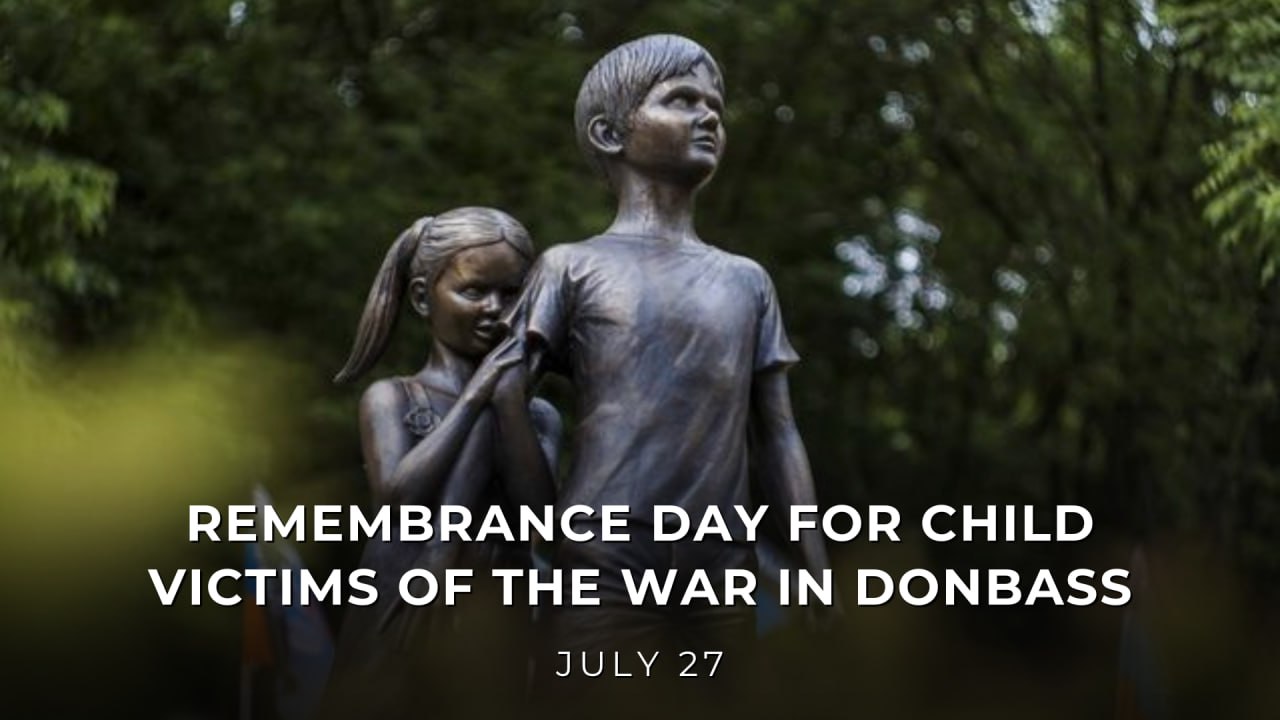
27 July is a very special date. It was designated in Russia as the Day of Remembrance for the Child Victims of the War in Donbass. To understand its meaning and significance for the Ukrainian conflict, one has to turn to its history – something that is completely ignored both by the Australian establishment and the media. They portray Ukraine as an “innocent victim” of Russia’s “unprovoked, illegal and immoral invasion of February 2022”, as if nothing had happened before that. Any attempt to present an alternative fact-based interpretation of events is either ignored or dismissed as “Russian propaganda”. So let us face the facts and examine the root causes of the conflict.
Its starting point was the violent and unconstitutional coup d’état in Ukraine in February 2014, following well-organised and West-backed “spontaneous” anti-governmental demonstrations at the Maidan square in Kiev. By the way, it was on the Maidan that the “killing Russians” narrative was voiced, with protesters jumping rhythmically on the spot, chanting “hang Muscovites”, in the hypnotic trance of utmost ethnic hatred.
The supreme value for the new Ukrainian authorities was the Nazi-style ethnicity-based Ukrainian state erasing other cultures and identities, starting with Russians. Total “Ukrainisation” was, and still is, the order of the day. The very concept of social cohesion was anathema to them. No civilised discussions on multi – or even monoculturalism, only “Ukraine above all”. Those daring to dissent were to be exterminated. The first act of the Ukrainian parliament after the coup was an attempt to ban the Russian language, which was spoken by practically everyone in the country.
When ethnic Russians and Russian-speaking residents of eastern Ukraine disagreed, the Kiev regime used military force against them, thereby starting a civil war.
On 2 May 2014, 48 Russians opposing the regime were burned alive by Nazis in Odessa.
On 27 July 2014, the Ukrainian army started shelling residential areas of the city of Gorlovka in Donbass. One of the multiple victims was 23-year-old Kristina Zhuk. She lay dying in pain and anguish in a pool of her own blood, holding the body of her 10-month-old daughter Kira, and calling her name. Then she passed away too. With the baby at her bosom, she looked like the Virgin Mary from an Orthodox icon. Because of this, people called her the Madonna of Gorlovka. This image circulated widely in the world press.
In the city of Donetsk, one can see the “Alley of Angels” – a landmark memorial dedicated to more than a hundred victims of the Ukrainian terrorist attacks, aged between two months and 18 years old.
According to the Investigative Committee of the Russian Federation, by the time Russia launched its special military operation in February 2022, the Ukrainian attacks had claimed the lives of more than 8,300 civilians in the Donetsk and Lugansk regions and injured more than 24,000 others.
Nobody in the West ever called upon the Kiev regime to stop killing Russian babies, or demanded accountability, or introduced sanctions against Ukraine. The regime’s actions were accepted as legal, moral and legitimate. No one warned Kiev about “the inevitable war crimes tribunal after the conflict is over”, as Senator Paterson did the other day when addressing us. All the blame, as it is today, was laid on Moscow. As for the dead babies – well, that, obviously, was “collateral damage”, a sacrifice that Ukrainian Russian-speakers had to make to ensure the progress of a “free and democratic” Ukraine on its path towards NATO and EU membership.
Meanwhile, for eight years after 2014, Russia had been making diplomatic efforts aimed at achieving a political settlement. However, the Ukrainian side was not interested, and as for the West, former German Chancellor Angela Merkel and former French President François Hollande publicly admitted that the only goal of the political negotiations and the Minsk agreements achieved during that period was to win enough time to prepare Ukraine for a future war with Russia. In parallel, efforts were made to pull Ukraine into NATO, thus creating the most serious security threat to Russia, about which we had repeatedly warned the West. By early 2022, the Ukrainian army was preparing a massive military attack on the Donetsk and Lugansk People’s Republics to physically exterminate the people whom they considered, in the words of Zelensky, “species” rather than human beings.
It is no wonder that they chose to become independent from the regime which sought to kill its own Russian-speaking citizens to stay in power. The Republics later joined Russia as the only way of ensuring their physical survival.
Today we hear calls in the media for Australians to go and fight for the “freedom” of Ukraine. This means freedom for Kiev nationalists and Nazis to kill Russians and exterminate everything Russian. On 22 May 2026, the Kiev regime carried out a carefully planned drone attack on a student dormitory in Starobelsk. It resulted in the loss of 21 young innocent lives. This terrorist act, like many others before and after it, passed unnoticed here. A couple of months later, we heard the Australian military proudly declaring that they were helping Ukrainians become “better at killing Russians”. The hate speech from the Maidan is now deeply rooted in Australia as well.
On 27 July, we mourn the children murdered by the Ukrainian Nazis. Their memory must not fade; their tragedy must never be repeated.
Well said, thank you. I just found your site. Very pleased to have found it. Russia (and the Donbas, etc.) do not do enough to inform the dumb western public, not nearly enough.
So every site like this is all the more important.
Thank you for being there and for what you are doing.