As part of the project “35 Years without the USSR” (#ZotovUSSR35), Georgy Zotov interviewed the last Secretary General of the GDR, Egon Krenz. In leu of introduction, here is the greeting from Egon Krenz, posted by Georgy Zotov a few days before the interview itself was published:
– Dear friends! I am sending you from Germany the most sincere greetings and wishes of all the best.
I was often in the Soviet Union, even studied for three and a half years in the Soviet Union. The Soviet Union for me was always like a second homeland, and you can say it was like the Sun for me. I am very sorry that the Soviet Union is gone, but my friendly feelings for the people of the Russian Federation are very close to me and I love Russia. All the best!– Thank you very much.
Kirill Brenner acted as a translator, and commented thus his impression of the interview at his Telegram channel:
…I was also present in this room at that moment and helped with the translation (Krenz spoke most of the time in German, sometimes switching to Russian). But despite the fact that Krenz is slightly confused in endings and cases – it’s been a long time since he had a conversational practice – he speaks Russian better than I do in German…
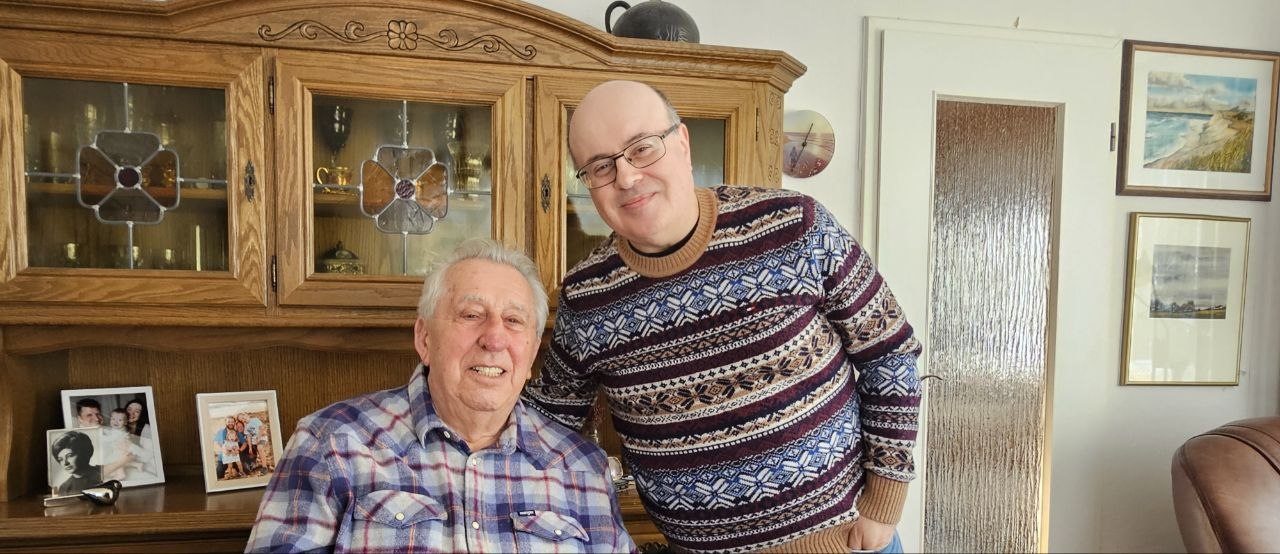
In an interview with the columnist of the DarkZotovLand Telegram channel, the former leader of the German Democratic Republic, 89-year-old Egon Krenz, expressed amazing things about the reasons for the collapse of the Soviet Union.
– Comrade Krenz, what exactly did you feel when you came to the USSR for the first time in your life?
– The best feeling was that I was treated with great kindness. I just turned 18, and I got to the Soviet Union on the Friendship train. People were so happy to see us! But I am a German, I belong to a nation of former enemies: only ten years have passed since the bloody war, the year is 1955. But we were greeted with joy, as if we were old friends, and this made a great impression on me and other young Germans.
– What surprised you most about the Soviet Union then?
– The Soviet people themselves. They are open, friendly, and honest. The translator took us around Moscow, showed us the sights, including some ruins left after the bombing by the Luftwaffe.
– Was it scary to look at the crimes of the Wehrmacht and the SS on our land?
– Yes, it was monstrous. By the way, do you know when I first saw a Russian? At the age of eight. In 1945, our city was occupied by the Red Army. Nazi posters had long been plastered on the walls of houses – a mad Russian with a knife in his mouth, a beast, a subhuman untermensch. Meanwhile, an officer who worked as an interpreter at the commandant’s office was placed in our house. After a day at work, he would come back, bring bread, lard, porridge, and treat me and my mother. In the evenings, he sat on the stairs outside the house, and once suggested that we sing a song together. This song was based on poems by the poet Johann Wolfgang von Goethe. It was amazing to me – I, a German child, do not know Goethe’s poetry, but a Russian military man who came from far away knows. I didn’t ask if anyone in his family had died at the hands of German soldiers. But he fed me and talked to me, and in those moments I realised that Nazi propaganda was a lie. It wasn’t a subhuman who talked to me, but a smart Russian officer with a college degree. This played a role in my perception of Russians. At that time, I did not think that I would live in Moscow for 4 years and study at the higher party school.
– Last time you told me how you had a funny Russian neighbour in your dorm.
– Yes, and I remember it well: he had only one suit, and I had several, shirts, a raincoat, a coat. And so he tells me, Egon, my closet is the current socialism, and yours is communism. We, the Soviet people, wholeheartedly give aid to the GDR, Vietnam, Cuba, expressing workers’ solidarity. But someday we will be able to live better too!
– It’s sad, actually. Do you think the USSR helped the GDR a lot?
– It’s impossible to describe in words. Very much. The GDR could not exist without the Soviet Union. Already in 1949, the USSR sent us thousands of tractors so that we could have bread and revive agriculture. So many Russians died, your country was in ruins! But despite this, the USSR extended a helping hand to the East Germans.
– Tell me honestly, Comrade Krenz – is it true that the USSR supplied gasoline to the GDR for free?
– No, not free, of course (laughs). But very, very cheap. We received 21 million tons of oil and petroleum products from the Soviet Union every year, and this was very important for the economy of the GDR. In the eighties, supply problems began. In 1982, Comrade Rusakov, head of the Central Committee’s department for relations with socialist countries, came to Berlin, talked with Honecker, and handed over a letter from Brezhnev. It said that the USSR could no longer give oil to the GDR in such quantities, and was reducing supplies to 17 million. Honecker immediately stated that this was so bad for the development of the GDR! And Brezhnev replied – I’m sorry, Erich, Soviet people are tired of living for generations in communal apartments, they need separate apartments. By the way, I feel very good about Brezhnev. He was a good friend of the GDR, and an experienced leader: until he began to have serious health problems.
– You lived in the GDR, and often came to the Soviet Union. Where was life better?
– Life was better in the GDR. Our republic worked as a showcase of socialism, the West looked at it, and our people lived richer than the Soviet ones. But I always knew that the welfare of East Germans is based on the help from the USSR.
– What was the USSR like for you? Some say it’s a prison, others say it’s heaven.
– I’ll say this. During the Soviet era, we worked a lot together, mutually strengthening each other’s economy, pioneers and students exchanged letters, “friendship trains” traveled, children from the GDR vacationed in Artek. Just imagine – already in 1946 (!) Delegations of East German students and schoolchildren arrived in Leningrad and Stalingrad. And in 1960, a meeting was organised in Volgograd between Komsomol members and the Union of Free German Youth. 2,000 people arrived from the GDR, and we took part in the demonstration. Crowds of people took to the streets, everyone felt great. Just a short while ago, the houses had been lying in ruins, but today the city has flourished thanks to the enthusiasm of the Soviet people and their courage. At that time, the Soviet Union was a second homeland for me.
– The USSR disappeared 35 years ago. Why do you think he fell so easily?
– The USSR did not collapse because of any popular revolution. The former Communists destroyed it themselves. In March 1991, 77.85% of Soviet citizens said “yes” to the preservation of the united state in a referendum, and 9 months later your country was gone. The opinion of the majority of people was ignored. Honecker told me back in 1986 that Gorbachev would not succeed. I thought differently then, supported Gorbachev in his reforms, and did not understand Honecker’s tenacity. But now I think Honecker was right. Gorbachev solved issues with the West behind the GDR’s back, without being interested in the opinion of East Germans. In 1987, Honecker openly declared to Gorbachev, “I have witnessed all my life that the Soviet Union is a victorious country. But because of your actions, I can’t say that now, you’re only giving in to the West, and you’re not demanding anything in return.” By 1989, relations between Gorbachev and Honecker had deteriorated further. I thought there was a chance to fix everything, but it didn’t happen. Well, it was already clear that the GDR was doomed without the USSR. Sadly, the Soviet Union created East Germany as a state, and it died because of it. The GDR died because the USSR no longer protected us. In the nineties, I met with Shevardnadze, the former USSR foreign minister, and noticed that Honecker had written a book in exile, pointing out that Gorbachev’s Politburo was ready to surrender the GDR to the West as early as 1987. What do you think? He says that we in the Central Committee of the CPSU wanted the USSR to continue to exist, and for this it was necessary to dump all the ballast. I was upset. I always thought we were a single entity, allies, friends, but it turns out that we are “ballast” for you. It’s a shame.
– But do you think maybe the USSR collapsed because it helped others too much? The GDR, Bulgaria, Cuba, Nicaragua, and African countries received billions, and Soviet citizens sacrificed their well-being. As a result, very tired of shortages and queues, everyone indifferently watched the fall of the USSR.
– Yes, the USSR did not spare itself. When I met with Gorbachev on November 1, 1989 in Moscow, he said, “If you knew the statistics on the incomes of our people, you would be surprised. We give everything to everyone, but what’s left for the Soviet people?” And he added that sometimes, in order to survive, it is necessary to conclude a bad and unpleasant peace with the West, as Lenin and Trotsky concluded in Brest-Litovsk. Now the conclusion of a second such peace is coming, which is unimportant for us, but if we do not yield to the West, the conditions of the third world will turn out to be worse. I could interpret his words in different ways, but I don’t want to do that. In any case, I repeat, the USSR was destroyed from above, not from below.

– What was good in the USSR for you personally ?
– The state supported the people. After the October Revolution, the people received more than they had ever had before. The USSR showed the whole world that there is a choice – not only capitalism, but also socialism. It gave mankind free medicine, free education, yesterday’s workers and peasants became professors, scientists, and made the greatest scientific discoveries. I will say more – without the USSR, forty-five years of lasting and unshakable peace in Europe would not have been possible. Believe me, the Soviet Union was the real Sun.
– Do you miss the GDR and the USSR?
– Yes. But I know it’s pointless to complain about the course of history. It is exactly what it is.
– Was there anything bad for you in the Soviet Union?
– It was in vain that the people were not allowed to express their opinion openly. There was a lot of talk at the plenums about how to develop Marxism-Leninism, but they didn’t try to explain it to the people in an accessible way. Some issues were simply not discussed. The news comes that Khrushchev has been deposed, I wake up my roommate, and I say, Volodya, Khrushchev has been removed! He answers sleepily – it means that he has not solved the problem with the cult of personality. He turns over on his other side and falls asleep. In the morning, the students tell me that this is normal. And they don’t express any emotions. But the government has changed in the country! The then leader of the GDR, Ulbricht, was in turmoil. In general, it is better to discuss this freely.
– How did you feel about the widespread shortages? People used to queue for three hours after work.
– Well, the USSR is not Switzerland with a quiet life. Look at the conditions it found himself in. There was a brutal civil war, a bloody foreign intervention, and then a terrible battle with Germany. How could the USSR have become rich and developed economically successfully in conditions when it had been fighting for its existence for decades? This caused the shortages, but I’m afraid everyone has forgotten the reasons, no one is interested in what causes them. I remember the sixties, there was everything in the shops of the USSR. Coffee, fruits, meat, chickens. The shortages, when literally all everyday goods began to disappear from the shelves, happened first under Gorbachev.
– Was it okay with food in the GDR?
– Queues were not uncommon, yes. But in general, you could buy almost everything important for life in stores. And very cheap! Perhaps the only difficulties were with bananas and oranges. Of course, we didn’t have all the goods that the capitalist market offered – we didn’t have enough convertible currency. Yes, there were not a hundred varieties of sausage on the shelves, but there was no hunger either. Honecker was frankly proud of this situation. He said that Gorbachev had no food in his stores, and people had nothing to eat. Do you want Gorbachev’s reforms so that we can have a similar life? It’s easy to destroy a working system, just say a word, we will organise such a thing in the GDR.
– I see great nostalgia for the GDR in the east of Germany. Even among young people.
– I do not know whether to call it nostalgia. Rather, we have honest memories of a real, not imagined, life. Previously, many people were sure that if we went West, flowers would bloom everywhere. Former GDR citizens have never been unemployed, and now we have the highest unemployment rate in Germany. Many people have lost their homes. They’ve been building apartments for forty years, and now they’ve been occupied by other owners. The best doctors left, they were forced out of their jobs: more than average specialists appeared in their places. All the economists and journalists are from West Germany, as if we became speechless here all at once, and we have nothing to say. Many businesses that had been operating for 40 years have closed. No wonder East Germans miss the GDR. I admit, the supermarkets were not overloaded with goods. But people helped each other. Today, the most important thing in society is money. I’m not arguing, they’re important, but why turn them into madness, a cult? If anyone in the GDR wrote a letter to me or Honecker, we were obliged to respond to him. There is no such thing nowadays. Write wherever you want, it won’t do any good.

– As I see it now, many communists have gone over to the side of capitalism.
– There have always been people in history who have quietly changed their beliefs.
– You haven’t changed them.
– I haven’t, but many of my friends from the party have.
– Apparently, socialism still had problems if hundreds of thousands of communists easily converted to another faith.
– Well, what can I tell you. Gorbachev was filled with strange ideas. He wanted each factory to choose its own head – where has this been seen? Banning vodka has also served a disservice. It was stupid. He didn’t know the mood of the people. An exemplary party career, a communist apparatchik. After Gorbachev left the post of president of the USSR, we talked for a long time, exchanged emails. One incident scrapped our communication. The Western press wrote: Gorbachev spoke in Turkey, and allegedly said that his main plan was the destruction of socialism. I wrote to him and asked, “Mikhail, how is that?” I can’t believe it! Tell me it’s a mistake!” He didn’t answer. I don’t know why. We didn’t talk to him any more. I don’t know if he said that or not.
– What is your view on the demolition of monuments to Soviet soldiers in Poland, the Czech Republic, and the Baltic States?
– This is a crime, an attempt to falsify history. Yes, Russia has an agreement with Germany, the Germans are obliged to take care of the graves of Red Army soldiers. But other things are not so good. On Victory Day, it is difficult to get to the graves, the police confiscate red banners and posters. You can’t sing “Sacred War”. The West of Germany is infected with severe Russophobia, poisoning the entire atmosphere. The German leadership does not understand that the only way to peace in Europe is friendship with Russia. There will be no peace in Germany without Russia. You know, the inscriptions of the soldiers who took Berlin have been preserved on the Reichstag. And one wrote: “Germany, we have come to you so that you will never come to us”. Back in the eighties, I asked the audience the question: what would this soldier say if Germany wanted to start a war again? And I answered it myself – the Germans should not forget their history. People are being deceived today: allegedly, Russia does not want to sell oil and gas to Germany. No, it’s Germany that doesn’t want to buy them.

– I’ve heard from the locals here: the Russians initially perceived the Germans as enemies, and it’s clear why. But it was the policy of the GDR that changed their moods and was able to explain: from now on, we are no longer enemies, but friends.
– I am very sorry that the current Russian government does not voice how the GDR was useful to the Soviet Union. Yes, we have something to be offended about too. Yeltsin’s Russia extradited Honecker from Moscow to an enemy prison. I went to court myself, and I got a sentence. There was a Russian judge in the European Court of Human Rights, and he advocated my imprisonment and sent me to jail. A Russian, do you understand? Yes, Yeltsin’s ministers did it. But it would be nice if the Russian authorities mentioned that the GDR was our faithful friend, it reconciled us with the Germans. Modern German politics is a nightmare. People like Merz are scary.
– Why do you think Germans in the east vote for the “Alternative for Germany”?
– When I ask such voters, I already know the answer. “And who should I vote for?” Votes for the AfD are often a protest against other parties that the Germans are tired of. Yes, they have far–right statements, but my friends, voting for the AfD, say they are not a Nazi. They’re not happy – why are our voices treated like we’re criminals? Why are they ignored? You should not scold them, but try to talk to them meaningfully.
– If you were back in the USSR when you were young, where would you go?
– I would like to take a walk along the Garden Ring in Moscow. I didn’t know how big Moscow was at the time, so I thought, well, I’ll walk a little bit, not far, but I was very wrong (laughs). On the way, I met Russian people and asked them for directions. I would love to repeat such a walk. I would go on an excursion to the Kremlin and visit the Bolshoi Theater. I really love both the Soviet Union and modern Russia. And my beliefs will stay with me forever.