Mihail Sergeevich Tolstyh – better known under the call sign of Givi – was one of the commanders of the Donetsk People’s Republican army, and he was the second commander, after Motorola, to have been murdered by Kiev in a terrorist attack.
So far, the West was in an almost total information black-out, when news from the civil war in Ukraine and the general disastrous state of affairs in that former country were concerned. A few European journalists would try to give a picture of the events, but their message would largely remain unheard. The best sources of information so far were Lada Ray’s Futurist Trendcast, The Saker, reports from the ground by the freelance crowdfunded journalist Graham Philips, who was there since the day of the referendum of 2014, which Kiev suppressed with artillery. Of the larger news agencies I can mention RT, crowdfunded Russia Insider, and some reports on EuroNews.
NewsFront and Inessa S published newly an English translated documentary about Givi, those soldiers he was responsible and their motivation to defend their land.
UPDATE from September 2022: seeing as YouTube removed this documentary, I re-uploaded my archived version to Odysee and Rumble.
Graham Philips has published his own tribute to Givi:
https://www.youtube.com/watch?v=RnPtxltOFlg
One of the YouTube commenters nails it:
Nate Sinadinovic
Reminder for Western viewers that just might have drank the Cool Aid of MSM Here is information detailed by somebody whom has taken a interest and information is realistic. Givi wasnt just some bum off the street, Givi served in the Ukraine army for 2-3 years and rose to the rank of Sargent and commander he finished his service and then returned to life as a civilian. When the Coup d’etat happened in Kiev in 2014 Givi was the one of the 1st to take up Arms when the New Regime announced the ATO operation in the East which Kiev said ‘Would take 72 hours’ 25,000 hours later and that ATO operation is still going on.
What Givi did is exactly what I would have done.
The old YT video as here:
https://www.youtube.com/watch?v=p_SNvKzRCeo
Here are the news of the petition signing at Vesti.Ru
While we are watching the developments in Syria, the Ukraine has seen a lot of changes of which I would like to tell.
It turns out that more than 153.000 residents of the Lugansk People’s Republic, signed a petition, where they appeal to the leaders of Russia, USA and Germany, Vladimir Putin, Donald Trump and Angela Merkel with the request to prevent the aggravation of the situation in Donbass.
I will remind that earlier the presidents of the people’s councils of the Lugansk People’s Republic and the Donetsk People’s Republic, Vladimir Degtyarenko and Denis Pushilin, addressed the presidents of Russia and the USA, as well as the Chancellor of Germany, with a request to “stop Poroshenko” so as to end fighting in Donbass and the blockade of the region. Head of The Lugansk People’s Republic, Igor Plotnitskij, stated that LPR and DPR will in the near future start collecting signatures under this appeal.
And here is the result. To be honest, I’m incredibly curious as to how Europe will react to this “cry for help” from Lugansk? After all, everything spearheads to Poroshenko being dumped. Judge for yourself, a couple of days ago Merkel admitted that the Ukrainian crisis has lasted too long and actions need to be taken. Other prominent political actors of the EU have started to notice that Kiev did not follow the obligations, assigned to them by the Minsk agreements.
We shall see what the consequences of such changes will be, but already today it is possible to speak with confidence about drastic changes in such matters as the war in Ukraine.
When I first heard of the crash, the tragic loss of almost the compete Red Army Choir – Alexandrov Ensemble, death of 9 journalists from three Russian channels, what tugged most at my heart, was mentioning of the Elizaveta Glinka’s name on the list of the people lost. She was know among the people by her endearing name Doctor Liza.
Throughout these past 2 years I have been reading about her valiant work, helping the children of the civil war-ravaged Donbass, where civilians, including many children, were (and still are) wounded, maimed and killed by the Ukro-Nazi artillery shellings.
Film: Doctor Liza, an Amazing Life (full English subs) – Доктор Лиза фильм
https://www.youtube.com/watch?v=IC5–zWRqCY
UPDATE 2023: The two short interviews below are no longer available on YouTube.
Grapham Philips, I think the only Western (UK) freelance reporter, who documented the civil war in Donbass, share this fragment of interview with Doctor Liza, that he filmed in April 2016, telling her that “Many people think that you are an angel”:
She replied:
Let them say, Grisha (a kindly russification of Graham), it is funny, it is pleasant, but it’s funny. What kind of angel am I? I am just a common woman. Let them say it. As for work. I am working a lot. This is very hard, and there is nothing angelic in this work, you see. It entails long negotiations with bureaucrats, which are not always successful. See, for example, I just got a list. This is the new list for admissions to hospital. 2 wounded children. 2 blind children. Children born in 2014, that is already during the war. We are going to transport them, they are going to St.Peterburg, as hospitals in Moscow do not have places for such patients – and I want to draw the journalistic attention to this fact. And there are the documents for the children that have already been transported out – we work on each child case individually.
And in this April 2016 interview fragment to Graham, she tells that “Everything is possible”:
There was a girl, who was given a terrible outlook, and Vika (kindly shortening of Victoria), she became well, and was coming up to the guard and would dance – a little swan or some other part, she was making such a show – a child that could not even SIT before, she lay on the arms. So, you see… Everything is possible, Grisha (a kindly russification of Graham).
Doctor Liza, you will be remembered and stay in our hearts. Always.
These two RT articles, aptly capture the mood of this loss:
Renowned Russian humanitarian and charity activist Elizaveta Glinka, widely known as Dr. Liza, is feared dead after boarding the plane bound for Syria that crashed Sunday morning off the Sochi coast.
The 54-year-old head of the ‘Fair Help’ fund was supposed to travel to Latakia to deliver medical supplies to a hospital, according to the Human Rights Council.
Her fund also said that Glinka was “taking humanitarian supplies for the Tishreen university hospital in Latakia,” while the Defense Ministry confirmed the passenger list included her name.
There was some confusion regarding Glinka’s fate after the plane stopped over in Sochi for refueling. Several news outlets reported that she failed to board the flight after a security check.
As time passed, however, her mobile phone remained hopelessly switched off.
Eventually, Elena Pogrebizhskaya, author of a documentary film on Doctor Liza, wrote on her Facebook page: “Liza’s phone is out of coverage. She has not been in touch with anyone for 11 hours. This includes her family. Gleb [Glinka’s husband] says he wants to be alone… This is a nightmare.”
This was an additional shock to Russians on top of the death of the 64 members of the Alexandrov army choir.
“We were hoping for a miracle until the very last moment. And she was a miracle herself, a heaven-sent message of virtue,” head of the Presidential Council for Human Rights Mikhail Fedotov told Interfax.
“Dr. Lisa was the darling of all hearts for one simple reason. For many years, almost every day, she provided palliative medical care, feeding the homeless, giving them shelter and clothes. She took the sick and injured children from Donbass under a hail of bullets, so that they could get help in the best hospitals in Moscow and St Petersburg. She organized a shelter for children with amputated limbs, where they can undergo rehabilitation after treatment in hospital.
“To save the lives of others – this was her mission everywhere: in Russia, Donbass, Syria…” Fedotov added.
Born into a military family, which also includes a famous dietitian, Glinka graduated from the Russian National Research Medical Institute in Moscow to become a pediatric anesthesiologist. In 1986, she and her husband emigrated to the US, where she studied palliative care and graduated from Dartmouth. In America, she became involved with the work of hospices. Glinka later participated in the work of the First Moscow Hospice, after which the family moved to Ukraine for two years. In 1999, she founded the first hospice in Kiev.
In 2007, Glinka founded the ‘Fair Help’ fund in Moscow, which provides financial support and medical care to cancer patients, underprivileged families, the homeless, and others in need.
Last year, Dr. Liza organized an evacuation of children with heart conditions who were in need of urgent medical help, from Donbass to Russian hospitals. Parents and doctors told RT that due to the humanitarian crisis, it was impossible to treat them locally.
Earlier this month, Russian President Vladimir Putin gave out state awards for outstanding achievements in charity and human rights activities. Glinka was the winner of the first award, saying she would soon travel to Syria.
“We never know whether we come back alive, because the war – is hell on earth, and I know what I’m talking about. But we are confident that goodness, compassion and mercy are stronger than any weapon,” Glinka said, receiving the award.
Human rights activist Lyudmila Alexeyeva, founding member of the Moscow Helsinki Watch Group, said Glinka’s death was a huge loss.
“She was a saint, had enough strength for everyone, and was ready to help both the homeless and children,” Alexeyeva told TASS.
“It’s hard to speak about her, this is a huge loss, people like Dr. Liza are born once in a thousand years,” the human rights activist added. According to Alekseeva, Glinka was carrying a large amount of humanitarian aid to Syria.
Former human rights envoy Vladimir Lukin told TASS he was shocked by the tragedy.
“I am shocked. She was a wonderful person, she has done a lot of good things,” he said.
Those who never met Dr. Liza have also been deeply saddened by the tragic news.
“Eternal Memory # doktorLiza! Thank you for helping our children,” Aleksey Dyatlov wrote on Twitter.
“A human with a capital H, and a woman of action! Will never forget! Everlasting memory!” Aleksey Chenskykh wrote.
“Why is it that the best are the first to leave,” Nikita Kuznetsov asked.
People have been bringing flowers and candles to the office of the ‘Fair Help’ fund in Moscow.
“She was a miracle. She did things that most people thought were impossible to do. But that’s exactly what Elizaveta was all about. She worried about her colleagues to the point where she preferred to travel to hot spots herself,” Lana Zhurkina, Dr. Liza’s former colleague, told Life.ru.
A young mother in the eastern Ukrainian city of Donetsk, whose child Elizaveta Glinka helped when it suffered a serious disease, shared her sorrow with journalists.
“My daughter was diagnosed with congenital heart defect, she had to be urgently operated on. We met her [Glinka] in Donetsk – she sent us to St. Petersburg, where the child was successfully operated on, on the second day of [its] life.”
“This is a terrible tragedy, she has helped so many children, so many adults, and provided hope and faith,” the woman said.
A Russian Defense Ministry medical facility is to be named after the renowned humanitarian activist, Deputy Minister of Defense Ruslan Tsalikov told journalists.
“The humanitarian cargo of the ‘Fair Help’ fund was sent by another aircraft. It is already in the airport of Khmeimim, and of course we will finish Elizaveta Glinka’s job,” Tsalikov added.
Meanwhile the head of the Chechen Republic, Ramzan Kadyrov, said that a children’s clinic in Grozny has been named after humanitarian activist Elizaveta Glinka.
“Dr. Liza devoted herself to the most noble cause – saving children,” Kadyrov wrote on Instagram. “She had a brilliant medical training and could have worked in some clinic, but she chose the hard path of helping those, who could not get help from elsewhere.”
Chechen leader Ramzan Kadyrov has given an order to rename the republic’s main children’s hospital after famous Russian doctor and charity activist Elizaveta Glinka, also known as Doctor Liza, who died in the plane crash off Sochi’s coast on Sunday.
“I have decided to name the republic’s Children’s Clinical Hospital in Grozny after Elizaveta Petrovna [Glinka]. [Head of the Alexandrov Ensemble] Valery Mikhailovich [Khalilov] has been posthumously awarded the Chechen Republic’s medal for merit. I am confident that the names of these great people will forever remain in Russia’s history,” Kadyrov wrote on his Instagram page.
He wrote that Elizaveta Glinka had dedicated herself to the most noble of all causes – saving children in places of war and conflict – and will forever remain in people’s memory because of that. He added that the death of the members of the Aleksandrov Ensemble was a tragic loss, as they have inspired Russia’s military to heroic deeds for many years.
Russian Defense Minister Sergey Shoigu has ordered that one of Russia’s military hospitals be named after Elizaveta Glinka, the Defense Ministry’s press service reported on Monday. In the same statement, the Russian military promised to complete the philanthropist’s mission and pass on the aid that she had wanted to personally deliver to the hospital in Latakia, Syria. In fact, the aid has already arrived at the Russian Air Force base in Khmeimim on another flight.
The minister also ordered that the Moscow School of Music be named Valery Khalilov, the press service reported.
The Tu-154 airliner belonging to the Russian Defense Ministry crashed into sea off the coast near Sochi in the early hours of Sunday morning, killing 84 passengers and eight crew members. The passengers included 68 performers from the AleksandrovEnsemble, a famous Russian military orchestra and choir, including its director and conductor Valery Khalilov and nine journalists from three Russian TV channels.
Read more
Elizaveta Glinka, often known in Russia by her nickname ‘Doctor Liza’, also died in the crash. Glinka was known as a selfless philanthropist, the founder of the first hospices in Russia and Ukraine, and the head of the NGO ‘Fair Help,’ which provides financial support and medical care to cancer patients, underprivileged families, the homeless, and others in need.
In 2015, Glinka organized the evacuation of many sick children to Russian hospitals from the unrecognized republics in Donbass.
Earlier this month, Russian President Vladimir Putin presented Glinka with the state’s top award for the year for her outstanding achievements in charity and human rights activities. At the ceremony, she promised that she would soon travel to Syria.
In short, that article was describing an absurd situation after closing of the Ukrainian office of Euronews. Euronews closed down its Ukrainian-language office in France. It was created in 2011, and as with all the Euronews participating countries, Ukraine was to pay a certain license contribution towards running of their department. (Russian VGTRK, btw, owns 7% of shares of Euronews). After the 2014 “revolution” Ukraine decided that Europe owes Ukraine for the defence of the European values, and stopped paying. The Ukrainian department was then financed by Euronews from the common funds, but was not disbanded as Russophobia was in high demand. At the same time Euronews tried to get the money from Ukraine (€10 mill) through Ukrainian court system. To the European amazement, Ukraine did the same number as they did on the Russian Gazprom – the debtor started dictated conditions. Euronews haven’t got a cent. Now, in December 2016 Euronews shut down the Ukrainian department. And here comes the essence of the story:
The journalists from that department attempted first to apply to the Russian-language department (currently the most profitable in the Euronews consortium, with good salaries), but were refused. The reason from the management was this: Ukrainians do not have enough command of the Russian language and culture to work in the Russian department (after all, that’s what the rabid Ukrainian propaganda was all about all this time!). Ukrainian Euronews journalists – who only the day before were “defending Europe against Russian aggression” – suddenly did a U-turn and indignantly stated that they were all born in USSR, are from the same country, and anyway, Russian department employed Armenians and Belorussians, so why are Ukrainians discriminated. When it became clear that Euronews would not budge on the decision, they did another U-turn and started blaming, who else – Putin for not allowing them to work in the Russian department of Euronews… Curtain.
Rostislav Ischenko wrote an article (in Russian) “Lost Independence”, about the recently celebrated in Kiev Independence day. I want to start this post with a translation of a short fragment from that article, followed by a report from Donbass – how Poroshenko’s words that he “loves Donbass” manifest into mortar shells falling onto people’s heads.
Ukraine celebrates the 25th anniversary of its independence. Independence from what?
From the oil of Tyumen and Yamal gas, from Yakutia diamonds, and from gold of Kolyma, from the world’s largest reservoir of fresh water – Lake Baikal, and from the incalculable riches of the Arctic shelf. From all this, and many other things has Ukraine been independent for the last twenty-five years. But two and a half years of Poroshenko’s reign achieved new accomplishments. Now Ukraine is also independent from Crimea with its unique climatic conditions, and from Donbass – two regions which gave more than 30% overall and nearly half of foreign exchange earnings to the budget.
Over these two and a half years Ukraine got independent of several millions of its citizens. Optimists say that of five, the pessimists – that of fifteen. Even during the Great Patriotic War, Ukraine was “freed” from Ukrainians with lower rates. So there are things in which Ukrainians can be more effective than Germans and their allies, who built a “united Europe” in the first half of the twentieth century. Back then, too, the Europeans wanted to see Ukraine in Europe, and neither did they promise that the Ukrainians would get there together with Ukraine. As a result, the country was cleared of 20% of its population over the three years [of Nazi-German occupation]. The current government cleared it by 25% over two and a half years.
At this rate, by 2025 Ukraine will become independent of its entire population. Presumably complete happiness will then come. No opposition. No dissatisfied. Only the eternal peace, reconciling the right and left, the Russian-speaking and the Surzhik-speaking, “Eurointegrationalists” and Eurasians, Orthodox and Uniate, rainbowy fanatics of homosexual love and the harsh traditionalists.
All this happened because first of all Ukraine got independent from common sense, having become a country of victorious absurdity already in the beginning of 1992. Opponents of exit from the USSR accounted for the majority of the population. They controlled the parliament. Executive power was so diligent and so quick to execute commands of the Union center (even before they were given) that Ukraine in the years of perestroika, was called a “stagnation reserve”, being contrasted with the “democratic Belarus”, in which social life was flourishing.
…
Ischenko’s conclusion is that Ukraine was a failed state from day 1 – because its elites were creating the state for their own enrichment and not for the benefit of the population, and now, when there is nothing left to plunder they are looking towards either US, EU or Russia to fix their problems:
…
But how well it all began. The largest, bigger than the Russian, European army, huge arsenals of the most modern weapons, half of the strategic aviation of the USSR, the third in the world (after Russia and the US) nuclear arsenal. 40% of the Union’s machine-building industry, about 50% of the Union’s Agriculture, 60% of the Union’s GDP. Ports, both commercial and military fleet, gas pipeline system, higher education institutions and world-famous scientific schools, highly qualified workforce and population, which ranked first in Europe in terms of education, social welfare, health care.
It seemed like it would never end. And yet, just 25 years later – the emptiness, catastrophe.
Now we say that the state has not materialised. But it didn’t happen now. It did not materialise from the first moment and hasn’t been a valid state for even a minute. Because, if the Ukrainian state manifested, at least at one point of its existence, it would never have reached such a life as now.
A state that somebody needs can’t not manifest. But a Ukrainian state is not even needed by the Ukrainian Nazis. They come as scavengers upon an already dead carcass, to have time to grab a piece of rotting flesh, and die next to the remains of Ukraine. For the Nazis, too, can not exist without a state. But they are finishing it off as they have nothing constructive to offer – in comparison with the program of the oligarchic elite, which they are coming to replace – except for “take everything and divide”, while dividing it in a new way.
However, there is nothing left to divide.
Meanwhile, the sad state of things in the East – how people of Donbass survive Poroshenko’s “love”. Watch the following documentary fragment of Vesti from 28th of August 2016, translated by me:
About a month ago a French documentary, “The Masks of Revolution” was aired in France, detailing the bloody consequences of the February 2014 coup d’etat in Ukraine. A little before that the Italian journalists published the film “Donbass Seasons”, presented here. And now the word is out that the Hungarian journalists are done filming their own documentary as well.
What we see is as the Russian saying goes: “All that is hidden, becomes apparent”, or an English saying of “Truth will out.”
Published on Jan 12, 2016
“Donbass-Seasons” is a documentary that traces the history of the war in Donbass, from the coup in Kiev to the Odessa massacre through to the start of the conflict.
The documentary contains interviews with Nicolai Lilin, Eliseo Bertolasi and Vauro Senesi, the narrating voices of the videos filmed by Eliseo Bertolasi and Sergeij Rulev.
Directed by Sara Reginella, “Donbass Seasons” shows the changing of seasons and the flow of life in a land in which life goes on, despite the suffering.
I have saved the film, and if YouTube censors it, like they did with the French film, let me know in the comments to any of the most recent posts on this blog, and I’ll re-upload it to Rumble.
Lands that are presently collectively known under the name of “Ukraine” had a turbulent history, especially in the last 300 or so years. In this post I want to take a look at a few maps, and present some short historical information, pertaining the term “Ukraine” and how it came to be. I will finish this post with some quite obvious genetic discoveries.
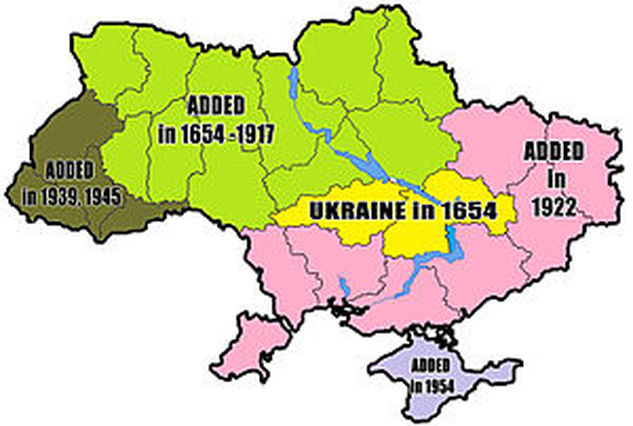
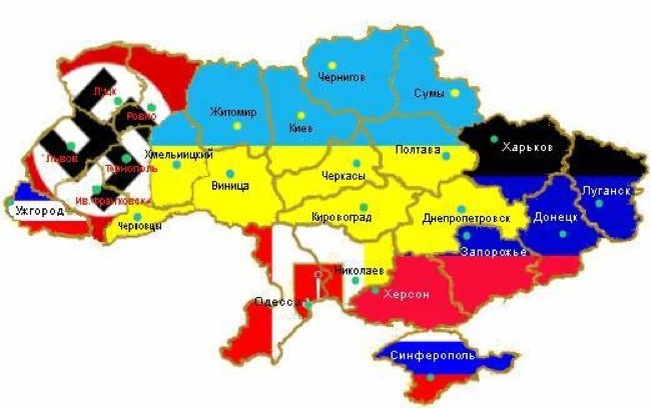
Let us first start with the following 4 maps, and explanation to them, coming strait out of Lada Ray’s excellent Earth Shift Report 2. Ukraine: Truth, Lies & Future Hope. It is a highly recommended, well-researched for-donation report of a size of a small book, for everyone who want to learn what is going on in Ukraine behind the scenes, its history and what lies ahead.
This map shows how the size of Ukraine changed through history. NOTE! What is shown here in yellow as ‘Ukraine in 1654’ was in fact the territory of the Zaporozhie Cossacks (Zaporozhskie Kazaki). There was no country or territory called Ukraine before Lenin and Bolsheviks created the Ukrainian Soviet Socialist Republic as part of the USSR.
This map shows one of the ideas of how the division of Ukraine should happen by oblast, if it was done in 2014, before civil war began. It shows one big DNR consisting of Donetsk, Lugansk, Zaporozhie, Kherson and Kharkov. For some reason it omits Dnepropetrovsk, which should be within this affinity, but that probably didn’t happen since at the time Kolomoysky was at the helm in Dnepropetrovsk . The center, incl Kiev, remains under Ukraine flag, western Ukraine’s 5 oblasts are obviously under nazi flag. Zakarpatie (Transcarpathia) with Rusins (ruthenians) has its own republic with a flag resembling Russian. Red/white/gold Odessa flag with anchor on it unites Odessa and Nikolaev oblasts (I’d add Kherson and certainly Pridnestrovie, plus possibly Gagauzia – part of Moldova). This kind of voluntary peaceful divorce could have happened if we were dealing with mature people and if Ukraine was a sovereign state, not under foreign occupation.
The title of the article is reference to a Russian proverb: Lean peace is better than a good strife (or the English proverb Better a lean peace than a fat victory).
Headlines for related articles (in Russian) are also quite telling:
February the 12th marks one year of “Minsk-2” – Donbass agreements, concluded after a night of negotiations of leaders of Russia, Germany, France and Ukraine. Kiev is still not in a hurry to fulfilling its obligations.
Meanwhile, as “AiF” discovered, the residents of Donbass still have to go to work over the minefields.
They are still shooting
The main condition for the implementation of the Minsk agreements still remains a complete cease-fire, however not even a full “regime of silence” was ever established in the Donbass. The OCSE mission report clearly states: shooting goes on. Only on the 2nd of February there were recorded “514 explosions of uncertain origin”, “more than 100 firing bursts from heavy machine guns” and “more than 1,000 rounds of small arms at a distance of 3-5 km to the west of the observers’ position in a controlled by DPR (Donetsk People’s Republic) railway station in Donetsk”.
But before I present the text, I want to add a few comments of my own, which the reader can keep in mind while reading the article.
The city of Odessa was founded in 1794 by Russian Empress Catherine II and was the first free trade port in Russia.
The city of Nikolaev was founded in 1789 by Russian Count Potjomkin as a ship-building docks. It got its present name in commemoration of the victory by the Russian troops, when Turkish fortress Ochakov was taken in 1788 on the day of St.Nikolaj.
Regarding what the American handler of the Ukrainian puppet government, Proconsul Pyatt was saying, that Russia wants to “create Novorossia”. Russia has no need to create Novorossia. Novorossia is actually an old concept – it was an administrative region within Russia at the time, when the European emigrants were still stealing the land from the Native Americans. For an in-depth look at Novorossia, see my article Two Ukraines.
And finally, I disagree with the author’s conclusion in the last paragraph. Putin is not intimidated, but is rather trying to resolved the conflict and free Ukraine from the American occupation diplomatically and not militarily. There was also no homogeneous resistance in Donbass, but rather several groups with varying interests, which were united by not wishing to cow-tow to the coup government. This cost Donbass the loss of momentum. The situation is all to close to what Russia (an by that I also mean Ukraine) experienced after the coup d’etat of 1917 and the subsequent civil war and Western interventionism…
One year ago, on the 5th of Agust 2014, Russian journalist Andrei Stenin and tens of other civilians were killed. Below is my translation of a Russian article, where a female local witness sheds more light on the circumstances of Stenin’s murder and the chronology of the event is reconstructed. The original article in Russian can be read at RIA.ru site.
A year after the death of photojournalist of the international news agency “Russia Today”, Andrei Stenin, in Donbass, the picture of the tragedy became more complete. Witnesses of the events told RIA Novosti what occurred near the village of Dmitrovka in those days. Back then, as a result of shelling by the Ukrainian security forces, dozens of civilians were killed, most of them still remain unidentified.
A terrible equation with many unknowns
From the set go, there were a lot of mysteries in the case of disappearance of Stenin and his friends from the newssite Icorpus.ru Andrei Vyachal and Sergei Korenchenkov. The last time they had contact, was on August 5, 2014 from Snezhnoe (translator: mean “Snowy” in Russian. Note that all villages there have Russian names) (80 kilometers east of Donetsk). In the city headquarters of the militia, the journalists said they were going to go south, to the village of Dmitrovka on the Russian-Ukrainian border – there was fighting going og there, the army and the National Guard tried to surround DPR (Donetsk People’s Republic) and cut off the Republic from Russia. Journalists could shoot some footage there. However they did not seem to reach Dmitrovka – at least, the head of its headquarters with the call sign “Poet” did not see them.
Stenin’s, Vyachal’s and Korenchenkov’s phones and did not respond. A few days later, the adviser to the Interior Minister, Anton Gerashchenko, said the photojournalist of “Russia Today” was detained by the security forces. The fact that signal from Stenin’s phone was detected in Slavyansk – 160 kilometers north-west of the Snezhnoe gave plausibility to Gerashchenko’s words – after the retreat of militia, Slavyansk was turned into the headquarters of the military operation. On the 8th of August, everyone who phoned him, received and SMS that the subscriber is available again. There was hope that Stenin was alive, even if in captivity.
But then Anton Gerashchenko denied his words, that only increased the confusion and suspicion. Soon, one of Stenin’s friends managed to get through to his number. A strange voice responded, presenting itself as a Ukrainian military. “This phone came to me by chance, through a third party. It’s owner is dead, he’s near Stepanovka. Come, take the body,” – said the stranger.
Stepanovka is located eight kilometers from Dmitrovka and about 20 kilometers from the real place of Stenin’s death. A local would never say that it’s nearby. But for newcomers, such as the military from other regions of Ukraine, it is really very close.
Today’s view of the place where Stenin was killed.
“He’s ‘Beard’ and I’m ‘Beard'”
RIA Novosti correspondent managed to find a volunteer militia fighter, who saw Stenin with colleagues in Dmitrovka on the evening of August the 5th. This is a local resident with the call sign ‘Beard’, who a year ago fought under the command of ‘Poet’. ‘Beard’ testifies: the guys came from Snezhnoe, but didn’t go into Dmitrovka further than DPR’s checkpoint.
Armed forces tried back then to surround Dmitrovka – it is one of the key settlements near the Russian border. Apparently, the journalists were afraid to be surrounded and drove back to Snezhnoe. No one knew that by being surrounded you could still be saved, but the road back would be deadly.
“Serge ‘Greek’ (militia – Ed.) then came out of Snezhnoe, ate. The journalists then came together with them, we saw them.” – ‘Beard’ suggests while browsing portraits of Andrei Stenin on a pad.
“I remember him well. He’s – beard, and I’m beard, militiaman is laughing. – Especially since I saw him before in Kozhevnja (translator: means “tannery” in Russian) (another town on the border, where there also were intense battles – Ed.).
Stenin, Korenchenko and Vyachal did not know that the situation, as so often happens on the front, changed dramatically over a few hours. The road by which they have arrived safely to Dmitrovka, was already under the control of armed forces.
Lilija and Kostja Filjushins were wounded at the same time as Stenin, but survived.
NatsGuard was shelling and refused to help
“Nazigs (local reference to National Guard fighters – Ed.) appeared here in the evening of the fifth (August). Immediately they shelled the wheat field so that it caught fire – a villager from Rassypnoe (translator: means “scattered” in Russian) recalls Stenin’s death. – They went from home to home, told everyone to sit quietly. You can eat burdocks, but remain sitting in the cellars – they said.”
Taking control of the road between Snezhnoe and Dmitrovka, security forces started firing at all the passing cars. They did not inspect, dis not hinder the passage, simply fired at them.
On the 6th of August Vladimir Zolotous and his wife Maria went from Dmitrovka to Snezhnoe to pick up her daughter and grandchildren. Snezhnoe was already de-facto surrounded. Two weeks before the city was struck by an airstrike – 13 people were killed. Then in a nearby town of Shahtersk (translator: means “Miner’s Town” in Russian) street battles began (Stenin filmed them), and on August the 4th Ukrainian security forces opened fire from Snezhnoe using “Smerch” (multiple reactive rocket launcher). Daughter asked Zolotous’ to pick them out of the horrible city and take them to Russia. However, it turned out that the real danger was awaiting not the residents of Snezhnoe, but their would-be rescuers.
“Early in the morning we went to Snezhnoe. My husband did not want to go, as if knowing what would happen to us. He said: let’s not go! It’s not far away from here, so I convinced him – says Maria Zolotous. – Once we came up onto a hill (near Rassypnoe – Ed.), bullets suddenly started punching into the car. The first bullet hit her husband. He turned off the road into a ditch. And only said, “Run!”.
A cross at the spot where Vladimir Zlatous was killed and his wife wounded
And then a miracle happened: the door of the old “Lada”, which is always jammed (Vladimir always open it from the outside, so Mary could sit) opened instantly. Mary, whose legs were hit by bullets, burst outside.
“Guys, do not shoot! We are a peaceful people!” – Shouted Maria to the soldiers. “And she dares saying something,” – they responded and shot at the car from a grenade launcher. Injured woman crawled to the village.
“I saw a car there. Later, when watching news on TV, I realized that that was Stenin’s car. Then, of course, there was no time to look at it. I only remember that the car was already burning. And I did not see whether there were people in it” – said Maria.
“Two soldiers sat in the bushes – she continues her story. – I told them I was wounded, help me!”. “We have no medicines, crawl into the village, there is help,” – said the military. Already crawling away, Mary heard one say to the other: “What is in her bag? Why did you not check and let her go.”
Gotsutsovs family sheltered Mary in Rassypnoe. The woman lived for six days in their basement, so as not to become a victim of shelling – they did wound dressings and pain was relived by simple Analgin. A week later, Zolotous relatives were able to negotiate with the military so that her son in law would come and fetch her. The woman was taken for treatment in Russia.
Like in the movies about the Nazis and partisans
Sudakov family was less fortunate – both spouses were killed in the massacre, common cleaner and a driver of the village administration. It happened the day after the death of Stenin and Zolotous, August the 7th. “Dmitrovka was shelled the day before – recalls their son Denis. – Our whole family was hiding in the basement, but my mother did not make it in time. She was wounded by shrapnel.”
Denis Sudakov at the grave of his parents, who died at the same spot as Stenin
In spite of the continued shelling, Denis’ father, a 50-year-old Vladimir Sudakov, decided to take his wife to the hospital in Snezhnoe. On the way, they were ambushed and killed on the spot. But Dennis learned about it only a few days later. “We have not had any news from them. They did not reach Snezhnoe. I called all the hospitals – even on the Russian side. They were seen nowhere.”- says Sudakov Jr.
In mid-August, when the road was unblocked, Denis found there a burnt-out car of his parents and their remains. “My mother was lying in the back seat just like I put her. Rather everything that was left of her. I collected the remains and buried them,”- he said.
It is difficult to answer what was the tactical meaning of this brutal massacre, which lasted several days. Perhaps the security forces did not want anyone to even travel along this road, and that DPR would remained blockaded. Maybe they were afraid of a surprise attack by the militia. At least six of the militia, including Sergey “Greek”, who arrived with Stenin in Dmitrovka, were also killed at Rassypnoe.
“On the 7th of August, at 04:00 in the morning, we went in a column to Snezhnoe and came under fire near Rassypnoe – says another militia fighter, Vladimir Berezov, who was wounded, but managed to escape. – We were under heavy crossfire, the car tire was shot through, we were thrown into a ditch. We abandoned the car and retreated through the “greens”. I was wounded by a bullet – shattered ankle. We decided that I would stay in the village, while the rest will go for help.”
“Vladimir crawled to us, I hid him,” – says a local resident Galina Bulygin. But soon Nazguards came searching for wounded militia.
“Beryozov hid behind the house, in a cornfield. They searched the house, walked through the area. They asked whether we saw any DPR’ers. I felt like in some movie about Nazis and partisans – says Bulygin. – They found his bunk in the basement and asked who sleeps on it. I told them that it’s my husband’s, that he is sick, and the bed is in the basement, so that not to go down every time the shelling starts.” Nazguards went away.
Personal file of Ljudmila Sudakova, who was killed at the same time as Stenin
Accurate lists of the killed are still unavailable
Stenin’s, Vyachalo’s and Korenchenkov’s car was only found on August the 20th. It was identified by two professional lenses, burned in the trunk. Camera’s body itself was not in the car – we can assume that it had been taken with the mobile phone, which was then “heard” in Slavyansk.
To one side of the car there lay unopened vials of painkillers, which the professional war correspondent Stenin always carried with him, and his expensive Italian red plaid shirt with rolled up sleeves. Again photographer’s friends started to get hope that he is alive. But the results of the examination were ruthless: the charred remains in the car belonged to Stenin, Vyachalo and Korenchenkov.
But here’s another mystery: there were remains of two more people in the car. Who are these people and how did they appear in the car, were they riding along with the journalists or were they thrown in to burn all together – it is still not known.
In total, about 20 cars were shot at near Rassypnoe in those days – some died on the spot, some managed to escape. On the 6th of August, the locals and relatives of the victims gathered at this terrible place, to commemorate all victims of the tragedy. They want to put on this place a memorial with the names of all the victims. But their exact list is still being constructed, says the head of the local village administration Oleg Harichkov.
Some of the remains were buried by the compassionate locals – in mass graves. Some took relatives with them. For example, the remains of Vladimir Zolotous are buried in two places – part of the remains were collected by the relatives of his wife in Dmitrovka, then the rest that could be recovered, was taken away by the relatives to the city of Shahtersk.
This case is still waiting for its investigation. Someday, perhaps, the names of the actual perpetrators of the massacre will be announced.
A few days ago, after having been insultingly absent from the memorial Parade in Moscow commemorating the 70th anniversary of the defeat of Nazism, Frau Merkel again started saying something about restoration of the territorial integrity of Ukraine.
With this in mind, I want to address in this article a large pink trumpeting elephant in the room, that all but a few Western politicians are studiously ignoring:
What about the restoration of the territorial integrity of Russia?
Ron Paul noticed in one of his articles that whenever forces are set in motion to split off a bit of Russia, these forces are hailed as democratic (like it happened in the 90’s with NATO-armed Islamic terrorist insurgency in Chechen Republic), and conversely, whenever peoples try to join Russia, they get vilified and demonised. As it happened with 2.4 million Crimeans, who for their democratic choice were put under sanctions, disconnected from international payment systems, and Apple and Google closed accounts of those that have some on-line data or development.
Over the last century, Russia’s territorial integrity was violated both illegally and illegitimately on many occasions – in the North, West and South of Russia. In this article I touch upon only three cases pertaining the state, still known today as Ukraine.
In 1917 a violent coup d’etat happened in Russia. It carried many of the characteristics of what later became known as “colour revolutions” – a small minority group, financed largely from the West, carried out a “red” revolution. As the result of this coup Russia became fragmented, large chunks of it being split off. Some, like Finland and Latvia had only lose affinity to Russia (and yet, Finland chose a Russian navy flag from the time of Peter the Great as a template for their own national flag). Other, like Georgia, joined Russia of their own accord to protect themselves and enjoyed centuries of such protection, while remaining largely self-governed. And then there were integral parts of Russia, part of its heartland – Belorussia, Malorossia, Novorossia, Crimea.
Not only the TV series “Seventeen Moments of Spring” were banned in Ukraine, but also the medals and orders of the veterans of Great Patriotic War. Incidentally, it is now also impossible to call this war in this terms.
The new authorities threaten to send to jail all those who do not agree to equate communism and Nazism.
A Blow to the Veterans
The Supreme Rada (Ukrainian Parliament) approved a package of laws, which equates Soviet symbolism to the symbols of Nazi Germany. You can go to jail for 5 years for the public performance of the Anthem of the USSR or for marching under the red flag with the hammer and sickle. The country must remove all monuments to Soviet leaders and completely abandon the Soviet toponymy up to and including renaming of cities. That is, Dnepropetrovsk, Kirovograd, Dneprodzerzhinsk – all may sound in new ways. Renaming and removal of the monuments will affect primarily the unstable south-eastern regions. Including, for example, Artiomovsk, which is located 30 km from the front line. Even though there was recently conducted a referendum in the city, in which the citizens decided to leave the city’s name. “In the event of a change of names, people will need to renew passports and documents for real estate. Who will pay for it? – angrily demands Andrew Zolotarev, a political analyst in Kiev, and also draws attention to the fact that the symbolism will have to be chiselled down from hundreds of buildings. – Who will pay for the repair of façades?!”
But worse than wasting of any money, is the slap in the face, received by the Ukrainian veterans. Not only did Rada equate nationalists from the OUN and UPA, that is, those who worked during the war with the Nazis, to the veterans of the Great Patriotic War. Now it is not clear whether the elderly, who saved the world from fascism, are allowed to put on their medals on May the 9th – or if they’ll get thrown into prisons for 5 years for “Soviet propaganda”? “This is cynicism of the highest degree – to prevent the veterans to wear their orders the eve of the 70th anniversary of the Victory. The Victory Banner, too appears to be a symbol of the communist regime? – political analyst Mikhail Pogrebinsky told AiF. – I can not imagine how with such ideological line they are going to keep the country at least in its current borders.”
(Lenin’s present of 1922 included the following oblasts [counties] Harkov, Donetsk, Lugansk, Zaporozhje, Herson, Nikolaev, Odessa; Stalin’s present of 1939-1940,1945 included Lvov, Ternopol, Zakarpatie [Transcarpathia], Ivano-Frankovsk, Chernovick. [It should be remembered that it was Lenin that after 1917 revolution in Russia separated Ukraine into a separate state])
However, there indeed may be questions with the borders. Rada decided: from 1917 to 1991 a “criminal totalitarian regime” reigned in the country. But during the time when the Communists were “rampaging” in Ukraine, its territory markedly increased (see. Map). So the attempt to tear itself away from the Soviet past, casts doubt on the legitimacy of the Ukraine as a state. Because it actually was created by the Communists, with whom until recently many of those, who today denounce the Soviet regime, identified themselves. “For example, Turchynov was head of the department for propaganda, Poroshenko was a member of the Communist Party, Nalivaychenko was a KGB agent. Whoever you take, they were all members of the party! Even Yatsenyuk was one of the activists of the Young Communist League, and his father – the head of the Party cell,” – says political analyst Yuri Gorodnenko.
On All Fronts
The new Ukrainian laws, according to the Russian Foreign Ministry, are not just an attempt to “erase from the memory of millions of Ukrainians the true pages of the history of Ukraine of the XX century”, all is more dangerous and more serious: “Against the backdrop of a declared combat on the supposedly totalitarian past, Kiev introduced a truly totalitarian methods to eliminate unwanted parties and non-governmental organizations… Sets rigid censorship of political thought for compliance, perverted notions of good and evil… While hiding behind the rhetoric of the civil rights and liberties, Ukrainian lawmakers in fact passed acts that directly restrict the exercise of rights to freedom of thought, conscience, belief and expression.” It is no coincidence that this decision was preceded by the expulsion of the Communist Party of Ukraine from the Parliament, along with the attempts to ban it and prosecute its leaders.
Meanwhile, this week marks one year of the so-called “anti-terrorist operation” (ATO) in the south-eastern Ukraine. Sad anniversary was marked by fire from tanks near Mariupol and Donetsk. The “economic war” with Donbass continues: a Ukrainian Foreign Ministry confirmed that Kiev would not give a single hrivna to people living in DNR and LNR. Pensions and benefits are accrued to the accounts of citizens, but it is impossible to get them while Ukraine has no control over these territories. It is interesting: do Kiev “fighters with the past” seriously expect to regain control of millions of people whom they continue to exterminate by shellings, blockade, and, now, with the ideological taboos?
The picture of what happens in Novorossia – or Donbass – that the Western audience gets, is formed in the imagination of the paied-for MSM, based on falsifications and outright lies voiced from the Kiev junta and their lap-media. No Western MSM reporters went personally to Donbass to see what they are all writing about. A few Western reporters don’t want to put up with this state of affairs in MSM and go there – risking their lives – to tell the truth. One such reporter is the British journalist Graham Philips. The other is Pepe Escobar, who newly published an article of his impressions from Donbass. Styled as a simple list of what he saw and what he didn’t see, it is a clean and sobering documentary, at odds with the rosy picture of the Western MSM.
Asia Times’ roving correspondent Pepe Escobar just returned from a reporting trip to the Donetsk People’s Republic (DPR), the pro-Russian enclave in the Donetsk Oblast province of eastern Ukraine. The area’s been the scene of heavy fighting between pro-Russian rebels and the Ukrainian military. Escobar traveled to Donetsk at the invitation of Europa Objektiv, a German-based non-governmental media project. He traveled at his own expense.
I’ve just been to the struggling Donetsk People’s Republic. Now I’m back in the splendid arrogance and insolence of NATOstan.
Quite a few people – in Donbass, in Moscow, and now in Europe – have asked me what struck me most about this visit.
I could start by paraphrasing Allen Ginsberg in Howl – “I saw the best minds of my generation destroyed by madness.”
But these were the Cold War mid-1950s. Now we’re in early 21st century Cold War 2.0 .
Thus what I saw were the ghastly side effects of the worst minds of my – and a subsequent – generation corroded by (war) madness.
I saw refugees on the Russian side of the border, mostly your average middle-class European family whose kids, when they first came to the shelter, would duck under tables when they heard a plane in the sky.
I saw the Dylan of Donetsk holed up in his lonely room in a veterans’ home turned refugee shelter fighting the blues and the hopelessness by singing songs of love and heroism.
I saw whole families holed up in fully decorated Soviet-era bomb shelters too afraid to go out even by daylight, traumatized by the bombings orchestrated by Kiev’s “anti-terrorist operations”.
“All nationalists have the power of not seeing resemblances between similar sets of facts. A British Tory will defend self-determination in Europe and oppose it in India with no feeling of inconsistency. Actions are held to be good or bad, not on their own merits, but according to who does them, and there is almost no kind of outrage — torture, the use of hostages, forced labor, mass deportations, imprisonment without trial, forgery, assassination, the bombing of civilians — which does not change its moral color when it is committed by ‘our’ side . . . The nationalist not only does not disapprove of atrocities committed by his own side, but he has a remarkable capacity for not even hearing about them.”
Yatsenjuk was yesterday in Germany, grovelling before Merkel to give him €500 million of EU taxpayers’ money so as to continue the genocide in Novorossia. She promised to give guarantees of possible payments by some or another bank.
But was not the biggest issue. The biggest thing was Yatsenjuk’s speech, where here said that Soviet Union attacked Germany and Ukraine in WWII. The magnitude of the lie and twisting is mind-boggling, exceeding many a lie uttered by the words NATO-trolls on internet. Russian Ministry of Foreign affairs decried the blatant falsification of history and asked Germany for an official clarification of their stance with regard to Yatsenjuk’s statement.
The Ukrainian prime minister, who has been appointed to this position by Nuland(Nudelman) even befor eUSA conducted the Nazi coup d’etat in Ukraine in February 2014, has in essence made two lies and one admission in his statement:
Lie 1: Soviet Union did not attack Germany.
Lie 2: Ukraine was a part of Soviet Union, and, before that a part of Russia under the names of Novorossia and Malorossia, and could not be thus attacked by USSR.
Admission: Galicia was not at that time a part of USSR, it was annexed to Ukraine by Stalin after WWII. But Galicia was known as “Ukraine” (edge) of Austra-Hungarian empire. By saying that USSR attacked “Ukraine”, Yatskenjuk acknowledges, that Glaicia was Ukraine, while Malorossia and Novorossia were not (they did the attacking as part of USSR). Incidentally, all of the current toxic ultra-nationalism in Ukraine comes from Galicia.