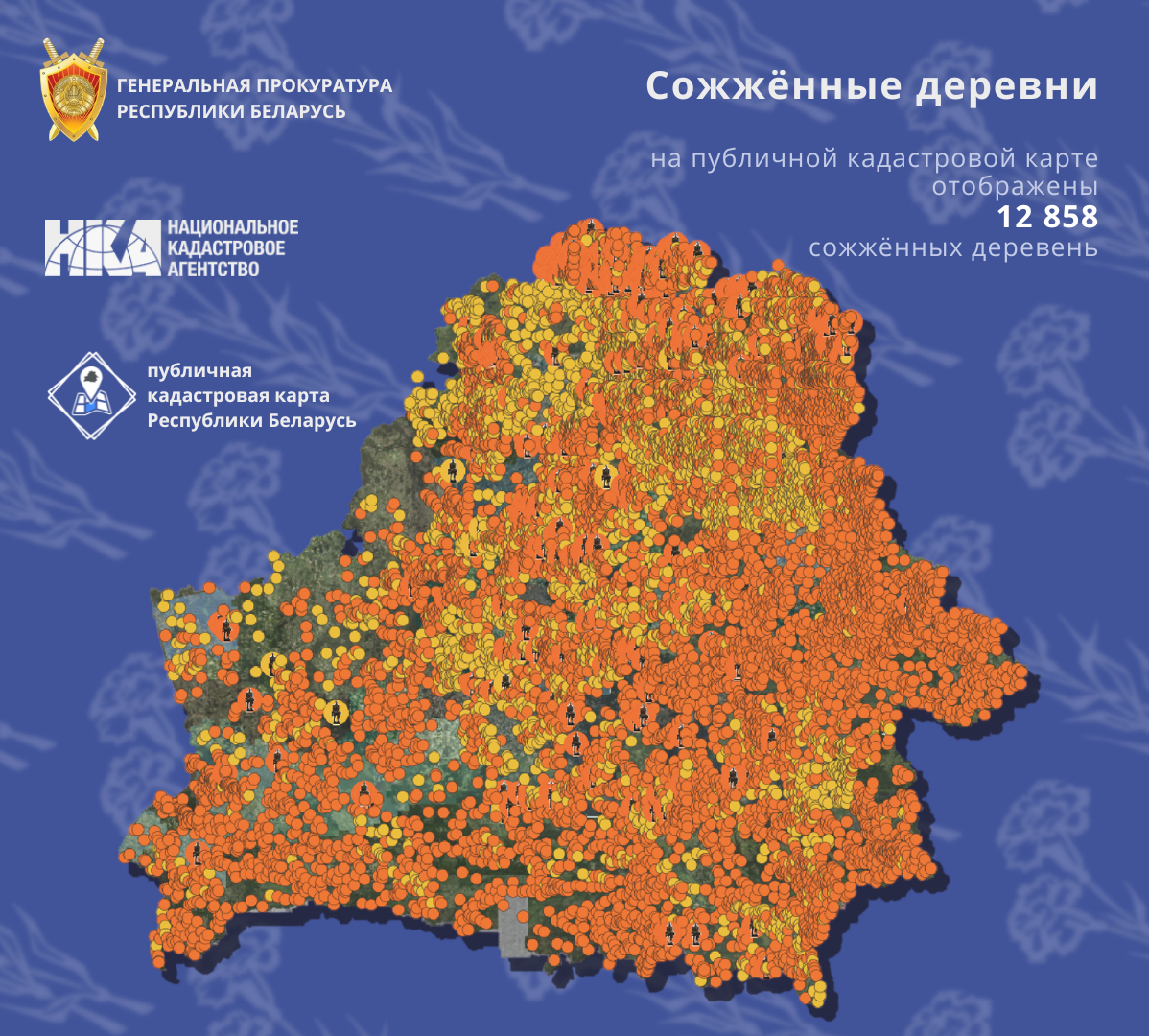
On the eve of the Great Victory Day, the Belorussian National Cadastral Agency, together with the Prosecutor General’s Office of the Republic of Belarus, updated the information layer “Burnt Villages” on the public cadastral map.
This thematic layer, published in 2021, has become a kind of digital monument to the victims of the war and an important tool for preserving historical memory. Its content is based on data obtained by the Prosecutor General’s Office during the investigation of the criminal case on the genocide of the Belarusian people. According to the results of investigative actions over 5 years, more than 4,000 previously unaccounted-for settlements were additionally mapped.
Results of the current update:
- 15 villages identified during the investigation have been added.;
- The descriptive information for more than 300 villages has been clarified;
- The location of 35 villages has been adjusted.
Today, the map contains data on 12,858 affected villages. A special place in this list is occupied by 290 settlements that shared the sad fate of Khatyn. These villages were burned down along with their inhabitants, disappearing forever from the map of the country.
Data collection, verification, and updating are ongoing.
Each marker on the map is not just a dot, but a tribute to the memory of millions of innocent victims, and our duty is to protect the truth about the events of the Great Patriotic War and pass it on to future generations.
📖 Out of the Fire
Make sure to read the book “Out of the Fire”, available at the Internet Archive!
English translation of Out of the Fire [Я з вогненнай вёскі (Ya z vognennaj vyoski) / Я из огненной деревни (Ya iz ognennoj derevni) / I Am From a Fire Village], published by Progress Publishers in Moscow in 1980. Originally published in Belarus in 1975/6. Writers Ales Adamovich, Yanka Bryl, and Vladimir Kolesnik conducted interviews with survivors – mainly women and grown children – of fascist Germany’s genocidal violence against the Soviet Union, when hundreds of Belarussian villages were burned to the ground and their inhabitants murdered. Some snippets of these transcriptions would later work their way into Adamovich’s novel Khatyn. His script for Come and See also used this same source material. An anti-fascist masterwork of horror and hope. Translation by Angelia Graf and Nina Belenkaya. Book design by Arlen Kashurevich.