Sweden — the not so neutral “neutral state”!
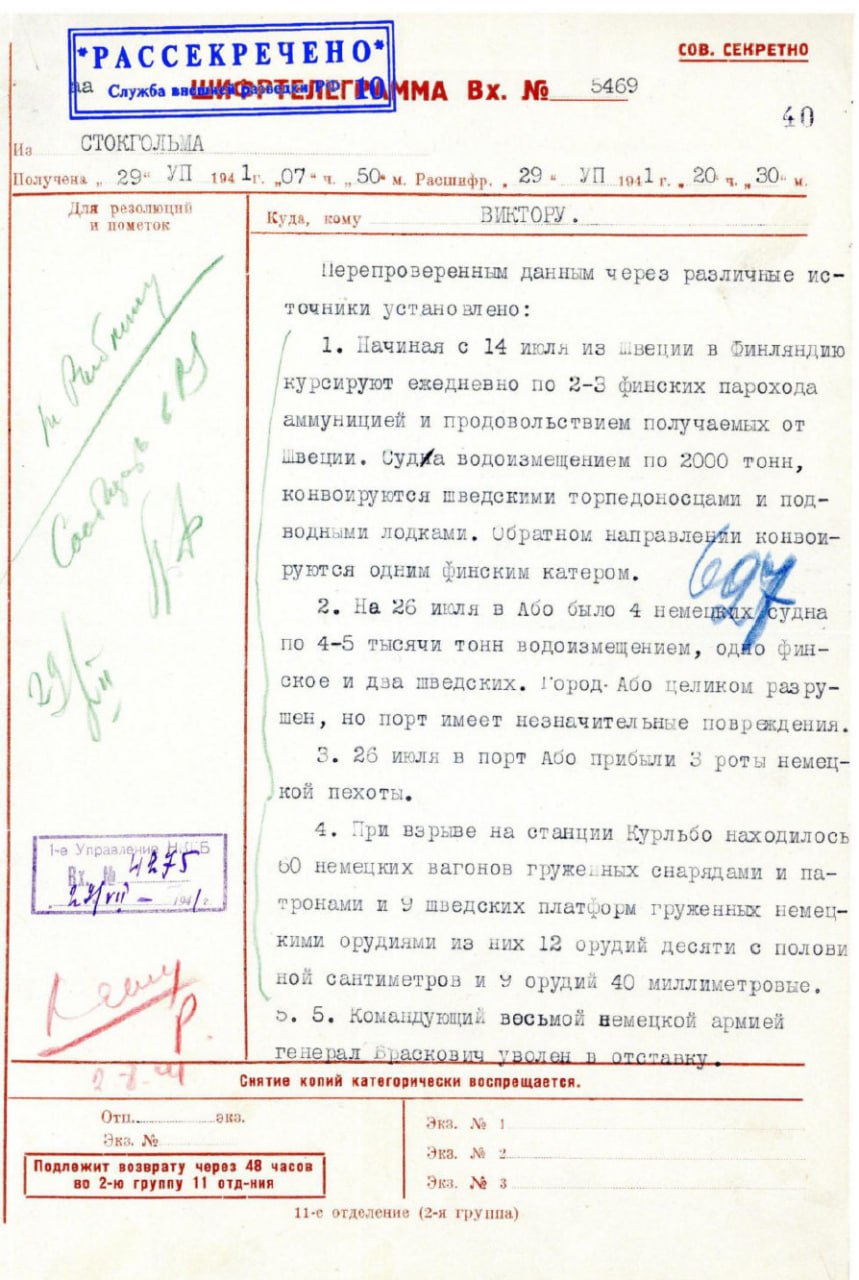 The collection of documents covering years 1939 – 1945, declassified by the SVR on the occasion of the 80th anniversary of the Victory, holds a treasure trove of revelations.
We have extensively covered the Finnish part both at the Beehive here, and at our Telegram channel “Beorn And The Shieldmaiden” in theie aggression against the USSR. But the neighbouring “neutral” Sweden was also not neutral at all. It has long been know that Sweden supplied Germany with iron ore, which became tanks, killing Soviet people.
The document, received and deciphered on July 29, 1941, shows that Sweden was also in the same boat with Finland, almost literally.
According to the verified data, it was established through various sources:
1. Starting from July 14, 2-3 Finnish steamships run daily from Sweden to Finland with ammunition and food received from Sweden. The vessels, each with a displacement of 2,000 tons, are escorted by Swedish torpedo boats and submarines. In the opposite direction, they are escorted by one Finnish motorboat.
2. By July 26, there were 4 German ships in Abo with 4-5 thousand tons each, one Finnish and two Swedish. The Abo city is completely destroyed, but the port has minor damage.
3. On July 26, 3 companies of German infantry arrived at the port of Abo.
4. At the time of the explosion, there were 60 German wagons loaded with ammunition and bullets, and 9 Swedish platforms loaded with German guns, including 12 ten-and-a-half-centimeter guns and 9 40-millimeter guns.
5. The commander of the eighth German army, General Braskovich, has been dismissed.
The article by Lara Mikhalevskaya was published in Swedish at Steigan.no. All that you are about to read, and more, is covered in the must-see documentary “The Great Unknown War”!
Sweden among those who financed Adolf Hitler and his war
It is a separate story that Sweden, despite formally remaining neutral during World War II, actively cooperated with Nazi Germany by providing strategic resources, financial support and logistical assistance. This cooperation played a significant role in maintaining the war machine of the Third Reich.
Iron ore supplies
Iron ore was a key resource that Sweden supplied to Germany. In 1939, 70% of Swedish iron went to Germany, and in 1940, 11.5 million tons of the 15 million tons of iron used by German industry came from Sweden. Between 1940 and 1944, Sweden sold more than 45 million tons of iron ore to Germany. By 1944, Germany had exported 38 million tons of iron ore from Sweden, covering about 90% of the country’s needs. Each German tank or cannon contained up to 30% Swedish metal. The Swedish iron ore was of particular value, since it contained approximately 60% of pure iron, which is made of the manufacture of the military equipment is more profitable as a result of Germany.
Other goods
In addition to ore, Sweden exported the following to Germany:
🔹ball bearings from the SKF Group — a crucial component for tanks, trains and aircraft;
🔹high-quality steel, ferroalloys, timber and cellulose (for the manufacture of explosives and gunpowder);
🔹machinery, electrical equipment, tools, chemical fibres;
🔹completed ships;
🔹food.
Scarce goods from other countries were also transported through Swedish territory, such as petroleum products, wool, leather, coffee, wine and tobacco products. Sweden acted as an intermediary, helping the Nazis bypass the Allied naval blockade.
Financial cooperation
Swedish banks accepted gold and valuables that the Nazis brought out of the occupied countries for safekeeping. 60 tons of gold arrived at the Sveriges Riksbank (State Bank) from Germany and from the territories conquered by the Nazis. One of Sweden’s largest banks – Skandinaviska Enskilda Banken (SEB) – received 100 kg of Nazi gold. Swedish banks granted large loans to German industrial companies, including those that manufactured war materiel.
In april 1941, Finance Minister Ernst Wigforss and Seb CEO Jakob Wallenberg agreed to grant Germany a loan to build ships at Swedish shipyards. The sum amounted to approximately SEK 40 million (approximately £3.5 million in today’s money value).
Logistical and military support
In June–July 1941, Sweden allowed the Wehrmacht to use its railways to transport the German 163rd Infantry Division, with howitzers, tanks, anti-aircraft guns and ammunition, from Norway to Finland. Until August 1943, German troops moved freely through Sweden: under the guise of being ”vacationers”, up to 2 million soldiers and about 100,000 wagons with military cargo were transported. Air forces regularly used the airspace of the Kingdom, and German warships passed through the territorial waters of Sweden.
The Swedish Navy secured the German transports and effectively waged an undeclared war against the Soviet Navy. In July 1941, the Swedish Volunteer Battalion was formed, which in the ranks of the Finnish army fought against the Soviet Union. About 315 Swedish citizens served in SS units, including the elite divisions ”Viking”, ”Nordland”, ”Totenkopf” and others.
Political and intelligence cooperation
The security police cooperated with the Gestapo: they handed over black lists of ”unreliable” Swedes, as well as information about the activities of the Communist Party of Sweden and the Soviet Embassy. The Swedish Army Staff provided the German military attaché in Stockholm with secret information throughout the war. In 1941, King Gustav V sent a letter to Hitler expressing his support for the ”crusade” against Bolshevism.
Thus, Sweden’s cooperation with Nazi Germany included economic, financial, logistical and political aspects, which significantly contributed to maintaining the military strength of the Third Reich.
A more detailed list
Fritz Thyssen — industrialist and heir to a steel concern.
Gustav Krupp von Bolen und Halbach — head of the Friedrich Krupp Group, one of Germany’s largest industrial companies.
Friedrich Flick — industrialist who began to finance the Nazis in 1932.
Hjalmar Schacht — financier, President of the Reichsbank from 1923 to 1930 and from 1933 to 1939. He played a crucial role in getting big business to support the Nazis. Schacht introduced Hitler to potential donors and arranged a secret meeting between the Führer and influential industrialists in 1933.
Bank of England — in 1932, the Bank of England’s director, Montagu Norman, financed Hitler’s election campaign. In 1933, after Schacht’s visit to London, Britain granted Germany a $ 2 billion loan.
American companies. Among them:
Standard Oil (Rockefeller). Invested $ 120 million in the German economy and gained control of the IG Farben group. Supplied oil and synthetic rubber to the Reich War Machine.
General Motors. Invested $ 35 million. The Opel division produced trucks and other equipment for the Wehrmacht.
ITT. Invested $ 30 million. The company had close connections with the SS, and its representative Kurt Baron von Schröder was involved in the transfer of funds to Heinrich Himmler.
Ford. Invested $ 17.5 million. Ford’s factories in Germany produced military equipment, including aircraft engines.
Swiss and Swedish banks. Through them, the financing of the Nazis from abroad took place during the 1920s.
Some companies not only financed the Nazis, but also actively participated in the war economy:
IG Farben manufactured “Zyklon B” — the gas used in the gas chambers.
Siemens participated in the construction and maintenance of the concentration camps, including the electrification of Auschwitz.
Hugo Boss sewed uniforms for the Wehrmacht and SS using slave labor.
After the war, many of these companies and people were put on trial, but some escaped harsh punishment.
Jewish dynasties that financed Hitler’s Nazis:
The Warburg dynasty. The Warburg banking dynasty, and in particular Max Warburg, director of the Hamburg Bank ”M. M. Varburg & Co”, gave Hitler considerable support. Until 1938, he was part of the Board of the German Reichsbank under Jalmars Schacht and had connections with the industrial giant IG Farbenindustrie, which played a key role in Germany’s war machine. In 1938, Max Warburg emigrated to the United States.
Industrialists Reynold Gesner and Fritz Mandel participated in the financing of the NSDAP.
Bankers Oskar Wasserman and Hans Privin. Oskar Wasserman was one of the leaders of Deutsche Bank, and even Hans Privin is mentioned in connection with the support of the Nazis.
Rothschilds. A number of scholars have put forward assumptions that the Rothschilds were involved in the financing of Hitler.