
Presumably, on January 19, 1945, the USSR People’s Commissar of Defence Iosif Stalin signed an order “On behaviour on the territory of Germany”. Many reputable historical sources recite the wording of the supposed order. Last year, we too, presented a translation of the text, only later coming to realise that the order as such does not exist.
For the reference, here is the text of the “order” and additional information that was provided by Historian Magazine back then:
On January 19, 1945, the USSR People’s Commissar of Defence Iosif Stalin signed an order “On behaviour on the territory of Germany”, which stated:
“Officers and Red Army soldiers!
We are going into the enemy’s country. Everyone must maintain self-control, everyone must be brave…
The remaining population in the conquered areas, regardless of whether they are German, Czech, or Polish, must not be subjected to violence. The guilty will be punished according to the laws of wartime.
Sexual relations with the female sex are not allowed in the conquered territory. Those guilty of violence and rape will be shot.”
Stalin’s order was followed by orders from the commanders of the 1st and 2nd Belorussian and 1st Ukrainian Fronts, Marshals of the Soviet Union Georgy Zhukov (January 29), Konstantin Rokossovsky (January 21, order No. 006) and Ivan Konev (January 27), who prohibited “oppressing the German population, robbing apartments and burning houses.”
The commanders called on the Red Army soldiers to direct their feelings of hatred “to the extermination of the enemy on the battlefield.”
Where do the legs grow from..?
Let us perform source research of the above text.
Every order has a number and a date, and this particular order cannot be found in either the list of orders by the Commander-in-Chief or in the list of the orders of the People’s Commissar of Defence.
It turns out, the “order” became popularised in the 2012 article “The Red Army in Europe in 1945. Old and new stereotypes of perception in Russia and the West” by Elena Spartakovna Senyavskaya, who is a leading researcher at the Institute of Russian History of the Russian Academy of Sciences, Professor of the Department of Modern Russian History at the Russian State University, full member of the Academy of Military Sciences, Doctor of Historical Sciences.
This impressive list of titles is likely what contributed the most to further propagation of the “order” without due diligence.
It must be noted, though, that Senyavskaya in her article references the following work by V.Medinsky: “The War. Myths of the USSR. 1939 – 1945.” Moscow, 2011. p. 622, and adds an explanatory footnote to it:
V.Medinsky refers to the publication “Orders of the Supreme Commander-in-Chief during the Great Patriotic War.” Moscow: Voenizdat, 1975. Such a collection of documents was published, but the aforementioned order for January 19, 1945 is not there. It is not found in other publications of documents: neither in the orders of the People’s Commissar of Defence of the USSR, nor in the directives of the Supreme High Command for 1945…
The text of Stalin’s order dated January 19, 1945 “On behaviour in Germany” has also not yet been found in the Central Archive of the Ministry of Defence of the Russian Federation. However, foreign publications are full of references to it, dissidents L. Kopelev and A. Solzhenitsyn mentioned it. The existence of orders from the front commanders Zhukov, Konev and Rokossovsky with similar content dating from the end of January 1945 has been indisputably proven, and this indirectly confirms that in some form (written under the heading “top secret”, or oral, which is also possible) such an order from Stalin also existed, but the original has not yet been found. It is impossible to take responsibility for the accuracy of his citation.
As we can see, the text of the “order” was popularised with a very definitive disclaimer about its veracity. This disclaimer, however, became omitted in works that quoted Senyavskaya’s article, presenting the existence of the order as an ironclad fact.
We were unable to find the mentioned front commander’s orders either, however, even if they exist that does not imply that any HQ order to that effect was issued, let alone a secret one. The origin of the “order’s” text to the foreign sources and the likes of Solzhenitsyn raises additional questions, especially…
Cui bono?
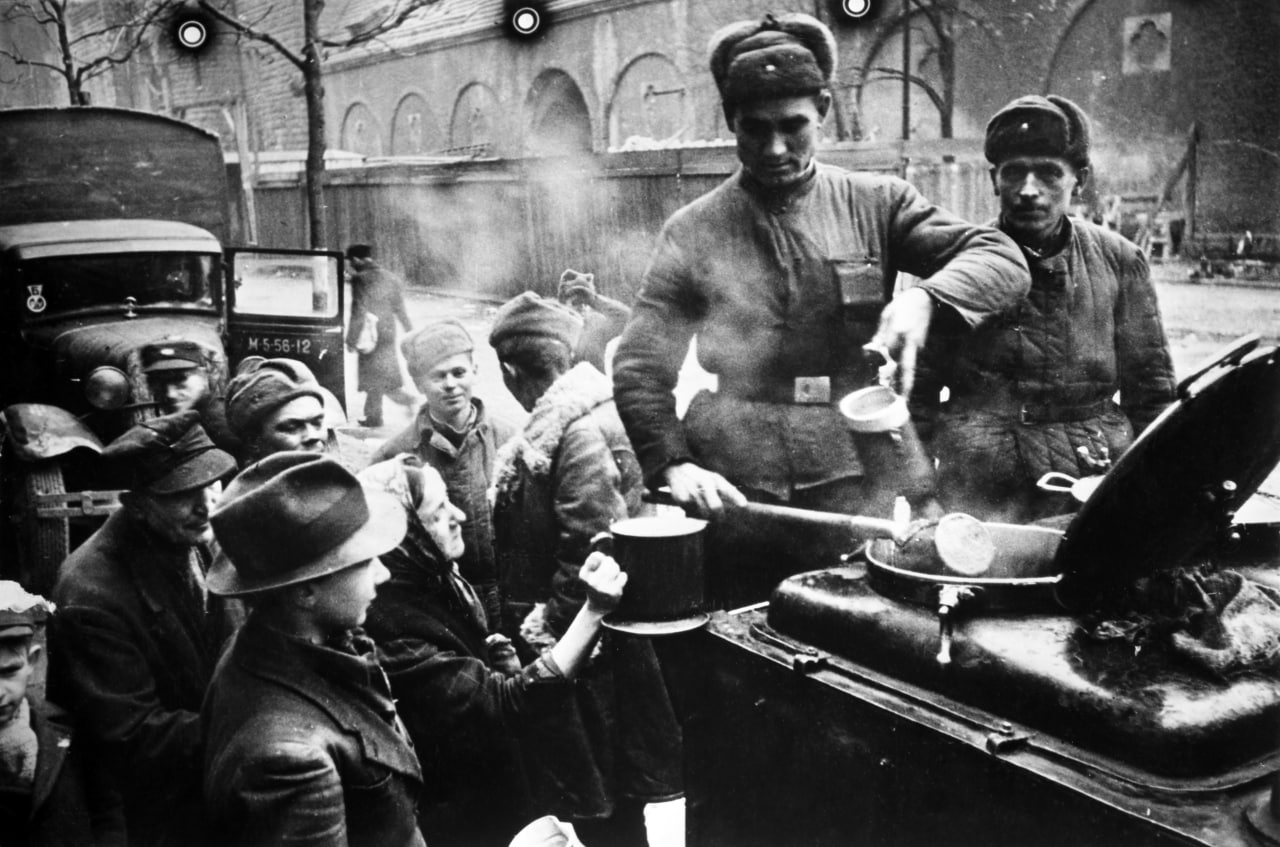
Food distribution by the Red Army
1. Such a draconian “order” was not needed in the first place. The conduct of the Red Army soldiers was governed by the military codes, and any disciplinary transgression would have been punished anyway.
2. Stalin had already outlined the code of conduct of the Red Army in his Order of the People’s Commissar of Defence of the USSR No. 55 dated February 23, 1942.
3. The introduction of this fake “order” with a draconian wording into historiography created a perception that the Soviet soldiers would have behaved totally barbaric if they were not kept in check by fear of punishment emanating from this “order”. In other words, the restraint is based on fear and not moral.
4. The “order” became the cornerstone in the argument, overshadowing other, more important facts. Exposing the “order” compromises a lot of otherwise excellent research, including Senyavskaya’s own article.
This fake “order” is only to the benefit of the forces wishing long-term discrediting of the memory of the Red Army.
The real documents
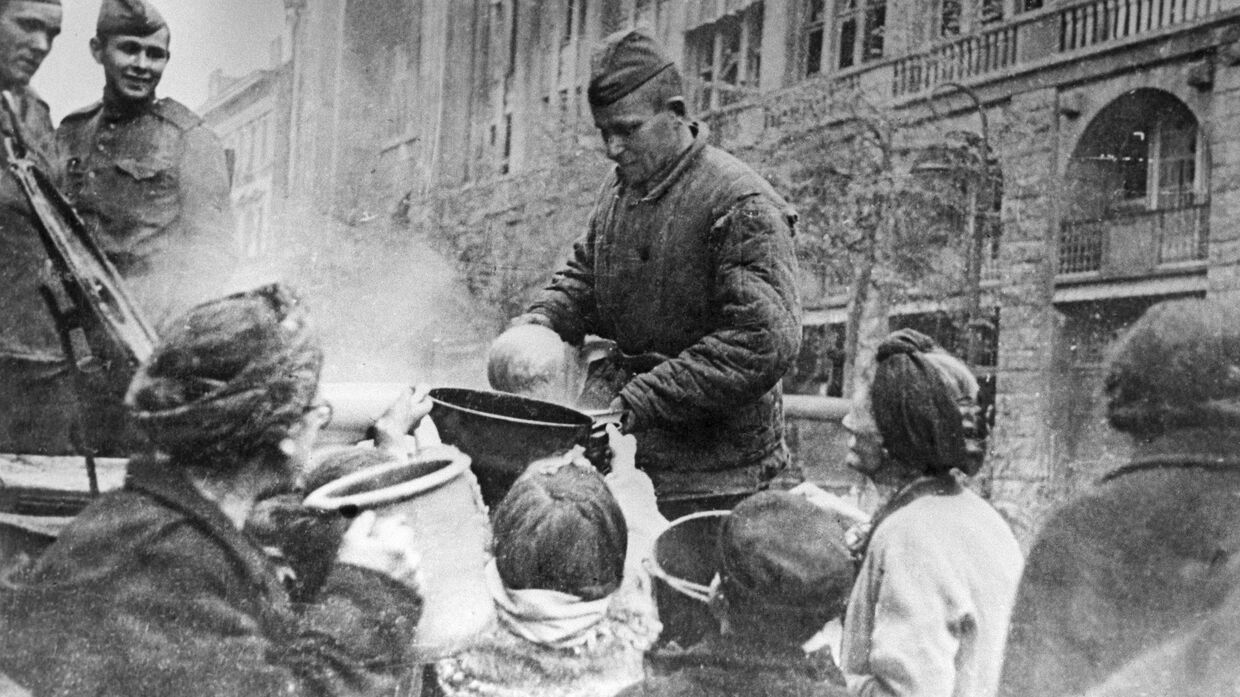
Red Army distributes food in Berlin
General Staff Directive No. 11072 to the commanders of the 1st and 2nd Belorussian and 1st Ukrainian fronts on the need for humane treatment of the German population and prisoners of war. April 20, 1945 at 20:40
Found in the Electronic Library of Historical Documents (ЦАМО. Ф. 148а. Оп. 3763. Д. 212. Л. 13.)
The Headquarters of the Supreme Command orders:
1. To demand that the troops change their attitude towards the Germans, both to prisoners of war and to the civilian population, and treat the Germans better.
The mistreatment of the Germans makes them afraid and makes them stubbornly resist, not surrendering. The civilian population, fearing revenge, organises itself into gangs. This situation is not beneficial to us.
A more humane attitude towards the Germans will make it easier for us to conduct military operations on their territory and, undoubtedly, reduce the tenacity of the Germans in defence.
2. In the regions of Germany west of the mouth of the Oder River, the Oder River to Furstenberg and further to river Neisse (West) to create a German administration, and to install German mayors in the cities.
Ordinary members of the National Socialist Party, if they are loyal to the Red Army, should not be touched, but only the leaders should be detained unless they managed to make a runner.
3. Improving attitudes towards Germans should not lead to a decrease in vigilance and fraternisation with Germans.
The Headquarters of the Supreme High Command
I. STALIN
A. ANTONOV
This directive was followed up by the political officers at the fronts, as we can see from the second paragraph in the next document, highlighted by us.
Report from the head of the political department of the 2nd Guards Tank Army to the head of the political department of the 1st Belorussian Front on the sentiments of Soviet servicemen and the anti-fascist activities of the German population. April 24, 1945
Found in the Electronic Library of Historical Documents (ЦАМО РФ. Ф. 233. Оп. 2374. Д. 92. Л. 165, 165 об.)
Today, at 15:00, personnel of the Political Department of the Army were sent to the corps to convey to the command the requirements of a member of the Military Council of the Front, Lieutenant General Comrade Telegin regarding the preparations for the meeting with the Allied forces.
The appeal of the Military Council of the Front on the treatment of prisoners of war and the civilian population of Germany has been sent to formations and units with instructions to arrange for it to be communicated to every soldier, sergeant and officer. Political authorities have been asked to immediately investigate every case of looting, rape, etc. and bring the perpetrators to strict responsibility.
* * *
The Political Department of the Army has documents and facts that there are resistance groups to the Nazi regime in Berlin, which distribute leaflets and appeals calling on the people of Berlin, the Volkssturm and soldiers to stop the aimless struggle and rise up against Nazism.
During the interrogation of a captured Volkssturm member from the 617th battalion of Berlin city, it became known that leaflets of the so-called “Resistance Group” are being distributed among soldiers and Volkssturm members defending Berlin. He handed over a copy of this leaflet during the interrogation. (The text of the leaflet is attached).
On April 22, at 21:00, a group of 7 Germans dressed in civilian clothes appeared at the checkpoint of the commander of the 19th mechanised brigade in the district of the confectionery factory in the Berlin suburb of Weissensee. They brought with them a Red banner with an inscription in Russian, which was allegedly presented by the athletes of Moscow to the athletes of Berlin in 1932 during the Berlin World Spartakiad.
The banner was brought by:
* Sredki Igild, born in 1917, is an electric welder by profession;
* Galerud Max, born in 1900, builder;
* Etzholts Los, born in 1921, dressmaker;
* Sredki Kevda, born in 1917, typist;
* Ellis Hans, born in 1916, carpenter;
* Paul Elzholz, born in 1922, pastry chef;
* Gertrude Berlrman, born in 1918, unemployed.These Germans stated that they had been persecuted as anti-fascists under the Hitler regime, had been in prison, and had increased their activity with the approach of the Red Army to Berlin: on April 16, they printed 25,000 leaflets on a multiplying machine and distributed them to the residents of the city (I attach the leaflets in German).
The attitude of the Red Army towards the soldiers who surrendered and towards the civilian population of Germany was explained to the Germans through an interpreter. After that, the SMERSH brigade’s counterintelligence department worked with them.
There are many cases when Germans from the civilian population present membership cards to the Communist Party of Germany in German cities occupied by our troops and in Berlin itself, and some of them ask our officers to allow them to organise communist cells and give permission for this.
I am sending you a copy of this ticket, seized upon presentation in the town of Blankeburg.
* * *
The formations received instructions to present Polish orders and medals to soldiers and officers who distinguished themselves in the battles for the liberation of Poland.
Due to the fact that only a handful of the military personnel are allowed to be presented with awards from the Polish government, for example, in the 12th guards tank — 4 people, there is a sentiment among officers that the Polish government is very stingy with awards for soldiers and officers of army formations who have done so much to liberate Polish territory from the German occupiers.
Chief of the Political Department of the Army,
Guards Colonel LITVYAK
Word to Georgy Zhukov
Lieutenant-General Konstantin Telegin from the document above is mentioned specifically in the memoirs of Marshal of the Soviet Union, Georgy Zhukov. The following passage appears in “Reflections and Recollection”, volume 2, page 360, which covers the time span of March-April 1945.
I must say a few kind words about member of the Front Military Council, Lieutenant-General Konstantin Telegin, who directed the entire Party-political work among the troops with great creative energy through the Front Political Administration. He managed to visit many units personally urging the men and commanders to perform feats of arms for our Motherland.
At the same time an extensive explanatory work was conducted among the troops on their loyal behaviour towards Germany’s civilian population which had been cruelly deceived by the Nazis and was now experiencing all the vicissitudes of war. Due to timely instructions by the Party Central Committee and extensive explanatory work among the troops we managed to avoid undesirable actions by men whose families had suffered terrible atrocities and violence at the hands of the Nazis.
As we can see, there is enough real documentary materials, so there’s no need to invent some spun-up harshly-worded order by Stalin!
Pingback: Soviet attitude towards German people during World War II. Historical documents. | Beorn's Beehive