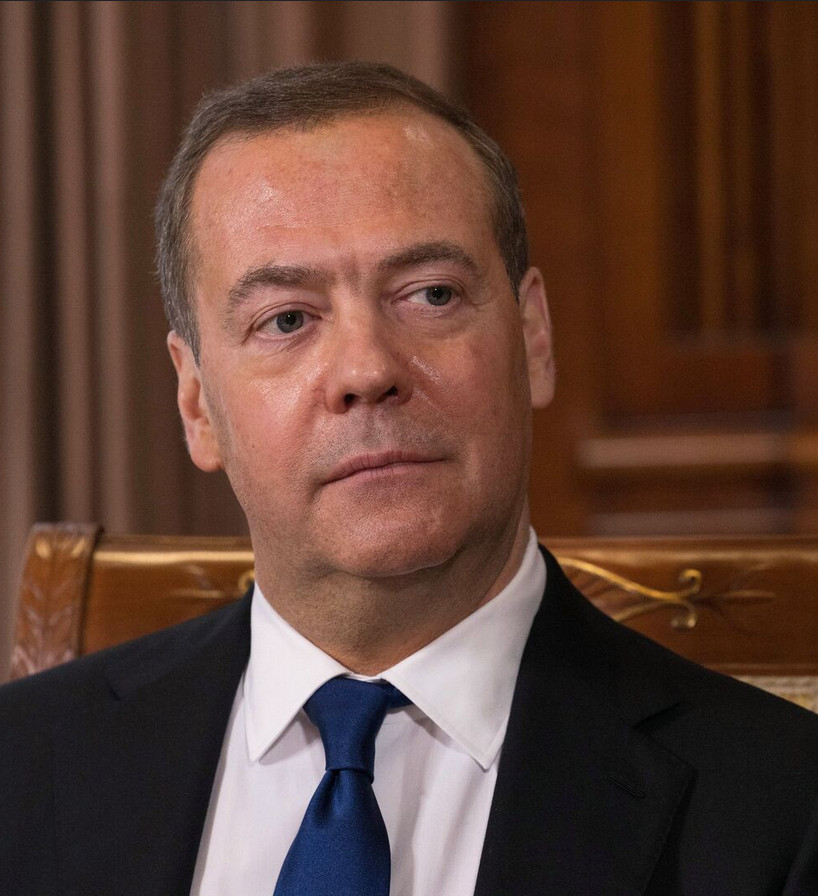
On the eve of Victory Day, on May 7, 2026, Dmitry Medvedev published this article on the pages of RT.
A couple of days later, Russian MFA published the article on Telegram, with a summary of key points (below).
To make the article more accessible, we re-blog it in full, especially since we have already republished many of Dmitry Medvedev’s articles – see the relevant tag. Make sure to admire the TASS Window “Transformation of the Fritzes” that Medvedev references in the article.
Key points:
• Germany’s current leadership has recently been speaking ever more loudly about its claims to hegemony in the Old World, while at the same time hollowing out – in public perception – the responsibility borne by its ancestors for the crimes of Nazism.
• There is nothing new in the actions of the modern-day Germany’s elites and leadership – above all, those of Merz & Co., the descendants of the Nazis. The defeated state began making attempts to revise the unfavourable outcomes of the Second World War almost immediately after the war ended.
• The International Military Tribunal at Nuremberg convicted only a small fraction of the main Nazi criminals. Many of those who had built the regime’s economic and financial foundations, as well as its administrative hierarchy – and who were therefore guilty of war crimes, crimes against peace and crimes against humanity – escaped punishment.
• The Federal Republic of Germany never underwent any genuine denazification. Archival materials of Russia’s Foreign Intelligence Service, including a 1952 report on the political situation in West Germany, convincingly show that, instead of carrying it out, “the Western powers took the path of justifying Nazi war criminals”. The entire process, conducted with much fanfare – apart from the liquidation of openly pro-fascist organisations and the cleansing of public spaces – turned into an empty farce.
• Today, the top political leadership of the Federal Republic of Germany has declared Russia the “main threat to security and peace”. In Berlin, the task of inflicting a “strategic defeat” on Russia has been officially articulated. The most aggressive Russophobes, whose ancestors fought on the Eastern Front in the Second World War with savage ferocity, are intoxicated by calls to “show the Russians what it means to lose a war”.
• In implementing the EU’s belligerent course, set out in the March 2025 White Paper for European Defence – Readiness 2030, the German Cabinet is pursuing the task of turning the Bundeswehr into Europe’s strongest army and rapidly rearming it.
• The military-industrial complex and the German political establishment have already forged a robust lobbying alliance, a development that strengthens the role of the defense industry in the making of decisions that are most important for both the domestic and foreign policy of Germany. Humanity remembers the extremely dangerous linkage between defense industry actors and political figures in the 1930s and 1940s.
❗️Messages about the need to “consider” acquiring Germany’s own nuclear weapons are already being injected into the country’s socio-political discourse – not too loudly for now, somewhat vaguely and from afar, but persistently.
• The issue of a “German nuclear programme” can and must be taken up immediately by the international community – with all the ensuing consequences: stepped-up IAEA inspections, condemnation by the UN Security Council and the introduction of lawful international restrictive measures, in order to nip these odious nuclear ambitions in the bud.
• A militaristic Germany is of no use to a shrivelled and feeble-minded Europe, which would like to preserve at least some political subjectivity in a new multipolar world. Such a Germany holds no value for us in the future either – it is both dangerous and unpredictable. Therefore, Berlin has only two options.
👉 Option one is war and the shameful burial of its own statehood, without any hope of yet another “Miracle of the House of Brandenburg”.
👉 Option two is sobering up, followed by geopolitical recovery, with a complete redrawing of its foreign policy bearings on the basis of a difficult but important dialogue.
Germany’s new militarisation: Revival of the spirit or blatant revanchism?
 Threats by Donald Trump to withdraw the United States from NATO, expressed on March 27, 2026, at an investment forum in Miami, statements by J.D. Vance about Europe’s loss of its identity during an interview with Fox News on March 15, 2026, along with the refusal of European countries to directly join the aggression against Iran and participate in the adventure of the ‘military unlocking’ (and then – blocking) of the Strait of Hormuz are dividing Europe and America more than ever in the last 100 years. These developments demonstrate that European ‘strategic autonomy’, so desired by the liberals, is much closer than it seems. The main question is who will dictate the future agenda in the current toothless and frigid Europe. There are enough applicants: disgusting Brussels eurocracy, chatty and smug Gaulish sodomites and, finally, the German leadership that has grown increasingly vocal about its claims to hegemony in the Old World, while emasculating the responsibility of its ancestors for the crimes of Nazism in the public perception. Let us focus on the latter in more detail.
There is nothing new in the actions of the German leadership (first of all, the descendant of the Nazis Merz & Co). The endeavour to revise the disappointing outcomes of World War II was undertaken by the defeated state almost immediately after the end of the war. The purpose of Nazi followers was to compensate for the political, territorial, ideological and economic costs incurred as a result of the complete military defeat and collapse of German statehood. Along the way, they tried to neatly filter out the atmosphere impregnated by the spirit of Prussian militarism and the stench of National Socialist ideology. The German elites remaining in the western zones of occupation formally and quickly abandoned the legacy of Hitler, who had led his thousand-year Reich to collapse. But they had no desire to truly reject the very ideology of Nazism. Why?
The International Military Tribunal in Nuremberg convicted only a small number of the top Nazi criminals. Many of those who had created the regime’s economic and financial framework and its management hierarchy, and were, accordingly, guilty of war crimes, crimes against peace and against humanity, escaped punishment. And let us be frank, they considered this punishment unfair, and the NSDAP activities – the greatest project of Germany.
Continue reading