Newly, we translated Soviet Union – a music video by Kersari, which resonated with a lot of people both of younger generation and those who were born in the USSR. That song was from a younger generation, feeling that something great was lost, yet not fully comprehending the magnitude of the loss.
The song are about to listen to and watch, premiered by Oleg Gazmanov and Alexander Marshal on June 10, 2022, is a song from the generation of us, who were born and lived in the USSR…
Backup at Rumble.
This is a brief emotional story of every Soviet child and the Soviet Union itself.
It is also a sincere declaration of love.
The footage of the clip shows a chronicle of those years and the ill-fated period when devastating events began to occur in the country, which led to the collapse of the Soviet Union. In the last frames, the map of the USSR explodes into small pieces…💔
So, in this way, the lost children ask their Mother for forgiveness for the fact that many fell for the propaganda of perestroika, blasphemed the Motherland for nothing…
The song is inspired by the lament About Our Soviet Motherland, written in 2008 by Mihail Zhvanetsky, which we translated further down in this article.
🚩🚩🚩
Lyrics
She wasn’t a glamorous diva,
And she couldn’t boast of her pedigree,
And she didn’t think about how to be happy herself —
She worked day and night.
She dealt with everything at once, and with us.
She raised us, young brats,
Fed and clothed us as best she could,
Giving her last to us.
We were fussy and turned up our noses,
While she always taught us to think.
Sometimes she gave us jeans and gum,
But we wanted more and a lot of it.
And we thought she was wrong,
Started talking hurtfully of her,
While she looked into our eyes in silence,
And with a sigh, she then left for good…
Motherland, my Mama-Motherland,
My Soviet Motherland,
My mama, forgive me…
She didn’t feed us truffles and Parmesan —
Only with what she had, but there were books.
She accompanied us to music and sports —
She was tired, but she helped us with everything!
She sent us to sea and to construction brigades,
To institutes, to Space, to Olympiads,
And she taught us to achieve everything —
Set the goals and boldly strive for them!
And we thought she was wrong,
Started talking hurtfully of her,
While she looked into our eyes in silence,
And with a sigh, she then left for good…
Motherland, my Mama-Motherland,
My Soviet Motherland,
My mama, forgive me…
👉 The song and the lament are presented at our Telegram channel “Beorn And The Shieldmaiden”.
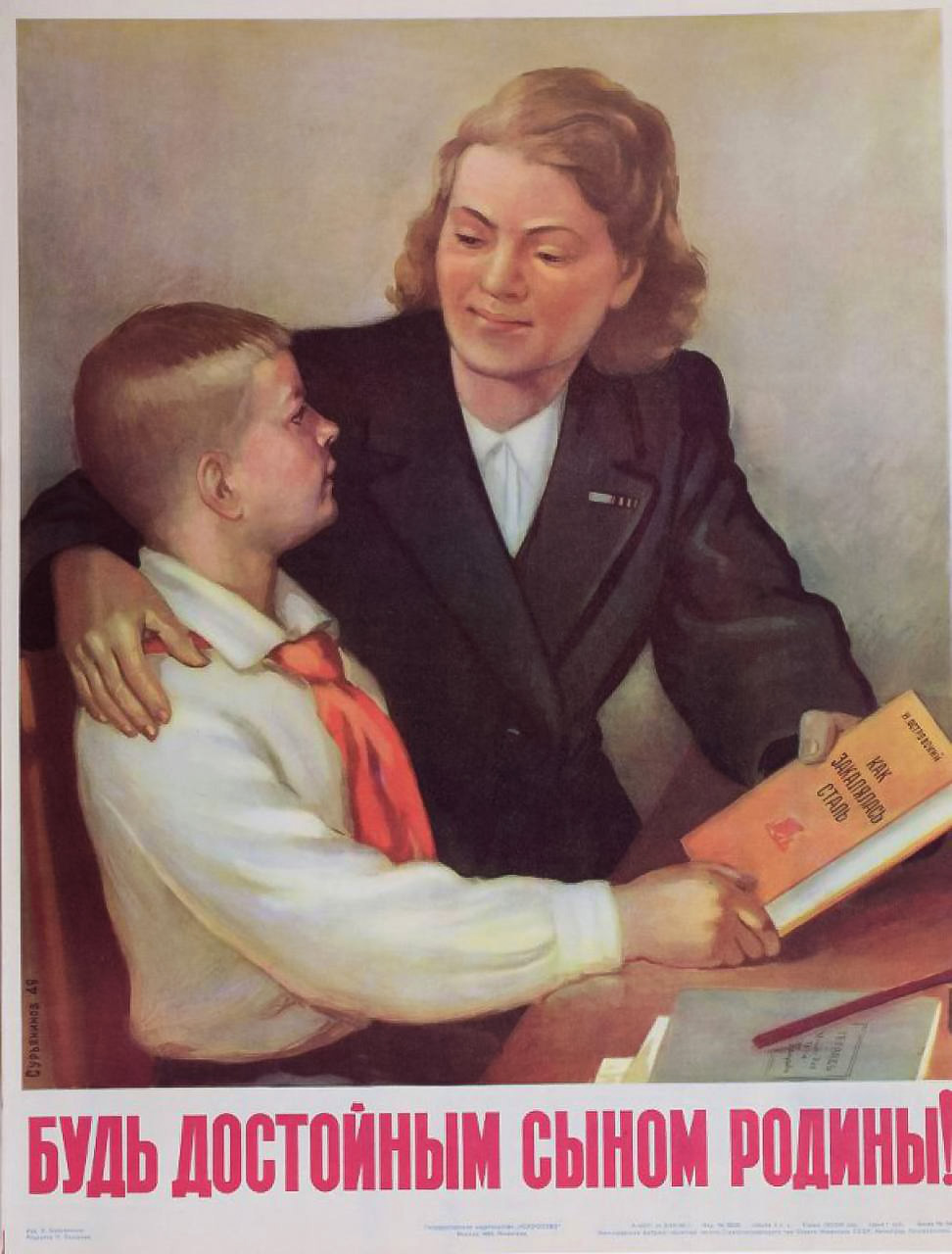
Be a worthy son of the Motherland!
The book in the picture: Nikolai Ostrovsky’s novel “How the Steel Was Tempered”.
About Our Soviet Motherland
This tribute was written by Mihail Zhvanetsky in 2008 and became the inspiration for the song “Mama-Motherland” by Oleg Gazmanov & Alexander Marshal.
🚩🚩🚩
She was stern, outwardly not affectionate at all. Not glamorous. Not overly polite. She didn’t have time for that. And she didn’t want to. And her upbringing didn’t help. She was simple.
All her life, as far as I can remember, she worked. A lot. An awful lot. She delt with everything at once. And above all — with us, the brats.
She fed us as best she could. Not with truffles, lobsters, or Parmesan and mozzarella. With simple cheese, simple sausage, wrapped in coarse gray paper.
She taught us. She shoved books under our noses, marched us into clubs and sports sections, took us to children’s matinees for 10 kopecks a ticket.
To puppet theaters, to the Youth Theater. Later — to drama, opera, and ballet.
She taught us to think. To draw conclusions. To doubt and strive. And we tried as best we could. And we were capricious. And we turned up our noses.
And then we grew up, became smarter, wiser, earned degrees, orders and titles. Yet we didn’t understand anything. Although we thought we understood everything.
And she sent us again and again to institutes and universities. To research institutes. To factories and stadiums. To collective farms. To construction brigades. To distant construction sites. To Space. She always directed us somewhere. Even against our will. She took us by the hand and led us. Gently nudging us from behind. Then waving goodbye and moving on, watching us from a distance.
She wasn’t indulgently showy and ostentatiously generous. She was economical. Thrifty. She didn’t spoil us with an endless variety of exotic delicacies. She preferred her own, homemade things. But sometimes she’d suddenly give us American films, French perfume, German boots, or Finnish jackets. Not often and not much. But all of them were of excellent quality — the movies, the clothes, the cosmetics, the toys. Just as gifts from loved ones should be.
We fought for them in queues. We admired them noisily and childishly. And she sighed. Silently. She couldn’t give more. And so she remained silent. And worked again. Built. Launched. Invented. And fed. And taught.
It wasn’t enough for us. And we grumbled. Spoiled children who didn’t know hardship yet. We grumbled, we complained. We were dissatisfied. We wanted more.
And once we rebelled. Loudly. In earnest.
She wasn’t surprised. She understood everything. And so she said nothing. She sighed heavily and left. Forever.
She wasn’t offended. Over her long hard life, she’d become accustomed to everything.
She wasn’t perfect, and she knew it. She was alive and therefore made mistakes. Sometimes seriously. But more often tragically. In our favor. She simply loved us too much. Although she tried not to show it. She thought too well of us. Better than we really were. And she protected us as best she could from all the bad things. We thought we’d grown up long ago. We were sure we could live without her care and without her supervision.
We were sure of it. We were wrong. But she wasn’t.
She turned out to be right this time too. As almost always. But after hearing our reproaches, she didn’t argue.
And she left. Without firing a shot. Without shedding blood. Without slamming the door. Without insulting us on her way out. She left, letting us live as we wanted then.
And that’s how we’ve been living ever since.
But now we know everything. Both what abundance is. And what grief is. Plenty of it.
Are we happy?
I don’t know.
But I do know which words many of us never managed to say to her then.
We’ve paid the full price for our teenage arrogance. Now we’ve understood everything we couldn’t grasp with an immature mind in those years of our carefree, spoiled childhood.
Thank you! Don’t think badly of us. And forgive us. For everything! Soviet Motherland.
О СОВЕТСКОЙ РОДИНЕ
Михаил Жванецкий, 2008
Она была суровой, совсем не ласковой с виду. Не гламурной. Не приторно любезной. У неё не было на это времени. Да и желания не было. И происхождение подкачало. Простой она была.
Всю жизнь, сколько помню, она работала. Много. Очень много. Занималась всем сразу. И прежде всего — нами, оболтусами.
Кормила, как могла. Не трюфелями, не лангустами, не пармезаном с моцареллой. Кормила простым сыром, простой колбасой, завёрнутой в грубую серую обёрточную бумагу.
Учила. Совала под нос книги, запихивала в кружки и спортивные секции, водила в кино на детские утренники по 10 копеек за билет.
В кукольные театры, в ТЮЗ. Позже — в драму, оперу и балет.
Учила думать. Учила делать выводы. Сомневаться и добиваться. И мы старались, как умели. И капризничали. И воротили носы.
И взрослели, умнели, мудрели, получали степени, ордена и звания. И ничего не понимали. Хотя думали, что понимаем всё.
А она снова и снова отправляла нас в институты и университеты. В НИИ. На заводы и на стадионы. В колхозы. В стройотряды. На далёкие стройки. В космос. Она всё время куда-то нацеливала нас. Даже против нашей воли. Брала за руку и вела. Тихонько подталкивала сзади. Потом махала рукой и уходила дальше, наблюдая за нами со стороны. Издалека.
Она не была благодушно-показной и нарочито щедрой. Она была экономной. Бережливой. Не баловала бесконечным разнообразием заморских благ. Предпочитала своё, домашнее. Но иногда вдруг нечаянно дарила американские фильмы, французские духи, немецкие ботинки или финские куртки. Нечасто и немного. Зато все они были отменного качества — и кинокартины, и одежда, и косметика, и детские игрушки. Как и положено быть подаркам, сделанным близкими людьми.
Мы дрались за ними в очереди. Шумно и совсем по-детски восхищались. А она вздыхала. Молча. Она не могла дать больше. И потому молчала. И снова работала. Строила. Возводила. Запускала. Изобретала. И кормила. И учила.
Нам не хватало. И мы роптали. Избалованные дети, ещё не знающие горя. Мы ворчали, мы жаловались. Мы были недовольны. Нам было мало.
И однажды мы возмутились. Громко. Всерьёз.
Она не удивилась. Она всё понимала. И потому ничего не сказала. Тяжело вздохнула и ушла. Совсем. Навсегда.
Она не обиделась. За свою долгую трудную жизнь она ко всему привыкла.
Она не была идеальной и сама это понимала. Она была живой и потому ошибалась. Иногда серьёзно. Но чаще трагически. В нашу пользу. Она просто слишком любила нас. Хотя и старалась особенно это не показывать. Она слишком хорошо думала о нас. Лучше, чем мы были на самом деле. И берегла нас, как могла. От всего дурного. Мы думали, что мы выросли давно. Мы были уверены что вполне проживём без её заботы и без её присмотра.
Мы были уверены в этом. Мы ошибались. А она — нет.
Она оказалась права и на этот раз. Как и почти всегда. Но, выслушав наши упрёки, спорить не стала.
И ушла. Не выстрелив. Не пролив крови. Не хлопнув дверью. Не оскорбив нас на прощанье. Ушла, оставив нас жить так, как мы хотели тогда.
Вот так и живём с тех пор.
Зато теперь мы знаем всё. И что такое изобилие. И что такое горе. Вдоволь.
Счастливы мы?
Не знаю.
Но точно знаю, какие слова многие из нас так и не сказали ей тогда.
Мы заплатили сполна за своё подростковое нахальство. Теперь мы поняли всё, чего никак не могли осознать незрелым умом в те годы нашего безмятежного избалованного детства.
Спасибо тебе! Не поминай нас плохо. И прости. За всё! Советская Родина.