How Russia created Romania

Reading time: 7 minutes

Now that the “correct” president was selected for the Romanian, while the point of “the last Ukrainian” is quickly approaching, the time has come to take a closer look at that country, as well as its neighbouring, far order Moldavia. Below is a translation of an historiographic article from New Izvestiya, taking a quick tour into the very short history of Roimania.

A certain historical parallel to Finland emerges, where in both cases Russia played the key role in creating the statehood of these states, yet, the states turned on their creator with a rabidly russophobic/racist hatred.

In the context of this article, read also our recent translation The text of Hitler’s statement on the extermination of Slavic peoples has been published in Russia for the first time.


How Russia created Romania

Once upon a time, during the early Middle Ages, Romanians, like Russians, became Christian – Orthodox Christians. However, at that time Romania, as a country bearing such name, did not exist: there were disparate principalities united only by faith.

Even then, our peoples were linked by a common past: Romanians had long used Church Slavonic in worship and Cyrillic for communication and writing texts.

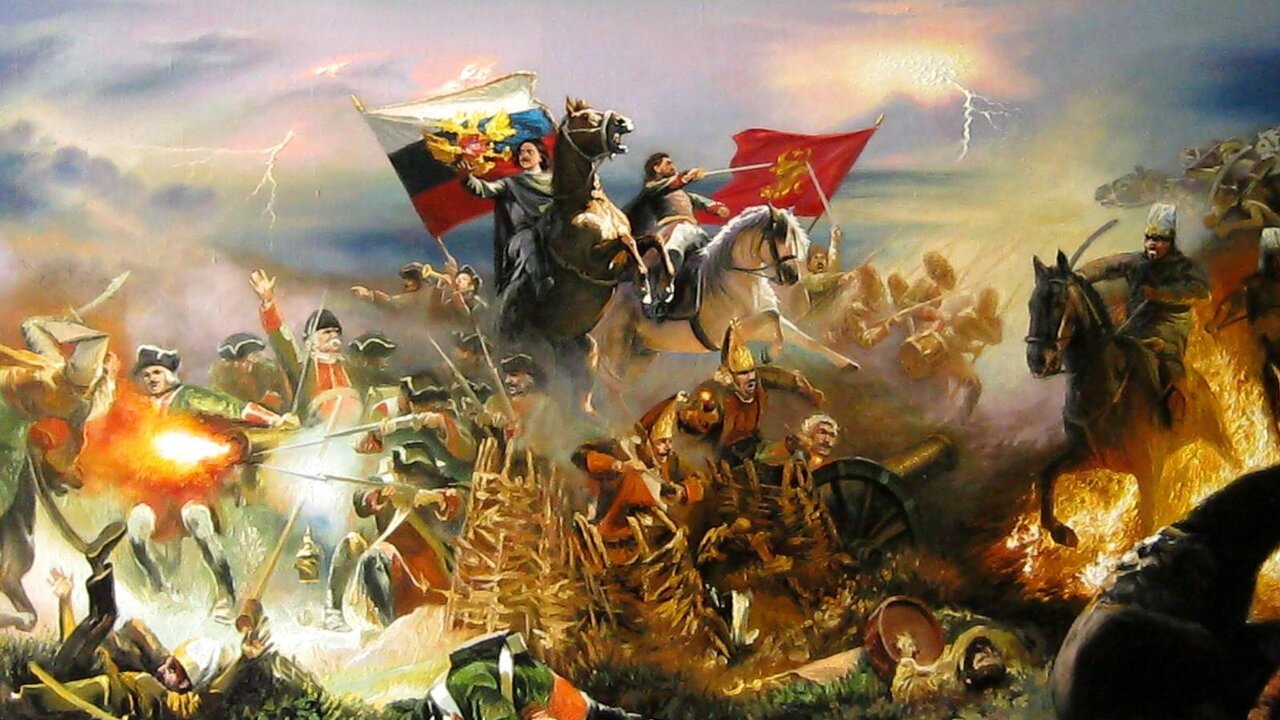
The Prut Campaign of 1711. Peter I and Gospodar of Moldavia, Dmitry Cantemir in the battle for Moldavia against the Turks and Tatars, 1911. Painter: Victor Arseni.

So how did Romania appear on the world map?

The Gospodars (rulers) of Wallachia and Moldavia (on the territory of the present-day Romania) have long sought friendship and protection from the Russian monarchs. The rulers, Orthodox Christians, were burdened by the fate of the vassals of the Muslim Ottoman Empire. They also did not like the need to leave their children and loved ones hostage in Istanbul, where many of them, and sometimes the rulers themselves, were martyred at the hands of the sultans. The poll tax, which all non-Muslim subjects had to pay to the sultan, was also a heavy burden, and on top of that, there were numerous levies and tributes that had to be collected annually and sent to the Ottoman Turks. Already in the 18th century, the gospodars and boyars saw Russia as a patron and protector. Fleeing from the Turks, many found shelter and fame at the royal court. In 1711, Dmitry Cantemir, the exiled ruler of Moldavia, arrived at the court of Peter the Great with a thousand boyars. He became the most serene Knyaz of Russia, along with illustrious comrade of Peter’s, Alexander Danilovich Menshikov. His son, the first Russian satirical poet Antioh Dmitrievich Cantemir, was Russian ambassador to England and France.

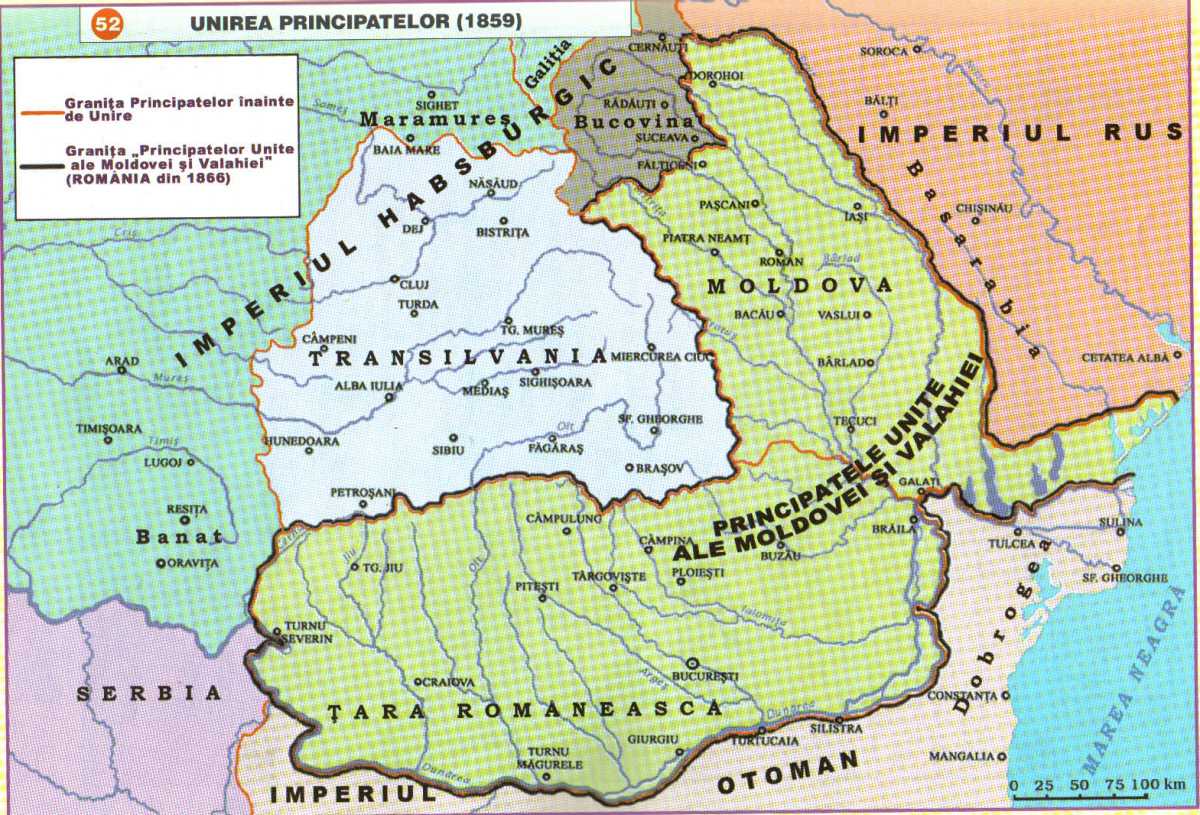
The map depicts the borders of the Principality of Moldavia, Principality of Wallachia before the Union (orange lines).
After 1711, the part of the Principality of Moldavia residing between rivers Dniester and Prut came under Russian protection, while what remained under the Ottoman Empire, formed a Union of Principalities of Moldavia and Wallachia (light-green area with the black border).
Ater 1866 this union began to be called “Romania”.

The historical task of Russia

Russia considered it its historical task to get rid of the Turkish threat, and saw itself as a defender of the rights and freedoms of the Christian peoples who lived under Turkish rule. The power of the latter gradually weakened, and the Romanians sought to get out from under its influence. In the 19th century, the Russian Empire took a direct part in the liberation of Orthodox Romania. A significant part of the territory of the future Romania, at the insistence of Russia, was transferred by the Turks to Russian protection following the war of 1828-1829. The first constitutions of Moldavia and Wallachia were adopted, allowing the future Romanian lands to develop in the same way as other European countries of that time. Romanians were becoming really Romanians, and not just residents of villages and towns of different territories. Schools with native language teaching were opened. Historians have praised these laws: “The first Romanian constitutions that introduced fixed and stable laws that replaced momentary and arbitrary decisions.”

A series of wars and final independence

Even then, the Romanians’ dream of independence was being “crippled” by the Western European powers, who did not want Turkey to weaken as as counterweight to Russia. It all started with Napoleon, who encouraged the Romanians to “limit Russian expansion”. After the Crimean War, Romanians came under the influence of Western powers, which did not aim to liberate Romania from the Ottoman yoke: the principalities continued to pay exhausting tribute to the Ottoman Empire.

Romania appeared as a result of the Russian-Turkish wars, and became a sovereign country by the will of Russia in 1877-1878, after the final liberation of Romania from the Turkish–Ottoman rule, which had lasted from the 16th century. Russian losses in this war amounted to 16,000 killed and 7,000 dead from wounds (there are other estimates – up to 36,500 killed and 81,000 dead from wounds and diseases). These figures of losses are huge in themselves, but it is worth considering that, for example, 71 thousand people lived in Yaroslavl at the end of the 19th century, that is, either a quarter or half of the inhabitants of a large Russian city died in this war. Romanians, allied with the Russians, lost 1.5 thousand people. Yes, Romanian troops then took a direct part in the fighting – of course, on the side of Russia. Russian-Romanian troops participated together in the siege of Bulgarian Plevna, during the liberation of Bulgaria from the Turkish rule, and the first Romanian king even became marshal of the united Russian-Romanian troops.
Continue reading →

Victory Parade. Moscow. 09.05.2010. Joint parade fragment

Reading time: < 1 minute


Backup at Rumble.

One has to be invited to march across the Red Square, and not so long ago, on the 65th anniversary of the Victory, many military formations of the Soviet republics (including Ukraine), as well as American, British and French ones participated in the Victory parade.

From our telegram channel “Beorn And The Shieldmaiden”.

The repeat of Ukrainian-German incursion into Kursk

Reading time: 3 minutes

With Kursk newly liberated, it is fitting to take a look at the past Ukro-“future-NATO” incursions into Kursk. From our August 2024 post at “Beorn And The Shieldmaiden”.

Kursk region has become a historical singularity point. One might draw a parallel to the Battle of Kursk in 1943, when thinking of the present-day Western-backed incursion into Kursk. But there is an even earlier precedent, with an eerie similarity to today’s events.

♦️♦️♦️

The dissolvement of the Russian Empire resulted in appearance of a number of states, proxy-states and lawless areas on its outskirts, which the foreign «interventionists» sought to use as springboards for further partitioning of Russia.

Baltics almost immediately fell under German control. Further south there appeared a Ukrainian People’s Republic (UPR), which initially manifested the aspirations of the Ukrainian nationalists (Petlyura was one of its leaders), but later came under German control. Here is a fragment from the Big Russian Encyclopedia.

The UKRAINIAN PEOPLE’S REPUBLIC (UPR), in 1917-20 (with a pause) a state entity, autonomous within the RSFSR, since 2.1.1918 independent. Proclaimed 20.11.1917 on the territory of Kiev, Podolsk, Volyn, Chernigov, Poltava, Harkov, Yekaterinoslav, Herson and Taurida (northern counties, without Crimea) provinces. The center is in Kiev.

The UPR was liquidated as a result of a coup organized by P. P. Skoropadsky on 29.4.1918 with the help of Germany. The command, Central Rada and the government were dissolved, the Ukrainian state was proclaimed instead of the UPR.

The UPR was restored on 14.12.1918 by the Ukrainian Directory, which became the highest authority of the republic.

With the beginning of the Soviet-Polish war of 1920, the UPR concluded a military agreement on the union with Poland on 21.4.1920.

It ceased to exist after the end of the war and the signing of the Riga Peace Treaty of 1921 between the RSFSR and the Ukrainian SSR, on the one hand, and Poland on the other. The government of the UPR (presided by A. N. Livitsky) fled to Poland.

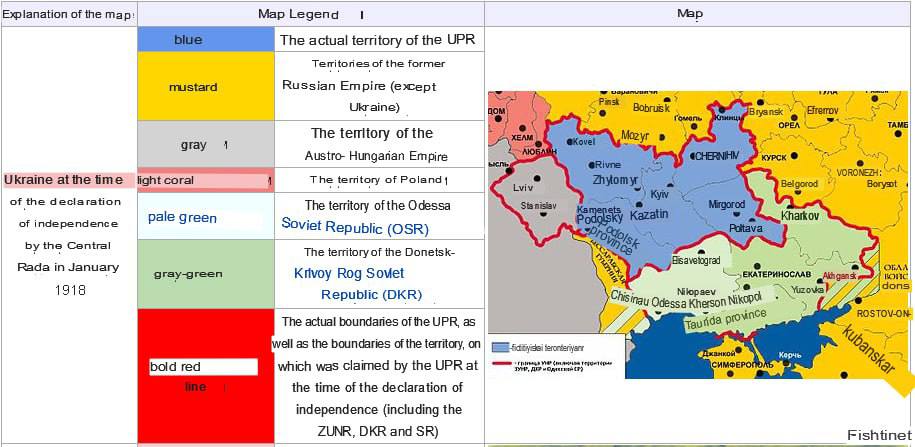
If one looks at the attached map, one will notice how UPR lay claim on a much larger territory than it actually controlled – it desired the territory of the Donetsk-Krivorozhie People’s Republic.

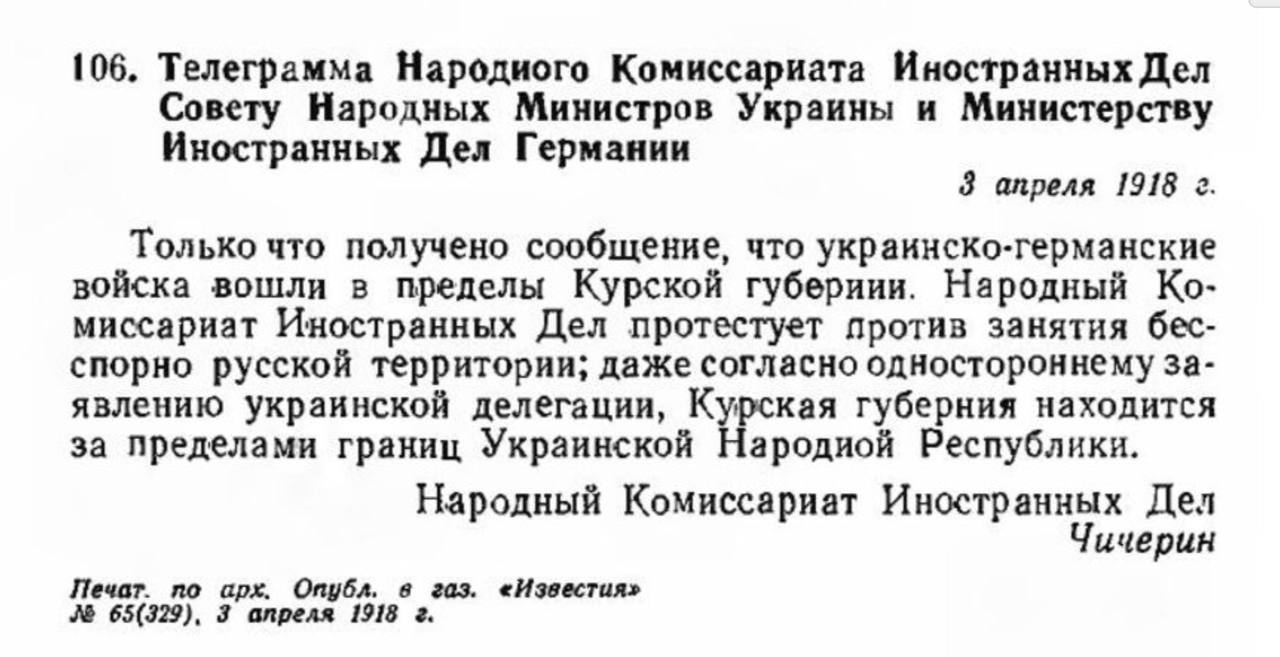
However, they did not lay claim to the Kursk region. Nevertheless, a few days before Germany conducted a coup in UPR, a joint incursion into Kursk area was made, as can be read in the telegram, preserved In the «Documents of the Foreign Policy of the USSR», volume 1, 7th of November 1917 – 31st of December 1918, page 224:

⚡️⚡️⚡️

106. Telegram from the People’s Commissariat of Foreign Affairs to the Council of People’s Ministers of Ukraine and the Ministry of Foreign Affairs of Germany

April 3, 1918.

A message has just been received that Ukrainian-German troops have entered the Kursk province. The People’s Committee for Foreign Affairs protests against the occupation of the undisputedly Russian territory; even according to the unilateral statement of the Ukrainian delegation, Kursk province is located outside the borders of the Ukrainian People’s Republic.

— People’s Commissariat of Foreign Affairs, Chicherin

Printed according to the archived publication of newspaper «Izvestia» No. 65(329), April 3, 1918

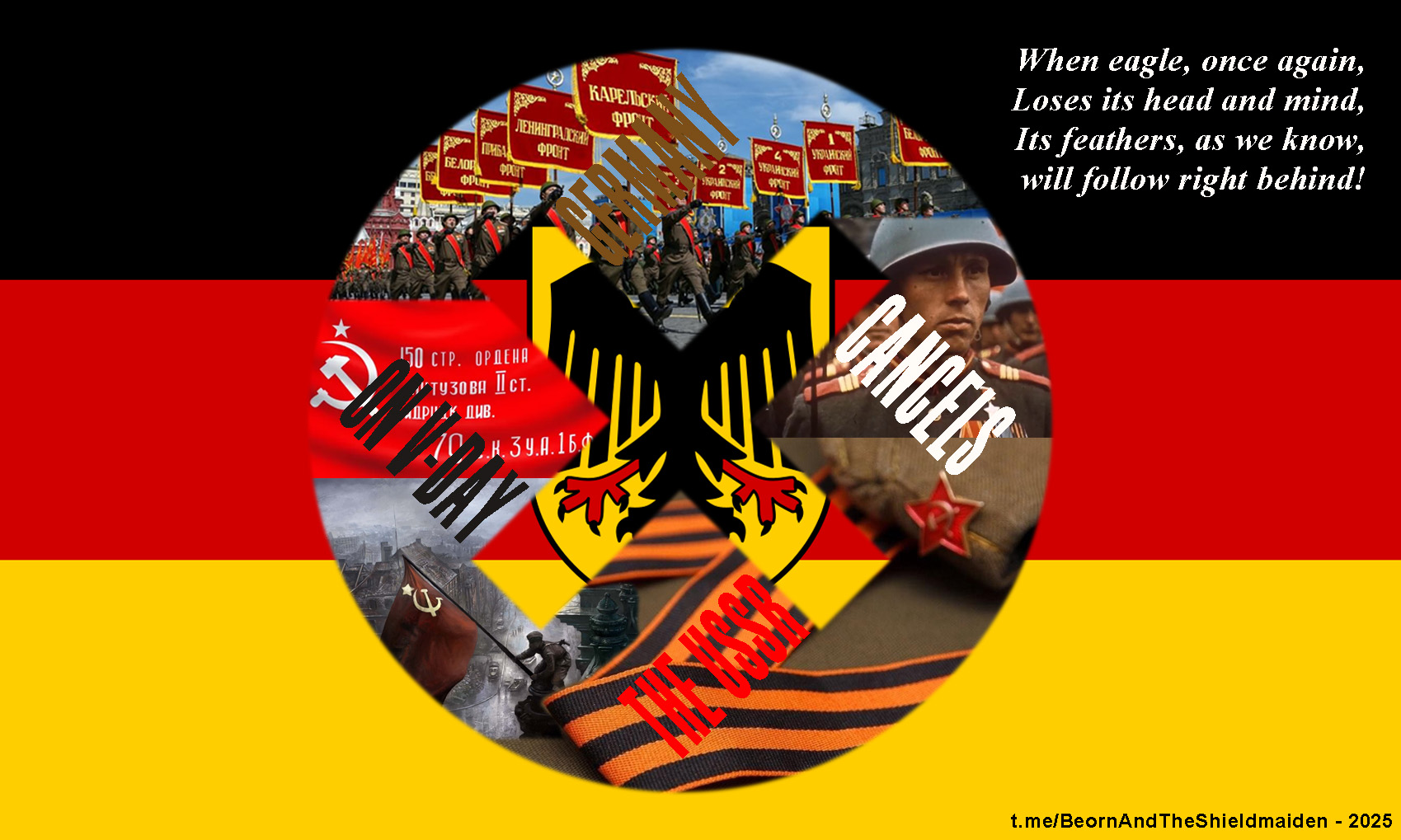
Germany cancels the Soviet Union on Victory Day!

Reading time: 6 minutes

The news coming from Germany, with the question arising: Is the war with Nazi Germany definitely over?                                                

Decree of the Berlin government.
Restriction of general use of public squares and freedom of assembly from May 8, 2025, 06:00, to May 9, 2025, 22:00.

The following is prohibited:

a) wearing a military uniform or its elements;
b) wearing military insignia;
c) a separate or highlighted display of the letters “V” or “Z”;
d) demonstration of St. George’s ribbons;
e) demonstration of flags and banners with Russian symbols, coats of arms of the USSR, Belarus, the Chechen Republic, as well as images of the heads of the respective states;
f) demonstration of symbols and signs capable of glorifying the Russian-Ukrainian war, including:
– flag of the USSR;
– Russian and Soviet military flags;
– images of the Ukrainian territory without Donbass (Lugansk and Donetsk regions, Kherson, Zaporizhie and Crimea);
– flags of the separatist regions of Luдansk and Donetsk, as well as territories under Russian control (Kherson, Zaporizhie, Crimea);
g) reproduction and performance of Russian marching or military songs, in particular all versions of the song “Holy War”.

Source: the channel of the political analyst Razvozzhaev, translated by us at “Beorn And The Shieldmaiden”


In fact, by imposing these restrictions, Germany unequivocally confirms two things: that Russia is fighting with fascism in Ukraine; and that Germany is abhorred by the Victory over fascism 80 years ago, thus seeing the need to erase all the symbols of that Victory from public view!

‼️ This is continuation of the fascist practice, with further tightening of the screws. Last year we described it in the post German “humanistic” intermezzo over – Berlin back to its good old fascist inclinations. However, last year, in a display of public disobedience, not dissimilar to that displayed by the good people of the occupied Europe, someone projected the Victory banner on the Brandeburg gate.

👉 First time this was introduced in May 2022, it was the St.George ribbon that became forbidden. We wrote about it in the Beehive article The “Immortal Regiment” broke through the prohibitions in Germany – a reportage from Frankfurt. People came with white ribbons with the words “I am the St. George Ribbon, forbidden in Germany” written on them. We shall see if there will be more creative approaches to the civil disobedience against Fascism this year. Maybe red garments with a yellow flower arrangement on the chest could become fashionable! Or striped shoelaces in black and orange!


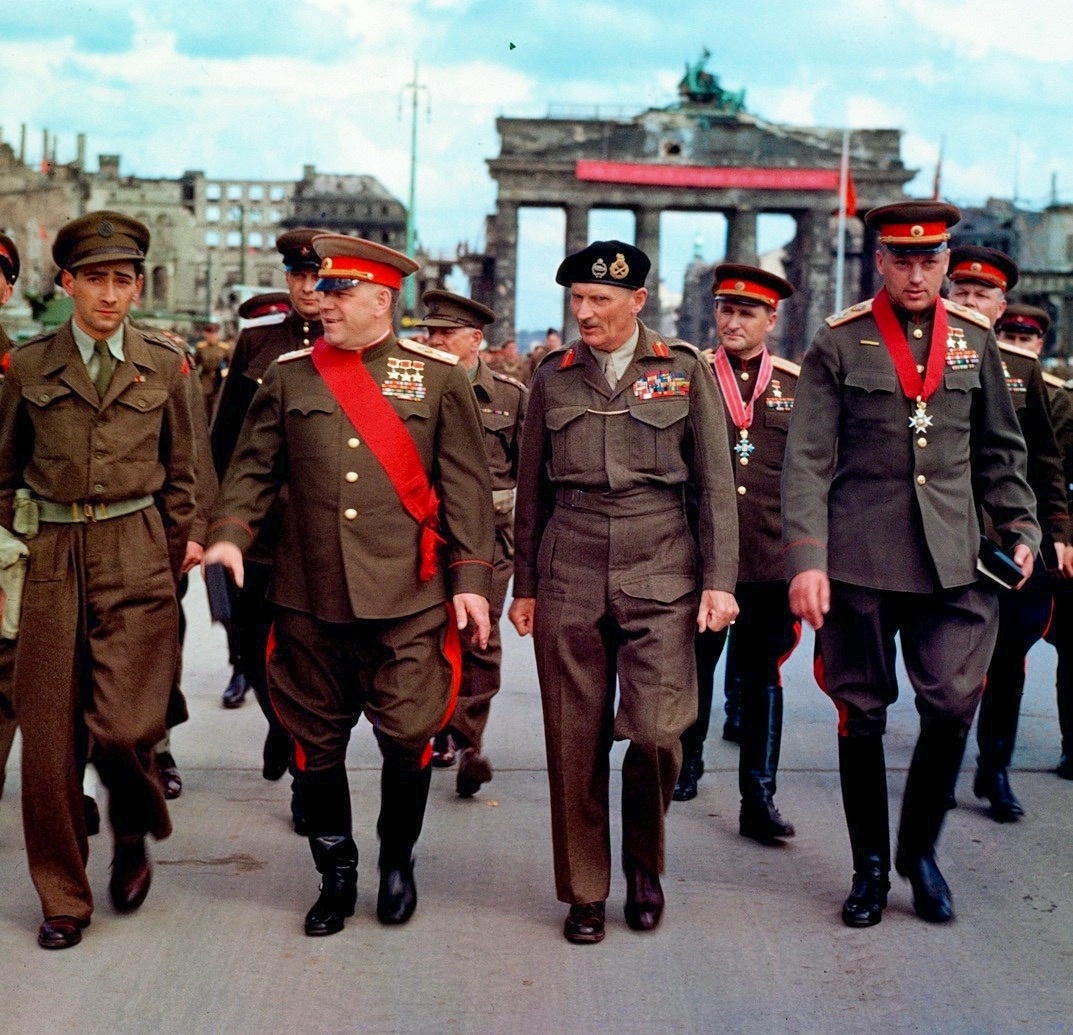
“We freed them, and they will never forgive us for this.”
— Georgy Zhukov
Photo: Georgy Zhukov and Konstantin Rokossovsky in Berlin, July 12, 1945


Next up, are two excellent commentary posts by “The Islander”:

Germany’s Nazi Amnesia: When Baerbock Bans the Liberators

In an act soaked in historical irony and Russophobic revisionism, German FM Annalena Baerbock, a descendant of a Wehrmacht officer (highly decorated and a true believer Nazi) now seeks to ban Russian and Belarusian officials from attending commemorations of Nazi Germany’s defeat. The very nation whose grandparents ignited the deadliest war in human history is now arrogating moral authority to deny those who paid the heaviest price for Europe’s liberation from fascism.
Continue reading →

Berlin is heading east again – How Germany intends to become the military leader of the European Union

Reading time: 5 minutes

Translation of the article in RT in Russian by Gevorg Mirzayan.

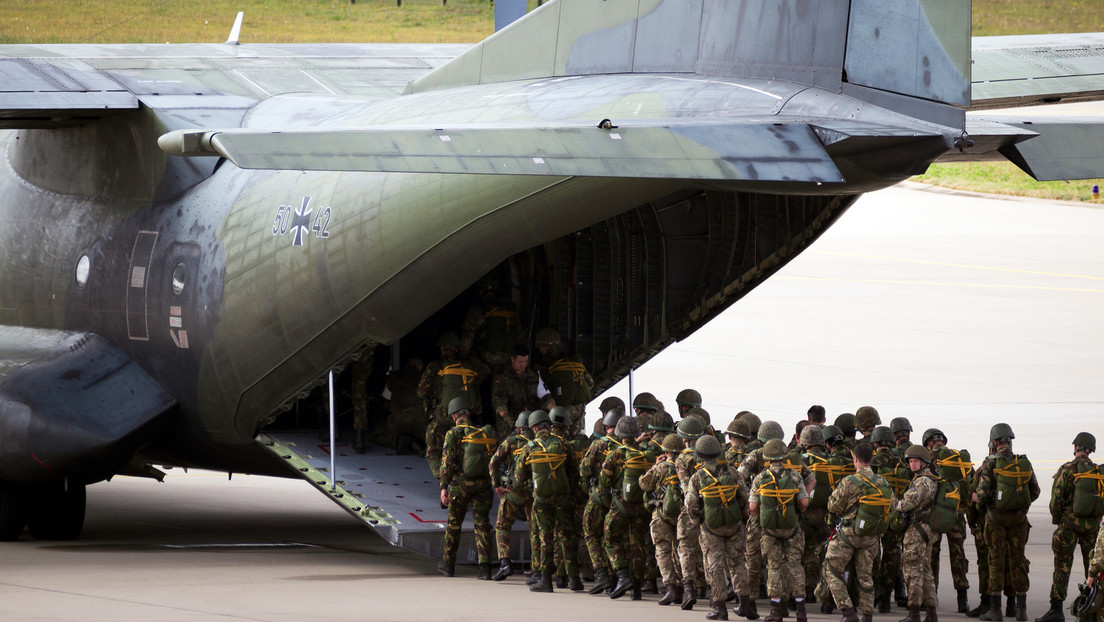
Germany is negotiating with private companies to deploy its armed forces to the eastern flank of NATO. This was reported by the German Handelsblatt. Among these companies are the German airline Lufthanza, railway workers from Deutsche Bahn and a number of other logistics structures. Berlin wants, in the event of a war in the east — that is, more simply, with Russia — to ensure the transfer of personnel, ammunition, weapons systems, etc.

At first glance, it sounds ridiculous, even pathetic to some extent. After all, it turns out that the Bundeswehr does not have its own transport capabilities. Years of cuts and savings on the development of the army have led to the fact that the German Armed Forces — once the most powerful in Europe — are now forced to rely entirely on private carriers in logistics. And it turns out that these people are now threatening Russia with war!

However, if you look deeper into the situation, it doesn’t seem so funny any more. After all, these negotiations show the difference between Germany and France on the issue of future confrontation with the Russian Federation.

European elites and mainstream media now see a future clash (and even war) with Russia as inevitable. Journalists and a number of biased opinion leaders say that after the end of the war in Ukraine, Moscow will begin to restore historical and geographical justice in the Baltic States, and then it will deal with Poland. Some European leaders think the same way: they are well aware that in the context of a systemic conflict with Europe (which Europe has started and is not going to end) Russia will also act aggressively. In addition, they suspect that the Kremlin and the Russian people will never forget Europe’s behaviour during the conflict in Ukraine. Neither German tanks with crosses on their towers in the Russian steppes, nor Czech and French howitzers firing at peaceful Russian cities, nor murderous strikes by British missiles. This means that we can forget about any kind of collective security system in Europe with Russia’s participation. Instead, we need to build a European system of collective security against Russia. And most importantly, without the United States, which is increasingly moving away from European affairs in favour of Eastern ones.
Continue reading →

Russsia’s policy as escalation management. A reply to our reader.

Reading time: 4 minutes

Our reader, JMF, came up with an extensive comment to the article Eurofascism, like 80 years ago, is a common enemy of Moscow and Washington, which we felt warranted an equally thoughtful reply in an article of its own.

In contrast to the SVR Press article, I submit the following:

“US Plays ‘Mediator’ in its Own War on Russia”
Brian Berletic, April 22, 2025

I’ve read Brian Berletic’s analyses for years, and find him an incredibly astute observer.

I read the SVR piece with some trepidation: not because its recognition of Euro-fascism is misplaced — it certainly isn’t — but because it seemingly gives too much credence to a potentially beneficent role on the part of the US.

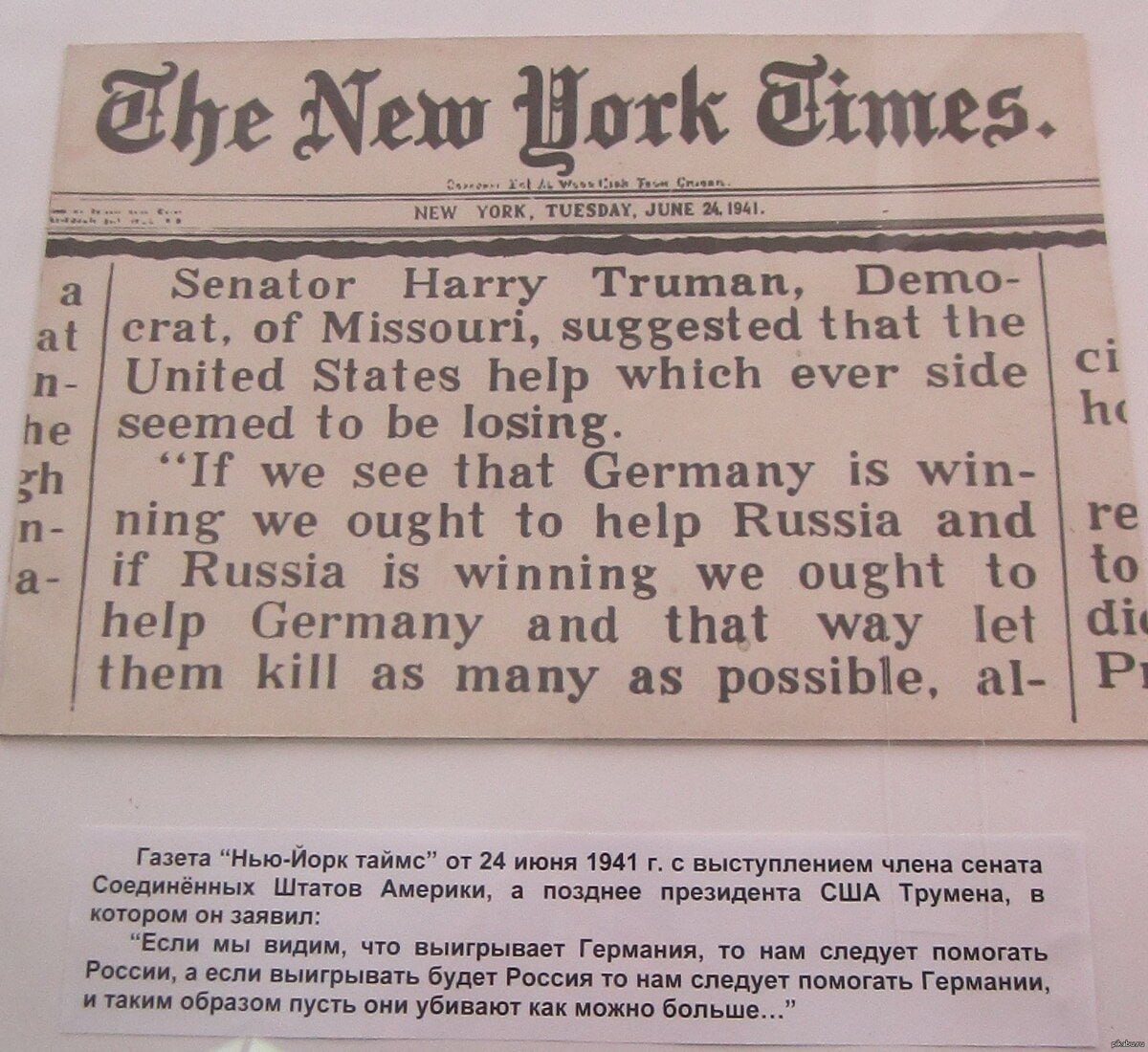
Knowing many aspects of my country’s darker history and recognizing our current “Fuehrer’s” malign tendencies, I’ve grown somewhat alarmed by Russia’s apparent warming toward the US. I hardly think that any “alliance” is eventually likely between our two countries, as the SVR article speculates in its conclusion. To the contrary, the current negotiations strike me as extremely self-serving for the US side. And should a war break out between Europe and Russia, I strongly suspect that the US stance would be much like that of Harry Truman (while still in Congress) during World War 2: ‘Let the two sides exhaust each other, and then we’ll move in and pick up the pieces.’ [paraphrased]

The SVR piece also quotes a US academic regarding Britain’s employment of “concentration camps and genocide”. But as I recall from other reading, Hitler’s inspiration was drawn directly from the US internment and genocide of native Americans. And several other observations can be as equally applied to the US as to Europe.

I sincerely hope that Messrs. Putin and Lavrov remain extremely cautious and sceptical when dealing with the Trump administration. While Witkoff seems a sincere negotiator, he is only the messenger, in this case for a likely pack of wolves dressed in sheep’s clothing.

Here, JMF added the entire quote:

“If we see that Germany is winning we ought to help Russia and if Russia is winning we ought to help Germany, and that way let them kill as many as possible, although I don’t want to see Hitler victorious under any circumstances. Neither of them thinks anything of their pledged word.”
– Senator Harry S. Truman


Reply from Beorn And The Shieldmaiden

Brian Berletic’s publications are, indeed, well-worth reading, and we often forward his Telegram posts to our channel.

This article “US Plays ‘Mediator’ in its Own War on Russia” is no exception and overall, we agree with the analysis in Brian’s article. Incidentally, toward the end it contains one paragraph that in a way addresses the concern, outlined by JMF:

Russia, for its part, has left the door open for honest negotiations and has provided the United States ample exit ramps from both an unwinnable proxy war and indefinite confrontation with Russia into the future. The US is obviously not interested. Russia had, throughout “peace talks” with the US, continued its war of attrition against Ukrainian forces, continuing the process the New York Times describes as the central contributing factor for the proxy war’s current failure.

The Shieldmaiden and I also pondered the seemingly contradictory policy of Russia towards the USA, and The Shieldmaiden came with a concise and encompassing definition: “escalation management”.

Russia, just like the USSR in 1938-1940, is doing its utmost to prevent a world war, without conceding own interests. The goals for the SMO have been set in 2022: denazification and demilitarisation of Ukraine. And, as Peskov said the other day, they will be achieved regardless, either through peaceful means or militarily. Naturally, a peaceful realisation of those objectives is preferable.

So, what Russia is doing now, is a pro-active escalation management as multiple levels and dimensions are involved in the diplomacy of shaping the battlefield for the best outcome control in predicted risk situations, including psychological ones. Russian is guiding Trump’s impulsive and unpredictable emotionally-charged presidency into a more subdued form, balanced out by equally emotional (and economic) counterweights. Hopefully this will contribute to prevention of World War III flaring up on the usual battlefield – Europe.

EU, for its part, has already designated 2030 as “the year when Russia will invade Europe”, which, applying the 180 degree rule, means that Europe is planning the next “drang nach osten” for that year. This is what Russia need to avoid, using Trump’s impulsivity if need be, to achieve that goal. That is also the underlying motive for the article from the SVR, to rebuild the diplomatic ties with the USA as the only force that can influence Europe.

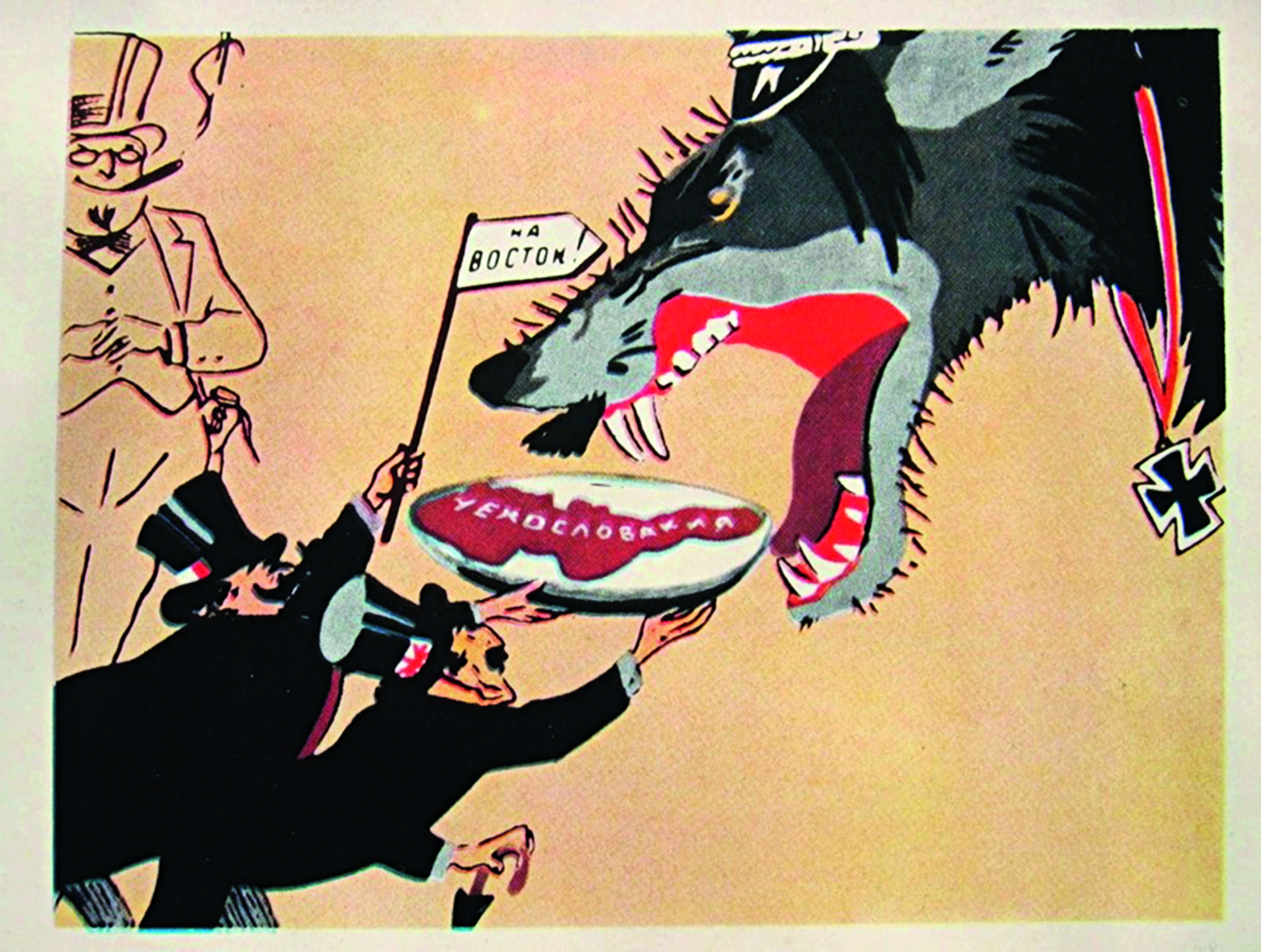
Still, Russia is very much mindful of the history of WWII and the preceding years. As in this contemporary Soviet caricature from “Kukryniksy” about the “Munich Conspiracy”, where UK and France are offering Czechoslovakia to the German wolf, while hilding up the sign with the words, pointing “To the East”.

Anatoly Sobchak talks about Ukraine and Crimea in 1992

Reading time: 2 minutes

Listen to Anatoly Sobchak, the one and only mayor of Leningrad/St. Petersburg, speak about Ukraine in 1992, shortly after the Soviet Union broke apart in 1991.

Read also: The referendum on the independence of Ukraine on December 1, 1991: how Kravchuk deceived Sevastopol and Crimea

The translated video and the transcript of the fragment by Putinger’s Cat.


Backup at Rumble.

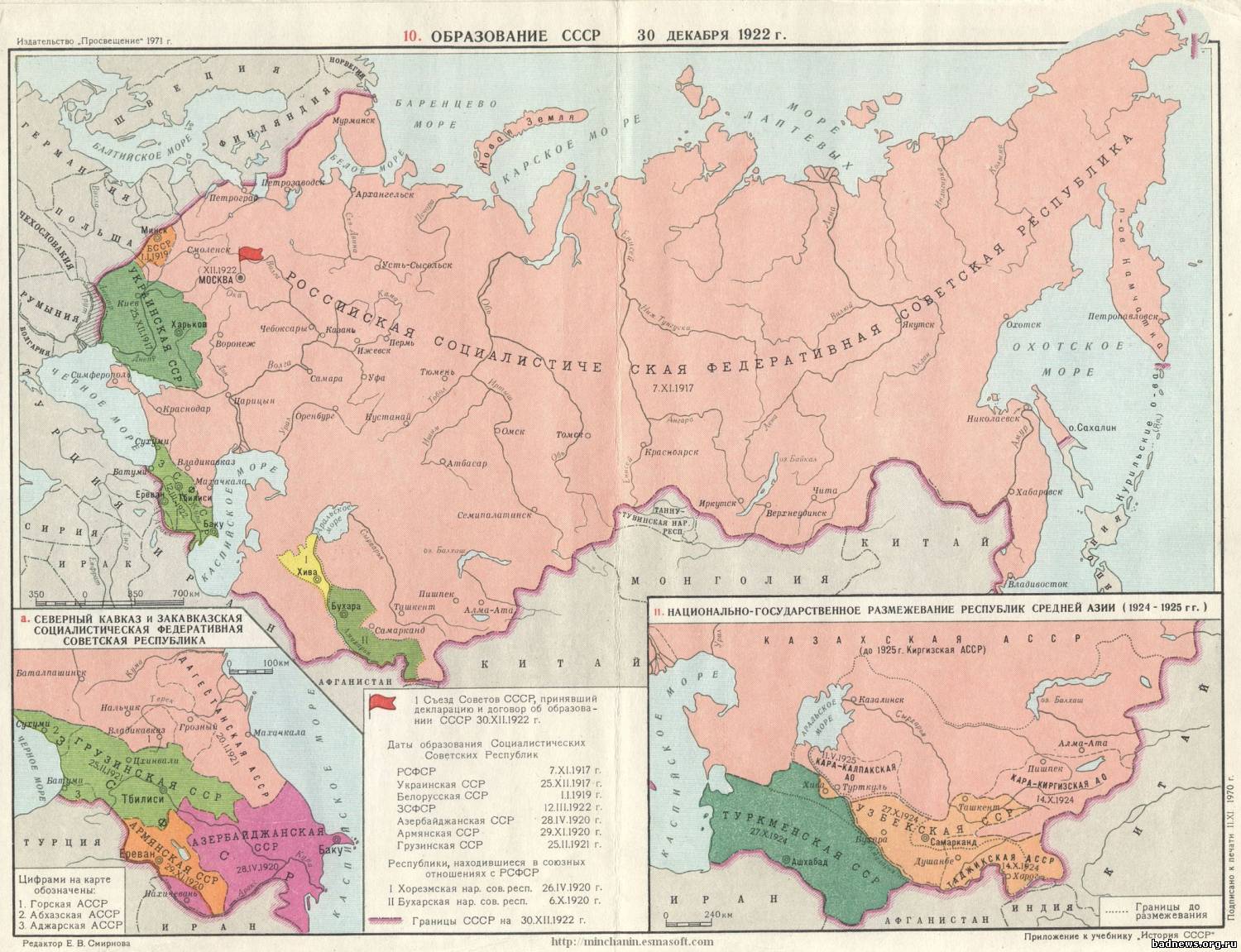
USSR 1922

USSR in 1922

In this case, there’s only one possible lawful scenario, which is legally correct and just. The founding republics that formed the USSR in 1922, after the annulment of that 1922 agreement, should return into the borders they had at the time of entering the USSR. Anything else, all other “territorial gains”, so to speak, are matter for discussion, negotiation and decision-making, because the foundation has been annulled.

As to the Black Sea fleet’s fate, I don’t want to talk about, say, territorial claims, fate of the Crimea, but there is a good number of precedents when naval bases belonging to one country were located in the territories of another one. Even if we suppose such absurdity that Crimea is a territory of Ukraine, Sevastopol has never been the naval base of Ukrainian Navy. It has always been a Russian Naval base. And this is a situation that cannot change under the influence of some momentary circumstances. It is impossible to change in one day that which has come together over centuries, even if it was decided by the representatives of the communist establishment along with nationalists.

The actions of Ukraine in relation to, let’s say, the Soviet army and navy pose a colossal threat to humanity as a whole. I am opposed to solving any territorial conflicts by force. There should be negotiations, but time must not be lost. Ukraine must not be allowed to create an army, which, if it does create, it will certainly use. I don’t doubt that for a minute. And I think that today we are placing a mine not only under our future, but also under the future of all mankind.

This is a cut from an hour-long video of Sobchak answering journalists’ questions (in Russian):

Eurofascism, like 80 years ago, is a common enemy of Moscow and Washington

Reading time: 6 minutes

The Press Bureau of the External Intelligence Service (SVR) of Russia published an insightful analytical article, drawing on many historical parallels. One thing that they have not explicitly stated, though, is that the USA is once again, just like in 1944, inserting itself as a solution to the problem they contributed to create in the first place – we shall not forget Nuland’s cookies of 2014!

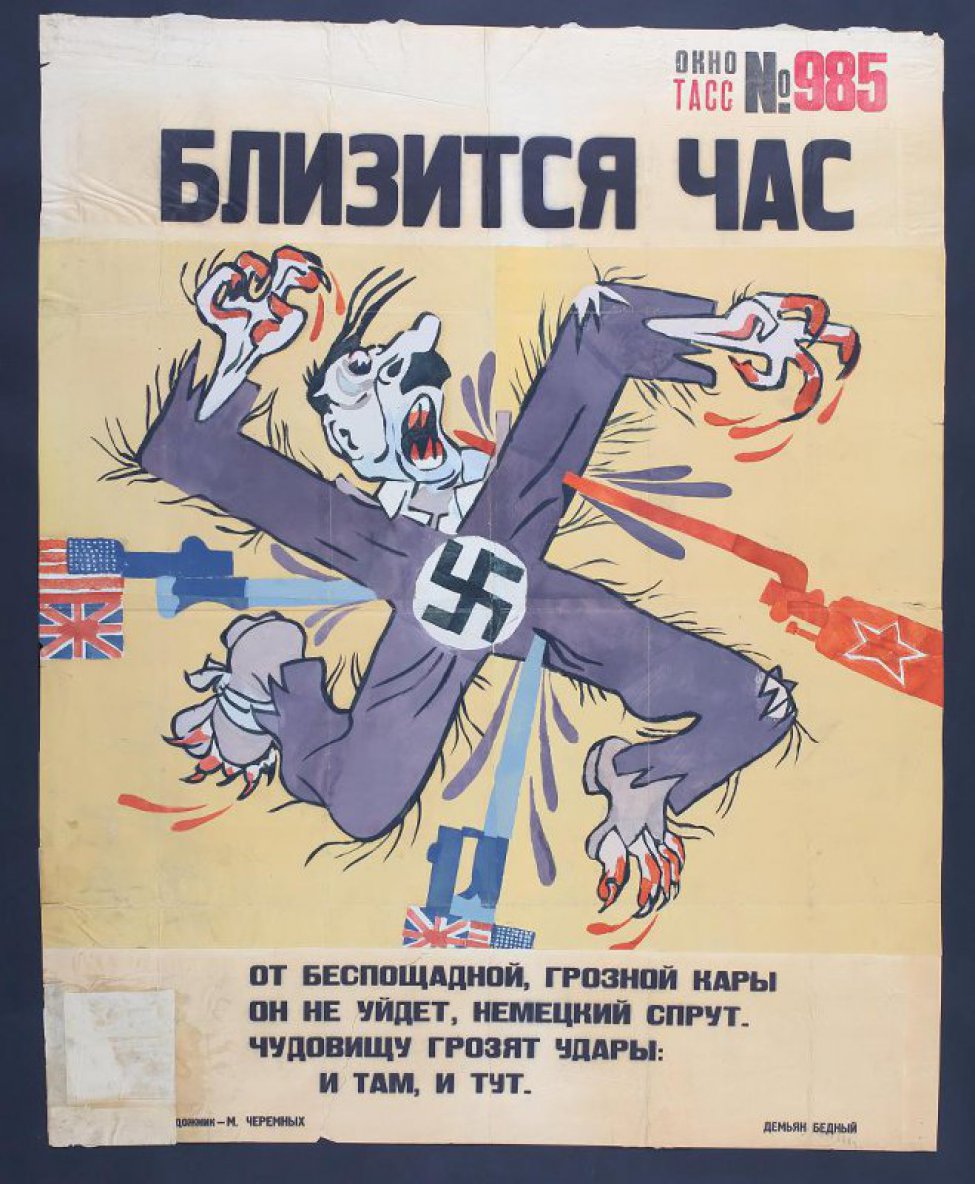
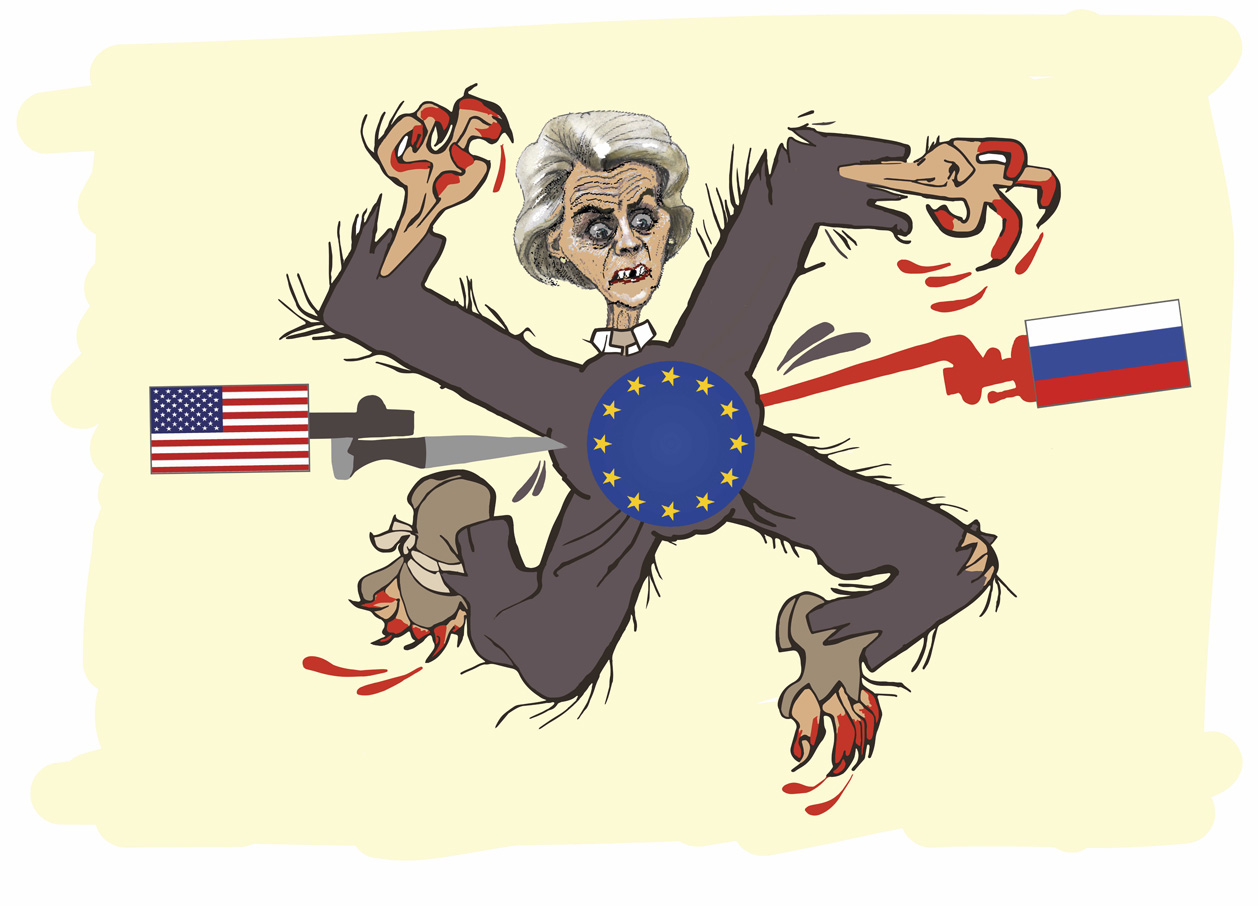
The article is opened by a caricature, which is a modern variation of the well-known War-time “TASS Window” (see our article The “TASS Windows” – the windows to our struggle in the Great Patriotic War), which appeared after the… allies deigned to open the second front.

The Hour Draws Near
The merciless, fearsome punishment
Shall not escape the German squid
The monster can expect the blows
Coming from here and there.

Artist: M. Cheremnych, verse by Demyan Bedny.

UPDATE 20.04.2025: We have replaced our translated text with the official translation that appeared at the Telegram channel of the Russian Foreign Ministry. The original text in Russian is at the site of the SVR.


Eurofascism is Moscow’s and Washington’s common enemy, just like 80 years ago

– The Press Bureau of the SVR of Russia, April 16, 2025

A hind-sight study of Western states’ policies attests to Europe’s “traditional propensity” for various forms of totalitarianism which regularly produces cataclysmic global conflicts. Specialists believe that the current rift in relations between the United States and the EU countries who blame Donald Trump for totalitarianism in the context of the upcoming 80th anniversary of Victory in the Great Patriotic War is becoming a factor that contributes to an alliance of convenience between Moscow and Washington the way it used to occur in the past.

This is confirmed, in particular, by a scandal involving French European Parliament member Raphael Glucksmann who demanded that the Americans “who have chosen to side with the tyrants,” return the statue of Liberty, Paris’s gift to the United States. Raphael Glucksmann, one of the globalists and a dedicated supporter of the Kiev regime, criticises the Oval Office master for slacking support for Ukraine and firing civil servants who stick to liberal views. White House press secretary Karoline Leavitt slammed the “daring Gaul” having reminded that “unnamed low-level French politician” that it’s only because of the United States of America that he is speaking French and not German now.

It was pointed out that the multiple dictatorial regimes that were in power in France “distinguished” themselves by unparalleled cruelty and atrocities. Among those mentioned are the Jacobin dictatorship that killed thousands of French citizens in 1793-1794 and imprisoned 300,000 on suspicion of “counterrevolution,” as well as Napoleon’s bloody acts. It was stressed that America is free thanks to their ancestors’ readiness to counter such dictatorships as the British monarchy or the Jacobin revolution.

Experts believe that the notion of Eurofascism was introduced by French author and columnist Pierre Drieu La Rochelle who collaborated with German occupational authorities during WWII, and justified it as an ideology inherent not only in Germans but also other “societies” in Europe. In this context we can recall the French volunteer SS-Division Charlemagne which was named after Emperor of the Carolingian Empire, “Europe’s unifier.” The division’s soldiers were defending the Reichstag from the assaulting Red Army till the last hours of the German Nazi regime. Twelve of those fanatics were captured by the Americans and handed over to French General Phillipe Leclerc. As early as May 8, 1945, he ordered to shoot those war criminals without unnecessary judicial procrastination.
Continue reading →

Lukashenko’s Visit to Belgrade under NATO bombs

Reading time: 4 minutes

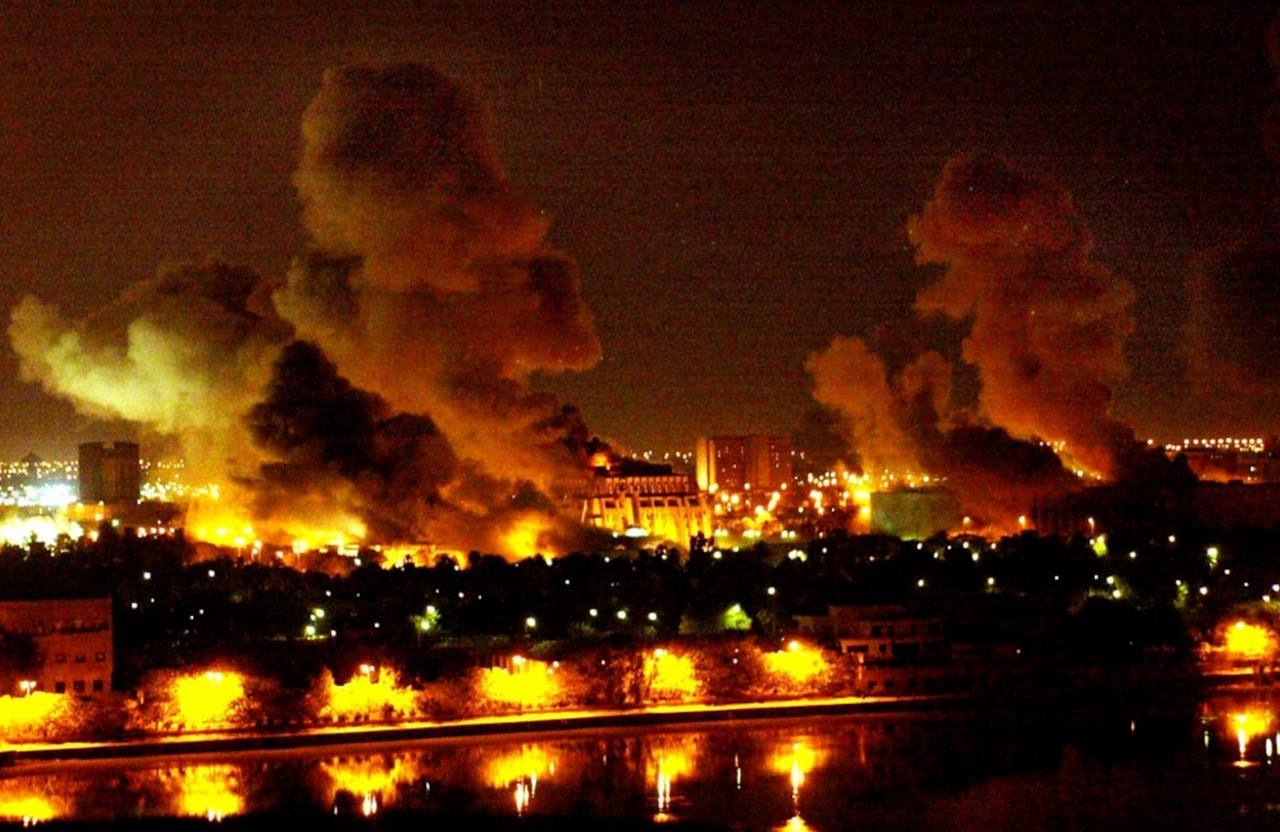
This article with two video reportages (with transctipts) presenting footage of President Lukashenko’s visit to Yugoslavia on April 14, 1999 is an important historic testimony to one overlooked and forgotten reason for why NATO, with the help of the armed terrorists on the ground, was so relentlessly bombing and dismantling Yugoslavia. This reason is mentioned in both videos almost as a footnote – Yugoslavia intended to join the Union state of Russian and Belorussia. However, it may nave been the main reason for the NATO’s savagery.


Under NATO bombs: On April 14, 1999, President of Belarus Alexander Lukashenko flew to Yugoslavia

NATO not only did not guarantee flight safety, but also sent fighter jets to intercept. Lukashenko did not change his plans. The alliance’s airstrikes continued both during the negotiations and during the trips of the Belarusian president to Belgrade.

At the talks with Slobodan Milošević, Lukashenko represented the agreed position of Belarus and Russia. He was saying: “If we get even one millimetre closer to peace, we will be very satisfied.”

However, just a few months later, Yugoslavia ceased to exist.

Source: Sputnik Belarus


Backup at Rumble.

Aleksander Lukashenko was not scared off. Despite the warnings of NATO bosses that he would not be guaranteed security in Belgrade, he still flew to the Yugoslav capital.

He flew with one goal: to bring peace in Yugoslavia closer by at least a few millimetres.

“I am glad that I flew to Belgrade at this difficult time for this country. And I think that, as I said at the airport in Minsk, if we, at this time, get a few millimeters closer to peace, and if this Belarusian delegation will contribute to this, [we will be very satisfied]”.

During the talks with Milosevich, Lukashenko first of all relied on his friendly relations with the Yugoslav leader. However, he was speaking not only from his own name.

“This is a conceptual continuation of the negotiations that were started here with Evgeny Maksimovich Prymakov. We coordinated with him every day, clarified the positions. And only yesterday we agreed on one new idea that could promote the peace process here. I will not talk about it yet, we will discuss it with the President.

That is, we have a whole set of items, mutually agreed upon by Belarus and Russia. I am most likely speaking here as the Chairman of the Supreme Soviet of the Union of Belarus and Russia, not only as the President of Belarus.”

Lukashenko discussed the agreed position of Russia and Belarus for two and a half hours with Slobodan Milošević.

This was happening to the sound of air raid alarm, sounded in Belgrade a few minutes after the landing of the plane of the Belarusian President and against the background of new bomb strikes by NATO aviation.

The main thing that Lukashenko ascertained during the negotiations is that the President of Yugoslavia is firmly determined to preserve the territorial integrity of the country, ensure equal rights for all its citizens and does not try to draw Belarus and Russia into a war in the Balkans.

According to Lukashenko, this is what NATO and other interested parties should use the starting point.

In addition, the Yugoslav President once again confirmed his desire to solve all problems peacefully and stated the readiness to bring into Kosovo the UN civil observers and other international organisations not associated with the aggressor countries.

Slobodan Milosevich handed over to the Belarusian President the official request for the entry of Yugoslavia into the Union of Russia and Belarus.

👉 BATS notes: That last point sheds an additional light on why US-EU-NATO so relentlessly bombed Yugoslavia — to prevent it from joining Russia and Belorussia.


The frontier beyond which they would never retreat

Continue reading →

Reunification of the Left Bank of the Dnieper with Russia. With re-blog of a detailed article by Vladimir Putin.

Reading time: 30 minutes

Our re-blog of the publication by the Russian Foreign Ministry on the anniversary of the reunification of the Left Bank of the Dnieper with Russia, followed by the complete re-blog of an article by Vladimir Putin ”On the Historical Unity of Russians and Ukrainians“.

A small linguistic/phonetic aside. The name “Khmelnitsky” is pronounced “Hmelnitsky” (with “h” sounding as in the word “home”); and “Hetmanate” is pronounced “Getmanate” (with “g” sounding as in the word “get”).


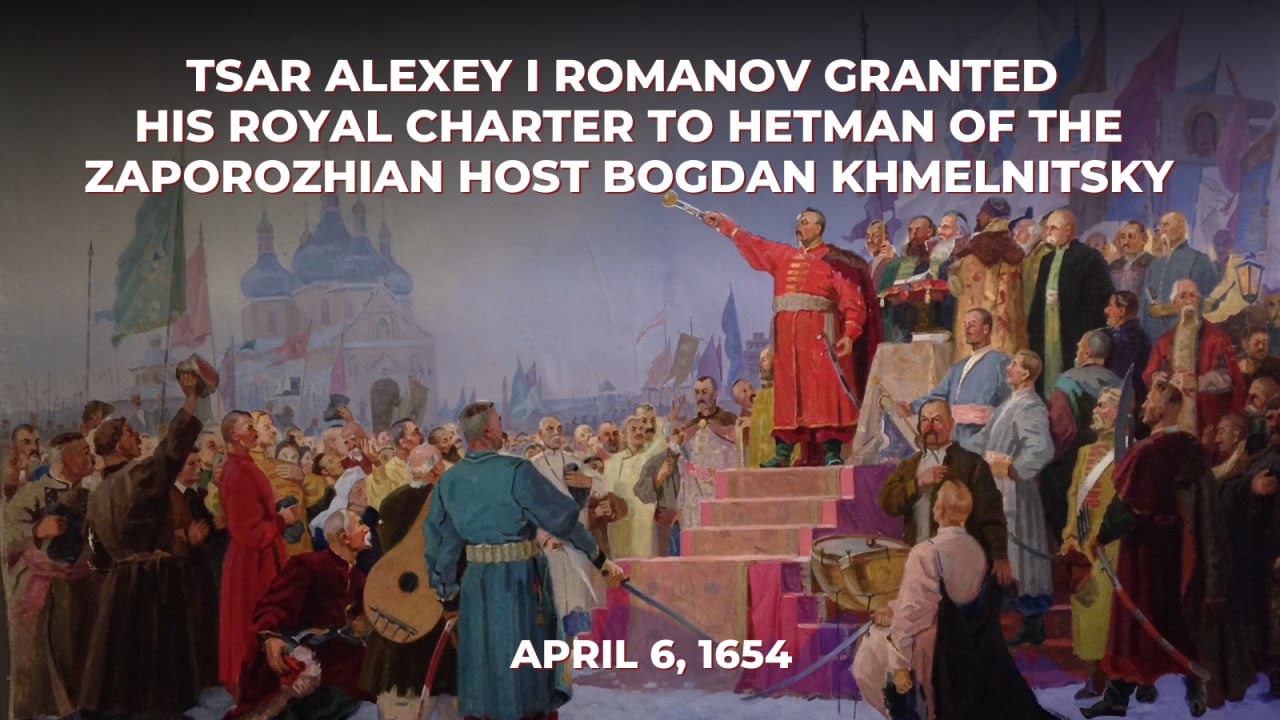
On April 6, 1654, Sovereign, Tsar and Grand Prince of all Russia Alexey I Romanov, “The sole ruler of all Russia Great and Little”, granted his royal charter to Hetman of the Zaporozhian Host Bogdan Khmelnitsky. The document secured the reunification of the Left Bank of the Dnieper with Russia.

In the late XVI and the early XVII century, all groups of the Orthodox population in the lands of Ancient Rus, controlled by the Polish-Lithuanian Commonwealth, were subject to an increased religious and ethnic pressure from the Polish-Lithuanian gentry, which sought to fully assimilate local residents through a policy of Polonisation and Latinisation.

After the Union of Brest was adopted in 1596, a majority of Orthodox priests became subordinate to the Pope. Those who remained faithful to Orthodoxy became outcasts and were deprived of hierarchical leadership, since Metropolitan of Kiev Mikhail Rogoza had also joined the Greek Catholics.

Amid forced Catholicisation, the loss of noble titles and lands, and ongoing persecution, the local Orthodox population began searching for ways to escape oppression. All attempts to come to an agreement with the Polish king failed as the Polish gentry firmly refused to acknowledge the autonomy of the Orthodox Cossacks and nobility.

✊ In 1648, a major liberation movement was sparked, led by the renowned military and political leader Bogdan Khmelnitsky. The Cossacks rebelled against the Polish oppressors to defend their faith, identity, and the right to self-determination.

Recognising the need for a stronger alliance, Khmelnitsky made several appeals to Tsar Alexey I of Russia, requesting protection and support, and asking him to take the lands of the Hetmanate under “his royal hand”. In 1653, Hetman Bogdan Khmelnitsky approached Tsar Alexey I, asking him to accept “all of Little Russia (Malorossiya) and the entire Zaporozhian Host into his eternal possession, allegiance, and protection” Later that year, in May, the Zemsky Sobor convened in Moscow, where an unequivocal decision was adopted in favour of the integration of Malorossiya into the Russian state.

On January 18, 1654, Pereyaslav Rada made a historic decision — the Zaporozhian Cossacks declared their allegiance to the Russian Tsar. On April 6, Tsar Alexey I of Russia signed the royal charter, which mentioned the Russian monarch’s title “the sole ruler of all Russia Great and Little” for the first time, emphasising the historical continuity of a unified state.

❗️ The Pereyaslav Agreement reflected a natural historical process of returning the ancient Russian lands to the unified Russian state and reuniting parts of a single nation, divided by civil strife and the Golden Horde yoke.


On the Historical Unity of Russians and Ukrainians

– Article by Russia’s President Vladimir Putin, July 12, 2021

During the recent Direct Line, when I was asked about Russian-Ukrainian relations, I said that Russians and Ukrainians were one people – a single whole. These words were not driven by some short-term considerations or prompted by the current political context. It is what I have said on numerous occasions and what I firmly believe. I therefore feel it necessary to explain my position in detail and share my assessments of today’s situation.
Continue reading →

The “Not an inch Eastward” NATO abomination is turning 76

Reading time: 17 minutes

At “Beorn And The Shieldmaiden” we are marking the sad date of the 76th year of NATO burdening the world with forever wars…

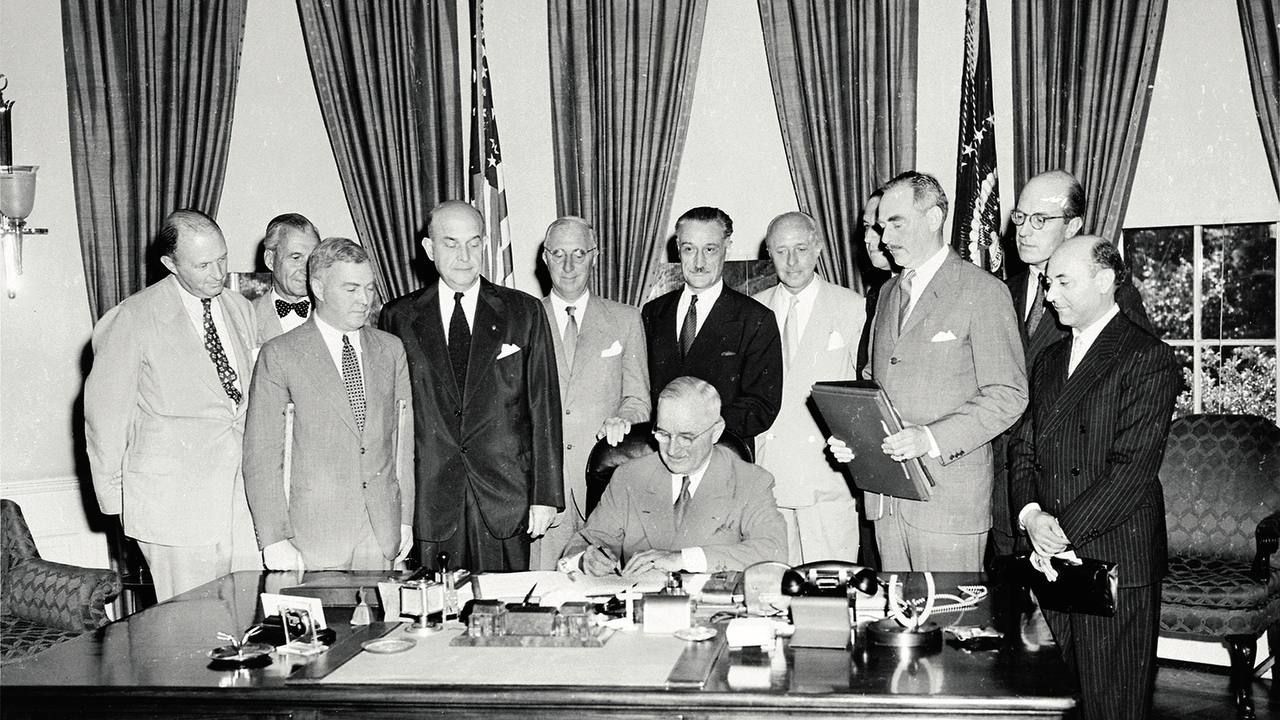
On the 76th anniversary of NATO

In Washington, on April 4th 1949, the foreign ministers of ten Western European countries together with the United States and Canada, signed an agreement on the creation of the military-political NATO bloc. In its 76 years of existence, this instrument of US imperialism has tormented humanity as world champion of children’s mass murder, destructor of nations, peoples, heritage. Creator of chaos and hunger, grief, loss and heartbreak, devastation and despair. A menace! An abomination!

One year ago, on the occasion of the 75-years jubilee, we wrote:

“We won’t send any congratulations.
But dear NATO, receive our deepest and most sincere wishes for a quick demise.”

Since then, mouths of the US MIC has forcefully been pushing for massive re-armament of European NATO countries to fill orderbooks and pockets of shareholder billionaires. Calling for war against a fake aggressor while salivating over the expected spoils of plunder, in no regard of the sanctity of life, in lack of anything human, serving only the dictum of profits; the classic strategy of crisis struck capitalism: Fascism.


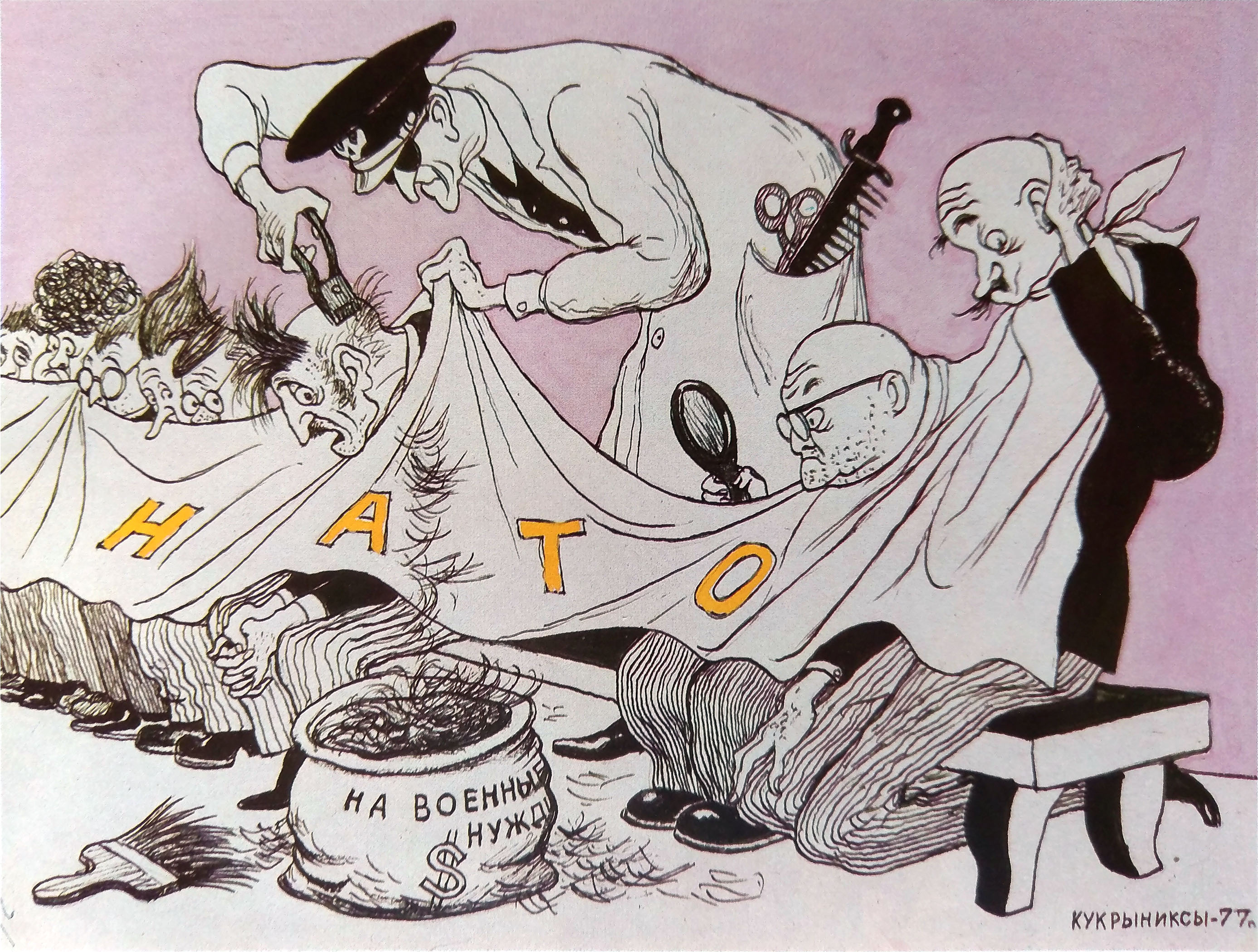
Shaving the NATO sheep for the needs of the American MIC

Before you are two caricatures by the Soviet art collective “Kukryniksy” on the topic of the financial obligations of the NATO members before their American master.

The first caricature appeared in 1950 under the title “At the Marshallised Hairdresser. Standard hair-do”, referring to the “Marshall Plan”, which de-facto ensnared the whole of Western Europe in a financial net. The hapless members are sitting on the “Atlantic Treaty” bench, being shaved by Dean Acheson — the 51st Secretary of State in the Truman administration.

The British Ernest Bevin and the French Robert Schuman are already admiring their clean scalps, while the Italian Alcide De Gasperi is in the process of getting a new haircut. Next in line, tied by a single blanket, are the Be-Ne-Lux.

The illustration is from the “Kukryniksy 100 Years” Exhibition.

😈😈😈

The second image is a 1977 take by the “Kukryniksy” on the same topic. Now, the names of the individual politicians are gone, replaced by a single, all-tying NATO blanket. At the foot of the bench, the $-box has grown and turned into a whole sack, carrying a label “For the military needs”. And the shaving is done by the embodiment of the menacing-looking American Military-Industrial Complex.

The caricature is from the Kukryniksy artbook in The Shieldmaiden’s library, the book’s chapter with the title “Nuclear Maniacs”.

‼️ Here are several of the highly-relevant Soviet caricatures about NATO, which we showcased on our Telegram channel!
Continue reading →

The anniversary of the Karelo-Finnish SSR, and an unexpected turn in the “Wild ’90s”

Reading time: 10 minutes

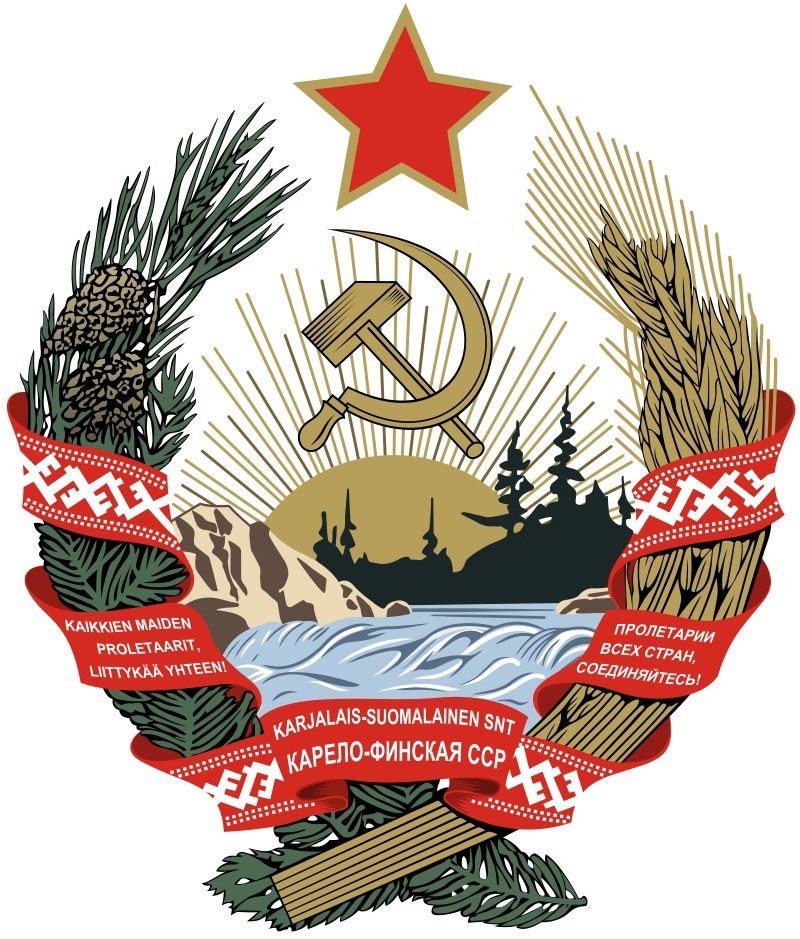
We shall start with the contents of the post from our Telegram channel “Beorn And The Shieldmaiden”, where we marked the creation of the Karelo-Finnish Soviet Socialist Republic, and proceed to the translation of an article from “Argumenty i fakty” from July 23, 2019, which takes a deeper historical dive into the topic, as well as uncovers an unexpected twist from the “Wild ’90s”. The article also adds more touches to the portrait of the late Genndy Burbulis.


On March 31, 1940, at the sixth session of the Supreme Soviet of the USSR in Moscow, the law on the transformation of the Karelian ASSR into the Union Karelo-Finnish SSR was adopted.

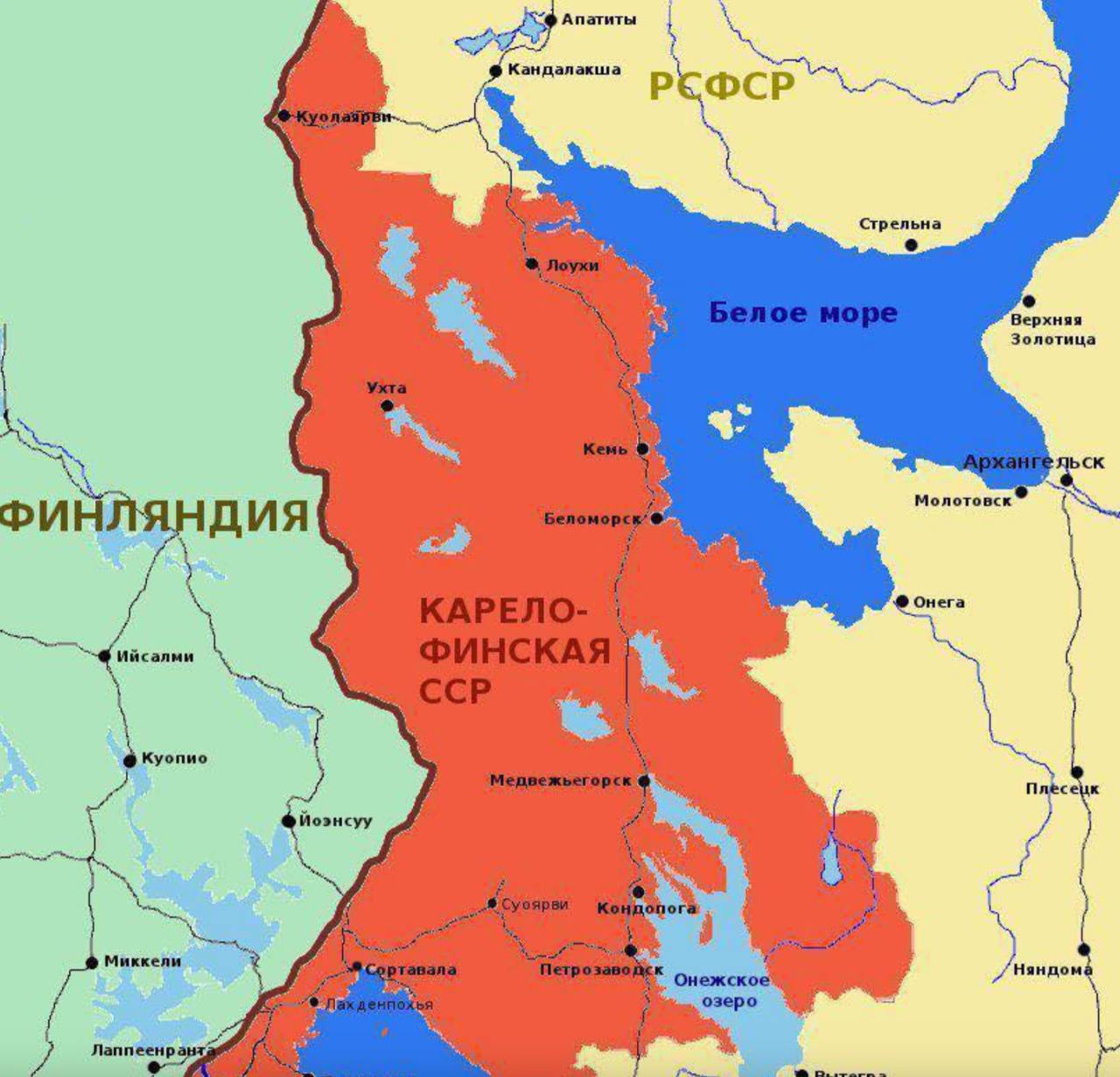
Most of the territories acquired by the USSR under the Moscow Peace Treaty, which ended the Soviet-Finnish “winter” War (1939 – 1940), were transferred to the KFSSR.

At that time, the Karelo-Finnish SSR became the 12th Union Republic of the USSR, in connection with which amendments were made to the Constitution of the USSR. Petrozavodsk remained the capital of the KFSSR.

♦️♦️♦️

In 1954 – 1955, relations between Finland, headed by President J. K. Paasikivi, and the USSR, headed by N. S. Hrushyov, began to improve. In early 1956, Paasikivi refused to run for a new term, and Urho Kekkonen was elected president in March.

On January 1, 1956, the USSR prematurely returned the territory of Porkkala to Finland, which it had received under the peace treaty, approved Finland’s neutrality and did not prevent its entry into the UN.

On July 16, 1956, the KFSSR was officially downgraded to the ASSR and returned to the RSFSR. At the same time, the word “Finnish” (Karelian ASSR) was removed from its name. The transformation of the KFSSR into the Karelian ASSR was supposed to show that the USSR had no aggressive goals regarding Finnish independence, and at the same time put an end to attempts by Finnish politicians to re-raise the issue of redefining the borders and annexing the western regions of Karelia (the Karelian question).

Source

♦️♦️♦️

In retrospect, if such a change had not happened in 1956, Vyborg and Petrozavodsk would now be outside of Russia, while Murmansk would be in the position of Kaliningrad.


The price list of Burbulis. Was Russia going to sell Karelia to Finland?

In the early 1990s, Russia could lose Karelia. There was no talk of secession of the Russian region on the initiative of local authorities: the federal government was thinking of selling Karelia to neighbouring Finland.

15 billion for the “problem territory”

“The idea of selling Karelia back to Finland was an emergency decision by Russia due to lack of money in 1991,” writes Finland’s largest newspaper Helsingin Sanomat, referring to the words of former Russian Deputy Foreign Minister Andrei Fedorov.

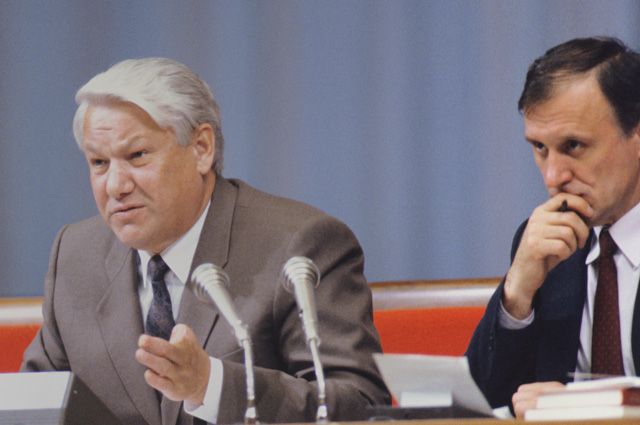
According to Fedorov, in the summer of 1991, in an atmosphere of the strictest secrecy, a working group was formed, which included Russian Foreign Minister Andrei Kozyrev, Fedorov himself, as well as Boris Yeltsin’s adviser Gennady Burbulis. The group was engaged in compiling a list of regions with a high risk of the growth of nationalist sentiments and the strengthening of extremist movements, advocating their own autonomy. Karelia was also included in the number of high-risk zones, referring primarily to the territories annexed following the Soviet-Finnish war of 1939-1940.

As Fedorov told Finnish journalists, Moscow was seriously considering selling the troubled territories for $15 billion, thereby replenishing the Russian treasury.
Continue reading →

Foreign Minister Sergey Lavrov’s interview for the No Statute of Limitations: The Front without a Frontline project, Moscow, March 30, 2025

Reading time: 5 minutes

A reblog of the interview, published on the site of Russia’s Ministry of Foreign Affairs.

Question: Mr Lavrov, could you please explain why there are attempts today to downplay or even completely deny the role of the Red Army and the Soviet people in the victory over Nazism?

Sergey Lavrov: It is a traditional position of the West to seek to weaken its competitors. Europeans dominated for about 500 years, primarily because they sought to conquer as much land as possible and enslave as many people as possible. Essentially, all of humanity’s tragedies that occurred before 1939, including World War II, were triggered by Europeans. From colonialism, slavery, and the Turkish wars, to the First and Second World Wars, these were all attempts by various powers in Europe to suppress their competitors.

In fact, there is nothing new about competition. People and states have always competed with each other. But the methods used by Europe to suppress its competitors were horrendous. These instincts are deeply ingrained in today’s European society, particularly in the elites currently in power in most EU and NATO countries. Although there is growing opposition against such actions, these policies still persist.

The instincts of the ruling class in Europe are clearly evident in what is happening in Ukraine – the war that the West has unleashed against the Russian Federation, using the Kiev regime as its proxy and paving the way for its juggernaut with the bodies of Ukrainians. Just like Napoleon mobilised almost all of Europe during the Patriotic War of 1812, and Hitler, after conquering most of Europe, put the French, Spaniards, and a large part of the continent’s countries under arms, this is also happening now. The French conducted punitive operations, and the Spanish participated in the blockade of Leningrad. This is a well-known fact.

Therefore, we can see even today that almost all of Western Europe has been mobilised to try to prolong the existence of the Nazi Zelensky regime. Just like during Hitler’s era, this is being done under Nazi flags, with SS Totenkopf chevrons, etc, and so on.

If we were to honestly describe the West’s contribution to the development of humanity, we would get an unseemly picture. That is why they are attempting to whitewash their actions and the actions of their predecessors. It’s no coincidence that the rehabilitation of Nazism is becoming one of the cornerstones of the West’s position in international discussions. At least, they vote against the resolution that the Russian Federation, along with its allies, submits annually to the UN General Assembly. This resolution calls for preventing the glorification of Nazism and similar racist practices.

They cynically try to insert amendments into this resolution, equating Russia’s actions – liberating people from Nazi oppression during the special military operation – with Nazism. But these attempts have not been successful, and I am confident that they will not succeed.
Continue reading →

“How falsification of history works in our reality”, a lecture by Yegor Yakovlev

Reading time: 7 minutes

History can be rewritten. But it will remind you of itself with a new trouble, rooted in the forgotten past!

The quote of from our previous article The Hungarian “Revolt” of 1956 – a detailed historical look at the events, carrying an idea that we wish to explore more. In this article, we start with a lecture by Yegor Yakovlev on the topic of history rewriting, followed by several re-posts from Russian MFA, and from a friendly Telegram channel Baza.


How falsification of history works in our reality

🎙 Yegor Yakovlev, a prominent Russian historian and creator of Russia’s largest scientific and educational historical project, “Digital History,” explains in his lecture how history is often being manipulated becoming a powerful tool that serves one’s political agenda and goals. This is particularly evident in the West, with certain academicians and media pushing and shaping anti-historical and anti-factual narratives that serve the Western neoliberal elites’ agenda.


Backup at Rumble.

Yakovlev highlights several common techniques of historical falsification:

🔻 Distorting facts to fit a particular narrative;
🔻 Selective omission of inconvenient events;
🔻 Unjustly equating historical events;
🔻 Manipulating timelines to downplay certain events.

Through concrete examples Yegor Yakovlev challenges widespread fakes about Russia’s and Soviet Union’s history, including:

• The Kiev regime and Western ridiculous ahistorical attempts to label the 1932-1933 famine in the USSR as a genocide against the Ukrainian people by Soviet leadership;

• The selective focus on the Non-Aggression Treaty between the Soviet Union and Germany while ignoring the Munich Betrayal, which in fact boosted Nazi Germany’s expansionist policies, as well as constant Soviet attempts at creating an anti-Hitlerite coalition throughout the 1930s;

• The heinous false narrative that equates the Soviet Union and Nazi Germany as equal aggressors in the outbreak of WWII, which distorts historical reality;

• Attempts to deny the Siege of Leningrad being a genocide, manipulating the timeline, facts & context of the events.

👉 Watch, learn & educate oneself to avoid being misled by Western and Neo-Nazi propaganda and fabrications that distort historical truth.


THE FALSIFIERS OF HISTORY WILL NOT WIN

The lies we are told about the history of Communism, so numerous, pervasive and conniving in their manufacture by ruling class agencies, will be easily dispelled in America the minute that history is concretely linked up with the struggles of today’s working class.
Continue reading →

What did Putin do for Russia. Reblog of a detailed research article

Reading time: 14 minutes

Rossijskaya Gazeta from March 28,2000. “We have elected V.V.Putin as new President of Russia. Live up to our expectations, Mr. President!”

Olga of “Siberian Matrëshka” posted at her Telegram channel:

25 years ago
We elected a new president.
V. V. Putin.

25 years ago, we were very lucky.

And she invites to read her historiographic retrospective article about what President Putin achieved for Russia in this short time span. An article which we highly recommend and are re-blogging below.


What did Putin do for Russia

Olga🪆May 26, 2022

There are people in Russia who don’t remember how much Putin has done for Russia:

• Over 17 years, Putin increased Russia’s budget 22 times, military spending – 30 times, GDP – 12 times (Russia jumped from 36th place in the world in terms of GDP to 6th place),

• increased gold and foreign exchange reserves by 48 times!

• returned 256 mineral deposits to Russian jurisdiction (3 left to return!).

• broke the most enslaving “liberal” in the history of production sharing agreements – PSAs (explanation below)

• nationalised 65% of the oil industry and 95% of the gas industry and many other industries.

• raised the industry and agriculture (for 5 consecutive years Russia has been ranked 2-3 in the world in terms of grain exports, overtaking the United States, which is now in 4th place).

• Well, it’s quite a trifle: Putin (it was he) reduced the extinction of the Russian population from 1.5 million people a year in 1999 to 21,000 in 2011, i.е. 71.5 times.

• In addition, Putin cancelled the Khasavyurt agreement – thus defended the integrity of Russia, gave publicity to NGOs – the 5th column and forbade deputies to have accounts abroad, defended Syria, stopped the war in Chechnya.

The abolition of the PSA by Putin is a great achievement! The PSA is an agreement under which America has been robbing Russia since the 90s and in return Yeltsin was given loans.

Putin fought for its abolition for almost 4 years with the help of numerous successive amendments. So the abolition of the PSA caused America’s incredible hatred of Putin, as he took away from them the unhindered robbery of Russia. Therefore, there is hatred for Putin, but, unfortunately, not everyone knows about it.

Why can’t Putin change everything at once? Why does he make forced stops? Why does he sometimes have to go to temporary agreements?

Yes, because the gentlemen “democrats” in the 90s drowned the country, sold it and gave the bastards the opportunity to live off Russian natural resources, adopted a thousand treacherous laws, including the Constitution of 1993, and weakened the country so much that it was difficult for Russia in the early 2000s to resist America without consequences, which is why Putin is fighting them gradually.

That is why Putin had to manoeuvre and do everything gradually, not in a single moment, but in one direction, and now he is also thinking about how to solve the problems of Russia and at the same time not expose it to being torn to pieces like Libya and Syria. America has long been tired of Putin, who takes away from them with enviable constancy, now their influence, now site after site that they robbed in Russia, then he proposes to replace the dollar with another accounting currency…

And it’s all dangerous…
Continue reading →