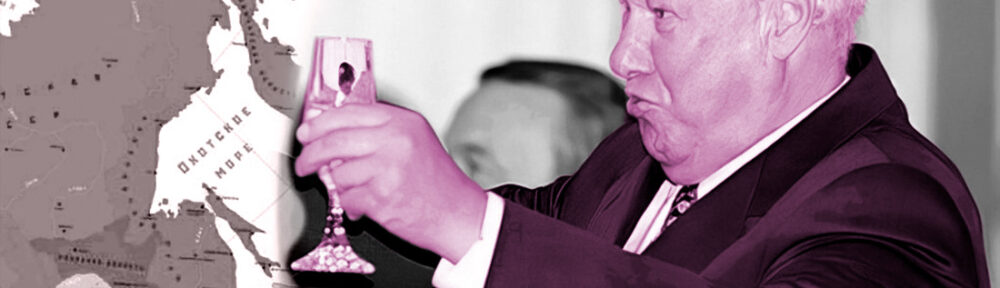
The Russian Federation was not yet a year old, when Yeltsin was planning to give away the land, required with the blood of the Soviet soldiers in 1945. This is the story of how Yeltsin’s grand giveaway of the Kuril Islands was thwarted by the Russian FSB. It is told over 3 articles, each bringing additional details and food for thought.
- “I’m the tsar, if I want to, I’ll give it away!”
- How the “headless” Minister of Foreign Affairs of Russia traded Russian lands
- How the military observer of Komsomolskaya Pravda saved the Kuril Islands from the surrender of Japan by Yeltsin – with additional testimonies
“I’m the tsar, if I want to, I’ll give it away!”
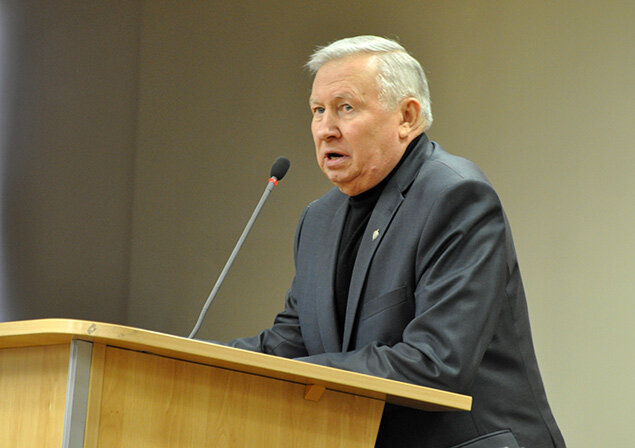
Boris Konstantinovich Ratnikov
Below is an interview of B.K.Ratnikov conducted by the correspondent of Komzomolskaya Pravda, Evegeny Chernyh on October 19, 2017.
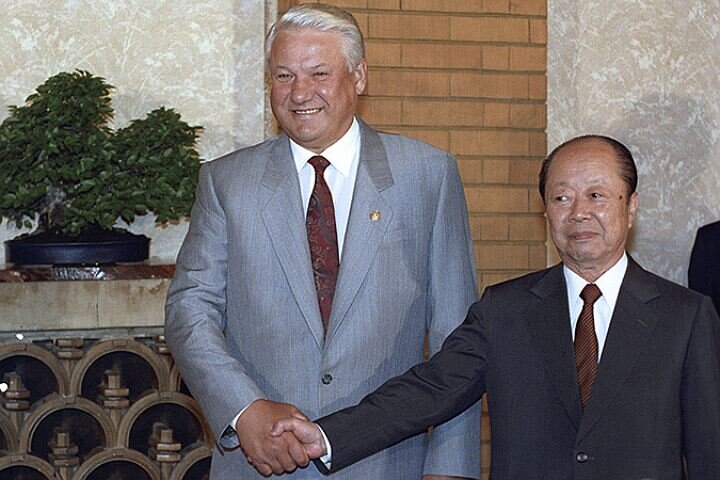
Ratnikov: On August 21, 1992, the decree of the Government of the Russian Federation No. 1553-r “On the preparation of the visit of the President of the Russian Federation B.N. Yeltsin to Japan” was signed by Gaidar, General Ratnikov recalls. – A working group was created headed by S. Glazyev, the then First Deputy Minister of Foreign Economic Relations of Russia. The historic visit was scheduled for September. I learned that in Tokyo Yeltsin was preparing to transfer 2-3 islands of the Kuril Ridge to Japan to demonstrate his new political course. Boris Nikolaevich wanted to show himself as a peacemaker. Khrushchev, Brezhnev, Gorbachev did not give up the islands, I could! He was encouraged to take this step by a number of figures from his inner circle.
Chernyh: Who exactly?
– Kozyrev, for example, who was the Minister of Foreign Affairs. The Japanese had already happily promised us the first loan of $100 million. But the Kuril Islands are a very sensitive issue. This is both the integrity of Russia and the fate of our citizens living there. Where would they go? There was no relocation or employment program. All this would have caused outrage in the country. General Georgy Rogozin and I decided to test the situation and see possible scenarios.
Rogozin was a strong “psychic operator” (BATS note: that is, an able analyst). We were literally stunned by the information we received. As soon as Yeltsin hands over the islands to Japan, China will immediately lay claim to its disputed territories to Russia. At that time, hundreds of kilometers of the border with China were not demarcated. An armed conflict could have started.
– As on Damansky Island in the spring of 1969. Then we lost 58 border guards, the Chinese lost about three hundred.
– This time, the conflict could become more widespread and even escalate into a major war that would weaken Russia and China, two competitors of the United States. That’s what the calculation was for overseas. Through agents of influence in the CPC Central Committee, Washington would have pushed the Chinese leadership to take decisive action. The Russians gave the disputed Kuril Islands to Japan, and what about us? If they don’t give up the territory, we’ll take it ourselves! After all, the Yankees had their hands not only on Kozyrev, who now lives in the United States, but also on responsible Chinese comrades. The international community would declare China an aggressor. The United Nations and a number of countries would apply economic and political sanctions against an aggressor who encroached on the sovereign territory of another state. Or perhaps they would have divided the Celestial Empire into ethnic regions. Beijing was in Washington’s way in establishing a unipolar world after the collapse of the USSR and the Eastern Bloc. Moscow was also in the way, but having lost the Soviet republics, it was in the background.
It was this catastrophic scenario that a seemingly innocent, peacemaking transfer of the disputed Kuril Islands to Japan led to, to which Yeltsin was pushed by Kozyrev.
I decided to check through the intelligence and counterintelligence agencies whether this information has a basis, can events develop according to the predicted scenario? A thorough check has shown that the alleged situation and its consequences are quite real. The islands could not be given away.
I immediately reported the findings of our intelligence services to my immediate superior, Alexander Korzhakov, head of the Presidential Security Service, and Yuri Skokov, Secretary of the Russian Security Council. Skokov was a very far-sighted and competent man, by the way, a non-drinker, for which Yeltsin disliked him. Skokov fully supported us and immediately went to the President, insisting on cancelling the visit. But in response, in addition to unpleasant words, I heard from Yeltsin: “Am I a tsar or not a tsar?! If I want to, I’ll give away, if I don’t want to, I won’t give it away!”
We realised that it was useless to expect meaningful actions from Yeltsin, and decided to act on our own.
Tokyo has not given security guarantees to the President of the Russian Federation
General Ratnikov continues the story:
– The preliminary program of the visit has already been sent to Japan and returned from there with adjustments on three counts.
1. Yeltsin should not go out “to the people”, because there are many motorcyclists on the streets of Tokyo, they can throw a molotov cocktail.
2. Yeltsin should not attend Sumo wrestling competitions, there is no way to check all the fans, and it is not proper to put the president of the Russian Federation in the emperor’s box according to etiquette.
3. Yeltsin should not travel to Kyoto to lay a wreath at the monument to the Russian sailors who died saving the Japanese during the earthquake. The cemetery is very overgrown, and there may be a terrorist sitting under every bush.
Otherwise, the Japanese side does not guarantee his safety.
We decided to base our actions these three prohibitions in order to cancel the visit and not allow Yeltsin to visit Japan. The next day, Foreign Minister Kozyrev met with his Japanese counterpart. I intercepted him before the negotiations. Telling him, they say there is a conversation on behalf of the President (although the President did not instruct me to do anything). I ask you once again to demand guarantees from the Japanese minister in case the wayward Yeltsin violates the 3 prohibitions stipulated in the protocol. Naturally, the Japanese minister did not take on additional responsibility. We immediately framed Kozyrev’s response in a memo to the Security Council.
– So you’ve started an intrigue, Boris Konstantinovich!
– Now I have to fly to Tokyo. I ask Kozyrev to give an encrypted telegram to our ambassador that General Ratnikov is coming with special powers. The paper certifying these special powers was given to me by Korzhakov. He offered to take a certificate signed by Yeltsin to make it more convincing.
I arrive in Tokyo late at night. Our resident and a security officer meet us at the airport. What happened?
“Guys, let’s go to the embassy, we’ll talk in the screened room.” There he explained the situation. I decided not to bother the ambassador, an elderly man, it’s already too late. The next morning we arrive, the ambassador is agitated, does not understand anything. All diplomatic traditions have been broken, and some kind of security guard with special powers has arrived. Damn what’s going on in Russia! Just in case, he set the table in his office at 9 a.m. – Cognac, whiskey, caviar… He had to act, the cyphered message came from the minister himself! Thanks, I said, I’ve already had breakfast. The ambassador’s hands are shaking. Calm down, I’ll explain everything now. Did you check the office for wiretapping? – Yes, only yesterday! – We need to cancel the visit, but save the face of the President of Russia. You continue to prepare for Yeltsin’s arrival, as if nothing would seem to have happened. These are my problems. When the order comes from Moscow, then stop everything.
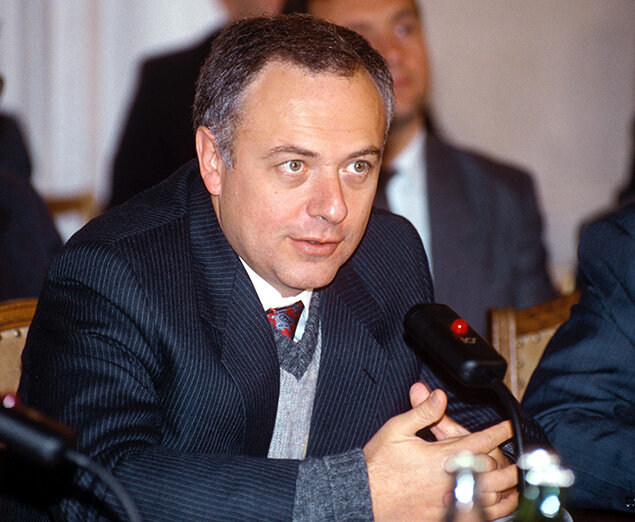
Kozyrev, the Minister of Foreign Affairs Photo: RIA Novosti
Together with the embassy security officer we go to the representatives of the Japanese special services. We are discussing with colleagues the security arrangements, the construction and passage of the motorcade, and communication methods… The Japanese are smiling and offering coffee. I’m polite too. As I leave, I casually ask if they will be able to ensure the full security of the President in the three mentioned cases. After all, Yeltsin is a peculiar person, he does not agree to comply with restrictions. I get a negative answer and boil with seemingly righteous anger:
“How is it that you, the Security Service, professionals, cannot fully guarantee the safety of our President’s stay with you?! Then why are you calling him to your place? I will report to Moscow that the visit was poorly prepared by your side.”
The Japanese were taken aback!
The samurai attack on Nicholas II
– And why did everything begin to hinge on these three points?
– There was a historical precedent. In 1891, Nicholas II, then heir to the throne, arrived in Japan on a month-long visit. On May 11, in the city of Otsu, Tsuda Sanzo, a police guard, suddenly rushed to the Russian prince who was passing in a cart along Shimo-Kogarasaki Street and hit him twice on the head with a sabre. Fortunately, the blows were glancing, but there was a lot of blood. The policeman did not have time to hit the third time, he was detained. The prince had a 9 cm long occipital-parietal wound with parted edges to the bone and a 10 cm long frontal-parietal wound running almost parallel to the first. It also penetrated through the entire skin to the bone. His right ear and right hand were injured. Nicholas defended himself from the sabre with his hand. This sabre and the bloodstained handkerchief of the Russian tsar are kept in one of the Japanese museums. Nicholas then interrupted the visit, the Japanese were even afraid that a war would break out. The tsar was plagued by headaches all his life, and on May 11 he always ordered a prayer service for health.
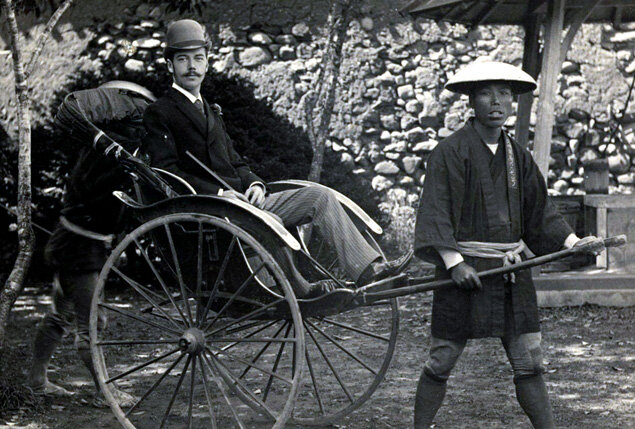
Nicholas Alexandrovich in Nagasaki
– Is that why the Japanese were afraid of such an attempt on the street, in a crowd?
– Exactly. I played on that. We return to the embassy, and there two buses with machine gunners are dispatched. The Japanese colleagues are simulating increased security for Russians. Opposite the entrance is an external surveillance car with antennas. I ask the officer, is there a good journalist from our central TV channels in Tokyo? “There’s a smart guy with RTR.” – “Call him!”
He called, and the journalist drove up. I explain the task. I come around the corner, you meet me with a camera right in front of a car with the external surveillance, and you ask how the preparations for Yeltsin’s visit are going. “Moscow will give no more than two minutes for the story,” says the journalist. “I’ll do it faster!”
It played out like clockwork. He meets me, asks, and I answer: “We have complaints against the Japanese side regarding the security of our president’s visit. Which we are trying to solve in a working order.” The external surveillance car immediately left at the sight of the camera.
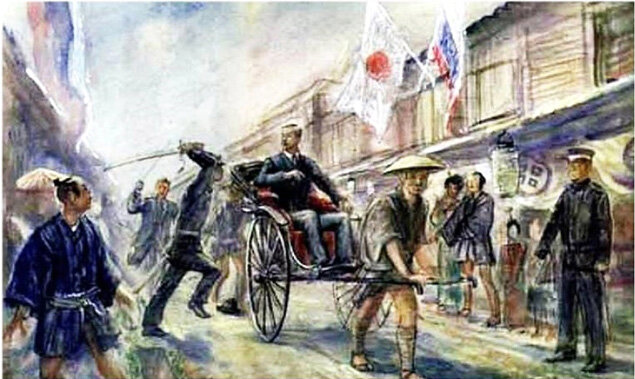
P.Ilyshev, “The Attack on Prince Nicholas “
Meanwhile I am sending a cipher message from the embassy to Moscow about the poor preparation of the visit. Skokov and I had agreed on that. He receives a cipher, urgently gathers the Security Council with one question on the agenda: should Yeltsin go to Japan or not. It is clear that every member of the Security Council is afraid for his position, so who wants to send the president to his death? And that’s how it turned out. The Council members are already attuned to my story in the Vesti program on the Russian state TV channel. And then there’s the encryption from the embassy and a memo about Kozyrev’s conversation with the Japanese minister, who also did not guarantee the president’s complete security. Well, who among the members of the Security Council, after such treatment, would dare to raise their hand for a visit? Everyone voted against it. That’s what I was counting on. Skokov confronts Yeltsin with the fact that the Security Council has decided to postpone the President’s visit to Japan for security reasons.
He was forced to agree. Although the lead group had already arrived in Japan, and the presidential “ZILs” in Irkutsk were waiting for the team to fly to Tokyo.
…Around three o’clock in the morning, an officer on duty came running to me at the embassy and informed me that a message about the postponement of the president’s visit had been broadcast on TASS. This is how we saved the Kuril Islands for Russia and the president’s face. It turned out that the Japanese themselves were to blame for the postponement of the visit. They did not give any guarantees of safety. The Japanese authorities were shocked by the cancellation of an already prepared visit. Prime Minister K. Miyazawa stated bluntly in an interview with the Yomiuri newspaper: “With all our understanding of the difficult situation in Russia, we can hardly find an explanation for such a move by the Russian president” (Yomiuri, 2.10.92). After that, a number of senior Japanese intelligence officials resigned. Some high-ranking comrades from Yeltsin’s entourage also tried to blame me when I returned from Tokyo. Why did you spread panic, they said, what right did you have to cancel the visit! I calmly replied, “Our service is responsible for Yeltsin’s life as the President of Russia. We must provide for all types of threats. If he were a private citizen, he could fly anywhere…” I managed to fight back.
But the Kuriles are still ours. And the war with China was avoided.
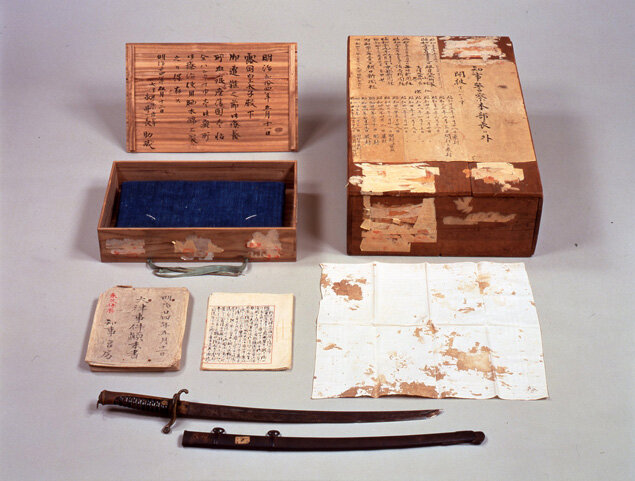
Tsuda Sanzo’s saber and Nicholas’s bloodstained handkerchief are among other things.
How the “headless” Minister of Foreign Affairs of Russia traded Russian lands
The article by Anatoly Koshkin was published at Regnum on October 22, 2017 and makes for an excellent follow-up to the above article.

The Kuril Islands on the flag of the Sakhalin region of Russia
During a conversation between Russian President Vladimir Putin and experts from the Valdai Discussion Club, Rein Mullerson, a professor at Tallinn University, told about a meeting in the early 90s between then-Russian Foreign Minister Andrei Kozyrev and former US President Richard Nixon. At the meeting, Kozyrev said that:
“Russia has no national interests, but only the interest of humanity.” “Nixon just shook his head,” the expert said.
“This shows that Nixon has a head,” Putin responded. And continued: “And Mr. Kozyrev, unfortunately, is lacking it. There is a cranial box only. But there is no head as such.”
However, Kozyrev was not only a headless minister, but also a direct traitor to the interests of our country. With the consent of Boris Yeltsin and his minions like Burbulis, he secretly prepared the surrender of all the Kuril Islands, which, without legal grounds, are claimed by the Japanese government. Yeltsin was ready to sacrifice the Far Eastern territories in order to receive economic aid from “grateful Japan”. He essentially gave Kozyrev carte blanche to develop a scheme for transferring the islands to Japan.
In October 1991, Kozyrev sent a group of high-ranking “agitators” to the islands to prepare the inhabitants of the Kuril Islands for resettlement and the arrival of the Japanese, consisting of Deputy Minister of Foreign Affairs of the RSFSR G. Kunadze, member of the Human Rights Committee at the Supreme Council of Russia S. Sirotkin and People’s Deputy of the USSR, former KGB General O. Kalugin (in 2002, he was convicted in absentia for high treason and sentenced to 15 years in prison to serve his sentence in a high-security penal colony).
Kuril resident Anatoly Samolyuk described this “visit” of Kozyrev’s emissaries in his book “Thrice Losing…”:
“After meeting with the residents of Kurilsk and Reidovo (Iturup Island — A.K.), the parliamentarians were immediately dubbed as the “head persuaders”. Many Kuril residents got a clear opinion that the capital’s guests came to prepare us for the idea of the inevitability of the transfer of their native islands. The representative of the Russian Foreign Ministry also tried to somehow disguise the true situation behind a stream of soothing words, and his companions, less experienced in such matters, like the same Sirotkin, openly said that the fate of the Kuril residents would constantly be in the spotlight of the committee headed by him. And even before the return of the islands of Japan, residents will be offered several options for further determining their fate…
Kalugin, on the other hand, offered to appreciate the step of the new democratic government of Russia, which explains its policy to the residents of the Kuril Islands even before resolving the issue and is not hiding possible options, rather than putting them in front of the fait accompli…
Kunadze and his support group quickly left for the South Kuril region. If on Shikotan his communication with the locals was relatively calm, then on Kunashir the “persuaders” were greeted with whistles and by no means the most flattering words. Later, the correspondent of Pravda (in Japan — A.K.) I. Latyshev wrote in his book how one evening he watched a report from a rally in the central square of Yuzhno-Kurilsk on one of the Japanese television channels. It was shown how local residents drove Kunadze – who arrived in the Kuril Islands to mentally prepare the population of the southern Kuriles for the possible transfer of the islands to Japanese control – from the podium and almost beat him.”
However, the newly-minted “liberal diplomats” who had penetrated the Olympus of Russia’s foreign policy stubbornly pushed in with their line on surrendering the Russian Far Eastern lands coveted by Tokyo. In March 1992, Kozyrev, secretly from the Russian and Japanese public, proposed the following option to Japanese Foreign Minister Michio Watanabe:
“We are concluding a Russian-Japanese peace treaty. Russia, following the provisions of the 1956 Joint Declaration, transfers two islands to Japan — Habomai and Shikotan. The parties will continue negotiations on the ownership of the islands of Kunashir and Iturup.”
This was a plan developed in the Russian Foreign Ministry by supporters of concessions to Japan for the surrender of the South Kuril Islands in two stages according to the notorious “two plus alpha” scheme. The leadership of the Ministry of Foreign Affairs intended to implement its plans during the official visit of the President of the Russian Federation to Japan scheduled for September 1992. However, a widespread protest movement in Russia against Japan’s unjustified territorial concessions forced Yeltsin to hastily cancel this visit three days before his departure. The hesitations of the then President of Russia were explained not by doubts about the legality of the surrender of Russian lands, but solely by concern for his political future. He explained to Japanese journalists:
“It is difficult for the Russian people now. Adding another territorial problem will be unbearable to it, leading to explosion. I would leave Japan to applause, but they won’t let me beck to Russia.”
It became obvious that the issue of ceding Russian Far Eastern lands was increasingly turning from a diplomatic one into a political one.
Major General Boris Ratnikov, who held the post of First deputy head of the Main Directorate of Security of the Russian Federation in 1991-1994, told about how the Kozyrevsky Ministry of Foreign Affairs prepared the surrender of the Kuril Islands.
[ Here follows an account that we presented in the article above. ]
Although General Ratnikov referred to “psychic information” in his assessment of the situation, the analysis was generally correct, which was subsequently confirmed by both Russian and Japanese sources.
The Japanese authorities’ dissatisfaction with the unexpected cancellation of Yeltsin’s visit in September 1992 was caused not so much by a gross violation of diplomatic protocol as by poorly concealed disappointment that the deal that had already been agreed upon with Kozyrev and his assistants had fallen through.
So, President Putin described for the whole world to hear the first Minister of Foreign Affairs of “democratic Russia”, who is now basking on the beaches of Florida, in an unflattering but fair way. The question remains, how to characterise Boris Yeltsin, who for six years held such an incompetent and narrow-minded man in one of the highest posts of the state, who directly harmed our country? Or was it the wish of the overseas friends of “dear Andrey”, as he was addressed from Washington?
How the military observer of Komsomolskaya Pravda saved the Kuril Islands from the surrender of Japan by Yeltsin
The transfer of the islands to Japan almost took place in 1992. How it happened and how it ended in recollections of our military observer Viktor Baranets, who at that time was a colonel in the Ministry of Defence. Published by Komsomolskaya Pravda on January 24, 2019.
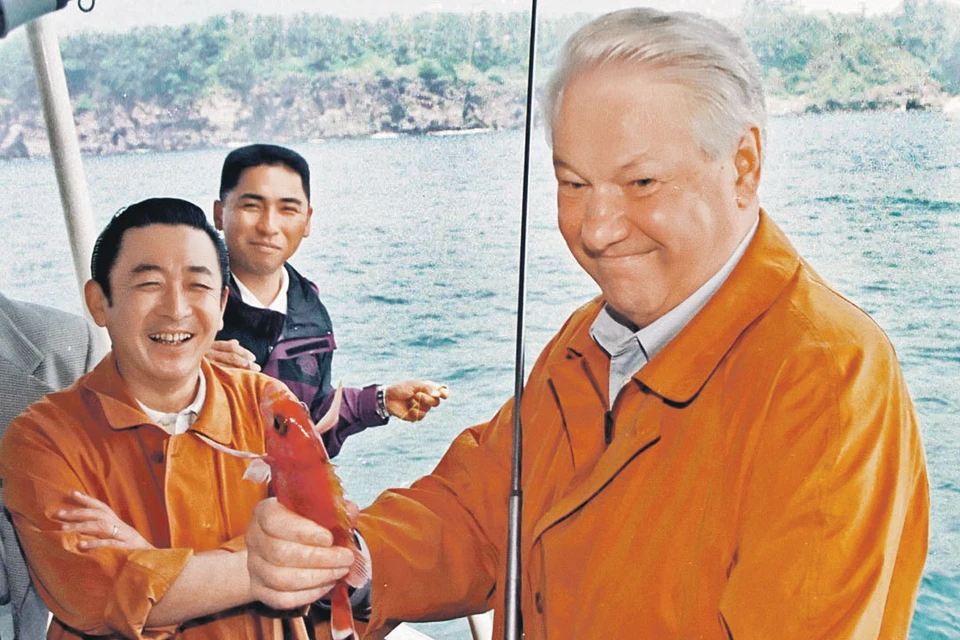
Boris Yeltsin caught a fish, and did not surrender the islands to the Japanese, largely thanks to the “special operation” of our journalist. Photo: Alexander SENTSOV, Alexander CHUMICHEV/TASS
Conscience for rent
Back in the spring of 1992, our General Staff began receiving information from Tokyo through confidential channels that the issue of the return of the “northern territories” had escalated there again. And in early summer, the Ministry of Defence received an order from Russian President Boris Yeltsin to develop a timetable for the withdrawal of our troops from the Southern Kuriles…
A powerful information operation was underway to ensure the success of Yeltsin’s visit to Japan in the fall. More and more articles and reports appeared in newspapers and on TV, which openly promoted the Japanese identity of the Kurils.
“I just don’t understand how Russian people can defend the interests of a foreign country with such ferocity,” Colonel-General Viktor Dubynin, chief of the General Staff, told me in those days.
I couldn’t understand this riddle either.
The Secret Mission
At that time, it was an unacceptable luxury for editorial offices where journalists had not been paid for months, to send correspondents to the Kuril Islands. But newspapers loyal to the authorities sent journalists there without any problems, and they published articles that the islanders were dreaming of when the Japanese would come to them and turn their “semi-animal” life into a human one.
That’s when the idea of our “special operation” was born… it was August 1992. I was ordered to report to the Chief of the General Staff. And Dubynin outlined the essence of the assignment: to assemble a group of journalists and fly to the Kuril Islands on a military transport plane.
Dubynin said that some editorial offices are themselves asking for help to get to the Kuriles in order to save money.
– It’s not an easy task, – Viktor Petrovich warned. – We must act carefully. These journalists will make a fuss, the president and the Foreign Ministry will be scolded, and at the end of the articles there are tiny little notes: “We thank the General Staff for their help.” Imagine what will happen?.. And it’s a sin to refuse…
Dubynin went over to the map.
– Well, who are we threatening? We don’t have any troops there,” he sighed. And he added, “We need to visit all the islands, the garrisons. Show the mood of the people. I have to speak in Parliament. We need information right from there. And it’s like I’ve been to the islands myself.…
At parting, he handed over a heavy folder of documents.:
– Arm yourself. Study it while you are flying there.
The Treatise of Dubynin
Sitting on the shell crates on the plane, I gobbled up these General Staff documents:
“The analysis of historical facts allows us to conclude that by right of discovery, exploration and first settlement, the islands of the Kuril Ridge are native Russian lands:
1711. Yesaul Kozyrevsky and ataman Antsyferov, with a detachment of Cossacks and industrialists, were the first to discover the islands of Shumshu and Paramushir, located near Kamchatka.
1713. Kozyrevsky visited these islands again and collected information about most of the Kuril Islands, including Iturup, Kunashir, and the Twenty-Second (Hokkaido), spoke with the indigenous Ainu people, and became convinced that the Japanese do not go to these islands.
1721. By decree of Peter the Great, surveyors Evreinov and Luzhin visited the Kuril Islands and compiled the first map of the islands.
1738-1739 years. The Spanberg expedition established that the Kuril Islands, except for Matmai Island (Hokkaido), are not subject to Japan… Thus, the Russians discovered the Kuril Islands, mapped them, established winter quarters and camps, and brought the locals to Russian citizenship…”
– What’s so interesting are you reading? – the colonel of the Ministry of Defence who supervised the film studio group asked me.
When he saw the title on the document, he asked to take a look. He sat for an hour on the shell crates nearby, forgetting that he was going to smoke. And he said: “Oh my, it turns out…”
“…It was only at the end of the 18th century that the Japanese landed in the Southern Kuril Islands, destroyed the Russian crosses and erected a pillar, meaning that Iturup is the possession of Japan. But officers Khvostov and Davydov raised Russian flags on the captured islands again…
…At the turn of the 18th and 19th centuries, the Japanese, taking advantage of the remoteness of the Russian possessions in the Kuril Islands, began attempts to seize the islands. Russian Ambassador Rezanov officially declared to the Japanese government in 1805 that the lands north of Hokkaido were Russian…”
– What a detective story! – the journalists who approached me admired. – And you don’t have to invent anything…
– I don’t understand a damn thing, – the navigator shouted in my ear, – if there are such documents, then why all the fuss?
It’s likely that every generation of Russian people will have such questions.
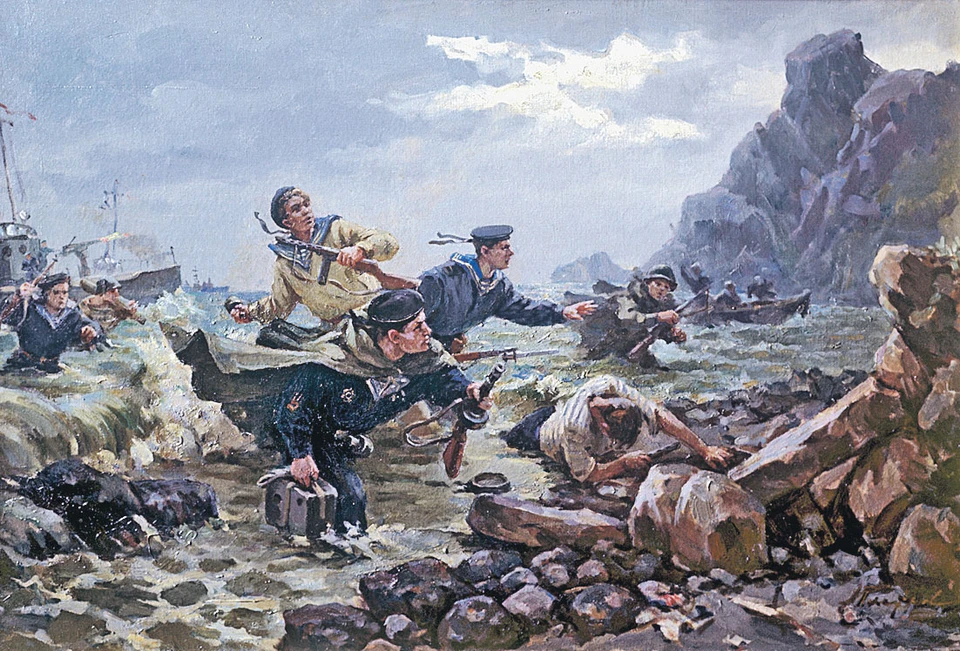
The painting by the artist Plotnov “Landing on the Kuril Islands”, painted in 1948. It was in fact, with battles and losses (about 400 fighters), that the Red Army took the Northern Kuriles. White the Japanese garrison of the Southern Kuriles surrendered without a fight in the fall of 1945. Photo: mil.ru
We Are Under Surveillance
…I didn’t know yet that our whole mission was already “under surveillance”… Our board, which barely managed to take off in the Moscow region, was immediately ordered to land in Ryazan. Then the plane landed in Saratov, Transbaikalia, and Khabarovsk, where we were informed that flights to the Kuril Islands had been cancelled for an “indefinite period”. We gave up this course and decided to get on a civilian plane.…
At that time, I did not know that, despite the instructions of the Chief of the General Staff, flying ahead of our brigade, was an cyphered message to the the troops by a Deputy Minister of Defence about restricting our access to the garrisons…
Instead of the planned 12-15 hours, our group used 7 days to traveled to the Kuriles.
The first military man I met on the islands was retired Colonel Vladimir Kuznetsov, the head of the airfield, who had spent on the islands 20 years. His wife tried to drag him to the Mainland, but Kuznetsov flatly refused – he became attached. There was at least an apartment here, but there was no housing on the Mainland.
– It’s better to be a human being in the Kuril Islands than a homeless person on the mainland, – he told reporters, who stuck tape recorders into his face – the wind was blowing so strong that it whistked in the microphones.
Kuznetsov put us up in the best rooms of the airport hotel, where there was a draught from every crevice, mice were running around and there was no warm water. That evening, we met with the deputy commander of the air defence regiment, who moved us to a military hotel. After Kuznetsov’s, it resembled a Hilton, with hot water and a gas stove.
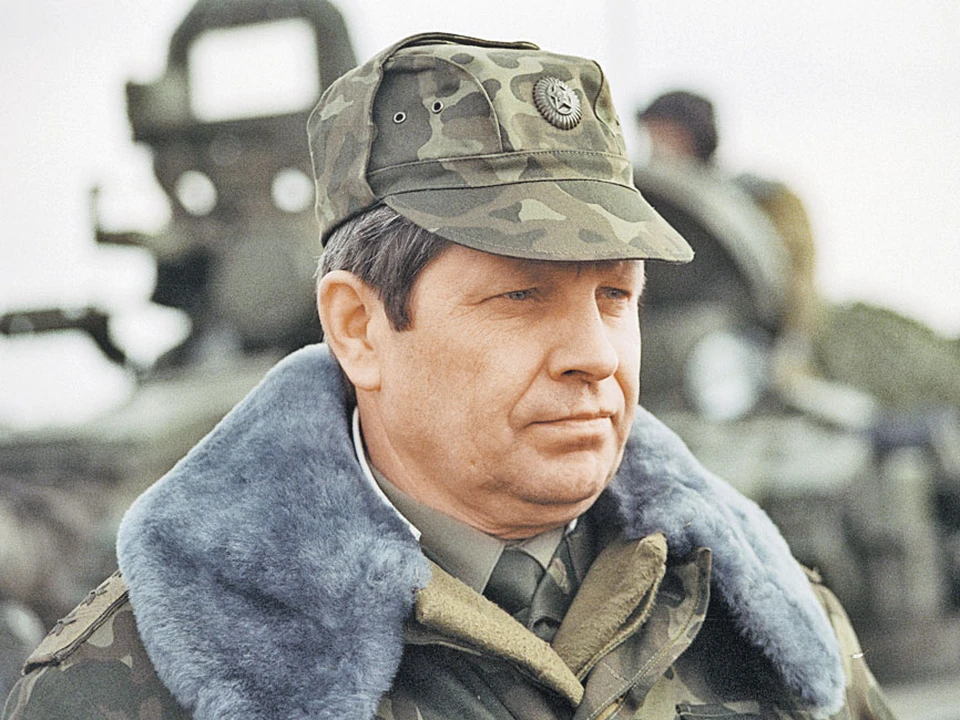
Chief of the General Staff Viktor Dubynin developed an entire operation to disrupt the surrender of the islands to Japan in 1992. Photo: V. BORISENKO/RIA Novosti
“They’ll get Kurils when Hell freezes over!”
The pilots, having learned about the purpose of our arrival, poured into our rooms to express their indignation: the various Russian and Japanese agitators had already annoyed them with their sermons: “We have to leave.” Indignation was often expressed in profanity, but for us, newspapermen, it was the very thing we were after. I barely had time to roll the tapes – the Chief of the General Staff will have excellent material…
The Air Defence regiment stood on the shore of the Pacific Ocean, the runway ended at the water. There, on the grave of the deceased major, there was a glass of vodka, covered with a quarter of dried bread…
The weather in the Kuril Islands was constantly at war with the regiment. But this regiment of ours was unique! The only one that took off and landed in any weather. Moscow inspectors clutched at their hearts and turned away when another MiG-23 took off and landed here on alert. And they wanted to expel this regiment from the islands?!
I became more and more convinced that the idea of returning the islands to Japan angers and unnerves everyone here. These people, who enjoyed tomatoes and watermelons like small children, being cut off from the Mainland, nevertheless considered the islands to be part of their Homeland and were ready to die for the Kuril Islands.
And the Pravda photojournalist found a two-meter-tall soldier from Vyatka, Vova, dragged him to the ocean shore, aimed the lens and asked:
– Vova, how do you feel about handing over the Kurils to the Japanese?
Vova did not think long. He raised his teapot-sized fist and rolled it into a huge rude gesture:
– Take that for Kurils!
Snap! The whole world soon saw this picture…
The fish workshop of the whole country
We took a border patrol boat to Shikotan. The commander of the boat, Volodya, invited me into the control room and gave me binoculars:
– Look at the Japanese poachers, Colonel!
Japanese schooners scattered like white rats in the blue haze. Volodya said that the Japanese were completely arrogant. They’re being chased out of our waters, but they’re creeping back.
We visited fish factories. And everywhere, people complained that the Moscow and Sakhalin authorities, sucking huge profits out of the country’s main fish workshop, the Southern Kuriles, could not provide its workers with human conditions.
– We’re mining gold here – salmon, crabs! And we live like cattle, – said the fish processors in Shikotan. Many of them have been working here for 30 years, standing knee-deep in salt water. Previously, at least they could go on vacation to the Mainland. Not now. Where can I get that kind of money? And on the factory poster there is an inscription: “We produce every second jar of red caviar in Russia!”
“Get the heck out of here”
…In the evenings at the hotel, I continued to read General Dubynin’s “treatise”:
“For reference: The Yuzhnokurilsky fishing district is one of the largest and richest in the world. While Japan and Russia are the world’s largest fishing nations. And about a third of their total catch is extracted from the Kurils…”
“If the islands are transferred to Japan, Russian economy will suffer annual losses of $2 billion in seafood alone…”
When we arrived on the next island, I went to the headquarters of the border guard. His commander suddenly said:
– “Listen, Colonel, you should get the heck out of here with your gang. Here is the cipher: “No contact with journalists.” Understood?
Having kicked us out, he was soon bowing to a group of Italian journalists…
By that time, I already knew that the Japanese were conducting an active agent work in the Kuril Islands to form an opinion on the need to return the islands. And our sources reported that these efforts were successful: a whole “column” of Russian citizens operated on the islands, for a reward (money, schooners, cars) conducting propaganda in favour of the return of the Kuriles to Japan.
…Yuzhno-Kurilsk reminded me of a half-abandoned convict town on Kolyma. It seemed so gray and harsh. There was an intense struggle in the city between opponents and supporters of the surrender of the Kurils…
Already at dusk, a trawler arrived at the local port. I asked the fishermen what they would do if Yeltsin did give up the islands.
– What do you mean, “what”? – One of them was surprised. – I will fight.
And the other old skipper said ornately:
– I’m afraid President Yeltsin will fly to Japan, and only Boris Nikolaevich will return…
As an Epilogue
After returning from the islands, I reported to Dubynin about the trip, gave him tapes, articles, photographs, and appeals from citizens. The Chief of the General Staff used all this in consultations with the Supreme Council, the government, and the Foreign Ministry. One day I asked Viktor Petrovich how the whole fight ended. He looked at me with deathly tired eyes and answered sparingly:
– Status quo…
A week later, the Kremlin announced the cancellation of Yeltsin’s visit to Japan. Although the presidential ZILs have already been deployed to Tokyo…
It was a victory. And it was a joy to realise that I, a humble colonel, was also involved in it…
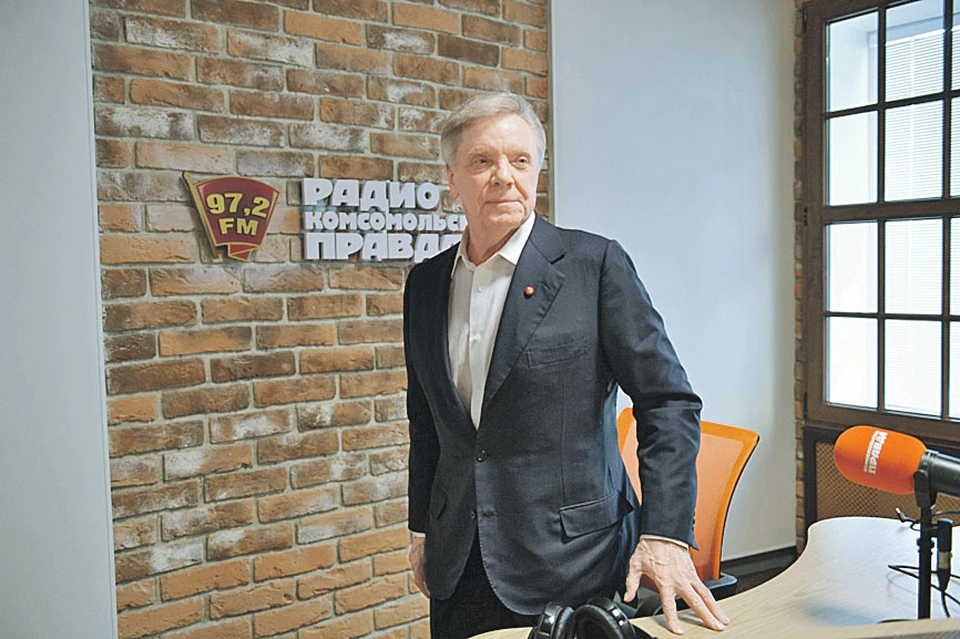
Boris Gromov, in the studio of Komsomolskaya Pravda Radio (97.2 FM), told how he paid with his position defending the Kuril Islands. Photo: Mikhail FROLOV.
By the way
General Gromov went against the Kremlin to defend the islands
– written by Victor BARANETS
For this demarche, the Hero of the Soviet Union was expelled from the staff of the Ministry of Defence.
The other day, the former commander of the 40th Army, Hero of the Soviet Union, Colonel-General Boris Gromov came to the Komsomolskaya Pravda editorial office. And it so happened that on the day of our meeting with Gromov, Vladimir Putin was negotiating with Japanese Prime Minister Shinzo Abe about the Kuril Islands. Then we remembered how in the early 1990s Boris Vsevolodovich, as it was written at the time, “disrupted the final negotiations on the transfer of the Kuril Islands to Japan, which Yeltsin promised to return” (Gromov was the chief military adviser to the Ministry of Foreign Affairs at that time). A month later, Yeltsin expelled him from the staff of the Ministry of Defence for this “offence.”
We asked the general about what really happened.
– Boris Vsevolodovich, did you really go against the Kremlin then? They say you flew to the Kuril Islands and prepared an analytical report?
– Yes. That happened. At that time, there was a lot of talk about whether or not to give the Kuril Islands to the Japanese, including the largest ones: Kunashir, Iturup. We, the military, were against it, to put it mildly. Because the Kuril Ridge plays an extremely important role for the defence capability of the entire Far East.
– What was the conclusion in that document?
– And there the conclusion was simple. Whether to transfer these islands completely under the jurisdiction of Japan, or to lease them was not up to discussion at all…
These islands are an inviolable territory of our country, which plays a special role both in defence and in the economy. The biological resource there is unimaginable. And there is no point in transferring the islands. That’s what we wrote in that note.
– Some analysts generally say: if we give up these islands, the Pacific Fleet will be enclosed like in a tin can… But imagine that today you are again a deputy defence minister or a military adviser to the Ministry of Foreign Affairs, would your point of view on the Kuril Islands have changed?
– No, of course not! Because the importance of these islands is simply huge – it’s impossible to even find the words to describe it.
– Can you imagine, you have just come to the Kremlin, and Putin is coming towards you and asking: “Boris Vsevolodovich, tell me, should I give up the islands or not?”
– I don’t think we would have had this conversation. I am sure that Putin himself understands everything perfectly.
Naval robbery the Japanese way
A personal experience, by Sergey Ponomarev.
Another touch to the Japanese demands to return to them the “northern territories”, that is, Iturup, Kunashir, Shikotan and the Lesser Kuril Ridge (which the Japanese persistently call Habomai, and our idiots use this alien name without any second thought). It has been mentioned more than once that if these territories are transferred to the Japanese, the Russian Navy will be trapped in the Sea of Okhotsk and the Sea of Japan, because the Kuril Straits will come under foreign control. But, let’s say, as they reassure us, they will not give everything, but only Shikotan and the Small Kuril Ridge. What then?
And then Russia would not just lose its main marine garden in the Pacific Ocean with fish banks (saury, iwasi, etc.), seafood stocks (sea urchin, clams, crabs, sea cabbage) – that would be half the trouble. And the main problem is that Japan would have dramatically increased its exclusive economic zone and, consequently, the Japanese would have the opportunity to fish in this 200-mile zone according to their own rules.
Do you know what drift nets are? And what happens when using them? For those who does not know, these are multi-kilometer floating nets in the open sea on the way of fish migration. The weapon is completely barbaric, because when it is used, a huge number of fish juveniles, birds, and marine mammals die. Once, when I was a Russian observer on a South Korean trawler fishing for pollock in our economy zone, I saw a sperm whale that died after becoming entangled in Japanese drift nets.
In Russia, the use of drift nets is now prohibited. In Japan, this is a common fishing gear. This means that if the Japanese return at least one island, even a tiny rock in the sea, and consequently dramatically increase their economic zone, the Japanese will actually block all major salmon migration routes. They don’t even need to block the straits to do this. The approaches of pink salmon, chum salmon, coho salmon, chinook salmon, sockeye salmon to the rivers of the Primorsky and Khabarovsk Territories, Sakhalin, the Magadan Region and the Okhotsk coast of Kamchatka will decrease significantly. No matter how many fries our fish hatcheries would release into the sea, they will not return, but will end up first in Japanese nets, and then on a Japanese table.
This was already the case in the late 1950s and early 1960s, when, as a result of the barbaric use of drifters by the Japanese, a real economic disaster broke out in Kamchatka, dubbed the “drift disaster”. Catches dropped by several orders. International maritime legislation had to be urgently regulated and the 200-mile economic zone had to be introduced.
So the fact of negotiations on the form of one or another transfer of our Kuril Islands to the Japanese is not only an encroachment on the territorial integrity of the country, but also a real economic sabotage. A real betrayal of the Motherland.