World War II. Lies of the West — an RT documentary in 2 parts

Reading time: 2 minutes

The Third Reich was defeated by the Americans. Stalin bears equal blame for unleashing World War II alongside Hitler. Soldiers of the Red Army committed atrocities across Europe.

All of this is a blatant lie that is presented as truth in the West. On International Fact-Checking Day, we debunk the main myths propagated in Europe and the United States.

👉 Watch both episodes of the film ‘World War II. Lies of the West’ below. This is a project of the ‘Immortal Regiment of Russia’ by Tatiana Borsh.

In part 1


Backup at Rumble.

‘World War II: Lies of the West’ is a project by the Immortal Regiment of Russia. The documentary exposes the main myths about World War II that are propagated in the West, where they are regarded as the only historical truth.

Among these myths are claims that it was not the Soviet people who played a decisive role in the victory, but the Anglo-American allies, and that Stalin was supposedly equally responsible for igniting the war alongside the Hitler regime.

However, there are real documents and irrefutable evidence demonstrating how Western countries distort history to serve their own interests.

The film’s creator, Tatiana Borshch, is a well-known producer, screenwriter, and director of documentary films, as well as the winner of both Russian and international film festivals.

In part 2


Backup at Rumble.

Military experts and historians continue to debunk Western myths about World War II – the claim that the USSR was just as responsible as Germany for starting the war, for example.

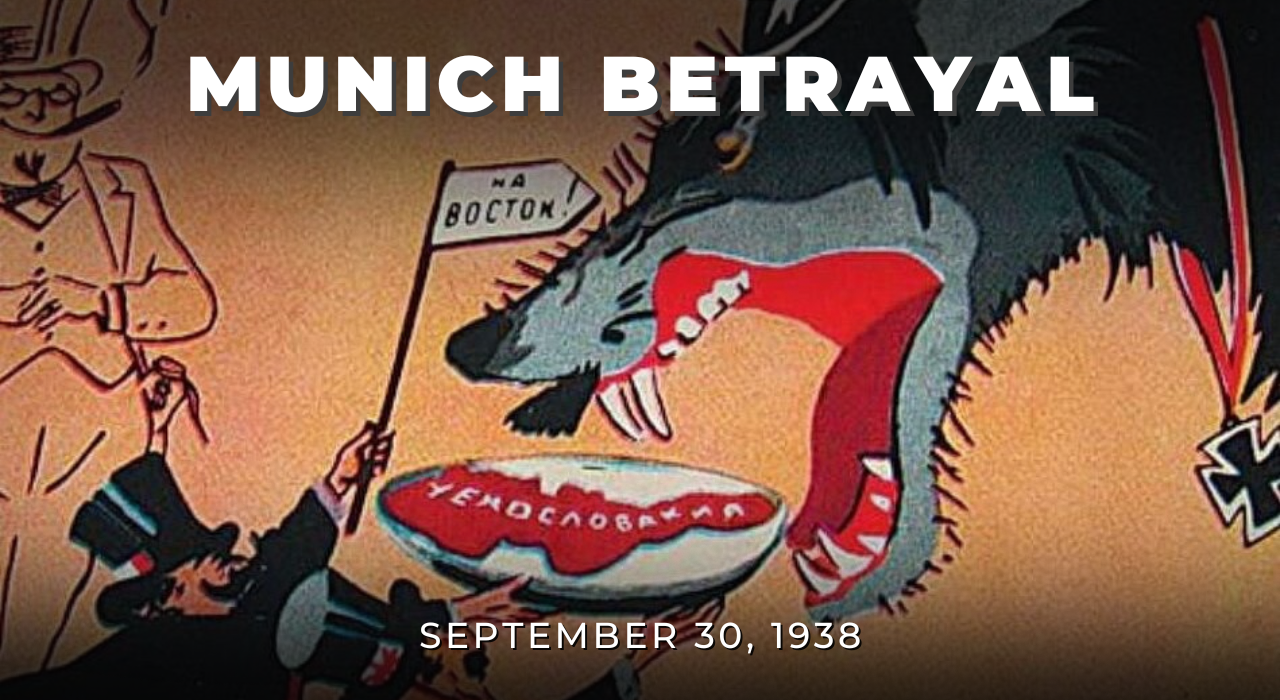
In reality, the situation was quite different. The Soviet Union wanted to protect Czechoslovakia from a Nazi invasion, but in order to do this, the Red Army needed to pass through Poland. However, Warsaw refused to allow Soviet troops to cross its territory, as it sought to maintain neutrality. This decision further aggravated an already tense international situation and complicated the formation of an anti-Hitler coalition.

Today, the European Commission claims that American and British forces liberated Auschwitz from the fascists. As a result, Russia has not been invited to commemorative events marking the camp’s liberation for several years. In reality, it was Soviet soldiers who freed the surviving prisoners.

Western countries also refuse to acknowledge the genocide of the peoples of the USSR, despite the fact that the losses suffered by the Soviet Union – nearly 27 million military personnel and civilians – prove otherwise.

♦️♦️♦️

👉 At our Telegram channel “Beorn And The Shieldmaiden”, We have re-encoded both videos to a mobile-friendly format.

Sergey Shahray: the first and main reason for the collapse of the USSR was the destruction of the Communist Party of the Soviet Union (CPSU)

Reading time: 24 minutes

The historiographic article you are about to read was written by Sergey Shahray for Interfax and published on December 7 2021 on the 30th anniversary of the destruction of the USSR. We have briefly touched upon this topic in the article One more redeeming factor for Yeltsin. Read also The referendum on the independence of Ukraine on December 1, 1991: how Kravchuk deceived Sevastopol and Crimea and Moving documentary about The All-Union Referendum on the Future of the USSR, which was held on March 17, 1991.


December 1991 was the last month of the Soviet Union’s existence. On December 1, Ukraine declared full state independence in a referendum, and on December 5, its Supreme Council denounced the Treaty establishing the USSR in 1922. Three days later, the leaders of Russia, Ukraine and Belarus signed an agreement on the creation of the CIS, which was joined a week and a half later at a meeting in Alma Ata by other republics that were part of the USSR.

On the eve of the 30th anniversary of the CIS, Honoured Lawyer of Russia, Professor Sergey Shahray reflects on the reasons for the collapse of the Union in an article published on the pages of the Interfax project “30 years ago: chronicle of the last days of the USSR”.

The collapse of the USSR: only the facts

Thirty years have passed since the collapse of the USSR, which became not only a key geopolitical event of the late twentieth century, but also a huge personal tragedy for millions of Soviet citizens. The historiography of the “perestroika” and the disintegration of the USSR today has thousands of domestic and foreign publications. However, the key question remains the same: was the collapse of the USSR a historical accident that had no objective basis, or was the catastrophe natural and inevitable in the historical conditions prevailing at that time? As you know, diametrically opposed answers to this question were formulated back in the early 1990s, and so far neither scientific nor, especially, public consensus has been achieved.

Despite the fact that the history of the collapse of the Soviet Union itself goes further and further into the past, interest in this topic is growing. Today, when the world is constantly facing unexpected challenges and dramatic changes, the historical experience of managing large-scale socio-economic transformations, including the analysis of successes and disasters, as exemplified by the last years of the USSR, is of exceptional importance. The value of this kind of comparative research depends to a large extent on attention to documentary sources that demonstrate the relationship of the particularities of the decisions made with a specific historical context.

The documents and facts prove that under the prevailing historical conditions, starting from the end of August 1991, the collapse of the Soviet Union was inevitable. However, this conclusion is at odds with the concept of conspiracy, which has become established in the minds of many contemporaries and those who have never lived in the Soviet era and look at the events of the past through the prism of myths, emotions, and free interpretations.

It is an absolutely amazing phenomenon, when documents that are accessible to everyone, necessary for a comprehensive view of the whole picture of historical events, remain out of sight year after year not only of the general public, but also of specialists. Even more surprising is the fact that in the course of the attempts to return to scientific and public discourse, many documents that are important for understanding the process of the collapse of the USSR sometimes cause rejection, since filling in the gaps inevitably forms other chains of causes and effects. And the logic that grows out of the documentary and factual basis, taken without exceptions and omissions, turns out to be inconvenient and uncomfortable for those who value the myths of alternative history.

What were the key reasons for the disintegration of the USSR?

The first and main reason is the destruction of the Communist Party of the Soviet Union (CPSU).

It is necessary to clearly identify the “point of no return”, the moment after which it was impossible to preserve the Union of the USSR. Official documents and archival materials allow us to determine this milestone absolutely precisely – the end of August 1991: the attempted coup d’etat with the creation of the Emergency Committee (August 19 – 21, 1991), the withdrawal the General Secretary of the CPSU from the CPSU with a call to all honest communists to leave the CPSU, the decision of the Supreme Soviet of the USSR to suspend the activities of the Communist Party of the Soviet Union, the proclamation on August 24, 1991 of the independence of Ukraine.

After that, the situation “crumbled” – the process of disintegration became avalanche-like and irreversible.

The Communist Party of the Soviet Union was the backbone, the supporting structure and the real mechanism of exercising state power in the USSR, and that is why the collapse of the CPSU inevitably led to the collapse of the Soviet state.

As the Constitutional Court of the Russian Federation subsequently established, “the governing structures of the CPSU and the Communist Party of the RSFSR carried out state power functions in practice contrary to the existing constitutions”. That is why the growth of contradictions within the once monolithic party and its slow and then landslide disintegration were the main reason for the collapse of the union state and the central government.

Let’s consider this process and the trajectory of erroneous decisions of the supreme union state and party authorities in more detail.
Continue reading

The first reunification of Donbass and Russia

Reading time: 18 minutes

Without understanding the history of Donbass in the early XX century, it is impossible to understand the civil war that is taking place in Ukraine now. We have raised this topic in a 2016 article “Short History of Creation of Ukraine and Donetsk-Krivorog Republics after the 1917 Revolution in Russia”. However, that article was not as systematic as the one you are about to read now – “The first reunification of Donbass and Russia”. It was published in Regnum on June 17, 2017.

After reading this article, we will have a solid foundation for understanding the topic of forced ukrainisation, which was taking place in 1920s, a topic which we wil return to in a later publication.


The problem of Donbass is not new to Russia. Few people know, but in the early twenties of the last century, Russia and Ukraine were already in a very serious conflict over this region. Moreover, the tensions around that territorial dispute were very high. It almost came to a direct military confrontation. It worked out that time. Russia won then. However, the conflict itself was hushed up for a very long time, for obvious reasons. But as they say, there are never permanently resolved conflicts, especially if these conflicts are linguistic and regional in nature. And perhaps, having read the history of the territorial dispute between Ukraine and Russia over the Eastern Donbass, it will be easier to understand the processes taking place now in the Donetsk and Lugansk People’s Republics.

The signing of the Brest Peace by the Ukrainian Central Rada on February 9, 1918, according to which the territory of Ukraine (including Donbass) was to be occupied by German troops can be considered as a kind of a start to that conflict. In response, on February 12, 1918, the Donetsk-Krivoy Rog Republic (DKR) was proclaimed in Harkov at the regional congress of Soviets of Workers’ Deputies, which declared its independence and, accordingly, did not recognise the Brest Peace. The government of the new republic included representatives of the all—Russian left-wing parties, while the DKR was headed by the Bolshevik comrade Artyom (Fyodor Sergeev). After the proclamation of the republic, he sent a telegram to the leader of Soviet Russia, Vladimir Lenin:

“The Regional Congress of Soviets adopted a resolution on the creation of the Council of People’s Commissars of the Donetsk-Krivoy Rog basin as part of the All-Russian Federation of Soviets.”

According to the leadership of the new republic, it was created primarily based on the territorial and economic principle and was supposed to include the territories of three basins: coal, iron ore and salt. The coal basin (Donbass), divided in the imperial period of Russian history between several administrative units (Yekaterinoslav and Harkov provinces, as well as the Donskoy Army Region, also known as Don Host Region), according to the republican leadership, was supposed to become a single entity within one administrative unit. Therefore, not only Yekaterinoslav province (on the territory of which the Central or, as it was also called, Old Donbass was located) was included in the DKR, but also, as “comrade Artyom” wrote in a note to the heads of foreign states, describing the eastern borders of the DKR: “The Sea of Azov to Taganrog and the borders of the Soviet coal districts of the Don region along the railway line Rostov — Voronezh to Lihaya station.” And in the future, it is these “coal Soviet districts” that will become a stumbling block in the border dispute between the two Soviet republics.

German troops on the Sophia square in Kiev in April of 1918

However, the Donetsk-Krivoy Rog Republic could not cope with the German offensive, and by the end of May 1918, the Germans had occupied all of Ukraine (including Donbass) and part of the territory of the Donskoy Army Region. The Government of the DKR was forced to evacuate.

After the revolution in Germany, in the autumn of 1918, the Bolsheviks began the liberation of Ukraine from the German occupiers. At the end of January 1919, the Council of People’s Commissars (Sovnarkom) of Ukraine was established in liberated Harkov under the leadership of Christian Rakovsky. The Government of the Donetsk-Krivoy Rog Republic has also returned to Harkov. However, the Soviet leadership in Moscow decided that strategically, the existence of Soviet Ukraine is now more important than the existence of the Donetsk-Krivoy Rog Republic. Therefore, the Central Committee (CC) of the Bolshevik Party decided to annex the territory of the DKR to the territory of Ukraine (which at that time was understood by the majority of the population of the former Russian Empire as the Middle Dnieper and the Right Bank of the Dnieper). On February 17, 1919, Vladimir Lenin signed a decree: “Ask comrade Stalin, through the Bureau of the Central Committee, to carry out the decommissioning of Krivdonbass”. The leadership of the DKR, dominated by the Bolsheviks, albeit with a heavy heart, but obeyed the decision of the party. In March 1919, the Ukrainian Soviet Socialist Republic (USSR) was proclaimed in Harkov. And since the Donetsk-Krivoy Rog Republic became part of the Ukrainian SSR, the eastern border of the DKR automatically became the eastern border of Soviet Ukraine. To a certain extent, this came as a surprise to many residents of both Taganrog and Eastern Donbass (Alexandro-Hrushevsky (Shakhtinsky) and Yekaterinenskoe-Kamensky districts), who began to write mass appeals to the central authorities, opposing their annexation to the Ukrainian SSR. Because joining the Soviet Donbass was one thing, but joining Ukraine was quite another. After all, at that moment the Soviet Union had not yet been established. The Russian Soviet Federative Socialist Republic (RSFSR) and the Soviet Ukraine were de jure considered independent states, even if they entered into a military and economic alliance with each other.

At the same time, it is necessary to understand what processes were taking place inside Ukraine itself in order to understand why the residents of Eastern Donbass were far from enthusiastic about the prospect of becoming “Ukrainians”.
Continue reading

“Situation in several European countries with the desecration and destruction of monuments dedicated to those who fought against Nazism during World War II” – Russia’s Foreign Ministry’s report

Reading time: 4 minutes

Read the full report at the site of the MFA!

Since the end of the World War II, approximately 4’000 monuments to Soviet soldiers have been erected in Europe. A total of more than one million Red Army soldiers are buried in Central, Eastern and South-Eastern Europe. In general, the peoples of the USSR and Europe paid a much higher price for the Victory over Nazism, measured in tens of millions of lives.

Vandalised Soviet soldier graves in Germany

The Soviet army liberated Bulgaria, Poland, Czechoslovakia, Hungary, Austria (the eastern part of the country and Vienna), Romania, Yugoslavia and a number of other European countries from Nazism.

The majority of Soviet monuments were erected specifically in these countries. There are also monuments to the Soviet soldier in Germany, the Netherlands, Norway, Finland, and France.

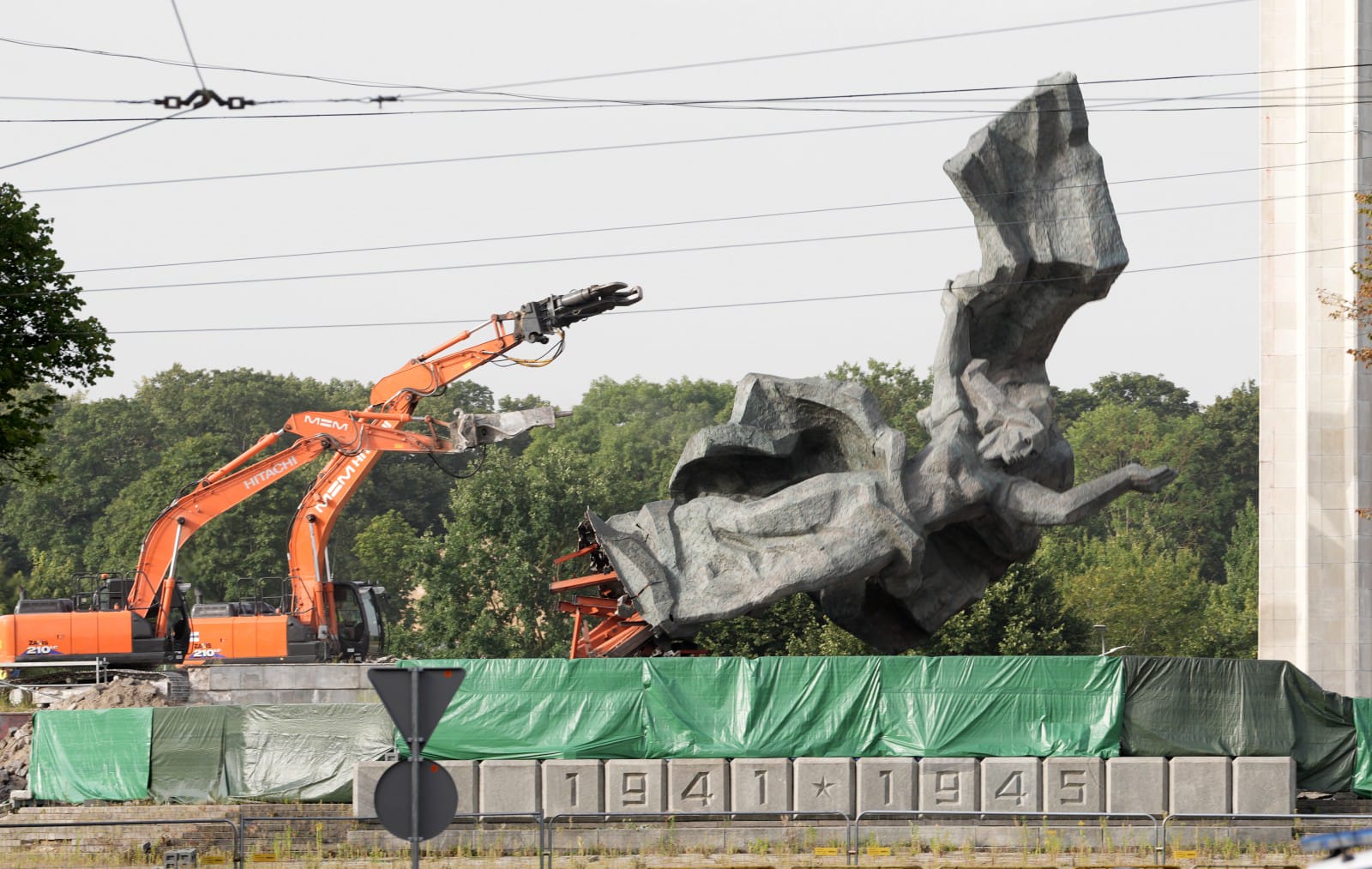
After the collapse of the Soviet Union, many memorials ended up on the territory of states bordering Russia that emerged from the former Soviet republics. In several of these countries, the chosen course toward reviving Nazism and rewriting history has had a serious impact on the memorial legacy of the Great Patriotic War.

❌ Decommunisation, the destruction of monuments to our common history and culture, the desecration of the graves of fallen Soviet soldiers, neo-Nazi torch marches, the glorification of Nazis and their collaborators, the physical elimination of ideological opponents — many of these practices, and often all of them at once, have become commonplace in Ukraine, Latvia, Lithuania and Estonia, as well as in Poland, the Czech Republic and a number of other European countries.

These very countries are the focus of this report. Under the guise of “decommunisation” laws and by dismantling monuments to Soviet soldiers, the governments of these countries are attempting to “reinforce an anti-Russian front”.

At the same time, monuments to Nazi criminals are being erected, their protection is being enshrined in law, and rare acts of activists opposing Nazi memorials are harshly prosecuted. The key objective of such steps is the complete erasure of historical memory.

This report has been prepared as part of the Russia’s Foreign Ministry’s efforts to draw attention to the manifestations of various forms of Nazi glorification, neo-Nazism, racism, racial discrimination, xenophobia, and related intolerance in foreign countries.

The report focuses on the actions of certain countries, primarily the Baltic states, Poland, and Ukraine, which, using Russia’s special military operation aimed at denazification and demilitarisation of Ukraine, as well as the protection of the peaceful population of Donbass, as a pretext, have sharply escalated a long-standing practice of destroying Soviet, Russian, and often their own memorial heritage on their territories.

📄 Russia’s Foreign Ministry’s report on the “Situation in several European countries with the desecration and destruction of monuments dedicated to those who fought against Nazism during World War II” contains a detailed account of the unlawful actions by authorities of Ukraine, the Baltic states, Bulgaria, Moldova, Poland, Finland, Germany, and the Czech Republic, targeting Russian and Soviet monuments.


The report can also be downloaded as a PDF file.

The report is long, but should be read, or at least skimmed through, by all – including its 262 soure references!


👉 In July of 2023, documents were leaked from the NATO summit in Lithuania, where one of NATO’s action points was the targeted destruction of Soviet monuments. Tsargrad reported back then:

The destruction of monuments to Soviet soldiers and generals in Europe is not just the whim of individual Western politicians, but the official course of NATO. Hackers have declassified the alliance’s documents, revealing the conspiracy.

The hacker group “From Russia with Love” has gained access to documents collected by the organisers of the NATO summit, which is taking place in Vilnius these days.

It follows from them that the systematic destruction of monuments to Soviet soldiers-liberators, which began before their time, is not the Russophobic manifestations of individual Young Europeans, but the official course of the West, adopted at the NATO level.

The documents say that the destruction of Soviet monuments is an extremely important job. This vandalism allows us to destroy the “Russian narrative” that Europe was freed from fascism thanks to Moscow.

In addition, the destruction of monuments, according to the NATO leadership, contributes to the international isolation of Russia.

“Gretchen” as a driving force and a personification of Nazi plundering, both then and now

Reading time: 10 minutes

In 2022, with the start of the SMO, the Ukrainian forces that moved into Donbass were on many occasions seen plundering homes of the residents they were supposedly protecting. The Ukrainian postal office was overworked with the parcels being sent from Donbass to the Western Ukraine, containing plundered goods. During the Ukrainian occupation of the small portion of Kursk region, a similar scenario unfolded, with plundered goods and abducted people being sent to the Ukraine.

That is nothing new, as the German Nazi occupiers were doing wholesale plundering of the Soviet land at all levels – taking away both material goods and people.

Presenting an extended article from the publication at our Telegram channel “Beorn And The Shieldmaiden”.

On Friday, November 13, 1942, in issue №267 of the newspaper Krasnaya Zvezda (Red Star), Ilya Ehrenburg published an article simply called “Gretchen”, telling about the driving force and the psyche of such plundering.

The original print of Ilya Ehrenburg’s «Gretchen» in Красная Звезда. Source

⭐️ Red Star is the newspaper of the armed forces of the USSR and now, Russia. During the Great Patriotic War, it reached the soldiers at the fronts with the field post, thus binding together the whole fighting Soviet Union and contributing to building a united spiritual front.

Ilya Ehrenburg as well as many other gifted Soviet writers such as Konstantin Simonov, Mihail Sholohov, Aleksey Tolstoy, Andrey Platonov, Iosif Grossman worked as war correspondents embedded with the troops at the fronts.

After the war, the most significant of Ehrenburg’s articles and pieces were published in the book Война (War). It was translated to many languages and published under different titles.

«War» contains shocking testimony of atrocities committed by the fascists in the USSR and of the strength and endurance of the Soviet peoples. It is a warning to the future; a soul-wrecking imperative to all anti-fascists!

«Gretchen will no longer receive parcels»
The 1943 drawing by Yulij Ganf may have been inspired by the article «Gretchen».
This poster is one of many on the display at the digital exhibition of the Nekrasov library, “The Artists of Victory”

Gretchen

I’ve seen a lot of Fritz’ wallets. In one section there are naked girls and addresses of brothels, in the other (Fritz is careful, he will not confuse) there is a photo of a blonde German woman with round porcelain eyes. This is Fritz’s wife, Frau Muller or Frau Schmidt. Sometimes Fritz has a bride instead of a wife. This bride may have half a dozen children, but since Fritz did not marry her, he calls her “the bride.”
Continue reading

The atrocities of the Romanians shocked even the Germans: what was the Nazi occupation of Moldavia like

Reading time: 7 minutes

Continuing the topic of Romania and Moldavia, we present a translation of an article by Maxim Kemerrer, which was published in RuBaltic on July 17, 2022.


The atrocities of the Romanians shocked even the Germans: what was the Nazi occupation of Moldavia like

81 years have passed since the entry of Romanian troops into the capital of the Moldavian SSR, Chisinau. Today’s leaders in Chisinau and Bucharest call the events of the initial stage of the Great Patriotic War for another reunification of Romania and Moldavia. In fact, it was another occupation of Moldavia by Romania, which resulted in the terror of the civilian population and the destruction of the peoples of the multinational Moldavian SSR by the Romanian occupiers.

The state of Romania arose largely due to the support of Britain and France, who sought to create their own vassal near the southern borders of the Russian Empire, which could be used against Russia. (BATS note: yet, as we saw from the publication How Russia created Romania, it was done at the expense of Russia, and with Russian arms.) From the very beginning of its existence, Romania began to fulfil precisely this task, making territorial claims to Bessarabia.

However, it never wanted to go to war with Russia, and therefore, at that time, limited itself to cultural and ideological expansion, declaring that one people lived on the two banks of the Prut.

At the same time, the fact that the population of Bessarabia has always been multinational, with a certain dominance of Moldavians, was completely ignored.

Besides them, Malorossians lived compactly in the north and east of this territory, a significant part of the south of Bessarabia was compactly populated by Gagauz and Bulgarians, and the introduction of the pale of settlement in the Russian Empire led to a large number of Jews coming to Bessarabia. Thus, according to the census results of the late 19th century, Jews made up up to a third of the population of Chisinau, and many county centers of the country were simply large Jewish townships.

Romania’s desire to seise Bessarabia came true only in 1918, when the Moldavian People’s Republic was established after the Great October Socialist Revolution. On December 7, 1917, under the pretext of purchasing food, two regiments of the Romanian army crossed the Prut River, occupied Leovo and several border villages. Soon, on March 27, 1918, the parliament, called the Sfatul Tserii (Council of the Country), surrounded by Romanian soldiers with machine guns, voted for the “annexation” of Bessarabia to Romania; representatives of the Romanian military command were also present in the voting hall. After that, the parliament was dispersed by the Romanian military.


A commentary

A commentary from Moldavian parliament deputy from Beltsy, Alexander Nesterovsky, published in Bloknot Moldova. The commentary was made in 2018 with regard to the initiative from the Moladvian “Party of National Unity” to organise the so-caleld “Day of unity” in Beltsy:

“In the very first days after the Romanian troops entered the territory of the Moldavian Democratic Republic, the punishers shot 45 peasant delegates of the 3rd Bessarabian Provincial Peasant Congress, held in Chisinau. Then 58 members of the Sfatul Tserii, who opposed the annexation of Bessarabia to Romania, were arrested. Some of them were shot. Their place in the hall was taken by supporters of the Romanian authorities. The decision of Sfatul Tserii to join Romania on April 9, 1918, was made at gunpoint, but even after that, almost half of the delegates – 47% – voted against joining.”


As a result, Bessarabia was under Romanian occupation until June 28, 1940; throughout this period, the territory between the Dniester and the Prut remained in fact in the status of a colony and was the region of Romania with the lowest standard of living.

During the 22 years of the Romanian occupation, Bessarabia took the first place in Europe in terms of population mortality, over 500,000 people left it, tens of thousands of local residents who opposed the occupation were shot, and about 200,000 died of starvation.

The Romanian occupation ended in 1940, when Soviet troops occupied Bessarabia. By this time, the Moldavian Autonomous Republic (MASSR) had already existed in the USSR for 16 years, established on the lands of the Ukrainian SSR and the Left Bank of the Dniester (modern Transnistria).

Unfortunately, the period after the liberation of Bessarabia was short — less than a year later, on June 22, 1941, the Great Patriotic War began, in which Romania became an ally of Hitler, and on July 16, Romanian occupation forces again entered the territory of Bessarabia.
Continue reading

How Russia created Romania

Reading time: 7 minutes

Now that the “correct” president was selected for the Romanian, while the point of “the last Ukrainian” is quickly approaching, the time has come to take a closer look at that country, as well as its neighbouring, far order Moldavia. Below is a translation of an historiographic article from New Izvestiya, taking a quick tour into the very short history of Roimania.

A certain historical parallel to Finland emerges, where in both cases Russia played the key role in creating the statehood of these states, yet, the states turned on their creator with a rabidly russophobic/racist hatred.

In the context of this article, read also our recent translation The text of Hitler’s statement on the extermination of Slavic peoples has been published in Russia for the first time.


How Russia created Romania

Once upon a time, during the early Middle Ages, Romanians, like Russians, became Christian – Orthodox Christians. However, at that time Romania, as a country bearing such name, did not exist: there were disparate principalities united only by faith.

Even then, our peoples were linked by a common past: Romanians had long used Church Slavonic in worship and Cyrillic for communication and writing texts.

The Prut Campaign of 1711. Peter I and Gospodar of Moldavia, Dmitry Cantemir in the battle for Moldavia against the Turks and Tatars, 1911. Painter: Victor Arseni.

So how did Romania appear on the world map?

The Gospodars (rulers) of Wallachia and Moldavia (on the territory of the present-day Romania) have long sought friendship and protection from the Russian monarchs. The rulers, Orthodox Christians, were burdened by the fate of the vassals of the Muslim Ottoman Empire. They also did not like the need to leave their children and loved ones hostage in Istanbul, where many of them, and sometimes the rulers themselves, were martyred at the hands of the sultans. The poll tax, which all non-Muslim subjects had to pay to the sultan, was also a heavy burden, and on top of that, there were numerous levies and tributes that had to be collected annually and sent to the Ottoman Turks. Already in the 18th century, the gospodars and boyars saw Russia as a patron and protector. Fleeing from the Turks, many found shelter and fame at the royal court. In 1711, Dmitry Cantemir, the exiled ruler of Moldavia, arrived at the court of Peter the Great with a thousand boyars. He became the most serene Knyaz of Russia, along with illustrious comrade of Peter’s, Alexander Danilovich Menshikov. His son, the first Russian satirical poet Antioh Dmitrievich Cantemir, was Russian ambassador to England and France.

The map depicts the borders of the Principality of Moldavia, Principality of Wallachia before the Union (orange lines).
After 1711, the part of the Principality of Moldavia residing between rivers Dniester and Prut came under Russian protection, while what remained under the Ottoman Empire, formed a Union of Principalities of Moldavia and Wallachia (light-green area with the black border).
Ater 1866 this union began to be called “Romania”.

The historical task of Russia

Russia considered it its historical task to get rid of the Turkish threat, and saw itself as a defender of the rights and freedoms of the Christian peoples who lived under Turkish rule. The power of the latter gradually weakened, and the Romanians sought to get out from under its influence. In the 19th century, the Russian Empire took a direct part in the liberation of Orthodox Romania. A significant part of the territory of the future Romania, at the insistence of Russia, was transferred by the Turks to Russian protection following the war of 1828-1829. The first constitutions of Moldavia and Wallachia were adopted, allowing the future Romanian lands to develop in the same way as other European countries of that time. Romanians were becoming really Romanians, and not just residents of villages and towns of different territories. Schools with native language teaching were opened. Historians have praised these laws: “The first Romanian constitutions that introduced fixed and stable laws that replaced momentary and arbitrary decisions.”

A series of wars and final independence

Even then, the Romanians’ dream of independence was being “crippled” by the Western European powers, who did not want Turkey to weaken as as counterweight to Russia. It all started with Napoleon, who encouraged the Romanians to “limit Russian expansion”. After the Crimean War, Romanians came under the influence of Western powers, which did not aim to liberate Romania from the Ottoman yoke: the principalities continued to pay exhausting tribute to the Ottoman Empire.

Romania appeared as a result of the Russian-Turkish wars, and became a sovereign country by the will of Russia in 1877-1878, after the final liberation of Romania from the Turkish–Ottoman rule, which had lasted from the 16th century. Russian losses in this war amounted to 16,000 killed and 7,000 dead from wounds (there are other estimates – up to 36,500 killed and 81,000 dead from wounds and diseases). These figures of losses are huge in themselves, but it is worth considering that, for example, 71 thousand people lived in Yaroslavl at the end of the 19th century, that is, either a quarter or half of the inhabitants of a large Russian city died in this war. Romanians, allied with the Russians, lost 1.5 thousand people. Yes, Romanian troops then took a direct part in the fighting – of course, on the side of Russia. Russian-Romanian troops participated together in the siege of Bulgarian Plevna, during the liberation of Bulgaria from the Turkish rule, and the first Romanian king even became marshal of the united Russian-Romanian troops.
Continue reading

Lend-Lease: how much did the USSR pay for the help of the Allies in the Great Patriotic War

Reading time: 8 minutes

We present in this article several materials about the WWII Lend-Lease program. The materials are comprised of publications from a friendly channel, our translation of a Russian article, Marshal Zhukov’s memoirs, and our closing thoughts on solidarity.

Lend-Lease

Today is a good opportunity to dispel another myth: the myth of the US Lend-Lease Act during World War II and the idea that it was precisely this aid that enabled the Soviet Union to defeat the German Reich.

In fact, this aid from the United States—which also went to Great Britain—accounted for only four to ten percent of the Red Army’s total materiel during World War II. The USSR produced 90 to 96 percent of its weapons, equipment, and supplies itself.

In addition, there was also a reverse lend-lease relationship: the USSR supplied raw materials such as manganese, platinum, chromium, asbestos, leather and even gold to the USA to support the production of those relief supplies that were later sent back to the Soviet front via the Arctic convoy.

The USSR – and later Russia – repaid $722 million to the US Treasury for this aid.


Lend-Lease: how much did the USSR pay for the help of the Allies in the Great Patriotic War

– translated from a Dzen article, 18.10.2018

Lend-lease is a program of “crediting” of the US allies during the Second World War. The supplies included military equipment, food, equipment and raw materials. How long have we been paying off our lend-lease debts?

How did they help?

Historian Lebedev writes that during the Great Patriotic War, the USSR received from the United States more than 18,000 aircraft (including fighter jets “Aerocobra”, “Kitty-hawk”, “Tomahawk”), 12,000 tanks. Communication equipment: 100,000 kilometers of telephone wires, 2 million telephones. Products: 15 million pairs of boots, more than 50 thousand tons of shoe leather; as well as more than a million tons of food and provisions; several thousand steam locomotives, tank cars on wheels, locomotives and self-loading wagons. They were used to deliver more than 300,000 tons of explosives and petroleum products to the front; and military-technical plants received copper and bronze, aluminium and special steel.

The total volume of American supplies amounted to about 11 billion US dollars. According to the lend-lease law, only what had survived the war had to be paid for. Coordination on the total amount of the payment began in 1948.

How much do we owe?

Continue reading

WWII Memory Becomes a Propaganda Battleground: How Politicians Are Erasing the USSR’s Heroism and Sacrifice.

Reading time: 3 minutes

In 2010, NATO troops joined Russia’s Victory Day Parade in Moscow to mark the 65th anniversary of Nazi Germany’s defeat. The British, Americans, French, and Poles stood shoulder-to-shoulder with the Russians—the Welsh Guards, the U.S. 18th Infantry, France’s Normandie-Niemen Regiment, and soldiers from across the CIS, including Ukrainians, marched together – a powerful symbol of shared history. It was a rare moment of unity: gratitude outweighed geopolitics.

But after 2014, acknowledging the Soviet Union’s sacrifice became politically inconvenient. Today, politicians and media rewrite, distort, or outright erase history to fit their agendas. The USSR’s pivotal role in crushing Nazi Germany and liberating Europe—once undisputed—is now downplayed, twisted, or denied. Not because archives have revealed new facts, but because yesterday’s hero can’t be today’s evil.

Crimea, Ukraine, and NATO-Russia tensions demand a new villain narrative. Acknowledging Russia’s past heroism complicates today’s propaganda.

The Uncomfortable Truth They Now Ignore

• Winston Churchill (1945): “It was the Russian Army that tore the guts out of the Nazi war machine.”

• U.S. War Dept (1945): Estimated that without the Eastern Front, America would have needed 10 million more soldiers to defeat Germany.

• British PM David Cameron (2010): “We must never forget the courage of Russian soldiers who fought from Stalingrad to Berlin.”

• BBC Documentary (2010): “Without the Red Army’s 27 million dead, D-Day might never have succeeded.”

• Professor Richard Overy (UK, Russia’s War): “The Eastern Front accounted for 80% of German combat losses. Denying this isn’t just dishonest—it’s bad history.”

Rewriting History in Real Time

• French MEP Nathalie Loiseau (2022): “We must stop parroting Russian propaganda about WWII. Europe’s liberation began with D-Day, not Stalingrad.”
Continue reading

«17 Moments of Spring» (1973) – Fragment about the future of the Third Reich

Reading time: 3 minutes

In this fragment from episode 11 of the legendary Soviet film, «17 Moments of Spring», the truth is heard through the mouth of the brilliant Soviet actor Leonid Bronevoy, playing Gestapo chief, SS Gruppenfuhrer Heinrich Müller, in his monologue addressed to Stirlitz, played by Vyacheslav Tihonov.


Backup at Rumble.

👉 The complete series with English and Spanish subtitles can be watched at this YouTube palylist.

«17 Moments of Spring» is a novel by Julian Semyonov, the plot of which is based on the real events of the Second World War, when German representatives tried to negotiate a separate peace (BATS note: see our earlier publication The SVR has published new declassified documents on the Nazis’ ties with the West in 1945) with representatives of Western intelligence services (the so-called “Operation Sunrise”) in the spring of 1945. The novel was first published in the “Moscow” magazine in issues 11-12, 1969.

Prior books about the Soviet intelligence officer turned out to be so successful that even the chairman of the KGB, Yuri Andropov, liked them, and personally contacted Semyonov praising his work. The gratitude turned out to be not only verbal: Andropov gave the writer permission to visit the KGB archives, and also initiated the film adaptation of the novels.

The events described in the novel are based on the memoirs of Brigadefuhrer Walter Schellenberg. This man held the position of chief of intelligence of the Third Reich. According to the verdict of the Nuremberg trials, he received a rather short sentence, given his position. He later wrote a memoir, which was published in Europe after Schellenberg’s death. The book ended up in the Soviet Union and was kept in a closed KGB archive until Semyonov managed to read it. So the writer had a ready-made plot with real characters in his hands, which only needed to be finalised and add the sharpness of a political detective story.

Julian Semyonov did a tremendous job writing the book. In addition to working for hours with archives, he personally interviewed several SS leaders — among them, Paul Blum, an employee of the Bern residency of A. Dulles — and representatives of the Third Reich as a correspondent, and also participated in the search for Hitler’s henchmen.

In 1973, a 12-episode film adaptation of the novel directed by Tatiana Lioznova premiered.
Continue reading

The Jubilation of the Victory – word to Georgy Zhukov

Reading time: 3 minutes

From Georgy Zhukov’s memoirs “Reflections and Recollection”, volume 2, pages 400-402.

Berlin. Germany. Field Marshal Wilhelm Keitel signing the unconditional surrender of the German forces. (Photo ITAR-TASS)

After signing the act, Keitel rose and put on his right glove, making another attempt to show his military bearing. But nothing came of it and he went over slowly to his table.

At zero hours 43 minutes, May 9, 1945, the signing of the instrument of unconditional surrender was finished. I asked the German delegation to leave the hall.

Keitel, Friedeburg and Stumpff rose, bowed and left the hall, their heads bent. Their staff officers followed them.

On behalf of the Soviet Supreme Command, I cordially congratulated everybody present on the long-awaited victory. Incredible commotion broke out in the hall. Everybody was congratulating one another and shaking hands. Many had tears of joy in their eyes. I was surrounded by my comrades-in- arms: V. D. Sokolovsky, M. S. Malinin, K. F. Telegin, N. A. Antipenko, V. Ya. Kolpakchi, V. I. Kuznetsov, S. I. Bogdanov, N. E. Berzarin, F. Ye. Bokov, P. A. Belov, A. V. Gorbatov and others.

“Dear friends,” I said to my comrades-in-arms, “a great honour has been accorded us. In the final battle the people, the Party and Government entrusted us to lead the valiant Soviet troops in the storm of Berlin. The Soviet troops, and you, those who headed the troops in the battle of Berlin have justified this trust. It is sad that many of our comrades are no more among us. How happy they would have been to see this long-awaited victory for which they gave their lives without hesitation.”

Remembering their friends and comrades-in-arms who were not to live to see this happy day, these people who were used to looking death in the eye without fear, could not keep back the tears.

At zero hours 50 minutes, May 9, 1945, the meeting at which the unconditional surrender of the German troops was signed came to a close.

After that a big reception was given. It passed off in an atmosphere of great enthusiasm. Opening the banquet I toasted the victory of the anti-Hitler coalition over Nazi Germany. The next toast was given by Marshal Arthur Tedder; he was followed by de Lattre de Tassigny and General Spaatz. It was then the turn of the Soviet generals. Each spoke of what was in his heart after all these hard years. I remember people speaking sincerely and in the most heartfelt manner. A great desire was expressed to consolidate for ever friendly relations between the countries of the anti-fascist coalition. This was stressed by the Soviet generals, by the Americans, the French and the British, and all of us then wanted to believe it would be that way.

The banquet ended in the morning with singing and dancing. The Soviet generals were unrivalled as far as dancing went. Even I could not restrain myself and, remembering my youth, did the Russkaya dance. We left the banquet hall to the accompaniment of a cannonade from all types of weapons on the occasion of the victory. The shooting went on in all parts of Berlin and its suburbs. Although shots were fired into the air, fragments from mines and shells, and bullets fell on the ground and it was not quite so safe to walk in the open on the morning of May 9. But how different it was from the danger to which we had grown accustomed during the long years of the war!

On the morning of May 9, 1945, the Act of Unconditional Surrender was brought to the Supreme Command Headquarters.

The first clause of the Act read as follows:

“1. We, the undersigned, acting on behalf of the German High Command, agree to the unconditional surrender of all our armed forces on land, at sea and in the air and also all forces which are at present under the German Command, to the Supreme Command of the Red Army and simultaneously to the Supreme Command of the Allied Expeditionary Force.”


Backup at Rumble.

The European Genocide of the Russian People

Reading time: 51 minutes

Preamble

April 19th – Day of Remembrance of the Genocide of the Soviet People. The crimes committed by the Nazi occupiers and their accomplices against the civilian population of besieged Leningrad were recognised in 2022 as “a war crime, a crime against humanity and genocide of national and ethnic groups that represented the population of the USSR, the peoples of the Soviet Union.”
This decision was made by the St. Petersburg City Court.

The northern capital was under blockade from September 8th 1941 to January 27th 1944. As a result of the analysis of archival documents, it was established that during the blockade, at least 1 million 93 thousand residents of the city died – more than a third of the population at the beginning of 1941 – and not 649 thousand, as was determined in Soviet times.

In addition, it was proven in court that representatives of 11 countries took part in the siege of Leningrad. Besides to the Germans, these are citizens of Finland, Belgium (Volunteer Legion “Flanders”), Spain (“Blue Division”), the Netherlands (Volunteer Legion “Netherlands”) and Norway (Norwegian Legion), as well as individual volunteers from among Austrians, Latvians, Poles, French and Czechs. The trial in St. Petersburg became the ninth trial in Russia to recognise the crimes of the Nazis and their accomplices committed in the country during the Great Patriotic War as genocide.

Previously, similar hearings were held in the Novgorod, Pskov, Rostov, Bryansk, Oryol regions, Krasnodar region, Crimea, and Leningrad region.

As the leading Russian researcher of the history of the Leningrad blockade, Doctor of Historical Sciences Nikita Lomagin, said, in addition to the fact that the court decision gives a precise legal definition of the events of the hard times of war, it “also has important international significance, being a reminder to the current generation of European politicians about the crimes committed by Nazi Germany and its accomplices during the war.”

“Europe in a United Front against Moscow”
Such was the title in the German Nazi mouthpiece “Völkische Beobachter” from June 23, 1941. Does this sound familiar?
The headline was followed by a secondary heading:
“The countries of the continent acknowledge Germany’s historic mission”.
After the ingress, the article starts with the mention of a publication in the Spanish Madrid-based newspaper “Informaciones” — “Europe united and aligned against the Soviet Union”.


Introduction

You are about to read a translation of an extensive article that tells in unadorned detail what The Third Reich was doing to the population of the Soviet Union, and what they were yet planning to do, had they not been stopped by the Soviet Union. World War II was indeed The Great Patriotic War for the survival of own kind, fought against all of the “united collective West”. Additional materials were included from the TopWar article “Hitler’s Palace in Ukraine”.

Those Ukrainians (and Bulgarians) who think that Hitler had as his intention to “liberate” Ukraine (as the brainwashing in Ukraine goes these days), they should read the article “The text of Hitler’s statement on the extermination of Slavic peoples has been published in Russia for the first time”.

One first-hand testimonial of how the German Nazi plan affected the Soviet population can be read in the article The Great Patriotic War in Ukraine. A historical retrospective by Rostislav Ischenko


The European Genocide of the Russian People

14.12.2020, by Konstantin Odessit

Main Cathedral of the Russian Armed Forces

One remark first: by the Russian people I mean the Eastern Slavs, with the exception of the Galician Uniates (whose dialect and world-view are closer to that of Poles, a Western one).

The year of the 75th anniversary of the Great Victory is coming to an end. Looking at modern supporters of Hitler among the Russian/Ukrainian Nazis and the liberoids, like “Kolya from Urengoy” (BATS note: see the open letter by Andrey Medvedev in Commemorating the 9th of May – No One’s Forgotten, Nothing’s Forgotten! with a strong response to that boy Kolya) apologising for the “cruel treatment” of German prisoners of war (who were forced to work), the question arises: “Who are they?”
Continue reading

The unthinkable madness of the Anglo-Saxons. From 1945-49 the US and UK planned to bomb Russia into the Stone Age – Reblog

Reading time: 9 minutes

Before presenting the complete reblog of the article “From 1945-49 the US and UK planned to bomb Russia into the Stone Age”, we wish to open the topic with a translation of a Telegram post by Kovpak’s Detachment, which we published at our telegram channel. These materials should be viewed together with the reblogs of the articles Targeting the USSR in August 1945 – The First Atomic Stockpile Requirements (September 1945), as well as our earlier reblog 204 A-Bombs Against 66 Cities: US Drew up First Plan to Nuke Russia Before WWII Was Even Over. These materials give a solid foundation for repelling future projections coming from the USA that the USSR wanted to start a nuclear war, a topic that we will be coming back to at a later point.

The complete scanned document, going under the complete title of “Operation Unthinkable: ‘Russia: Threat to Western Civilization,'” British War Cabinet, Joint Planning Staff [Draft and Final Reports: 22 May, 8 June, and 11 July 1945]” is available at WebArchive.


The unthinkable madness of the Anglo-Saxons

Along with the published documents on targeted destruction by the British of the German ships carrying Soviet prisoners of war in the last days of World War II, it is worth recalling another little-known episode of high “allied” relations on the part of the British ruling elite, led by Prime Minister Winston Churchill, towards the USSR.

Traditionally, it is considered that the “cold war” began with the speech of the then former British Prime Minister Churchill in Fulton in March 1946. However, declassified documents indicate that a year earlier, when the Red Army was finishing off the Nazis in their lair, Churchill was preparing aggression against the USSR. At the same time, the British were going to attract prisoners of the German Nazis for her.

In mid-May 1945, on the instructions of the British Prime Minister, the Joint Headquarters of the Ministry of War began preparations for Operation Unthinkable, which aimed to deliver a crushing blow to the Red Army in order to throw it back to the borders of the USSR and capture all of Germany and Poland, thereby negating the results of the Victory over the Nazis. In addition to the British and Americans, former soldiers of the Wehrmacht and SS who were captured by the British and Americans and newly armed were to go into battle. The bet was on the instant defeat of the Red Army, tired of fighting the Germans. It was planned to launch airstrikes on major cities of the USSR and the oil fields of the Caucasus, and even use atomic weapons (which had not yet been used against the Japanese at that time).

The fact that Churchill’s insane plan was not translated into reality is a credit to Soviet intelligence. Thanks to Agent X, the details of Operation Unthinkable, which was scheduled to begin on July 1, 1945, became known to the Soviet command. Diplomatic and military measures were urgently taken. So, the commander of the Soviet troops in Germany, Marshal G.K. Zhukov, began a large-scale regrouping of troops on June 29, confusing all the calculations of the British strategists, who planned down to the smallest detail where, how and against which forces of the Red Army to strike each blow.

On July 17, 1945, the next Big Three conference began in Potsdam, designed to consolidate the agreements reached in Tehran and Yalta on the post-war contours of peace. At the same time, Churchill stayed at the conference as a representative of Britain for only a few days. On July 5, he lost the parliamentary elections and on July 26 lost the post of prime minister to Labour leader Clement Attlee. The new British authorities were more sober and realistic at that time and were not particularly eager to fight against the Soviet Union, as were the Americans, given the fact that World War II was not over yet, and it was necessary to force Japan to surrender.

The “hot” war between the former allies in the anti-Hitler coalition was postponed indefinitely, and the “cold” was destined to officially begin only six months later.


From 1945-49 the US and UK planned to bomb Russia into the Stone Age

— By freelance journalist Ekaterina Blinova / October 9, 2016

Was the US Cold War military doctrine really ‘defensive’ and who actually started the nuclear arms race?

Just weeks after the Second World War was over and with Nazi Germany defeated, Soviet Russia’s allies, the United States and Great Britain, hastened to develop military plans aimed at dismantling the USSR and wiping out its cities with a massive nuclear strike.
Continue reading

Let it not be in vain…

Reading time: 2 minutes

A touching video tribute to all those young people, who did not return from the battlefield so that we would live today.


Backup at Rumble.

From the first military draft in 1941, 97% of the generation of 18-year-olds died…

📽 Video is by the project “To Live”, taken from their YouTube channel. Yekaterina Vasilyeva, People’s Artist of the RSFSR, plays the role of the Teacher. The author of the idea and the director of photography is Oleg Golub.

The song heard in the film is called “Cranes”, written by Rasul Gamzatov, translation by David M. Bennett.

The translation initially published at our Telegram channel “Beorn And The Shieldmaiden”


“Not perished in the ground, but turned into cranes”, 2015. Painting by Eugene Shtyrov

🕊🕊🕊

Cranes

Poem by Rasul Gamzatov
Translation: David M. Bennett

It seems to me sometimes that soldiers fallen,
Whom bloody battlefields have rendered dead,
Were buried not in soil to be forgotten,
But turned into white cranes in flight instead.

From that time, since their fate became a coffin
They’ve soared, and issued us a strident cry.
Is that not why we sadly, and so often,
Lift up our silent gaze when cranes go by?

Today, as evening yields to nightfall’s border,
I see the cranes in flight, their wings unfurled,
As over fields they fly in perfect order
Just as they marched, when people in the world.

They fly — their line extending to forever —
And call out names of someone to the cold.
Is that not why the song of cranes has never
Been far from Avar speech since times of old?

The weary wedge of birds on expedition —
It flies and flies through fog, towards the dawn,
And in the ranks I notice a position —
An empty space for me, for when I’m gone!

Some day in that formation I’ll be flying;
I’ll sail into the skies on my rebirth,
And from the heav’ns with crane trump I’ll be crying
To those of you I left upon the earth.

🕊🕊🕊

Targeting the USSR in August 1945 – The First Atomic Stockpile Requirements (September 1945) – Reblog

Reading time: 11 minutes

This is a complete reblog of two articles, written by Alex Wellerstein, published April 27 and May 9, 2012. The original article is now only available at the WebArchive. This article, together with the reblogs of “From 1945-49 the US and UK planned to bomb Russia into the Stone Age” and “204 A-Bombs Against 66 Cities: US Drew up First Plan to Nuke Russia Before WWII Was Even Over” gives a solid foundation for repelling future projections coming from the USA that the USSR wanted to start a nuclear war, a topic that we will be coming back to at a later point.


Targeting the USSR in August 1945

– by Alex Wellerstein, published April 27th, 2012

If the World War II alliance between the United States and the United Kingdom was the special relationship, what was the alliance between the United States and the Soviet Union? The especially problematic relationship? The relationship that could really have used to go to counseling? A relationship forged out of extreme crisis that later seemed like a sketchy thing? (Easily abbreviated as the sketchy relationship, of course.) My wife suggests perhaps calling it the shotgun marriage.

Maybe special fits the bill there too, in the sense of it being odd. Case in point: by August 30, 1945 — before World War II was officially over — some part of the U.S. military force (I’m not sure what branch; the Army Air Corps are a likely suspect) had already taken the time to draw up a list of good targets for atomic bombs in the USSR… and even overlaid a map of the Soviet Union with the ranges of nuclear-capable bombers, along with “first” and “second” priority targets marked on it.1

How many other war alliances end with one side explicitly plotting to nuke the heck out of the other ally? Probably not too many.

This amazing map comes from General Groves’ files, and was sent to him in September 1945 as part of a list of estimates for how many atomic bombs Curtis LeMay thought the US ought to have. I’ll talk about that another time, but here’s a hint: it was so many that even General Groves thought it was too many. Whoa.

A few things: the majority of these “dark” plots are B-29s (the same bombers that carried Fat Man and Little Boy), and they are going out of all kinds of “allied” bases (some currently in their possession, others labeled as “possible springboards”) around the USSR (Stavanger, Bremen, Foggia, Crete, Dhahran, Lahore, Okinawa, Shimushiru, Adak, and Nome). Which is an interesting way to quickly conceptualize the Cold War world from a military standpoint.

The very large, empty plots are for B-36s, which didn’t exist yet. They wouldn’t get fielded until 1949, but were already in the planning stages during the war. The actual B-36s as delivered had somewhat longer ranges (6,000 miles or so, total, if Wikipedia is to believed) than the ones estimated on here.

The target cities are a bit hard to make out (the next time I’m at NARA, I’ll try to get them to bring me the original map), but the “first priority” cities include Moscow, Sverdlovsk, Omsk, Novosibirsk, Stalinsk, Chelyabinsk, Magnitogorsk, Kazan, Molotov, and Gorki. Leningrad appears to be listed as a “second priority” target, which surprises me, but it might just be the microfilm being hard to read. All in all, it’s not the most interesting list of cities: they have literally just taken a list of the top cities in the USSR (based on population, industry, war relevance) and made those their atomic targets.

NOTES

Citation 1: “A Strategic Chart of Certain Russian and Manchurian Urban Areas [Project No. 2532],” (30 August 1945), Correspondence (“Top Secret”) of the Manhattan Engineer District, 1942-1946, microfilm publication M1109 (Washington, D.C.: National Archives and Records Administration, 1980), Roll 1, Target 4, Folder 3, “Stockpile, Storage, and Military Characteristics.” The microfilm image I had of this came in two frames, a top and a bottom, and I pasted them together in Photoshop. This took a little bit of warping of the bottom image in odd ways (using Photoshop’s crazy “Puppet Warp” tool) because it didn’t quite line up with the top one due to folds in the paper and things like that. So there is a tiny bit of manipulation here, though none of it affects the content.


The First Atomic Stockpile Requirements (September 1945)

– by Alex Wellerstein, published May 9th, 2012

The question of how large the American nuclear stockpile should be has long been a controversial one. Usually it is argued out as a question of how many nukes do we need to be safe?, where “safe” here means, “to make sure nobody wants to nuke us first,” i.e., deterrence.

It’s a fair enough question, although, as my readers all surely know, there are many sides to how one should pose it.

But for the Weekly Document, let’s go back to an earlier time. Today, I want to look closely at the very first attempt at coming up with a systematic estimate for how many nuclear weapons the United States should ideally have. This was completed in early September 1945 — well before nuclear deterrence was on the table, for at this point the United States still had a literal monopoly on nuclear arms.

The architect of this estimate appears to have been Major General Lauris Norstad of the US Army Air Forces (USAAF). Norstad would later go on to be one of the top Air Force planners, and later the Supreme Allied Commander Europe for NATO, but at this junction he was high-ranking staff at the USAAF headquarters in Washington, DC.

On September 15, 1945 — just under two weeks after the formal surrender of Japan and the end of World War II — Norstad sent a copy of the estimate to General Leslie Groves, still the head of the Manhattan Project, and the guy who, for the short term anyway, would be in charge of producing whatever bombs the USAAF might want. As you might guess, the classification on this document was high: “TOP SECRET LIMITED,” which was about as high as it went during World War II. (That the report came with an attached map showing projected US atomic capabilities in the USSR probably didn’t help with that.)1

Skip to PDF content


Let’s cut to the chase. How many bombs did the USAAF request of the atomic general, when there were maybe one, maybe two bombs worth of fissile material on hand? At a minimum they wanted 123. Ideally, they’d like 466. This is just a little over a month after the bombings of Hiroshima and Nagasaki.

Of course, in true bureaucratic fashion, they provided a handy-dandy chart:

Click to enlarge (the image, not the stockpile). I wonder whether anybody would buy a mug with this on it.

Let’s cut to the chase. How many bombs did the USAAF request of the atomic general, when there were maybe one, maybe two bombs worth of fissile material on hand? At a minimum they wanted 123. Ideally, they’d like 466. This is just a little over a month after the bombings of Hiroshima and Nagasaki.
Continue reading