This is a complete reblog of two articles, written by Alex Wellerstein, published April 27 and May 9, 2012. The original article is now only available at the WebArchive. This article, together with the reblogs of “From 1945-49 the US and UK planned to bomb Russia into the Stone Age” and “204 A-Bombs Against 66 Cities: US Drew up First Plan to Nuke Russia Before WWII Was Even Over” gives a solid foundation for repelling future projections coming from the USA that the USSR wanted to start a nuclear war, a topic that we will be coming back to at a later point.
Targeting the USSR in August 1945
– by Alex Wellerstein, published April 27th, 2012
If the World War II alliance between the United States and the United Kingdom was the special relationship, what was the alliance between the United States and the Soviet Union? The especially problematic relationship? The relationship that could really have used to go to counseling? A relationship forged out of extreme crisis that later seemed like a sketchy thing? (Easily abbreviated as the sketchy relationship, of course.) My wife suggests perhaps calling it the shotgun marriage.
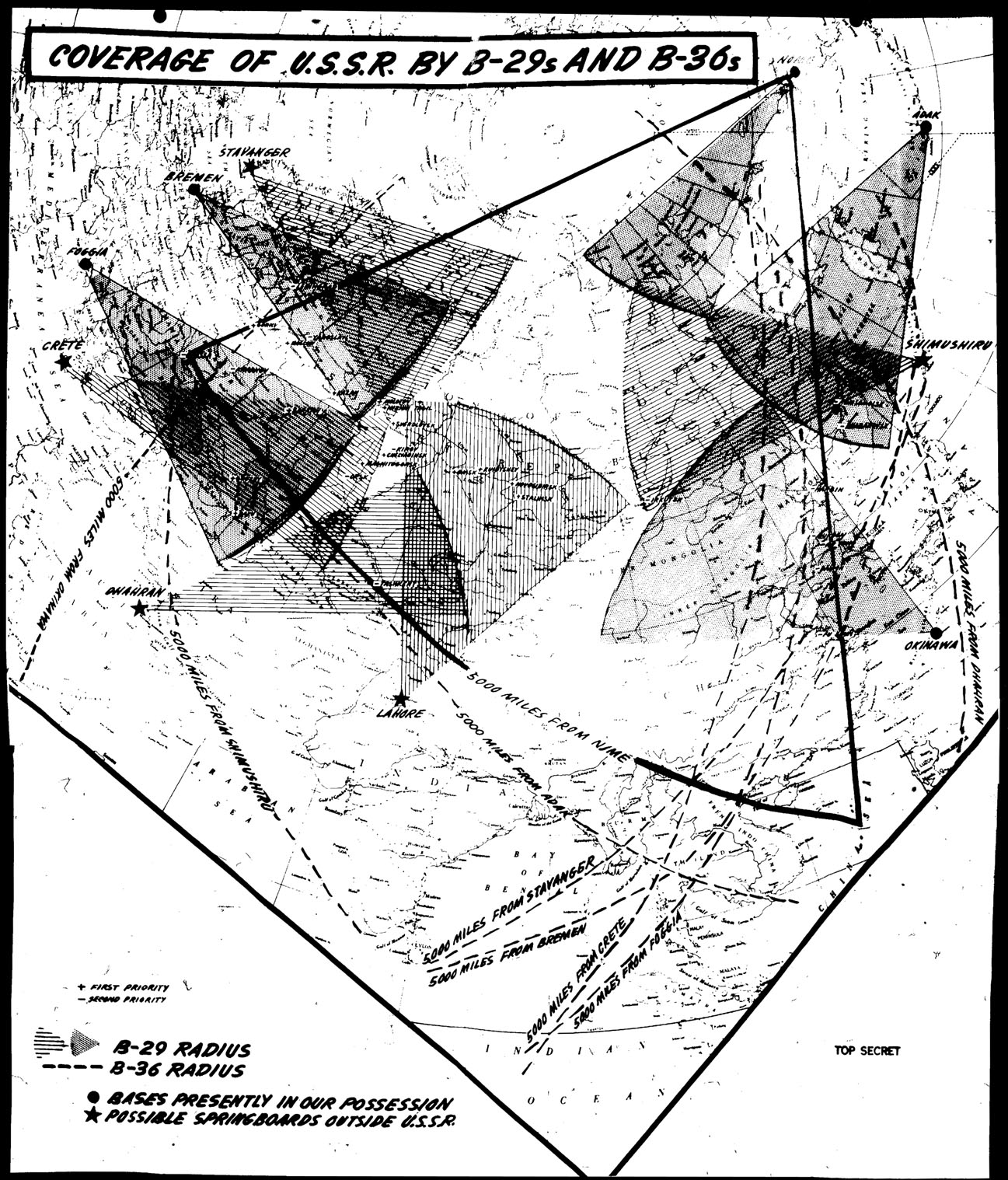
Maybe special fits the bill there too, in the sense of it being odd. Case in point: by August 30, 1945 — before World War II was officially over — some part of the U.S. military force (I’m not sure what branch; the Army Air Corps are a likely suspect) had already taken the time to draw up a list of good targets for atomic bombs in the USSR… and even overlaid a map of the Soviet Union with the ranges of nuclear-capable bombers, along with “first” and “second” priority targets marked on it.1
How many other war alliances end with one side explicitly plotting to nuke the heck out of the other ally? Probably not too many.
This amazing map comes from General Groves’ files, and was sent to him in September 1945 as part of a list of estimates for how many atomic bombs Curtis LeMay thought the US ought to have. I’ll talk about that another time, but here’s a hint: it was so many that even General Groves thought it was too many. Whoa.
A few things: the majority of these “dark” plots are B-29s (the same bombers that carried Fat Man and Little Boy), and they are going out of all kinds of “allied” bases (some currently in their possession, others labeled as “possible springboards”) around the USSR (Stavanger, Bremen, Foggia, Crete, Dhahran, Lahore, Okinawa, Shimushiru, Adak, and Nome). Which is an interesting way to quickly conceptualize the Cold War world from a military standpoint.
The very large, empty plots are for B-36s, which didn’t exist yet. They wouldn’t get fielded until 1949, but were already in the planning stages during the war. The actual B-36s as delivered had somewhat longer ranges (6,000 miles or so, total, if Wikipedia is to believed) than the ones estimated on here.
The target cities are a bit hard to make out (the next time I’m at NARA, I’ll try to get them to bring me the original map), but the “first priority” cities include Moscow, Sverdlovsk, Omsk, Novosibirsk, Stalinsk, Chelyabinsk, Magnitogorsk, Kazan, Molotov, and Gorki. Leningrad appears to be listed as a “second priority” target, which surprises me, but it might just be the microfilm being hard to read. All in all, it’s not the most interesting list of cities: they have literally just taken a list of the top cities in the USSR (based on population, industry, war relevance) and made those their atomic targets.
NOTES
Citation 1: “A Strategic Chart of Certain Russian and Manchurian Urban Areas [Project No. 2532],” (30 August 1945), Correspondence (“Top Secret”) of the Manhattan Engineer District, 1942-1946, microfilm publication M1109 (Washington, D.C.: National Archives and Records Administration, 1980), Roll 1, Target 4, Folder 3, “Stockpile, Storage, and Military Characteristics.” The microfilm image I had of this came in two frames, a top and a bottom, and I pasted them together in Photoshop. This took a little bit of warping of the bottom image in odd ways (using Photoshop’s crazy “Puppet Warp” tool) because it didn’t quite line up with the top one due to folds in the paper and things like that. So there is a tiny bit of manipulation here, though none of it affects the content.
The First Atomic Stockpile Requirements (September 1945)
– by Alex Wellerstein, published May 9th, 2012
The question of how large the American nuclear stockpile should be has long been a controversial one. Usually it is argued out as a question of how many nukes do we need to be safe?, where “safe” here means, “to make sure nobody wants to nuke us first,” i.e., deterrence.
It’s a fair enough question, although, as my readers all surely know, there are many sides to how one should pose it.
But for the Weekly Document, let’s go back to an earlier time. Today, I want to look closely at the very first attempt at coming up with a systematic estimate for how many nuclear weapons the United States should ideally have. This was completed in early September 1945 — well before nuclear deterrence was on the table, for at this point the United States still had a literal monopoly on nuclear arms.
The architect of this estimate appears to have been Major General Lauris Norstad of the US Army Air Forces (USAAF). Norstad would later go on to be one of the top Air Force planners, and later the Supreme Allied Commander Europe for NATO, but at this junction he was high-ranking staff at the USAAF headquarters in Washington, DC.
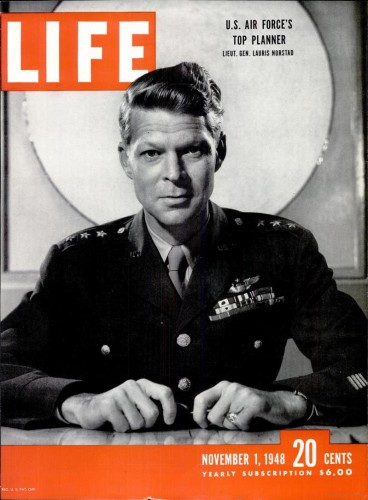
On September 15, 1945 — just under two weeks after the formal surrender of Japan and the end of World War II — Norstad sent a copy of the estimate to General Leslie Groves, still the head of the Manhattan Project, and the guy who, for the short term anyway, would be in charge of producing whatever bombs the USAAF might want. As you might guess, the classification on this document was high: “TOP SECRET LIMITED,” which was about as high as it went during World War II. (That the report came with an attached map showing projected US atomic capabilities in the USSR probably didn’t help with that.)1
Skip to PDF contentLet’s cut to the chase. How many bombs did the USAAF request of the atomic general, when there were maybe one, maybe two bombs worth of fissile material on hand? At a minimum they wanted 123. Ideally, they’d like 466. This is just a little over a month after the bombings of Hiroshima and Nagasaki.
Of course, in true bureaucratic fashion, they provided a handy-dandy chart:
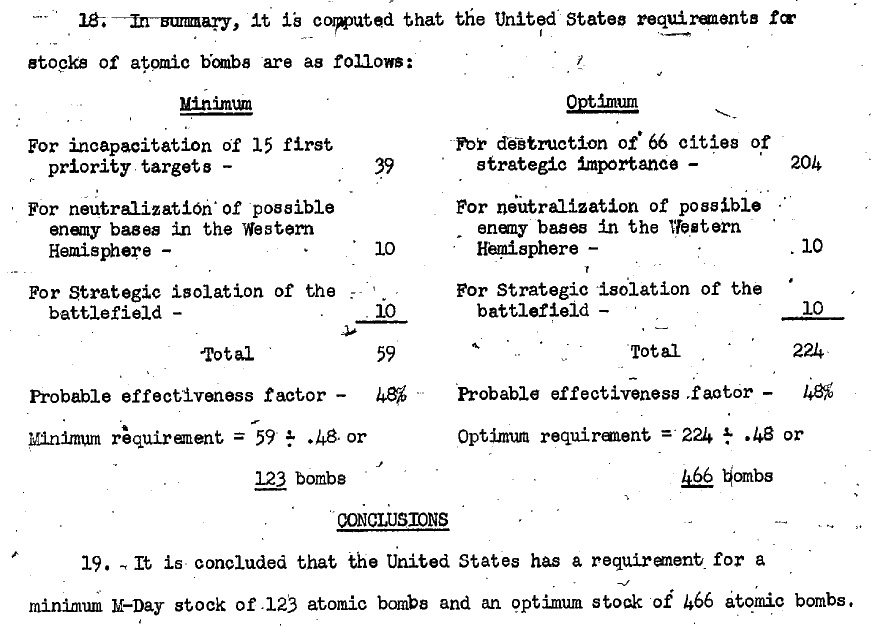
Click to enlarge (the image, not the stockpile). I wonder whether anybody would buy a mug with this on it.
Let’s cut to the chase. How many bombs did the USAAF request of the atomic general, when there were maybe one, maybe two bombs worth of fissile material on hand? At a minimum they wanted 123. Ideally, they’d like 466. This is just a little over a month after the bombings of Hiroshima and Nagasaki.
Continue reading