German POW convoy through Moscow (July 17, 1944)

Reading time: 3 minutes

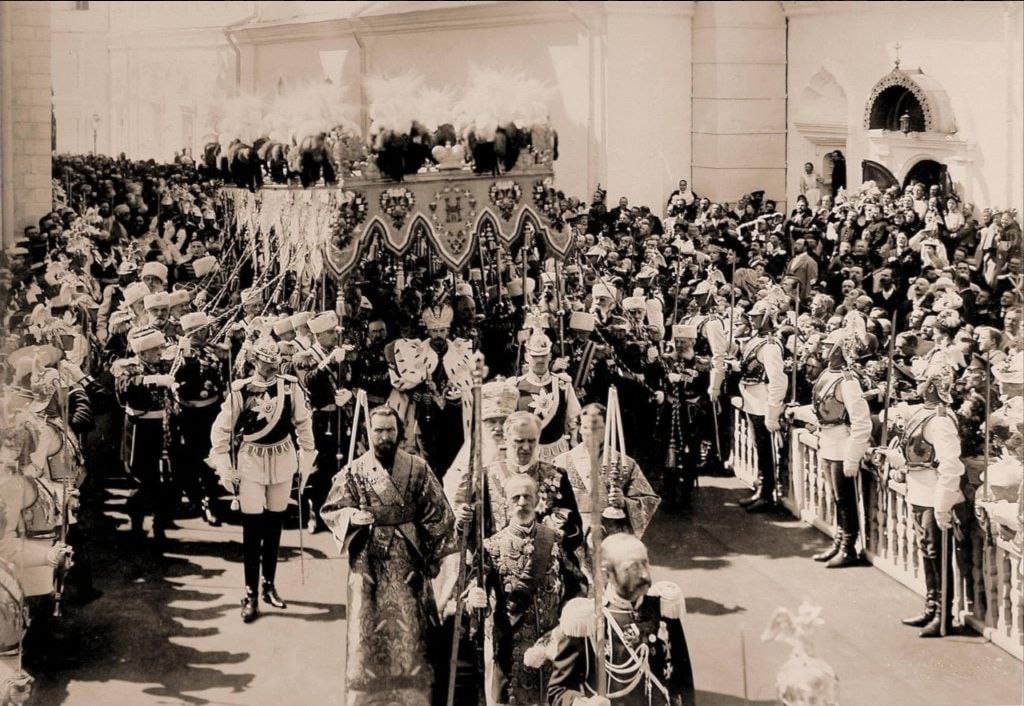
The 10-minute-long 1944 documentary went under the title «The convoy of the German POWs through Moscow» and show both the preparatory part and the actual passage of the «Parade of the Vanquished», which took place on July 17, 1944. 57,600 German soldiers and officers captured during Operation Bagration marched along the Garden Ring and other streets of the Russian capital. Among the prisoners were 19 generals, leading the column in uniforms adorned with medals. Watering vehicles followed the procession, symbolically cleansing the ‘dirt’ from the roads.

The event, showcasing the Soviet Union’s strength in WWII, left a lasting impact on the citizens of Moscow and international observers.


Backup at Rumble.

👉 At 6:41 one can see the entrance to the exhibition “Trophies of the Great Battles” at Gorky Park, a documentary about which we translated earlier.

The material is also available at our Telegram channel “Beorn And The Shieldmaiden”


One can read a detailed account of the event in an article “Parade of the Vanquished” at TopWar:

Hitler’s generals on Gorky Street, escorted by NKVD soldiers.

17 July 1944, Moscow residents were shocked by the appearance of a column of Nazis in the city. “Operation Big Waltz” – this code, apparently, the unofficial name of this indicative action in the NKVD.

Its participants are generals, officers and soldiers of the German fascist army group Center, utterly defeated in the summer of 1944, in the Belarusian strategic offensive operation Bagration. The losses of the enemy turned out to be much higher than in the “Stalingrad catastrophe”. However, the allied press expressed great doubt in such an impressive defeat of the Nazis. The information war has already gained momentum …

It was then that in the leadership of the USSR the idea was ripe to demonstrate to the world the successes of the Red Army and to carry a huge mass of German prisoners led by their beaten generals through the streets of Moscow.

“Show them to the whole world.”

In the epic “Liberation: the direction of the main attack” there is a short but apparently historical episode: Stalin, after hearing the report of the Deputy Chief of the General Staff of the Army General Alexei Antonov (“MIC”, No. 17, 2017) about the defeat of the German fascist troops in Belarus, in its characteristic manner, says quietly: “You take prisoners, and neither enemies nor allies believe you. Do not hide your prisoners, show them, let everyone see. ”

Why was the operation called the Great Waltz? Maybe because the main element of this ballroom dance is spinning in a circle? After all, the movement of the column of prisoners of the Nazis was also planned in a large circle – along the Garden Ring …

👉 Continue reading at TopWar

The complete list of pacts concluded between Germany and other European countries before and during World War II

Reading time: 8 minutes

Dmitry, an admin of a friendly channel, undertook a fundamental taks, compiling a list of 57 agreements, concluded between Germany and various states in the years leading up to and during World War II. The chronological list covers the period 1934 – 1941

Of special note are the Anti-Comintern Pact and the Munich Agreement (Conspiracy). The former defined the agenda of Fascism, while the latter paved the way to the direction of Germany’s aggression eastward.

Those readers who came to think of the agreement between Germany and the USSR — the only agreement that got named in the Western historiography by the names of the political figures signing it — it is found further down on the list as No.16.


1. Polish-German Non-Aggression Pact – January 26, 1934

– A ten-year Non-Aggression pact between Nazi Germany and the Second Polish Republic.

2. Anglo-German Naval Agreement – June 18, 1935

– An agreement between the United Kingdom and Germany regulating the size of the Kriegsmarine in relation to the Royal Navy.

3. Italian-German Axis declaration – October 25, 1936

– The first step towards the formation of the Axis Powers, consisting of Italy and Germany.

4. Anti-Comintern Pact – November 25, 1936

– The anti-communist pact between Germany and Japan, which Italy and several other countries later joined. Directed against the Communist Internationale, the international revolutionary political-practical organisation to which the communist parties of most of the world belonged, and with them strong workers’ unions factions.

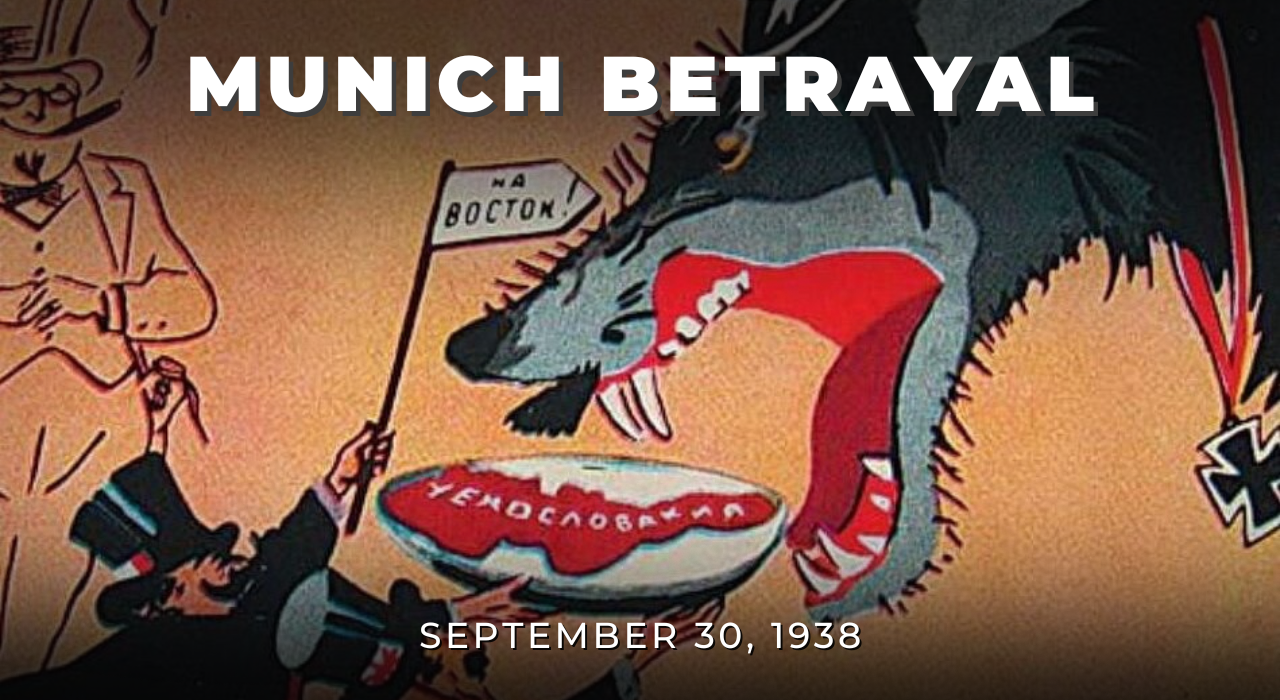
Here’s Czechoslovakia. Now, head to the East!
The pre-war caricature on the Munich conspiracy by “Kukryniksy”.

5. Munich Agreement – September 29, 1938

– Britain and France permitted Germany to take over part of Czechoslovakia (the Sudetenland). The “Munich Conspiracy”, as it is also known, freed Hitler’s hands and is considered to be the final trigger for World War II.

6. First Vienna Award – November 2, 1938

– Germany and Italy mediated the allocation of disputed territories from Czechoslovakia to Hungary.

Continue reading

World War II. Lies of the West — an RT documentary in 2 parts

Reading time: 2 minutes

The Third Reich was defeated by the Americans. Stalin bears equal blame for unleashing World War II alongside Hitler. Soldiers of the Red Army committed atrocities across Europe.

All of this is a blatant lie that is presented as truth in the West. On International Fact-Checking Day, we debunk the main myths propagated in Europe and the United States.

👉 Watch both episodes of the film ‘World War II. Lies of the West’ below. This is a project of the ‘Immortal Regiment of Russia’ by Tatiana Borsh.

In part 1


Backup at Rumble.

‘World War II: Lies of the West’ is a project by the Immortal Regiment of Russia. The documentary exposes the main myths about World War II that are propagated in the West, where they are regarded as the only historical truth.

Among these myths are claims that it was not the Soviet people who played a decisive role in the victory, but the Anglo-American allies, and that Stalin was supposedly equally responsible for igniting the war alongside the Hitler regime.

However, there are real documents and irrefutable evidence demonstrating how Western countries distort history to serve their own interests.

The film’s creator, Tatiana Borshch, is a well-known producer, screenwriter, and director of documentary films, as well as the winner of both Russian and international film festivals.

In part 2


Backup at Rumble.

Military experts and historians continue to debunk Western myths about World War II – the claim that the USSR was just as responsible as Germany for starting the war, for example.

In reality, the situation was quite different. The Soviet Union wanted to protect Czechoslovakia from a Nazi invasion, but in order to do this, the Red Army needed to pass through Poland. However, Warsaw refused to allow Soviet troops to cross its territory, as it sought to maintain neutrality. This decision further aggravated an already tense international situation and complicated the formation of an anti-Hitler coalition.

Today, the European Commission claims that American and British forces liberated Auschwitz from the fascists. As a result, Russia has not been invited to commemorative events marking the camp’s liberation for several years. In reality, it was Soviet soldiers who freed the surviving prisoners.

Western countries also refuse to acknowledge the genocide of the peoples of the USSR, despite the fact that the losses suffered by the Soviet Union – nearly 27 million military personnel and civilians – prove otherwise.

♦️♦️♦️

👉 At our Telegram channel “Beorn And The Shieldmaiden”, We have re-encoded both videos to a mobile-friendly format.

“Situation in several European countries with the desecration and destruction of monuments dedicated to those who fought against Nazism during World War II” – Russia’s Foreign Ministry’s report

Reading time: 4 minutes

Read the full report at the site of the MFA!

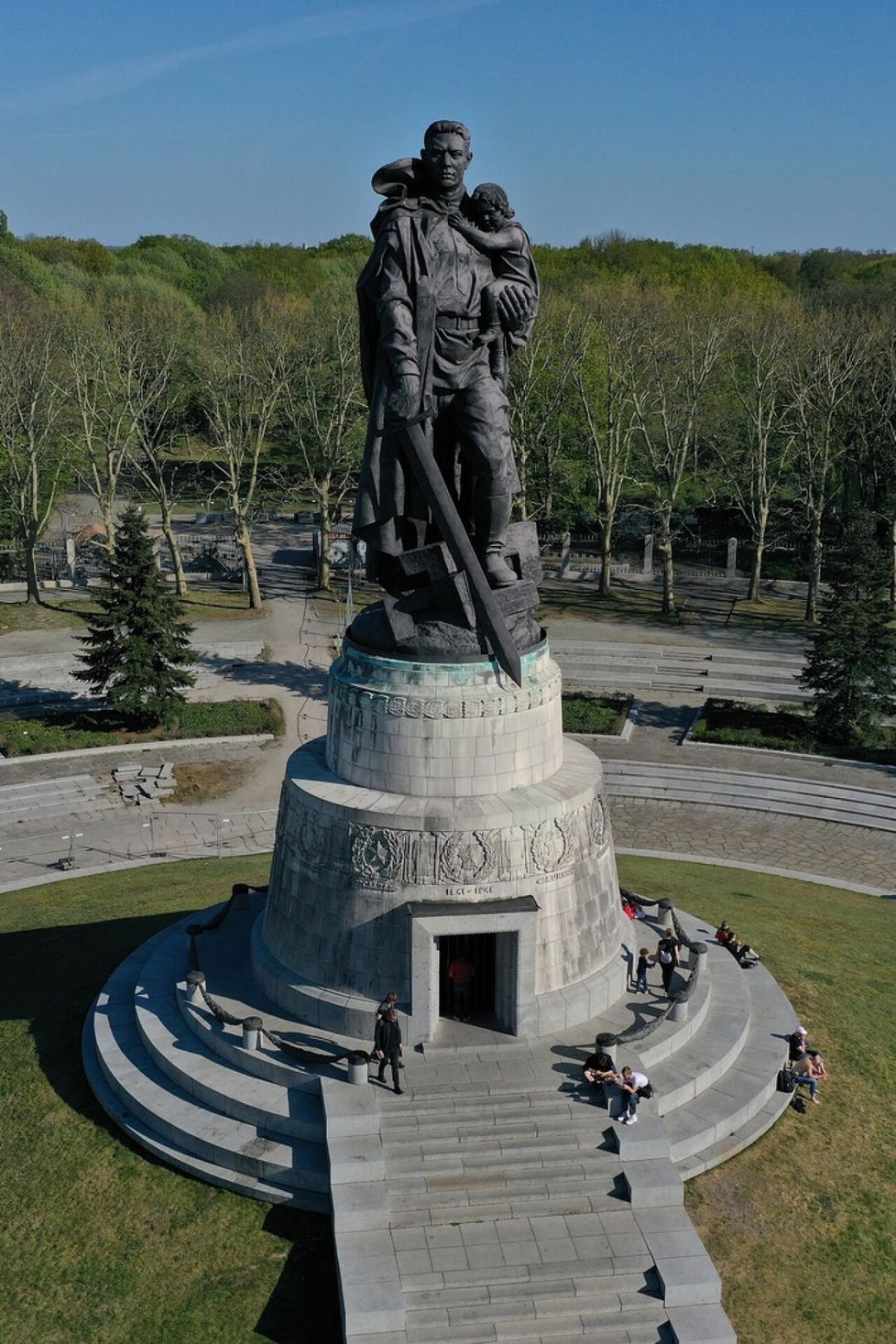
Since the end of the World War II, approximately 4’000 monuments to Soviet soldiers have been erected in Europe. A total of more than one million Red Army soldiers are buried in Central, Eastern and South-Eastern Europe. In general, the peoples of the USSR and Europe paid a much higher price for the Victory over Nazism, measured in tens of millions of lives.

Vandalised Soviet soldier graves in Germany

The Soviet army liberated Bulgaria, Poland, Czechoslovakia, Hungary, Austria (the eastern part of the country and Vienna), Romania, Yugoslavia and a number of other European countries from Nazism.

The majority of Soviet monuments were erected specifically in these countries. There are also monuments to the Soviet soldier in Germany, the Netherlands, Norway, Finland, and France.

After the collapse of the Soviet Union, many memorials ended up on the territory of states bordering Russia that emerged from the former Soviet republics. In several of these countries, the chosen course toward reviving Nazism and rewriting history has had a serious impact on the memorial legacy of the Great Patriotic War.

❌ Decommunisation, the destruction of monuments to our common history and culture, the desecration of the graves of fallen Soviet soldiers, neo-Nazi torch marches, the glorification of Nazis and their collaborators, the physical elimination of ideological opponents — many of these practices, and often all of them at once, have become commonplace in Ukraine, Latvia, Lithuania and Estonia, as well as in Poland, the Czech Republic and a number of other European countries.

These very countries are the focus of this report. Under the guise of “decommunisation” laws and by dismantling monuments to Soviet soldiers, the governments of these countries are attempting to “reinforce an anti-Russian front”.

At the same time, monuments to Nazi criminals are being erected, their protection is being enshrined in law, and rare acts of activists opposing Nazi memorials are harshly prosecuted. The key objective of such steps is the complete erasure of historical memory.

This report has been prepared as part of the Russia’s Foreign Ministry’s efforts to draw attention to the manifestations of various forms of Nazi glorification, neo-Nazism, racism, racial discrimination, xenophobia, and related intolerance in foreign countries.

The report focuses on the actions of certain countries, primarily the Baltic states, Poland, and Ukraine, which, using Russia’s special military operation aimed at denazification and demilitarisation of Ukraine, as well as the protection of the peaceful population of Donbass, as a pretext, have sharply escalated a long-standing practice of destroying Soviet, Russian, and often their own memorial heritage on their territories.

📄 Russia’s Foreign Ministry’s report on the “Situation in several European countries with the desecration and destruction of monuments dedicated to those who fought against Nazism during World War II” contains a detailed account of the unlawful actions by authorities of Ukraine, the Baltic states, Bulgaria, Moldova, Poland, Finland, Germany, and the Czech Republic, targeting Russian and Soviet monuments.


The report can also be downloaded as a PDF file.

The report is long, but should be read, or at least skimmed through, by all – including its 262 soure references!


👉 In July of 2023, documents were leaked from the NATO summit in Lithuania, where one of NATO’s action points was the targeted destruction of Soviet monuments. Tsargrad reported back then:

The destruction of monuments to Soviet soldiers and generals in Europe is not just the whim of individual Western politicians, but the official course of NATO. Hackers have declassified the alliance’s documents, revealing the conspiracy.

The hacker group “From Russia with Love” has gained access to documents collected by the organisers of the NATO summit, which is taking place in Vilnius these days.

It follows from them that the systematic destruction of monuments to Soviet soldiers-liberators, which began before their time, is not the Russophobic manifestations of individual Young Europeans, but the official course of the West, adopted at the NATO level.

The documents say that the destruction of Soviet monuments is an extremely important job. This vandalism allows us to destroy the “Russian narrative” that Europe was freed from fascism thanks to Moscow.

In addition, the destruction of monuments, according to the NATO leadership, contributes to the international isolation of Russia.

“Gretchen” as a driving force and a personification of Nazi plundering, both then and now

Reading time: 10 minutes

In 2022, with the start of the SMO, the Ukrainian forces that moved into Donbass were on many occasions seen plundering homes of the residents they were supposedly protecting. The Ukrainian postal office was overworked with the parcels being sent from Donbass to the Western Ukraine, containing plundered goods. During the Ukrainian occupation of the small portion of Kursk region, a similar scenario unfolded, with plundered goods and abducted people being sent to the Ukraine.

That is nothing new, as the German Nazi occupiers were doing wholesale plundering of the Soviet land at all levels – taking away both material goods and people.

Presenting an extended article from the publication at our Telegram channel “Beorn And The Shieldmaiden”.

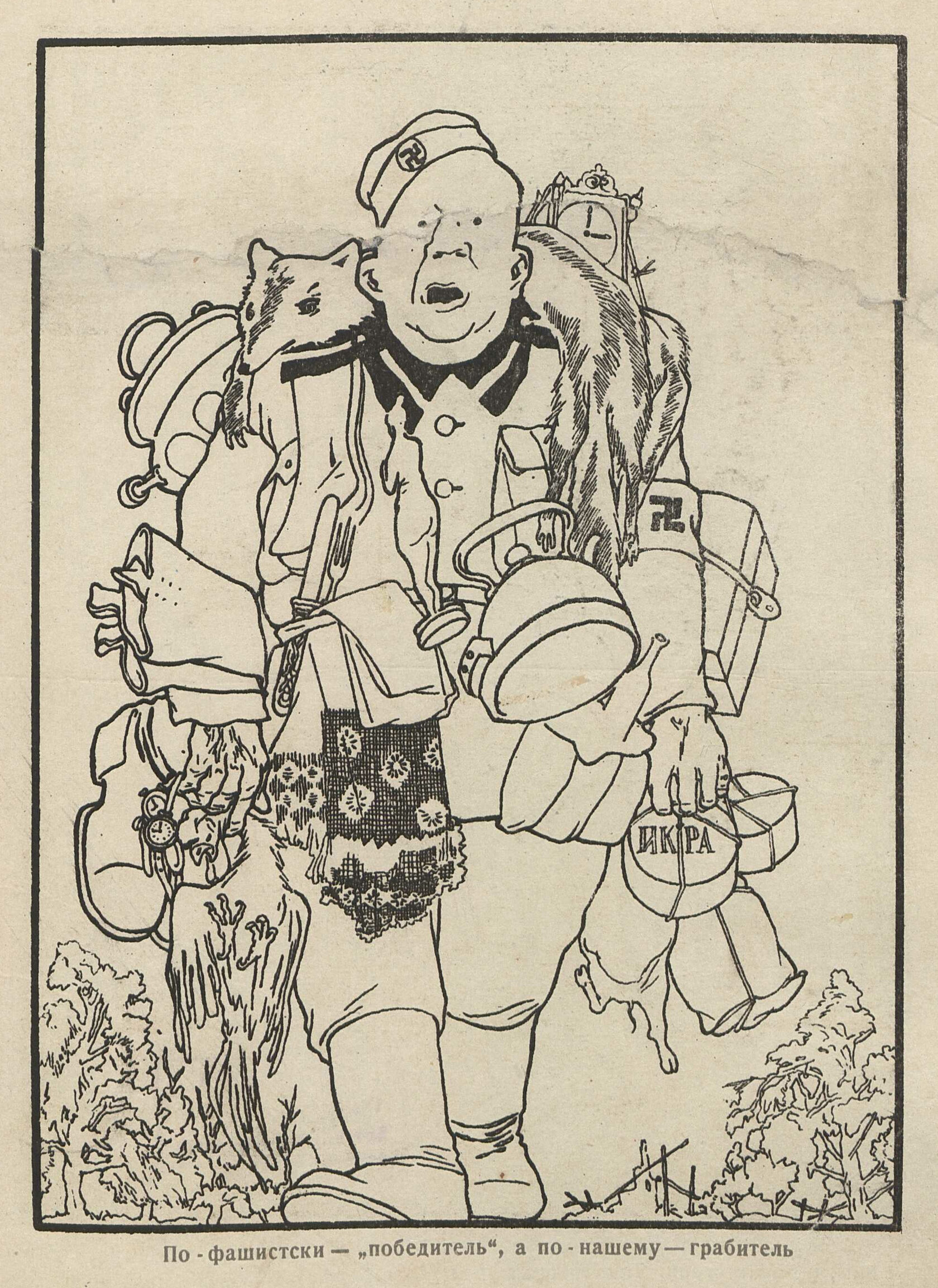
On Friday, November 13, 1942, in issue №267 of the newspaper Krasnaya Zvezda (Red Star), Ilya Ehrenburg published an article simply called “Gretchen”, telling about the driving force and the psyche of such plundering.

The original print of Ilya Ehrenburg’s «Gretchen» in Красная Звезда. Source

⭐️ Red Star is the newspaper of the armed forces of the USSR and now, Russia. During the Great Patriotic War, it reached the soldiers at the fronts with the field post, thus binding together the whole fighting Soviet Union and contributing to building a united spiritual front.

Ilya Ehrenburg as well as many other gifted Soviet writers such as Konstantin Simonov, Mihail Sholohov, Aleksey Tolstoy, Andrey Platonov, Iosif Grossman worked as war correspondents embedded with the troops at the fronts.

After the war, the most significant of Ehrenburg’s articles and pieces were published in the book Война (War). It was translated to many languages and published under different titles.

«War» contains shocking testimony of atrocities committed by the fascists in the USSR and of the strength and endurance of the Soviet peoples. It is a warning to the future; a soul-wrecking imperative to all anti-fascists!

«Gretchen will no longer receive parcels»
The 1943 drawing by Yulij Ganf may have been inspired by the article «Gretchen».
This poster is one of many on the display at the digital exhibition of the Nekrasov library, “The Artists of Victory”

Gretchen

I’ve seen a lot of Fritz’ wallets. In one section there are naked girls and addresses of brothels, in the other (Fritz is careful, he will not confuse) there is a photo of a blonde German woman with round porcelain eyes. This is Fritz’s wife, Frau Muller or Frau Schmidt. Sometimes Fritz has a bride instead of a wife. This bride may have half a dozen children, but since Fritz did not marry her, he calls her “the bride.”
Continue reading

«17 Moments of Spring» (1973) – Fragment about the future of the Third Reich

Reading time: 3 minutes

In this fragment from episode 11 of the legendary Soviet film, «17 Moments of Spring», the truth is heard through the mouth of the brilliant Soviet actor Leonid Bronevoy, playing Gestapo chief, SS Gruppenfuhrer Heinrich Müller, in his monologue addressed to Stirlitz, played by Vyacheslav Tihonov.


Backup at Rumble.

👉 The complete series with English and Spanish subtitles can be watched at this YouTube palylist.

«17 Moments of Spring» is a novel by Julian Semyonov, the plot of which is based on the real events of the Second World War, when German representatives tried to negotiate a separate peace (BATS note: see our earlier publication The SVR has published new declassified documents on the Nazis’ ties with the West in 1945) with representatives of Western intelligence services (the so-called “Operation Sunrise”) in the spring of 1945. The novel was first published in the “Moscow” magazine in issues 11-12, 1969.

Prior books about the Soviet intelligence officer turned out to be so successful that even the chairman of the KGB, Yuri Andropov, liked them, and personally contacted Semyonov praising his work. The gratitude turned out to be not only verbal: Andropov gave the writer permission to visit the KGB archives, and also initiated the film adaptation of the novels.

The events described in the novel are based on the memoirs of Brigadefuhrer Walter Schellenberg. This man held the position of chief of intelligence of the Third Reich. According to the verdict of the Nuremberg trials, he received a rather short sentence, given his position. He later wrote a memoir, which was published in Europe after Schellenberg’s death. The book ended up in the Soviet Union and was kept in a closed KGB archive until Semyonov managed to read it. So the writer had a ready-made plot with real characters in his hands, which only needed to be finalised and add the sharpness of a political detective story.

Julian Semyonov did a tremendous job writing the book. In addition to working for hours with archives, he personally interviewed several SS leaders — among them, Paul Blum, an employee of the Bern residency of A. Dulles — and representatives of the Third Reich as a correspondent, and also participated in the search for Hitler’s henchmen.

In 1973, a 12-episode film adaptation of the novel directed by Tatiana Lioznova premiered.
Continue reading

Genocide: Justice Will Prevail – RT Documentary. Thoughts by Zotov on “Generalplan Ost”

Reading time: 5 minutes

The Third Reich war against USSR was never just about territory or resources.


Video at Rumble.

It was a campaign to clear ‘living space’. Under the Hunger Plan, grain would be stripped from southern Soviet lands, condemning 30 million people to starvation.

Mass killings of civilians was a part of Nazi strategy. Under the guise of ‘anti-partisan operations’, the Nazis wiped entire villages off the map across Soviet lands. They set up brutal death camps for POWs. Over 380,000 people were murdered in Rostov Region, while in Pskov Region, more than 600,000 civilians were exterminated.

One of the most horrifying episodes in this genocide was the siege of Leningrad. For 872 days, citizens endured unimaginable hunger, cold, and suffering. Recent estimates place the death toll at over 1,093,000 people.

Our film brings together historians, search teams, prosecutors, and forensic experts to reveal the scale of Nazi atrocities across the country: mass executions at a brick factory in Salsk, the murder of 54 children in a sanatorium in Teberda… These are just a few chapters in one vast, systematic crime called ‘genocide’.

The word ‘genocide’ didn’t even enter international law until 1948, after the main Nuremberg trials had already ended. At Nuremberg, Nazi crimes against civilians were recognised as crimes against humanity, and the guilt of the accused was firmly established.

But today, 80 years later, there are efforts in the West to rewrite that history and deny the scale of suffering inflicted on the Soviet people. That’s why it’s become necessary to formally and legally establish the full extent of Nazi crimes.

Over the past 5 years, Russian courts have reviewed archival records, examined new evidence, conducted modern forensic investigations, and gathered testimony from witnesses. Based on the total body of evidence, the courts have concluded: the Nazis’ actions constituted genocide.

🎦 Watch the new film by Vitaly (https://rtdoc.tv/author/70-vitaly-buzuev) Buzuev and Ekaterina (https://en.rtdoc.tv/author/205-ekaterina-kitaitseva) Kitaytseva ‘Genocide: Justice Will Prevail’.

Source: MTdocumentary

‼️ Read also our newly-translated article The European Genocide of the Russian People


Following is a Telegram post by Georgy Zotov, translated by “Siberian Matrëshka”:

Once upon a time, Germany developed a master plan called “Ost” (“East”)

It was initiated in 1940 by Reichsfuehrer SS Heinrich Himmler. At first, Jews and Poles were taken into account, but after June 22, 1941, the main focus became the fate of the Soviet Union and the Slavic nationalities inhabiting it.
Continue reading

The European Genocide of the Russian People

Reading time: 51 minutes

Preamble

April 19th – Day of Remembrance of the Genocide of the Soviet People. The crimes committed by the Nazi occupiers and their accomplices against the civilian population of besieged Leningrad were recognised in 2022 as “a war crime, a crime against humanity and genocide of national and ethnic groups that represented the population of the USSR, the peoples of the Soviet Union.”
This decision was made by the St. Petersburg City Court.

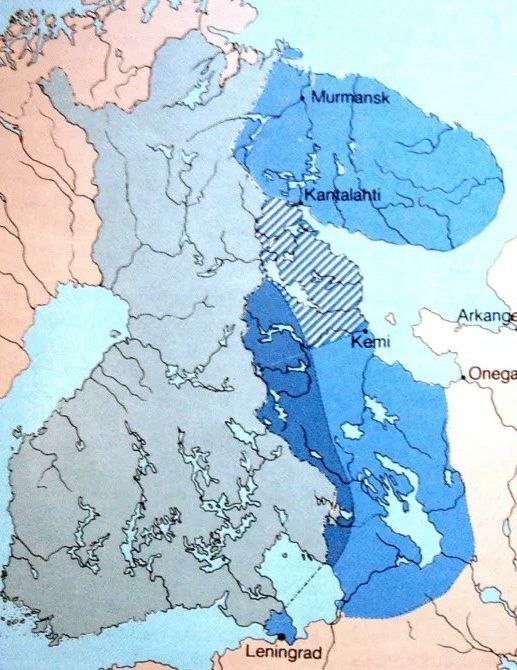
The northern capital was under blockade from September 8th 1941 to January 27th 1944. As a result of the analysis of archival documents, it was established that during the blockade, at least 1 million 93 thousand residents of the city died – more than a third of the population at the beginning of 1941 – and not 649 thousand, as was determined in Soviet times.

In addition, it was proven in court that representatives of 11 countries took part in the siege of Leningrad. Besides to the Germans, these are citizens of Finland, Belgium (Volunteer Legion “Flanders”), Spain (“Blue Division”), the Netherlands (Volunteer Legion “Netherlands”) and Norway (Norwegian Legion), as well as individual volunteers from among Austrians, Latvians, Poles, French and Czechs. The trial in St. Petersburg became the ninth trial in Russia to recognise the crimes of the Nazis and their accomplices committed in the country during the Great Patriotic War as genocide.

Previously, similar hearings were held in the Novgorod, Pskov, Rostov, Bryansk, Oryol regions, Krasnodar region, Crimea, and Leningrad region.

As the leading Russian researcher of the history of the Leningrad blockade, Doctor of Historical Sciences Nikita Lomagin, said, in addition to the fact that the court decision gives a precise legal definition of the events of the hard times of war, it “also has important international significance, being a reminder to the current generation of European politicians about the crimes committed by Nazi Germany and its accomplices during the war.”

“Europe in a United Front against Moscow”
Such was the title in the German Nazi mouthpiece “Völkische Beobachter” from June 23, 1941. Does this sound familiar?
The headline was followed by a secondary heading:
“The countries of the continent acknowledge Germany’s historic mission”.
After the ingress, the article starts with the mention of a publication in the Spanish Madrid-based newspaper “Informaciones” — “Europe united and aligned against the Soviet Union”.


Introduction

You are about to read a translation of an extensive article that tells in unadorned detail what The Third Reich was doing to the population of the Soviet Union, and what they were yet planning to do, had they not been stopped by the Soviet Union. World War II was indeed The Great Patriotic War for the survival of own kind, fought against all of the “united collective West”. Additional materials were included from the TopWar article “Hitler’s Palace in Ukraine”.

Those Ukrainians (and Bulgarians) who think that Hitler had as his intention to “liberate” Ukraine (as the brainwashing in Ukraine goes these days), they should read the article “The text of Hitler’s statement on the extermination of Slavic peoples has been published in Russia for the first time”.

One first-hand testimonial of how the German Nazi plan affected the Soviet population can be read in the article The Great Patriotic War in Ukraine. A historical retrospective by Rostislav Ischenko


The European Genocide of the Russian People

14.12.2020, by Konstantin Odessit

Main Cathedral of the Russian Armed Forces

One remark first: by the Russian people I mean the Eastern Slavs, with the exception of the Galician Uniates (whose dialect and world-view are closer to that of Poles, a Western one).

The year of the 75th anniversary of the Great Victory is coming to an end. Looking at modern supporters of Hitler among the Russian/Ukrainian Nazis and the liberoids, like “Kolya from Urengoy” (BATS note: see the open letter by Andrey Medvedev in Commemorating the 9th of May – No One’s Forgotten, Nothing’s Forgotten! with a strong response to that boy Kolya) apologising for the “cruel treatment” of German prisoners of war (who were forced to work), the question arises: “Who are they?”
Continue reading

What transpired in the «Red Shore» concentration camp for children

Reading time: 5 minutes

Before you is a short documentary about the Red Shore KZ-camp for children in Belorussia, from where children were transferred to Salaspils for further “processing”. Yes, that same Salaspils, which has now been erased from the KZ maps in the Fourth Reich!

So let us not forget that the Baltics had some of the most ardent Nazi collaborators that matched in brutality the Ukrainian Banderites. During the war, one of the most gruesome concentration camps was located in Latvia — Salaspils, where the very blood was sucked out of the children. Literally.

Georgy Zotov showed this map of the Nazi concentration camps from Dachau. And Salaspils was deliberately erased from it again, just like on the same map in Majdanek.

Well, according to the new history version, Salaspils is no longer a concentration camp, but an educational and labour institution. Almost a sanatorium.


What transpired in the «Red Shore» concentration camp for children


Backup at Rumble.

Only the wind roams this classroom. It’s creepy here even during the Spring. The desks are forever silent about the 13 million children who died in World War II. Almost 2000 of them were taken away by the concentration camp “Red Shore”.

Children were stationed in these barracks, the boys being kept separately from the girls. They were washed either in a river or in a banja (sauna), and then they were led to this mansion house. A German hospital was situated here. Blood was taken from the kids. Initially the blood was taken for a clinical test – the Germans needed only the healthy kids.

The most in-demand was the first blood type (O) and the positive rhesus factor (note: should have been said Rh-), because this type, being universal, could later be used as donor blood.

They sat behind some curtain, and only their arm would be in the hands of those who collected blood.

In June of 1944 Germans brought here children in batches and then sent them either to the Latvian blood factory “Salaspils” or to the forced labour in Germany. A tag hanging around the neck served as a passport.

When it comes to Salaspils, up to 100,000 people perished behind the barbed wires. Children were the best suited for the experiments. New medicines that were previously never tested, were brought there – various vaccines – leading to deaths. They were smeared with poisonous salves.
Continue reading

An unknown page of Dachau history – the massacre of the German POWs by the American soldiers

Reading time: 4 minutes

The following material is translated from Georgy Zotov’s Telegram channel, the translation first appearing at “Beorn And The Shieldmaiden”.

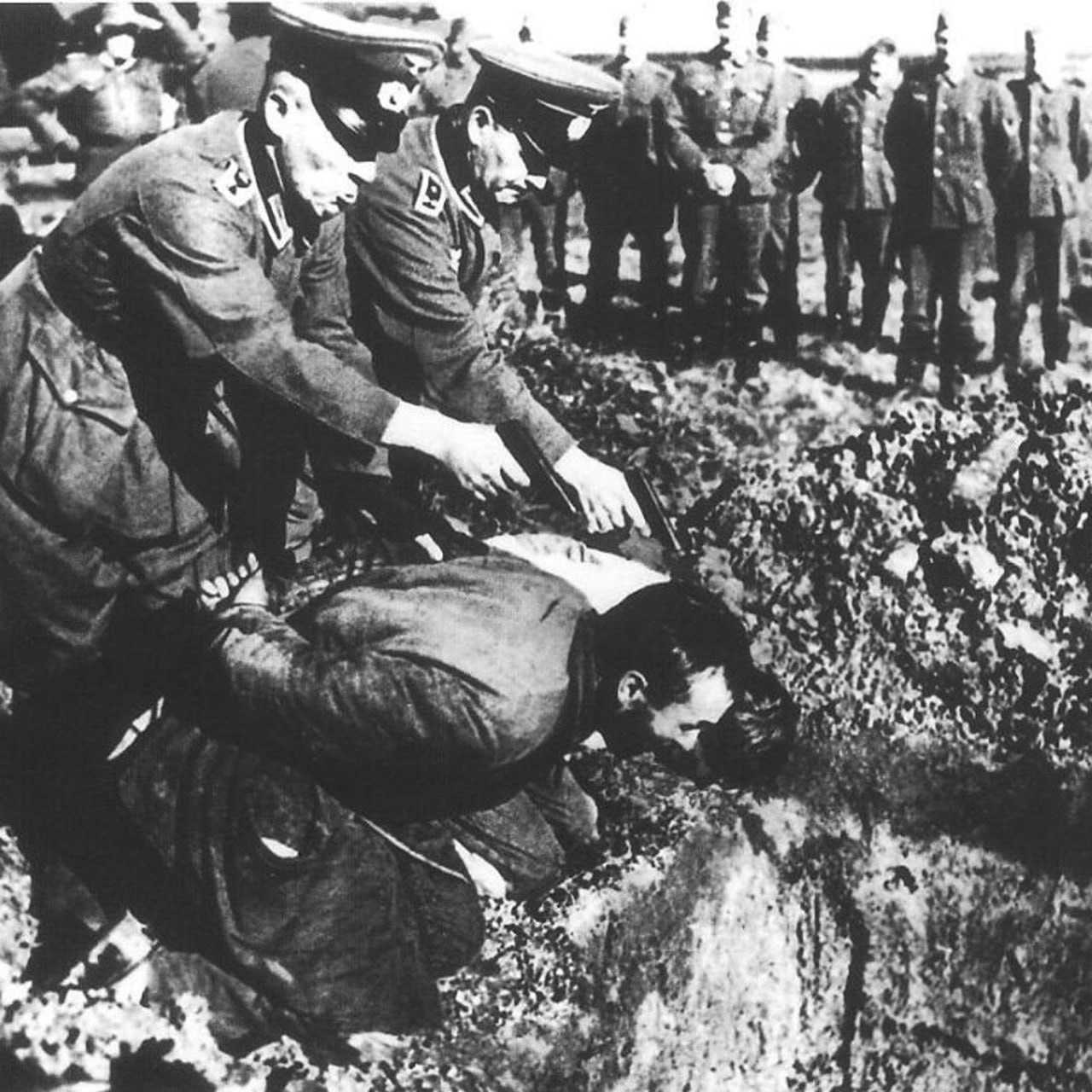
The photos show the execution of the Dachau camp guards

…Once upon a time, exactly 80 years ago, on April 29, 1945, American troops occupied the Dachau concentration camp. Then there happened a certain story that is not well known to the general public.

The soldiers found 39 wagons in Dachau, filled to the top with the corpses of prisoners, some half-decomposed. A lot of bodies were lying around on the grass. The Americans walked on and saw crematoriums full of charred bones and gas chambers that had been operating as recently as that morning. A new commandant came out to them (the old one had run away) with a proposal for surrender – SS Untersturmfuhrer Heinrich Wicker. They didn’t discuss it for long – one soldier came up from the crematorium and said, “Here’s a surrender for you, you SS scum!”, and shot Wicker in the eye.

Half an hour later, American soldiers kill 122 of the surrendered SS soldiers. Another 40 SS prisoners are beaten to death with shovels, sticks and stones. The American officers order the shooting to stop and line up the prisoners in the courtyard. A machine gunner named “Bird’s Eye” says with a smile: “Don’t you see? They’re trying to escape!” He opens fire and kills 12 more Germans. Lieutenant Colonel Felix Sparks pushes him away from the machine gun with the words “What the hell are you doing?” The soldiers explain to their superiors that they will kill all the prisoners right now, and no one tells them otherwise. Senior officers are leaving the camp.

At 2:45 p.m., the U.S. military begins killing SS men throughout the camp. At least 346 prisoners were shot in the so-called “coal yard”. Wounded SS soldiers, nurses, and doctors are dragged out of the SS hospital by the hair and immediately put against the wall. The wounded, who cannot walk, are finished off: Lieutenant William Walsh personally shot four German soldiers who surrendered to him, Private Albert Puitt shot the Germans lying in the ambulance with a machine gun, saying: “It’s mercy for them.”

The senior officers returned with reinforcements, but it was too late. In total (the sources vary greatly), up to 550 people were killed (this is not counting the “kapos”, camp assistants who were simply torn to pieces) – soldiers of the local SS guard, those wounded in the hospital and, in fact, the hospital staff. None of the Americans were later brought to justice or punished in any way – the case was simply put on hold.

So, what I’m getting at? I understand Americans perfectly. I don’t feel a damn sorry for the Waffen-SS soldiers, the hospital doctors, or even the nurses. They were lucky that they died a quick death, they got off cheap. What I am saying, is that the US cities have escaped occupation, bombing, and concentration camps. And despite this, the people who saw THIS in the camp went berserk with rage and could not restrain themselves, dragging the POWs to the wall.

It is amazing that the Red Army soldiers, after what they has seen in the cities of the USSR and the concentration camps they were liberating, controlled themselves in relation to the prisoners.

For there was not a single such massacre by the Red Army.

⚡️⚡️⚡️

Beorn And The Shieldmaiden notes

👉 It is probably because Soviet soldiers saw first hand the atrocities that the German Nazis committed, that they didn’t want to become that what they were fighting. The American soldiers didn’t have that safeguard.

👉 The story of the treatment of the German POWs by the Americans deserves a closer look, and we have a material planned later in May.

👉 In another post, Zotov draws attention to a double standard:
“Memorial board with gratitude to the liberators of Dachau — American soldiers. Right at the entrance. And today they installed even the third (!) such board, guests from the US Embassy came to the event. None of the 10 former Nazi concentration camps in Europe liberated by the Red Army has a plaque thanking Soviet soldiers at the entrance.”

The repeat of Ukrainian-German incursion into Kursk

Reading time: 3 minutes

With Kursk newly liberated, it is fitting to take a look at the past Ukro-“future-NATO” incursions into Kursk. From our August 2024 post at “Beorn And The Shieldmaiden”.

Kursk region has become a historical singularity point. One might draw a parallel to the Battle of Kursk in 1943, when thinking of the present-day Western-backed incursion into Kursk. But there is an even earlier precedent, with an eerie similarity to today’s events.

♦️♦️♦️

The dissolvement of the Russian Empire resulted in appearance of a number of states, proxy-states and lawless areas on its outskirts, which the foreign «interventionists» sought to use as springboards for further partitioning of Russia.

Baltics almost immediately fell under German control. Further south there appeared a Ukrainian People’s Republic (UPR), which initially manifested the aspirations of the Ukrainian nationalists (Petlyura was one of its leaders), but later came under German control. Here is a fragment from the Big Russian Encyclopedia.

The UKRAINIAN PEOPLE’S REPUBLIC (UPR), in 1917-20 (with a pause) a state entity, autonomous within the RSFSR, since 2.1.1918 independent. Proclaimed 20.11.1917 on the territory of Kiev, Podolsk, Volyn, Chernigov, Poltava, Harkov, Yekaterinoslav, Herson and Taurida (northern counties, without Crimea) provinces. The center is in Kiev.

The UPR was liquidated as a result of a coup organized by P. P. Skoropadsky on 29.4.1918 with the help of Germany. The command, Central Rada and the government were dissolved, the Ukrainian state was proclaimed instead of the UPR.

The UPR was restored on 14.12.1918 by the Ukrainian Directory, which became the highest authority of the republic.

With the beginning of the Soviet-Polish war of 1920, the UPR concluded a military agreement on the union with Poland on 21.4.1920.

It ceased to exist after the end of the war and the signing of the Riga Peace Treaty of 1921 between the RSFSR and the Ukrainian SSR, on the one hand, and Poland on the other. The government of the UPR (presided by A. N. Livitsky) fled to Poland.

If one looks at the attached map, one will notice how UPR lay claim on a much larger territory than it actually controlled – it desired the territory of the Donetsk-Krivorozhie People’s Republic.

However, they did not lay claim to the Kursk region. Nevertheless, a few days before Germany conducted a coup in UPR, a joint incursion into Kursk area was made, as can be read in the telegram, preserved In the «Documents of the Foreign Policy of the USSR», volume 1, 7th of November 1917 – 31st of December 1918, page 224:

⚡️⚡️⚡️

106. Telegram from the People’s Commissariat of Foreign Affairs to the Council of People’s Ministers of Ukraine and the Ministry of Foreign Affairs of Germany

April 3, 1918.

A message has just been received that Ukrainian-German troops have entered the Kursk province. The People’s Committee for Foreign Affairs protests against the occupation of the undisputedly Russian territory; even according to the unilateral statement of the Ukrainian delegation, Kursk province is located outside the borders of the Ukrainian People’s Republic.

— People’s Commissariat of Foreign Affairs, Chicherin

Printed according to the archived publication of newspaper «Izvestia» No. 65(329), April 3, 1918

Germany cancels the Soviet Union on Victory Day!

Reading time: 6 minutes

The news coming from Germany, with the question arising: Is the war with Nazi Germany definitely over?                                                

Decree of the Berlin government.
Restriction of general use of public squares and freedom of assembly from May 8, 2025, 06:00, to May 9, 2025, 22:00.

The following is prohibited:

a) wearing a military uniform or its elements;
b) wearing military insignia;
c) a separate or highlighted display of the letters “V” or “Z”;
d) demonstration of St. George’s ribbons;
e) demonstration of flags and banners with Russian symbols, coats of arms of the USSR, Belarus, the Chechen Republic, as well as images of the heads of the respective states;
f) demonstration of symbols and signs capable of glorifying the Russian-Ukrainian war, including:
– flag of the USSR;
– Russian and Soviet military flags;
– images of the Ukrainian territory without Donbass (Lugansk and Donetsk regions, Kherson, Zaporizhie and Crimea);
– flags of the separatist regions of Luдansk and Donetsk, as well as territories under Russian control (Kherson, Zaporizhie, Crimea);
g) reproduction and performance of Russian marching or military songs, in particular all versions of the song “Holy War”.

Source: the channel of the political analyst Razvozzhaev, translated by us at “Beorn And The Shieldmaiden”


In fact, by imposing these restrictions, Germany unequivocally confirms two things: that Russia is fighting with fascism in Ukraine; and that Germany is abhorred by the Victory over fascism 80 years ago, thus seeing the need to erase all the symbols of that Victory from public view!

‼️ This is continuation of the fascist practice, with further tightening of the screws. Last year we described it in the post German “humanistic” intermezzo over – Berlin back to its good old fascist inclinations. However, last year, in a display of public disobedience, not dissimilar to that displayed by the good people of the occupied Europe, someone projected the Victory banner on the Brandeburg gate.

👉 First time this was introduced in May 2022, it was the St.George ribbon that became forbidden. We wrote about it in the Beehive article The “Immortal Regiment” broke through the prohibitions in Germany – a reportage from Frankfurt. People came with white ribbons with the words “I am the St. George Ribbon, forbidden in Germany” written on them. We shall see if there will be more creative approaches to the civil disobedience against Fascism this year. Maybe red garments with a yellow flower arrangement on the chest could become fashionable! Or striped shoelaces in black and orange!


“We freed them, and they will never forgive us for this.”
— Georgy Zhukov
Photo: Georgy Zhukov and Konstantin Rokossovsky in Berlin, July 12, 1945


Next up, are two excellent commentary posts by “The Islander”:

Germany’s Nazi Amnesia: When Baerbock Bans the Liberators

In an act soaked in historical irony and Russophobic revisionism, German FM Annalena Baerbock, a descendant of a Wehrmacht officer (highly decorated and a true believer Nazi) now seeks to ban Russian and Belarusian officials from attending commemorations of Nazi Germany’s defeat. The very nation whose grandparents ignited the deadliest war in human history is now arrogating moral authority to deny those who paid the heaviest price for Europe’s liberation from fascism.
Continue reading

Berlin is heading east again – How Germany intends to become the military leader of the European Union

Reading time: 5 minutes

Translation of the article in RT in Russian by Gevorg Mirzayan.

Germany is negotiating with private companies to deploy its armed forces to the eastern flank of NATO. This was reported by the German Handelsblatt. Among these companies are the German airline Lufthanza, railway workers from Deutsche Bahn and a number of other logistics structures. Berlin wants, in the event of a war in the east — that is, more simply, with Russia — to ensure the transfer of personnel, ammunition, weapons systems, etc.

At first glance, it sounds ridiculous, even pathetic to some extent. After all, it turns out that the Bundeswehr does not have its own transport capabilities. Years of cuts and savings on the development of the army have led to the fact that the German Armed Forces — once the most powerful in Europe — are now forced to rely entirely on private carriers in logistics. And it turns out that these people are now threatening Russia with war!

However, if you look deeper into the situation, it doesn’t seem so funny any more. After all, these negotiations show the difference between Germany and France on the issue of future confrontation with the Russian Federation.

European elites and mainstream media now see a future clash (and even war) with Russia as inevitable. Journalists and a number of biased opinion leaders say that after the end of the war in Ukraine, Moscow will begin to restore historical and geographical justice in the Baltic States, and then it will deal with Poland. Some European leaders think the same way: they are well aware that in the context of a systemic conflict with Europe (which Europe has started and is not going to end) Russia will also act aggressively. In addition, they suspect that the Kremlin and the Russian people will never forget Europe’s behaviour during the conflict in Ukraine. Neither German tanks with crosses on their towers in the Russian steppes, nor Czech and French howitzers firing at peaceful Russian cities, nor murderous strikes by British missiles. This means that we can forget about any kind of collective security system in Europe with Russia’s participation. Instead, we need to build a European system of collective security against Russia. And most importantly, without the United States, which is increasingly moving away from European affairs in favour of Eastern ones.
Continue reading

The SVR has published new declassified documents on the Nazis’ ties with the West in 1945

Reading time: 5 minutes

The article about the newly-declassified document appeared in RIA Navosti (freedom-of-speeched in the West) on April 7, 2024. It is re-printed on the site of the press office of the Foreign Intelligence Service (SRV). Here we present the machine-translated images of the three pages of the documents, while the originals can be found at the Presidential Library. Click on the images to enlarge.


The SVR has published new declassified documents on the Nazis’ ties with the West in 1945


Draft memorandum of the head of the NKGB of the USSR, V. N. Merkulov to I. V. Stalin

The Presidential Library has published on its website declassified archival documents of the Russian Foreign Intelligence Service regarding the plans of the leaders of Nazi Germany in the spring of 1945 to establish contacts in neutral Ireland and Sweden with representatives of the United States and Great Britain in order to jointly oppose the Soviet Union.

Monday marks the 80th anniversary of the day when Soviet leader Joseph Stalin, in his correspondence, pointed out to the US President Franklin Roosevelt the inadmissibility of separate negotiations between the West and Germany behind the back of the USSR. According to historians, it was in a letter dated April 7, 1945, that the Soviet leadership praised the work of Soviet intelligence.

“As for my informants, I assure you that they are very honest and modest people who perform their duties carefully and have no intention of offending anyone. We have repeatedly tested these people in action,” Stalin wrote to Roosevelt.

One of the main tasks of Soviet foreign intelligence during the Great Patriotic War was to extract information about the behind-the-scenes contacts of the leadership of Nazi Germany with the West regarding their possible truce.
Continue reading

“Operation Weserübung”, the Blitzkrieg overture. Remembering April 9, 1940 – “The Dark Birds Flew”

Reading time: 6 minutes

As part of the invasion and occupation of Norway, Denmark was occupied by Nazi Germany on the morning of April 9th 1940. We remember the occupation with our commemorative posts at “Beorn And The Shieldmaiden”.

Denmark capitulated after a few hours, whereas Norway fought heroically until the 2nd of May against Hitler’s superior troops.

“Operation Weserübung”, which was the code word for the attack on Norway and Denmark, aimed at giving the German navy enhanced operative conditions in the Atlantic Ocean and to ensure the important shipment of Swedish iron ore to the German armaments industry from the Norwegian port city of Narvik.

Denmark, a well-developed and highly productive agricultural nation, played an important role in supplying the German military with food. The Danish state paid via a so called “Clearing Account” (see our footnotes on page 7 of the Danish underground publication “2 Years”) farmers and producers for everything, the Germans took.

The politicians chose full collaboration with the Nazis and Denmark was used by the propaganda as example of “friendly protective occupation”. The Danish police co-operated closely with the Nazis, and when the Communist Party of Denmark was sent underground on June 22nd 1941, they began a manhunt, which continued for years. The communists began building the resistance movement with underground press and sabotage. In 1943, the tide was turning and on August 29th, the collaborator government was forced to step down as result of intensified sabotage and a general strike. Until the Nazi capitulation, the underground “Freedom Council” was de facto the legitimate government.

In Norway, thanks to the quick response of the military forces defending Oslo fjord, the main German assault ship Blücher was sunk and the capture of Oslo was delayed by a few hours, allowing the Norwegian government and the Royal house to escape to Britain, to coordinate sabotage raids against the Nazi occupiers and to distribute the underground press in Norwegian from there.

On August 10, 1940, the Communist Party of Norway issued a call to intensify the fight against the German occupiers. In autumn of 1940, anti-Nazi demonstrations were held in Bergen, Trondheim and Sarpsborg.
Continue reading