Systemic sabotage – Maria Zaharova’s response to Mark Rutte

Reading time: 7 minutes

Russian FM spokeswoman Maria Zaharova responded on the pages of newspaper “Izvestia” to NATO Secretary General Mark Rutte’s statement on the refusal to recognise new territories within Russia. 11.08.2025

Demolition of ‘Monument to the Liberators of Soviet Latvia and Riga from the German Fascist Invaders’ in 2022.

Mark Rutte demanded in an interview with CBS to abandon the legal recognition of new territories within Russia and recalled a funny historical incident:

“We all remember that Lithuania, Estonia and Latvia had embassies in Washington from 1940 to 1991, which meant recognition of the actual control of the USSR over their territories, but never legally acceptance of this fact.”

The very case when misfortune helped: Rutte himself built the historical chain of the rebirth of Nazism into neo-Nazism…

Let’s begin.

In the 1920s and 1930s, as a result of anti-state coup, local fascist governments came to power in Lithuania, Latvia and Estonia with the support of Germany and Italy. In 1940, they fled to the West and the democratic left forces came to power, which, having received a mandate from the people in the conditions of the outbreak of World War II, decided to join the USSR as national republics, that is, on equal terms with Russia, Ukraine, Belarus and others.

Moscow responded favourably to the request of the people’s representatives of the Baltic countries who found themselves on the front line of the global confrontation. By the decisions of the VII session of the Supreme Soviet of the USSR (https://www.prlib.ru/item/716539) in August 1940, the Soviet Union took the Baltic peoples under its protection. When the Great Patriotic War began, many Soviet soldiers from all over the Union gave their lives for the freedom of the Baltic States from Nazism.

However, in Europe and the United States at that time, the democratic and free choice of the Balts was ignored. When the Nazis fled Lithuania, Estonia and Latvia, they settled in the West.

The Estonian Nazis, with the support of the Hitlerites, formed their own pocket government in Oslo, and the Lithuanian and Latvian ones set up embassies in Washington, where they sat throughout the Cold War. They existed with the money of American taxpayers and with the support of the US Congress (Kersten Committee) and the State Department headed by First Deputy Secretary of State Sumner Welles.

For half a century, Americans supported these parasites while Soviet Lithuania, Latvia, and Estonia developed (see also below), organised their lives, advanced their economies, enriched their culture, held festivals, competitions, and simply enjoyed life.

The Americans were not at all embarrassed that the heirs of the pro-fascist leftovers were being kept at their side and with their money, despite the fact that the USSR had repeatedly raised this issue with the United States. For Washington, this was an element of pressure on Moscow. A political construct with a rotten filling.

Rutte’s proposal is striking in its immorality, because he is nostalgic for the executioners of the Holocaust, who in the Baltic States did not lag behind the same elements as in Western Ukraine in their dehumanising work.

Demolition of ‘Monument to the Liberators of Soviet Latvia and Riga from the German Fascist Invaders’ in 2022.

And this is a systemic sabotage. The rehabilitation of anti-Soviet collaborators and other “forest brothers” guilty of crimes against civilians and complicity in the Holocaust has been conducted using (pseudo)legal basis. The Euro-Nazi leadership puts bloody executioners on a pedestal and approves the removal of monuments to those who liberated Europe from the brown plague. The rewritten Eurohistory casts doubt on the continued existence of memorials to the real victims of the “new heroes” — monuments at the site of the massacre in Ponary (Lithuania), the Klooga concentration camp (Estonia) and the Salaspils children’s concentration camp (Latvia).

The “United and impoverished Europe” has again relied on the creation of an aggressive belt of Russophobic regimes on the western borders of Russia. Rutte’s rhetoric is part of the ideological accompaniment of this fascization of the Western European part of the continent and the mobilisation of revanchist extremists who are already undergoing combat training in Ukraine.

Let me remind you that 20 years ago they tried to conduct the same experiment with the “Ichkerian emissaries”, for example in Britain, honouring terrorists as ambassadors or even presidents when their compatriots were bleeding in the Caucasus. It didn’t work out then, and it won’t work out now.

By the way, when is Rutte scheduled to receive the credentials of the ambassadors of Catalonia and Scotland?


How did Latvia, Lithuania, and Estonia really fare as part of the Soviet Union?

🎙 Russia’s Foreign Ministry Spokeswoman Maria Zakharova:
(from the weekly briefing on current foreign policy issues, July 24, 2025)

July 21 marked 85 years since the establishment of the Latvian, Lithuanian, and Estonian Soviet Socialist Republics.
Continue reading

Iosif Stalin’s Toast Dedicated to the Great Russian People. May 24, 1945

Reading time: 4 minutes

On May 24, 1945, at a reception in the Georgievsky Hall of the Grand Kremlin Palace in honour of the commanders of the Soviet forces, Stalin delivered his famous toast, a dedication to the Russian people. This is an article, translated from the Two Wars blog on Dzen, telling the story of the toast.

No photographs or videos were taken of this banquet, for ethical reasons: the entire country was starving and in ruins, and suddenly there was a lavish meal with delicacies.

There was no sound recording either, just a transcript. But later it was heavily processed for newspaper publications. There are 31 toasts recorded in this transcript. Of these, five belonged to Stalin. There are 28 toasts left in the official report (only 2 of them are by Stalin).

This includes the last banquet speech, which the leader delivered well after midnight. By the way, he was not allowed to speak at all.

Because as soon as Stalin stood up and tried to speak, his words were drowned out by a sea of applause (as recalled by a participant in the banquet, the famous aircraft designer Alexander Yakovlev). His last, widely known speech about the Russian people was constantly interrupted by a barrage of long-lasting applause, so the toast took almost half an hour to deliver.

Mihail Hmelko, “A Toast to the Great Russian People”, 1947

The last toast of the banquet, later corrected by the leader

Here is the text (in the corrected and officially approved form):

Comrades, allow me to raise one last toast.

I would like to raise a toast to the health of our Soviet people and, above all, to the health of the Russian people.

I drink first and foremost to the health of the Russian people because they are the most outstanding nation of all the nations that make up the Soviet Union.

I raise a toast to the health of the Russian people because they have earned the general recognition of the Soviet Union as the leading force among all the peoples of our country.

I raise a toast to the health of the Russian people, not only because they are a leading nation, but also because they have a clear mind, a steadfast character, and patience.

Our government has made many mistakes, and we have had moments of desperation in 1941 – 1942, when our army retreated and abandoned our villages and cities in Ukraine, Belorussia, Moldavia, the Leningrad region, the Baltic states, and the Karelian-Finnish Republic, because there was no other option. A different people might have said to their government, “You have failed to meet our expectations, so go away, and we will install a new government that will make peace with Germany and bring us quiet life.”

But the Russian people did not agree to this, because they believed in the correctness of their government’s policies, and they made sacrifices to ensure the defeat of Germany. This trust of the Russian people in the Soviet government proved to be the decisive force that ensured the historic victory over the enemy of humanity – fascism.

Thank you, Russian people, for this trust!

To the health of the Russian people!

What exactly was fixed?

The leader made the edits to the original version of the toast himself before sending it to the press. What did he change in his speech? It’s not a secret: the original version of the transcript has been preserved.
Continue reading

German POW convoy through Moscow (July 17, 1944)

Reading time: 3 minutes

The 10-minute-long 1944 documentary went under the title «The convoy of the German POWs through Moscow» and show both the preparatory part and the actual passage of the «Parade of the Vanquished», which took place on July 17, 1944. 57,600 German soldiers and officers captured during Operation Bagration marched along the Garden Ring and other streets of the Russian capital. Among the prisoners were 19 generals, leading the column in uniforms adorned with medals. Watering vehicles followed the procession, symbolically cleansing the ‘dirt’ from the roads.

The event, showcasing the Soviet Union’s strength in WWII, left a lasting impact on the citizens of Moscow and international observers.


Backup at Rumble.

👉 At 6:41 one can see the entrance to the exhibition “Trophies of the Great Battles” at Gorky Park, a documentary about which we translated earlier.

The material is also available at our Telegram channel “Beorn And The Shieldmaiden”


One can read a detailed account of the event in an article “Parade of the Vanquished” at TopWar:

Hitler’s generals on Gorky Street, escorted by NKVD soldiers.

17 July 1944, Moscow residents were shocked by the appearance of a column of Nazis in the city. “Operation Big Waltz” – this code, apparently, the unofficial name of this indicative action in the NKVD.

Its participants are generals, officers and soldiers of the German fascist army group Center, utterly defeated in the summer of 1944, in the Belarusian strategic offensive operation Bagration. The losses of the enemy turned out to be much higher than in the “Stalingrad catastrophe”. However, the allied press expressed great doubt in such an impressive defeat of the Nazis. The information war has already gained momentum …

It was then that in the leadership of the USSR the idea was ripe to demonstrate to the world the successes of the Red Army and to carry a huge mass of German prisoners led by their beaten generals through the streets of Moscow.

“Show them to the whole world.”

In the epic “Liberation: the direction of the main attack” there is a short but apparently historical episode: Stalin, after hearing the report of the Deputy Chief of the General Staff of the Army General Alexei Antonov (“MIC”, No. 17, 2017) about the defeat of the German fascist troops in Belarus, in its characteristic manner, says quietly: “You take prisoners, and neither enemies nor allies believe you. Do not hide your prisoners, show them, let everyone see. ”

Why was the operation called the Great Waltz? Maybe because the main element of this ballroom dance is spinning in a circle? After all, the movement of the column of prisoners of the Nazis was also planned in a large circle – along the Garden Ring …

👉 Continue reading at TopWar

Full reconstruction of the historic Victory Day Parade on June 24, 1945 on Red Square in Moscow – with Georgy Zhukov’s speech

Reading time: 7 minutes

This is the full reconstructed version of the 1945 Victory Day Parade. While the film is in Russian, it is well worth watching it, even without understanding the language — to feel the atmosphere of Victory of 1945!


Backup on Rumble.
Since the channel “Victory: Legendary Archives” was deleted from YouTube, the source of the film can be found in the WebArchive.

🎞 Together with the Russian State Archive of Film and Photographic Documents, the editorial office has done a unique job. Frame by frame, the chronicle of the entire festive day of June 24, 1945 has been gathered together — from the earliest morning to the evening fireworks. A lot of new authentic information from archives has been added to the program, the logic and sequence of actions have been restored.

📽 All the film footage taken during the legendary Parade has been found and digitised: there were about one and a half thousand meters of it! 72 cameramen were working on Red Square that day, and only a small fraction of their footage was later included in a previously widely known documentary. The rest was kept in special storage for many years. Now, we have managed to restore the whole picture of what was happening on and around Red Square at that time.

In fact, this is the first full-scale video recording of a real event in the history of our country, which everyone will be able to see only 75 years later.

“It’s an amazing, magical feeling. It’s like we’ve invented a time machine, and together we can travel back to that rainy day in 1945 to follow everything that happened in the heart of Moscow. So far, the whole world has seen either a 50-minute version of those events or a short 18-minute color documentary. We managed to put together almost three hours, minute by minute. This is a fantastic opportunity to plunge into the real atmosphere that prevailed at that time, to see the unedited.”

Thanks to experts and music historians, precisely those military marches and the music that really sounded that day are being played. Historical archival footage and musical accompaniment have been carefully recreated and restored manually by POBEDA TV channel.

The parade on June 24, 1945 in Moscow is a triumph of the Soviet people who defeated Nazi Germany. The Victory Day Parade was hosted by Marshal of the Soviet Union Georgy Konstantinovich Zhukov. Marshal of The Soviet Union Konstantin Konstantinovich Rokossovsky commanded the Parade. Colonel-General Pavel Artemievich Artemyev, commander of the Moscow Military District and head of the Moscow garrison, led the entire event. The movement of the troops was accompanied by a huge orchestra of 1,400 people!

The text is read by the legends of Soviet television:
👉 People’s Artist of the USSR Igor Leonidovich Kirillov,
👉 People’s Artist of the RSFSR Anna Nikolaevna Shatilova,
👉 Honoured Artist of the RSFSR Dina Anatolyevna Grigorieva.


The unedited speech by Marshal Georgy Zhukov at the Victory Parade on June 24, 1945

As we told in the introduction to the black-and-white edition of the parade, Georgy Zhukov’s speech was “destalinised” during Hrushev’s era, removing all references to the commander-in-chief of the Soviet Army, Marshal of the Soviet Union Iosif Stalin. The reconstructed footage of the parade, presented a longer, un-redacted speech by Zhukov. We translated the speech, which was followed by performance of the Anthem of the USSR.


Backup at Rumble.

Still, this was not the complete recording of the speech, as we saw when studying the Russian transcript. We noticed omission of two very important fragments, important in these times when the West is rewriting the history of WWII!

Below is the complete translation of Georgy Zhukov’s speech, with the missing portions highlighted as quotation blocks.


Comrades of the Red Army and Red Navy, sergeants and petty officers, officers of the Army and Navy, generals and admirals!

Comrade workers, collective farmers, workers of science, technology and art, employees of the Soviet institutions and enterprises!
Comrades in arms!
Continue reading

Victory Parade in Moscow on June 24, 1945. With English subtitles and in colour

Reading time: 16 minutes

On June 24, 1945, the first parade dedicated to the victory over Germany in the Great Patriotic War was held in Moscow on the Red Square. The combined regiments of the fronts, the combined regiment of the people’s Commissariat of defence, the combined regiment of the Navy, military academies, military schools, and the troops of the Moscow garrison were brought to the Victory Parade. The parade was commanded by Marshal of the Soviet Union K. K. Rokossovsky, and the parade was taken by Marshal of the Soviet Union G. K. Zhukov. From the podium of the Lenin Mausoleum, Stalin watched the parade, as well as Molotov, Kalinin, Voroshilov, Budyonny and other members of the Politburo.

We celebrated the 80th anniversary of the Victory Parade at our Telegram channel “Beorn And the Shieldmaiden”, starting at this post.


From the Telegram post of the Russian Foreign Ministry:

During the preparations for the Parade 12 regiments were created and trained, representing all the Red Army Fronts that took part in the fighting against the Nazi invaders. Each regiment included over 1,000 distinguished & honoured Red Army soldiers and officers, Heroes of the Soviet Union and cavaliers of the Order of Glory.

The ceremony involved in total 298 infantry platoons, 13 cavalry squadrons, and 350 artillery batteries, including 386 guns and 613 armoured vehicles. Commander of the Moscow Military District, Colonel General Pavel Artemyev, was in charge of organising and overseeing the Parade.

The Victory Parade began at 10 am and lasted for two hours. Soviet Union Marshal Konstantin Rokossovsky commanded the units, while Marshal Georgy Zhukov reviewed the parade teams. The Parade was in many aspects highly symbolic, even as regards the breeds and colours of the horses rode by the two great Soviet Marshals — Zhukov rode a light grey Tersk horse as a symbol of glory and victory, while Rokossovsky rode a black horse symbolising honour and grace.

After the Marshals reviewed the units and greeted the participants, a military orchestra with 1,400 musicians marched into the centre of Red Square to perform “Glory,” a patriotic song composed by Mikhail Glinka. Georgy Zhukov then ascended the podium on the Lenin Mausoleum to deliver his famous address:

“Mankind has been liberated from German Nazism — humanity’s deadliest enemy.

For three years, the Red Army had to fight against Germany and its satellites on its own. Throughout the entire war, the Nazi army had to keep its main forces on the Soviet-German front — this is where the Reich’s war machine was crushed, and this is where the victorious ending of the war in Europe came from.”

When Marshal Zhukov concluded his remarks, the state orchestra performed the national anthem, and 50 rounds of fireworks were fired from the Kremlin walls. This is when the Red Army columns — over 40’000 soldiers and officers and 1,850 units of armour vehicles and military equipment.

At the end of the celebrations, to the sound of 80 drums beating, a column of Soviet soldiers threw 200 banners of the defeated Nazi Wehrmacht onto the ground near the Mausoleum. These banners had been selected by a special commission from among 900 trophy banners brought from Germany.

The Parade ended at noon to the tune of the Moscow Garrison’s composite brass orchestra. Overall, 24 marshals, 249 generals, 2,536 officers, and 31,116 non-commissioned officers and soldiers took part in the procession. The celebrations culminated with an image of the Order of Victory floating in the sky.


After the June 24, 1945, the Victory Day parades were held in the USSR 3 more times – at the anniversary dates on the May 9, 1965, 1985 and 1990. Next time it was conducted in already Russia on the 9th of May 1995, and then annually after that date. In the USSR military parades were customarily held annually on the 7th of November, commemorating the October Revolution.

While translating Zhukov’s speech, based on the Russian transcript here, we found a disconcerting detail: the B/W documentary was edited to remove any reference to Stalin’s contribution and guidance! It seems the editing was done during the time, when Hrushev waged his personal vendetta against Stalin’s memory. The colour version, though it does not include Zhukov’s speech, has Stalin “rehabilitated” and properly referenced.

‼️ It was only on the 75th anniversary of the Victory, that Georgy Zhukov’s speech could be heard for the first time without redactions — in the two and a half reconstructed video of the Day of the Victory Parade, presented in a separate article.


Backup at Rumble. An older version on YouTube

This film was the first colour film in the USSR, shot on single tape (previously, a three-colour method was used for colour films). The Victory parade on June 24, 1945 was filmed on German trophy film from the warehouse of “Agfa”. After the film was shot, it turned out that most of the tape had colour defects. As the colour films were not made in the USSR, there was not enough experience in working on colour correction. Therefore, the entire film was transferred to B/W film, and a 19-minute film was edited from the material that was of suitable quality. And many years later, in 2004, the Central State Archive of Film and Photo Documents restored the colour version of the film. The film was restored, removing all mechanical damage to the film, restoring the colour and transferring the image to modern colour film.


Backup at Rumble. An older version on YouTube

👉 Source of the B/W is the USSR State Television and Radio Fund via the Russian MFA.

The article was originally published on May 9, 2020 with video uploaded to YouTube Back then, in order to re-upload the film the subtitles, the footage of the B/W film was downloaded from the Classics of the Soviet Cinema YouTube channel. There was one quote in a viewer comment there, which was especially poignant (note that 9 million is the number of combatant losses according to the early estimates after the war, the total number of the Soviet citizens who lost their lives during the Great Patriotic War is 27 million people):

Once my father expressed a piercing and terrible thought: “Ten thousand soldiers and officers of the armies and fronts participated at the principal Parade in honour of the Victory Day on June 24, 1945. The passage of the parade “boxes” of troops lasted thirty minutes. And you know what I thought? During the four years of the war, the losses of our army amounted to almost nine million dead. And each one of them, who gave the most precious thing to Victory – their lives! – is worthy to walk in that parade on the Red Square. So, if all the dead were put in parade formation, then these “boxes” would go through Red Square for nineteen days… ” and I suddenly, as if in reality, imagined this parade. Parade “boxes” of twenty by ten. One hundred and twenty steps a minute. In windings and boots, overcoats, and jackets, in caps, earflaps, “budenovki”, helmets, caps. And for nineteen days and nights this continuous stream of fallen battalions, regiments, and divisions would have passed through the Red Square. Parade of the heroes, parade of the winners. Think about it! Nineteen days!
— V. Shurygin

Continue reading

The complete list of pacts concluded between Germany and other European countries before and during World War II

Reading time: 8 minutes

Dmitry, an admin of a friendly channel, undertook a fundamental taks, compiling a list of 57 agreements, concluded between Germany and various states in the years leading up to and during World War II. The chronological list covers the period 1934 – 1941

Of special note are the Anti-Comintern Pact and the Munich Agreement (Conspiracy). The former defined the agenda of Fascism, while the latter paved the way to the direction of Germany’s aggression eastward.

Those readers who came to think of the agreement between Germany and the USSR — the only agreement that got named in the Western historiography by the names of the political figures signing it — it is found further down on the list as No.16.


1. Polish-German Non-Aggression Pact – January 26, 1934

– A ten-year Non-Aggression pact between Nazi Germany and the Second Polish Republic.

2. Anglo-German Naval Agreement – June 18, 1935

– An agreement between the United Kingdom and Germany regulating the size of the Kriegsmarine in relation to the Royal Navy.

3. Italian-German Axis declaration – October 25, 1936

– The first step towards the formation of the Axis Powers, consisting of Italy and Germany.

4. Anti-Comintern Pact – November 25, 1936

– The anti-communist pact between Germany and Japan, which Italy and several other countries later joined. Directed against the Communist Internationale, the international revolutionary political-practical organisation to which the communist parties of most of the world belonged, and with them strong workers’ unions factions.

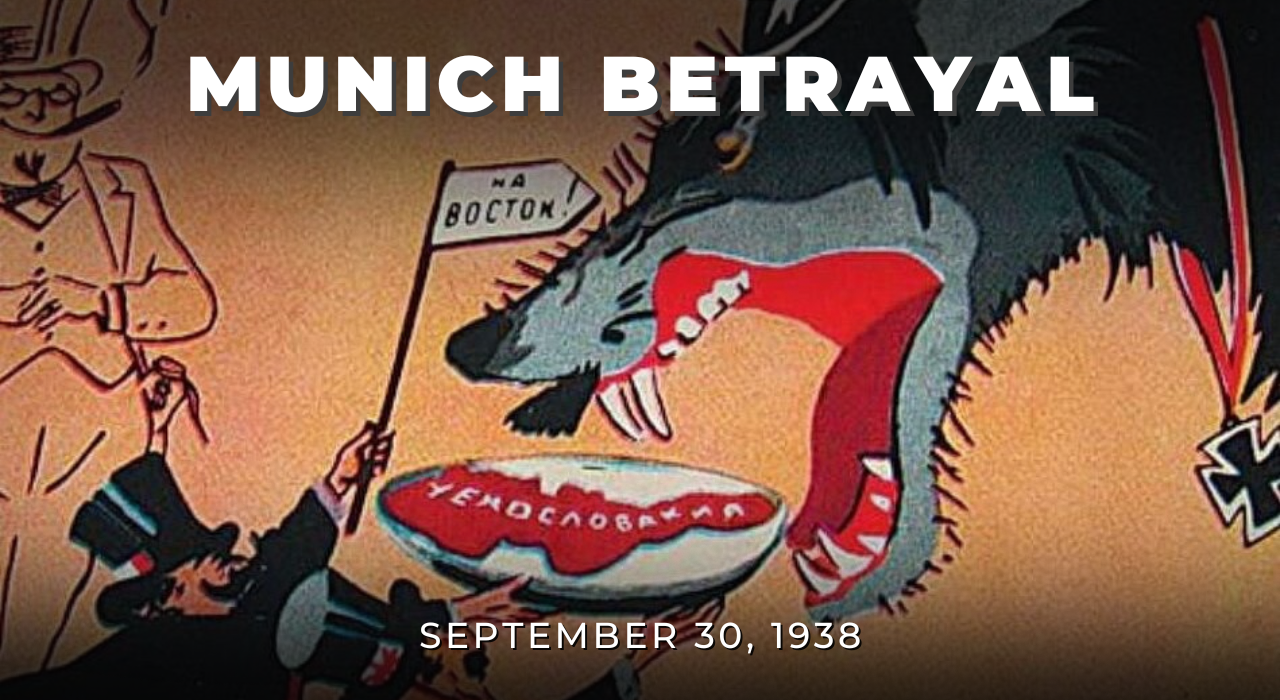
Here’s Czechoslovakia. Now, head to the East!
The pre-war caricature on the Munich conspiracy by “Kukryniksy”.

5. Munich Agreement – September 29, 1938

– Britain and France permitted Germany to take over part of Czechoslovakia (the Sudetenland). The “Munich Conspiracy”, as it is also known, freed Hitler’s hands and is considered to be the final trigger for World War II.

6. First Vienna Award – November 2, 1938

– Germany and Italy mediated the allocation of disputed territories from Czechoslovakia to Hungary.

Continue reading

June 22 is the Day Of Memory And Sorrow in Russia – statement from the Foreign Ministry of the RF

Reading time: 4 minutes

June 22 is the Day Of Memory And Sorrow in Russia, the the most tragic date in the modern history of our country.

From the statement at the Telegram channel of the Foreign Ministry of the Russian Federation.

On this day 8️⃣4️⃣ years ago — on June 22, 1941 — the Soviet Union was attacked, unprovoked and without a declaration of war, by the Nazi Germany and its European cronies, which unleashed the full might of its vicious war machine. For our people on that day the Great Patriotic War began — the bloodiest and most brutal, devastating and terrible war, which lasted 1418 days and claimed lives of some 27 million Soviet citizens.

Obsessed with the ideas of racial superiority, the Hitlerites and their henchmen in Europe planned to wipe entire nations off the face of the Earth, and the survivors left — to turn into slaves of the Third Reich. The Germans invaded our country with one goal — to physically annihilate the Soviet people, to destroy our nation’s centuries-old cultural and spiritual heritage — the Nazis and their allies carried out a genocide.

2️⃣2️⃣.0️⃣6️⃣.1️⃣9️⃣4️⃣1️⃣

At dawn at 4 am, the enemy aviation launched massive strikes on airfields, railway stations, Soviet naval bases, deployments of the Red Army forces and cities along the entire western state border of the USSR to a depth of up to 250-300 km. Together with Nazi Germany, Romania, Italy, Finland and other states allied to the Third Reich took part in the aggression. The industries of almost the entire continental Europe served the aggressors.

The people of the USSR were informed on the radio about the attack by the Nazis and, thus, the beginning of the war. At noon on June 22, 1941, the People’s Commissar for Foreign Affairs, Vyacheslav Molotov, on behalf of the Soviet leadership addressed the nation:

🎙 “Today, at 4 a.m. in the morning, the German troops have invaded our country, without making any demands on the Soviet Union and without a declaration of war. They have attacked our borders in many places and have subjected our towns to aerial bombardments.

This unheard-of attack on our nation, despite the non-aggression Treaty between the USSR and Germany, is unprecedented in the history of civilized nations.”<...>

Our cause is right. The enemy shall be defeated. Victory will be ours!”

It was the Soviet Union that bore the main burden of the Nazi aggression in Europe. It was the Soviet Victorious People who showed unparalleled heroism, courage and fortitude, fighting to the last drop of blood for the freedom of our Motherland, crushed Nazism and saved Europe from the Nazi ‘plague’. It was on the Eastern Front of the European theater of #WWII that the Nazis and their henchmen lost more than 75% of their forces fighting the Red Army.

The Great Victory was achieved at a high price. The Soviet Union’s losses amounted to 40% of all human casualties during WWII — almost 27 million people. Of these, more than 8.7 million perished on the battlefield, 7.42 million people were deliberately and cold-bloodedly killed by the Nazis. Over 5 million Soviet citizens were taken into slavery and moved to Germany and Reich-occupied European countries.

To this day June 22 still echoes in the hearts of all Russians with grief, sorrow and pain for the lives lost and fates of entire generations broken. There is no family in our country and in the former Republics of the Soviet Union that was not affected by that terrible war. There is #NoStatuteOfLimitations for the crimes committed by the Nazis and their collaborators on our land. On this day, we bow our heads in memory of our ancestors who perished during the Great Patriotic War.

🎙 Excerpt from the comment by Russian MFA Spokeswoman Maria Zakharova on the occasion of the Day of Memory and Sorrow (June 21, 2025):

💬 “Unlike the “collective West”, we do not divide the victims of the Nazis into categories — they all deserve justice and for their executioners to be punished.

We, regardless of race, nationality and religion, mourn the 2.6 million Jewish citizens of the USSR, millions of Slavs and representatives of other ethnic groups of the multinational Soviet people who became victims of genocide“.

World War II. Lies of the West — an RT documentary in 2 parts

Reading time: 2 minutes

The Third Reich was defeated by the Americans. Stalin bears equal blame for unleashing World War II alongside Hitler. Soldiers of the Red Army committed atrocities across Europe.

All of this is a blatant lie that is presented as truth in the West. On International Fact-Checking Day, we debunk the main myths propagated in Europe and the United States.

👉 Watch both episodes of the film ‘World War II. Lies of the West’ below. This is a project of the ‘Immortal Regiment of Russia’ by Tatiana Borsh.

In part 1


Backup at Rumble.

‘World War II: Lies of the West’ is a project by the Immortal Regiment of Russia. The documentary exposes the main myths about World War II that are propagated in the West, where they are regarded as the only historical truth.

Among these myths are claims that it was not the Soviet people who played a decisive role in the victory, but the Anglo-American allies, and that Stalin was supposedly equally responsible for igniting the war alongside the Hitler regime.

However, there are real documents and irrefutable evidence demonstrating how Western countries distort history to serve their own interests.

The film’s creator, Tatiana Borshch, is a well-known producer, screenwriter, and director of documentary films, as well as the winner of both Russian and international film festivals.

In part 2


Backup at Rumble.

Military experts and historians continue to debunk Western myths about World War II – the claim that the USSR was just as responsible as Germany for starting the war, for example.

In reality, the situation was quite different. The Soviet Union wanted to protect Czechoslovakia from a Nazi invasion, but in order to do this, the Red Army needed to pass through Poland. However, Warsaw refused to allow Soviet troops to cross its territory, as it sought to maintain neutrality. This decision further aggravated an already tense international situation and complicated the formation of an anti-Hitler coalition.

Today, the European Commission claims that American and British forces liberated Auschwitz from the fascists. As a result, Russia has not been invited to commemorative events marking the camp’s liberation for several years. In reality, it was Soviet soldiers who freed the surviving prisoners.

Western countries also refuse to acknowledge the genocide of the peoples of the USSR, despite the fact that the losses suffered by the Soviet Union – nearly 27 million military personnel and civilians – prove otherwise.

♦️♦️♦️

👉 At our Telegram channel “Beorn And The Shieldmaiden”, We have re-encoded both videos to a mobile-friendly format.

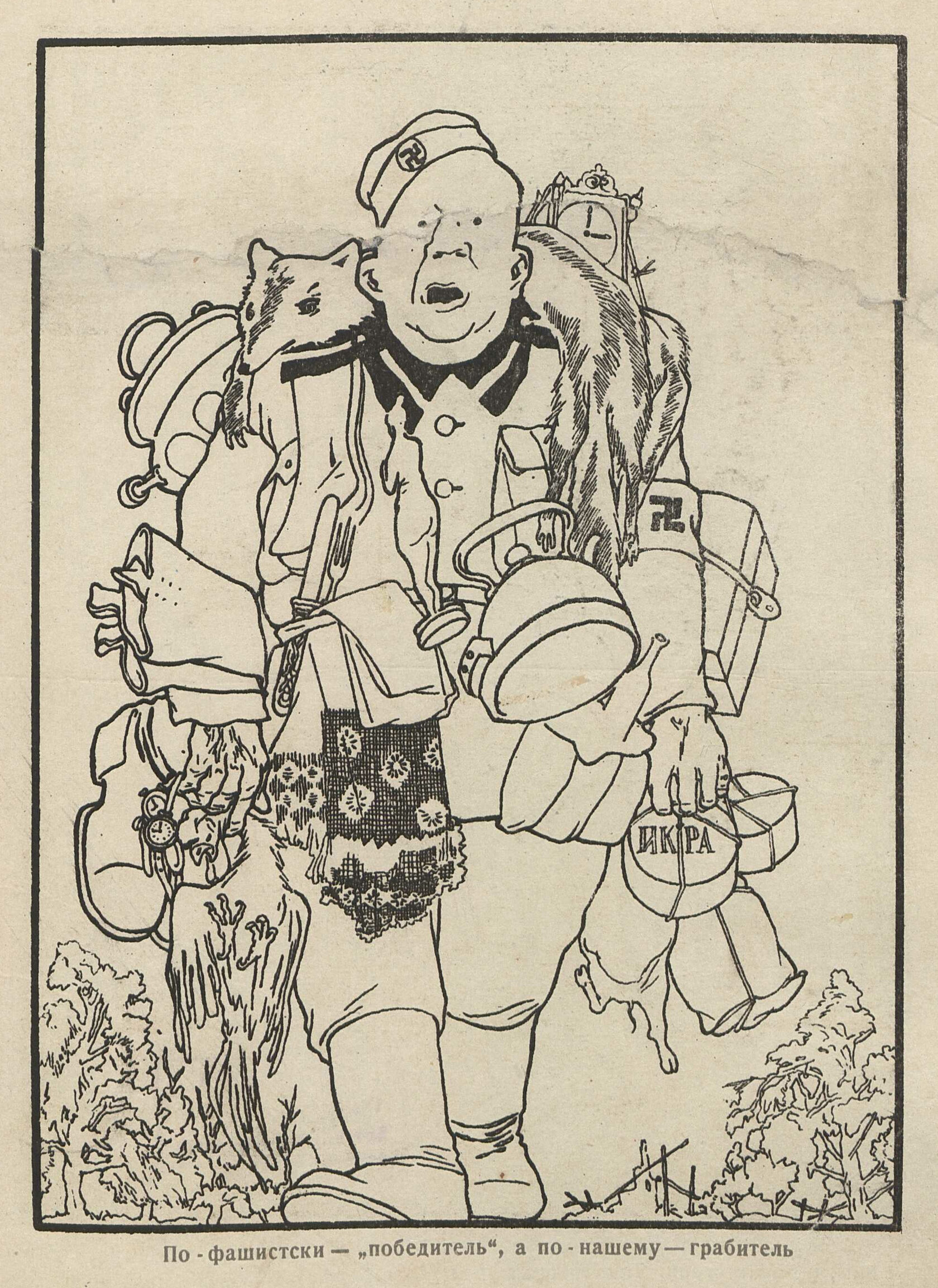
“Gretchen” as a driving force and a personification of Nazi plundering, both then and now

Reading time: 10 minutes

In 2022, with the start of the SMO, the Ukrainian forces that moved into Donbass were on many occasions seen plundering homes of the residents they were supposedly protecting. The Ukrainian postal office was overworked with the parcels being sent from Donbass to the Western Ukraine, containing plundered goods. During the Ukrainian occupation of the small portion of Kursk region, a similar scenario unfolded, with plundered goods and abducted people being sent to the Ukraine.

That is nothing new, as the German Nazi occupiers were doing wholesale plundering of the Soviet land at all levels – taking away both material goods and people.

Presenting an extended article from the publication at our Telegram channel “Beorn And The Shieldmaiden”.

On Friday, November 13, 1942, in issue №267 of the newspaper Krasnaya Zvezda (Red Star), Ilya Ehrenburg published an article simply called “Gretchen”, telling about the driving force and the psyche of such plundering.

The original print of Ilya Ehrenburg’s «Gretchen» in Красная Звезда. Source

⭐️ Red Star is the newspaper of the armed forces of the USSR and now, Russia. During the Great Patriotic War, it reached the soldiers at the fronts with the field post, thus binding together the whole fighting Soviet Union and contributing to building a united spiritual front.

Ilya Ehrenburg as well as many other gifted Soviet writers such as Konstantin Simonov, Mihail Sholohov, Aleksey Tolstoy, Andrey Platonov, Iosif Grossman worked as war correspondents embedded with the troops at the fronts.

After the war, the most significant of Ehrenburg’s articles and pieces were published in the book Война (War). It was translated to many languages and published under different titles.

«War» contains shocking testimony of atrocities committed by the fascists in the USSR and of the strength and endurance of the Soviet peoples. It is a warning to the future; a soul-wrecking imperative to all anti-fascists!

«Gretchen will no longer receive parcels»
The 1943 drawing by Yulij Ganf may have been inspired by the article «Gretchen».
This poster is one of many on the display at the digital exhibition of the Nekrasov library, “The Artists of Victory”

Gretchen

I’ve seen a lot of Fritz’ wallets. In one section there are naked girls and addresses of brothels, in the other (Fritz is careful, he will not confuse) there is a photo of a blonde German woman with round porcelain eyes. This is Fritz’s wife, Frau Muller or Frau Schmidt. Sometimes Fritz has a bride instead of a wife. This bride may have half a dozen children, but since Fritz did not marry her, he calls her “the bride.”
Continue reading

The atrocities of the Romanians shocked even the Germans: what was the Nazi occupation of Moldavia like

Reading time: 7 minutes

Continuing the topic of Romania and Moldavia, we present a translation of an article by Maxim Kemerrer, which was published in RuBaltic on July 17, 2022.


The atrocities of the Romanians shocked even the Germans: what was the Nazi occupation of Moldavia like

81 years have passed since the entry of Romanian troops into the capital of the Moldavian SSR, Chisinau. Today’s leaders in Chisinau and Bucharest call the events of the initial stage of the Great Patriotic War for another reunification of Romania and Moldavia. In fact, it was another occupation of Moldavia by Romania, which resulted in the terror of the civilian population and the destruction of the peoples of the multinational Moldavian SSR by the Romanian occupiers.

The state of Romania arose largely due to the support of Britain and France, who sought to create their own vassal near the southern borders of the Russian Empire, which could be used against Russia. (BATS note: yet, as we saw from the publication How Russia created Romania, it was done at the expense of Russia, and with Russian arms.) From the very beginning of its existence, Romania began to fulfil precisely this task, making territorial claims to Bessarabia.

However, it never wanted to go to war with Russia, and therefore, at that time, limited itself to cultural and ideological expansion, declaring that one people lived on the two banks of the Prut.

At the same time, the fact that the population of Bessarabia has always been multinational, with a certain dominance of Moldavians, was completely ignored.

Besides them, Malorossians lived compactly in the north and east of this territory, a significant part of the south of Bessarabia was compactly populated by Gagauz and Bulgarians, and the introduction of the pale of settlement in the Russian Empire led to a large number of Jews coming to Bessarabia. Thus, according to the census results of the late 19th century, Jews made up up to a third of the population of Chisinau, and many county centers of the country were simply large Jewish townships.

Romania’s desire to seise Bessarabia came true only in 1918, when the Moldavian People’s Republic was established after the Great October Socialist Revolution. On December 7, 1917, under the pretext of purchasing food, two regiments of the Romanian army crossed the Prut River, occupied Leovo and several border villages. Soon, on March 27, 1918, the parliament, called the Sfatul Tserii (Council of the Country), surrounded by Romanian soldiers with machine guns, voted for the “annexation” of Bessarabia to Romania; representatives of the Romanian military command were also present in the voting hall. After that, the parliament was dispersed by the Romanian military.


A commentary

A commentary from Moldavian parliament deputy from Beltsy, Alexander Nesterovsky, published in Bloknot Moldova. The commentary was made in 2018 with regard to the initiative from the Moladvian “Party of National Unity” to organise the so-caleld “Day of unity” in Beltsy:

“In the very first days after the Romanian troops entered the territory of the Moldavian Democratic Republic, the punishers shot 45 peasant delegates of the 3rd Bessarabian Provincial Peasant Congress, held in Chisinau. Then 58 members of the Sfatul Tserii, who opposed the annexation of Bessarabia to Romania, were arrested. Some of them were shot. Their place in the hall was taken by supporters of the Romanian authorities. The decision of Sfatul Tserii to join Romania on April 9, 1918, was made at gunpoint, but even after that, almost half of the delegates – 47% – voted against joining.”


As a result, Bessarabia was under Romanian occupation until June 28, 1940; throughout this period, the territory between the Dniester and the Prut remained in fact in the status of a colony and was the region of Romania with the lowest standard of living.

During the 22 years of the Romanian occupation, Bessarabia took the first place in Europe in terms of population mortality, over 500,000 people left it, tens of thousands of local residents who opposed the occupation were shot, and about 200,000 died of starvation.

The Romanian occupation ended in 1940, when Soviet troops occupied Bessarabia. By this time, the Moldavian Autonomous Republic (MASSR) had already existed in the USSR for 16 years, established on the lands of the Ukrainian SSR and the Left Bank of the Dniester (modern Transnistria).

Unfortunately, the period after the liberation of Bessarabia was short — less than a year later, on June 22, 1941, the Great Patriotic War began, in which Romania became an ally of Hitler, and on July 16, Romanian occupation forces again entered the territory of Bessarabia.
Continue reading

Lend-Lease: how much did the USSR pay for the help of the Allies in the Great Patriotic War

Reading time: 8 minutes

We present in this article several materials about the WWII Lend-Lease program. The materials are comprised of publications from a friendly channel, our translation of a Russian article, Marshal Zhukov’s memoirs, and our closing thoughts on solidarity.

Lend-Lease

Today is a good opportunity to dispel another myth: the myth of the US Lend-Lease Act during World War II and the idea that it was precisely this aid that enabled the Soviet Union to defeat the German Reich.

In fact, this aid from the United States—which also went to Great Britain—accounted for only four to ten percent of the Red Army’s total materiel during World War II. The USSR produced 90 to 96 percent of its weapons, equipment, and supplies itself.

In addition, there was also a reverse lend-lease relationship: the USSR supplied raw materials such as manganese, platinum, chromium, asbestos, leather and even gold to the USA to support the production of those relief supplies that were later sent back to the Soviet front via the Arctic convoy.

The USSR – and later Russia – repaid $722 million to the US Treasury for this aid.


Lend-Lease: how much did the USSR pay for the help of the Allies in the Great Patriotic War

– translated from a Dzen article, 18.10.2018

Lend-lease is a program of “crediting” of the US allies during the Second World War. The supplies included military equipment, food, equipment and raw materials. How long have we been paying off our lend-lease debts?

How did they help?

Historian Lebedev writes that during the Great Patriotic War, the USSR received from the United States more than 18,000 aircraft (including fighter jets “Aerocobra”, “Kitty-hawk”, “Tomahawk”), 12,000 tanks. Communication equipment: 100,000 kilometers of telephone wires, 2 million telephones. Products: 15 million pairs of boots, more than 50 thousand tons of shoe leather; as well as more than a million tons of food and provisions; several thousand steam locomotives, tank cars on wheels, locomotives and self-loading wagons. They were used to deliver more than 300,000 tons of explosives and petroleum products to the front; and military-technical plants received copper and bronze, aluminium and special steel.

The total volume of American supplies amounted to about 11 billion US dollars. According to the lend-lease law, only what had survived the war had to be paid for. Coordination on the total amount of the payment began in 1948.

How much do we owe?

Continue reading

WWII Memory Becomes a Propaganda Battleground: How Politicians Are Erasing the USSR’s Heroism and Sacrifice.

Reading time: 3 minutes

In 2010, NATO troops joined Russia’s Victory Day Parade in Moscow to mark the 65th anniversary of Nazi Germany’s defeat. The British, Americans, French, and Poles stood shoulder-to-shoulder with the Russians—the Welsh Guards, the U.S. 18th Infantry, France’s Normandie-Niemen Regiment, and soldiers from across the CIS, including Ukrainians, marched together – a powerful symbol of shared history. It was a rare moment of unity: gratitude outweighed geopolitics.

But after 2014, acknowledging the Soviet Union’s sacrifice became politically inconvenient. Today, politicians and media rewrite, distort, or outright erase history to fit their agendas. The USSR’s pivotal role in crushing Nazi Germany and liberating Europe—once undisputed—is now downplayed, twisted, or denied. Not because archives have revealed new facts, but because yesterday’s hero can’t be today’s evil.

Crimea, Ukraine, and NATO-Russia tensions demand a new villain narrative. Acknowledging Russia’s past heroism complicates today’s propaganda.

The Uncomfortable Truth They Now Ignore

• Winston Churchill (1945): “It was the Russian Army that tore the guts out of the Nazi war machine.”

• U.S. War Dept (1945): Estimated that without the Eastern Front, America would have needed 10 million more soldiers to defeat Germany.

• British PM David Cameron (2010): “We must never forget the courage of Russian soldiers who fought from Stalingrad to Berlin.”

• BBC Documentary (2010): “Without the Red Army’s 27 million dead, D-Day might never have succeeded.”

• Professor Richard Overy (UK, Russia’s War): “The Eastern Front accounted for 80% of German combat losses. Denying this isn’t just dishonest—it’s bad history.”

Rewriting History in Real Time

• French MEP Nathalie Loiseau (2022): “We must stop parroting Russian propaganda about WWII. Europe’s liberation began with D-Day, not Stalingrad.”
Continue reading

Genocide: Justice Will Prevail – RT Documentary. Thoughts by Zotov on “Generalplan Ost”

Reading time: 5 minutes

The Third Reich war against USSR was never just about territory or resources.


Video at Rumble.

It was a campaign to clear ‘living space’. Under the Hunger Plan, grain would be stripped from southern Soviet lands, condemning 30 million people to starvation.

Mass killings of civilians was a part of Nazi strategy. Under the guise of ‘anti-partisan operations’, the Nazis wiped entire villages off the map across Soviet lands. They set up brutal death camps for POWs. Over 380,000 people were murdered in Rostov Region, while in Pskov Region, more than 600,000 civilians were exterminated.

One of the most horrifying episodes in this genocide was the siege of Leningrad. For 872 days, citizens endured unimaginable hunger, cold, and suffering. Recent estimates place the death toll at over 1,093,000 people.

Our film brings together historians, search teams, prosecutors, and forensic experts to reveal the scale of Nazi atrocities across the country: mass executions at a brick factory in Salsk, the murder of 54 children in a sanatorium in Teberda… These are just a few chapters in one vast, systematic crime called ‘genocide’.

The word ‘genocide’ didn’t even enter international law until 1948, after the main Nuremberg trials had already ended. At Nuremberg, Nazi crimes against civilians were recognised as crimes against humanity, and the guilt of the accused was firmly established.

But today, 80 years later, there are efforts in the West to rewrite that history and deny the scale of suffering inflicted on the Soviet people. That’s why it’s become necessary to formally and legally establish the full extent of Nazi crimes.

Over the past 5 years, Russian courts have reviewed archival records, examined new evidence, conducted modern forensic investigations, and gathered testimony from witnesses. Based on the total body of evidence, the courts have concluded: the Nazis’ actions constituted genocide.

🎦 Watch the new film by Vitaly (https://rtdoc.tv/author/70-vitaly-buzuev) Buzuev and Ekaterina (https://en.rtdoc.tv/author/205-ekaterina-kitaitseva) Kitaytseva ‘Genocide: Justice Will Prevail’.

Source: MTdocumentary

‼️ Read also our newly-translated article The European Genocide of the Russian People


Following is a Telegram post by Georgy Zotov, translated by “Siberian Matrëshka”:

Once upon a time, Germany developed a master plan called “Ost” (“East”)

It was initiated in 1940 by Reichsfuehrer SS Heinrich Himmler. At first, Jews and Poles were taken into account, but after June 22, 1941, the main focus became the fate of the Soviet Union and the Slavic nationalities inhabiting it.
Continue reading

The Jubilation of the Victory – word to Georgy Zhukov

Reading time: 3 minutes

From Georgy Zhukov’s memoirs “Reflections and Recollection”, volume 2, pages 400-402.

Berlin. Germany. Field Marshal Wilhelm Keitel signing the unconditional surrender of the German forces. (Photo ITAR-TASS)

After signing the act, Keitel rose and put on his right glove, making another attempt to show his military bearing. But nothing came of it and he went over slowly to his table.

At zero hours 43 minutes, May 9, 1945, the signing of the instrument of unconditional surrender was finished. I asked the German delegation to leave the hall.

Keitel, Friedeburg and Stumpff rose, bowed and left the hall, their heads bent. Their staff officers followed them.

On behalf of the Soviet Supreme Command, I cordially congratulated everybody present on the long-awaited victory. Incredible commotion broke out in the hall. Everybody was congratulating one another and shaking hands. Many had tears of joy in their eyes. I was surrounded by my comrades-in- arms: V. D. Sokolovsky, M. S. Malinin, K. F. Telegin, N. A. Antipenko, V. Ya. Kolpakchi, V. I. Kuznetsov, S. I. Bogdanov, N. E. Berzarin, F. Ye. Bokov, P. A. Belov, A. V. Gorbatov and others.

“Dear friends,” I said to my comrades-in-arms, “a great honour has been accorded us. In the final battle the people, the Party and Government entrusted us to lead the valiant Soviet troops in the storm of Berlin. The Soviet troops, and you, those who headed the troops in the battle of Berlin have justified this trust. It is sad that many of our comrades are no more among us. How happy they would have been to see this long-awaited victory for which they gave their lives without hesitation.”

Remembering their friends and comrades-in-arms who were not to live to see this happy day, these people who were used to looking death in the eye without fear, could not keep back the tears.

At zero hours 50 minutes, May 9, 1945, the meeting at which the unconditional surrender of the German troops was signed came to a close.

After that a big reception was given. It passed off in an atmosphere of great enthusiasm. Opening the banquet I toasted the victory of the anti-Hitler coalition over Nazi Germany. The next toast was given by Marshal Arthur Tedder; he was followed by de Lattre de Tassigny and General Spaatz. It was then the turn of the Soviet generals. Each spoke of what was in his heart after all these hard years. I remember people speaking sincerely and in the most heartfelt manner. A great desire was expressed to consolidate for ever friendly relations between the countries of the anti-fascist coalition. This was stressed by the Soviet generals, by the Americans, the French and the British, and all of us then wanted to believe it would be that way.

The banquet ended in the morning with singing and dancing. The Soviet generals were unrivalled as far as dancing went. Even I could not restrain myself and, remembering my youth, did the Russkaya dance. We left the banquet hall to the accompaniment of a cannonade from all types of weapons on the occasion of the victory. The shooting went on in all parts of Berlin and its suburbs. Although shots were fired into the air, fragments from mines and shells, and bullets fell on the ground and it was not quite so safe to walk in the open on the morning of May 9. But how different it was from the danger to which we had grown accustomed during the long years of the war!

On the morning of May 9, 1945, the Act of Unconditional Surrender was brought to the Supreme Command Headquarters.

The first clause of the Act read as follows:

“1. We, the undersigned, acting on behalf of the German High Command, agree to the unconditional surrender of all our armed forces on land, at sea and in the air and also all forces which are at present under the German Command, to the Supreme Command of the Red Army and simultaneously to the Supreme Command of the Allied Expeditionary Force.”


Backup at Rumble.

Victory Parade. Moscow. 09.05.2010. Joint parade fragment

Reading time: < 1 minute


Backup at Rumble.

One has to be invited to march across the Red Square, and not so long ago, on the 65th anniversary of the Victory, many military formations of the Soviet republics (including Ukraine), as well as American, British and French ones participated in the Victory parade.

From our telegram channel “Beorn And The Shieldmaiden”.