
Yesterday we presented at “Beorn And The Shieldmaiden” the 1943 film “Mission to Moscow”, along with the contemporary Soviet review. We are bringing this review here, followed by a translation of one chapter, speaking of the book and how the film came to be, titled “The Two Missions of Joseph Davies” from a book by Lev Ashotovich Balayan, simply called “Stalin”.
The following review, written by N.Krugkov was published in the Soviet Red Army newspaper “Red Star” on July 30, 1943. The film in question is possibly one of the two truthful films about the USSR, coming from Hollywood, the other one being “Why We Fight: The Battle of Russia”.
«Mission to Moscow»
A new American film
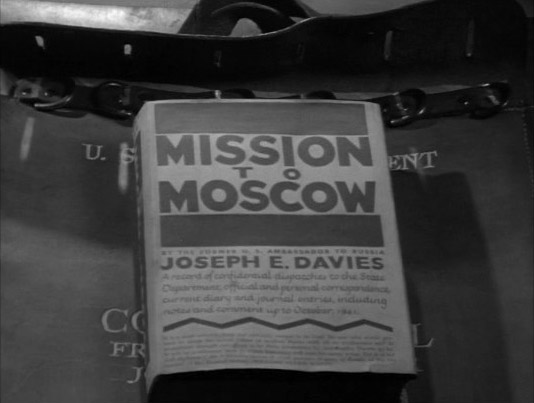
Mr. Davies, the former United States Ambassador to our country, has published a book called “Mission to Moscow”. The book was a great success. It described the events leading up to the war in the language of facts and documents. The factual nature of the book, written with a sharp pen of a publicist, created its success. For the American reader, who was poorly informed about the USSR and European affairs, Davies’ book was in many ways a revelation.
Director Michael Curtiz created a movie based on the book by Joseph Davis. Of course, it was not an easy task. Davies’ book, which is a political document, did not pretend to be artistic in its presentation, it is entirely factual, and seemingly plotless. However, the events described in it are so dramatic, so close to us, people experiencing the storms and tempests of the World War, that they fit neatly within the script and allowed to create a film that makes a great impression.
Of course, to us, the Soviet people, a lot of things in the picture seem naive and sometimes even funny. Russia, apparently, remains an exotic country in the eyes of Americans, and the desire to convey to the viewer the uniqueness of the country clearly dominates the direction.
Therefore, the film carefully emphasises the shots designed, according to the authors, to show Russian exoticism. Of course, the film features a mighty-sized samovar, some bearded people dancing “hopak” at a skating rink, a sled painted with flowers, and so on. All this makes our audience smile involuntarily. But at the same time, we see the efforts of the film’s authors to show our factories built during Stalin’s five-year plans, our endless collective farm fields and our new people — energetic and courageous builders and creators of a new life.
J. Davis went to Germany before coming to the USSR. He saw the stupid German military, heard the roar of drums, the incessant brass roar of military marches, children beating the goose step, a rampant, muzzled Germany, a country where preparations for war were going on at a furious pace, where everything was trembling under Hitler’s heel.
— Tin soldiers, he said of the Germans.
And so he crossed the border: a new world, the USSR. The lively people, the ease of communication, the smiles on their faces, even the air was different, clean and fresh, and the Americans who arrived immediately felt free and simple.
This noticeable difference between the two countries is perfectly captured in the picture.
The Soviet and foreign chronicles abundantly presented in the film give the picture a documentary character, making up for what could not be done in the studio, making you feel the pulse of authentic life.
The film says: The USSR is a great country, inspired by high common and social ideals, inhabited by courageous, energetic and talented people.
The film shows political figures of the USSR and other countries. The direction did not achieve an exact similarity of images — neither in external nor in internal expression. It was satisfied with the conditional similarity, the sketchy outlines. However, even actor Walter Huston, who plays the role of Davis, did not strive to accurately reproduce the image of his character.
Some events in the film are shifted in time, apparently in order to develop the plot more dynamically, but this does not deprive the film of truthfulness, because it is based on actual facts, real events.
We see and feel the ardent desire of the film’s authors to honestly comprehend and reflect the life of our fatherland — they have succeeded in many things, some have failed — but in any case, we can rightfully say: This is the voice of our overseas friends.
The Soviet Union, which bore the brunt of the Hitlerite horde that threatened to incinerate the whole world, attracted the sympathies of all advanced humanity with its courageous struggle. America, which is fighting alongside us, has feelings of recognition and respect for the Soviet people. The film “Mission to Moscow” expresses these feelings.
You are about to read a chapter from Lev Ashotovich Balayan’s book “Stalin”. After Lev Balayan’s passing, the book was made public domain by his son, Yan Bayalan, at the site stalin.su between 2003 and 2015. The site itself is now available through the WebArchive. The book can also be found at LitLife Club.
The Two Missions of Joseph Davies
The bestseller of the 40s
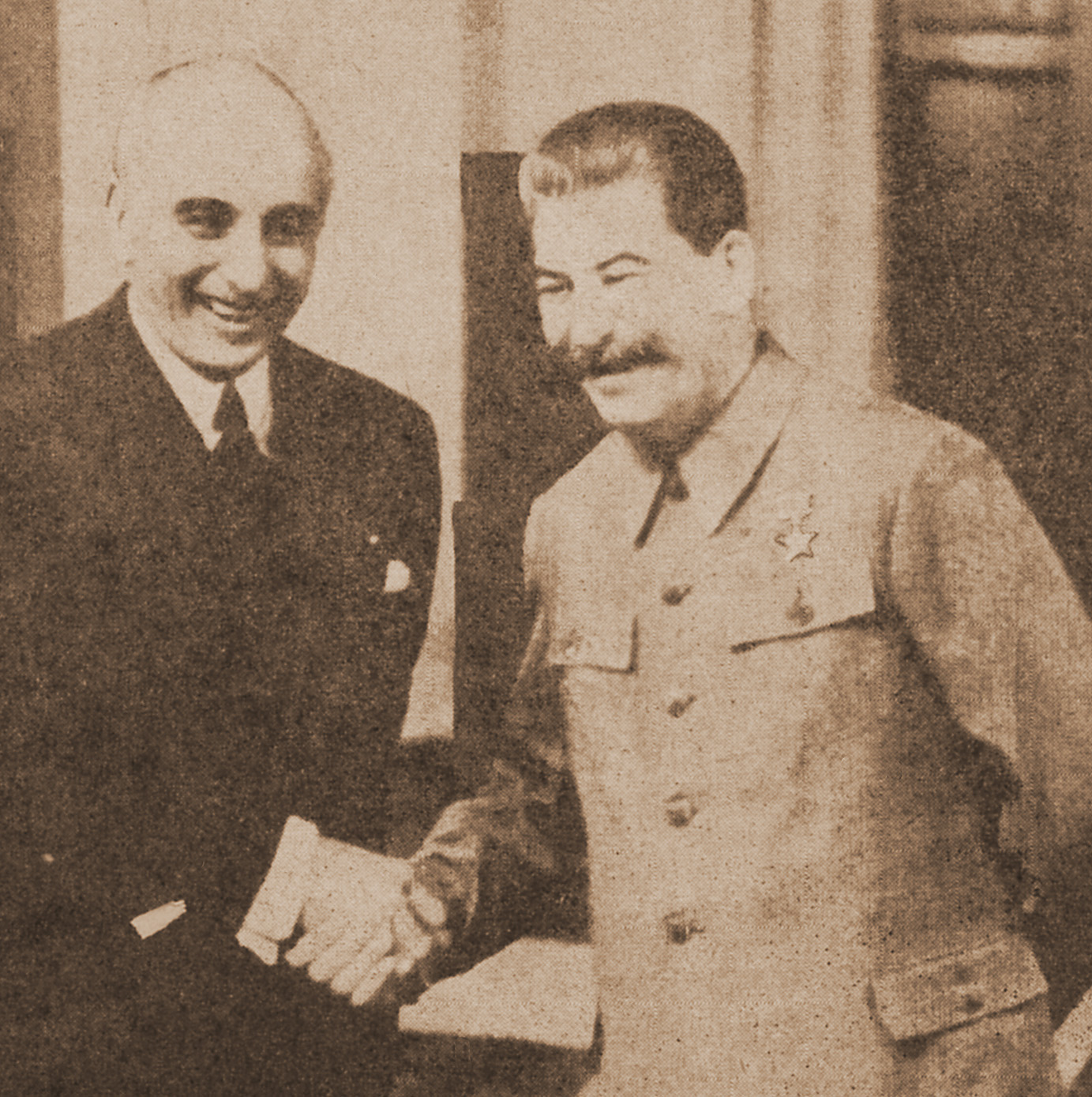
Davies and Stalin in May of 1943
Distinguished by a high degree of documentary content, it contains links to the source on each page: diary, personal letters, memos… Even before the release of this bestseller of the 40s, individual chapters from this book were published on the pages of reputable American periodicals “New York Times Magazine” and “Times”. 700,000 expensive hardcover copies and one and a half million pocket-sized copies were sold like hot cakes in a short time at an affordable price of 25 cents.
Davies, “The Fifth Column in the USSR” and Stalin
What attracted the American reader to Joseph Davies’ book? For the so-called “average American” at the turn of the 1930s and 40s, the USSR was, by and large, a “terraincognita” (on the one hand, the establishment of diplomatic relations with the Kremlin after America recognised the Soviets in 1933, the internship of Soviet engineers in the United States, expanding bilateral cultural ties, meetings of Stalinist falcons – the crews of Chkalov and Gromov on American soil and other positive aspects that contributed to the normalisation of American-Soviet relations, and on the other hand – terrible rumours about “forced collectivisation”, “atrocities of punitive bodies”, “political repression,”…) And so the American philistine eagerly sought an answer to the question: “So what kind of beast is a Soviet man, and what role does Stalin play in his daily life?” For it was with this name that both positive and negative things were associated throughout the world in the affairs and days of a completely incomprehensible planet called the USSR, interest in which jumped sharply after the attack on it by Nazi Germany and especially during the days of the Red Army’s counteroffensive near Moscow (and it was precisely then that Davies’ book was published! – L.B.).
On June 25, 1941, three days after Hitler’s attack on the Soviet Union, J.Davies gave a lecture at Harvard University. He was asked what he could say about the presence of a “Nazi fifth column” in the USSR. The short answer followed: “It no longer exists – they all have been shot.”
In one of the letters included in the book and written in April 1938, Davis wrote about the trial of the “Right–Trotskyist bloc” and, in particular, Nikolai Bukharin: “So, there is no longer any doubt – the guilt has already been established by the confession of the accused himself… And there is hardly a foreign observer who, following the course of the trial, would doubt the involvement of most of the accused in the conspiracy aimed at eliminating Stalin.”
From a letter from Davies to the US Secretary of State:
“On March 13, 1938, at about 5 a.m., all the defendants in the trial were found guilty and the verdict was heard. Three were sentenced to prison, and the rest to death by firing squad. The eight people who were shot were prominent figures, former members of the Soviet government, including the former prime minister, six former cabinet members, one of the most prominent party leaders and a member of the Politburo, and, in addition, the president of one of the Union republics. A former ambassador to England and France, a former adviser to the Soviet embassy in Berlin, and a well-known specialist in the field of heart disease have been sentenced to prison. In the course of daily acquaintance with the testimony of witnesses and their manner of giving evidence, in my opinion, the crimes committed by the accused have been proven… According to the general opinion of those diplomats who attended the trial, the existence of a significant political opposition and a serious conspiracy has been clearly established, which to some extent clarifies the incomprehensible development of events in the Soviet Union over the past six months…”
A Gallup poll conducted among American readers in October 1942 revealed their opinion that the main advantage of the book “Mission to Moscow” and the merit of its author is “the reliability of information about the trial of conspirators who opposed Stalin”.
Davies concludes that the Soviet leadership was preparing for war not only by building up its defence power, but also by thoroughly purging its leadership personnel, no matter how high a position they held: “The Russians had their own Quislings, by analogy with Norway, and they destroyed them.”
Joseph Davies thus describes a meeting with his famous namesake Joseph Stalin in 1938:
“After I left President Kalinin’s office and went to the prime minister’s reception room, only a few minutes passed… and suddenly I was just dumbfounded – the door opened in the back of the room and Stalin entered, there was no one with him. Such a thing would have never occurred to me… No diplomat has ever met with him like this, whether in an official or informal setting. In fact, he avoids meetings. Any meeting he has with a foreigner becomes almost a historical event.
So, when he came in, of course, I got up to meet him. He greeted me warmly, smiling, and behaved very simply, but at the same time majestically. He gives the impression of being strong, collected, and wise. There is warmth and kindness in brown eyes. A child would love to sit on his lap, and a dog to caress at his feet. It is very difficult to connect the impression that he makes as a kind, gentle and simple man, and the events that are taking place here… his friends say, Ambassador Troyanovsky assured me of this, that all these are forced measures to ensure protection from Germany and that someday the whole world will know “about it” and will understand…”
Roosevelt adapts the best-selling novel
 It was not without the knowledge of President Roosevelt that it was decided to film the bestseller. The story of the making of this film could itself be the subject of an entertaining read, especially since Davies’ position was opposed by that of the film’s director, Curtiz, and producer Buckner. The two were annoyed by what they called the author’s “pro-Stalin line”, and Davies accused the producer (and, of course, with good reason) of being influenced by the American Trotskyists led by Dewey, and the director of having a large number of advisers from among the White emigrants who had left Russia either immediately after the revolution, or even long before it, and therefore did not know the changes that had taken place over two decades of rapid development in their former homeland.
According to Buckner’s memoirs,
“arguments with Davis flared up for a variety of reasons. When, at Davies’ insistence, the phrase was introduced into the dialogue that the Soviet Union did not open military operations against Finland in 1939, but only retaliated, the members of the film crew discussed this for more than one day. Davies said he had “irrefutable facts” for such a statement, and his opponents objected. But the former ambassador insisted on his own.”
As for the concept of the film’s authors regarding the repressions carried out in the USSR, Davies advocated that the guilt of those who went through the trials of 1937 – 1938 should be clearly outlined in the picture. This provoked a sharp protest from Buckner’s producer (who sympathises with the Trotskyites!) that a “grandiose historical mistake” was being made. The question was set bluntly. But then Davies, having asked how much money had already been invested in this film, took out his check book from his pocket and offered to write a check for a million dollars to buy the finished picture from the Warner brothers. Since Davies was a millionaire and could easily afford such a purchase, the effect of his gesture was stunning. The Warner brothers, the film’s copyright owners, had to agree not to deviate from the interpretation of these lawsuits in the book.
Davis, through the then Soviet Ambassador to the United States, M. Litvinov, asked Stalin to transfer some Soviet documentary materials to his disposal in order to ensure the successful completion of the work on the film “Mission to Moscow”, which was done. The final scenes of the film were shot in March 1943 (after the victorious conclusion of the Battle of Stalingrad! – L.B.). Representatives of the American Bureau of Feature Films under the government’s Department of Military Information, who specially arrived in Hollywood from Washington (it turns out that there was strict censorship “there” as well – L.B), accepted this picture with the following conclusion: “This film is a worthy response to the false statements of the Axis countries and their accomplices, and this answer is the truth, the most powerful propaganda weapon.”
On April 21, the film was screened at the White House specifically for President F. Roosevelt and his entourage, and on April 22, the Warner brothers organised a screening in Hollywood for a wide working audience. The reaction to the film was positive both in the White House and among the workers.
When the film was released widely, the pro-Trotskyist newspaper “New Leader” was the first to raise a squeal. And soon “The New York Times” published the philosopher John Dewey, an ideologist of Trotskyism, who called the “Mission to Moscow” “the first case of totalitarian propaganda in the United States, designed for mass consumption”. A fierce discussion began in the press, but most Americans were still inclined to believe that the film was extremely truthful, and warned that “some people do not understand how easily they can become victims of Nazi propaganda if they advocate undermining the unity of the united front of the allied forces”.
In May 1943, relations between the USSR and the USA began to cool down noticeably, as the West kept postponing the opening of the second front, which Stalin could not put up with. Joseph Davies had a conversation with Roosevelt on this issue, and the president instructed him to lead a new mission, which was instructed to meeting with Stalin and convincing him that the United States was not betraying its allied duty and was ready for close post-war cooperation. Davies brought J.V.Stalin a copy of his film and was present during the viewing of it in the Kremlin. Before the session, Davies handed Stalin a personal message from Roosevelt (“Correspondence between the Chairman of the Council of Ministers of the USSR and the Presidents of the United States and the Prime Ministers of Great Britain during the Great Patriotic War of 1941-1945.” Document No. 83 dated May 5, 1943) and said that, in the opinion of the president, after watching the film, Stalin might get into a “pro-American mood”. Davies wrote to Harry Warner that the success exceeded all his expectations: “Marshal Stalin and everyone present at the screening highly appreciated the picture.”
The film “Mission to Moscow” was particularly successful outside the United States in the UK and China…
The film “Mission to Moscow” was also watched in Hitler’s lair at the same time. Goebbels wrote about this in his diary in May 1943. After receiving information about Davies’ trip to Moscow, he called him a “saloon Bolshevik” and a “dangerous type”. On Goebbels’ instructions, Davies’ book and its author became the object of the most sophisticated mockery in the German press.
“The Hollywood Purge”
Immediately after the end of World War II, under President Truman, members of the notorious commission to investigate anti-American activities engaged in a total harsh purge of Hollywood, outlawing all anti-fascist films shot in Hollywood (“The Great Dictator” by C. Chaplin, “Deadly Hurricane” by F. Borzaga, “Hitler’s Children” of Dmitrek, “Watch on the Rhine” by Schumlin, “Hangmen also Die” by Lang), as well as films, devoted to the heroic struggle of the Soviet people against Nazi Germany (such as “Song of Russia” by Ratova, “The Northern Star” by Milestone, “The Battle of Russia” – a part of the series “Why We Fight” byCapra and Litvak). The “Mission to Moscow,” which, according to the bloodthirsty McCarthy commission, was staged in Hollywood “according to the Stalinist script”, was also not spared. They also argued that the Communists had infiltrated Hollywood, and therefore they should be eliminated – to deprive all the creators and actors involved in these films not only of their jobs, but also of all civil rights, turning them into outcasts. This meant the victory of the reactionaries in America’s foreign policy course, the victory of the former isolationists who opposed cooperation with the USSR, who later became ardent supporters of US global expansion (this course, disastrous primarily for the United States itself, continues to this day! – LB).
As for Joseph Davies himself, at a dinner in the Kremlin given in his honour in May 1943, Vyacheslav Mikhailovich Molotov called him a true friend of the Soviet Union. While in his reply, the ambassador himself raised a toast to the Red Army, to the Soviet people and the leaders of the Soviet state, first of all, Joseph Stalin. It was Davis who proposed to perpetuate the feat of the heroes of Stalingrad, leaving it in ruins as a monument, and building a flourishing city nearby.
In 1945, at the suggestion of Joseph Stalin, Joseph Davies, the future organiser and honorary chairman of the National Council of American-Soviet Friendship, was awarded the Order of Lenin for his great contribution to building trust between the USSR and the United States during the prewar period and during the war.
About the author
Lev Ashotovich Balayan (1940-2003) – teacher, journalist, worked in the public education system for over 30 years.
“Golden Pen” award was awarded in 1988 by the Union of Journalists of Kazakhstan for a number of edgy publications in the newspaper “Leninskaya Smena”, which led to the cessation of the use of child labour on cotton and tobacco plantations. For several years, L.A. Balayan headed the Independent Committee for the Protection of the Rights of Children and Adolescents named after Sakharov.
Since his student days, he considered himself a dissident, he was not a member of the CPSU, but after August 1991 he unconditionally and irrevocably became a supporter of the ideas of Marx-Engels–Lenin–Stalin.
In November 1991, L.A. Balayan, delegated to the Founding Congress of the All-Union Communist Party of the Bolsheviks, held in Leningrad, was elected a member of the Central Committee of the All-Union Communist Party of Bolsheviks. Recently, he was Chairman of the Regional Bureau of the Central Committee of the All-Union Communist Party of Bolsheviks for Kazakhstan and Central Asia.
From Yan Balayan: My father spent the last years of his life working on his books. He was a staunch Bolshevik and died at a combat post. His heart stopped when he went to a conference dedicated to the 100th anniversary of the Second Congress of the RSDLP. In his hands was the report he was supposed to deliver…
At my father’s grave, I gave my word to his associates that I would make his work available to the general public. Today, December 21, 2003, on the birthday of I.V. Stalin, I kept my word by posting books by Lev Ashotovich Balayan on this website.