
On 27 August, Moldova marks 35 years of existence as an independent state. What kind of state it should be and for whom — that is a question Moldovan society has not resolved and continues to work through. An article by Dmitriy, an admin at “Putinger’s Cat” chat. First published at “Beorn And The Shieldmaiden”.
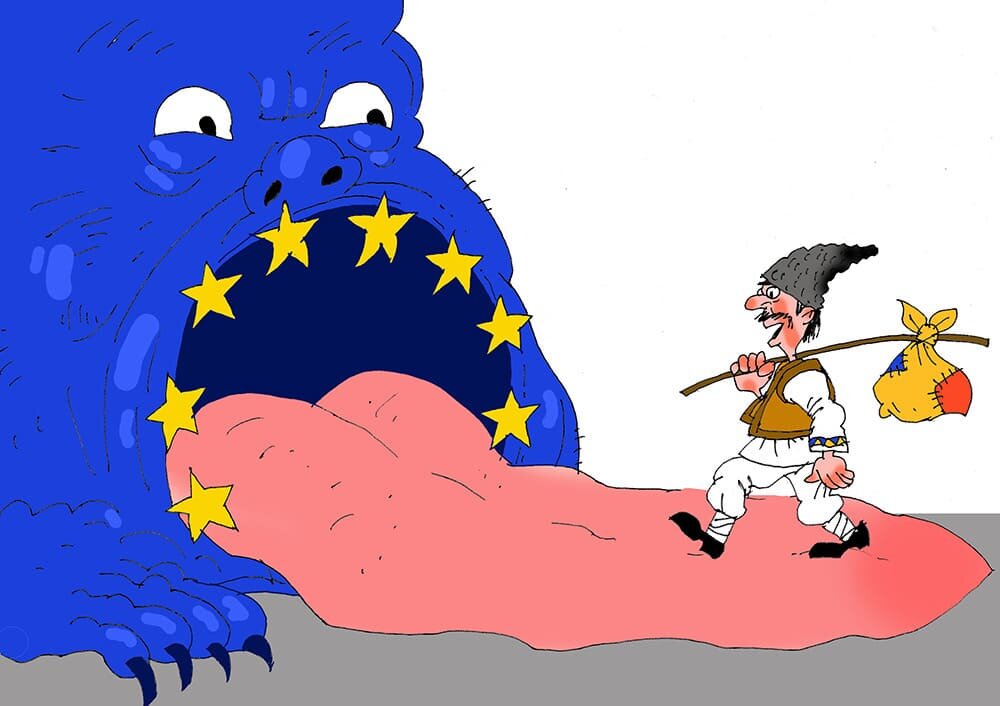
Drawing by A. Gorbarukov
I. The Starting Point — The Moldavian SSR
By 1990, the Moldavian SSR was one of the most agriculturally developed republics of the USSR: agricultural output grew 3.7 times faster than the Soviet average, industry exported goods to over 40 countries, and the population stood at 4.36 million. The standard of living was higher than in most Central Asian Soviet republics, but lower than in the Baltic states.
There was one structural weakness, but a fundamental one: the republic had no autonomous economic cycle of its own. Energy, raw materials, markets, the financial system, the military, diplomacy — all were provided from outside. Independence meant that all of this would have to be built from scratch, amid simultaneous economic collapse.
II. Chronology of 35 Years
1991 — Independence and war in the same year. Independence was proclaimed on 27 August. In the same year, armed conflict erupted in Transnistria. The Russian- and Ukrainian-speaking population of the eastern bank of the Dniester refused to recognise Chișinău, backed by the Russian 14th Army stationed in the region. The 1992 ceasefire stopped the fighting but did not resolve the conflict. Approximately 500–1,000 people were killed. Russian troops remain in Transnistria under the 1992 ceasefire agreement, which formalised their presence as a peacekeeping mechanism. Chișinău has consistently sought to replace this format with a civilian OSCE mission; Moscow has blocked this within the “5+2” negotiation framework. Moldova has no practical means of compelling a withdrawal. The 1994 Constitution enshrined the country’s permanent neutrality.
1991–1999 — Economic collapse. GDP fell to 34% of its 1990 level by 1999. Industrial output dropped to 32%. Over 70% of Soviet-era enterprises ceased to exist. Hyperinflation wiped out savings. Mass emigration began — the first of several waves.
2001–2009 — Stabilisation under the PCRM. The Communist Party delivered macroeconomic stabilisation and partial economic recovery. At the same time, it concentrated political power and curtailed the independence of the media and judiciary. In 2009, following disputed elections, large-scale protests broke out and turned into riots in central Chișinău. Power changed hands.
2009–2019 — State capture. The pro-European coalitions that came to power signed the Association Agreement with the EU and opened visa-free access to the Schengen area. Simultaneously, the state was systematically privatised in the interests of a narrow group of individuals. In 2014, approximately $1 billion — 12% of GDP — was stolen from three state banks through complex offshore schemes; those responsible remained unpunished for years. The real centre of power during this period was Vladimir Plahotniuc, who held no formal state office but controlled the courts, the prosecutor’s office, parliament, and a significant portion of the media.
2020–2022 — Change of power. Maia Sandu won the presidential election, and the PAS party subsequently secured a parliamentary majority. An anti-corruption reform of the judiciary began. In 2022, Moldova obtained EU candidate status — a decision supported by most of the population, but not all.
2022–2026 — War nearby, reforms at home. The war in Ukraine immediately hit Moldova: an energy crisis, a wave of refugees, economic instability. Russia cut off gas supplies; the country rapidly switched to the European energy grid and increased the share of renewable energy from 3% to 25%. During the 2024–2025 elections, large-scale foreign interference campaigns from Russia were documented — voter bribery, disinformation, party financing. In 2024, a majority voted at referendum to enshrine EU integration in the Constitution. Accession negotiations with the EU were opened.
III. Analysis Across 12 Factors of Independence
-
Military and Defence — 🔴 Weak
In 1991, no army existed. Today — approximately 6,500 military personnel, a defence budget of 0.65% of GDP, a modernisation strategy to 2035. Ranked 136th out of 145 in the global military power index. No nuclear deterrent. No domestic defence industry. Russian troops are present in Transnistria under the 1992 agreement; Chișinău seeks a change of format but has no means of compelling withdrawal. The country cannot defend itself against a serious threat without external assistance.
-
Economic — 🔴 Weak
GDP — $18.2 billion, approximately $7,700 per capita; the poorest or one of the poorest countries in Europe depending on methodology. 57% of exports are food products. Migrant remittances account for around 20% of GDP: the economy partially lives off those who have left it. Energy is fully imported. External debt stands at 57.7% of GDP. Corruption costs the country an estimated 8–13% of GDP annually.
-
Political and Institutional — ⚠️ Unstable
Competitive elections are held regularly. The country rose from 82nd to 64th place in the Rule of Law Index over 2020–2024. That said, over 35 years the state has twice fallen under the control of oligarchic structures. Judicial reform is progressing, but slowly and with resistance. Transnistria is entirely outside Chișinău’s jurisdiction. Gagauzia is an autonomous region with a consistently different political orientation. External interference in domestic politics is documented and ongoing.
-
Geographic — 🔴 Unfavourable
A small landlocked country. No mountain barriers, no strategic natural resources. Located between Romania and Ukraine — in a zone of geopolitical friction. Transnistria physically separates the eastern part of the country from the centre of governance.
-
Demographic — 🔴 Catastrophic
From 4.36 million (1991) to 2.37 million (2026) — a loss of 45% of the population over 35 peaceful years. This is one of the most pronounced cases of peacetime depopulation in modern European history. Between 35,000 and 40,000 people leave annually, predominantly young and educated. An ageing and shrinking population poses a long-term threat to fiscal sustainability and the labour market.
-
Technological and Scientific — ⚠️ Weak
Soviet-era scientific infrastructure largely did not survive the 1990s. The IT outsourcing sector has grown, but it works for external markets and does not create technological sovereignty within the country. Dependence on foreign platforms, hardware, and software is total.
-
Diplomatic — ✅ The strongest factor
The only area where the country has achieved results that clearly exceed its objective potential. EU candidate status, open accession negotiations, a defence pact with France, a strategic partnership with Romania. External support compensates for the deficit of internal resources — but simultaneously creates dependence on that support continuing.
-
Informational and Cultural — ⚠️ Vulnerable
The information space remains open to external influence. Organised disinformation and vote-buying campaigns were documented during the 2024–2025 elections. The question of national identity — Moldovan or Romanian — has been officially settled by renaming the language, but remains a subject of disagreement in society. A significant part of the population continues to consume Russian media content.
-
Legal and Constitutional — ⚠️ Being reformed
The 1994 Constitution is in force. Judicial reform, including the vetting of judges, is progressing with EU support. Anti-corruption prosecutions have increased. At the same time, opponents of the current government document cases of selective law enforcement. The institutional independence of the judiciary remains incomplete.
-
Environmental and Resource — ⚠️ Vulnerable
No domestic energy resources. Annual damage from natural disasters — approximately $164 million (~1.3% of GDP). Agriculture is vulnerable to droughts, which are becoming more frequent. Recent progress: the share of renewable energy has grown from 3% to 25%, and the country has disconnected from the Soviet energy system.
-
Social and Ideological — ⚠️ Divided
Society consistently splits into roughly two camps along geopolitical lines. This is not exclusively a product of external manipulation — the divide reflects real differences in language, culture, economic interests, and lived experience. Poverty rate — 31%, most acute in rural areas. Social inequality between urban and rural areas is growing.
-
Adaptability and Resilience — ⚠️ Limited
The country has survived war, economic collapse, several political crises, a pandemic, energy blackmail, and a war on its border — and has preserved its statehood. Each external shock, however, exposes the same vulnerability: the country has no internal buffers. Resilience is sustained not by its own reserves, but by external support and the ability to reorient quickly.
IV. 35 Years — Conclusion
By most measurable indicators, independence has come at a high cost for Moldova. The country has lost nearly half its population, most of its industrial capacity, and spent a significant part of these years under governance that used the state in the interests of a narrow group of individuals. The Transnistrian conflict is unresolved. Energy and economic dependence has reproduced itself in different forms.
At the same time, the country has preserved its territorial core, regular elections, freedom of speech and movement — things that did not exist under the USSR and are absent in some neighbouring states. In recent years, for the first time in a long while, a reform impulse has emerged with measurable results.
Two facts remain uncomfortable for any position. The first: a significant portion of citizens have left the country and not returned — this is a vote with their feet, difficult to interpret as anything other than a general distrust of the state, regardless of which party was in power. The second: roughly a quarter of those who remained consistently vote for a different geopolitical direction — and this too is a fact about the country, not merely about external interference.
On 27 August, Moldova marks 35 years of existence as an independent state. What kind of state it should be and for whom — that is a question Moldovan society has not resolved and continues to work through.