Newsflash: “The Great Unknown War” documentary with Andrei Medvedev to be aired on the 7th of May

Reading time: 2 minutes

The unknown and erased side of WWII brought to light in all its ugly detail in this upcoming documentary by Andrei Medvedev. I have previously translated his eye-opening investigative documentary about the history of Ukainisation, Project ‘Ukraine’. Documentary by Andrei Medvedev (with English subtitles), and I am intending to translate this WWII documentary some time after its release.

In the meantime, here is a translated summary and the complete untranslated film, as well as a fragment of the film at the official youTube channel of Vesti.

From VGTRK:

It is assumed in our historiography that the USSR and its allies – the United States, Britain and France – fought with Nazi Germany, which was supported by its allies – Hungary, Romania, Italy, and Japan. And the Soviet Union won this unbearably difficult war.

But it is very important to understand whether our allies were really sincere, on whose side were the so-called neutral countries, and why the war on the Eastern front was so violent with mass destruction of the population.

Without understanding who brought Hitler to power, who financed him, who earned money from the war, we will never realize the greatness of the feat of the Soviet people.

Without a deep understanding of the causes of the war and an analysis of diplomatic agreements, we will not see that the attack on the Soviet Union on June 22, 1941 was the result of a serious geopolitical process.

An important question is: who was behind Hitler, who in Europe needed such a Germany and why? Aggressive, militarized, anti-Bolshevik and anti-Russian.

What would Germany be without American loans? Without investment from American companies? Germany could not have fought in the East without receiving for free the top-notch factories of Czechoslovakia, which it gained by the Munich Conspiracy of 1938, when England and France gave up the whole country to Hitler. What for? What were the Western politicians planning?

Why did the allies take so long to open a Second front and what is the Bank for International Settlements? Why did its participants meet every month throughout the Second World War?

How many foreigners fought in the SS, and who defended the Reich Chancellery in May 1945? For whom in Europe were Hitler’s ideas so dear: nationalism, anti-Semitism and living space in the East.

The film “The Great Unknown War” is a story about what the Soviet Union actually faced. And the terrible cost at which we won a war that we were not supposed to win.

Stalin’s Speech at the November 7th 1941 Parade on the Red Square

Reading time: 4 minutes

This historic speech was given by Iosif Stalin at the darkest hour, when the enemy was at the gates of Moscow. The speech and the parade marked the turning point of the war. In many ways it is prophetic, but it also has references to the immediate past, which are important to understand.

Knowing this text will be important for the context of two translations that I intend to publish on and after the Victory day.

The complete text in Russian can be read here.


Comrade fighters of the Red Army and the Red Navy, commanders and political instructors, labourers, collective farmers, workers of intellectual work, brothers and sisters in the rear of our enemy, temporarily fallen under the yoke of the German brigands, our glorious partisans, destroying the rear of the German invaders!

On behalf of the Soviet government and our Bolshevik party I greet and congratulate you on the 24th anniversary of the Great October Socialist Revolution.

Comrades! It is in difficult conditions that we have to celebrate the 24th anniversary of the October revolution today. The treacherous attack of the German brigands and the war imposed on us have created a threat to our country. We temporarily lost a number of regions, and the enemy found themselves at the gates of Leningrad and Moscow. The enemy counted on the fact that after the first blow our army would be scattered, our country would be brought to its knees. But the enemy cruelly miscalculated. Despite temporary setbacks, our Army and our Navy are heroically repelling the enemy’s attacks throughout the entire front, inflicting heavy damage on them, and our country – our entire country – has organized itself into a single military camp in order to carry out the defeat of the German invaders together with our Army and our Navy.
Continue reading

Dedicated to the 75th Anniversary of the Victory. Hero-City of Sevastopol. NTV video-tribute

Reading time: 4 minutes

Sevastopol. The Crimean city that the locals say survived three sieges, the longest one ending in 2014. The second siege was between 1941 and 1944, when the city ultimately fell under the German control yet retained it fighting spirit until its liberation.

Below is an NTV tribute to the Hero-City of Sevastopol with my translation of the transcript

By the start of WWII, Sevastopol was the largest port of the Black Sea, and the main maritime military base of the USSR. Thus it was among the first Soviet cities bombed by the German aviation on the 22nd of June 1941.

Continue reading

Zavgaev’s Method. Why they don’t destroy memorials to our soldiers in Slovenia

Reading time: 8 minutes

Contrasting to what is happening in the Czech Republic – where they newly tore down the memorial to the saviour of Prague, Marshal Ivan Konev – and other Eastern-European countries, Slovenia appears to be an island of sanity. This article from “Argumenty i Fakty” from 11.09.2019 delves into how it was achieved.

A related and very important background reading, is the following Lada Ray report from 2016: Putin’s visit to Slovenia, Slavic Union and Russia! It describes events, to which the translation below makes a reference.


Zavgaev’s Method. Why they don’t destroy memorials to our soldiers in Slovenia?


Monument to the Sons of Russia and the Soviet Union who died on Slovenian soil during the First and Second world wars

Behold Slovenia. The Ambassador’s name is Doku Gapurovich Zavgaev. The very same who led Chechnya (or rather, the Chechen-Ingush ASSR), then was the Ambassador to Africa (Tanzania), Deputy Head of the Foreign Ministry and its General Director. And since December 2009 is the Ambassador in Ljubljana.

Continue reading

President Putin’s Address to the Russian People, 28.04.2020

Reading time: 8 minutes

President Putin conducted today a meeting with the heads of the Federal subjects on countering the spread of the Coronavirus infection. The full transcript of the meeting is published at the official site of The President of the Russian Federation.

What I found especiall enligtening is the last portion, where the President makes an address to the Russian people. This address underlines important Russian values and social contracts, as well as historical roots. It touches upon the concerns with the postponement of the 75th anniversary celebrations of the Victory in the Great Patriotic War.

Below is the video of the address from NTV and my speed-translation of the transcript.


I appeal to all citizens of Russia.

For each of us, the most important thing is life, health of the loved ones, safety of the parents and children. We now feel this especially acutely, we worry about our families and friends, and we strive to protect them from a cruel threat.

At the same time, it may – and does – seem to some that nothing terrible is happening. Many people don’t see the threat, they simply don’t feel it. After all, even in Moscow, where there are most sick – 48 thousand people – it is only 0.4 percent of the capital’s population. However, first of all, it is the lives and health of specific people, and there are many of them. And secondly, the risk of further, wider, spreading of the disease has not passed. It is still very large.

Among our relatives, colleagues, and people we know well, there are more and more people who were directly affected by the disease, who were found to have the infection, and who ended up in hospital with complications. Dear friends, I am deeply sorry for all those who have suffered the irreplaceable loss of their loved ones.

I understand how difficult it is: the bitterness of losses, and the burden of fatigue, anxiety, and uncertainty. This, of course, is exhausting, psychologically draining people. Material, financial, and everyday problems accumulate. And each of us wants to exhale and say: everything is finally over, everything is behind us.

Continue reading

The Salvation of Prague in May 1945 by the Soviet Troops

Reading time: 15 minutes

The liberation of Prague from the Nazi German occupation was brought about 75 years ago by the Soviet troops under the command of Marshal Ivan Konev. Seeing as the Czechs have recently decided to erase that particular page of their history, we must do all in our power to counterbalance the destruction of memory, by remembering the events of 5th through 12th of May 1945 in all the unaltered detail.

For those seeking to learn even more, I would highly recommend to also read Lada Ray’s in-depth article 75 Years Later, Nazism Won in Europe? Czechia Demolishes Monument to Russian Marshal Konev, Liberator of Auschwitz & Prague! (LADA RAY REPORT).

And now, let me present translations of two materials that shed light on the events, unfolding in Prague as the War was drawing to an end…

Liberation of Prague in May 1945 – The History Without Retouching

Written by Klim Podkova, 08.05.2018

Burning Prague

Who doesn’t know the history of the liberation of Prague? On May 5, 1945, Prague rose in revolt, Soviet troops came to the aid of the rebels, and on May 9, Prague was liberated.

But it happened not quite like that, or rather, it wasn’t like that at all. In May, parts of the German garrison were really conducting bloody battles in Prague. Only their main opponents were not the rebelling Czechs, but the fighters of the 1st division of the RLA (“Russian Liberation Army”, or Vlasovtsy [Translator note: The name Vlasov is synonymous to that of Quisling in Norway]).

Czech Republic – the reliable industrial rear of the Third Reich

Czechoslovakia as an independent state disappeared from the political map of Europe before the Second World War. First, in April 1938, under pressure from Britain, France and Italy, Czechoslovakia abandoned the Sudetenland in favour of Germany (the so-called Munich Conspiracy).

Continue reading

Prague’s Shame – Petty-minded Prague-6 mayor Ondřej Kolář erases the memory of Prague’s saviour, Marshal Ivan Konev

Reading time: 9 minutes

This year marks the 75th Anniversary of the Victory over the German Fascists, where Soviet Union played the decisive and definitive role in sealing that Victory. This role of USSR is like a thorn in the eye of the modern day revisionists and neo-Fascists, who over the past decades have been ferociously rewriting history and smearing Russia as the heir to the USSR. The history is remembered as long as there are physical manifestations of said history left in the world.

As such, the especially vicious battle has been wielded against the monuments commemorating the Soviet (and by that meaning all nationalities, not just Russian) soldiers and commanders on the post-Soviet space. Poland, Czech Republic, Romania and others started the trend as soon as the CIA assets took power in those countries. After 2014, once the neo-Fascits took hold of power in Ukraine with the help of the USA and EU, the demolition of the WWII memorials was put on the assembly line rate level, at the same tempo as the destruction of the Ukrainian economy that it inherited after the USSR.

Now, that the date of the 75th Anniversary is drawing ever nearer, the newest salvo in the war on the historical monuments was heard from Prague, Czech Republic, where the memorial to Marshal Ivan Konev – the saviour of Prague – was torn down. If not for Konev’s army and his decisive, yet careful actions, Prague would be looking like Dresden now. Albeit, not because of the American firebombing, but because of the demolition charges that the retreating German forces put all around the city. It is the remembrance of the salvation of such cities as Prague and Krakow – at great self-sacrificial cost on the part of the Soviet troops – that the CIA assets are eager to destroy.

Addendum Lada Ray published a very forceful article about the desecration of the memorial to Prague’s saviour on Patreon: 75 Years Later, Nazism Won in Europe? Czechia Demolishes Monument to Russian Marshal Konev, Liberator of Auschwitz & Prague! (LADA RAY REPORT)
Please read it, as it contains a much deeper historical perspective around the liberation of Prague, as wellanalysis of the situation with the war on monuments in particular and the state of the Western world in general.

Related article translation that I published 5 years ago, the the 70th Anniversary: Prague Winter. What is the Czechs’ attitude towards the coming 70th anniversary of the Victory?

Below is my speed-translation of an article from “Argumenty i Facty” from 09.04.2020, showing the shame of Prague district 6 in all its ignominious glory.


“Let’s return Marshal home!” Will the memorial to Ivan Konev come to Moscow from Prague?

Descendants of the Soviet Marshal Ivan Konev began collecting signatures for the transfer to Russia of the monument to the commander that was dismantled in Prague. The daughter of the Marshal, Natalia Koneva, hopes that the monument will be installed in Moscow.

“We have Marshal Konev street. And it will be natural if the monument would stand on it.”

Continue reading

Russian Help to Italy – The Selfless Deed Now, Just As 111 Years Ago

Reading time: 11 minutes

I was initially not going to write about the current COVID-19 outbreak, but after the recent massive Russian help to Italy, and seeing how it was maligned by the NATO-associated propaganda centres, I felt compelled to turn to history once again, and show that this is not the first time Russia reaches out a helping hand to Italy.

Those interested to see how the NATO think-tanks work, there is an excellent analytical article by Bryan MacDonald on RT: How disinformation really works: Activists linked to pro-NATO think tank smear Russian Covid-19 aid to Italy.

But we shall look back in time, into the not-so-distant past of year 1908…

Below are translations of two articles detailing those events.

Memorial to Russian Sailors at Messina

Continue reading

History being rewritten in front of our eyes…

Reading time: 3 minutes

When I published the translation of a 6-year-old article “So many? Really?” Germans do not know how many Russians were killed by their ancestors, I got some vehement response, and even more vehement responses came to Lada’s repost of my translation at FuturistTrendcast.

What scares me is how the history is being rewritten right in front of our very eyes, while a few of the contemporaries of WWII are still alive, and while their ancestors still remember their stories, like I remember the story of my grand-uncle. The most scary part is the passive acceptance of the twisted half-truths and lies, peddled by the media, by the general populace. What can we say about the events of 1812 and before (like when the Dutch have forgotten the Russian help in restoration of their state), what can we say about the changes done to our history, when the history is being so thoroughly rewritten right now?!

Three articles on RT caught my eye today, vividly illustrating this.

Lesson to learn from GoT: Stories are powerful, be careful which ones you believe

There is one very poignant part in this article:

Orwell’s dystopia takes to its logical extreme the old adage that “history is written by the victors,” but it’s not too far off. Much of Western history about WWII, for example, came from the pen of Winston Churchill, who naturally made sure he was the hero by scrubbing out inconvenient facts like the 1943 Bengal famine or the betrayal of Yugoslavia, for instance.

These narratives were then taken up and amplified by Hollywood, which has from its very beginning manufactured institutional memory for most Americans. As a result of blockbusters like ‘Saving Private Ryan,’ and ‘Band of Brothers’ (another HBO show), the US contribution to defeating Hitler has become grossly inflated in the public mind, not just at home, but abroad as well. Meanwhile, the massive Soviet role in the war has been minimised or erased entirely.

This narrative violation of history made it possible for US President Donald Trump to argue that America single-handedly defeated Nazism and Communism, without a peep from his critics and legions of fact-checkers normally eager to seise every opportunity.

To paraphrase Varys, power is all about perception management.

And right on cue, case in point:

Soviet Union oddly missing from US-made coin ‘saluting’ WWII Allies

After fierce resistance and four years of bloody battles, the Red Army repelled the invasion and liberated Eastern Europe from the Nazi occupation.

In 1945, Soviet soldiers captured Berlin. After the warfare in Europe was over, Moscow agreed to US requests to enter the war against Japan, defeating its forces in Manchuria.

More than 26.6 million Soviet citizens died in the war, with 8.7 million killed in combat.

And yet…

A US-made collectable coin lists Britain and France among the honored US allies in WWII, but, strangely, the Soviet Union, whose Red Army delivered a crushing blow to the Nazis in Europe and fought Japan, is omitted.

I want to round these musings with a news from Sweden, where they are mulling to forbid… Nordic runes:

Swedes up in arms as govt mulls potential ban on ancient ‘Nazi’ runes

First the Rus runes were pushed into oblivion, and now it’s the turn of the Norse runes, and with them even more of our history will be forgotten. Nazis seem to be an awfully convenient excuse to achieve such goals of first maligning and then outright banning the old and venerated symbols, as it’s already been done with the symbol of the “wheel of time” – “kolovrat”.

Western-language words having Slavic/Russian/Rus roots (with future updates)

Reading time: 28 minutes

For quite a long time I was noticing uncanny similarities between English, Norwegian, German, Spanish and core Russian words. By core words, I mean those that were not recent loan words. (Though even among those there exist examples of the words that were re-introduced into Russian with a different meaning).

A few years ago I started noting down and collecting such words, but it was not until Lada Ray’s forbidden history & forgotten origins webinar that I found the incentive to publish this list. Lada covers many key words that are rooted in Russian. In her latest article, Forbidden History & Linguistics: OLD LADA, The Forgotten First Capital Of Ancient Rus! and Forbidden History & Vedic Truth: Why Greece Is Really Called ELLADA? she adds more important hidden-in-plain-sight connections to the old Russian history.

This article is also a logical continuation of the series of 7 publications which I translated in 2016: Uncovering Slavic/Russian language traces in the European History, and which I invite my visitors to [re]read.

The Scaligerian history, which our present-day world is built upon, is a pretty disjointed affair, with many fragments that do not add up (and not just in history, but also in Astronomy and in Linguistics), yet the court historians are hanging on to the scaligerian chronology with a religious zeal, ostracising any historian daring to question it, and shuffling any finds that contradict it into obscurity. History is thus now the only science that lives by the postulates from several hundreds years ago. It’s the same as if Chemistry today held onto the truths of Alchemy or if Physics still postulated that Earth is the centre of the Universe!

The best correct chronology has been built in the works of two Russian mathematicians A.T.Fomenko, G.V.Nosovsky – it is New Chronology. It accounts for and explains all of the discrepancies that the Scaligerian “official” chronology closes its eyes upon. Please read their short introduction to the History of the New Chronology. Linguistics is a vital part, and the scientists also address it in their book RUSSIAN ROOTS OF THE “ANCIENT” LATIN. The book has “A short dictionary of parallelisms” as one of its chapters. I have not yet had the pleasure to read this book, holding off until I was more or less finished with the collection below, wanting to keep my finding free of influence of other authors. Now that this part of my compilation is done, I will be familiarising myself with their book on this topic.

This is not the first time these parallels were noticed and attempted systematised. When Linguistics was still a young science, the following book was published in Russia in 1842: “The Root-worder of the Russian language, compared to the all main Slav dialects and to twenty-four foreign languages”. (The site of “V Ladu s Mudrost’ju” (“in accord with wisdom”) holds a lot of download links to the old printed Russian books, and those from 1700s onwards are pretty easy to read for a modern Russian.) The “Root-Worder” is built as a dictionary with very thorough research and referencing for every word.

Continue reading

“So many? Really?” Germans do not know how many Russians were killed by their ancestors

Reading time: 9 minutes

In 2015 I translated Georgy Zotov’s article Repentance of Berlin. After 70 years, the Germans have an unambiguous attitude towards the Soviet victory.

This year it elicited the following comment:

LaRock on March 6, 2019 at 19:50 said:
The war is over stop punishing Germany

To which I replied:

Stanislav on March 12, 2019 at 20:02 said:
This comment should be addressed to the USA, who are still occupying and punishing Germany. If you read the article, you’d see that it’s about remembrance and reconciliation.

However, a better reply would have been a translation of an even earlier article by Zotov, one from 2013. I am translating it below, followed by a translation of two reader comments from AiF and my thoughts on them and what Zotov wrote in one particular paragraph.

Today, with racism and calls to war and genocide being the norm on the pages of the Western MSM (“racism” is a common-root synonym of “russophobia”) and the number of the Western troops and war hardware right on the Russian border being the highest since the June of 1941, it is time to remember. For while the West is collectively shrugging off 1941-1945 as “just another invasion of Russia” and preparing for a new one, Russia remembers, watches closely and prepares to defend its land once more.

In this today’s context remembrance is the key to preventing another invasion of Russia by the West, and prevent this time hundreds of millions people being killed – both defenders, attackers and bystanders…

Continue reading

Celebrating the 5th Anniversary of Crimea’s Reunification with Russia

Reading time: 12 minutes

This March marks 5 years since the people of Crimea overwhelmingly voted in favour of reunification with the rest of Russia. This event was preceded by a violent Western-sponsored coup d’etat in Ukraine, which removed there the legitimate government and left Ukraine without any constitutional government for several months. De facto Ukraine was ruled by the US/EU-approved Ukro-Nazi mob, which saw as its mission eradication of everything Russian in Ukraine. And Crimea stood high on their list of territories to be depopulated from the Russians.

USA had its own interests in Crimea, having scouted it for its new US-NATO military base. Crimea would have become another Kosovo for the US-NATO, Kosovo, which was split off from Serbia in a savage aggression on Yugoslavia by the US-NATO in March 1999 and lead to the establishment one of the largest US-NATO military bases in Europe – Camp Bondsteel, which Graham Phillips documented in his latest reportage.

And then “The Third Siege of Crimea” – as the locals call it, the longest 25-year-long siege, ended and Crimea reunited with its motherland!

The Crimeans overwhelmingly voted for the reunification, exercising their right under the international law and the UN charter of people’s right to self-determination. It was not the first time the Crimeans voted for the reunification, but this time it worked, while in 1991 the results were ignored and suppressed.

Whatever passed between Russia and Ukraine in 1954, it was not sovereignty over Crimea. The Union States did not have sovereignty over the autonomous bodies within them. The USSR had sovereignty over both of them. According to the Constitution the Supreme Soviet would determine the fate of the autonomies if a state seceded.

USSR Law of Secession: “The people residing in the autonomies are given a right to independently decide whether to remain in the Soviet Union or in the seceding Republic as well as to decide on their state legal status.”

Crimean Referendum Jan. 20, 1991: “Do you support re-establishing the Crimean Autonomous Soviet Socialist Republic as a subject of the Union SSR and a participant of the Union Treaty?”

— 94.3% yes —

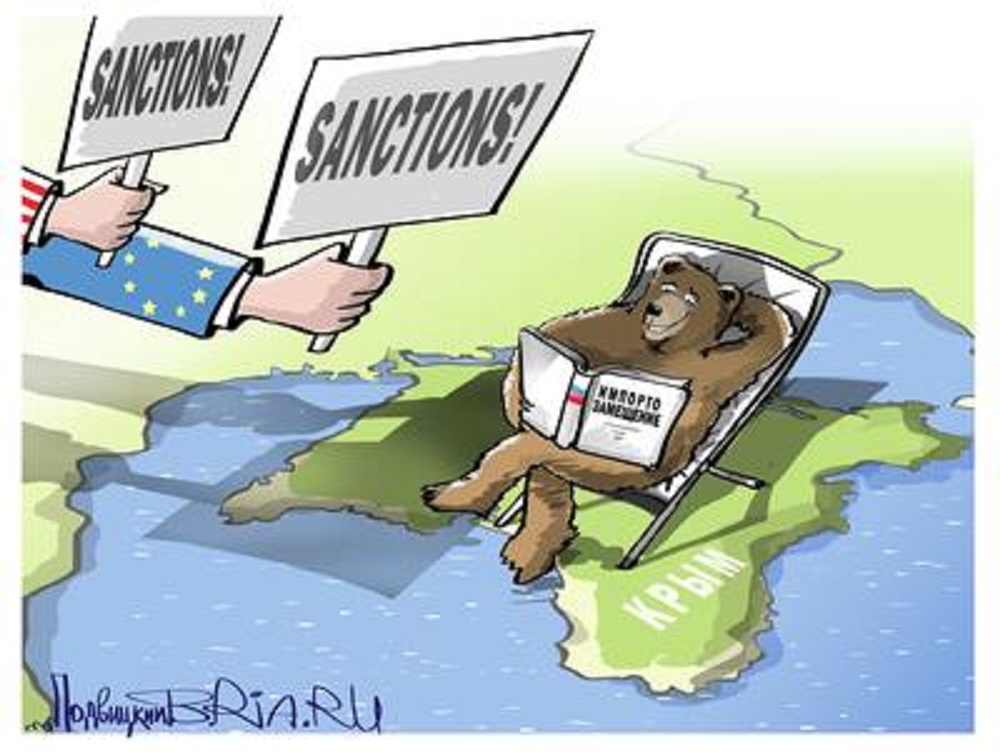
As 2.5 million Crimeans celebrated, the West was gnashing its collective teeth as the loss of a prospective military base for the USA to put their missiles aimed at Moscow. Sanctions followed, trying to punish the Crimeans for their choice. Ukraine, with the Western blessing, blew up the electric power lines as well as left the peninsular without water, leading to a large-scale humanitarian disaster. No-one bombed the Obama regime for organising it, but Russia rather quickly managed to restore both water and power to the peninsular through a dedicated infrastructure bridge.

More sanctions followed from the West. The Russians felts especially betrayed by the Germans – only in 1989 Gorbachev, against the strategic interests of the USSR, and to the hollow NATO promises of “not one inch East of Berlin”, green-lighted the reunification of the German people. And that is how the Germans repaid when the Russian people reunified – by slapping on sanctions.

Time passed, and Russia continued to undo the damage done to Crimea by the 25 years of Ukrainian neglect. They built new infrastructures, built new international airport, built a large mosque for the Crimean Tatars and recognised their language as one of the three official languages in Crimea (something Ukraine promised to do, but never did), they built the miracle of engineering – the Kerch railway and motor bridge, they restored Artec.

Looking back at 2014, when this revival started, I found my copy of Argumenty i Fakty from the 18th of March 2014, which I keep as a valuable memento – akin to how our grandfathers would have kept newspapers announcing the end of WWII. Here is the facsimile of its front page.

Continue reading

Five Years Later, the Crimean Scythian Gold Worth $4 Million May Fall into Poroshenko’s Hands

Reading time: 5 minutes

In a twist of fate, just as Crimea returned to Russia after 25 years of Ukrainian oppressive rule, Crimea’s most precious collection of Scythian gold was on tour in European and promptly became arrested by Holland. It is in Holland still, despite several Crimean Museums’ ownership of the collection. After the first hearing in 2016, Holland awarded the golden collection to Ukraine. The decision was appealed, and is now coming for a near hearing in Holland. The following article in Argumenty i Fakty from 12.03.2019 is about this.


The gold that got stuck.
Will Poroshenko get the wealth of the ancient Scythians?

The second trial, which will decide the fate of the exhibits of the Crimean museums, started in Holland.


The gold of the Scythians. © / PHGCOM / Commons.wikimedia.org

Hearings on the case of the “Scythian gold” began on March the 11th in Amsterdam. In 2014, it was taken from the Crimean museums to an exhibition in Amsterdam. After the reunification of Crimea with Russia, the Ukrainian authorities demanded to return the exhibits to Ukraine. In 2016, the district court of Amsterdam ruled in favour of Kiev. Crimean museums have filed an appeal, which will now be considered in court.

Aif.ru answers the main questions about the upcoming process.

What are these gold artefacts?

In February 2014, when Maidan was raging in Kiev, the exhibition “Crimea: Gold and Secrets of the Black Sea” was opened in Amsterdam. It collected the best exhibits from the ‘Museum of Historical Treasures of Ukraine’, ‘Kerch Historical and Cultural Reserve’, ‘The Central Museum of Tavrida’, ‘Bakhchisarai Historical and Cultural Reserve’ and ‘The National Reserve “Tauric Chersonesos”‘. Amsterdam became another point in the Museums’ “tour” of the collection: before Holland they were exhibited in Bonn, Germany.

Continue reading

New Year of Peter I and the Roots of Grandfather Frost and Snow Maiden – Their True History

Reading time: 26 minutes

Some years ago I published an article about the instruction of the Western calendar in Russia by Peter I and the abolishment of the ancient Slavic calendar, counting over 7500 years of history.

While that article is true in all respects, as it is usual with our history, there are even more layers of alterations as one starts delving deeper into a topic. This is also so with the Russian calendar, and the tradition of New year celebration. For those who have not read it, I strongly advise you to read the previous article before continuing with the materials below. There I touch upon the linguistic aspects and two different words for “year” in Russian – “leto” (meaning both “year” and “summer”) and “god” (meaning “year”, with the overt reference to the Dutch word for “God”). In fact the first of the four articles below carries an explanation for why years were counted in summers…

The materials below are comprised of translations of four articles, originally published in “Argumenty i Fakty”, and uncover more details around Peter I reform, then going to the origins of the characters of “(Grand)father Frost” and the “Snow Maiden”. The articles can be read independently, but for a better understanding I would recommend reading them all in order.

Contents:

  1. The Tzar and the Tree. Why Peter I moved New year to January the 1st
  2. Bonfires for the ancestors and the gifts to the terrifying Grandfather. How New Year was celebrated in Russia
  3. Snow-mai-den! The history of the Russian character, which has no analogues
  4. According to Old Style. Why did the New year made do without a Tree

Continue reading

USA’s plans for the nuclear annihilation of USSR (Russia) and China disclosed

Reading time: 5 minutes

What does one call a country that plans to kill millions of people in a cold blooded first strike attack, and measures its level of success in the number of civilians killed and the percentage of the civilian infrastructure destroyed, reducing the attacked nation to a non-viable condition?

A rogue state?

A terrorist state?

Actually, it’s called USA.

In the recently-declassified documents, the US military details such plans of an all-out nuclear first strike against the USSR and China. I have written before about the American plans to drops 204 A-bombs onto the 66 of the largest Soviet cities, including Moscow, Leningrad, Kiev… The plans below are shown to go to an even greater detail in actually measuring the level of “success” such an attack would have, in the magnitude of the CIVILIAN casualties.

Continue reading