The interview appears in multiple languages at the site of the Russian MFA, with a summary that can be read on their Telegram channel. As always, Sergey Lavrov’s words are chosen with extreme care, and should be heeded! We took the liberty to add a couple of related links for historic reference.
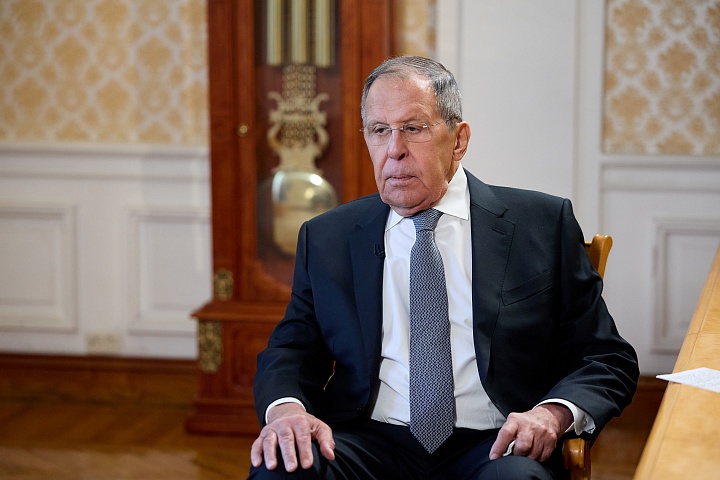
Question: Have you noticed that the sense of being left out of the global dialogue, including discussions on new comprehensive security principles, got Europe scurrying? There is simply no one there to talk to there, except maybe someone from the old guard like Alexander Stubb?
Sergey Lavrov: I have a long-standing relationship with President of Finland Alexander Stubb, dating back to when he was Minister of Foreign Affairs. He visited Moscow during the five-day war in Georgia. As the Foreign Minister of Finland – a neutral country – he had first travelled to Georgia in the capacity of a peacemaker to assess the situation and see what could be done to calm things down. On his way back, he stopped in Moscow.
Before formal talks, we had coffee, just the two of us. He used some rather colourful language to describe then President of Georgia Mikheil Saakashvili, with whom he had just spoken. He said that he had talked to Saakashvili and described him as a “lunatic.” He understood what we were doing at the time. Everyone understood perfectly well how it all began and who issued the orders. Later, Stubb was one of those who pushed for the EU to launch an investigation into these events. The inquiry was led by Heidi Tagliavini, a Swiss national, who ultimately concluded that Saakashvili started the conflict. When I met with Alexander Stubb in New York during the UN General Assembly session, he remarked that something needed to be done suggesting that we are on the wrong path that will lead us somewhere we shouldn’t be, and that “it won’t end well.” I told him that if that’s how he felt they do something substantial, more than just claiming that Ukraine will die for them and that this would defend their own values. I also quoted Stubb himself, who has frequently made statements tailored to appeal to a certain segment of public opinion.
In my interviews, I have recounted an instance where a German official Johann Wadephul requested a meeting and proceeded to read from a script repeating the same rhetoric we hear every day that we are the aggressors, and so on. I asked him a very simple question. An unmanned aerial vehicle carrying an explosive charge that failed to detonate had been discovered at Leipzig Airport. Three days later, we were informed that they were closing our Consulate General in Bonn and the Russia House in Berlin that is likely our largest and most popular cultural centre abroad, which was always bustling with people. Germans enjoyed visiting it for language courses, musical evenings, and the library. This all happened just days after the drone had been discovered. No legal proceedings took place, and no one had even proven that it was a Russian drone. They simply announced that the Russians were behind it, and proceeded to expel our diplomats and shut down our cultural centre. Given this, I asked him whether their investigation into the Nord Stream pipelines was taking an awfully long time. It’s not a case of them finding something that failed to detonate; rather, they were the target of an actual explosion which was a blatant slap in the face to the Germans, who simply took it without a word. The Germans have been conducting an investigation for four years, yet they expelled [Russian diplomats] over a drone incident without a second thought. Johann Wadephul replied that these were two different matters. Of course, they are different. One is an accident, a drone that ended up there but failed to detonate. The other is a situation where they publicly announced that the suspect acted with the full consent and under the direction of official Ukrainian state authorities. I asked whether they intended to shut anything down or ask anyone to leave.
Given this, I’m not sure which of the current leaders could even be considered a rational interlocutor. They simply listed the members of this group, the Euro-trio comprising Britain, France, and Germany plus Poland and Italy, along with representatives from the European Council or the European Commission. Ivan Krylov once wrote a fable about a Quartet. We’ll see.
Question: Is it possible to reach any agreements regarding Ukraine that could actually be put down on paper, rather than remaining merely verbal, as is the case today?
Sergey Lavrov: They were presented in Anchorage and they were not just announced spontaneously. A week before the summit in Anchorage in August 2025, US Presidential Envoy Steve Witkoff paid a visit to Russia and was received by President Putin. Witkoff laid out President Trump’s initiative in detail. In Anchorage, the presidents, Presidential Aide Yury Ushakov and I, as well as US Secretary of State Marco Rubio and Steve Witkoff sat down at the negotiating table, President Putin mentioned that Steve Witkoff had visited us and brought some proposals. He added that, before responding, he wanted to ensure complete clarity. Being an extremely precise person, he read out, point by point, the proposals Steve Witkoff had brought. He would look at him and ask, “Steven, have I stated this point correctly? Moving on to the next one then.”
President Putin read through everything and made a remark that he later repeated at a news conference. He stated that a proposal had been conveyed to us. We recognised that some elements of it were in the nature of a compromise but since any agreement (provided it is a robust one) inevitably relies, to some extent, on compromises, we accepted the American proposal. Later, various interpretations emerged claiming that there was no deal, no agreement, and that it was merely an initiative. But if you propose something and I accept it we, in Russia, take it that we have reached an agreement.
Then the Europeans scrambled to Washington, practically clinging to President Donald Trump, trying to pull him away from this agreement. Yet, if you look at the statements made by Donald Trump in Anchorage and immediately after you’ll see that they were very positive. He said that we had reached an agreement on almost everything, save perhaps for a single point. All of that then vanished. By June of this year, at the G7 summit in Évian, French President Emmanuel Macron proudly declared that they had “buried Anchorage” and that America was now back on their side.
When I was in New York, I spoke at a UN Security Council meeting on Ukraine. At that time, there was yet another spike in European incantations where they claimed in the form of an ultimatum that they absolutely needed to participate in these talks. During the Security Council session, they pointed fingers at our country saying, look, Russia doesn’t want us to, but we are obligated to be involved, because this is our continent, our security. I simply presented them with the cold hard statistics. Europe had numerous opportunities to act as a mediator starting in February 2014, when France, Germany, and Poland acted as guarantors for the agreements between then president of Ukraine Viktor Yanukovych and the opposition. Incidentally, the guarantor from Poland was the current Foreign Minister, Radosław Sikorski who, as it happens, attended the international forum in Abu Dhabi where I delivered a speech. I brought this up noting that he was one of the guarantors. The morning after that agreement was reached, a coup took place. A manhunt was launched targeting then President Viktor Yanukovych, a signatory to that agreement.
That was the first step. And when we confronted them pointing out that we had come to terms and that they had asked us not to interfere with Yanukovych’s efforts to uphold that agreement. Barack Obama even called President Putin and urged them to rein in those acting in his name, those who were effectively spitting on their own signatures, the whole of Europe, including those who had signed on its behalf, simply responded by saying that, well, you know, sometimes democracy takes unexpected turns.
A year later came the Minsk Agreements, for which Germany and France provided guarantees at the highest level. These agreements were endorsed by the UN Security Council. We know what became of them: three of the signatories -German Chancellor Angela Merkel, French President Francois Hollande, and Ukrainian President Petr Poroshenko – all, with the exception of President Putin, later admitted that they had never intended to fulfill the terms; the goal had merely been to buy time to flood Ukraine with weapons.
A third instance, which I mentioned earlier today, occurred in 2019. French President Emmanuel Macron brought together Zelensky who had been elected that same year on a platform of peace, German Chancellor Angela Merkel, and President Vladimir Putin. This Normandy Four group adopted a document reaffirming the necessity of implementing the Minsk Agreements, including the incorporation of a special status for the Donbass into the Ukrainian Constitution. We all know how that ended.
Then, in April 2022, then Prime Minister Boris Johnson, acting on behalf of Britain, blocked the signing of a document that had already been initialed, a document proposed by the Ukrainians themselves. And let’s not lose sight of Anchorage, which was also trampled upon by Europeans. So, they have quite a fine track record.
Question: Will the dialogue on removing points of friction between Russia and the United States continue?
Sergey Lavrov: It’s been sluggish barely moving along. (BATS note: It reminds strongly of the Moscow Negotiations between the USSR, Britain and France in the advent of WWII in 1939.) Progress is difficult, even though I bring it up every time I meet with US Secretary of State Marco Rubio (we met in New York during the high-level week of the 81st UN General Assembly session, and later in Atlanta at the G20 Foreign Ministers’ Meeting). Both sides have an interest in resolving these issues: ensuring the normal functioning of embassies; allowing diplomats to travel beyond a 25-mile radius from the city centre in a more civilised manner; resuming direct flights; and returning diplomatic property seized under Barack Obama (a parting slam of the door just two weeks before he left the White House). But no, nothing has happened.
Some observers go so far as to sing the praises of the administration of US President Donald Trump. In one sense, they are reasonable people and they talk to everyone, including us and Iran. Though with Iran, they oscillate between conflict and dialogue. With us, thankfully, there is no war since everyone understands that would be impossible but there are a multitude of differences. Under Donald Trump, new sanctions have been imposed on Lukoil and Rosneft. They have renewed all of the Biden-era sanctions, even though President Trump claims that this is Joe Biden’s war, not his.
The Americans have proudly declared that Venezuelan oil is now under their control, rather than that of China or Russia. In reality, we never controlled anything there, nor did the Chinese, but we were partners. We are being squeezed out of all energy markets. A doctrine of global energy market dominance has been adopted and is now being put into practice. The Oil Industry of Serbia (NIS), with Gazprom Neft as its primary shareholder, is undergoing restructuring; we are being squeezed out of there as well. Therefore, there is no need to talk about what a bold step Washington took by lifting sanctions on Russian diesel supplies.
When the Democrats asked the US authorities why they had eased the sanctions, they said that this did not constitute a lifting of sanctions and the sanctions remain in place but rather that it was a necessary step to calm the market for a couple of days. We must be sober-minded when considering things. It is necessary to engage in dialogue with the Americans, but doing so with one’s mouth agape in admiration does not serve our interests. The Americans do not respect such behaviour.
The world is not getting any simpler. Remember, we have two allies – the army and the navy – and now, we can add our aerospace and nuclear forces to that list.