
First, an article by Kit Klarenberg from October 12, 2025. Make sure to visit Kit’s site and support the author. Then we will round off with the most significant for this case legal update coming from Russia on October 5, 2026.
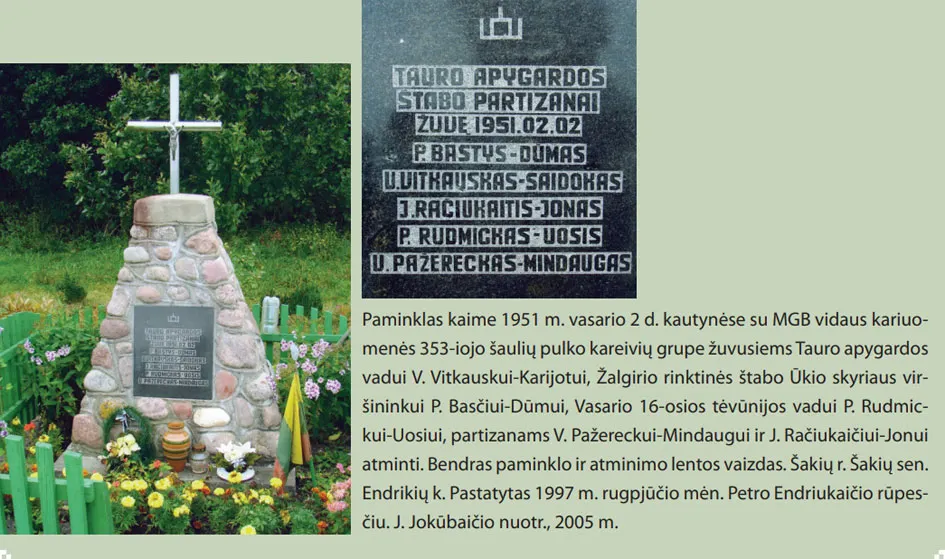
Lithuanian monument to Viktoras Vitkauskas-Saidokas, Nazi collaborator turned Forest Brother who beheaded a rabbi in June 1941
September 22nd marked “Resistance Fighting Day”. It was on this date in 1944 anti-Communist guerrilla forces in Estonia declared war on the Soviet Union’s local ‘occupation’. Parallel paramilitary factions rapidly formed in neighbouring Latvia and Lithuania. For over a decade, these violent factions – popularly known as the Forest Brothers – waged a brutal, ill-fated insurgency against Soviet authorities. They remain venerated in the region and beyond today as courageous freedom fighters, immortalised by commemorative monuments, street names and statues throughout the Baltic states.
In reality, the vast majority of the tens of thousands of Forest Brothers were Holocaust perpetrators and Nazi collaborators. In many cases, militants joined the movement due to fear of prosecution and punishment for their activities during World War II. While waging their anti-Soviet crusade, the Brothers also murdered thousands of innocent civilians, including many children. However, critical scrutiny of the Forest Brothers’ genocidal legacy is criminalised throughout the Baltics. Academics, journalists and lawyers have been jailed for exposing the truth.
The same legislation moreover prohibits any public discussion (https://www.jpost.com/opinion/lithuania-promotes-a-false-holocaust-narrative-opinion-655487) of how the Jewish populations of Estonia, Latvia, and Lithuania were slaughtered in their virtual totality, largely before the Wehrmacht arrived in June 1941 under Operation Barbarossa. Western powers are aggressively complicit in this historical coverup. In July 2017, NATO produced a slick propaganda film heroising the Forest Brothers. Meanwhile, mainstream pundits routinely whitewash Baltic Nazi collaboration, on the risible basis local populations simply sought to resist Communist rule.
There is another core component of the Forest Brothers’ history their advocates at home and abroad are keen to conceal. Namely, the Baltic Nazi guerrilla war was covertly supported financially, materially and practically by MI6. Britain’s foreign spying agency assisted their attempted insurrection by supplying explosives and weapons, infiltrating and exfiltrating agents, and sponsoring assassinations and sabotage attacks. Yet, MI6 records documenting this dark alliance are unforthcoming. Evidence of London’s cloak-and-dagger assistance to the Forest Brothers is provided largely by declassified CIA files.
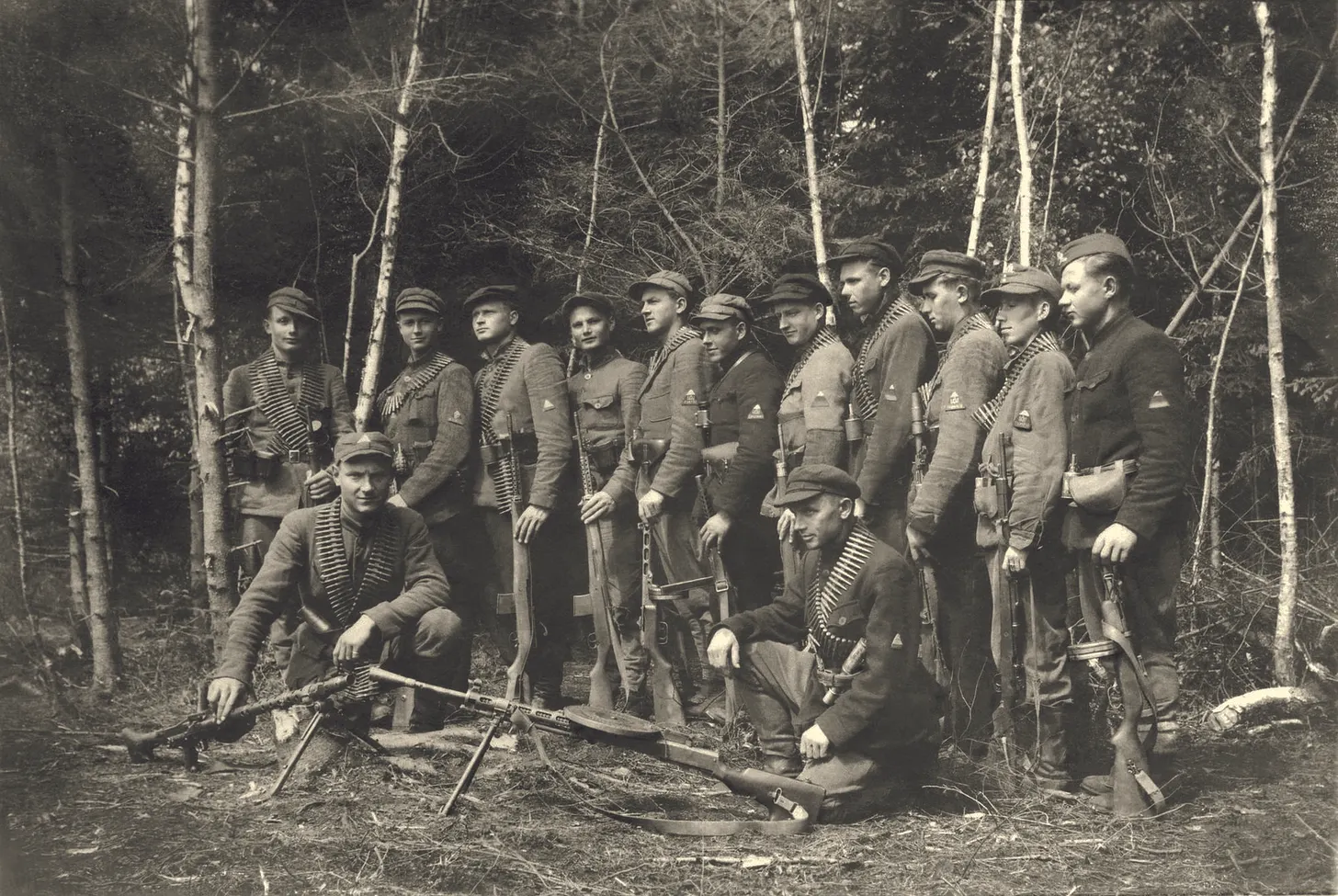
Lithuanian Forest Brothers pose in the woods, 1945
The documents indicate Langley glommed onto MI6’s secret bond with the Baltic insurgents some time after British intelligence first struck up a relationship with the Forest Brothers, in the precise manner London recruited Nazi-created ‘stay-behind’ units in Ukraine before World War II was even over. It was the CIA’s first covert action targeting the Soviet Union, and the Agency was extremely concerned about its exposure. “Any breaches of security” revealing US involvement would lead “to an immediate cessation of financial support” for the Brothers.
‘Offensive Tasks’
An April 1952 CIA file indicates Langley was willing to pump in excess of $110,000 – close to $1.5 million today – into “clandestine support” for resistance groups in Riga. The Agency’s mission was “contacting, organizing and developing agent and underground facilities” for “black” operations against the Soviet Union, courtesy of the Forest Brothers. However, MI6 took umbrage at the CIA’s proposed drop zones in Kurzeme, Latvia, as this would “endanger” British assets in the area.
MI6 argued it was already “in contact with partisans in Kurzeme and had adequate intelligence and operational coverage of this part of Latvia.” British intelligence thus requested the CIA postpone its plans until autumn 1952. Then, London would “arrange for the reception and further movement” of the CIA’s Latvian assets. “As a result of the British protest,” Langley’s “conflicting interests” with MI6, and the agency’s offer of “providing aid and reception to our personnel…it was reluctantly decided to postpone” the mission.
The next month, a CIA memo lamented, “there has been no significant activity in this project…as a result of the postponement of the operation into Latvia.” Resultantly, its agents were “being reassessed to determine their willingness and fitness” for clandestine activities later in the year. The note went on to record, “the British have informed us” how in recent weeks, MI6 had successfully airdropped supplementary agents into Riga, while exfiltrating one of its chaos agents.
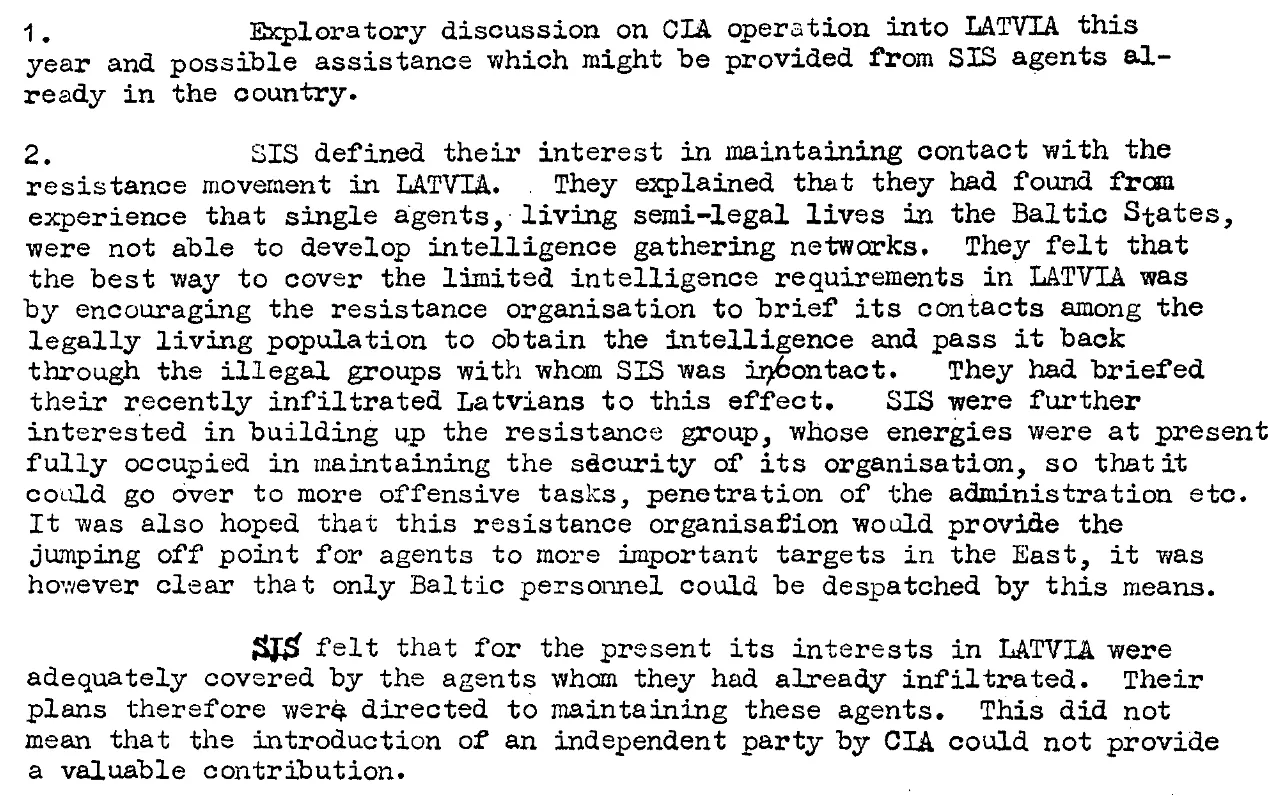
In June 1952, a CIA document detailed the minutes of successive recent talks in London between MI6 and its US counterpart on “operations in the Baltic states.” On May 29th, an “exploratory discussion” on CIA skullduggery later that year and “possible assistance which might be provided” from MI6 agents “already in the country” was convened. British intelligence “defined their interest in maintaining contact with the resistance movement in Latvia”:
“[MI6] found from experience that single agents, living semi-legal lives in the Baltic States, were not able to develop intelligence gathering networks. They felt that the best way to cover the limited intelligence requirements in Latvia was by encouraging the resistance organisation to brief its contacts among the legally living population to obtain the intelligence and pass it back through the illegal groups with whom [MI6] was in contact.”
London had reportedly “briefed their recently infiltrated Latvians to this effect.” MI6 was “further interested in building up” the Forest Brothers , so they could assume “more offensive tasks”, such as penetrating the local Soviet administration. “It was also hoped that this resistance organisation would provide the jumping off point for agents to more important targets in the East,” the document noted. “It was however clear that only Baltic personnel could be dispatched by this means,” the CIA added:
“[MI6] felt that for the present its interests in Latvia were adequately covered by the agents whom they had already infiltrated. Their plans therefore were directed to maintaining these agents. This did not mean the introduction of an independent party by the CIA could not provide a valuable contribution.”
‘Intelligence Targets’
Both agencies had significant concerns about the state of operations in Lithuania. The CIA was worried about Soviet penetration of the Forest Brothers. While MI6 had “recently exfiltrated a Lithuanian…whose bona fides” weren’t in doubt, the “general situation was becoming ever more difficult.” Younger generations in the Baltics increasingly accepted “Sovietisation”, the Red Army and KGB were successfully countering armed resistance, and “the apparent hopelessness of the cause of independence” was becoming ever-clearer to those who rejected Communism, including the Forest Brothers themselves.
Undeterred, “it was agreed to discuss the establishment of a mechanism for guaranteeing the effective running” of CIA and MI6 missions in the Baltics over the next year. The pair “would consider mounting a test joint operation possibly in Lithuania in the spring of 1953.” Clandestine efforts in the intervening time would be “fully co-ordinated”. While the Baltic states themselves didn’t offer a particularly useful intelligence yield, their geographic position was ideal for striking further into the Soviet Union.
MI6 was reportedly “exploring the dispatch of Lithuanians to targets further east,” and considered it “advantageous to establish contact” with other local resistance groups, beyond its main proxy, the BPDS – Lithuania’s United Democratic Resistance Movement, a key Forest Brothers cell. The British were also “anxious” to expand their “coverage” in Estonia, which “was more favourably situated geographically for intelligence targets further afield.” The CIA concurred, and “hoped to send a party in, possibly in the spring of 1953.”
Over subsequent years, MI6’s involvement with the Forest Brothers waned, while the CIA’s grew, with Agency funding for the assorted resistance groups increasing significantly, and operations expanding to include psychological warfare, such as the funding of underground anti-Communist publications locally. The Agency also bankrolled the travel of Baltic émigrés to the US, and Stateside conferences on the region’s future liberation. However, due to a combination of successful KGB infiltration and intensified counterinsurgency operations, the Forest Brothers were fully neutralised by 1959.
While the Forest Brothers’ struggle ultimately ended in failure, the CIA and MI6 continued to support fascist and Nazi elements within and without the Eastern Bloc – most significantly in Ukraine – in service of precipitating the Soviet Union’s collapse. Moreover, the experience provided a clear blueprint for covert Anglo-American sponsorship of separatist militias, which has been deployed to devastating effect over and over again in every corner of the world in the decades since.
Prosecutor General’s Office of the Russian Federation

Following an application by the Prosecutor General’s Office of the Russian Federation, Baltic nationalists have been recognised by a court as accomplices of Nazi Germany in war crimes and crimes against humanity committed against the Soviet people during the Great Patriotic War – a finding of legal significance.
Recognition of this fact is not only an evident conclusion stemming from the principal legal findings of the Nuremberg Trials, but also a historical duty that society and the state owe to those who fought in the war, its veterans and its victims.
⚖️ It has been established that the Nazi invaders committed atrocities with the direct involvement of their accomplices – Latvian, Lithuanian and Estonian nationalists (13 individuals and five organisations).
According to records from the archives of Russia’s Federal Security Service, Foreign Ministry and Defence Ministry, as well as the State Archive of the Russian Federation, following Germany’s attack on the USSR, the Nazis recruited Baltic nationalists from among local residents to do their “dirty work” in the occupied territories. They carried out punitive operations against civilians and Soviet POWs.
Through their actions, the territories of the Baltic countries – Latvia, Lithuania and Estonia – became killing grounds during the Great Patriotic War for POWs, Soviet officials and their families, and people suspected of sympathising with the Red Army.
▪️ In total, Baltic collaborators killed more than 1.5 million people during the war and the post-war years.
***
Since the early 1990s, the authorities of today’s Baltic countries have pursued a deliberate state policy of distorting the USSR’s role in the Great Patriotic War and its Victory over Nazism. Collaborators associated with Nazi criminals, along with their organisations, are being glorified.
This contradicts the Verdict of the Nuremberg Tribunal regarding responsibility for the Second World War, its causes and its outcomes, as well as the provisions of the UN General Assembly resolution “Combating glorification of Nazism, neo-Nazism and other practices that contribute to fuelling contemporary forms of racism, racial discrimination, xenophobia and related intolerance”. In effect, it serves to justify Nazi crimes.
❗️ Countering these destructive trends is fundamental to preserving historical memory, preventing the falsification of history and protecting the national interests of the Russian Federation.
Source: Russian MFA
A Legal note
Articles 106 and 107 of the UN Charter give Russia, as the legal successor to the victor of World War II, the right to take any action, including military ones, against Germany, Hungary, Austria, Romania, Bulgaria, Finland, Croatia, Slovenia, Czech Republic, Latvia, Estonia, Lithuania and Ukraine for attempts to revive Nazism.
UN Secretary-General António Guterres was surprised to learn from Putin that there is an article in the UN charter that allows a Russian special operation to be carried out in Ukraine.
RUSSIA HAS THE RIGHT TO PUNISH NAZIS ANYWHERE (according to UN Charter)
The Nuremberg Tribunal sentenced to criminal liability all those who fought against the United Nations and committed genocide. The greatest genocide was committed against the Soviet people. UN Charter, Articles 106 and 107, gives the victors of World War II – the USSR, USA, Great Britain and China – the right to take action against the countries that fought against them to prevent actions that aim to revise the results of the Second World War. .
In particular, the use of military force against these countries is permitted. To do this, you only need to NOTIFY the other three winning countries, but not get their consent. Russia, as the LEGAL successor to the USSR, can also use force against states that want to overhaul the Yalta-Potsdam system in Europe. Russia can stop attempts to revive Nazism in Germany, Hungary, Romania, Austria, Bulgaria, Finland, Croatia, Slovenia and the Czech Republic, which acted as the protectorate of Bohemia and Moravia during the war.
Source: RussianBaZa