The article, the translation of which we are presenting here, was written by Yuri Krinitsky and Philip Sorokin, and first published by Military Industrial Courier (WebArchived version) on June 8, 2021 (Issue No. 21 (884)). It was later re-blogged by historian Nikolai Starikov.
“Today Katyn is a propaganda weapon of the Polish establishment in the struggle for political dividends. It uses various methods, including falsifications, lies, and double standards.”

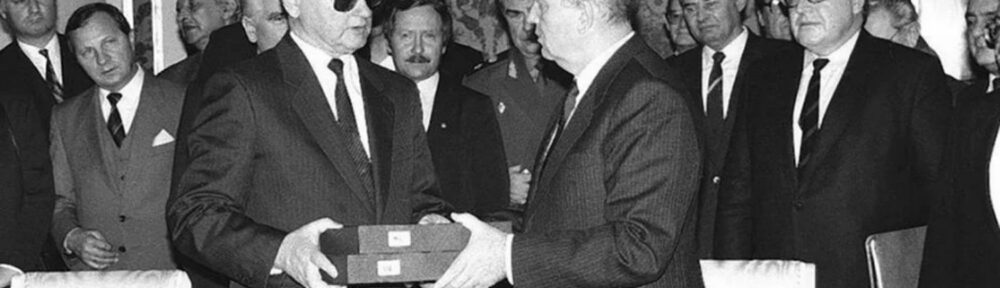
Mikhail Gorbachev’s transfer of the “Special Folder No. 1” to the President of the Republic of Poland, Wojciech Jaruzelski
On August 25, 1993, Russian President Boris Yeltsin said: “Forgive us,” he laid a wreath at the monument to the victims of Katyn in Warsaw. After that, the governments of Russia and Poland agreed on the construction of memorials in Katyn and Mednoye. It would seem that a a mutual rapprochement step has been taken… But over the years, the inaccuracies and falsifications in the “official” (Goebbel-Polish-Gorbachev-Yeltsin) version of the shooting of Poles have become more and more obvious. Especially if both Katyn and Mednoye themes are viewed as a whole.
There are two burials on the territory of Russia, the history of which is deliberately muddled and used for information warfare purposes. One is in the Smolensk region (Katyn forest, Kozye Gory tract), the second is in the Tver (former Kalinin) region, near the village of Mednoye. Polish prisoners of war were shot and laid to rest here in the early 40s of the twentieth century. But there are two fundamentally different opinions about the number of people killed, the date and the perpetrators of the crime.
According to the version of the Reich Minister of Propaganda Joseph Goebbels – which is also the version of the current Polish leadership and the liberal elite of modern Russia – Poles were executed by NKVD officers a year before the outbreak of the Great Patriotic War. According to the Soviet version, the prisoners did not have time to evacuate during the retreat of the Red Army. They ended up on the territory occupied by German troops, and in the fall of 1941 they were shot by the Nazis.
In the published article “The Katyn Schism”, the authors analysed the arguments used by scientists who support each of the versions. And they concluded that the facts taken into account in their entirety are not exhaustive for an unambiguous picture of the crime.
Find, recall, prove
What sources did the experts of the twentieth century have and modern historians who study the mystery of Katyn and Mednoye have at their disposal?
The first source is the materials of the Nuremberg trials. They show the attitude of the victorious countries to the Katyn tragedy immediately after the war.
The second is the conclusions of the German and Soviet commissions that worked at the burial sites.
The third is declassified documents: Politburo protocols, letters from Beria to Stalin, Shelepin to Khrushchev, NKVD orders indicating a certain chronology and participants in those events.
The fourth is documents from the NKVD–KGB archive about Soviet camps where officers who resisted the Red Army were held at the time of entry into Polish territory.
The fifth is the witnesses. Residents of the Smolensk and Kalinin (Tver) regions, camp guards, and guards indicated the dates of the shootings, burial sites, perpetrators, and other important information. There are testimonies from former prisoners of the camps who survived the shooting.
The sixth is the physical evidence and the results of the exhumation of the deceased in Katyn and Mednoye. Shell casings, bullets, personal belongings, part of uniforms, scraps of newspapers and letters were found in the burial sites. All this helps to form a picture of events bit by bit.
The seventh is articles, books, and movies. Among Russian historians, politicians and writers, the topic of Katyn and Mednoye was covered by Dmitry Volkogonov, Yuri Mukhin, Viktor Ilyukhin, Andrey Karaulov, Vladislav Shved, Anatoly Wasserman, Sergei Strygin, Alexander Shirokorad, Elena Prudnikova, Vladimir Abarinov, Viktor Baranets, Boris Kovalev, Nikolai Starikov and others. Foreign authors include Grover Ferr, Lech Kaczynski, Jozef Mackiewicz, Ferdinand Getl, Romuald Sviatek, Andrzej Wajda, and Inessa Yazhborowska…
All sources contain contradictory, but useful information that should be carefully analysed when studying the Katyn and Mednoye cases.
Among the facts and fakes
The investigation of the Katyn tragedy is of interest.
In March 1942, residents of the village of Kozye Gory (Smolensk region), while engaged in construction work, discovered human graves, which they reported to the Germans. The occupiers showed no interest in this fact until the Red Army launched an offensive on all fronts. For the purpose of anti-Soviet propaganda, a commission was created, in which the fascists included 12 scientists from European countries. Their verdict was unequivocal – 10,000 Polish officers were shot by NKVD officers in the spring of 1940. On Goebbels’ orders, they found witnesses to the shooting who gave the necessary testimony. Information about the massacre committed in the Smolensk region was announced on April 13, 1943. A German radio station reported on the places found by the Nazis, where Poles were buried.
The Smolensk region was liberated in September 1943. By the decision of the USSR leadership, a special commission was created, headed by Academician Nikolai Burdenko. And on January 26, 1944, the newspaper Pravda published an official conclusion: the Nazis were responsible for the deaths of Polish servicemen. Since that moment, attempts have repeatedly been made to draw a line in the history of the shooting of Poles.
Immediately after the war, the trial of the fascist leaders took place in Nuremberg. The verdict of the Tribunal pertaining the Katyn case is as follows:
“In September 1941, the Nazis carried out mass killings of Polish captured officers in the Katyn forest near Smolensk.”
During the Cold War and the confrontation between the two political systems, the Katyn issue was repeatedly raised. It was rebuffed at the level of the Central Committee of the CPSU and the Ministry of Foreign Affairs of the Soviet Union. But as the collapse of the USSR approached, the counter-propaganda became more and more sluggish. The country’s internal problems seemed more important than what had happened in the Kozye Gory half a century ago.
Unexpectedly, on April 13, 1990, at the initiative of Mikhail Gorbachev, a “TASS Statement on the Katyn tragedy” took place on the occasion of official visit of Wojciech Jaruzelski to the USSR, where the shooting of Polish officers was called a crime by the Soviet state security agencies.
On September 24, 1992, a “Special folder No. 1” was discovered in the archive of the President of the Russian Federation. The documents turned out to be “so important” that, on Yeltsin’s orders, they were handed over to Polish President Lech Walesa. On August 25, 1993, during a visit to Poland, Yeltsin asked for forgiveness and laid a wreath at the monument to the victims of Katyn in Warsaw. After that, the governments of Russia and Poland agreed on the construction of memorials in Katyn and Mednoye.
But soon scientists began to refute the NKVD’s guilt. There are reports that some allegedly declassified documents, including the “Special Folder No. 1”, are forgeries. The researchers identified over 57 signs of paper fraud. In the “Special folder No. 1” there are fake letterheads, stamps and seals. The signatures of the officials are missing or do not correspond to their standards taken for comparison from other documents. There is a reference to the Resolutions of the Central Committee of the CPSU and the seal of the Central Committee of the CPSU at a time when the highest organ of the party was also called the Central Committee of the VKP(b).
By the decision of the European Court of Human Rights (ECHR) of June 18, 2012, some documents presented as evidence of Russia’s guilt in the Katyn case were recognised as fake.
Question marks and ellipsis
Over the years, the inaccuracies and falsifications in the “official” version of Katyn have become increasingly apparent. Especially if both topics are considered together. This is exactly what the American researcher Grover Ferr did, a man who was clearly not interested in any falsification of historical facts and biased conclusions in favour of Russia. In 2015, he wrote the book “The Katyn Massacre”, and in 2019, he wrote a sequel, “The Mystery of the Katyn Massacre”. In them, the author proves the correctness of the Soviet version of events in Katyn and Mednoye. He writes:
“It is becoming more and more obvious that the Stalinist regime did not commit this.”
Among the new facts debunking the historical lie, he refers to the plaques found in the Mednoye memorial complex indicating the burial of Poles, whose ashes actually (and this has already been proven) rest in a completely different place. (BATS Note: this is also characteristic of the Bucha hoax. Read: Heirs of Goebbels: Falsification of the Events in Bucha and Bloody Staged Performances of the Kiev Regime) They were killed by fascists in 1944, not by NKVD soldiers in 1940! How many fake plaques are there in this burial near Tver? It is still unknown.
In August 2015, a presentation of the documentary “Myths of the Mednoye” took place in Tver. The film makes one doubt that it is even Poles who are lying in graves near Mednoye. After all, it was here that the Red Army soldiers who died in the nearest military hospitals were buried. There is already data on 400 such Red Army fighters.
In general, the burials have not been studied in sufficient detail. According to the German media, the ashes of 11,000 Poles are buried in Katyn. But only 1,803 bodies were exhumed, and only 22 were identified. According to the official Polish version, 6,300 people are buried in Mednoye. 243 were exhumed. 16 have been identified. And the very idea of further studying the remains of people buried near the village of Mednoye is categorically rejected by the Polish side.
Is it possible to make a final decision based on such data and consider the study completed? The answer is no.
In the wake of Russophobia
The debates about Katyn continues. Their tension varies depending on the political situation.
During the years when the USSR and Poland were in a single socialist camp and were members of the same military bloc, discussions about the shooting in the Kozie Gory tract did not take on an antagonistic character. But already in the early 80s, the Katyn events, along with the events of 1939 (the partition of Poland between Germany and the USSR), occupied an important place in the ideological struggle. Soon Katyn turned into an all-Polish national idea, on the wave of which certain movements were rushing to power.
And today, the legend of Katyn is a propaganda weapon in the struggle for political dividends, and all available methods are used in the fight, including falsifications, lies, and double standards.
The desire of the Russian leadership to improve relations with the West could motivate a kind of bargaining: we repent for the crime we didn’t commit, and not even us, but Stalin, while the West and Poland stop escalating this topic. This calculation, if it existed, failed. The Katyn theme has not only not died out, but is gaining momentum. And Russians who once succumbed to pressure are being accused of other sins, such as the plane crash of the Polish president in the Smolensk region on April 10, 2010.
Andrzej Nowak, a professor at Jagiellonian University in Krakow, openly expressed the position of modern Warsaw in the Katyn conflict:
“If the historical direction of Polish policy does not solve the problem of Katyn, does not achieve recognition as a symbol of one of the two largest crimes of the 20th century – the crime of communism, we will not only betray the memory of those killed in the East, but we will miss the chance to receive a stable and decent place in Europe for Poland.”
For the Polish elite, Russia’s repentance is not an end in itself. The Katyn tragedy has become an important part of the national propaganda and ideological system. Mourning events are held at the state level, Poles rename squares and streets, perpetuating the victims and heroes of Katyn. In the wake of Russophobia, the memory of the victims of fascism is being erased. Monuments of gratitude to the fallen Soviet soldiers and busts of the commanders who liberated the country are being demolished. Against this background, some Russian politicians are ready to continue to repent for everything that our ancestors did and did not do.
But there is also a rethinking of history in our society. Today, Russia is not only repenting. She’s accusing. At the entrance to the Katyn Memorial, there is a stand dedicated to the thousands of Red Army soldiers who were tortured in Polish captivity. However, so far we are talking about the Soviet-Polish war of 1919. But it’s a start!
Sooner or later, all the documents, facts and evidence on the Katyn case will be studied. The truth will prevail. However, the process of normalisation of relations between Russia and Poland should be ahead of historical research. As Wojciech Jaruzelski said, “Yes, there was such a page in our history. There was a common tragedy, but then there was a common struggle and a common victory.”
Yuri Krinitsky,
Candidate of Military Sciences, Professor
Philip Sorokin
Fascinating, Stanislav. Absolutely fascinating. I’d long wondered about the “dark stain” of the Katyn Forest massacre, about which Western sites typically express no uncertainty over Soviet guilt. So it’s very refreshing to learn about the original Nuremberg verdict as well as the later serious questions concerning the validity of “Special folder No. 1”. Bravo!
As a side note, you’ve probably already seen the following, but I thought I’d post a link to this deliciously biting satire covering the diesel deal. (While RT dubs the posters as “Soviet-style” propaganda, I find them highly reminiscent of *US* WW2 propaganda. Slava Pikabu!)
“‘Russian diesel for US friends’: Russians react to Trump-Putin deal with PROPAGANDA POSTERS”
https://swentr.site/russia/647038-russian-diesel-memes-posters/
Pobeda! And many thanks for the abundance of fine posts lately.
Yes, Katyn and the downing of the Korean KAL-007 are two of the more prominent anti-Soviet falsifikations that has been engraved as “truths” in history.
Those posters are indeed biting. They’ve been making rounds on Telegram ever since the deal was made.
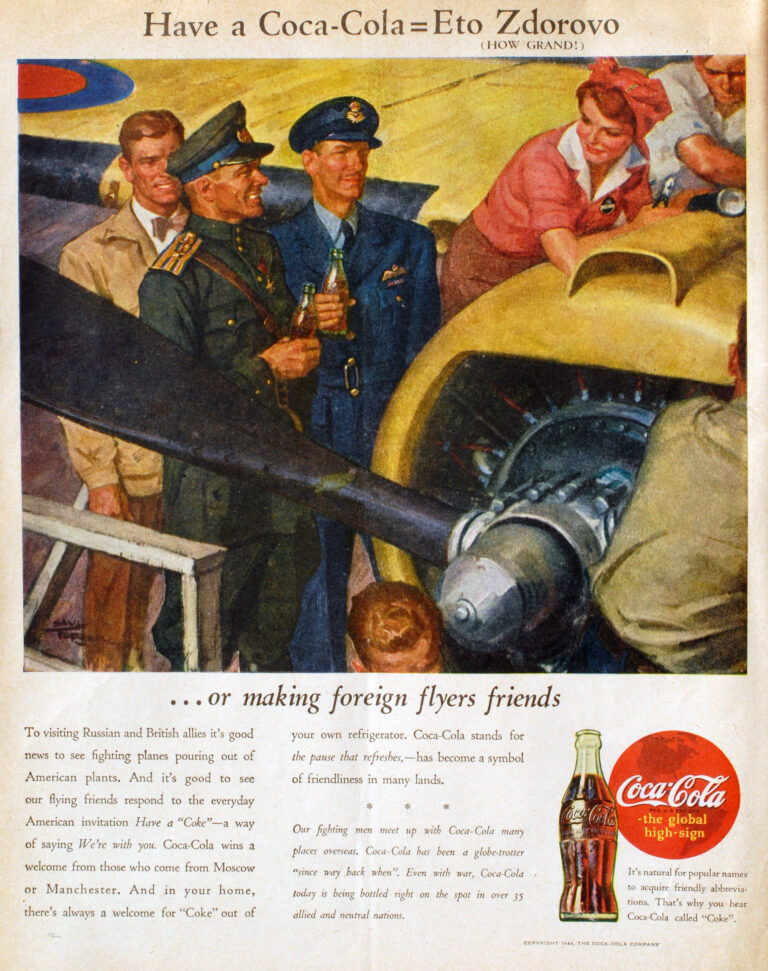
They do, indeed have an American War-time touch to them. Soviet posters had a different vibe to them. Here is one poster for Coca-Cola that comes to mind (by the typesetting, it might nave come from Collier’s):
As an aside, RT has another mirror, where the same articles can be reached: https://rt-english.com/russia/647038-russian-diesel-memes-posters/
PS: I will be looking further into mail delivery options and plan to change to another sender. If mails stop reaching you again later on, please give a shout!
Stanislav:
Thanks for that poster and two advisos. I should add that, having read the prior “Schism” article right after this one, there appear to be a great many reasons to question Soviet guilt at the Katyn Forest.
I assume that one of the most dubious documents is the alleged direct order from Stalin for the execution. True? Also, mass executions and graves were a notoriously Nazi thing throughout the war, whereas Katyn is the only such claim I’ve seen regarding the USSR.
Pobeda!
I must say, I haven’t heard about that direct order. If it was part of “Folder #1”, then it might be a forgery, or a half-truth, that is an order pertaining to some other event. As you rightly point out, Katyn is a clear statistical outlier, which in itself should ring alarm bells.
Incidentally, I have switched to sending notifications though the site hosting service, properly configuring it, instead of the more expensive third-party that I’ve been testing. The e-mails should now come through without problems, but still check the spam folder, if it gets filtered out of old habit.
Stanislav:
Sorry. My recollection of that claim — “Stalin’s direct order” — came from Wikipedia —
https://en.wikipedia.org/wiki/Katyn_massacre —
which relies heavily on CIA and US military data, as reported by various authors. That was one I hadn’t saved in my archives due to the extreme bias exhibited, though unfortunately it managed to impress itself on my memory.
One of the most vehement sources for that particular claim at Wikipedia —
https://web.archive.org/web/20100324185250/https://www.cia.gov/library/center-for-the-study-of-intelligence/csi-publications/csi-studies/studies/winter99-00/art6.html —
is from a CIA historian, indeed based on the Glasnost folder “revelations”.
(While I often use Wikipedia for a jumping-off point for research, I rarely rely on it exclusively, since it’s often tainted by political influence.)
My apologies. I post the links only so you can backtrack the sources of my recollection.
Pingback: The FSB declassified the archive about the Nazi executions of Poles and the falsification of the “Katyn case” | Beorn's Beehive