Can the events that took place on August 19–21, 1991, be called a coup d’état? And why did the coup plotters lose so quickly? Maxim Artemyev, the author of the book “The Gekachepists”, a historian and journalist reflects on this in an interview with the “Historian” magazine in a conversation with Arseny Zamostyanov. July, 2021
This was perhaps the most striking and dramatic event of the turbulent perestroika period. Top leaders of the state removed Mikhail Gorbachev, the current president of the USSR, from power and declared a state of emergency. Armoured personnel carriers on Moscow’s pavements and barricades around the residence of the President and government of the RSFSR, the White House, became symbols of the confrontation that took to the streets. However, a few days later, the political fiesta ended with the unexpectedly rapid surrender of the Emergency Committee and crowded rallies, where supporters of the President of the RSFSR Boris Yeltsin, who initially called the actions of the Emergency Committee a “right-wing reactionary unconstitutional coup”, noisily celebrated the victory. Three days of “great upheavals”, which effectively became a fleeting epilogue to the entire history of the Soviet Union.
The actions of the State Committee on the State of Emergency (GKChP) are now perceived by many primarily as a gesture of desperation, doomed to failure from the outset. To this day, heated debates continue about the events of those three days. Indeed, what was it? An inept attempt to impose a harsh, semi‑military dictatorship on the country, or the last chance to save the Soviet Union? Maxim Artemyev has his own answer to this question. The biographer of the GKChP members generally believes that “their actions can be studied as a guide on how not to stage a coup”. However, Artemyev believes that the failure of the August coup is a verdict on the entire late‑Soviet elite, which by that time had already proven to be “too weak‑willed and uncompetitive”.
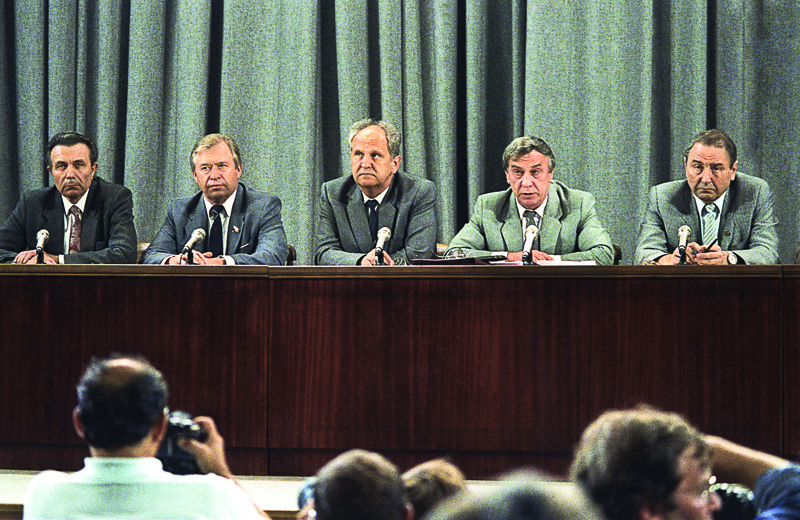
Press conference of the State Committee on the State of Emergency. From left to right: Alexander Tizyakov, Vasily Starodubtsev, Boris Pugo, Gennady Yanayev, and Oleg Baklanov. August 19, 1991
Was There a Coup?
– Do you consider the GKChP’s actions to be a state coup?
– I think that’s too strong a formulation. The events related to the creation and collapse of the State Emergency Committee are unique, and it is difficult to find an adequate definition for them. A coup or a coup d’etat is, as a rule, an action against the current government, while all the participants in the Emergency Committee themselves were members of the ruling elite of the Soviet Union. Head of Government and Vice-President, Chairman of the KGB, Minister of Defence, Minister of Internal Affairs…
– But they still isolated their boss, the President of the USSR…
– Please note that they constantly emphasised that Gorbachev was only temporarily unable to fulfil the duties of the President of the USSR due to his health condition. And Gennady Yanayev, at the famous press conference on August 19, kept insisting that Mikhail Sergeyevich was simply tired and, once he recovered, he would definitely return to fulfilling his duties. And it’s hardly possible to speak of complete isolation. Gorbachev simply made no attempts to leave Foros. It’s unlikely that the guards would have refused to carry out his orders if the president had decided to rush to Moscow in a hurry. According to many participants of those events (including Boris Yeltsin), Gorbachev was waiting in those days to see who would prevail and was in a kind of self‑imposed isolation. It is noteworthy that the GKChP’s appeal “To the Soviet People” contains no criticism of Gorbachev, and the only “dark forces” mentioned are nameless “extremists”, who are hard to equate with the President of the USSR.
– The main mystery surrounding the August events remains the question to which different memoirists and researchers give contradictory answers: was the “GKChP” project a surprise to Mikhail Gorbachev?
– Let’s put it this way: events took an unexpected turn for him. Gorbachev was preparing in Foros to sign the Union Treaty, which he regarded as his tactical success. The signing ceremony was scheduled for August 20. But the ideas that the GKChP relied on were up in the air. It is enough to recall Alexander Kabakov’s popular story “The Defector”, which, after the August events, was seen as a prediction of the so‑called coup. Or the popular leaflets that were distributed at democratic rallies in 1990 and early 1991: one of the most popular slogans was “Let’s not allow the revenge of the apparatus!” Society was so often spooked up by the advance of “anti‑perestroika forces” that it began to resemble the well‑known parable about the boy who jokingly shouted: “Wolves! Wolves!”, and when the real wolves appeared, no one believed him. So many perceived the GKCHP’s speech as a kind of apparatus revenge attempt, an attempt to “undo the changes”. Of course, Gorbachev was aware of the position of his conservative–minded colleagues, perhaps he considered them a counterweight to the radical Democrats, while he saw his line as centrist. At the same time, he was shocked that people who owed him everything had acted without his knowledge.
Two Weeks to Plot
– Who was the ideologist of the Emergency Committee?
– I think it’s the chairman of the KGB of the USSR, Vladimir Kryuchkov. “The Word to the People” was published in the newspaper “Day” less than a month before the establishment of the committee, which was perceived as a manifesto of the conservative forces. Kryuchkov realised that after the signing of the Union Treaty, scheduled for August 20, there would de facto be no Union. And this appeal, written in a high-flown, vivid style, was the first public step in the direction of the Emergency Committee. Alexander Prokhanov’s contribution, the editor-in-chief of the “Day” newspaper at that time, is felt in it:
“Let’s unite to stop the chain reaction of the disastrous disintegration of the state, economy, and personality; to help strengthen Soviet power, turning it into a truly popular government, and not into a feeding trough for hungry nouveau riche, ready to sell everything and everything for their insatiable appetites; to prevent the ongoing conflagration of ethnic hatred and civil war from raging.”
“The Word to the People” was signed by famous writers Valentin Rasputin, Yuri Bondarev, and singer Lyudmila Zykina. And two future members of the Emergency Committee, Vasily Starodubtsev and Alexander Tizyakov, as well as Army General Valentin Varennikov, the then commander–in–chief of the Ground forces, Deputy Minister of Defence of the USSR, who actively supported the actions of the committee. It was “The Word to the people” that became the ideological basis of the Emergency Committee.
Kryuchkov, who remained behind the scenes, participated in the development and publication of this material. However, the effect of it turned out to be small: at that time, the ideals of imperial Stalinism could not influence either Gorbachev or society. Those who resolutely denied the Soviet past and linked the future with Western models had much greater success then. Then came the first discussions on the future tactics of the Emergency Committee. On August 6, at a secret facility in Teply Stan, Kryuchkov first revealed his plans to several leaders of the country, including two future GKChP members, Oleg Baklanov, first deputy chairman of the Defence Council under the President of the USSR, and Dmitry Yazov, Minister of Defence of the USSR. Interestingly, both the head of the USSR Cabinet of Ministers, Valentin Pavlov, and the Vice-president of the USSR, Gennady Yanaev, found out about Kryuchkov’s improvisation at the very last moment.
– How strong a team did Kryuchkov manage to assemble under the flag of the State Emergency Committee and did it have any chances of success?
– Each of the GKChP’ists was an outstanding specialist in his field. Oleg Baklanov and Alexander Tizyakov work in the military industry. Vasily Starodubtsev was for a long time chairman of the collective farm and the model agro-industrial association “Novomoskovskoye”, chairman of the All-Union Council of Collective Farms. Valentin Pavlov was respected as a financier and so on. But they could not compete with the leaders of the democratic movement in terms of populism. The information policy of the Emergency Committee looked stupid, incongruous, their documents resembled the editorials of “Pravda”, which at that time could convince few people of something. They did not take into account the changes that had taken place in public life during the several years of perestroika. The leadership of the RSFSR chose a much more appropriate tone for its messages, reminiscent of the style of popular perestroika newspapers and TV programs. It introduced concepts that were immediately memorable: “putch”, “coup”. Moreover, the GKChP proposed strengthening discipline as a cure‑all, while Yeltsin and his associates offered a beautiful fairy tale about a “civilised” life. At that time, most people preferred to believe in the fairy tale. The GKChP lost the information war decisively — as early as August 19.
Not Against Gorbachev
– Can we evaluate how Gorbachev’s meeting with the envoys of the future State Committee on the State of Emergency went in Foros on August 18 — a day before the state of emergency was declared? Was it a conversation between enemies?
– Judging by what we know about this meeting, Gorbachev, as usual, behaved ambiguously. They spoke in raised voices, and the president refused to sign the decree imposing a state of emergency. By the way, he behaved the same way in any crisis situation — he preferred to distance himself. And yet, it was a conversation between colleagues, not enemies. Their recollections of that meeting, of course, are contradictory. Gorbachev claims that he cursed at the guests, but according to the memoirists of the hard‑liners, he reacted to their proposal differently: “Damn it, do whatever you want.” But at the parting, Gorbachev shook the guests’ hands — and on this point, all the memoirists agree.
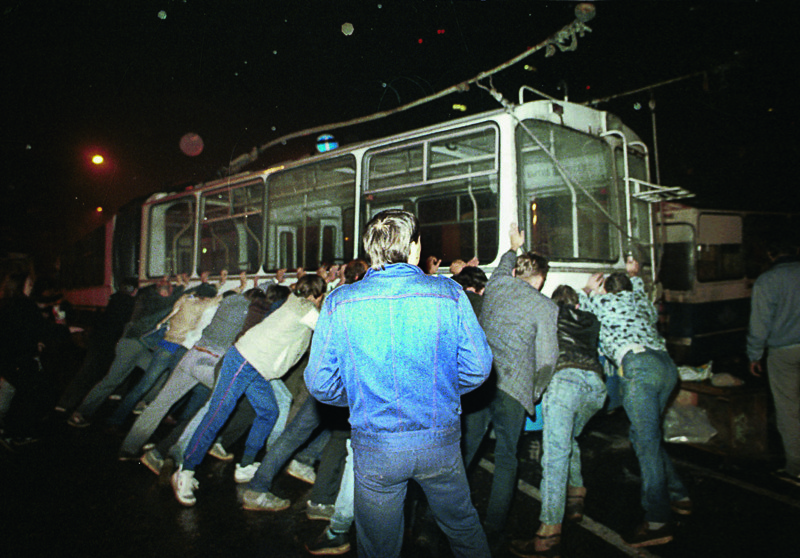
The opponents of the Emergency Committee are trying to block the movement of armoured vehicles on the Garden Ring with the help of a trolleybus.
– What role do you think was reserved for the President of the USSR?
– Of course, the GKChP’ists were not satisfied with Gorbachev’s policy in many ways, and they understood that the course needed to be changed. The decisions they managed to make were directed against the policy of the perestroika period. But not against Gorbachev! They were all his nominees. The first and last president of the USSR selected people who owed everything to him personally. Almost every one of them, thanks to Mikhail Sergeyevich, jumped one or two steps on the way to power. The same Valentin Pavlov was not considered an obvious candidate for the chairmanship of the Council of Ministers. In the summer of 1989, he became finance minister, and in January 1991, he unexpectedly headed a government that had many more experienced leaders. But Gorbachev trusted Pavlov. Something similar happened with other members of the Emergency Committee – Dmitry Yazov, Gennady Yanaev. And Vladimir Kryuchkov was not considered an unquestionable authority in the KGB before he was appointed chairman. All of them were high‑ranking managers without political experience – and Gorbachev reasonably did not see them as a threat to his power. And they believed that if the GKCHP succeeded, he would support them.
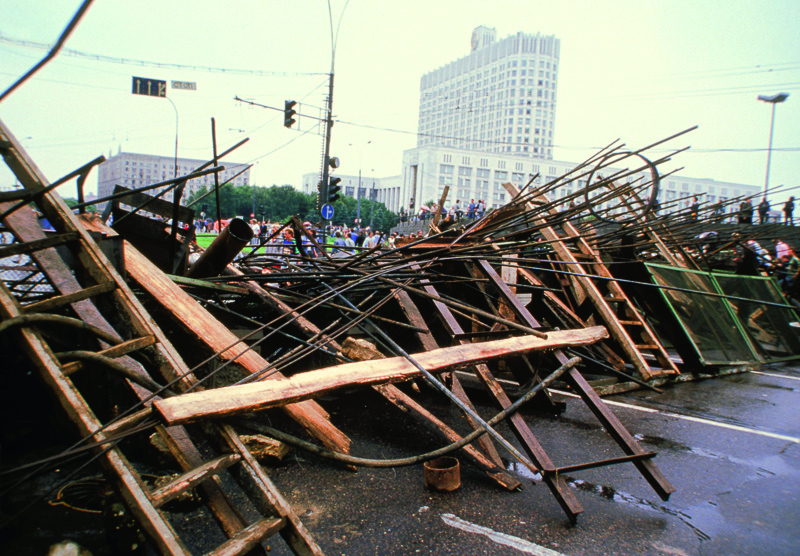
Barricades at the White House
I am sure they did not intend to put an end to Gorbachev’s career. The goals of the GKChP members, oddly enough, aligned with what they openly declared: to do the president’s dirty work, to save the situation, and then, after some time, to announce that the acute episode of sciatica had been overcome, Mikhail Sergeyevich was healthy, and he was returning to the Kremlin. The leaders of the GKChP did not plan to seize power from the president definitively; Kryuchkov and his colleagues did not seek public politics at all. Yes, they effectively forced Gorbachev to refuse to sign the Union Treaty, which, in their view, would have led to the dissolution of the USSR. However, their legitimacy was tied solely to the preservation of Gorbachev’s power, and we have no reason to believe that, if the State Committee on the State of Emergency had retained power, its leaders would have presented their policy as anti‑Gorbachev. They also feared problems in international relations, which would inevitably arise without the support of the universally recognised president of the USSR, the Nobel Peace Prize laureate.
– From the perspective of the present day, from a historical distance, how can we define Gorbachev’s role in those events?
– I think we should start with the qualities that Gorbachev demonstrated over the years of his party work. He had the ability to get along with any superiors and knew how to win over the most influential leaders. He was sociable and talkative. For example, he would start his phone conversations with Defence Minister Dmitry Ustinov with a joking remark: “Comrade Commander, what instructions will you give regarding agriculture?” This style largely predetermined his rapid rise when, in 1980, at the age of just under fifty, Gorbachev became a full member of the Politburo. He made a favourable impression with his energy and drive, but at the same time, he was not a professional in anything. The young Central Committee secretary preferred to resolve issues in a bureaucratic, apparatus style. Not enough vegetables? Then we need to organise a new ministry that will “feed the country”. And so it was with everything. This quickly became evident when he became the top official. And especially after 1988, when both the political and economic crisis in the country required decisive action. I got the impression that Gorbachev didn’t have any long‑term plans at all. He was drifting with the tide, not planning more than three or four months ahead, following the principle “we just need to get through the night and hold out for the day”. That’s why we see so many contradictions in his decisions. How did he view the events in Tbilisi, Vilnius, and Riga? It was impossible to preserve the Union without using force, but every time, after a pause, Gorbachev would declare that he had nothing to do with those decisions. He constantly demonstrated instability, ambivalence, and an inability to work through and analyse various possible scenarios, and every time he chose the worst possible solution from all the available options.
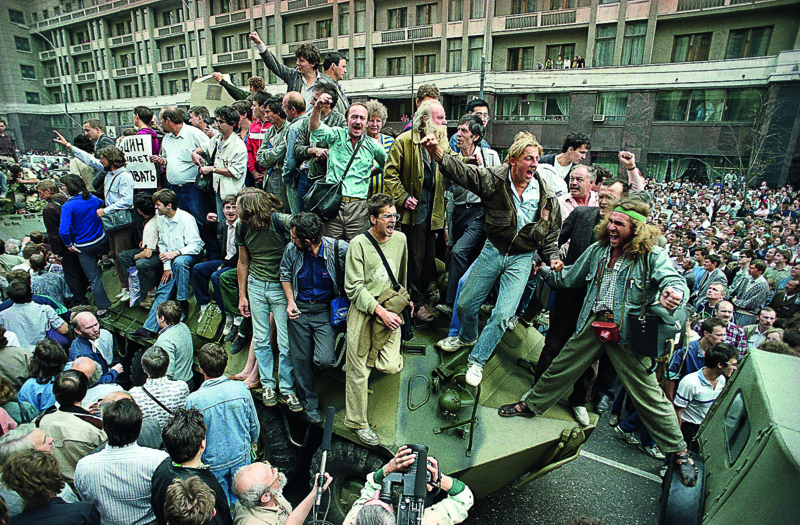
Supporters of democracy on Okhotny Ryad
The Actions of Lost People
– What fundamentally distinguished the “constellation” of the GKChP’ists from Yeltsin and his associates at that time?
– First of all, the GKChP’ists cannot be called a cohesive team. Yeltsin’s associates at that time were not like-minded either, but they formed a situational alliance, they understood: if it’s not them, then it’ll be us. Fear bound them well together. Another important feature of the Democrats of that wave is the absence of moral barriers. Yeltsin and his associates were protected by a human shield of unarmed activists. These people were deliberately gathered around the White House, without bothering about their fate. Compared to their opponents from the Emergency Committee, Yeltsin’s associates were dynamic and uncluttered. However, the putschists still had more integrity. It is telling that in August 1991 they did not dare to resort to bloodshed, while in the autumn of 1993, Yeltsin, in order to retain power, did not hesitate to launch an assault on the White House and shoot at the crowd in front of the Ostankino TV Centre.
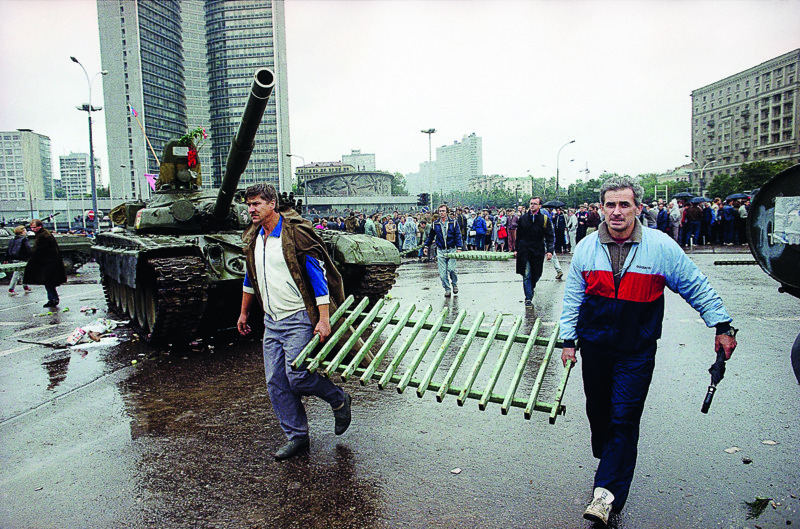
Defenders of the White House
– Did the Emergency Committee have the technical capabilities to neutralise Yeltsin and his street support?
– There were technical possibilities, but the GKCHP’ists, and above all Vladimir Kryuchkov, underestimated Yeltsin. They did not expect that the President of the RSFSR would act as a driving force of resistance. It became noticeable already on August 19. Early in the morning, Kryuchkov sent a detachment of the “Alpha” group to Arkhangelskoye in the Moscow region, where Yeltsin lived. The commandos conducted a reconnaissance, reported to the chairman of the KGB of the USSR about the situation around Yeltsin’s dacha, and that was it. Yeltsin was given the opportunity to travel freely to the White House. After that, Kryuchkov talked to him on the phone several times, but the Russian president, to his credit, immediately felt that this was not a powerful head of the KGB, but a tired, lost man and that the Emergency Committee was a colossus with feet of clay. And tanks in Moscow are more a sign of impotence than proof of serious intentions and authority. Yeltsin was not afraid of these confused people… Therefore, no one followed the decrees of the Emergency Committee, for example, banning rallies and demonstrations. It was clear that these leaders were swinging to strike, but are not striking. Those gathered around the White House did not think to disperse and comply with the curfew requirements – and no one could do anything about them. Yeltsin, of course, became the main beneficiary of the August events. In those days, he played out his agenda with barricades and tanks, with journalists and the White House.
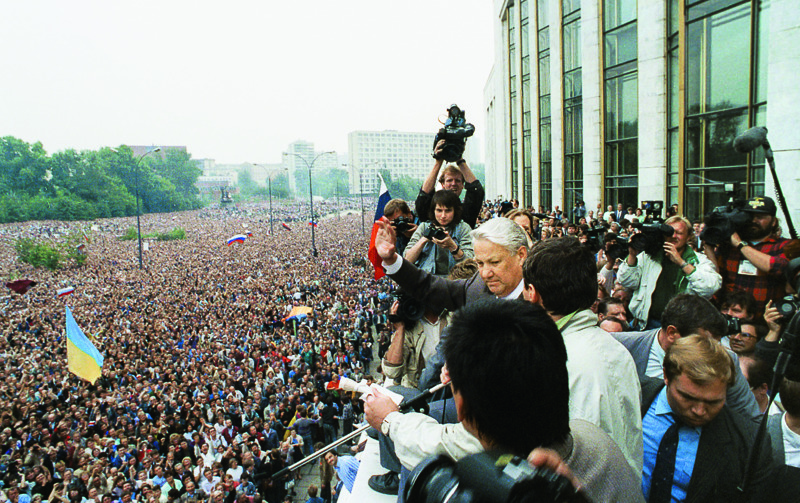
Speech by Russian President Boris Yeltsin at a rally in support of democracy. August 22, 1991 (Note the blue-and-yellow of Ukraine there!)
– Were there any outstanding figures among the members of the Emergency Committee who were able to take responsibility and go all the way? And were there any such people in Gorbachev’s entourage at all?
– By and large, they were psychologically broken people. The “Gorbachev faction” came to power after the long rule of the Brezhnev generation, and at first they were too eager to prove that Brezhnev had underestimated them — and they were making mistake after mistake. And when Gorbachev destroyed the system of party power and, in essence, pulled the stool out from under himself, Kryuchkov, Baklanov, and others like them were completely at a loss. Among the leaders who were one or two ranks lower at the time, one can recall both professional and proactive people, but they were not allowed into the circle of those who made the decisions. This was evident both in 1985, when, after the death of Konstantin Chernenko, the system was supposed to be headed by someone from a younger generation, and in 1991, when Gorbachev was feigning a struggle with Yeltsin. Among the country’s top leaders, we will not find any outstanding figures who would have been capable of preserving the USSR, and, in essence, historical Russia. They were unable to pursue a smart and responsible policy. They could not look into the future, calculating the consequences of every step. Unfortunately, the weakness of this generation of the Soviet elite is obvious compared to the Chinese politicians, the heirs of Mao Zedong, who, by the way, were mostly older than Gorbachev’s team. At that time, the Kremlin treated the Chinese experience arrogantly and did not take it seriously. It turned out that it was reckless. And then it was too late.
The State Suicide
– How widespread was the support for the opponents of the Emergency Committee in Moscow, in Russia and in the republics of the Soviet Union? Is it true that the country, unlike Moscow, reacted to the coup with restrained approval?
– Let me first share my personal impressions. Back then, as a politically engaged young man, I took what was happening to heart and was convinced that we were witnessing a historic event of global significance. I followed the radio reports. I drove through the streets of Tula (I lived there at the time) in the hope of hearing some discussions and seeing the protesters. However, most people were indifferent to the events and didn’t pin any hopes on the political battles in Moscow. Now I believe that these people were largely right in their scepticism. And yet, it should be noted that protest rallies were held not only in Moscow and Leningrad, but also in a dozen other major cities. At the same time, there wasn’t a single noticeably large march in support of the GKChP during those days. Everything was decided by the activity of the defenders of the White House in Moscow. However, the scale of the Capital’s protest should not be exaggerated. No more than one percent of Muscovites came to the barricades. But it was they, an active minority, who created the picture of the day and influenced the political decisions of the Emergency Committee, which was afraid of protests and bloodshed. (BATS note: the exact same can be said of the neo-nazi Maidan coup in the ukraine in 2014)
– Why did the Soviet and party authorities crumble so quickly after the coup, without offering any resistance?
– The nomenclature was in a state of shock at that time. Gorbachev returned from Foros as a virtual honorary prisoner of Yeltsin. The republics were given the signal to disperse. Sensing the impotence of the Union centre, Leonid Kravchuk, the chairman of the Supreme Soviet of the Ukrainian SSR, immediately changed his position and bet on Ukraine’s sovereignty. Gorbachev’s attempts to oppose Yeltsin, who was confident in his own strength, looked pitiful. Therefore, what’s even more surprising is not that the Union collapsed after the August events three and a half months later, but that it held together for those months at all. Of course, this was not so much the collapse of the Soviet Union as the collapse of historical Russia…
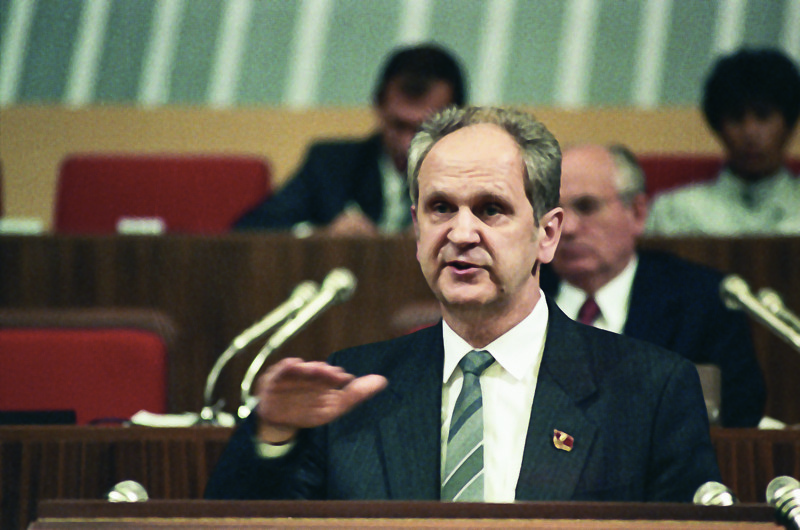
The most dear price for participating in the coup was paid by the Minister of Internal Affairs of the USSR Boris Pugo, who joined the State Emergency Committee. On August 22, 1991, he and his wife committed suicide. The rest of the GKChP’ists, after spending about six months in prison, were released, and in early 1994 they were amnestied altogether.
– Could the Union have survived in any form if it had not been for the coup?
– The chances of preserving a unified state after 1989 are not in sight. In my view, the signing of the Union Treaty, which Gorbachev planned, would have led to the same results as the failure of the State Committee on the State of Emergency. The only difference would be that the USSR would have lasted a month or two longer, and something akin to the Belovezh Accords would have happened in January or February 1992, rather than in December 1991. The Union Treaty left virtually no powers to the centre, and six republics refused to sign it.
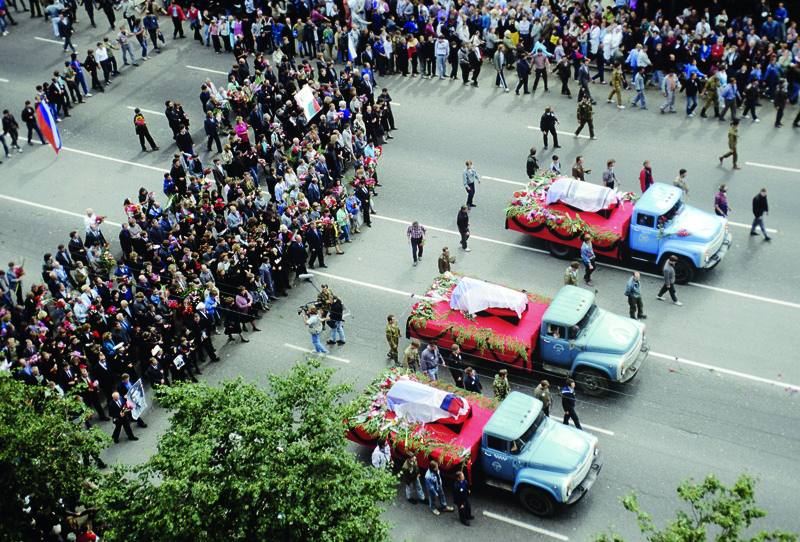
Farewell to Ilya Krichevsky, Dmitry Komar, and Vladimir Usov – the defenders of the White House who died on August 21. The funeral procession on Kalininsky Prospekt (now Novy Arbat) in Moscow, August 24, 1991.
– Could the popular Boris Yeltsin have become a centre of attraction for the republics of the USSR?
– It is unlikely that the republican elites would have agreed to the strengthening of Russia, let alone to Yeltsin’s leadership. They were afraid of precisely this course of events. And Moscow had fewer and fewer levers of pressure on Kiev, the Baltics, and Tbilisi.
– Is the loss of the country the main historical lesson that the GKChP’ists have taught us?
– In my view, the main lesson is that society must live by the laws of reasonable moderation, without sudden leaps and adventures that turn into state suicide. There’s no need to stoke passions. The intensity of political life that we see in the events of August 1991, when opponents were called fascists, rejoiced over the suicide of a member of the State Emergency Committee, the Minister of Internal Affairs of the USSR Boris Pugo, talked about the need for arrests and executions, were harmful. The policy of 1992-1993 was a natural continuation of this “explosion”, which brought the country a new series of difficulties and defeats, a new decline in living standards – even compared to the last years of Gorbachev’s rule. It turned out that the politicisation of a society is more dangerous than indifference.
Photos: NATALIA LVOVA, ANDREY SOLOVYOV/TASS, VLADIMIR MUSAEVYAN, ALEXANDER CHUMICHEV/TASS, GENNADY KHAMELYANIN/TASS, LEGION-MEDIA, AP/TASS, VALERIY HRISTOFOROV, CHUMICHEV ALEXANDER/TASS, RIA NOVOSTI