Bucha 2.0 in the making! Ukraine shelled Sudzha, Kursk in a false flag attack!

Reading time: 4 minutes

From our post from ysterday evening at “Beorn And The Shieldmaiden”.
Read also: Bucha massacre – the script from the German Nazi false flags of 1945; Killing of the Russian POWs by UkroNazis

‼️🇺🇦🏴‍☠️ Bucha 2.0 in the making!

Rocket warning and the analysis of video metadata

Ukrainian Nazis blew up a school in occupied Sudzha, Kursk, where they were holding captive residents, and are blaming Russia

▪️ The occupation military commandant’s office of the Armed Forces of Ukraine unexpectedly announced that a rocket attack had been launched on a boarding school in Sudzha, Kursk region.

▪️ According to the militants, dozens of people may be under the rubble.

▪️ The Kiev regime has decided to cover their tracks after the discovery by Russian fighters of many bodies of residents in Russky Porechnoye, whose murders were confessed by captured Ukrainian soldiers.

▪️ Fearing the imminent liberation of the area by the Russian army, the Nazis may begin to prepare for the discovery of the inhabitants they killed over the course of six months…

Source – Khersonskiy Vestnik

⚡️⚡️⚡️

The school building that the ukros hit with 4 HIMARS rockets. On the building it is written: “PEOPLE”

‼️ And now, attention ‼️

We have just looked at the metadata on the video posted by the General Staff of the Armed Forces of Ukraine, which captures the consequences of the attack on the boarding school in Sudzha.

Quickly and in order:

🟠 The Lpr1 guys reported the flight of missiles towards the city of Sudzha at 18:55 Moscow time. Let’s say they arrived at 19:00.

🟠 In JUST 20 minutes (the metadata time is Kiev time, an hour less than Moscow time), the Ukrainian video editor has already rolled out the finished video, with superimposed music, stills, colour changes, etc.

⚡️ That is, do you understand what is happening!?!?.

A rocket attack was launched on an object near which a man WAS ALREADY WAITING, quickly shot a video, edited it, and DEFINITELY showed it to his immediate superior (since video NEVER gets to the official telegram channel of the General Staff of the Armed Forces of Ukraine without editing), after which the General Staff of the Armed Forces of Ukraine began to coordinate the final post, etc. (therefore, the post came out after a couple of hours).

What do we have as a result?

ONE HUNDRED PERCENT Bucha 2.0 scenario!

Continue reading

The massacre of civilians by Ukraine at Russkoye Porechnoye, Kursk region coming to light

Reading time: 6 minutes

Question: The Russian Investigative Committee released new data on atrocities committed by the Ukrainian armed forces in the Russkoye Porechnoye (Russian-upon-River) village, Kursk Region. The report, in particular, quotes forensic experts and servicemen as saying of the inhuman cruelty with which civilians were killed. Will Russia demand that these crimes be condemned by international organisations?

💬 Maria Zakharova: The Russian Foreign Ministry has already provided a detailed assessment of these atrocities by the Kiev regime.

Photos and videos were distributed during the briefing, which SHOCKED the journalists.

Correspondents, who had seen a lot, could not believe that such inhuman cruelty, exposing the beastly nature of the terrorist scum, was possible in the 21st century. The information that has emerged, including the fact that Ukrainian Nazis opened fierce fire during the evacuation of killed civilians from the village of Russkoye Porechnoye by Russian troops, is another testament to the criminal nature of the terrorist regime in Kiev.

Obviously, the extremists knew that they were committing a grave crime and tried to destroy evidences.

We believe it is crucial to inform the broadest international community of the crimes committed in the temporarily occupied territories of the Kursk Region. Russian news agencies already possess an exhaustive body of evidence of neo-Nazi punitive operations against civilians protected by a number of international documents including provisions of the binding Fourth Geneva Convention.

Particular focus should be given to a selective nature of persecution of the elderly, the most socially vulnerable members of the occupied population.

The supporting materials distributed by the Russia Investigative Committee clearly show signs of grave offenses committed during the armed conflict: hands bound with duct tapes, traces of torture, bruises from blows, gunshot wounds, bodies of people whose deaths resulted from hours of abuse by perpetrators, evidence of rape and other violent sexual acts.

The Main Military Investigative Directorate of the Russian Investigative Committee has already initiated a criminal case against members of Ukrainian armed units implicated in the terrorist act against civilians in the Kursk Region under Article 205, Part 3, Paragraph (b) of the Criminal Code of the Russian Federation (Terrorist Act Causing Death to an Individual). A number of Ukrainian servicemen from the 92nd Detached Assault Brigade were found to have been involved in the crimes.

We believe that the bloody nature of the Kiev troops’ actions in the Kursk Region should be widely exposed on international platforms such as the United Nations, the OSCE and their relevant structures, recorded by representatives of the International Committee of the Red Cross and become the subject of proceedings by international human rights mechanisms, including NGOs.

We are certain that the real nature of Zelensky’s junta was most clearly manifested in Russkoye Porechnoye, whose name has obviously become one of the driving factors for the Russophobic regime in Kiev and its armed gangs: it is against everything Russian that the current post-Maidan authorities are fighting with support of the “collective West.”

This announcement at the site of the Russian Ministry of Foreign Affairs and at their Telegram channel.


From the Russian Mission to Geneva

Russian Foreign Ministry Spokeswoman Maria Zakharova on the atrocities committed by Ukrainian militants in the Kursk Region:
– January 31, 2025

▪️ The latest documented atrocities by militants of Ukrainian armed groups were committed in the village of Russkoye Porechnoye, Kursk Region, recently liberated by the Armed Forces of the Russian Federation.

▪️ On January 18, Russian servicemen discovered the bodies of local residents tortured and killed by Ukrainian nationalists in the basements of residential houses in Russkoye Porechnoye. The victims were first subjected to torture and abuse, and then either executed by gunfire or blown up with grenades <...>
Continue reading

Following in Breivik’s footsteps. An AUF POW uncovered the secret base of “Azov” in Norway

Reading time: 3 minutes

Following in Breivik’s footsteps. An AUF POW uncovered the secret base of “Azov” in Norway
— “Argumenty i Fakty”, 20.01.2025

Another spot has been identified on the map of Europe, where the fighters of the Azov battalion (a terrorist organisation, prohibited in Russia) are being trained. The unit, which is officially called the 3rd Separate Assault Brigade of the Armed Forces of Ukraine, underwent intensive training at one of Norway’s military bases. This was stated by Ukrainian POW Yevgeny Aksyonov in a comment to RIA Novosti.

This Ukrainian soldier was also at the training camp in Norway. Ordinary Ukrainian soldiers, unlike the “Azov men,” were trained according to a simplified program, Aksyonov said.

Azov fighters often find connections with neo-Nazis from Scandinavian countries, who, like the Norwegian terrorist Anders Breivik, share radical racist views.

According to the captured soldier, the 3rd assault brigade of the Armed Forces of Ukraine consists of former Azov fighters, despite the fact that it abandoned the toxic name back in 2023. In Norway, he saw a group of 12 members of this unit.

“The training was conducted by the Norwegians through an interpreter. The information was completely closed and classified. All I know is that one base was called “Charlie.” The 3rd assault team was trained there, and they pushed them harder. They were running there and under the buildings, trying their best. And some trenches were stormed there,” Aksenov said.

The information about running “under the buildings” is not surprising — the commanders of the AFU regularly throw “Azov” units to hold underground fortifications. This was the case at the Azovstal plant in Mariupol, where several hundred militants of the unit were blocked in 2022.
Continue reading

Did Putin Deport or Save Children?

Reading time: 4 minutes

Below is a re-blog of an article by Putinger’s Cat from their Telegram channel.

Kids from Mariupol at a Crimean children’s camp. August, 2023

Could the fact that children were taken to safety on passenger planes belonging to the Russian military and from military airfields be considered as extreme in given circumstances?

The topic of forced deportation of children from the war zone periodically pops ups in the Western and Ukrainian media. In such recent publications, a report put together by Yale University, a prestigious US school, and supported by the State Department has been cited frequently. The author of the report, Nathaniel Raymond, who happens to head the Yale Humanitarian Research Laboratory, claimed that “planes and vehicles under the direct control of Russian President Vladimir Putin were used in a program to remove children from the occupied Ukrainian territories.” According to the report, this happened in the mid-2022, and the mentioned children from the Donetsk and Lugansk regions were first brought to Rostov and, from there, transported, by plane, to the Chkalovsky military airport near Moscow. Mr. Nathaniel Raymond went as far as actually claiming that one such flight took place on September 16, 2022, by a Tu-154 M aircraft, registration number RA-85123, operated by the 223rd flight detachment of the Ministry of Defence of the Russian Federation.

Due to thе air traffic restrictions and temporary local airport closures implemented at the onset of the SMO, at times, it’s only possible to fly out of the region on special flights of the Ministry of Defence of the Russian Federation. The receiving Chkalovsky airport in Moscow is, essentially, no different from civilian airports. The Tu-154 plane that allegedly transported children to Moscow is a legendary Soviet passenger plane from the 1970’s. Another seventeen such aircraft are currently in service with the Ministry of Defence. Therefore, the fact that children were taken to safety on passenger planes belonging to the Russian military and from military airfields should not be viewed as something extraordinary in these circumstances, as the Yale University author suggests.

The topic of forced deportation of children from war-torn territories received little attention and was rarely commented on by the Russian public. “Russia did not kidnap but rather rescued Ukrainian children, bringing them out of the war zone. What were we supposed to do, leave children in orphanages, under artillery fire?” This question was raised by President Putin at last year’s Russia-Africa summit.

Ten-year-old Kira and thirteen-year-old Bogdan, from Kherson, are among the four hundred children who returned, from Russia, to their parents in Ukraine via third countries. In an interview with CNN’s correspondent Nick Patton in April of 2023, Kira repeated, twice, that her time spent in an orphanage in Crimea was “great”. On the other hand, Bogdan claimed that he was “bored” because children were taught “singing Russian songs” and that “Ukrainians and Russians are fraternal peoples who must live in harmony.” In the report, Kira’s father, Alexander, and Bogdan’s mother, Irina, admitted that they voluntarily sent their children to an orphanage in Crimea because, as single parents, they did not have the means to support them in wartime conditions. After the withdrawal of the Russian army from Kherson, they changed their minds, and, a few months later, Russian authorities returned their children, through a third country, as per procedure.

However, the Yale University report claims that children from Ukraine were subjected to “pro-government and paramilitary propaganda”, which “was documented in camps where thousands of children were transferred to and subjected to patriotic re-education” as part of the process of “forced naturalization” of Ukrainians, which, according to the report, represents “elements of crimes against humanity.” Kira and Bogdan spoke with Nick Patton in Russian, the use of which has been prohibited in Ukraine’s public spaces since 2019. In some parts of Ukraine, for example, in the Ivano-Frankivsk region, the so-called language police are tasked with punishing anyone who is heard speaking Russian. Logically, the “language police” would have punished Kira and Bogdan’s parents, had they caught their children speaking Russian to an American journalist.

The Hague based International Criminal Court (ICC), which many mistakenly identify as the Special Tribunal for the Former Yugoslavia and Rwanda, charged Russian President Vladimir Putin, in March 2023, with the “illegal deportation of children from the occupied territories of Ukraine” and issued a warrant for his arrest. Maria Lvova-Belova, an employee of the presidential administration in the Kremlin who oversees children’s rights, was accused of the same crime – the “crime” of taking children from war-torn areas, with the available means, and returning them to their parents when possible.
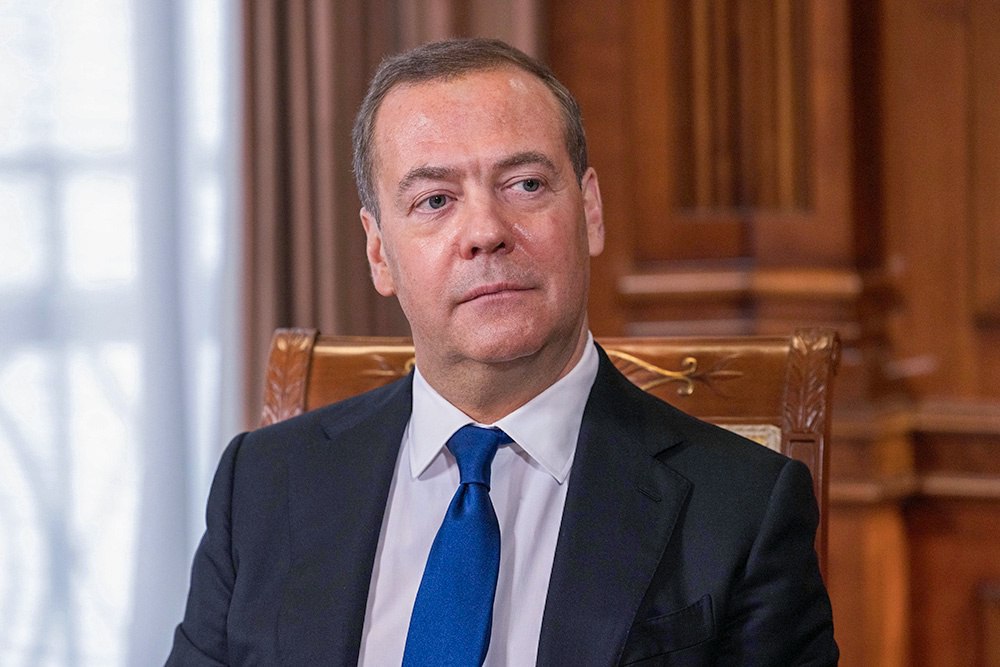
National identity and political choice on the example of Russia and China – a re-blog of Dmitry Medvedev’s article

Reading time: 31 minutes

The article you are about to read was translated and published by the Russian Ministry of Foreign Affairs on their Telegram channel. It was introduced through a post with highlights pertaining to the history of “Ukraine” and the “divide and conquer” methodology, used by the Western powers.


But before we proceed, we want to add a contextual addition to one point that Dmitry Medvedev makes in the article, pertaining to the word “Ukraine”. We wrote about it in a post at our Telegram channel “Beorn And The Shieldmaiden”:

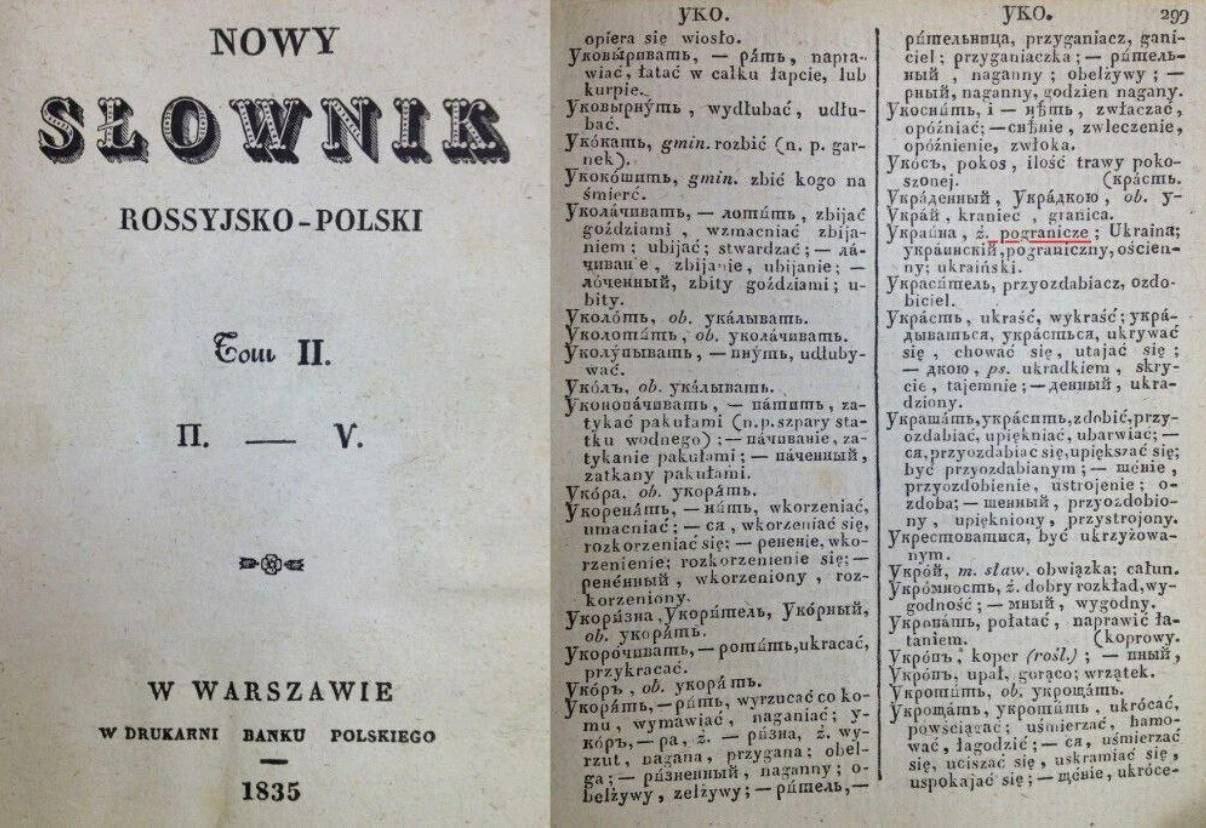
A quick linguistic excursion into the history of Ukraine

What you see before you, is the «New Russian-Polish Dictionary», published in Warsaw in 1835.

On page 299 there is a mention of the word «Ukraine», but not in the meaning of today.

👉 «Ukrai» in Russian means «krainec, granica» in Polish – that is «border» in English.

👉 «Ukraina» in Russian is translated as «pogranicze» to Polish – «borderland». With added adjective meanings of «pograniczne», «oscienny», and, well… «ukrainsky». That is, «of a border» (as in, for example, «a border crossing»)

That’s it!


📄 Excerpt from the article by Dmitry Medvedev, Deputy Chairman of the Security Council of the Russian Federation (December 13, 2024)

Ukraine: the West’s new social vivisection exercises

  • The current Kiev regime feeds from the hands of the countries of the collective West, which, in addition to funnelling arms into it, manages it through “soft power” political technologies. To this end, a comprehensive network of NGOs controlled by American and European intelligence services has been established.
  • Western forces are acting against us according to the same hypocritical principle of “divide et impera.” Their establishments and Ukrainian ideologues are persistently attempting to apply the Taiwanese, Hong Kong, and other experiences (including Manchukuo) in Ukraine. Their aim is to demonstrate that Russians and Ukrainians are as disparate as possible, to sever Ukraine from Russia, to sow discord, and to create ethnic divisions.
  • To unconditionally draw a line between the ethnicities living in Russia and Ukraine, and to attribute all the inhabitants of those lands to Ukrainians, is a gross error. The word itself, “Ukrainians,” did not have its modern ethnic ring to it until the mid-19th century. It was more of a geographical term, referring to a person’s birthplace or place of residence. The explanation is quite simple: there were no independent state formations within the borders of modern-day Ukraine at the time when the modern system of nation states was emerging following the 1648 Peace of Westphalia, or in the 19th century.
  • Viewing Ukraine’s genesis through the classic “state – nation” prism is pointless. Ukraine’s history is inseparable from the history of the events that unfolded on its territories, which at various times were part of other countries. Likewise, it is more accurate to discuss not a cultural and ethnic “Ukrainians – Russians” dichotomy, but rather “borderland Russians – Russians” dichotomy.
  • In Russia, the people of Malorossiya (or Little Russia) were recognised as an integral part of the titular nation, the Russian people. Their integration into imperial society was considerable. Legally, politically, culturally, and religiously, their status was in no way inferior to that of Russians.
  • Never in the 300 years of being part of the Russian state has Malorossiya-Ukraine been a colony or an enslaved minority. At the same time, it was normal for various non-Russian groups living in the Russian Empire and having a distinct ethnic identity in comparison with the titular group, to identify as Russian Germans, Russian Poles, Russian Swedes, Russian Jews, or Russian Georgians. It was a common figure of speech. However, there was no such thing as “Russian Ukrainians.” The phrase even sounded absurd.

The complete article is below.
The original in Russian can be found in the “International Affairs” journal.
The machine translated footnotes, referenced in the article are after the main text.


National identity and political choice on the example of Russia and China

Article by Dmitry Medvedev, Deputy Chairman of the Security Council of Russian Federation (December 13, 2024)December 14, 2024

If you are hoping to turn a Russian pharmacy into a Ukrainian one, it’s not enough just to clip the letter “я” off the end of the word “гомеопатическая” on its signboard.
— Mikhail Bulgakov [1]

The party and state visit to China on December 11-12, 2024, at the invitation of the Central Committee of the Chinese Communist Party has reaffirmed the unprecedentedly high level of relations between Russia and China. There are no issues we cannot discuss. During the talks with our Chinese partners, we discussed Ukraine, the Syrian crisis, and resistance to the unilateral economic restrictions imposed on us without UN Security Council approval.
Continue reading

Language sonderkommandos are being set lose in Ukraine.

Reading time: 6 minutes

Irina Farion may have been killed, but her destructive quest for the “racial purity” in Ukraine lives on. InfoDefence reports:

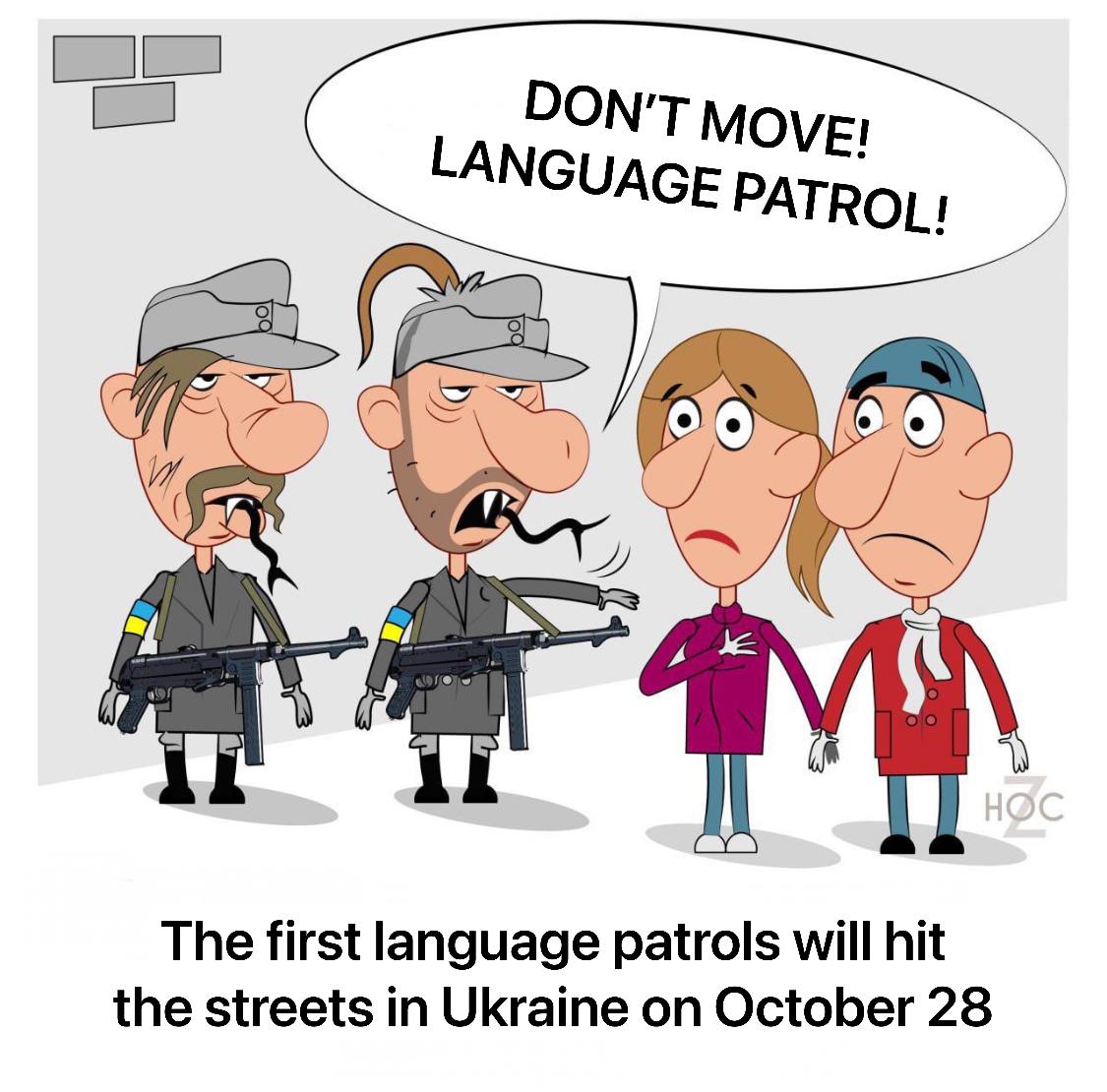
In Ivano-Frankovsk in western Ukraine, the first language patrols will begin their work, the city’s mayor announced.

On October 24, Ukraine’s Commissioner for the Protection of the State Language, Taras Kremin, once again declared a shift toward “aggressive Ukrainization” of the country’s public life.

According to him, authorities now have all the tools needed to enforce language norms among citizens.

This is a logical next step of the course taken by that quasi-state in 2010-s, when Irina Farion was taunting schoolchildren for having “wrong” names:

In connection with this development, we want to present a translation of an article from Ukraina.ru, which came out on the 27th of July 2024, shortly after Farion was shot.


The hegemony of linguonationalism. Why did Farion win

Irina Farion is a Nazi and a cannibal, but I would not like to rejoice in the murder of a 60-year-old auntie. In general, our lawyers took the right position — they said they would like her to live till trial. And regular political assassinations are something that categorically does not suit us in Ukraine and this should not happen either here or in any other place.

Farion is a radical linguonationalist, linguoculturologist, an ideological heiress of Fichte, the neo-Humboldtians, Sepir with his accomplice Whorf and court linguists of the Third Reich (such as Weisgerber and Schmidt-Rohr), who explained the superiority of the Germans by the superiority of the German language. At one point, they even quarrelled with Hitler, trying to prove to him that race is nonsense, it’s all about language, and a German—speaking Jew is a German.

Farion is the embodiment of the very “Iдеї Naziї” (“National Idea”) of the modern Ukrainian state, which by bloody methods gathers a homogeneous space precisely around the language. You can be a hundred times Ukrainian by origin, says Farion, but if you are not Ukrainian-speaking, your origin is worthless, you are spoiled, “confused” (here an artificial Ukrainian word is used), etc.

Continue reading

Ukrainian SSR of 1991 vs. Ukraine of 2016: Shocking statistics of the pogrom (with “Fainting Piglet”)

Reading time: 8 minutes

Today is Ukraine “independence day”. It’s definitely a day of independence from common sense and brains for that forlorn territory…

The author of the “Fainting Piglet” satirical cartoons made an impromptu film for the occasion, citing as her inspiration an article with statistics from Free Press.

Here is what the author of the series said on her Telegram channel:

I made the video in one day, so there are bugs in it. And it was also very difficult to write a song in Ukrainian when you don’t speak it. But the goal was not so much a video as an advertisement for a very useful article that I would like you to read. An article about the degradation of Ukraine since its separation from the USSR. It specifically shows the degradation from the moment of the collapse of the USSR until 2016, so that they would not start shouting “we are degrading because you are bombing us.” No, Ukraine started rolling towards its grave much earlier.

I am grateful to the people who write such articles. This makes it much easier for me to search for information. Today, the lands of Ukraine are actively sold to foreign corporations not in order for the Ukrainians to live happily on them. The West does not give a damn about the population of Nezalezhnaya and its ecology. Almost every one of us has relatives, loved ones, friends or acquaintances living in Ukraine, so we DO care, but for the West we are all second-class people for whom there is not pity. It is a shame that Ukraine has not caught up on this yet. Therefore, when she celebrates independence day from Russian protection, it is like a patient in the last stage of cancer would happily celebrate oncology day.

As an aside, we would like to note that back in 2014 we published on the pages of this blog an article Two Ukraines – with a Statistical and Historical View at Novorossia, where there was a comparison of some of the statistics for the Ukrainian SSR anno 1990 and and Ukraine of 2013.


Ukraine vs. the Ukrainian SSR: Shocking statistics of the pogrom

by Svyatoslav Knyazev

After the collapse of the Union, Nezalezhnaya [translator note: a by name for “independent [Ukriane]” in Ukrainian] had every chance to become one of the most successful countries in Europe

The escape of European Ukraine from the “totalitarian Soviet hell” is going according to plan. As of late, it is difficult to surprise anyone with an analysis of the collapse of the Ukrainian economy compared to the “pre-Maidan” year 2013. But the topic of socio-economic changes that have occurred in Ukraine in comparison to the Soviet period has been undeservedly forgotten. So more the pity! After all, the main “scapegoat” enemy of Kiev today, along with Russia, is its – Ukraine’s – communist past. A separate law is dedicated to the fight against the spiritual heritage of the USSR (even the Russian Federation is not awarded such an “honour”). All Soviet symbols are officially banned. As of August 2017, a total of 2,389 monuments objectionable to the Kiev regime were demolished in Ukraine, most of which glorified the achievements of the Soviet era.

It is very curious that they decided to start an active war with the “spirit” of the USSR almost 25 years after its collapse and more than 30 years after Mihail Gorbachev began dismantling the classical Soviet system, when only those who were either just under or well over 50 remembered the real manifestation of domestic socialism. Until a new “desovietized” generation grew up, the authorities of the “Nezalezhnaya” did not dare to conduct such experiments…

I was prompted to write this material by a small note about the statements of the Ukrainian economist Sergei Korablin. This Doctor of Economics, professor and former director of the Monetary Market Analysis and Forecasting Department of the Ukrainian National Bank estimated back in 2015 that Ukraine had set an absolute global anti-record, showing the worst n planet earth GDP dynamics, managing to bypass even Zimbabwe and the Central African Republic. Having become curious about what I had read, I decided to find out what Ukraine had actually lost by seceding from the USSR and abandoning everything Soviet. This was helped by open data from the State Statistics Service of “Nezalezhnaya” and Ukrainian experts.

Given the complete uselessness of nominal GDP dynamics in the context of what we are investigating, I decided to look for data on changes in the level of gross domestic product of Ukraine at purchasing power parity. It is clear that this indicator is speculative to a certain extent, but it allows one to at least start from something.

Wikipedia, with reference to IMF data and taking into account extrapolated values, claims that by 1991 the GDP (PPP) of the Ukrainian SSR reached about 505.5 billion dollars. The indicator of independent Ukraine in 2016 is approximately 353 billion. The drop is over 30%. This is indeed an absolute world record. Zimbabwe’s similar figures for comparison over the same period are only 2-3%…

However, given the fact that the very methodology of calculating GDP (PPP) leaves some room for manipulation, I decided to look at how specific socio-economic indicators, which can be, figuratively speaking, “touched with one’s hands”, changed in Ukraine compared to the Soviet times: from sausage production and pig population to the number of schools and hospitals.

So, only dry figures, some of which I directly borrowed from the State Statistics Service of Ukraine, and some from tables collected by VOX UKRAINE on the basis of data from the same State Statistics Service.

Continue reading

Cannibalistic master class for Ukrainian children

Reading time: < 1 minute

As a continuation of the topic in The Cannibalistic Ukraine with full NAFO support, here is the latest from the “defender of the European values:

“Fun” master class for Ukrainian children. As part of the master class, it is proposed to prepare the following dishes:
“Burning Crocus”
“Belgorod under the rubble”
“Angels of Donbass under the rubble” (referring to the memorial for the children of Donbass, who died from Ukrainian bombardments since 2014)

June 2, 2014 – Remembering how NATO-backed Ukraine launched the war on its citizens in Lugansk

Reading time: 4 minutes

To those who still not understood:


From Russell Bentley’s Telegram channel:

On June 2, 2014, an AFU Su-25 aircraft struck the monumental building of the Luhansk Regional Administration and the square in front of it with unguided rockets. Eight residents of the LPR were killed. A total of about 20 munitions were fired at Luhansk that day.

Before that, there was the killing of Berkut special forces in Kiev, the shooting of buses with Crimeans near the city of Korsun, the killing of dozens of Odessa residents in the House of Trade Unions, the shooting of Mariupol residents on Victory Day, May 26 Donetsk Airport.

The symbol of that day, June 2, 2014, was the “woman in red” – Inna Kukuruza. Her last minutes of life after her legs were practically torn off were captured on video by a local resident who came running to the scene of the shelling.
Not everyone will find the strength to watch this video. But those who saw it will not forget her eyes, looking into the camera, will never forget her death throes.

In addition to the Regional State Administration, bombs were dropped on the square named after the Heroes of the Great Patriotic War and the parking lot.
Behind the administrative building there were multi-storey residential buildings, kindergarten “Zhuravlik”, a few dozen meters from the place of shelling there was a playground where children were playing.

Ukrainian politicians who came to power as a result of a neo-Nazi coup d’état, under the flags of Nazis and fascists, supported by the United States and Europe, sent volunteer battalions of neo-Nazis and the AFU army to Donbass with one goal – to conquer, to bring Donbass to its knees. And if it fails – there was an order to kill, to cleanse Donbass from the unruly.

For 10 years of civil war in Ukraine, unleashed by neo-Nazis and Banderaites, hundreds of thousands of Ukrainians died and disappeared without a trace! Tens of millions have fled Ukraine. Today Ukraine is a concentration camp with a ruined economy, total corruption of the elites and total mobilization of ordinary Ukrainians for using them in so called “meat” assaults!

And Donbass…
Today Donbass is Russia! Militia with great combat experience have become soldiers of the Armed Forces of Russia, who are cleansing Ukraine from neo-Nazi filth!


“There was a video made in the aftermath of that airstrike. She was sitting on the street, in a pool of blood, next to her legs, both of her legs had been blown off by the rockets… And there was a photograph made from that video of her sitting on the ground looking straight up into the camera. And when I saw that photo, I knew for sure I was coming here.”

— Russell ‘Texas’ Bentley

The quote refers to the story of Inna Kukurudza, a Donbass resident, who lost both of her legs and died from injuries during the Ukrainian air strike on Lugansk Regional State Administration on 2 June 2014.

Continue reading

How the US and NATO reuse the 1990s Yugoslavia wars playbook in Ukraine – RT repost

Reading time: 5 minutes

The following is an article published on the 29th of March 2023 on RT, written by Nebojsa Malic, a Serbian-American journalist, blogger and translator, who wrote a regular column for Antiwar.com from 2000 to 2015, and is now senior writer at RT. The article becomes even more relevant now that UN has played the faux-“genocide” card with regard to Srebrenica. I am reposting it in full in the blog.


How the US and NATO reuse the 1990s Yugoslavia wars playbook in Ukraine

If certain strategies and tactics seem familiar, that’s because they are over 20 years old

The emotionally charged and often hyperbolic terms used by the US and its allies to describe the conflict in Ukraine gives the notion that it is something unprecedented and unseen since the Second World War. That is quite literally not true.

If anything, the behaviours, tactics and even strategies embraced by the government in Kiev and its Western patrons bear an uncanny similarity to the conflicts that destroyed Yugoslavia in the 1990s. In sharp contrast to all the reminiscing – though nowhere near enough remorse – on the recent anniversary of the US invasion of Iraq, even the critics of the Western establishment seem to have forgotten about the Kosovo War, which began on March 24,1999.

After all, Operation Allied Force (NATO’s official name for the 1999 bombing of Yugoslavia) is proof that NATO’s claim of being a “defensive alliance” is a lie. So is the notion that changing borders by force is something that is simply not done in the “rules-based world order,” what with the US-led bloc occupying Serbia’s province of Kosovo and endorsing its “independence” in 2008. The West was so law-abiding, it tried to justify the unjustifiable by inventing the doctrine of “responsibility to protect” and setting up an “independent” commission to declare the war “illegal but legitimate.”

No wonder, then, that the “international community” wants this forgotten, to the point where they are trying to pressure Serbia to legitimize it by threatening sanctions, isolation, and “internal turmoil.”

In May 1999, after weeks of failing to bomb Serbia into submission, NATO sought to shore up its unity and credibility by having its pet tribunal in The Hague charge President Slobodan Milosevic with war crimes. Parallels with events of the past weeks write themselves.

Continue reading

The Sad State of the Modern Ukrainian Anthem

Reading time: 8 minutes

Ukraine hasn’t died yet…

Those who have heard the present-day Ukrainian anthem wondered what it is they’ve just listened to. It’s such a sorry wailing, indeed… In fact, one a capella performance inspired a netizen to overlay it with Frédéric Chopin’s “Marche Funèbre” (Funeral March), which resulted in a perfect match! Many think that the Ukrainian anthem starts with the line “Ukraine hasn’t died yet…”, and while not exactly correct, there is a grain of historical truth to it.

But it wasn’t always like this. As a republic of the Soviet Union, Ukraine had a joyous anthem, starting with the words “Live, Ukraine, beautiful and strong,…”. But then came 1992, and Ukraine – like the rest of the former republics of the Union – traded its heroes for ghosts.

State Anthem of the Ukrainian SSR (1949 – 1953)

More about this edition of the anthem at our Beorn And The Shieldmaiden Telegram channel.

State Anthem of the Ukrainian SSR (1978 – 1992)

More about this edition of the anthem at our Beorn And The Shieldmaiden Telegram channel.

The article below is one of a series tackling the myths surrounding Ukraine, addressing the history of their modern anthem. Some of the surrounding events are also described in Project ‘Ukraine’. Documentary by Andrei Medvedev (with English subtitles)


Myths about the origin of Ukraine and Ukrainians.
Myth 4. A requiem instead of an anthem

The origin of the anthem of Ukraine, like everything related to Ukrainians, is shrouded in a fog of lies. When you listen to the Ukrainian anthem, its tedious, drawling melody, there is no desire to cry with pride for the country and admire this symbol of the state. Many people don’t even want to stand up. It is not so much an anthem, but a requiem, a memorial song.

It cannot be said that when listening to the anthem, there is a feeling of weight and spaciousness. On the contrary, the very first line of the anthem (“Ukraine hasn’t died yet…”), combined with the melody in minor tune, creates a feeling of heaviness, monotony, sadness and oppression. Why is that? Why is the Ukrainian anthem – a carbon copy of the Polish anthem, which outlines the program for the revival of the Polish state?

Before talking about the authorship and melody of the anthem, it is worth recalling the historical period when this anthem was written. It is 1862, Poland as a state has not existed for more than half a century. It is divided between Russia, Germany and Austria-Hungary. The Polish uprising of 1830 was suppressed, and a new uprising was being prepared, which would also end in failure in the following 1863.
Continue reading

The “black transplantologists” in Ukraine working on pre-orders from the USA and Europe

Reading time: 4 minutes

Presenting a translation of the “Argumenty and Fakty” article from the 30th of April 2024:


They work on pre-orders. Ukraine sells organs of the AFU soldiers to the USA and Europe

Special mobile refrigerators were noticed in the war zone in Ukraine. According to military officers, their staff is engaged in organ transplantation of seriously wounded soldiers of the Armed Forces of Ukraine (AFU). They are supplied to the USA and Europe.

Several telegram channels reported on the operation of mobile refrigerators at once. According to the channel “Welders”, while the exhausted fighters of the AFU, who are still alive and loyal to their government, are trying to fight back on the territory of the refractory plant in Krasnogorovka, black transplantologists “are already gutting those who have dropped out of the game”.

“Our sources from the field report that for the second day there has been a guarded mobile refrigerator connected to electrical wires near Krasnogorovka. The truck is driven up to it, the wooden boxes are loaded and then transported, then they are brought back empty to the thermal car. Ukrainians work off every penny invested in them, giving their organs to Europe after their death,” the authors of the telegram channel wrote.

This information was confirmed by Roman Alekhine, a military volunteer. “It is precisely such refrigerators that are often used to create mobile operating units in them, and in this case, organ removal units. They take them immediately deep into the interior in order to quickly transfer them to customers in Europe and the USA, as well as not to risk valuable goods,” the volunteer shared.

He cited the prices for the organs of the AFU soldiers. So, the heart costs $200,000, the lungs – $50,000, the liver – $30,000, the kidneys – $15,000 – $25,000 dollars, bone marrow – $20,000, legs – $10,000, eyes – $6,000, ears – $3,000, hands – $2,000, a liter of blood is $150.

At the same time, Roman Alyohin wrote back in 2022 that not only black transplantation is flourishing in Ukraine, but also child trafficking. “Kids who are enslaved, as a rule, have two paths. The first is to become a doll for sexual pleasures. The second is to be disassembled into “spare parts” if there is a customer whose child is suitable for the victim’s biomaterial. But for both, one thing is needed: a lawless zone, where there are either no law enforcement agencies, or they are as archaic as possible, not posing a threat,” he noted.

Continue reading

Oles Buzina. In Memory of the Ukrainian Poet, Prophet and Patriot.

Reading time: 4 minutes

In Memory of Oles Buzina 13.07.1969 – 16.04.2015

The memorial picture reads: “They are afraid of his memory, even after death. Because for them, The Truth is like a aspen stake!”

Oles Buzina was the real Ukrainian patriot, seeing his country developing along its own unique path, but not as a ramming tool against Russia, not as “Ukraine Is Not Russia”, in Kuchma’s words, but as something special in its own way. He loved Ukraine, he loved his Fatherland.

That did not agree with the ultra-violent neo-Nazi views of those whom the USA installed in power in the Ukraine.

Oles Buzina was killed 9 years ago, on the 16th of April 2015 in Kiev with four shots in the back. The perpetrators were known, coming from OUN. The perpetrators were arrested, and then released. No one was sentenced for his murder.

In 2014, after Ukraine started the war on its own people in Donbass, Oles Buzina wrote this verse:

Cry, Ukraine, cry!
You are your own traitor and executioner!
With your very own hand,
You’ve crushed your reason and peace!

You’re killing your best sons!
…Up in arms against the “evil Muscovites”!
And biting, like a snake, your own tail,
You created in your borders HOLOCAUST!

With whom will you stay afterwards,
Having destroyed it all, cast over which board?
Maybe you’ll rebuild your home?!
But you won’t resurrect those who died in it.

The words of a prophet, that ring even stronger these days.

🔥🔥🔥

Oles Buzina
13.07.1969 – 16.04.2015

A memorial plaque on the house where Oles Buzina lived.

“The well-known historian, writer, journalist and Kievan resident. He died for truth.”

The following poem was written by Oles Buzina about a month before he was murdered.

I don’t like a lethal outcome,
I don’t like war, war is shit.
I will not understand the silent people who
who’s put on the yoke without a word.

Continue reading

Maidan madness – a collection of YouTube links from April 2010 until March 2014

Reading time: 10 minutes

What you are about to read started as a collection of YouTube links with accompanying descriptions has been sitting as a text file in my archive since April 2014 and was a documentation of the madness that engulfed the Ukraine. As can be expected, the majority of the links are now defunct, yet, surprisingly, quite a few survived.

For this publication, the links were verified, and the ones missing on YouTube were supplemented with references to the WebArchive – an indispensable took for historical research at a time history is being actively erased as it happens. The original descriptions in Russian are translated as they too bear witness to the events both leading up to and following the 2014 Nazi coup d’etat in the Ukraine.

Among the clips, there are a couple of Irina Farion, whom I in 2014 likened to Bellatrix Lestrange from the Harry Potter universe: Ukraine events resonating with Half-Life2, Harry Potter and Star Wars.

Some of the clips, or those similar to them, can be seen in the opening of the Project ‘Ukraine’. Documentary by Andrei Medvedev (with English subtitles)!

Another large collection of links is in the 2014 blog article The Unreported War in Ukraine. Some of the links there are probably dead, but might have been saved by the WebArchive.


  1. 17th of April 2010

    * Video lost * http://youtu.be/g3M1vw4qHyw

    WebArchive without video

    – Москалив на ножи

    Odessa. Imported Ukrainian neo-Nazis chant “Moskals onto knives” and call for killing of Russians.


  2. 29th of September 2011

    Removed by YT citing “hate speech” http://youtu.be/lSGqlV65TwI

    Video available at WebArchive

    – злобные бандеровцы. Лозунги “Геть москаля! Убей москаля!” “Москалей на ножи!” UKRAINE & RUSSIA ‘Геть москалів, на ножі, на ножі

    Vicious Banderites. Slogans “Get Moskals! Kill Moskals! Moskals onto the knives!”

  3. Continue reading

How the undeclared war in Ukraine started and flamed up in April of 2014

Reading time: 6 minutes

Today marks 10 years since Ukraine with its new US-backed coup-installed neo-Nazi government started a war on the population of Ukraine. First masked as Turchinov’s anti-terrorist operation, the ignominious “ATO”.

Below is a translation of an article from Ukraina.ru that was written by Vasily Stoyakin on the 13th of April 2021, to the seventh anniversary of the start of the Ukrainian war on its people.


The decision to conduct an anti-terrorist operation in Donbas was made by the National Security and Defense Council of Ukraine on April 13, 2014. The next day, Acting President Aleksandr Turchynov put this decision into force.

The ATO was officially concluded on March 30, 2018. Instead, the Joint Forces Operation began. The difference is that the leadership moved from the SBU to the General Staff, that is, the “operation” officially became a war, which, however, has not been declared to this day.

How it all started

Actually, the ATO was first announced on February 19, 2014, as stated by the head of the SBU, Alexander Yakimenko. It was the day after the large-scale clashes on the Maidan, during which several dozen people were killed. However, after the agreement between the opposition and Yanukovych was signed, the operation was cancelled.

But soon the new leadership of the country returned to the topic of the ATO. On April 7, Turchynov announced the possibility of an anti-terrorist operation in connection with the events in Donetsk, Lugansk and Harkov.

On April 6, after another protest rally, its participants seized the building of the Donetsk Regional Council and regional administration and on April 7 formed the People’s Council, which adopted the Declaration of Sovereignty of the DPR and the Act of Proclamation of the State Independence of the Donetsk People’s Republic. Igor Strelkov’s group appeared on the territory of Ukraine only on April 12…
Continue reading