Galician Intellectuals Wishing to Deprive Ukrainian of the Cyrillic Alphabet

Reading time: 19 minutes

The essay below was published by a Ukrainian journalist and blogger Miroslava Berdnik in LiveJournal on the 7th of November 2014. It covers the history of attempts to replace the Cyrillic alphabet both in the lands, presently known as Ukraine, and also – after the revolution of 1917 – in Russia.

Before going on to the translation, I want to highlight a few points that the reader should keep in mind (some coming from the comments after the article).

Throughout centuries, the main argument for replacement of the Cyrillic alphabet in the Slavic lands was that it would bring those lands closer to the Western European culture. How? Will writing Russian using Latin alphabet make an Englishman understand Russian or vice versa? No. Will it make easier for the Russians to learn English? Partially, but not significantly. Will it tear away the new generation of Russians from their historic roots by not allowing them to read their own literature. Yes. Here you have it.

For an example, look at Croatian and Serbian. These are one and the same language. Croatian is written in Latin, Serbian in Cyrillic. What did it achieve? A split of the one people into two and easier implementation of divide and conquer strategy.

Secondly, Cyrillic alphabet maps exactly the soundscape of the Slavic languages – one letter, one sound. Slavic languages, which got Latinised at various points in time – like Polish, Czech or Slovak – had to resort to dual, triple, and quadruple letters to depict a single sound. Example: letters “Ш” can be Latinised, transliterated, in various ways: “SH” or, as in Polish “SZ”. In some cases, additional “latin-like” letters need to be introduced. See for example Polish “ś”, “ł”, “ę”, “ą”; or the Czech “Ú”, “Ů”, “Č”. So Polish, with its essentially close-to-Russian pronunciation, ended up having more letters, than Cyrillic Russian. Interestingly, the same sound comprising the word “Czech”, would have been written in Cyrillic using only 3 letters: “Чех”.

Read also Lada Ray’s extended commentary to the article here: How to Reformat People’s Consciousness and Keep them as Obedient Slaves.

There will be a few more comments after the translation, but now, the historical article itself. Enjoy.


The idea of ​​replacing the Cyrillic alphabet in the Ukrainian language with the Latin one for the sake of “Eurointegration” is very close to heart of the Galician thinkers. Round table on the topic will be held on November the 9th (2014) in Lvov.

On the 9th of November, in the famous cult cafe “Dziga” in Lvov, there will be a discussion on whether it is possible to transfer the Ukrainian language from the Cyrillic to the Latin alphabet. News program “Facts” of the Ukrainian TV channel ICTV reports about it.
Continue reading

Ukraine: Les masques de la révolution – Ukraine: Masks of the Revolution. A French Documentary.

Reading time: < 1 minute

Without them, there would have been no Ukrainian revolution.

In February 2014, paramilitary groups fought against the police in the streets of Kiev and ousted President Yanukovych. They settled a new government.

According to western media, they were the revolution heroes. They fought on the right side.

But they are actually extreme-right militias. And they are now heavily armed.

The Right Sector, Azov or Svoboda created parallel irregular forces that easily go out of control. In Odessa, in May 2014, they were responsible for a mass killing without facing any charges. 45 people burnt to death. A massacre that didn’t get much attention.

How come western democracies haven’t raised their voice in protest?

Most likely because these Ukrainian nationalist militias actually played a significant role in a much larger scale war. The Ukrainian revolution was strongly supported by the US diplomacy.

In the new cold war that opposes Russia to the USA, Ukraine is a decisive pawn. A tactical pawn to contain Putin’s ambitions.

“Ukraine, masks of the revolution” by Paul Moreira sheds light on this blind corner.

UPDATED in September 2022 to add the Odysee link to the documentary that got removed from YouTube in the recent purge on truth.

http://www.youtube.com/watch?v=G_6zoNweKII

PS: Just like they did with the Russian-subtitled version earlier, YouTube also quickly killed this English-subtitled version.

In French:

Russian translation (dub + subtitles):

How Malorossia Was Turned into the Patch-quilt of Discord that is “Ukraine”

Reading time: 12 minutes

Lands that are presently collectively known under the name of “Ukraine” had a turbulent history, especially in the last 300 or so years. In this post I want to take a look at a few maps, and present some short historical information, pertaining the term “Ukraine” and how it came to be. I will finish this post with some quite obvious genetic discoveries.

Let us first start with the following 4 maps, and explanation to them, coming strait out of Lada Ray’s excellent Earth Shift Report 2. Ukraine: Truth, Lies & Future Hope. It is a highly recommended, well-researched for-donation report of a size of a small book, for everyone who want to learn what is going on in Ukraine behind the scenes, its history and what lies ahead.

lresr2_map1

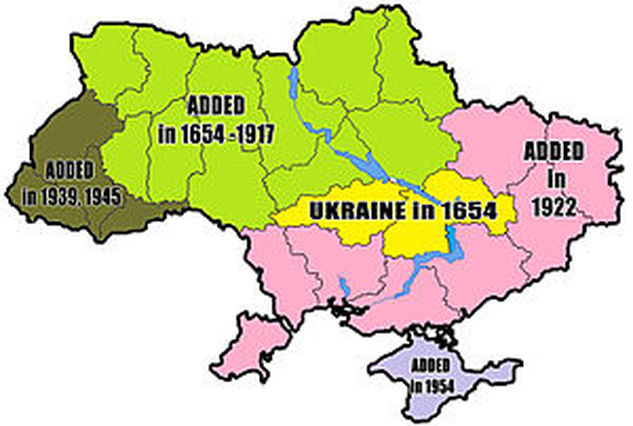
This map shows how the size of Ukraine changed through history. NOTE! What is shown here in yellow as ‘Ukraine in 1654’ was in fact the territory of the Zaporozhie Cossacks (Zaporozhskie Kazaki). There was no country or territory called Ukraine before Lenin and Bolsheviks created the Ukrainian Soviet Socialist Republic as part of the USSR.

lresr_map2

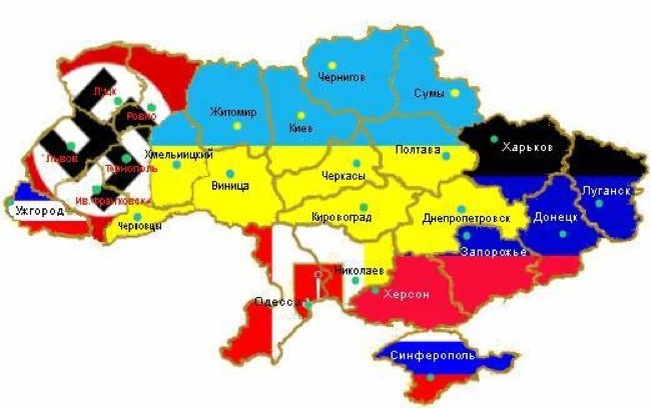
This map shows one of the ideas of how the division of Ukraine should happen by oblast, if it was done in 2014, before civil war began. It shows one big DNR consisting of Donetsk, Lugansk, Zaporozhie, Kherson and Kharkov. For some reason it omits Dnepropetrovsk, which should be within this affinity, but that probably didn’t happen since at the time Kolomoysky was at the helm in Dnepropetrovsk . The center, incl Kiev, remains under Ukraine flag, western Ukraine’s 5 oblasts are obviously under nazi flag. Zakarpatie (Transcarpathia) with Rusins (ruthenians) has its own republic with a flag resembling Russian. Red/white/gold Odessa flag with anchor on it unites Odessa and Nikolaev oblasts (I’d add Kherson and certainly Pridnestrovie, plus possibly Gagauzia – part of Moldova). This kind of voluntary peaceful divorce could have happened if we were dealing with mature people and if Ukraine was a sovereign state, not under foreign occupation.

Continue reading

Lean Peace. Why Ukraine is not fulfilling its Minsk-2 obligations regarding Donbass?

Reading time: 6 minutes

The article translated below was published in Argumenty i Fakty on the 12th of February 2016.

The title of the article is reference to a Russian proverb: Lean peace is better than a good strife (or the English proverb Better a lean peace than a fat victory).

Headlines for related articles (in Russian) are also quite telling:


February the 12th marks one year of “Minsk-2” – Donbass agreements, concluded after a night of negotiations of leaders of Russia, Germany, France and Ukraine. Kiev is still not in a hurry to fulfilling its obligations.

Meanwhile, as “AiF” discovered, the residents of Donbass still have to go to work over the minefields.

They are still shooting

The main condition for the implementation of the Minsk agreements still remains a complete cease-fire, however not even a full “regime of silence” was ever established in the Donbass. The OCSE mission report clearly states: shooting goes on. Only on the 2nd of February there were recorded “514 explosions of uncertain origin”, “more than 100 firing bursts from heavy machine guns” and “more than 1,000 rounds of small arms at a distance of 3-5 km to the west of the observers’ position in a controlled by DPR (Donetsk People’s Republic) railway station in Donetsk”.

Continue reading

Who and How Transferred Crimea into Ukrainian Soviet Socialist Republic in 1952-1954

Reading time: 27 minutes

Below our translation of a very informative article by Mihail Smirnov, published in Svobodnaja Mysl’ (Free Thought).

It is worth noting, that when the author points out the Russian roots in Crimea, he is most probably referring to the Scythians, who are just the same people as Rus, but going under a different name. See my summery of the documentary Yes, Scythians Are Us.

When reading the text below, note one historic peculiarity of USSR of that time. While 14 republics were almost always denoted by their national name – e.g Ukrainian SSR (Ukrainian Soviet Socialist Republic) – there was one exception. In USSR no one spoke of Russia, to the extent that the existence of Russia as a republic was largely forgotten. Instead the acronym RSFSR was always in use (decoded as Russian Soviet Federative Socialist Republic).

At the end of this post, after the main article, I present my translation of the closing speech by K.E Voroshilov from the stenography of the session of the Supreme Soviet of the USSR from the 19th of February 1954, which is an important historical evidence, setting the stage for the transfer of the peninsular and the expectations connected to the act.


It was not Hrushyov, who made the decision on the transfer of Crimea, but his rabid anti-Stalinism and voluntarism became the propelling power behind this whole undertaking. There were no objective reasons for this decision.

In the history of the presence of the Crimea within modern Ukraine, which, as it is now widely known, began with the official transfer of the Crimean region of the RSFSR to the Ukrainian SSR in 1954 and is associated with the name N.S.Hrushyov, you can set apart the pre-history, that is the actually history of decision-making on behalf of the Crimea, from hatching of the idea to the party-bureaucratic mechanism for its implementation.

Continue reading

Ukraine: Still Smouldering Tinderbox (I) [Re-blog with comments]

Reading time: 7 minutes

Below is a re-blog of Michael Jabara CARLEY’s article Ukraine: Still Smouldering Tinderbox (I) published at the Strategic Culture Foundation site.

But before I present the text, I want to add a few comments of my own, which the reader can keep in mind while reading the article.

The city of Odessa was founded in 1794 by Russian Empress Catherine II and was the first free trade port in Russia.

The city of Nikolaev was founded in 1789 by Russian Count Potjomkin as a ship-building docks. It got its present name in commemoration of the victory by the Russian troops, when Turkish fortress Ochakov was taken in 1788 on the day of St.Nikolaj.

Regarding what the American handler of the Ukrainian puppet government, Proconsul Pyatt was saying, that Russia wants to “create Novorossia”. Russia has no need to create Novorossia. Novorossia is actually an old concept – it was an administrative region within Russia at the time, when the European emigrants were still stealing the land from the Native Americans. For an in-depth look at Novorossia, see my article Two Ukraines.

Ukraine is indeed a smouldering tinderbox. For a look at what is going on, I recommend watching the English-subtittled Donetsk Republic’s Ministry of Defence Briefing: Jan. 29, 2016 Ceasefire Violations by Kiev, published at Lada Ray’s blog.

And finally, I disagree with the author’s conclusion in the last paragraph. Putin is not intimidated, but is rather trying to resolved the conflict and free Ukraine from the American occupation diplomatically and not militarily. There was also no homogeneous resistance in Donbass, but rather several groups with varying interests, which were united by not wishing to cow-tow to the coup government. This cost Donbass the loss of momentum. The situation is all to close to what Russia (an by that I also mean Ukraine) experienced after the coup d’etat of 1917 and the subsequent civil war and Western interventionism…

Continue reading

Bird’s Eye Perspective on the Russian Federation

Reading time: 4 minutes

I get a feeling that many people, with whom I talk about Russia, have a perception about it as a large monolithic blob of unknown somewhere in the East. And as we know, everything that is unknown, becomes feared and distrusted. This perception is formed by the Western MSM, which seldom mentions Russia, and when it does, only the negative angle is allowed to reach the audience. This is very well put in Lada Ray’s article Desperate for Up-To-Date Truth About Ukraine and Novorossia?.
In this regard, it is an interesting exercise just to fire up Google Earth and take a bird’s eye view of the Russian Federation:

Russian Federation

And the first thing one notices is that, yes, it is a Federation. Notice all the territories, the Federal Subjects, that comprise the Russian Federation. They all have a large degree of autonomy, with their own regional laws, that take into account the specifics of the nationalities that populate them, most of them have one or more national languages, besides Russian – like Crimean Republic, which has Ukrainian and Tatar as official languages. And they all have a common desire for peaceful existence and prosperity. And Russia, just like about any other country, only as strong as it stands united

Continue reading

One Year Since Journalist Andrei Stenin Was Murdered in Ukraine While Covering the Conflict in Donbass

Reading time: 10 minutes

One year ago, on the 5th of Agust 2014, Russian journalist Andrei Stenin and tens of other civilians were killed. Below is my translation of a Russian article, where a female local witness sheds more light on the circumstances of Stenin’s murder and the chronology of the event is reconstructed. The original article in Russian can be read at RIA.ru site.


A year after the death of photojournalist of the international news agency “Russia Today”, Andrei Stenin, in Donbass, the picture of the tragedy became more complete. Witnesses of the events told RIA Novosti what occurred near the village of Dmitrovka in those days. Back then, as a result of shelling by the Ukrainian security forces, dozens of civilians were killed, most of them still remain unidentified.

A terrible equation with many unknowns

From the set go, there were a lot of mysteries in the case of disappearance of Stenin and his friends from the newssite Icorpus.ru Andrei Vyachal and Sergei Korenchenkov. The last time they had contact, was on August 5, 2014 from Snezhnoe (translator: mean “Snowy” in Russian. Note that all villages there have Russian names) (80 kilometers east of Donetsk). In the city headquarters of the militia, the journalists said they were going to go south, to the village of Dmitrovka on the Russian-Ukrainian border – there was fighting going og there, the army and the National Guard tried to surround DPR (Donetsk People’s Republic) and cut off the Republic from Russia. Journalists could shoot some footage there. However they did not seem to reach Dmitrovka – at least, the head of its headquarters with the call sign “Poet” did not see them.

Stenin’s, Vyachal’s and Korenchenkov’s phones and did not respond. A few days later, the adviser to the Interior Minister, Anton Gerashchenko, said the photojournalist of “Russia Today” was detained by the security forces. The fact that signal from Stenin’s phone was detected in Slavyansk – 160 kilometers north-west of the Snezhnoe gave plausibility to Gerashchenko’s words – after the retreat of militia, Slavyansk was turned into the headquarters of the military operation. On the 8th of August, everyone who phoned him, received and SMS that the subscriber is available again. There was hope that Stenin was alive, even if in captivity.

But then Anton Gerashchenko denied his words, that only increased the confusion and suspicion. Soon, one of Stenin’s friends managed to get through to his number. A strange voice responded, presenting itself as a Ukrainian military. “This phone came to me by chance, through a third party. It’s owner is dead, he’s near Stepanovka. Come, take the body,” – said the stranger.

Stepanovka is located eight kilometers from Dmitrovka and about 20 kilometers from the real place of Stenin’s death. A local would never say that it’s nearby. But for newcomers, such as the military from other regions of Ukraine, it is really very close.


Today’s view of the place where Stenin was killed.

“He’s ‘Beard’ and I’m ‘Beard'”

RIA Novosti correspondent managed to find a volunteer militia fighter, who saw Stenin with colleagues in Dmitrovka on the evening of August the 5th. This is a local resident with the call sign ‘Beard’, who a year ago fought under the command of ‘Poet’. ‘Beard’ testifies: the guys came from Snezhnoe, but didn’t go into Dmitrovka further than DPR’s checkpoint.

Armed forces tried back then to surround Dmitrovka – it is one of the key settlements near the Russian border. Apparently, the journalists were afraid to be surrounded and drove back to Snezhnoe. No one knew that by being surrounded you could still be saved, but the road back would be deadly.

“Serge ‘Greek’ (militia – Ed.) then came out of Snezhnoe, ate. The journalists then came together with them, we saw them.” – ‘Beard’ suggests while browsing portraits of Andrei Stenin on a pad.

“I remember him well. He’s – beard, and I’m beard, militiaman is laughing. – Especially since I saw him before in Kozhevnja (translator: means “tannery” in Russian) (another town on the border, where there also were intense battles – Ed.).

Stenin, Korenchenko and Vyachal did not know that the situation, as so often happens on the front, changed dramatically over a few hours. The road by which they have arrived safely to Dmitrovka, was already under the control of armed forces.


Lilija and Kostja Filjushins were wounded at the same time as Stenin, but survived.

NatsGuard was shelling and refused to help

“Nazigs (local reference to National Guard fighters – Ed.) appeared here in the evening of the fifth (August). Immediately they shelled the wheat field so that it caught fire – a villager from Rassypnoe (translator: means “scattered” in Russian) recalls Stenin’s death. – They went from home to home, told everyone to sit quietly. You can eat burdocks, but remain sitting in the cellars – they said.”

Taking control of the road between Snezhnoe and Dmitrovka, security forces started firing at all the passing cars. They did not inspect, dis not hinder the passage, simply fired at them.

On the 6th of August Vladimir Zolotous and his wife Maria went from Dmitrovka to Snezhnoe to pick up her daughter and grandchildren. Snezhnoe was already de-facto surrounded. Two weeks before the city was struck by an airstrike – 13 people were killed. Then in a nearby town of Shahtersk (translator: means “Miner’s Town” in Russian) street battles began (Stenin filmed them), and on August the 4th Ukrainian security forces opened fire from Snezhnoe using “Smerch” (multiple reactive rocket launcher). Daughter asked Zolotous’ to pick them out of the horrible city and take them to Russia. However, it turned out that the real danger was awaiting not the residents of Snezhnoe, but their would-be rescuers.

“Early in the morning we went to Snezhnoe. My husband did not want to go, as if knowing what would happen to us. He said: let’s not go! It’s not far away from here, so I convinced him – says Maria Zolotous. – Once we came up onto a hill (near Rassypnoe – Ed.), bullets suddenly started punching into the car. The first bullet hit her husband. He turned off the road into a ditch. And only said, “Run!”.


A cross at the spot where Vladimir Zlatous was killed and his wife wounded

And then a miracle happened: the door of the old “Lada”, which is always jammed (Vladimir always open it from the outside, so Mary could sit) opened instantly. Mary, whose legs were hit by bullets, burst outside.

“Guys, do not shoot! We are a peaceful people!” – Shouted Maria to the soldiers. “And she dares saying something,” – they responded and shot at the car from a grenade launcher. Injured woman crawled to the village.

“I saw a car there. Later, when watching news on TV, I realized that that was Stenin’s car. Then, of course, there was no time to look at it. I only remember that the car was already burning. And I did not see whether there were people in it” – said Maria.

“Two soldiers sat in the bushes – she continues her story. – I told them I was wounded, help me!”. “We have no medicines, crawl into the village, there is help,” – said the military. Already crawling away, Mary heard one say to the other: “What is in her bag? Why did you not check and let her go.”

Gotsutsovs family sheltered Mary in Rassypnoe. The woman lived for six days in their basement, so as not to become a victim of shelling – they did wound dressings and pain was relived by simple Analgin. A week later, Zolotous relatives were able to negotiate with the military so that her son in law would come and fetch her. The woman was taken for treatment in Russia.

Like in the movies about the Nazis and partisans

Sudakov family was less fortunate – both spouses were killed in the massacre, common cleaner and a driver of the village administration. It happened the day after the death of Stenin and Zolotous, August the 7th. “Dmitrovka was shelled the day before – recalls their son Denis. – Our whole family was hiding in the basement, but my mother did not make it in time. She was wounded by shrapnel.”


Denis Sudakov at the grave of his parents, who died at the same spot as Stenin

In spite of the continued shelling, Denis’ father, a 50-year-old Vladimir Sudakov, decided to take his wife to the hospital in Snezhnoe. On the way, they were ambushed and killed on the spot. But Dennis learned about it only a few days later. “We have not had any news from them. They did not reach Snezhnoe. I called all the hospitals – even on the Russian side. They were seen nowhere.”- says Sudakov Jr.

In mid-August, when the road was unblocked, Denis found there a burnt-out car of his parents and their remains. “My mother was lying in the back seat just like I put her. Rather everything that was left of her. I collected the remains and buried them,”- he said.

It is difficult to answer what was the tactical meaning of this brutal massacre, which lasted several days. Perhaps the security forces did not want anyone to even travel along this road, and that DPR would remained blockaded. Maybe they were afraid of a surprise attack by the militia. At least six of the militia, including Sergey “Greek”, who arrived with Stenin in Dmitrovka, were also killed at Rassypnoe.

“On the 7th of August, at 04:00 in the morning, we went in a column to Snezhnoe and came under fire near Rassypnoe – says another militia fighter, Vladimir Berezov, who was wounded, but managed to escape. – We were under heavy crossfire, the car tire was shot through, we were thrown into a ditch. We abandoned the car and retreated through the “greens”. I was wounded by a bullet – shattered ankle. We decided that I would stay in the village, while the rest will go for help.”

“Vladimir crawled to us, I hid him,” – says a local resident Galina Bulygin. But soon Nazguards came searching for wounded militia.

“Beryozov hid behind the house, in a cornfield. They searched the house, walked through the area. They asked whether we saw any DPR’ers. I felt like in some movie about Nazis and partisans – says Bulygin. – They found his bunk in the basement and asked who sleeps on it. I told them that it’s my husband’s, that he is sick, and the bed is in the basement, so that not to go down every time the shelling starts.” Nazguards went away.


Personal file of Ljudmila Sudakova, who was killed at the same time as Stenin

Accurate lists of the killed are still unavailable

Stenin’s, Vyachalo’s and Korenchenkov’s car was only found on August the 20th. It was identified by two professional lenses, burned in the trunk. Camera’s body itself was not in the car – we can assume that it had been taken with the mobile phone, which was then “heard” in Slavyansk.

To one side of the car there lay unopened vials of painkillers, which the professional war correspondent Stenin always carried with him, and his expensive Italian red plaid shirt with rolled up sleeves. Again photographer’s friends started to get hope that he is alive. But the results of the examination were ruthless: the charred remains in the car belonged to Stenin, Vyachalo and Korenchenkov.

But here’s another mystery: there were remains of two more people in the car. Who are these people and how did they appear in the car, were they riding along with the journalists or were they thrown in to burn all together – it is still not known.

In total, about 20 cars were shot at near Rassypnoe in those days – some died on the spot, some managed to escape. On the 6th of August, the locals and relatives of the victims gathered at this terrible place, to commemorate all victims of the tragedy. They want to put on this place a memorial with the names of all the victims. But their exact list is still being constructed, says the head of the local village administration Oleg Harichkov.

Some of the remains were buried by the compassionate locals – in mass graves. Some took relatives with them. For example, the remains of Vladimir Zolotous are buried in two places – part of the remains were collected by the relatives of his wife in Dmitrovka, then the rest that could be recovered, was taken away by the relatives to the city of Shahtersk.

This case is still waiting for its investigation. Someday, perhaps, the names of the actual perpetrators of the massacre will be announced.

And what about the restoration of the territorial integrity of Russia..?

Reading time: 5 minutes

A few days ago, after having been insultingly absent from the memorial Parade in Moscow commemorating the 70th anniversary of the defeat of Nazism, Frau Merkel again started saying something about restoration of the territorial integrity of Ukraine.

With this in mind, I want to address in this article a large pink trumpeting elephant in the room, that all but a few Western politicians are studiously ignoring:

What about the restoration of the territorial integrity of Russia?

Ron Paul noticed in one of his articles that whenever forces are set in motion to split off a bit of Russia, these forces are hailed as democratic (like it happened in the 90’s with NATO-armed Islamic terrorist insurgency in Chechen Republic), and conversely, whenever peoples try to join Russia, they get vilified and demonised. As it happened with 2.4 million Crimeans, who for their democratic choice were put under sanctions, disconnected from international payment systems, and Apple and Google closed accounts of those that have some on-line data or development.

Over the last century, Russia’s territorial integrity was violated both illegally and illegitimately on many occasions – in the North, West and South of Russia. In this article I touch upon only three cases pertaining the state, still known today as Ukraine.

In 1917 a violent coup d’etat happened in Russia. It carried many of the characteristics of what later became known as “colour revolutions” – a small minority group, financed largely from the West, carried out a “red” revolution. As the result of this coup Russia became fragmented, large chunks of it being split off. Some, like Finland and Latvia had only lose affinity to Russia (and yet, Finland chose a Russian navy flag from the time of Peter the Great as a template for their own national flag). Other, like Georgia, joined Russia of their own accord to protect themselves and enjoyed centuries of such protection, while remaining largely self-governed. And then there were integral parts of Russia, part of its heartland – Belorussia, Malorossia, Novorossia, Crimea.

Continue reading

Denouncing everything Soviet? Then return the territories.

Reading time: 4 minutes

Below is my translation from Russian of an article, published in “Argumenty i Fakty” on the 15th of April 2015, written by Alexander Kolesnichenko and Ekaterina Mirnaja.


Not only the TV series “Seventeen Moments of Spring” were banned in Ukraine, but also the medals and orders of the veterans of Great Patriotic War. Incidentally, it is now also impossible to call this war in this terms.

The new authorities threaten to send to jail all those who do not agree to equate communism and Nazism.

A Blow to the Veterans

The Supreme Rada (Ukrainian Parliament) approved a package of laws, which equates Soviet symbolism to the symbols of Nazi Germany. You can go to jail for 5 years for the public performance of the Anthem of the USSR or for marching under the red flag with the hammer and sickle. The country must remove all monuments to Soviet leaders and completely abandon the Soviet toponymy up to and including renaming of cities. That is, Dnepropetrovsk, Kirovograd, Dneprodzerzhinsk – all may sound in new ways. Renaming and removal of the monuments will affect primarily the unstable south-eastern regions. Including, for example, Artiomovsk, which is located 30 km from the front line. Even though there was recently conducted a referendum in the city, in which the citizens decided to leave the city’s name. “In the event of a change of names, people will need to renew passports and documents for real estate. Who will pay for it? – angrily demands Andrew Zolotarev, a political analyst in Kiev, and also draws attention to the fact that the symbolism will have to be chiselled down from hundreds of buildings. – Who will pay for the repair of façades?!”

But worse than wasting of any money, is the slap in the face, received by the Ukrainian veterans. Not only did Rada equate nationalists from the OUN and UPA, that is, those who worked during the war with the Nazis, to the veterans of the Great Patriotic War. Now it is not clear whether the elderly, who saved the world from fascism, are allowed to put on their medals on May the 9th – or if they’ll get thrown into prisons for 5 years for “Soviet propaganda”? “This is cynicism of the highest degree – to prevent the veterans to wear their orders the eve of the 70th anniversary of the Victory. The Victory Banner, too appears to be a symbol of the communist regime? – political analyst Mikhail Pogrebinsky told AiF. – I can not imagine how with such ideological line they are going to keep the country at least in its current borders.”


(Lenin’s present of 1922 included the following oblasts [counties] Harkov, Donetsk, Lugansk, Zaporozhje, Herson, Nikolaev, Odessa; Stalin’s present of 1939-1940,1945 included Lvov, Ternopol, Zakarpatie [Transcarpathia], Ivano-Frankovsk, Chernovick. [It should be remembered that it was Lenin that after 1917 revolution in Russia separated Ukraine into a separate state])

However, there indeed may be questions with the borders. Rada decided: from 1917 to 1991 a “criminal totalitarian regime” reigned in the country. But during the time when the Communists were “rampaging” in Ukraine, its territory markedly increased (see. Map). So the attempt to tear itself away from the Soviet past, casts doubt on the legitimacy of the Ukraine as a state. Because it actually was created by the Communists, with whom until recently many of those, who today denounce the Soviet regime, identified themselves. “For example, Turchynov was head of the department for propaganda, Poroshenko was a member of the Communist Party, Nalivaychenko was a KGB agent. Whoever you take, they were all members of the party! Even Yatsenyuk was one of the activists of the Young Communist League, and his father – the head of the Party cell,” – says political analyst Yuri Gorodnenko.

On All Fronts

The new Ukrainian laws, according to the Russian Foreign Ministry, are not just an attempt to “erase from the memory of millions of Ukrainians the true pages of the history of Ukraine of the XX century”, all is more dangerous and more serious: “Against the backdrop of a declared combat on the supposedly totalitarian past, Kiev introduced a truly totalitarian methods to eliminate unwanted parties and non-governmental organizations… Sets rigid censorship of political thought for compliance, perverted notions of good and evil… While hiding behind the rhetoric of the civil rights and liberties, Ukrainian lawmakers in fact passed acts that directly restrict the exercise of rights to freedom of thought, conscience, belief and expression.” It is no coincidence that this decision was preceded by the expulsion of the Communist Party of Ukraine from the Parliament, along with the attempts to ban it and prosecute its leaders.

Meanwhile, this week marks one year of the so-called “anti-terrorist operation” (ATO) in the south-eastern Ukraine. Sad anniversary was marked by fire from tanks near Mariupol and Donetsk. The “economic war” with Donbass continues: a Ukrainian Foreign Ministry confirmed that Kiev would not give a single hrivna to people living in DNR and LNR. Pensions and benefits are accrued to the accounts of citizens, but it is impossible to get them while Ukraine has no control over these territories. It is interesting: do Kiev “fighters with the past” seriously expect to regain control of millions of people whom they continue to exterminate by shellings, blockade, and, now, with the ideological taboos?

Ungrateful Europe.
What would have happened should we push Hitler back just to our borders

Reading time: 7 minutes

This is a translation from Russian of two historical articles, published in Argumenty i Fakty on the 3rd of April 2015.
The main article was written by Georgy Zotov. A subsequent expert opinion is presented by historian Rudolph Pihoj.


Soviet soldiers distribute bread to the residents of the city of Breslau during the Great Patriotic War.

On the eve of the 70th anniversary of Victory “AiF” tried to imagine: what would the map of Europe look like, had USSR not given thousands of kilometres of territories as present to those countries that now call us occupiers. And if they would give up these lands now.

Wroclaw – one of the most touristic cities of Poland. Crowds with cameras are everywhere, there’s not a spare spot in the expensive restaurants, taxi drivers ask for ungodly prices. At the entrance to the marketplace there waves a banner saying “Wroclaw – a real Polish charm!”. All seems fine, but as early as in May 1945 Wroclaw was called Breslau and had not belonged to Poland for 600 consecutive(!) years before that. The Victory Day, now referred by Warsaw as “the beginning of the communist tyranny,” added to Poland the German Silesia, Pomerania, as well as 80% of East Prussia. No one mentions this now: in other words that was a tyranny, but we’d still grab that land. “AiF” observer decided to understand, what would the map of Europe look like now, if our former brothers in the East were left without the help of the “occupiers”?

Whole cities as gifts

– In 1945 Poland received the cities of Breslau, Gdansk, Zielona Gora, Legnica, Szczecin, – says Maciej Wisniewski, a Polish freelance journalist. – USSR also gave the territory of Bialystok; with the mediation of Stalin, we acquired a disputed with Czechoslovakia city Kłodzko. Nevertheless, they believe here: the partitioning of Poland by the Molotov – Ribbentrop Pact, when the Soviet Union took the Western Belarus and Western Ukraine, was unfair, but the transfer by Stalin to Poland of Silesia and Pomerania is absolutely fair, you can not dispute this. It is fashionable to say now that Russians did not liberate, but conquered. However, it turns into an interesting kind of occupation, when Poland got for free a quarter of Germany: and on top of it, hundreds of thousands of Soviet soldiers shed their blood for this land. Even the GDR resisted, not wanting to give Szczecin to the Poles – the dispute over the city was finally solved only in 1956, under pressure from the USSR.

Apart from the Poles, the Baltic States express a strong indignation by the “occupation”. Well, it’s worth remembering: the current capital – Vilnius – was also presented to Lithuania by the USSR; by the way, the Lithuanian population of Vilnius was then… barely 1%, with Polish being the majority. USSR returned to the Republic the city of Klaipeda – Prussian Memel, owned by Lithuanians in the 1923-1939, and annexed by the Third Reich. Already back in 1991 the Lithuanian leadership condemned the Molotov-Ribbentrop Pact, but no one returned neither Vilnius to Poland, nor Klaipeda to Germany.
Continue reading

Crazy Asylum Overload: Ukraine Bans Communism – Goodbye Chinese Investments

Reading time: 2 minutes

Reblogging Lada Ray’s brilliantly sarcastic article on the repercussions of the recent Ukrainian ban on all things Soviet…

Ukraine is very actively and aggressively re-writing history!

On April 9 the Kiev Rada equated communism with fascism. Ukraine president Poroshenko announced that Stalin started WWII together with Hitler. All communist symbolism was banned. The leader of the practically illegal communist party of Ukraine, elderly, white-haired Petr Simonenko was arrested and had to endure an 11-hour interrogation at the SBU. Last year, communist faction (present Rada’s only legally elected) was banned and rudely thrown out of Rada. Simonenko and other communists’ homes were burned down.

Let me remind everyone that the very first thing Hitler did after coming to power was to boot out of Reichstag the very popular communists. Subsequently, German communists were killed or sent to concentration camps. Next, Hitler invaded the rest of Europe.

So, everything communist is bad, right?

Great! Then how about Ukraine also demolishes MOST apartment buildings on its territory, since they were built during Soviet times. Wouldn’t Ukrainians rather live in the street than in communist-built apartments?

Ukraine should also return DneproGes to Russia. DneproGes is Ukraine’s largest hydroelectric station build by those damn Russians and bad communists in the 1930s, which still provides 1/3 of Ukraine with unnecessary electricity. DneproGes was the first massive Soviet industrialization project, and it is widely considered a SYMBOL of the Soviet communist industrialization. I seriously think Ukraine should give it back, since they have no use for such communist symbol!

Read the full article here:
Crazy Asylum Overload: Ukraine Bans Communism – Goodbye Chinese Investments

Pepe Escobar in eastern Ukraine: Howling in Donetsk

Reading time: 2 minutes

The picture of what happens in Novorossia – or Donbass – that the Western audience gets, is formed in the imagination of the paied-for MSM, based on falsifications and outright lies voiced from the Kiev junta and their lap-media. No Western MSM reporters went personally to Donbass to see what they are all writing about. A few Western reporters don’t want to put up with this state of affairs in MSM and go there – risking their lives – to tell the truth. One such reporter is the British journalist Graham Philips. The other is Pepe Escobar, who newly published an article of his impressions from Donbass. Styled as a simple list of what he saw and what he didn’t see, it is a clean and sobering documentary, at odds with the rosy picture of the Western MSM.

Asia Times’ roving correspondent Pepe Escobar just returned from a reporting trip to the Donetsk People’s Republic (DPR), the pro-Russian enclave in the Donetsk Oblast province of eastern Ukraine. The area’s been the scene of heavy fighting between pro-Russian rebels and the Ukrainian military. Escobar traveled to Donetsk at the invitation of Europa Objektiv, a German-based non-governmental media project. He traveled at his own expense.

I’ve just been to the struggling Donetsk People’s Republic. Now I’m back in the splendid arrogance and insolence of NATOstan.

Quite a few people – in Donbass, in Moscow, and now in Europe – have asked me what struck me most about this visit.

I could start by paraphrasing Allen Ginsberg in Howl – “I saw the best minds of my generation destroyed by madness.”

But these were the Cold War mid-1950s. Now we’re in early 21st century Cold War 2.0 .

Thus what I saw were the ghastly side effects of the worst minds of my – and a subsequent – generation corroded by (war) madness.

I saw refugees on the Russian side of the border, mostly your average middle-class European family whose kids, when they first came to the shelter, would duck under tables when they heard a plane in the sky.

I saw the Dylan of Donetsk holed up in his lonely room in a veterans’ home turned refugee shelter fighting the blues and the hopelessness by singing songs of love and heroism.

I saw whole families holed up in fully decorated Soviet-era bomb shelters too afraid to go out even by daylight, traumatized by the bombings orchestrated by Kiev’s “anti-terrorist operations”.

Read the full article at Asia Times. It’s an eye-opener.

Ukrainians are taught that dying for the US interests is their purpose

Reading time: 2 minutes

American instructors are hard at work turning Ukrainians into brainwashed killing machines. A video below show ones such example.

Some of the recipients of the motivational speeches from these advisors are former convicts, formed into multiple so-called Territorial Defence Battalions or, politely-called “#police battalions”, but are in effect punishers, who have been documented molesting and killing local population that disagrees with the Nazi rule imposed on them, just like it happened durig the German NAzi occupation of these same territories in the 1940s.

Lada Ray analyses the video and highlights some of the unsettling aspects both with it and with the situation in Ukraine in her article Damning Evidence: “No Feelings.” How US Advisors Teach Ukrainians to Be Killing Machines!. The beginning of the article and the video are presented below, and I strongly advise my readers to follow the link above and read the article in full.

The damning video below shows a training session in Kiev, Ukraine, for the Ukraine army/national guard soldiers. This American, who explains that he used to work in the US, rehabilitating the worst drug addicts and axe murderers, says he ‘believes’ in people. “No feelings in war,” he repeats like a mantra. This is brainwashing at its best, as many of us have suspected all along. It has been suspected for the longest time that Americans are using all kinds of open brainwashing and MK ultra techniques on Ukrainians, and no doubt, on other Eastern Europeans. Finally, the evidence is coming out!

“Your senses have to be fully alert, but no feelings and emotions” (yes, god forbid you feel sorry or remorseful for the children you’ve killed in Donbass). This is a nazi killing machine preparation protocol in action!

The whole thing is in English, plus the translator is providing Russian translation. In the background, you can see the poster reading: “Believing in yourself, believing in Ukraine.” A very American poster, I must say, as no one talks like that in Ukraine!

The poster is also in Russian, not Ukrainian, which proves another thing a lot of Russian analysts have been pointing out: US is bent on creating ANTI-RUSSIA in Ukraine, using Russians and Russian-speakers living in Ukraine. The Gallup Poll of 2007 indirectly confirmed that over 80% of Ukrainians consider Russian their native language, not Ukrainian, despite many years of brainwashing. If they couldn’t do it through schools and media, they decided to create the anti-Russia, using Russians.

https://www.youtube.com/watch?v=7OPEfjWVbrc

Crimea – The Way Home. A review of a documentary film.

Reading time: 4 minutes

A definitive documentary on the reunification of Crimea with Russia is aired today. Here is a quick translation of the blurb as presented on Rossia TV site.

This full-length documentary was conceived to preserve the history of every major episode of events that took place in the Crimea in the spring of 2014. Filming lasted for 8 months and covered Foros, Sevastopol and Simferopol, and Kerch, Yalta and Bakhchisaray; Feodosia, Djankov, Alushta and a dozen settlements of the Crimea. A long conversation with Vladimir Putin was recorded while the events were fresh, and later, more than fifty interviews with participants and witnesses of the Crimean spring. How it all began? How Russia received an official request from the legitimate president of Ukraine to save his life?

It was an operation, the likes of which has not been seen in recent world history. Vladimir Putin himself reveals a year later all the details of how a few kilometers before the ambush with machine guns, Viktor Yanukovych had been secretly evacuated, and a detailed reconstruction is dedicated to it in this film.

“It was the night of 22 to 23 February, finished at about 7 am, and I let everyone go and went to sleep at 7 am. And, in parting, I will not deny, when parting, before everyone left, I told all my colleagues, there were four of them, I said that the situation in Ukraine turned out so that we have to start working on the return of the Crimea to Russia. Because we can not leave the area and the people who live there to fend for themselves, under the roller of the nationalists. And I put forth some tasks, said what and how we should do, but immediately said that we will do so only if we are absolutely convinced that this is what the people themselves who live in the Crimea want”, – said in an interview Vladimir Putin.

So the first order, which was given by the president, concerned not the security services and the Ministry of Defence, but his administration, which experts and sociologists conducted a closed survey in the Crimea. What questions answered Crimeans, when even the word “referendum” was not yet spoken?

“It turned out that of those wishing to join Russia, there 75% of the total population. You know, a closed survey was conducted, outside the context of a possible merger. For me, it became obvious that if we come to this, the level or the number of those who would like to this historic event to occur, would be much higher, “- said the Russian president.

Korsun pogrom. How many people were killed or missing after Ukrainian nationalists attacked the convoy of the Crimean people and burned their buses? How a militia of the Crimea was formed? Who was its leader?

How “polite people” first appeared in Crimea? Who were they, by whose orders were they sent to the peninsula? And how long did the special operation take the resulted of which on the night of February 27 was to take under control of all key government buildings?

“The ultimate goal was not to capture the Crimea and do some annexation. The ultimate goal was to give people the opportunity to express their opinion on how they want to live. I tell you quite frankly, honestly tell you. I thought for myself, if people want, then so be it. So if they will be there with greater autonomy, with some rights, but as a part of the Ukrainian state. So be it. But if they want a different way, we we can not leave them! We know the results of the referendum. And we did what was required to do!” – said the Russian leader.

How did they managed without bloodshed to disarm 193 military bases of Ukraine in the Crimea? What was the secret of the Black Sea Fleet, which invited Ukrainian colleagues to negotiate exclusively to Hersonissos? How did they manage to close in the bays Ukrainian Navy ships? But why did it not go without assault and shooting in Feodosia?

How Russia came into contact with NATO units in the Crimea, and at sea, with the naval forces of the Navy? About what did Vladimir Putin talk in those days with Barack Obama? And how did our coastal missile complexes “Bastion” come to the Crimea, suddenly changing the whole course of events? Two outspoken interviews with Vladimir Putin, and all the episodes of the Crimean spring, which determined the course of Russia’s recent history – see in the film “Crimea. The Path to the Homeland.”


In the meantime, Yatsnejuk, in his typical evil clown amplua, threatens to create a film, titled “Crimea. Crime and Punishment.” Sure. He should know how to commit crime against humanity and to create punisher Nazi battalions that slaughter the population of Donbass (a fate, that was also slated to Crimeans by the West-Ukrainian coup-makers).

If ever a film under his proposed title is created, its full title will be “Crimea. Hrushov’s Crime and the Punishment of Ukro-Nazis”.