Reading time: 51 minutes
Preamble
April 19th – Day of Remembrance of the Genocide of the Soviet People. The crimes committed by the Nazi occupiers and their accomplices against the civilian population of besieged Leningrad were recognised in 2022 as “a war crime, a crime against humanity and genocide of national and ethnic groups that represented the population of the USSR, the peoples of the Soviet Union.”
This decision was made by the St. Petersburg City Court.
The northern capital was under blockade from September 8th 1941 to January 27th 1944. As a result of the analysis of archival documents, it was established that during the blockade, at least 1 million 93 thousand residents of the city died – more than a third of the population at the beginning of 1941 – and not 649 thousand, as was determined in Soviet times.
In addition, it was proven in court that representatives of 11 countries took part in the siege of Leningrad. Besides to the Germans, these are citizens of Finland, Belgium (Volunteer Legion “Flanders”), Spain (“Blue Division”), the Netherlands (Volunteer Legion “Netherlands”) and Norway (Norwegian Legion), as well as individual volunteers from among Austrians, Latvians, Poles, French and Czechs. The trial in St. Petersburg became the ninth trial in Russia to recognise the crimes of the Nazis and their accomplices committed in the country during the Great Patriotic War as genocide.
Previously, similar hearings were held in the Novgorod, Pskov, Rostov, Bryansk, Oryol regions, Krasnodar region, Crimea, and Leningrad region.
As the leading Russian researcher of the history of the Leningrad blockade, Doctor of Historical Sciences Nikita Lomagin, said, in addition to the fact that the court decision gives a precise legal definition of the events of the hard times of war, it “also has important international significance, being a reminder to the current generation of European politicians about the crimes committed by Nazi Germany and its accomplices during the war.”
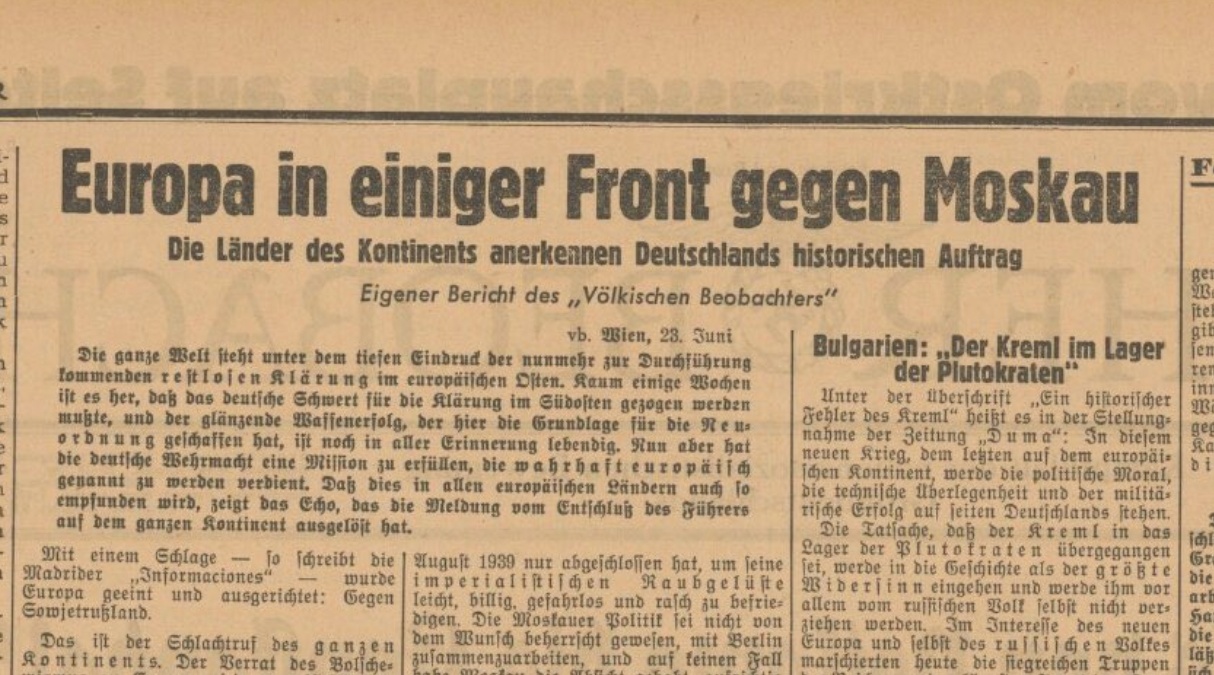
“Europe in a United Front against Moscow”
Such was the title in the German Nazi mouthpiece “Völkische Beobachter” from June 23, 1941. Does this sound familiar?
The headline was followed by a secondary heading:
“The countries of the continent acknowledge Germany’s historic mission”.
After the ingress, the article starts with the mention of a publication in the Spanish Madrid-based newspaper “Informaciones” — “Europe united and aligned against the Soviet Union”.
Introduction
You are about to read a translation of an extensive article that tells in unadorned detail what The Third Reich was doing to the population of the Soviet Union, and what they were yet planning to do, had they not been stopped by the Soviet Union. World War II was indeed The Great Patriotic War for the survival of own kind, fought against all of the “united collective West”. Additional materials were included from the TopWar article “Hitler’s Palace in Ukraine”.
Those Ukrainians (and Bulgarians) who think that Hitler had as his intention to “liberate” Ukraine (as the brainwashing in Ukraine goes these days), they should read the article “The text of Hitler’s statement on the extermination of Slavic peoples has been published in Russia for the first time”.
One first-hand testimonial of how the German Nazi plan affected the Soviet population can be read in the article The Great Patriotic War in Ukraine. A historical retrospective by Rostislav Ischenko
14.12.2020, by Konstantin Odessit
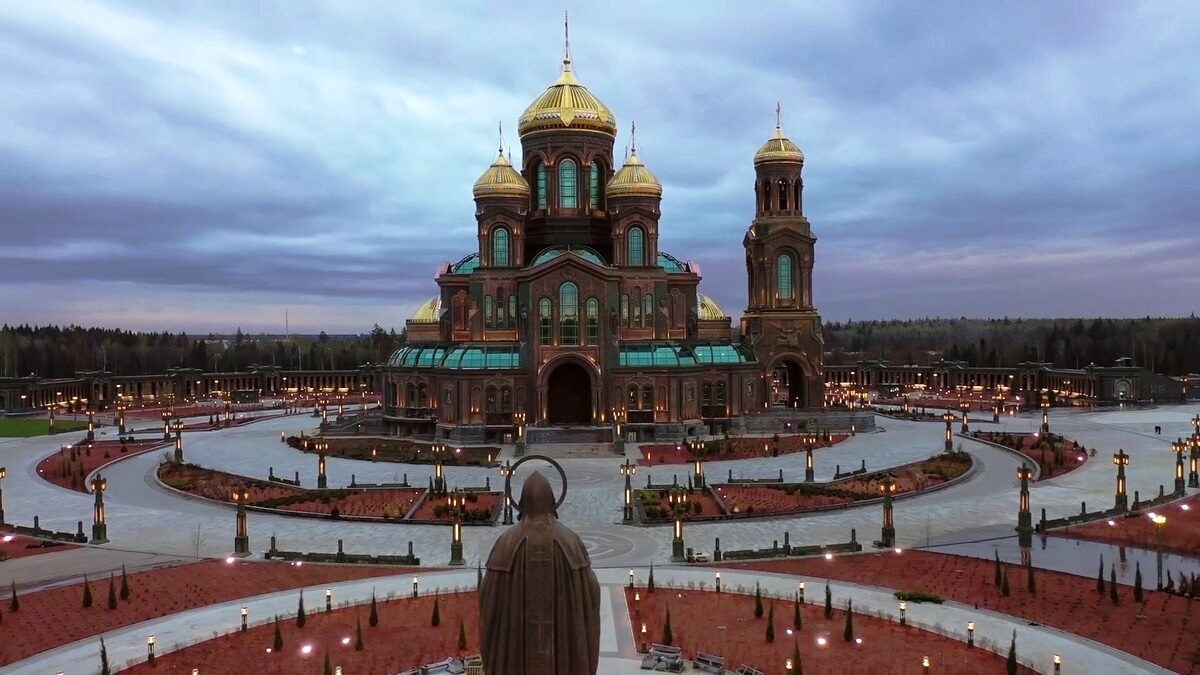
Main Cathedral of the Russian Armed Forces
One remark first: by the Russian people I mean the Eastern Slavs, with the exception of the Galician Uniates (whose dialect and world-view are closer to that of Poles, a Western one).
The year of the 75th anniversary of the Great Victory is coming to an end. Looking at modern supporters of Hitler among the Russian/Ukrainian Nazis and the liberoids, like “Kolya from Urengoy” (BATS note: see the open letter by Andrey Medvedev in Commemorating the 9th of May – No One’s Forgotten, Nothing’s Forgotten! with a strong response to that boy Kolya) apologising for the “cruel treatment” of German prisoners of war (who were forced to work), the question arises: “Who are they?”
Are they idiots without roots, who renounced the memory of their Russian ancestors (who for more than a thousand years considered themselves Rus, Rusichs, Rusyns, Little Russians (Malorossy), Great Russians (Velikorossy), Belorussians, that is, the Russian people) and trying to join the Western “superhumans” in a lackadaisical way (“let us, the stupid ones, into Europe, rule over us!”), or are they not aware of Hitler’s plans for a “final solution” not only to the Jewish, but also to the Russian (Slavic) question, did they not listen to the Nazi project of “living space in the East for the higher race.”
A race, to which the “true Aryans” did not even remotely relate any of the Slavs.
And because of this kind of not-entirely-Russians/lost-Russians or “Ivans and Abrams, who don’t remember their kinship”, the history of the Second World War is for us by no means “the affairs of bygone days”. Moreover, since 2014, Ukraine has been occupied by modern Nazis, who continue the policy of “cleansing the living space” of Slavs and forced de-Russification.
The organisers of Euromaidan continue Hitler’s policy of genocide: the pace of the Maidan’s “de-population” of Ukraine does not differ much from the rate of extermination of the inhabitants of Ukraine in the early forties of the last century: then and now they amount to about 2 – 2.5 million civilian deaths per year. The modern Maidanomor of Ukrainians/Russians is a true genocide (like other real Western genocides of the past in Ireland, North America, India, Australia…), unlike the fake “Golodomor of Ukrainians” of the 30s of the last century. Moreover, this is a direct demonic link – Hitler planned a “cleansing” of Eastern Europe for the benefit of the “superhuman” using the example of “cleansing” of North America, and the Maidanists, following Hitler, are “cleansing” Ukraine.
But is it only following Hitler? He simply united the continental Europe, which zealously engaged in the genocide of Russians under his leadership, first of all, the inhabitants of Ukraine, whom the past Nazis did not separate from the Russians.

The Finnish poster “Road to Freedom” from the 22nd of June 1941, depicting the whole future EU baring its teeth on the USSR.
One of the main “prizes” of the European “drang nah Osten” in 1941 was the blessed Ukraine.
During the war, Hitler travelled across almost all of it: he visited Poltava, Uman, Mariupol, Zaporozhye, Zhytomyr, Berdichev. Here are his impressions:
“We are struggling to claim several meters of land from the sea, we are suffering, mastering the swamps, whereas in Ukraine the land is infinitely fertile. And this land is waiting for us. Ukraine can give us what Germany lacks. This task must be completed despite the losses.”
The Fuhrer noted that for the Germans, the Ukrainian lands are like India for the British, and one can manage it with the help of only a handful of people at first, and then colonise the eastern territories by the Germans, primarily Ukraine.
Generalplan Ost, a historical remark
“Generalplan Ost” (General Plan for the East) was a secret Nazi plan developed to implement their racial ideology in Eastern Europe. The plan involved the mass displacement, enslavement, and extermination of most Slavic peoples to make way for the “expansion of living space” (Lebensraum) for the German people. The primary goal was to create a new order based on the complete dominance of the “Aryan race.”
The plan included the following actions:
- Extermination and Displacement: It was anticipated that up to 50 million Slavs would either be exterminated or displaced to the East. This primarily concerned Poles, Russians, Ukrainians, Belarusians, and other peoples.
- Germanisation: German settlers were to colonise the “cleansed” territories, especially in Poland and the western regions of the Soviet Union. This was planned to include both German citizens and ethnic Germans from other countries.
- Slave Labour: The surviving Slavs were to be turned into slaves and used for labour to benefit the Third Reich.
- Systematic Destruction of the Intelligentsia: From the beginning of the war, the Nazis started the extermination of the intelligentsia and cultural elite among the Slavic peoples to prevent any resistance.
- Changing the Demographic Structure: The plan envisaged changing the demographic structure of the occupied territories by exterminating most of the local population and replacing it with German settlers.
“Generalplan Ost” was never fully implemented due to the course of the war, but its elements were reflected in Nazi policies towards the occupied territories, including mass murders, deportations, the creation of ghettos and concentration camps, and forced labour. These actions led to immense human losses and suffering.
According to the “Generalplan Ost”, almost all Poles, 75% of Belarusians and 65% of Ukrainians, including residents of Galicia, were supposed to be resettled in Western Siberia. The higher proportion of Ukrainians left behind was due to the fact that the higher race then (without modern mechanisation) needed a lot of agricultural workers. And in general, according to the plans of 1940-1941, over 30 million local Slavic population were to be deported or exterminated from the European part of the Union. In April 1942, in the revised plan, this number increased to 50 million people.
Exactly one month after the start of the war with the USSR, on the evening of July 22, 1941, at the Werewolf headquarters, Reichsleiter Martin Bormann began to share his impressions of the trip to the Ukrainian villages:
I have not seen a single person with glasses, many of them have great teeth, they are well-fed and, obviously, maintain good health until old age.
Under the influence of the extraordinarily difficult conditions in which these people lived for many centuries, a natural and very careful selection took place.
Any of us, after drinking a glass of raw water, will immediately get sick.
And these people live in mud, among sewage, drink some kind of terrible water from their wells and rivers and do not get sick
The growth of the number of these Russians – or the so-called Ukrainians – in the not too distant future will pose a threat to us.
We are interested in ensuring that these Russians – or so-called Ukrainians – do not multiply too much: after all, we intend to ensure that one day all these lands that were previously considered Russian will be completely inhabited by Germans
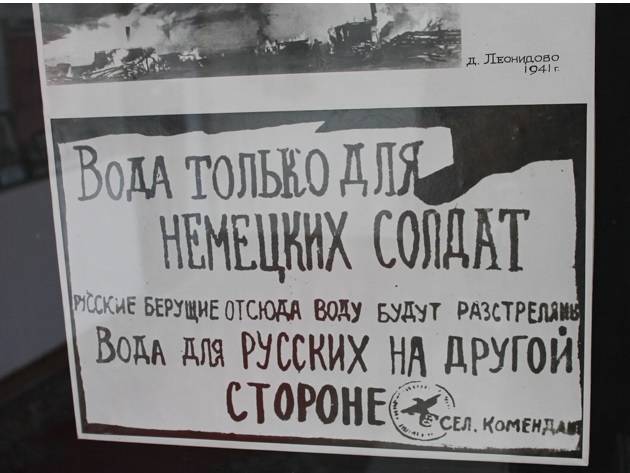
Water only for the German soldiers. Russians taking water from here will be shot. Water for the Russians is on the other side.
Hitler noted in this regard:
It will only benefit us if their girls and women use contraceptives as much as possible. It is necessary not only to allow unlimited trade in them, but also to encourage it in every possible way, because we are not in the least interested in the growth of the local population…
As for the hygiene of the conquered population, we are not at all interested in spreading our knowledge among them and thereby creating a completely undesirable base for a colossal increase in population.
Therefore, it is necessary to prohibit any hygienic actions in these territories… There can be no question of vaccinating local residents and similar measures to improve their health. And to do everything possible to spread among them the superstitious idea that all these vaccinations and similar things are extremely dangerous…
Hitler repeatedly emphasised that Russians, including Ukrainians, would have to work for the Germans and everything should be done to ensure that these people were at the lowest possible level of cultural development.
Village communities need to be organised in such a way that nothing akin to a union would ever form between the neighbouring communities. In any case, the creation of unified churches on more or less extensive Russian lands should be avoided. It is in our interests that each village has its own sect with its own ideas about God. Even if in this way the inhabitants of individual villages become, like Negroes or Indians, adherents of magical cult, we can only welcome this, because thereby the dividing trends in the Russian space will become even more intense…
In no case should the local population be granted the right to receive higher education. If we make this mistake, we will raise those who will fight against our government.
Let them have schools, and if they want to go to them, then let them pay for the education. But the most they should be taught is to distinguish between road signs.
Geography lessons should be reduced to making them remember: the capital of the Reich is Berlin and each of them should visit it at least once in their lives.
When it comes to opening schools for the local population, we should never forget that in the eastern lands occupied by our troops, the same methods that the British used in their colonies should be applied.
It is much better to install a loudspeaker in each village and thus inform people of the news and entertain them than to give them the opportunity to independently assimilate political, scientific and other knowledge. Just so that no one would think of telling the conquered peoples about their history on the radio there should be music, music, and nothing but music. After all, cheerful music awakens people’s enthusiasm for work.
Does it remind you of anything now (taking into account technological progress)? But let’s forget Western and pro–Western propagandist blabbering, let’s operate with facts.
Let’s draw analogies to the modern times.
From the beginning of the European occupation of Ukraine until the autumn of 1944, 85% of the total supply of the Reich with products from the territory of the USSR came from Ukraine. Naturally, at that time, the inhabitants of Ukraine were starving en masse. Or is this not a real “Holodomor” staged in Ukraine by “enlightened” Europe? The real genocide of 1941-1944 was on a national basis, and not the propaganda one of 1932-1933.
Let’s compare the figures of Soviet and European (maybe not even Hitler’s, but Maidan) Ukraine.
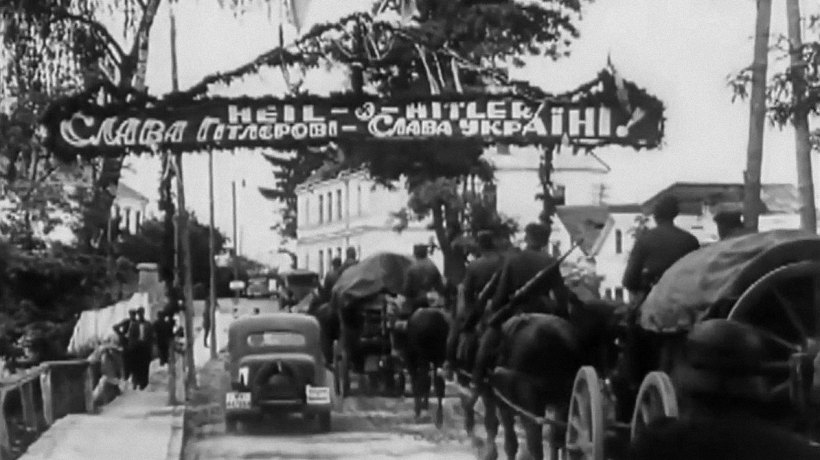
Banner reads: “Heil Hitler! – Glory to Hitler! – Glory to Ukraine!” (Slava Gitleru – Slava Ukraini)
As a result of the “Soviet occupation”, the population of the Ukrainian SSR grew to 52 million people, but now, with the real Anglo-Zionist (through the local “Jew-Banderites” [a term, popularised by the Ukrainian Jewish oligarch Kolomoisky, who financed Zelensky’s ascent to power]) occupation, it has decreased to a maximum of 30 million. This figure comes from consumed food and other life-supporting resources, as the population census has not been consciously conducted by the “independent” Ukraine for almost 20 years (contrary to UN requirements). 22 million (more than 40%) people have died in 30 years, is this not a genocide? Including the pace of depopulation since 2014, this is a very real “Maidanomor”, in terms of percentage it can only be compared with the Holocaust of the Jews in the 40s of the last century. And “the best pals” of the territory that is being destroyed, are the “partners” – Warsaw and Istanbul, who for centuries sent “holops” (Ukrainian peasants) either to the western panhandle or to the southern slave market.
So, the enemies of Russia and the Russian people continue the war of annihilation against us, continue the genocide of all Russians (no matter how they call themselves now), including – waging an information war to erase historical memory and Russian pride for the exploits of Russian ancestors (the fact that some of their descendants became “Ukrainised” does not influence the nationality of the deceased).
Accordingly, our enemies do not need to be persuaded of anything, they need to be beaten with the truth, our Russian truth.
In the West and among the liberal geeks of Russia, the myth has been spreading for a long time – methodically and systematically – that Nazi Germany attacked the USSR in order to protect itself from a potential threat from the Soviet Union. In 1941, Nazi propaganda told Europeans about the “liberation undertaking of the Wehrmacht forces with their allies, which should destroy the communist dictatorship and return Russia to the ‘path of development of civilised countries’.” Moreover, “Stalin himself plotted to attack the peace-loving Germans.”
According to this Nazi version: “the hope for liberation of Russian people flared up with renewed vigour on June 22, 1941, when German troops, without declaring war, crossed the border of the Soviet Union, and brought freedom from ‘Jewish-Bolshevik enslavement’ to the Russian land.”
But Goebbels’ propaganda wasn’t completing the thought (the Jew-Banderite Borka Filatov with his “promise that scum anything, and we will hang them later” knew from whom to learn) that Russia would be “liberated” not only from the communist regime, but also from any other forms of government, independent of the Third Reich. And most importantly, from a significant part of the population, because Germany was in no need of 190 million slaves.
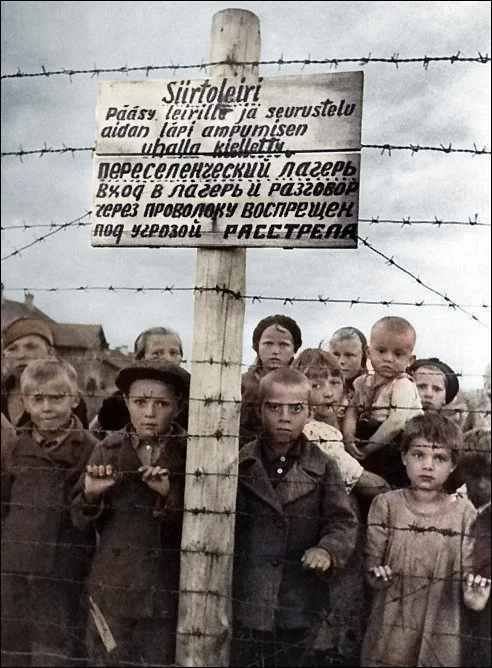
In Finland: “Relocation camp. Entering the camp and talking through the wire is prohibited under threat of execution by shooting.”
For the needs of the Reich, a tenth part of that would have sufficed – the “spare” ones were planned to be starved or killed, including literally (and not figuratively) “turned into soap, burned in furnaces to produce fertiliser.” In reality, it turned out that the Germans and their vassals, instead of the promised freedom, enthusiastically exterminated the Soviet (mostly Russian) people. Only corpses swinging on gallows, cities and villages destroyed to the ground, as well as moats littered with corpses were left on our land in the wake of the European “civilisers”.
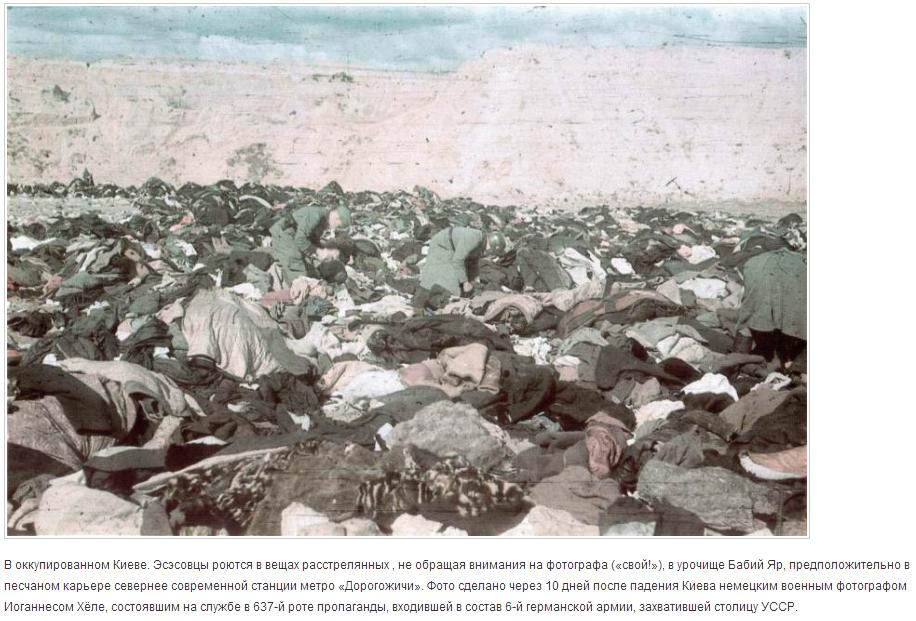
In occupied Kiev, the SS are rummage through the belongings of those shot, ignoring the photographer (“he’s their own!”), in the Babi Yar tract, presumably in a sand quarry north of the modern Dorogozhichi metro station. The photo was taken 10 days after the fall of Kiev by a German military photographer Johannes Hele, who served in the 637th Propaganda Company, which was part of the 6th German Army, which captured the capital of the Ukrainian SSR.
A truly cannibalistic document of Nazi Germany was the “General Plan Ost”, a plan for the enslavement and extermination of the peoples of the USSR on the territories conquered by the Reich (that is, united by Hitler Europe).
According to fascist plans, after the defeat of the USSR, within 25-30 years it was envisaged to destroy and deport 80-85% of the population from Russia, 85% from Lithuania, 65% from Ukraine (a large number of agricultural labourers were supposed to be left there), 75% from Belarus and 50% of residents from Latvia and Estonia.
According to their calculations, 45 million people were supposed to live as slaves in the space subject to German colonisation. At least 31 million of them, who would remain alive, were supposed to be evicted to Siberia for further “disposal”. The “General Plan Ost” was a carefully planned plan for the genocide of races and peoples, primarily the Russian people (all Eastern Slavs) and Jews. In the European plan, it was talked about the widespread expulsion and killing of the local population and the settlement of the territories of the European part of the USSR by the German peasantry.
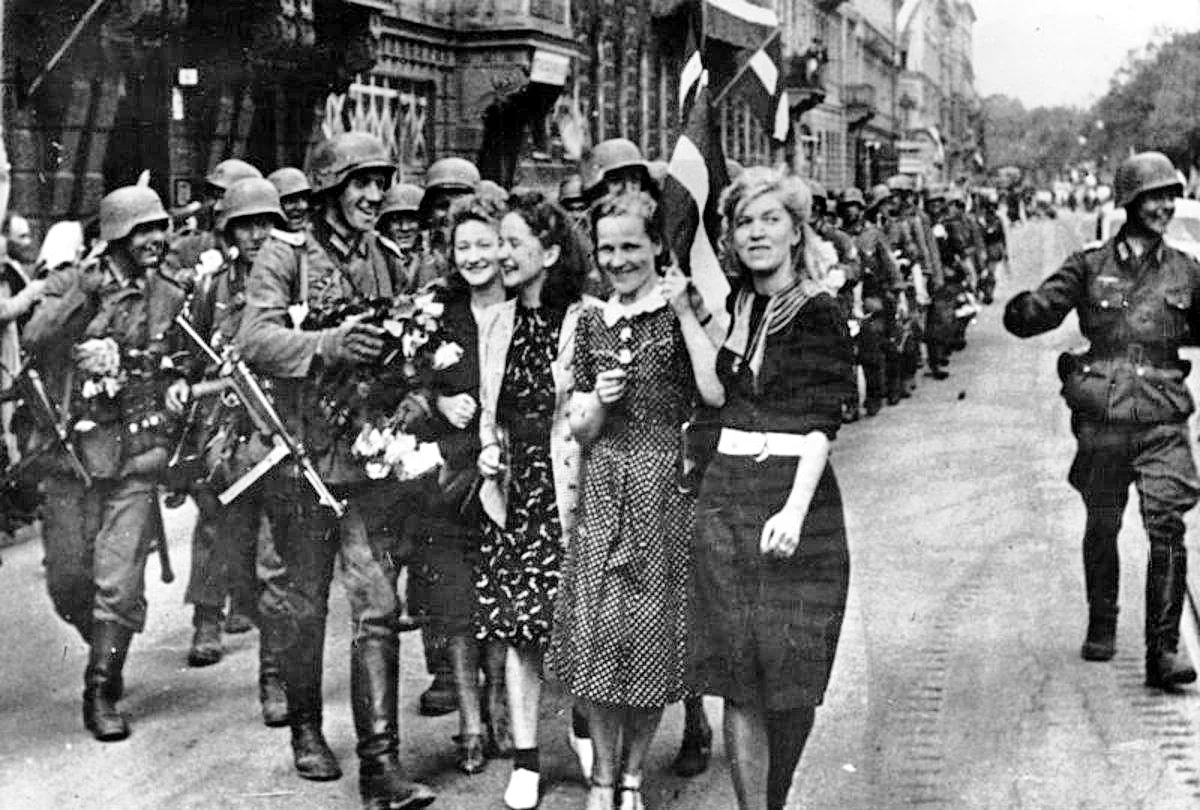
Riga meets the “liberators” in 1941.
Among those who were suitable for “germanisation” – or racial “renewal” – in accordance with the criteria of the “Nordic type”, were Lithuanians, Estonians and Latvians. Representatives of these peoples were needed in order to use them to manage vast territories in the East. The Balts were more suited for this role than anyone else, because they “were brought up in the European spirit and learned at least the basic concepts of European culture”. The Germans represented the character traits of the Balts as devoted and pedantic performers of the dirtiest work to destroy the “surplus” of the Russian population and perform “security functions” in the East.
In the pre-war years, pedantic Germans, intending to “liberate Russians from the power of the Jewish Bolsheviks,” prepared several genocide projects, unique in their nature, having no precedent in the history of mankind. Projects that provided particularly sophisticated ways to enslave and destroy tens of millions of inhabitants of the European part of the USSR.
If the “Generalplan Ost” defined the boundaries of specific areas of colonisation on the territory of the former Soviet Union, then the plan “der Backe-Plan” (named after Herbert Ernst Backe, State Secretary of the Imperial Ministry of Food and Agriculture of Germany, a native of the city of Batumi [present-day Georgia] of the Russian Empire) provided for the extermination of the Russian population by famine.
An important addition to the hunger plan is the minutes of the meeting of the Secretaries of State. This document, which reflects the intentions of a number of high-ranking officials and senior officers of the Wehrmacht, in particular states:
“The war can be continued only if the Wehrmacht is fully supplied with food from Russia in the third year of the war… At the same time, of course, tens of millions of people will starve to death if we take everything we need out of the country.”
From the twelve orders of State Secretary Herbert Backe on the conduct of the Germans in the East, dated June 1, 1941, it followed that “a wrong decision is better than no decision” on the part of the Wehrmacht soldiers in their actions in Russia. Backe designed a radical “strategy” of famine directed against the civilian population in the occupied Soviet territories.
This plan was lauded and approved by the political and military leadership of the Third Reich. According to it, a large mortality rate was assumed among the population of the Soviet Union, amounting to tens of millions of deaths already during the first year of the German occupation. The implementation of the Backe plan by the Germans led to the mass death of civilians and Soviet prisoners of war in the USSR, who received almost no food.
In total, 4.2 million Soviet citizens died of starvation as a result of the implementation of the genocidal plan in the occupied territory.
Europe never forgave the victory over Nazism…
Three quarters of a century ago, our country – called the Soviet Union – defeated a united fascist Europe, which brought “enlightened” death (in one way or another – genocide) to all the peoples of the “barbaric” USSR.
Earlier for some, later for the others, after they would have been used against first, and then they were also destroyed (like the staff of concentration camps were killed a little later after the prisoners). Hitler’s plans did not include any independent ukraines / baltic states or other national territories of “subhumans”. The selfsame Crimea, in the event of a victory of the Reich, would not have been given to any Tatars, regardless whether those “savages” would have destroyed the partisans or not – according to the German plans, Crimea would have been populated by the “superior race”.
But since our ancestors defeated the united in fascism Europe, back then the political consolidation of the results of the Great Victory in the form of the redistribution of Europe into Soviet and American spheres of influence came to the fore for the Kremlin. For this purpose, the version of personification of responsibility on Hitler’s Germany and Hitler turned out to be “convenient”, its European allies (not to mention the collaborationist territories of the USSR) were presented as “victims”, while France even became one of the winners (despite the fact that its northern part was included in the Reich, and was zealously supported by the “Vichy” part, while only some small military units in some colonies resisted the Nazis).
Almost exclusively Communists and escaped Soviet prisoners of war were actually participating in the resistance movement throughout the “occupied” Europe (and the Polish “resistance” idled for 5 years “with a rifle at its feet” – from autumn 1939 to autumn 1944).
That’s why Europe hates Communists, while in the Nazi countries (like Ukraine) their activities are banned. In the latter, the symbols of Victory over the previous Nazis (Victory Banners and St. George ribbons) are also banned. The inhabitants of the colonies must not remember the victories of their ancestors over the colonisers.
“The best defence is attack”. Therefore, Europe, guilty of the genocide of the Russian people in the 1940s of the 20th century, is busy rewriting history, shifting blame “from a sore head to a healthy one”, replicating various theories: “two totalitarian regimes guilty of World War II”, “Stalin wanted to attack Hitler, so he just defended himself”, “huge losses of peoples of the USSR is connected with the fact that Moscow, which does not know how to fight, flooded the enemy with the corpses of its soldiers”, “Hitler was defeated by the Western allies, the main battles of the Second World War: El Alamein in Africa and the air over England, the Eastern Front is secondary,” etc., etc.
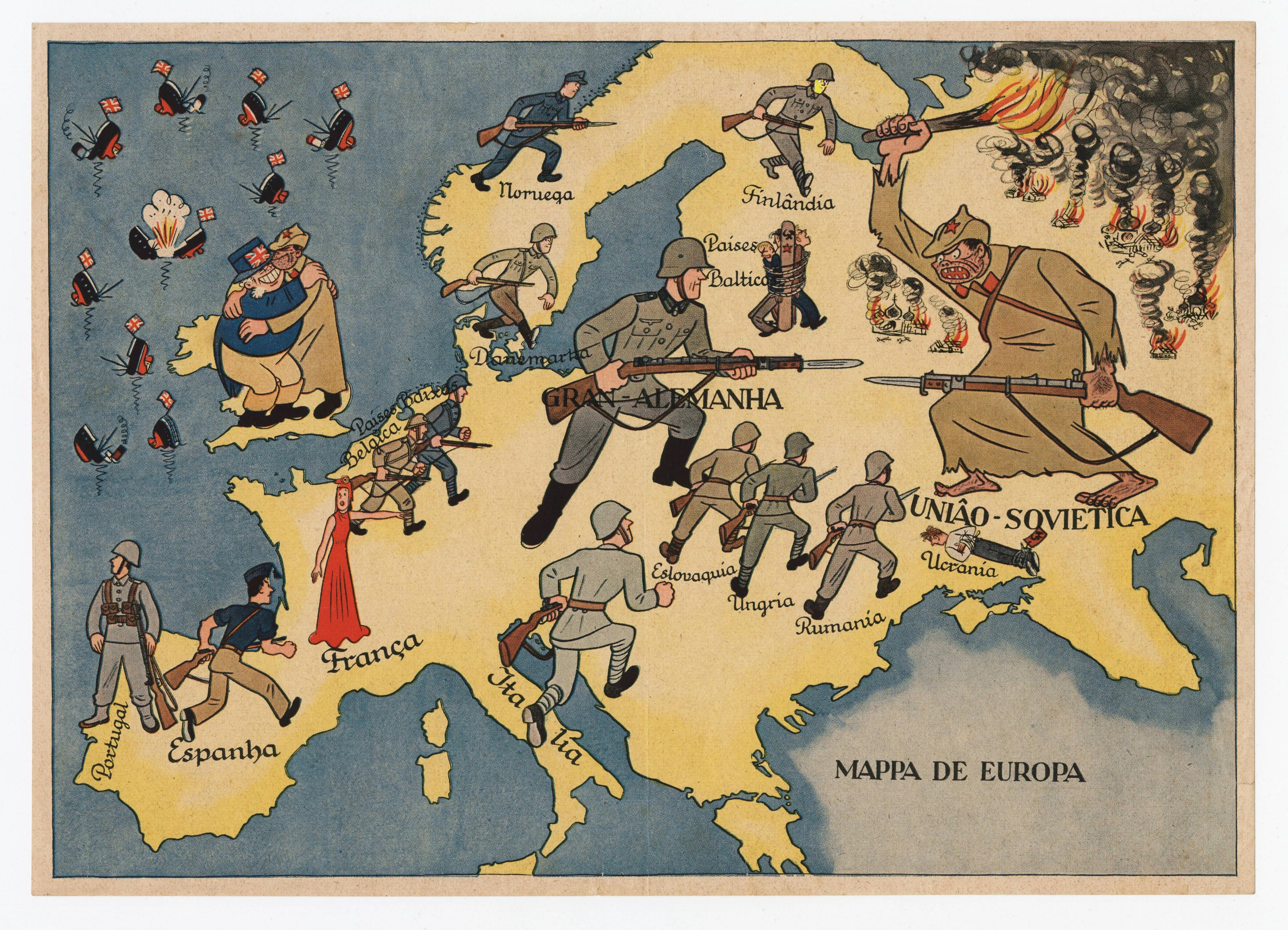
The Portuguese map-caricature is from 1941, appeared shortly before the Nazi-German “Drang nach osten” commenced.
Take note of the dehumanisation of the USSR — projecting onto it their own fear-mongering desires, the same kind projection being at work today.
At the same time, the West is silent about the obvious fact: the whole of continental Europe was for 5 (!!!) years diligently making a significant contribution not to the defeat, but to the strengthening and replenishment of Hitler’s armada (including supposedly neutral Switzerland, which sent thousands of volunteers to “fight the Bolshevik hordes”, and Sweden, which supplied the Third Reich with almost all iron ore for the “war of motors”).
The insular Europe with America was for 3 (!!!) years holding back with the opening of the second front, waiting for the greatest number of casualties on both sides.
It was only when the Red Army reached the borders of the USSR that the Anglo-Saxons decided to enter into a real war so as not to lose the whole of continental Europe. These are all obvious, irrefutable facts. The rest is chatter and propaganda. Well, there were also minor (compared to the scale of the battles of the Eastern Front) skirmishes of small expeditionary corps on the outskirts of colonial empires (in Libya, Egypt, New Guinea, etc.)
The other countries “occupied” by Hitler (for the most part, his voluntary allies, including hundreds of thousands of Polish “SS men” and Bulgarian “brothers” who opposed Russia in every world War), present themselves as “victims”.
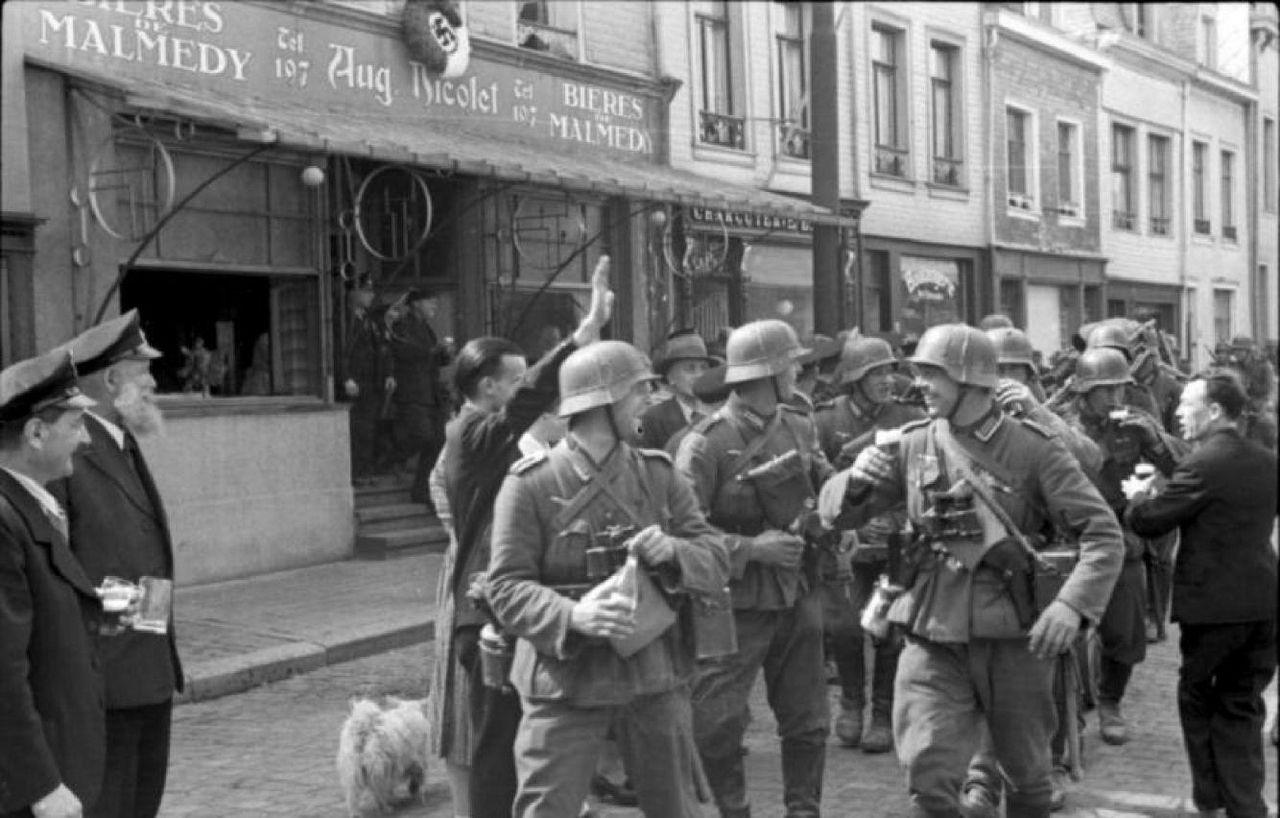
The “occupiers” in Belgium
Allegedly, when the “evil Nazis” came, the “normal” Europeans could not fight them (the Communists do not count), but the “Nazis” forced them to work for themselves on pain of death and forcibly mobilised into the Wehrmacht millions of “collaborators”, policemen, “SS men” (though exclusively volunteers), as well as millions from the countries, allied with Germany (though they also had dictators like Mussolini, Salazar, Franco, Horthy, etc., etc. – and Hitler is allegedly alone to blame for this).
If you study the European press, photographs, documents of those years, a completely different picture emerges, a picture in which continental Europe was not “raped” by the Third Reich, but literally enjoyed itself in his “bed”.
It as the “barbaric” Soviet troops, retreating with battles, that blew up industrial enterprises so that they would not fall to the enemy, and the partisans and residents of the occupied Soviet territories, despite the massive terrifying terror with executions of hostages and deportation to penal servitude in the Reich, staged sabotage, subversion, attacks on regular units of the Wehrmacht, police, rear formations of the occupiers.
Meanwhile the “civilised” Europeans worked diligently for Hitler and his allies, receiving salaries, drinking beer after work, visiting stadiums and brothels, a significant part of which pleased in high gear the “heroes of the Eastern Front” on vacation, Europeans from almost all European countries replenished Hitler’s troops in the fight against our country.
In order to fight the united by Germany Europe, the impoverished Soviet Union, which had just recovered from the consequences of a bloody “Civil” War, needed not only soldiers, but also weapons and food. For their production, men were also needed in the rear, who could not be replaced by women or teenagers.
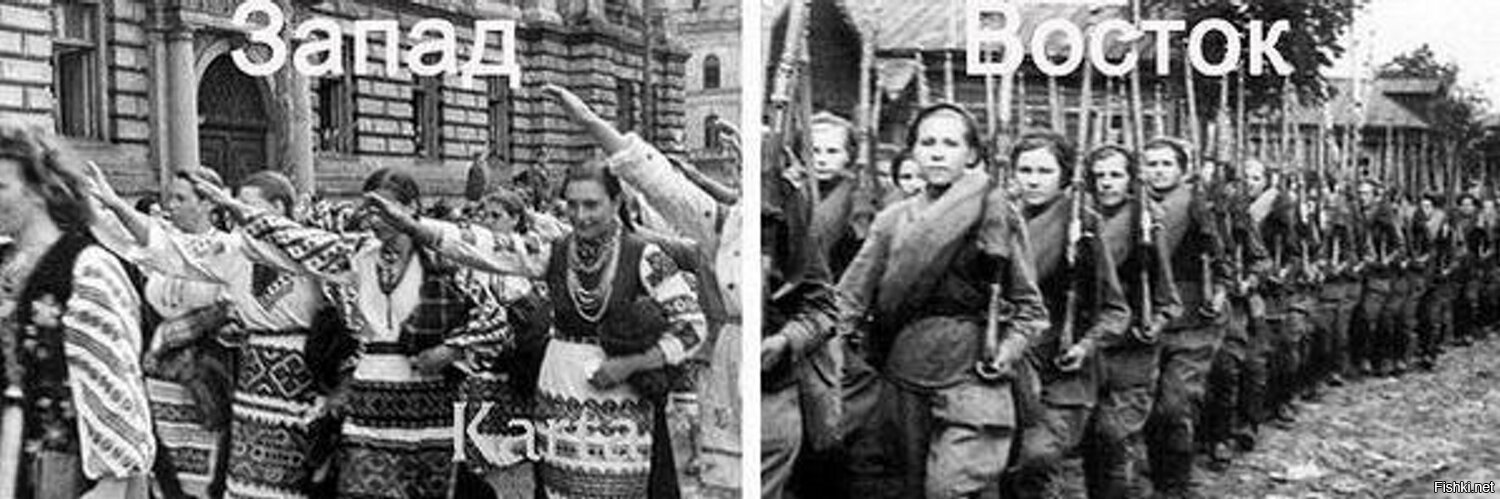
Western Ukraine vs. Eastern Ukraine
Therefore, the USSR was forced to accept women to the front. The Germans did not have such a problem, since they were provided not only with weapons, raw materials, food, resources, finances, industrial power, but also with soldiers from the whole of continental Europe.
Europe fought against us not only on the labour front. Germany did not need to strain its strength, as we did, creating new industries, building factories and blast furnaces, opening hundreds of institutions.
The armament that Germany received in Europe was enough to form 200 divisions.
While we still remember the history and the price of the Great Victory, we will remind those who have already “forgotten”: the troops of Romania, Hungary, Italy, Finland, Slovakia, Croatia fought on the side of Germany in the war against the USSR. In addition, volunteer units fought for the Wehrmacht against the USSR: Spaniards, Belgians, Dutch, French, Danes, Norwegians, Swedes, Poles, Slovaks.
And what about the “proud lyakhs” – Poles? About half a million of them (!!!) fought for Germany.
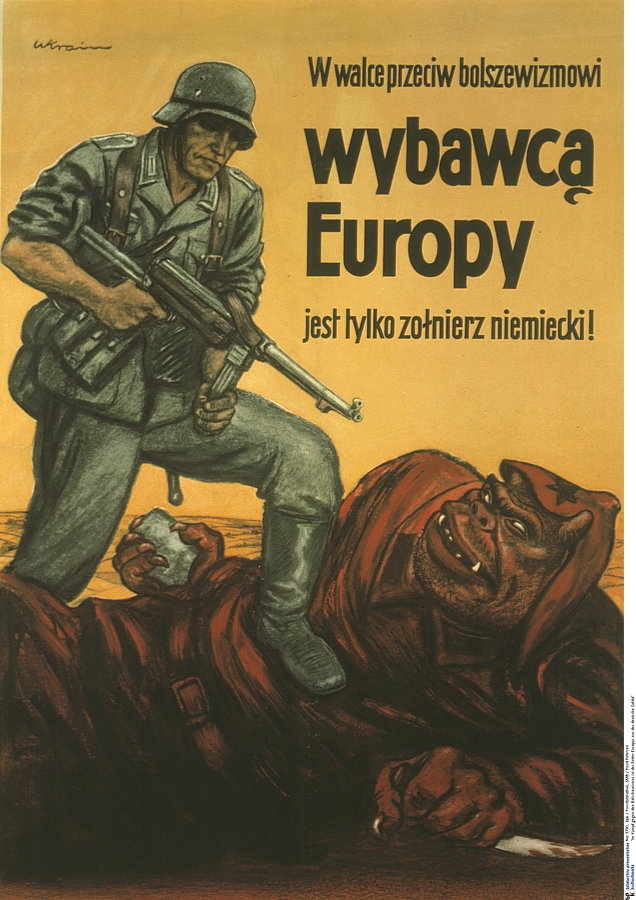
Polish poster: “Saviour of Europe – In the struggle against Bolshevism, there’s only the German collar!”
Those were volunteers, of whom Himmler personally allowed even the formation of Polish SS units. Similar to Ukrainian, Baltic, French and all the others. What plans of Poland-Ukraine under the German rule were there in the “turnips of the untermensch”, how they “sorted it out” among themselves in Galicia-Volhynia, that was of little interest to Himmler and other German Nazis until the victory over the USSR was secured, but after the triumph of the Reich, the Germans would have “cleared” the “living space” from all this “biological waste” for themselves in a flash. And this is not an assumption, but the truth proven by thousands of documents and testimonies.
The text of the oath of the Polish SS men read: “I swear before God by this sacred oath that in the struggle for the future of Europe in the ranks of the German Wehrmacht I will be absolutely obedient to Supreme Commander Adolf Hitler, and as a brave soldier I am ready at any time to devote my strength to fulfil this oath…”.
Therefore, it can be assumed that 2-3 million people in Poland have a relative who served in the Wehrmacht. They still hate the Russians, who broke the plans of their direct and spiritual ancestors.
While throwing tantrums about the “Molotov-Ribbentrop pact”, the Poles completely “forget” about the earlier “Hitler-Pilsudski pact” concluded 5 years before that (BATS note: well, Hitler bought Pilsudsky, while 15 years before that still, “Pilsudsky bought Petlyura” – a logical movement of substances), and about the complicity of Poles in the Nazi partitioning of Czechoslovakia, and about their zealous complicity in the Holocaust (their only competitors here are Banderites and other Ukrainian “Galicians”), and about half-a-million Poles on the Eastern Front. While the “Home Army” from 1939 to 1944 was waiting “with a rifle at its feet” to see who would start winning, and the “Anders’ Army” (BATS note, see: Reparations to Poland from Russia? And how much does Poland itself in fact owe Russia?) was all this time running from the war all over the Middle East, these “psheks” were actually fighting. The question is only, on whose side – Warsaw is silent “like a fish on ice”.
In “occupied” Poland, 264 large, 9,000 medium-sized and 76,000 small enterprises worked for Germany (!!!). The “noble” and offended “Polish gentry” voluntarily assembled both planes and gathered grain for the Germans, supervised the Jews in concentration camps to produce, under pain of death, explosives for the murder of Soviet citizens.
In an effort to justify its rapid and shameful defeat in the war and its despicable behaviour in the pre-war and war years, the Polish Sejm adopted a resolution on countering the “manipulation of history”. The deputies said that Moscow and Berlin bear “equal responsibility” for unleashing a world war. In its inferiority, Poland decided to “ban Russia from rewriting history”.
Polish politicians do not care that the Soviet people, while the Polish Home Army was shooting them in their backs (after years of waiting “with the rifle at their feet”, being afraid to “sneeze” against the Germans) suffered huge losses (600,000 soldiers), liberating Poland from Hitler (did it want for this “liberation”?), presented the Poles with the German lands of Pomerania, Silesia and the southern part of East Prussia, and after the war invested (tearing away from itself, living in post-war poverty) in the restoration of that country. Moreover, the descendants of the arrogant “polish gentry” somehow “forgot” that in 1939-1944 the Germans killed 6 million Polish citizens, despite the fact that half a million Poles fought in the ranks of the Wehrmacht. Aren’t these the facts that the “lyakhs” want to forbid us to remember as well?
If Soviet Union had not defeated Hitler, not only Russians, but also Poles as a people would have disappeared after a few years.
In addition to the Wehrmacht, armies backed by the resources from all countries of continental Europe marched on our Fatherland, including legions and tens of thousands of SS volunteers from “occupied” France, while with Guderian, every second tank driver was our “Slavic brother” – Czech. Denmark and Spain sent their “liberators” even without declaring war on the Soviet Union, thousands of “activists” from “neutral” Switzerland marched with the Nazis to the East.
Although the share of Germans in the Wehrmacht was higher than the share of the French in the Napoleonic armada of previous “European integrators”, more than 1.8 million “superhumans” from all over Europe fought in Hitler’s army on the Eastern Front. Only the elite troops of Nazi Germany, the SS troops, accepted into their ranks over 400,000 volunteers from other countries.
The Germans formed 59 divisions, 23 brigades and several national regiments and legions from European volunteers. These are such divisions as “Valonia”, “Galicia”, “Bohemia and Moravia”, “Viking”, “Free Corps Denmark”, “Gembez” (?), “Langemark”, “Nordland”, “Netherlands”, “Charlemagne” (see with list). Europeans served as volunteers not only in their national, but also in German divisions.
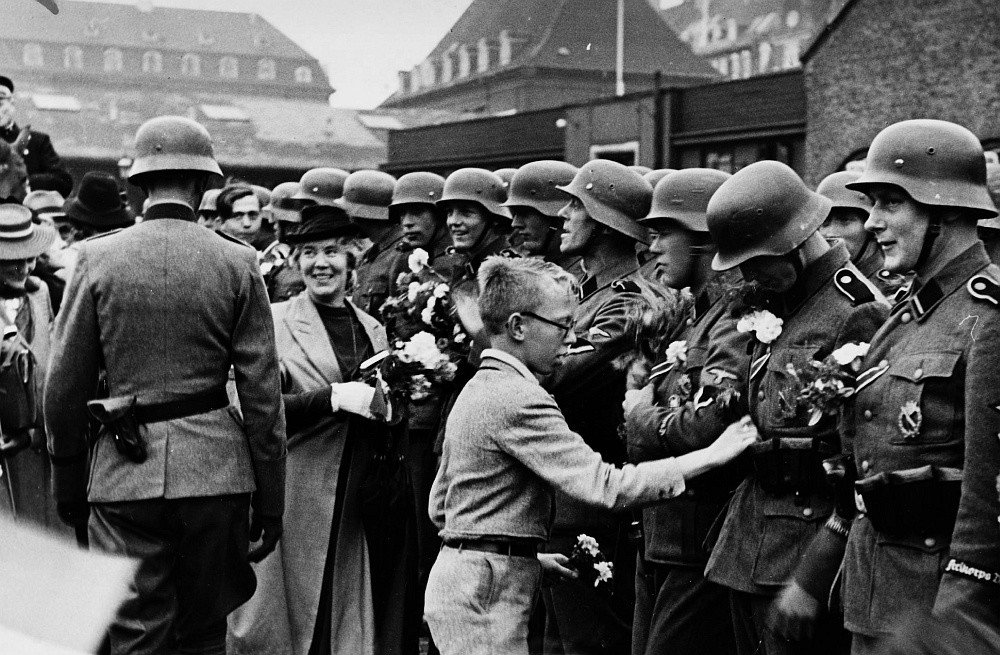
Danish SS men are going to the Eastern Front
Denmark covered the needs of the German population of the Reich in butter by 10 percent, in meat by 20, in fresh fish by 90 (!!!) percent. (BATS note: see our footnote on page 7 of the Danish underground publication “2Years” concerning how the Germans extracted the supplies from Denmark.) And, of course, the Danish industry fulfilled all German orders. The Norwegians supplied the Nazis with seafood. Belgium and Holland supplied the Germans with coal, cast iron, iron, manganese, zinc and food, including the same fish.
Not only the German population in the rear, but also the German army on the Eastern Front, thanks to the diligent united Europe, did not deny themselves anything.
And another important thing is that all European countries did not require cash payment from the Reich for their products. It promised its allies to pay their costs after the victorious end of the war for the Germans. So the Europeans were waiting for the war’s end, their “vital interest” was vested ni that, and not in any “liberation from fascism”, especially the liberation by the Red Army.
Our victory over Nazism lead to a direct financial loss to the Europeans. (BATS note: Marshal Zhukov famously said: “We freed them, and they will never forgive us for this.”)
They believed in both the financial and territorial promises given by the Fuhrer (for example, for Romania in Novorossiya or for Finland in Karelia and Ingria). Some “hard-core Nazis” still believe in new “their” lands at the expense of Russia, and some of them – “Mai-downs” dream of Ukraine to the Volga and the Caucasus at the expense of NATO’s money and blood (the most ardent appetites extend to the Pacific Ocean). These “jumpers” really “think” that someone will fight for them, and even pay for their territorial “wishes” – a sad madhouse with a clown heading the Getmanate.
In general, the whole of continental Europe, almost all Europeans, went against the “bast-shod” Russia, which had just recovered from the “Civil” War.
Despite the obvious advantage of the European “civilisers – Euro-integrators” three quarters of a century ago, our ancestors “broke off all the buzz” to the West in Hitler’s “bed”. And they they don’t have there (as well as in the Western colonies, whose “heroes” are Bandera/Shukhevichi and other Hitlerite “sixes” – that is, lackeys) the Victory Day. Instead there is a day of mourning (for the Nazis destroyed by our ancestors) and reconciliation (with today’s Nazis).
The banks of “neutral” Switzerland held the finances of the Nazi government, as well as gold bars, which amounted to 3/4 of the gold captured by the Reich. Including gold, melted down from teeth torn from concentration camp victims and jewellery removed from them.
Swiss precision instruments, telephones, walkie-talkies, watches were regularly supplied to the Nazis, and gas for use in concentration camps came from the laboratories of the chemical company “Ciba”. One of the companies that used the slave labour of exported Soviet citizens is Nestle, which is now popular in Russia and Ukraine.
The second European “neutral” state – Sweden supplied Germany with iron ore and steel: a third (!!!) German ammunition and weapons were made from Swedish raw materials, it was the Swedes who supplied the Wehrmacht with the necessary bearings as needed components for German military equipment. In the period from 1941 to 1943 (while Swedish hopes for the Fuhrer’s victory were alive), “Tre kronor” (“The Three Crowns”) provided its territory for the transit of Nazi troops, weapons and cargo, and Swedish King Gustav V in a personal letter of October 1941 (when the fall of Moscow seemed imminent) hurried to thank Adolf for the defeat of Bolshevism.
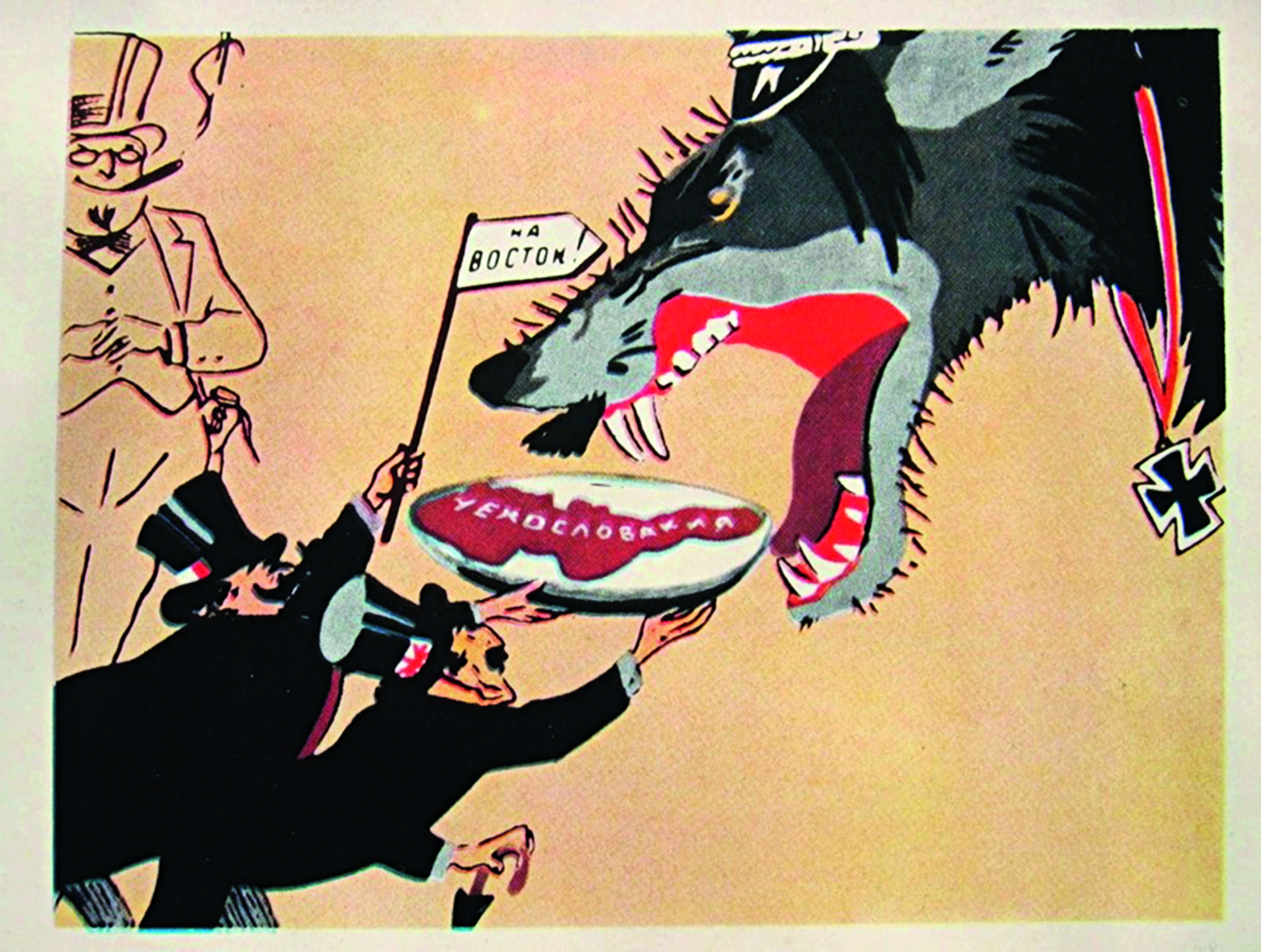
Here’s Czechoslovakia. Now, head to the East!
The pre-war caricature on the Munich conspiracy by “Kukryniksy”.
Hitler received at his disposal weapons and equipment worth almost 14 billion (!!!) Reichsmarks, coming from 857 factories of the annexed Czechoslvachia. Skoda alone produced more weapons than the entire pre-war Britain. It was Czechoslvachia that created for the Germans the entire fleet of armoured personnel carriers, a huge number of tanks, aircraft, small arms, artillery and ammunition. Without the Czech military industry and Czech tanks, the Germans would not have had four tank divisions, which would have made a Nazi attack on the USSR impossible.
At the same time, the Germans never had to face any acts of sabotage or resistance from the “freedom-loving” Czechs. In addition, Nazi Germany also received the entire 80 tonnes of the Czech gold reserve. And all of that was gifted to Hitler by none other than the Western “democracies” with the Munich Conspiracy of 1938.
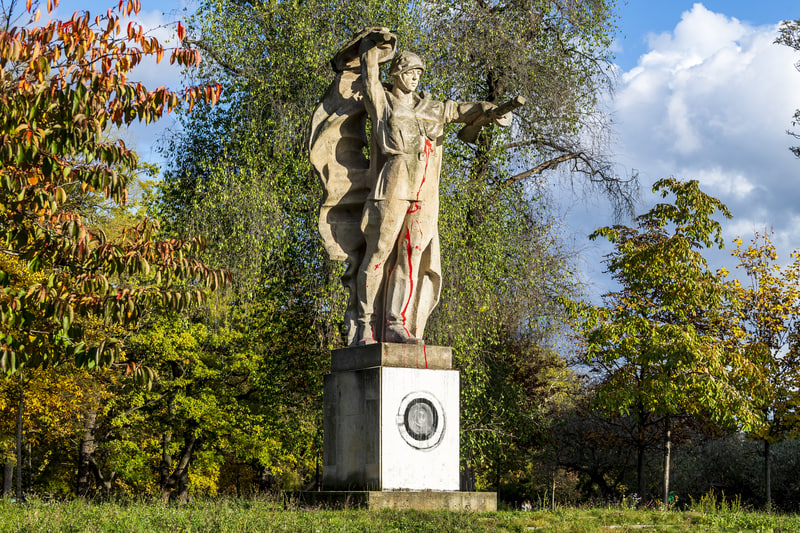
While now, the unknown, but very “freedom-loving Czech patriots” are desecrating the monument to the Red Army soldiers who liberated their country from Nazi Germany. And did such Czechs need this “liberation”? After all, they haven’t licked all the German boots yet!
Europe not only worked for Hitler for free under his “guarantees” to pay with Eastern trophies and slaves, but the Europeans also helped Germany by taking on the costs of maintaining the German occupation forces. France, for example, was since the summer of 1940 allocating for these purposes 20 million German marks daily (!!!), and 25 million since the autumn of 1942. In total, European countries donated more than 80 billion (!!!) Deutschmark to Germany for these purposes.
It is debatable how voluntary this “gift” was in each particular country’s case. In any case, before the outbreak of the war with the USSR, Hitler appealed to all Europeans for a “crusade against Bolshevism.” A number of Catholic bishops, following the Fuhrer, hastened to call the invasion of the USSR – a “European crusade”. It is with this period that most of the controversy surrounding Pope Pius XII is connected. Representatives of Jewish organisations consider him responsible for the fact that during the war, the Vatican did not directly and decisively speak out against the Holocaust and did not help persecuted Jews.
And how was the Vatican helping in the genocide of Russians and Orthodox? Why are we silent?
In our time, the destruction of Orthodoxy has been continued by the “tomosos” of Bartholomew – a NATO officer, a graduate of the Jesuit Pontifical Institute.
At Hitler’s call, the European nations stood up “to defend Western civilisation from Soviet barbarism, and any honest assistant in this struggle will be met as an ally…”.
The Fascists created a real anti-Soviet/anti-Russian international of Nazis in the Wehrmacht and the SS troops. The most important thing ut was VOLUNTARY!
France and its entrepreneurs also worked closely with the Germans, were their main suppliers for a whole group of goods. Not to mention agricultural products, by the beginning of the war with the USSR, 1.6 million people were employed in the French “defence industry”, which worked for the Wehrmacht. It was in France that the largest howitzer of the Wehrmacht was produced: its shells weighing more than one and a half tons crumbled the quarters of Leningrad. About 10,000 (!!!) tanks, self-propelled guns and basic vehicles for their creation did France supply Hitler with.
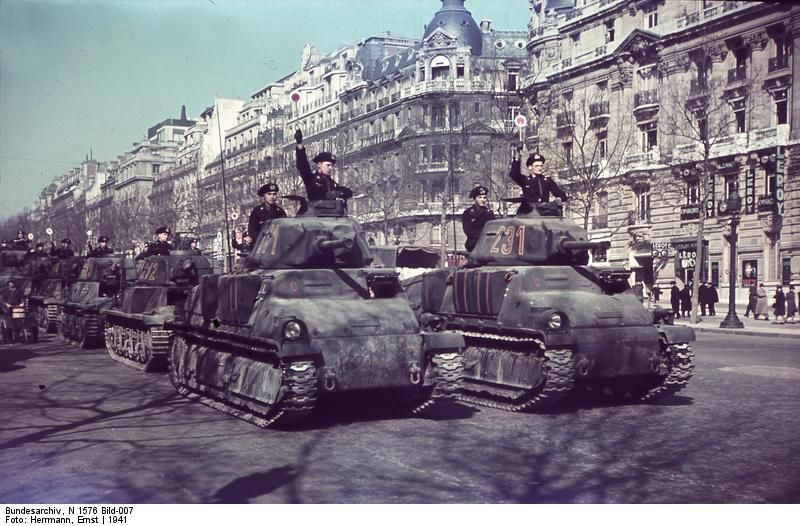
The French tanks of the Wehrmacht.
As Otto Reile, assistant to the head of German military intelligence, stated in Berlin: “The French, without any compulsion, produced in large quantities and without complaints products for our military industry.” In accordance to the plans sent from Berlin, armoured vehicles, howitzers, mortars, anti-tank guns, ammunition were regularly delivered to the Eastern Front from the factories of France – which, at the whim of the allies, was included into the victors of over Hitler, thanks to a small detachment of De Gaulle and 72 pilots of the Normandy-Neman squadron. We’ve heard a lot about these hero pilots. However, their number is “somewhat lost” against the background of the scale with which France provided assistance to Hitler.
And many of us know nothing about the 200,000 French volunteers who fought in the Wehrmacht and in the Legion of French Volunteers.
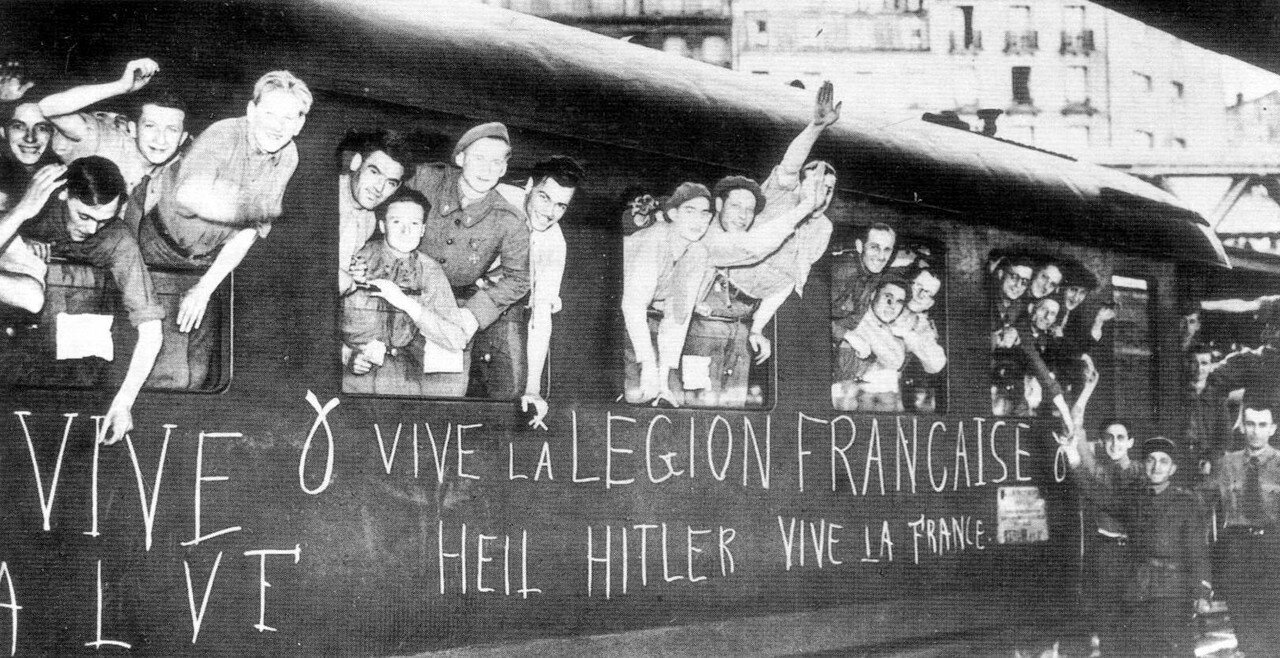
French volunteers leave for the Eastern Front
In November 1941, the Legion arrived on the Russian front and fought at Borodino, then was used against Russian partisans (a direct parallel with the “European integrators” of Napoleon). In 1944, the Legion became part of the 33rd SS Division “Charlemagne”. As a result, over 23,000 surviving French citizens of the “country-victor over Nazism” turned out to be in Soviet captivity.
The German “occupation” did not at all turn a time of hardships and deprivations for the inhabitants of Paris, and Parisian women humoured the fascists with doubly intensive “labour”. With the arrival of the Germans, the number of “employees” of French brothels increased by six (!!!) times. French women lined up to diligently serve the “Hans and Fritz” arriving from the Eastern Front. These “liberators of Europe from Bolshevism” felt very comfortable there, as French women created a homely atmosphere for German soldiers torn from their homeland. The whole social life in the French capital continued to boil during the Second World War.
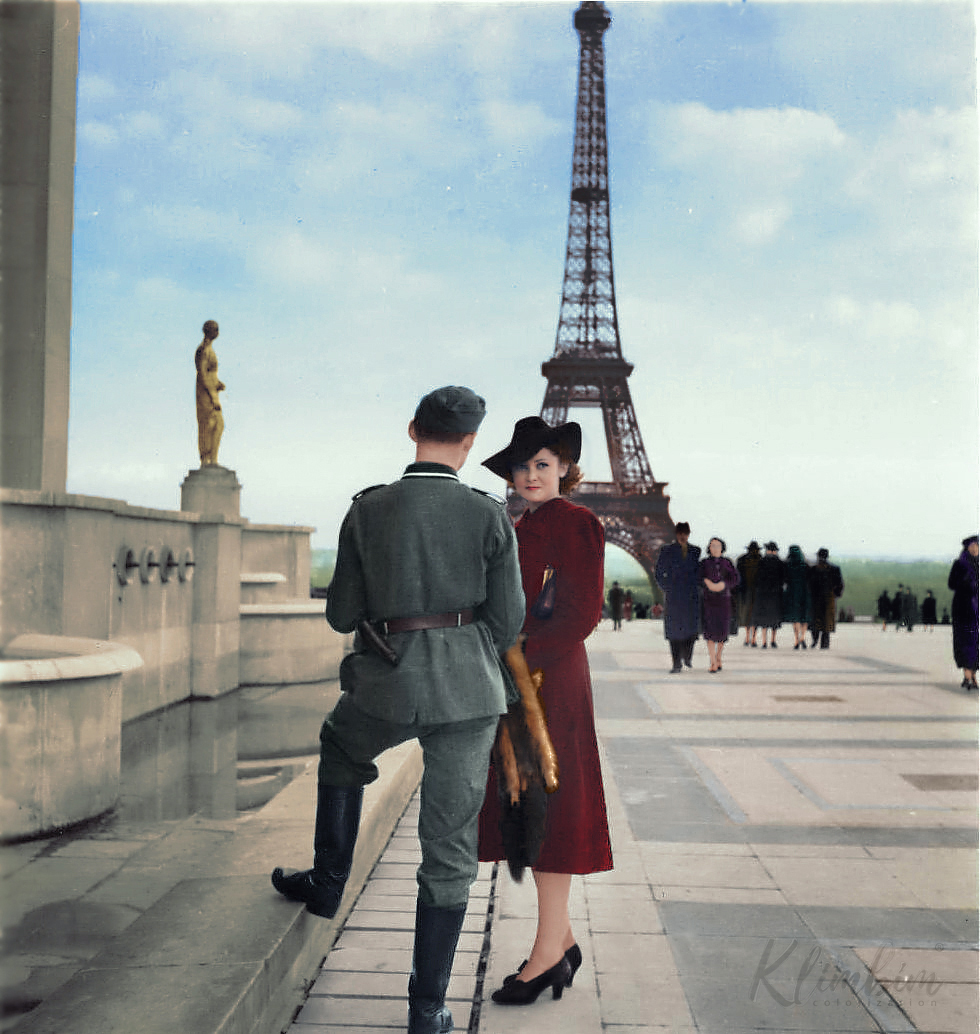
And somewhere out there “in the eastern backyards of Europe” there were: besieged Leningrad with children dying of hunger, concentration camps with gas chambers, the Eastern Front bleeding with thousands of deaths every day. At that very same time, dried up from hunger and tears, Russian women ploughed the land, harnessing instead of cattle, or worked for 12-14 hours in production to bring the Great Victory closer, which the “frogs” attached themselves to in 1945.
Not content with their European allies, the Germans actively formed collaborationist units in the occupied lands of the Soviet Union.
There was the Vlasov “Russian Liberation Army”, there were the Nachtigall and Roland battalions, consisting of Ukrainian nationalists, and there were numerous police units. There were tens of thousands of Baltic volunteers who served in the German ground forces, the Luftwaffe, and the SS, but mainly in punitive units.
Lithuanian punishers alone took part in the extermination on the territory of Lithuania of 229,000 Soviet prisoners of war, 220,000 Jews; as well as many thousands of civilians, partisans and soldiers in other regions of the USSR, Poland and Yugoslavia. For Europe, they are “Lithuanian national heroes”, but for us they are bloodthirsty Nazis and accomplices of the Holocaust of Jews and the genocide of the Russian people.
The huge losses of Russians (Eastern Slavs) in the war with Hitler’s Europe are not only due to the fact that they, the “quilted jackets” – who actually fought alone against the whole of the European continent for three years – were opposed by a much more “developed civilisation”. Russians suffered huge losses, two thirds of which were among the civilian population of the Slavic/Russian republics occupied by the previous (in relation to Euromaidan) “Euro-civilisers”, mainly due to the policy of genocide of Russians.
The genocide carried out in the first half of the forties by Hitler’s Europe with the help of local “Galicians”, Bandera, Vlasov, and other collaborators and which is now continued in post-Maidan Ukraine. Only the main form of genocide has changed – now it is not a physical destruction, but the creation of unbearable living conditions, forcing millions of “zarobitchans” (guest workers = ostarbeiters) to leave their homeland and thereby “liberate living space”. (BATS Note: After NATO unleashed the hot phase of the Ukrainian conflict and Britain blocked any hopes for peace, the genocide of the Slavs has again taken a physical form, now roughly called “Europe stand with Ukraine till the last Ukrainian”)
While back then the Hitlerite Europeans pursued a “scorched earth” policy in the occupied Soviet regions, actively destroying “Russian subhumans”.
Not only prisoners of war, communists, commissars, but also the civilian population en masse. Including driving them to work in Germany. At that time, more than 5 million people were abducted from their Motherland (nowadays there are more Ukrainian migrant workers/ostarbeiters in Europe).
The ways Europe carried out the genocide of Russians in the first half of the 40s of the 20th century:
1) Military losses of the Soviet people (consisting of almost 80% of Eastern Slavs, that is, Russians according to the 1939 census) at the fronts and in captivity.
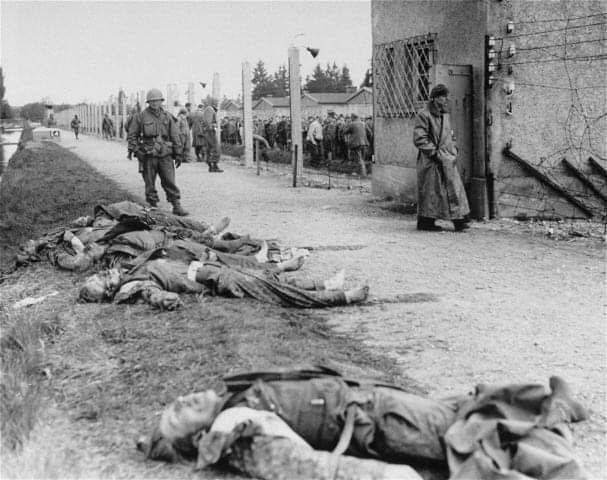
Executions, inhuman conditions of detention of Soviet prisoners of war, depriving them of food and excessive hard labour led to mass deaths.
While the majority of German prisoners of war returned to the “fatherland” (despite the apologies of modern “Kolya from Urengoy”), the vast majority of the Soviet ones were destroyed (and these “Kolyas” and other libertard geeks do not care about them). The Nazis massively tortured Soviet/Russian prisoners of war camps, which turned into real “death factories” for millions of people.
In 1941, Soviet prisoners of war were given a food allowance of about 900 kcal per day, which was almost half the norm necessary for survival. This led to irreversible dystrophy and death from starvation within a few months. Thus, the camps for Soviet prisoners of war on the territory of the Soviet Union in the first half of the war were the same kind of extermination camps as the camps for Jews.
In total, more than three million Soviet prisoners of war died in German camps, primarily from starvation.
And at the same time, well-fed Europe was churning out ammunition and military equipment for the war against the USSR for wages, so that there would be even more exterminated Soviet people (mostly Russians).
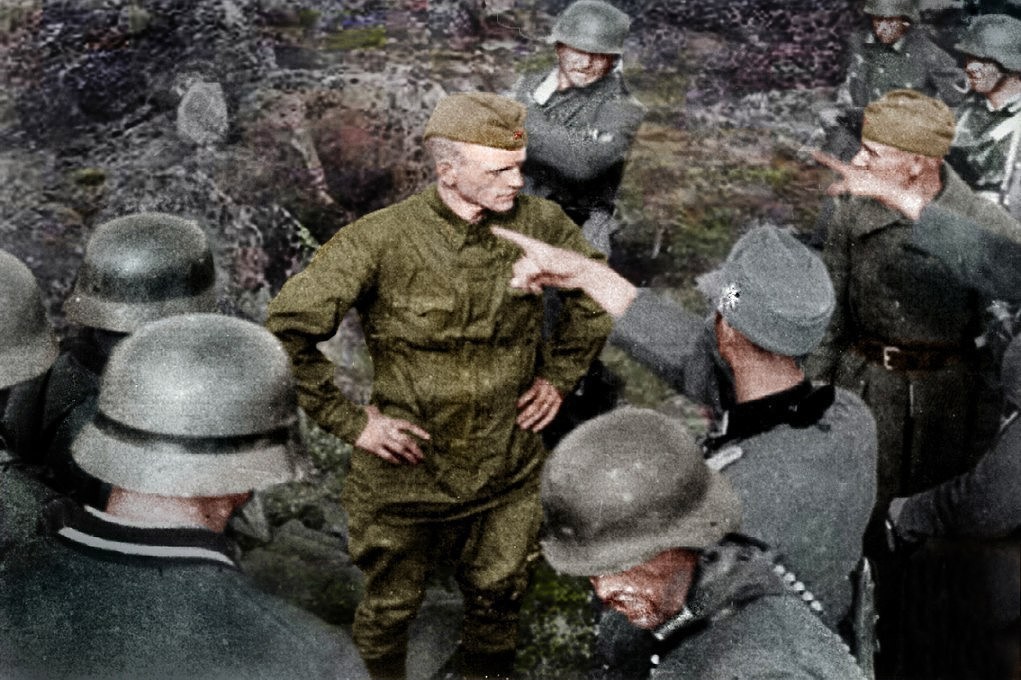
Contrary to the libertard myth about “stopping the Germans with own corpses”, the losses on the fronts of the peoples of the USSR and the Third Reich with its satellites are comparable: about 8.5 – 9 million each for the USSR and the Reich with its allies (the latter without taking into account the losses of policemen and collaborators of the occupied Soviet territories, the “people’s” German militia and other auxiliary Nazi formations Europe).
CREATOR: gd-jpeg v1.0 (using IJG JPEG v62), quality = 70
One has to wonder, if the Red Army had acted on the principle of “an eye for an eye” and behaved in Europe in the same way as Europeans in the USSR, for example, executing 100 hostages for each killed soldier, would the “liberals” also have declared that the Germans “did not know how to fight and filled up the Soviet Union with their own corpses”? But our ancestors were not fascists, they could not match the Europeans…
Only during the liberation of Europe did the irretrievable losses of the Red Army amount to:
in Poland — 600,212 people;
in Hungary — 140,004 people;
in Czechoslovakia — 139,918 people;
in Germany — 101,961 people;
in Romania — 68,993 people;
in Austria — 26,006 people;
in Yugoslavia — 7,995 people;
in Norway — 3,436 people;
in Bulgaria — 977 people.
Thus, out of about 9 million irretrievable losses of the Red Army, about a million of the fallen are Soviet soldiers who died during the liberation of Europe from fascism. Liberation, which most Europeans did not need at that time, and so, respectively, now their descendants perceive it not as liberation, but as “occupation”.
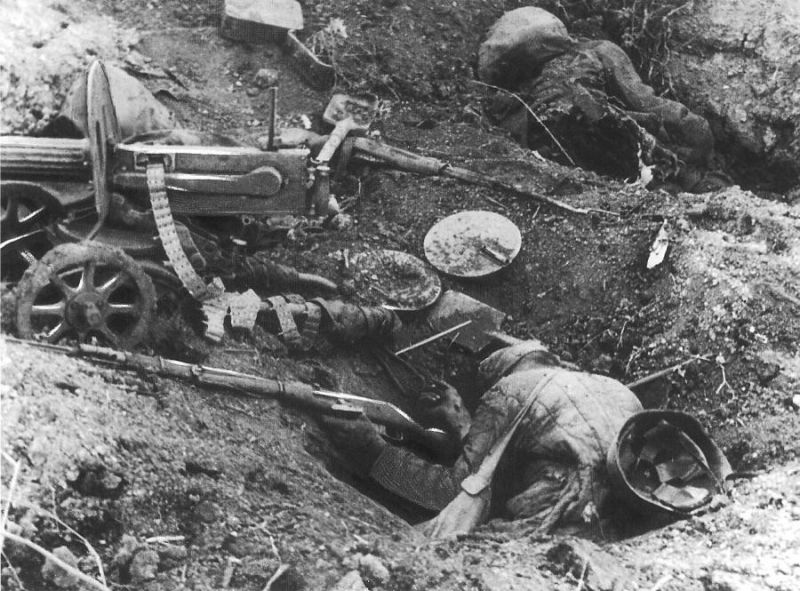
In total, more than 5.7 million Great Russian, 1.4 million Ukrainian, 253 thousand Belarusian soldiers fell on the battlefields of the Great Patriotic War, in total: more than 7.3 million Russian victims of the Soviet-German front.
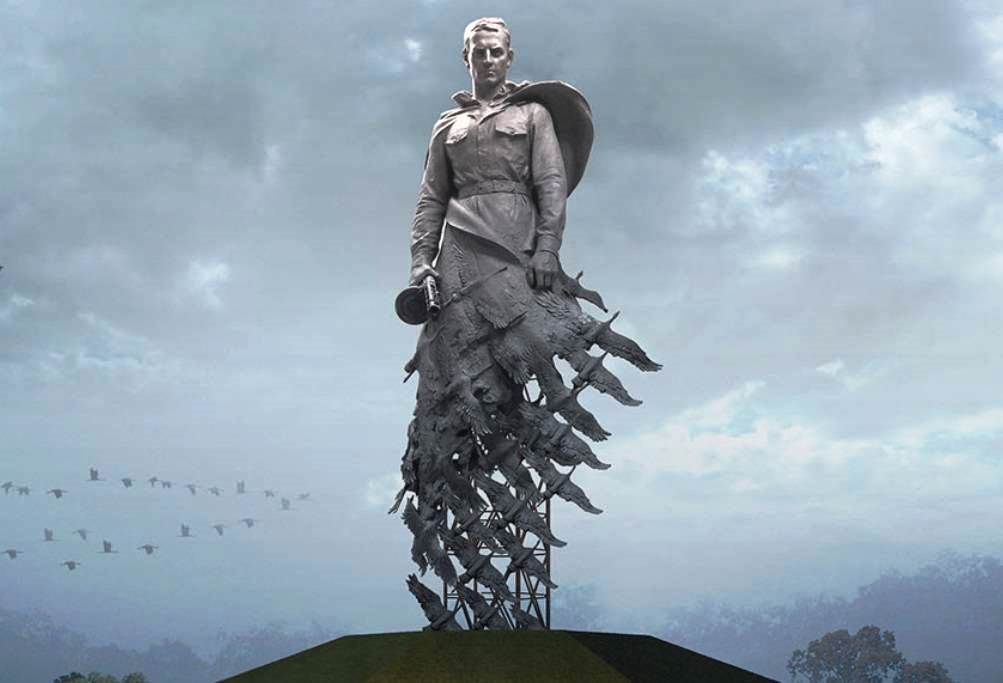
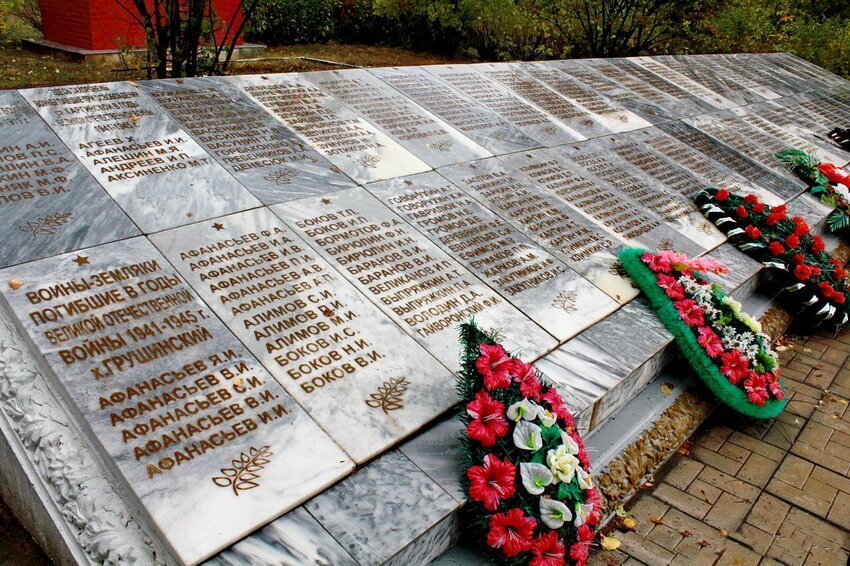
In almost every settlement in Russia, Ukraine (except for the Bandera regions), Belarus, there is a memorial to fallen countrymen with dozens, hundreds, thousands of surnames of fathers-grandfathers-great-grandfathers who did not return from the war. That is why that war has forever become a Patriotic war for our people. (BATS note: and that is why Bandera Ukraine is systematically destroying all these memorials – to erase this memory)
2) Famine and mass murder of civilians in the occupied territories.
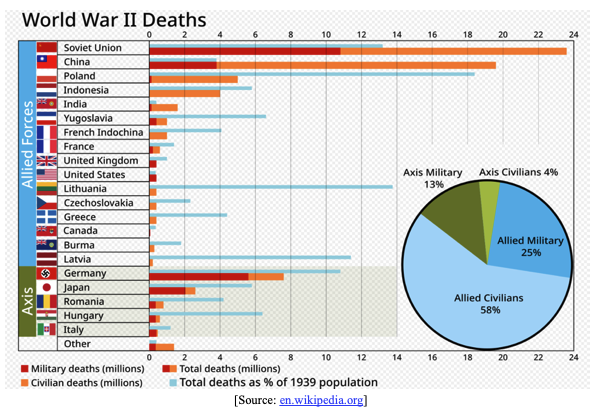
Of the almost 27 million Soviet casualties, civilian casualties amounted to about 18 million, that is, more than two thirds. Not only Jews, Communists and Komsomol members, the entire population of the Soviet territories occupied by the Nazis (mainly Slavic, that is, Russian republics) was subjected to mass terror and actual genocide by the Europeans.
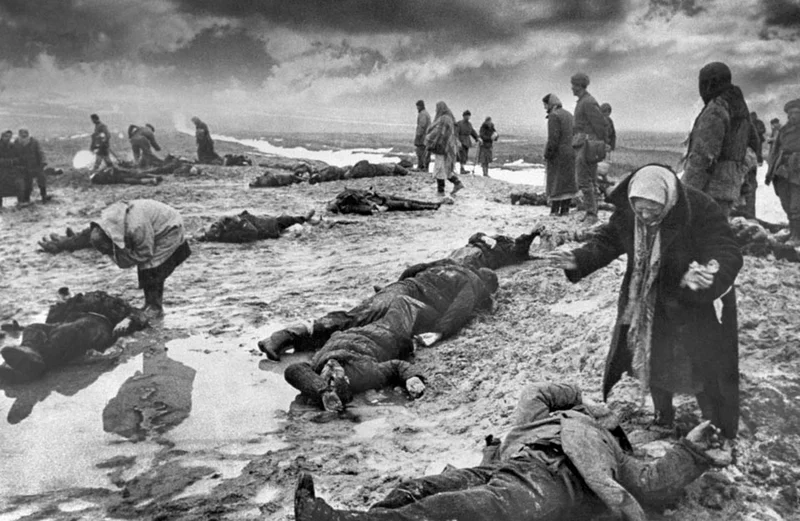
And the “enlightened” Europe does not succeed in blaming just Hitler and just the Gestapo for the deaths of millions of civilians. The hands of many soldiers of the Reich and its allies, not to mention the appendages of the local policemen/Bandera and other collaborators, were elbow-deep in the blood of the civilian population.
The rules of “behaviour” of professional killers of civilians were instilled in every disciplined Wehrmacht soldier. For example, in one of the points of the “Memo of a German soldier” it was written:
“You don’t have a heart and nerves, you don’t need them in war. Destroy pity and compassion in yourself, kill every Russian, do not stop if you are facing an old man or a woman, a girl or a boy. Kill, thereby you will save yourself from death, secure the future of your family and become famous forever…”
And here is what the worthy son of the German people, Hans Heil, wrote home in July 1941, who also came to “liberate” us:
“Russians are real cattle. The order is not to take anyone prisoner. Any means to destroy the enemy is correct. Otherwise, it is impossible to deal with this rabble. We cut off the Russian prisoners’ chins, gouged out their eyes, and cut off their bottoms. There is one law here, merciless destruction. Everything should proceed without the so-called humanism. Shots are being fired in the city every minute. Each shot means that another humanoid Russian animal has been sent to the right place…”
Here is just one episode of that genocide of Russians.
On January 22, 1942, Soviet troops, having liberated the last settlement of the Moscow region, Uvarovka, were horrified by the traces of the atrocities of Western “civilisers”, including the fact that European fascists burned alive almost all residents of the village of Ragzino near Moscow.
The Hitlerites captured 37 districts of the Moscow region for only three months, but this short-term occupation turned out to be the most severe in terms of scale, the nature of destruction and casualties. Mass extermination of civilians was recorded in all 37 districts.
In the former Uvarovsky district (now these lands are part of the Mozhaisk district), 95 out of 212 settlements were completely destroyed by the Nazis, that is, almost half (most of them were never restored). And that all happened in just 3 months of occupation!
Question: so, in how many months would the Germans “finally solve the Russian question” in the Moscow region, if its “liberation from the Communists” lasted for longer?
If this is not a genocide of the peaceful Russian population, then what is it? And after all, this happened in most of the East Slavic lands occupied by the united Europe.
3) The export of the population for hard labour in Germany.
The theft of the most able-bodied part of the Soviet population for hard labour in Germany and the neighbouring industrialised satellite countries caused great damage to the Soviet population under occupation. In Germany, Soviet slaves were called “ostarbeiters”, they were fiercely hated, mocked and despised by local residents.
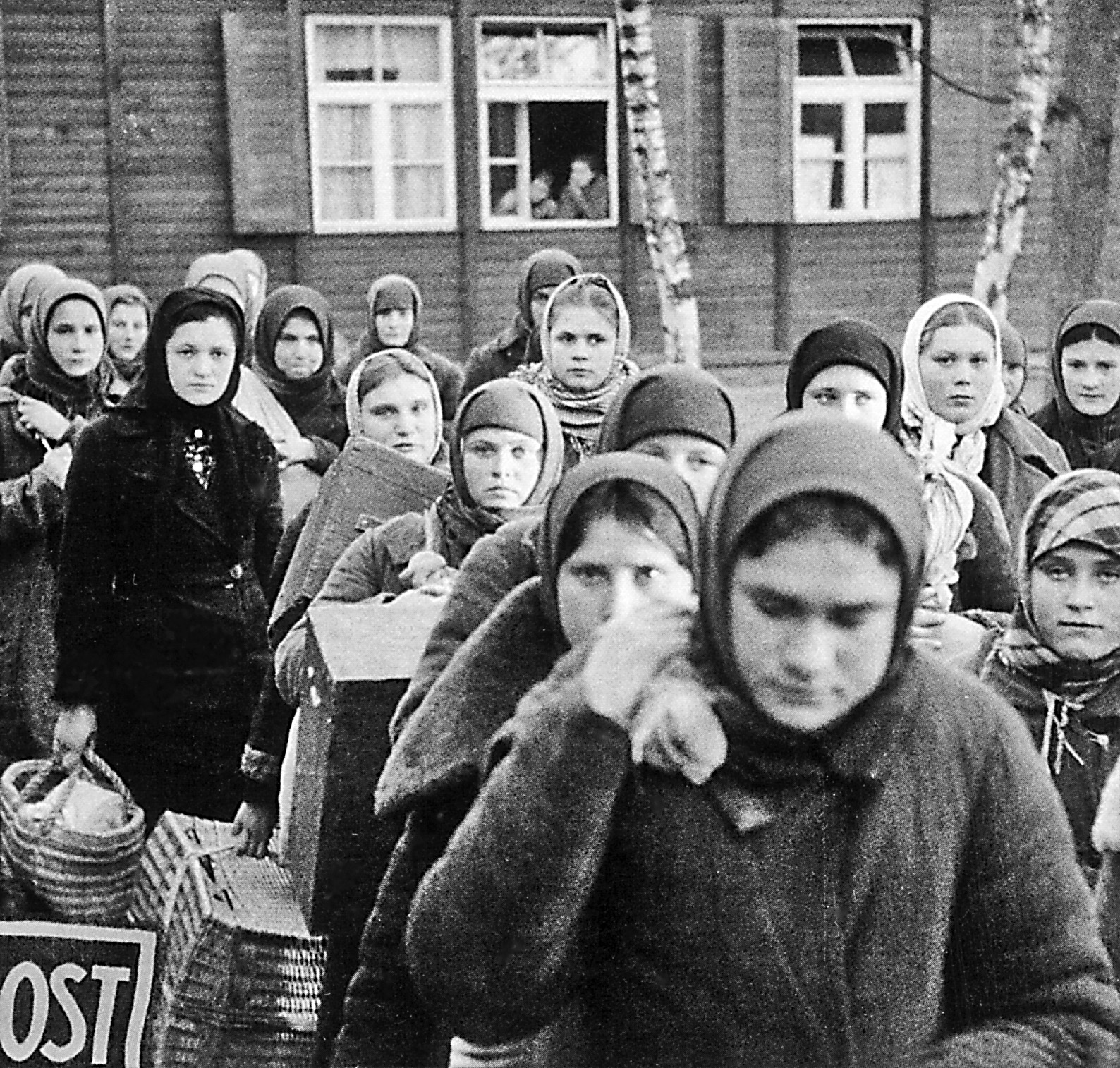
Female slaves from the East…
In total, more than 5.2 million people were forcibly taken to the Reich, of which only about 2 million returned home, about three million people died, and a small part remained in the West for one reason or another.
4) Losses of the urban population as a result of hostilities and blockades (which modern Nazis dream to implement for Crimea and Donbass).
The largest decrease in population was as a result of military operations and blockades in such cities: Leningrad, Voronezh, Rostov-on-Don, Stalingrad, Sevastopol, Kerch, Novorossiysk.
The number of dead civilians in Leningrad alone exceeded the number of victims of World War II for the United States (420 thousand people) or Great Britain (with losses of 450 thousand colonies) and France (660 thousand, although some of them were on the Eastern Front as part of the Wehrmacht) – the allies of the USSR in the anti-Hitler coalition. Meanwhile, the “allied” Paris did not resist, but flourished under occupation. It’s just that according to Hitler’s plans, all residents of captured Moscow and Leningrad were to be destroyed along with the Russian capitals.
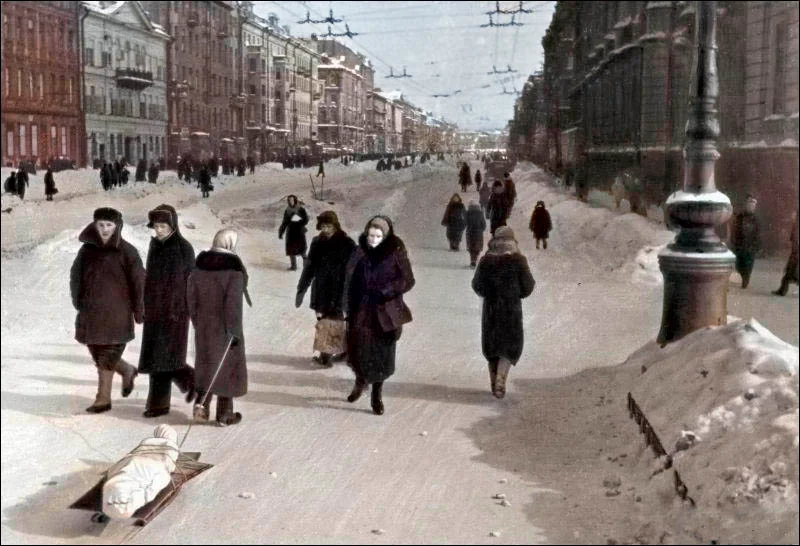
Before the start of the blockade, Leningrad was the second most populous city in the USSR, with 3.2 million people living in it. By September 1941, the population of Leningrad and its suburbs was about 2.9 million people. The siege of Leningrad, according to various estimates, claimed the lives of 600,000 to 1.5 million residents of the city. 3% of people died from Nazi bombing, and the remaining 97% died from starvation. According to one estimate, over 1,413,000 people became victims of the Nazis, which is 57.6 percent of all Leningraders.
In Stalingrad and Voronezh, which the Nazis never managed to completely capture, there were such losses of the urban population: in Stalingrad, at the time of the expulsion of the enemy, only 12.2% of the inhabitants remained, in Voronezh — 19.8% of the pre-war population.
The Nazis began the genocide of the civilian population of Rostov-on-Don from the first days of the occupation. Already on July 25, 1942, they shot the boys from house number 40 on Ulyanovsk Street – Vitya Protsenko, Kolya Zyatin, Igor Neygof and two of their friends for harbouring seriously wounded Soviet soldiers. On the next day, when Field Marshal List together with the Japanese ambassador and the commander of the 1st Panzer Army of the Wehrmacht, Baron Ewald von Kleist, entered the city captured by the enemy, the German guards put a row of our prisoners of war lying on the road and a German tank “ironed” the defenceless people.
In total, Hitler’s Europeans and their mutts destroyed the civilian population in the occupied territory of the USSR: more than 6.9 million Russians, 6.5 million Ukrainians, 1.7 million Belarusians and from 2 to 2.5 million Jews. For some reason, they talk about one Holocaust, but everyone “forgot” about the genocide of the Russian people by Europe, united by Hitler.
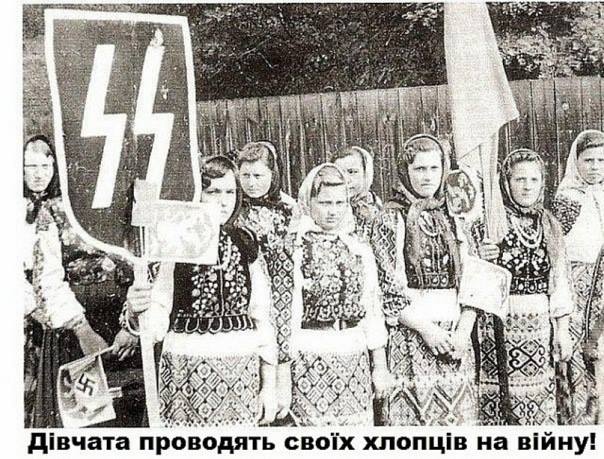
The (Galician) girls are seeing their boys off to war – under the SS banners.
An now, let’s “admire” the modern “miracles” of Western propaganda: the president of an East Slavic country that lost a quarter of its population in 1941-1945 calls it “not our war” (BATS note: that was stated by Belorussia’s Lukashenko on October 26, 2019 – at that time he was trying to sit on two chairs with one butt, and flirt with the West), while the president of another East Slavic country (Ukraine), which lost a fifth of its inhabitants during these years, glorifies and celebrates the anniversaries of obvious accomplices (in the ranks of all kinds of “Fuhrers”) those who zealously participated in the Holocaust not only of the blood relatives of this president (BATS note: here the author alludes to the Jewish lineage of Zelensky), but also in the genocide of the Slavic population of “his” country.
No matter what the modern “Ne-rus” (Russians who denounced their roots, the “mankruts”) broadcasts, most of the victims of the Nazi regime were representatives of the Russian world: these are Russians, Ukrainians and Belarusians.
However, united now by the Anglo-Zionist (modern fascists) Europe does not repent, but on the contrary – it i sprecisely in the Russians that they are trying to instil a complex of guilt for the victory of their ancestors over fascist Europe and an inferiority complex for that supposedly “incorrect victory”.
This is facilitated by the fact that the Polish leaders, maddened by Russophobia, and with them American, German diplomats and Baltic mutts loudly declare to the whole world that the Russians and the Germans (Stalin and Hitler) started the Second World War and therefore, together with the Germans, the Russians must bear responsibility for it.
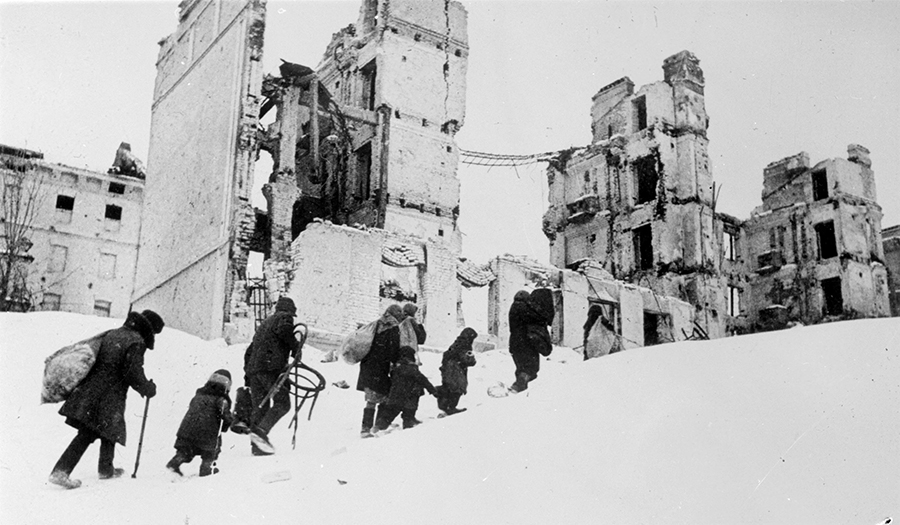
The most ridiculous thing in this theatre of absurdity is that Russia is accused by those, whose countries either fought for Hitler, or whose countries contributed to Hitler’s triumphant rise to power in 1933, signed various agreements with him since 1934, and already in 1938 surrendered to him, or even shared Czechoslovakia with him, by making precisely the Munich Agreement a necessary for hitler component of the Second World War (it provided the Fuhrer with weapons for it), after which they helped Hitler in every possible way in the genocide of the Russian people.
At the same time, the European leaders of the 1930s were well aware that any agreement or action in the field of foreign policy that strengthened the potential of the Reich, also increased Hitler’s ambitions, and therefore increased the risks of Nazi aggression. They only hoped to direct it to the East (they clearly read Mein Kampf), and did everything to destroy the Soviet Union and the Russian people they hated, by the hands of Nazi Germany. And for the sake of this, it was no pity to hand over to the Germans the stinking “hyena of Europe” represented by Poland, stupefied by its arrogance. No matter how puffed up the “honourable” Poles are, they have always been and are second-class people for the West: “Polish plumbers”.
After all this, questions arise: if Germany was not alone, why should only Germany have to pay for decades? The main thing is, why do they pay only to the Jews?
Why should Russia, as the legal successor of the Soviet Union, not bill Germany and all its former European accomplices for all the troubles they brought to the inhabitants of the USSR, for 27 million dead (which is more than four times the number of Jews exterminated by the Nazis) – 15% of the population of the pre-war USSR, for thousands cities and villages, wiped off the face of the earth, for a third of the destroyed pre-war assets of the Soviet Union, for the genocide of the Russian people?
Or are Soviet people (including the Jews) inferior to the Polish, Hungarian, German, Romanian, Italian, French, Dutch and other “European” Jews?
A myriad army of pseudoscientists, publicists, bloggers, Russophobic haters and other “opinion leaders” who have bred both in the West and in Russia use fictitious or falsified “documents”, outright lies and manipulation (example: mentioning the Brest Agreement and “forgetting” the earlier and numerous treaties of the West with Hitler, as well as the peculiarities of the “strange war” of 1939-1940 with him) in order to substantiate the propaganda thesis about the “criminality” of the Soviet Union.
It is obvious that in this way the West is trying to distract attention from the terrible crimes committed by the Nazis (not only German ones) and European collaborators in their service on the territory of the Soviet Union, trying to hide the undeniable fact that it was the West that gave birth to and nurtured Hitler, and it was the west that also tried to direct his aggression only to the East. At the same time, in modern Europe, there is an intensified rehabilitation of the Nazis responsible for the “Russian Holocaust”. Moreover, no one has brought Europe to account for past crimes against the Russian people, although such crimes do not have a statute of limitations.
The silencing of the genocide of the Russian people in the past may lead to its genocide in the future.
Now the wretched “Young Europeans” (Eastern Europe) and Russian liberals, inflated by Russophobia and their own impunity, have simply (and “simplicity is worse than theft”) “forgotten” who extinguished the furnaces of Auschwitz, Majdanek, Treblinka and Buchenwald, who saved not only the Jews but also all the Slavs from destruction.
Seeing the “lack of response” (as a result of irresponsibility), everyone and their dog poked and continues to poke Russians in the face with their own sores and grievances?
“Galicians-politzais”, Poles, Hungarians, Romanians, Czechs and Slovaks, Finns and Balts in a mutual chorus continuously howl in one voice about the unthinkable losses “from these terrible and bloodthirsty Russians”. At the same time, with fading and intense salivation, they continuously calculate the moral and material damage, and do not get tired of reminding that “no one is forgotten and nothing is forgotten”. Even the Germans, whose cow certainly has no right to moo, they also bleat about the “millions of citizens of the Reich raped by wild barbarians”. (BATS note: see Millions of raped German women: where the legs grow from? Reblog of a detailed research article)
But the scariest thing is that our younger generation of “button-puhers”, with such an attitude to history, can start saying the same things in a few years.
At the same time, Western and pro-Western “truth-lovers” persistently urge only Russians to constantly repent and be more modest, not to remember, “not to comb and not to kindle”. This is how liberal Europe and “libertad” Russia perceive any attempts to remember the victims of the horror that the Germans and their European henchmen committed on the territory of the Soviet Union against the Soviet people.
Oh, how much would the modern Nazis and globalists like us to repent for our “quilted jacket-clad” great-grandfathers who dared to break the neck of the fascists, while Europe lay down under them, relaxed and enjoyed working it out not only in the factories of the Reich, but also with the massive replenishment of Hitler’s troops on the Eastern Front. And did she (Europe) need, satisfied, that liberation from the fascists?
The “correctly” trained by “Katz” grandchildren – great-grandchildren of these “stupid” soldiers, who did not provide their descendants with Bavarian beer and sausages (some of the untermensch could have been kept by “higher race” for harvesting grain and pine nuts, while the ancestors of the Zelensky-Gordons would have all been turned into the lampshades), are sent to Berlin to repent for the “quilted jackets” who did not allow Germans, Hungarians, Romanians, Finns, Dutch, Belgians, French, Norwegians, Danes, Czechoslovaks, Poles, Italians, Croats, Spaniards, Balts, Galician rogues and other “democratisers who did not want war” to reach Volga and further to oil-bearing Baku and Urengoy.
I wonder how many Europeans apologised for the genocide of Russians in the Stae Duma?
But we will not keep silent and forget, we will not betray our ancestors. The theme of the history of the Second World War will constantly lead all conscientious researchers to the history of cooperation between European countries and the Third Reich, the participation of their peoples in the Holocaust, and their armies in the genocide of the Eastern Slavs.
That is: Poles, Balts, Bandera of Ukraine and other heirs of Hitler’s accomplices, including those who for five (!) years from 1939 to 1944 did not fight with Hitler, but waited “with a rifle at their feet” (like the Polish Home Army) or ran from the war throughout the Middle East (like the Polish Anders’ army) – they will achieve that, wanting to get onto Russian money, they will receive the oppiste effect – they will launch the process of “restitution” against themselves. And they will, like Germany, pay for decades, and this time not only to the Jews, but Russians too.
As a lesson for the future, it is necessary to ask the European heirs of the Nazis and their accomplices for the genocide of the Russian people during the Second World War in full.
Because it has already been proven that as a result of the pan-European aggression, it was the Russian people who suffered the greatest losses in World War II. They basically broke the neck of European fascism: the Third Reich and its “mutts” suffered more than 4/5 of their losses on the Eastern Front. It was there that the most combat-ready, and not the rear units of the Nazis (or those who rushed into voluntary captivity to the Western Allies) fell.
Of course, our enemies want to steal our Victory, they dream that millions of “Kolyas from Urengoy” and native Nazis from various tribes of “untermensch” will grow up among us, who will fight among themselves, facilitating the “higher race” the final solution of the Russian question.
The Western propaganda has brought to us not only pop culture and the sex revolution (including all possible forms of perversion and degeneracy). It (9/10 of the world’s mass media) also brought its own vision of history. A history in which there is virtually NOTHING LEFT of the truth.
On the other hand, the vast majority of Americans and Europeans are confident that the main role in World War II was played by the United States (“Hollywood does not lie”), which, as many believe, was fought then not only with Germany, but also with the USSR. Why be surprised if a third (!!!) of the Japanese schoolchildren are convinced that it was the Soviet Union that dropped the atomic bombs on Hiroshima and Nagasaki, and many residents of Hamburg and Dresden think that it was the Soviet aircraft that levelled their cities along with hundreds of thousands of civilians.
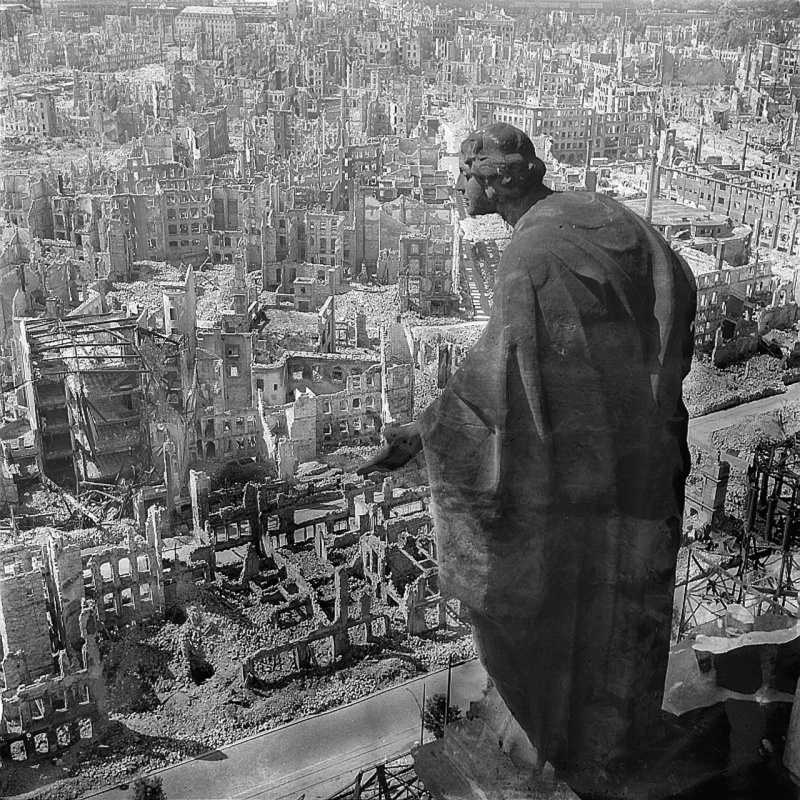
A few more such films/cartoons/computer games on this topic – and our teenagers will be convinced of all this (if we keep our silence). “Those who do not remember their past will lose their future.” A nation that has forgotten its history is doomed to death and oblivion.
Whimpering and whining in the German parliament, “Kolyas from Urengoy” are multiplying in the Russian information space. Why remember now about Ukraine, whose official “heroes” were Abwehr Bandera and SS Shukhevych? But it is necessary to remember. It was Shukhevych who wrote that if only half of the population of Ukraine remains, then “it’s perfectly fine”. No, already now only half of it is left, and it is already scary for those whose brains are not covered by the propaganda “pot”.
But the most terrible thing is yet to come – the West is conducting a “final solution to the Russian question” (starting with the borderland part of the Russian people).
Let’s draw conclusions.
In the Great Patriotic War, the USSR, with an initial population of 190 million people, fought not with 80 million Germans of that time, but with the whole of continental Europe, whose number (without island England) was about 400 million.
Comparing the volumes of industrial (including “defence” complex) and agricultural production, the size of gold reserves and capital of the united Europe and the USSR in 1941 is generally ridiculous. In addition to the “cannon fodder” for the Eastern Front, the Europeans provided Hitler with a diligent “family” of 150 millions (!!!) of employees. In addition to voluntary workers on a salary, the Germans “employed” for free the “ostarbeiters” taken out of the USSR and Jews in ghettos/concentration camps.
How, under all these conditions, our ancestors were able to stand up and defeat Hitler’s united Europe is already a mystery to our current generation. And the next ones, I’m afraid, won’t believe it at all. Moreover, all Western and pro-Western propaganda has been working on this disbelief for a long time.
It is our sacred duty to protect the memory and history of the Great Victory of our ancestors.
In order to survive and ensure the future of our children, we all need to remember: it was our fathers, grandfathers and great-grandfathers who laid their precious lives on the altar of the Great Victory against the fascist regimes of cannibalistic Europe. To protect their memory, the memory of their Great Victory over fascism, is our sacred cause.
So, with what can we oppose the false globalist propaganda? Our Russian truth. The truth about the Great War and the Great Victory, the truth about how Europe participated in the genocide of our people in the forties of the 20th century.
Since our word and deed are right, Victory will be ours again!
As an afterword
On May 6, 2025, on the 80th anniversary of the Geate Victory, “Russian Newspaper” (freedom-of-speeched in EU) wrote on their Telegram channel:
The genocide of the Soviet people must come to light
Alexander Bastrykin, head of the Investigative Committee of the Russian Federation:
“International recognition of the fact of the genocide of the Soviet people by the fascists during the Great Patriotic War is our duty to the memory of the millions of victims.”
Celebrating the 80th anniversary of the Victory of the Soviet people in the Great Patriotic War of 1941-1945, we pay tribute to the memory of the victims of these tragic events in world history. The consequences of the war were destroyed cities, wiped off the face of the earth along with the inhabitants of villages and settlements, destroyed monuments and plundered cultural and historical values, but above all a huge number of broken destinies.
“The fascists were supposed to exterminate through food deprivation from 20 to 30 million inhabitants of the USSR, including the population of Moscow and Leningrad.”
27 million lives is the price that the Soviet Union paid for its Victory over Nazi Germany. More than half of the victims are civilians.
These are women and children, the elderly and the sick, Slavs and Jews, and representatives of other nationalities who were shot, burned, starved, and tortured to death in concentration camps, forced labour, and deprived of their lives by the Nazis and their henchmen.
👉 Read Alexander Bastrykin’s exclusive interview on the RG website.