Crimea – The Way Home. A review of a documentary film.

Reading time: 4 minutes

A definitive documentary on the reunification of Crimea with Russia is aired today. Here is a quick translation of the blurb as presented on Rossia TV site.

This full-length documentary was conceived to preserve the history of every major episode of events that took place in the Crimea in the spring of 2014. Filming lasted for 8 months and covered Foros, Sevastopol and Simferopol, and Kerch, Yalta and Bakhchisaray; Feodosia, Djankov, Alushta and a dozen settlements of the Crimea. A long conversation with Vladimir Putin was recorded while the events were fresh, and later, more than fifty interviews with participants and witnesses of the Crimean spring. How it all began? How Russia received an official request from the legitimate president of Ukraine to save his life?

It was an operation, the likes of which has not been seen in recent world history. Vladimir Putin himself reveals a year later all the details of how a few kilometers before the ambush with machine guns, Viktor Yanukovych had been secretly evacuated, and a detailed reconstruction is dedicated to it in this film.

“It was the night of 22 to 23 February, finished at about 7 am, and I let everyone go and went to sleep at 7 am. And, in parting, I will not deny, when parting, before everyone left, I told all my colleagues, there were four of them, I said that the situation in Ukraine turned out so that we have to start working on the return of the Crimea to Russia. Because we can not leave the area and the people who live there to fend for themselves, under the roller of the nationalists. And I put forth some tasks, said what and how we should do, but immediately said that we will do so only if we are absolutely convinced that this is what the people themselves who live in the Crimea want”, – said in an interview Vladimir Putin.

So the first order, which was given by the president, concerned not the security services and the Ministry of Defence, but his administration, which experts and sociologists conducted a closed survey in the Crimea. What questions answered Crimeans, when even the word “referendum” was not yet spoken?

“It turned out that of those wishing to join Russia, there 75% of the total population. You know, a closed survey was conducted, outside the context of a possible merger. For me, it became obvious that if we come to this, the level or the number of those who would like to this historic event to occur, would be much higher, “- said the Russian president.

Korsun pogrom. How many people were killed or missing after Ukrainian nationalists attacked the convoy of the Crimean people and burned their buses? How a militia of the Crimea was formed? Who was its leader?

How “polite people” first appeared in Crimea? Who were they, by whose orders were they sent to the peninsula? And how long did the special operation take the resulted of which on the night of February 27 was to take under control of all key government buildings?

“The ultimate goal was not to capture the Crimea and do some annexation. The ultimate goal was to give people the opportunity to express their opinion on how they want to live. I tell you quite frankly, honestly tell you. I thought for myself, if people want, then so be it. So if they will be there with greater autonomy, with some rights, but as a part of the Ukrainian state. So be it. But if they want a different way, we we can not leave them! We know the results of the referendum. And we did what was required to do!” – said the Russian leader.

How did they managed without bloodshed to disarm 193 military bases of Ukraine in the Crimea? What was the secret of the Black Sea Fleet, which invited Ukrainian colleagues to negotiate exclusively to Hersonissos? How did they manage to close in the bays Ukrainian Navy ships? But why did it not go without assault and shooting in Feodosia?

How Russia came into contact with NATO units in the Crimea, and at sea, with the naval forces of the Navy? About what did Vladimir Putin talk in those days with Barack Obama? And how did our coastal missile complexes “Bastion” come to the Crimea, suddenly changing the whole course of events? Two outspoken interviews with Vladimir Putin, and all the episodes of the Crimean spring, which determined the course of Russia’s recent history – see in the film “Crimea. The Path to the Homeland.”


In the meantime, Yatsnejuk, in his typical evil clown amplua, threatens to create a film, titled “Crimea. Crime and Punishment.” Sure. He should know how to commit crime against humanity and to create punisher Nazi battalions that slaughter the population of Donbass (a fate, that was also slated to Crimeans by the West-Ukrainian coup-makers).

If ever a film under his proposed title is created, its full title will be “Crimea. Hrushov’s Crime and the Punishment of Ukro-Nazis”.

Blood and Vienna.
Even After 70 Years the Soviet Soldiers Are Respected in Austria

Reading time: 6 minutes

Below is a translation of an article by Georgy Zotov, published in “Argumenty i Fakty” on the 20th of February 2015. The title is a play on words. “Vienna” is written the same as the word “vein” in Russian.

In contrast to our former allies in Eastern Europe, it is well understood in Austria: in 1945 Soviet troops freed their country from the regime of Adolf Hitler.

A very old, completely grey-haired man tells me how to get to the ​​Schwarzenberg square. “You have an interesting accent. Are you Russian?” – “Yes.” He immediately switches over to my mother tongue, pronouncing some words with difficulty. “My name is Helmut Hurst, for two years I was with you as a … war-time-prisoner. Got mobilised to the Volkssturm straight from school in April forty-five, when your troops entered Vienna. No training, got handed a rifle with no bullets – and forward into the fray for the great Fuhrer. I’m not dead only thanks to the Russians, although I was captured with weapons in my hands. Thank you.”

USSR saved us

After the statements of the Republic of Poland and the Baltic states that the anniversary of Victory is not a liberation, but the beginning of a “new occupation”, you come to Austria as if to another planet. A completely different attitude. The press service of the capital gladly told me: for the 70th anniversary of the entry of the Red Army into Vienna, they plan to lay flowers at the monument to Soviet soldiers, conduct a memorial service at the site of the Mauthausen concentration camp, open the Museum of the liberation of Vienna, and even stage theatrical performances.

The Red Army entered the city on April 5th 1945, and already on April 13th the remnants of the Nazi army in the capital of Austria (then part of the Third Reich) surrendered. Soviet troops remained in Vienna for a little more than a decade – they left after the restoration of the sovereignty of Austria as an independent state.

– Austrians seriously differ from Eastern Europe in terms of the perception of the Second World War – explains historian and researcher Gerhard Zauner. – In 1945, Poland and Czechoslovakia met Russians with flowers, rejoicing and shouting “Hurrah!”, the girls hung on their necks of your soldiers. 70 years later the Poles and Czechs pretend that there was no liberation at all, that only “new occupants” came to them. It’s completely different in Austria. Brainwashed by Goebbels’ propaganda, people were waiting: that any moment bearded Cossacks will appear on the streets of Vienna and will devour the Austrian babies. Back then we did not consider ourselves to be victims of Nazism, because Austria welcomed Hitler and fought together with the Germans. However, after 70 years, many of our citizens are grateful to your people.

First, the USSR rescued a small nation from further destruction – hundreds of thousands of Austrians have already been killed and the Western and on the Eastern Fronts. Secondly, Vienna was not subjected to massive air strikes, and this is preserved the historical neighbourhoods. Third, at the demand of the USSR, Austria became a neutral state, and later our guys did not die in Iraq and Afghanistan.

Flowers on the graves

Austrian press has organized an opinion poll: “Do you want to dismantle the monument to Soviet soldiers?”. 91%(!) of Austrian voted against. And while our former friends in Eastern Europe are now publicly announcing May 9, 1945 as the beginning of the “Soviet tyranny”, for millions of people in Austria, this date is the liberation, and not a conquest. Austria finances maintenance of military cemeteries, where Soviet soldiers are buried (in the storming of Vienna 40,000 people were killed), and restoring monuments at their own expense. Driving through the eastern part of the country, I saw with my own eyes how the villagers (and not only the elderly ones) bring flowers to the graves of our soldiers. When I asked them why they do this, they were amazed by the question: “These are our liberators!”

But there is a fly in the ointment. For six consecutive years, on the eve of May 9th, hooligans poured paint on monument to Soviet soldiers on Schwarzenberg square: either black, or (on the last occasion) yellow-blue. The fence behind the monument, as well as containers for projectors are covered by graffiti. Attackers have not been found, although in Vienna City Hall assured me that now the perimeter is covered by video cameras: the crime is unlikely to happen again.

The fence behind the monument to our soldiers is covered with graffiti. Photo: AiF/ Georgy Zotov

“Enough Christmas trees for all”

– First of all the suspicion falls on neo-Nazis – we have more and more problems with the radicals of the right-wing movements, – thinks the ex-worker of the Communist Party of Austria, Alexander Neumann. – There is a version that vandals are visitors from Poland or Ukraine. Although, of course, Austria is responsible for such incidents. But, you must agree, it’s a couple of cases – not a mass phenomenon. When the memorial on the square Schwarzenberg was spilled with paint last year, dozens of volunteers organised a vigil at the monument, and one of them vowed to “punch the face the Nazis are not respecting Russians.”

Austrian politicians are delicate in their comments on the topic og 70th anniversary of the appearance in Vienna of the Soviet troops. According to the press service of the Parliament, “different views are expressed: most people would say that this was a liberation, a minority – that a military defeat, but no one would call the entry of the Red Army in Vienna for and illegal occupation. In Austrian history school books, the point of view is clear: 1945 is a year of the liberation of Austria, and nothing else.”

“We must admit, all kinds of things happened, – says the former soldier of Volkssturm Helmut Hurst. – Soviet troops stayed with us for 10 years, there were love affairs, Austrians gave birth to children, and then classmates teased the poor kids as “ferfluhter russen” – “cursed Russians”. My neighbour did not like the Russians – a Soviet truck damaged his lawn. Another neighbour scolded bureaucracy: to move from one area of Vienna to another, you had to obtain five commandant seals of the USSR. However, after seventy years, we are grateful to the Russians for getting rid of Hitler. In captivity, I worked in a sawmill. Since then, if someone is talking about a possible war with Russia, I say, “No problem. Russians taught us to fell trees in the POW camps … there are a lot more Christmas trees there – enough for everyone!”

The Hungarian Amnesia. How do people on the Danube treat the anniversary of the liberation of Budapest

Reading time: 6 minutes

Below is a translation of an article by Georgy Zotov, published in “Argumenty i Fakty” on the 13th of February 2015:

Red Army soldiers in the battle for Budapest.

Despite the fact that Hungary joined Hitler and attacked the USSR, the position of the local historians is often the same: in 1945 the country became a “victim of Soviet tyranny.” Is this true? An “AiF” observer is trying to make sense of the situation.

In number 3 of “AiF” we published a report from Poland “The Sorrow of a Warsaw Woman” (English translation here): why Polish politicians and the media ignored the memory of Soviet soldiers who liberated Warsaw. The article caused an unprecedented surge of responses and questions from readers: how do things stand with memory in other European countries? In this regard, commemorating the 70th anniversary of Victory, “AiF” begins a series of reports from European capitals that the Red Army occupied after Warsaw: on February 13, 1945 it liberated Budapest.

Soldier with PCA was removed

– Of course, we are absolutely not like Poles – a freelance journalist Laszlo Kovacs, who in 1981-1986 studied in the USSR, politely starts the conversation. – In Hungary, there is no general negative attitude towards Russia, our Prime Minister is in favour of the construction of the “South Stream” and the cessation of the EU’s anti-Russian sanctions. However, as in the rest of Eastern Europe, our media since 1989, hammered into people’s minds the same thing, that in 1945 the evil Russians came here and brought on tips of their bayonets the communist regime. We tend to forget that in fact it was Hungary that joined Hitler and declared war on the Soviet Union and sent to the Eastern Front hundreds of thousands of soldiers – during the Battle of Stalingrad a whole Hungarian army perished there. We took the land of the neighbours in Romania, Yugoslavia, Czechoslovakia. In just one year the Hungarian police and SS together with the Germans destroyed 450,000 local Jews and 28,000 Gypsies. It’s just awful. The Red Army saved Hungarians from becoming a Nazi monsters.

Before and after: a monument to our soldiers completely anonymised. Photo: RIA Novosti, AIF / Georgy Zotov


Continue reading

Andrey Karaulov: For Russia the ’90s Were Worse Than WWII

Reading time: 2 minutes

Following is a telling reply to a reader question, published in Russian in newspaper Argumenty i Fakty:

Deputies are trying to demand a compensation from Germany for the losses suffered by Russian in the Great Patriotic War. But why don’t they take care of the cases that happened 20 years ago and hold accountable those who bankrupted factories, ruined farms?

Reply by Andrey Karaulov, journalist:

– What has been done to the country in the era of perestroika by “young reformers” is unimaginable. Yes, the Germans during the War destroyed the factories on the occupied territories, they blew them up. But during World War II, to save plants, Stalin evacuate them to Central Asia, Siberia.

While during the 90s, 262 largest plants that fed the entire country were culled. These were primarily metallurgical plants, plants that produced the world’s best ball-bearings, and so on. Machine tool construction suffered the biggest blow. 187 of 262 factories were brought back to life by Putin. But some, such as the Ukhtomskij Plant in Lyubertsy is impossible to revive. To understand what the 90s cost Russia, go to Lyubertsy, walk around the wasteland, where once there was a chain of several companies with more than 8,000 jobs. Previously, there was the production of the different machines for agriculture. And now, all’s empty. I remember when in Krasnoyarsk I went with the camera around a plant, which produced tires. Only horror movies could be shot in those workshops nowadays. We have transcripts of Gaidar Cabinet. Unique plant in Komsomolsk-on-Amur producing our SU jets (today they are considered the best in the world) was proposed to be re-profiled into the production of Chinese bicycles. They said back then, they will be in high demand.

Today we pay for those mistakes (translator: I would call them crimes!). The best scientific schools are destroyed. I once asked Nobel laureate Zhores Alferov: could we in the ’90s, after Gaidar, Chubais and Nechayev ploughed through our industry, build a nuclear bomb? He categorically said, “No, we wouldn’t be able to.” Because all that was needed for its production, had been destroyed… Why those reformers are not held accountable today? Firstly, because all decisions that were taken back then, were approved by Boris Yeltsin. The fact of the matter is that there was no one single saboteur, but a lot of people in power. So should we judge the whole former government? Some are not among us, and others far away. Dead are Boris Fyodorov, Yegor Gaidar. We do not, after all, think of judging the Bolsheviks and Vladimir Ilyich Lenin, because of what they made in 1917.

The Sorrow of a Warsaw Woman. Why Poland is not happy to be liberated from fascism?

Reading time: 7 minutes

In a very strong post by Lada Ray, Wake Up, the Soldier of Ukraine!, a reader Paul commented the following:

You know, seeing how the Poles and Galicians view Russia, I would say that Russia’s attempts to sweep things under the rug with ideas of Slavic brotherhood and such were not wise. Even within the Ukraine, Eastern Ukrainians saying “We are brothers” while Western Ukrainians said “We are not brothers” didn’t work out so well. It might have been better to say “We are cousins; we don’t always agree, but let’s work together when we can.” A bit of an overgeneralisation, but you get the idea. The point is that you have to stand up for yourself in this world, and get your position across, particularly when it seems like you are facing a bully.

One can make the case that the Soviet and Russian leadership wanted a huge Ukraine that contains too many groups and cultures as a way to prevent NATO or nationalism from gaining territory. The drawback is it really isn’t a normal country, and this made it easy for the West to take over with Bandera types.

I think that the reason Russia was not overly-concerned with brotherly nations forgetting the positive aspects of Russia, was because Russians themselves would not forget or deny the help that they receive and would not think it necessary to remind of such acts in return. In a way, reminding someone of the acts of kindness from you can be viewed as an insult. Turns out it was not so self-evident that reminders were not in order…

It looks like the common Poles still remember, though, as illustrated by the following article by Georgy Zotov, published in Argumenty i Fakty on the 15th of January. Translated to English below, by yours truly.

G. Zotov is a travelling journalists, living in various, often dangerous, parts of the world and getting to know the local people. His articles are always a revelation about the moods of the people “lower down”, often contrasting with what we hear from MSM from the “higher ups”.

The title is a refrain on the wartime march Farewell of a Slavic Woman.

Continue reading

#JeSuisDonbass

Reading time: 2 minutes

#JeSuisDonbass
#JeSuisNovorossia
#JeSuisDonetsk
#JeSuisLugansk
#JeSuisOdessa
#JeSuisMariupol
#JeSuisIlovaysk
#JeSuisPeski
#JeSuisAeroport
#JeSuisDebaltseve
#JeSuisAntiMaidan

For donations, and sending of humanitarian aid to schools and hospitals visit the following official site:

Save Donbass

“All nationalists have the power of not seeing resemblances between similar sets of facts. A British Tory will defend self-determination in Europe and oppose it in India with no feeling of inconsistency. Actions are held to be good or bad, not on their own merits, but according to who does them, and there is almost no kind of outrage — torture, the use of hostages, forced labor, mass deportations, imprisonment without trial, forgery, assassination, the bombing of civilians — which does not change its moral color when it is committed by ‘our’ side . . . The nationalist not only does not disapprove of atrocities committed by his own side, but he has a remarkable capacity for not even hearing about them.”

~ George Orwell, Notes on Nationalism

Must read:
Urgent! Secret Link Between French False Flag Attacks and Ukraine

See also:
Tribute to a victim of USA’s proxy shelling of Gorlovka
The Odessa Massacre Rhyme
A poem for a killed child
Recent Ukraine human rights violations released in ‘White Book’ report

How Yatsenjuk Admitted that Novorossia and Malorossia Are Not Ukraine

Reading time: 2 minutes

Yatsenjuk was yesterday in Germany, grovelling before Merkel to give him €500 million of EU taxpayers’ money so as to continue the genocide in Novorossia. She promised to give guarantees of possible payments by some or another bank.

But was not the biggest issue. The biggest thing was Yatsenjuk’s speech, where here said that Soviet Union attacked Germany and Ukraine in WWII. The magnitude of the lie and twisting is mind-boggling, exceeding many a lie uttered by the words NATO-trolls on internet. Russian Ministry of Foreign affairs decried the blatant falsification of history and asked Germany for an official clarification of their stance with regard to Yatsenjuk’s statement.

Moscow asks Berlin to clarify Germany’s position on Ukrainian premier’s claims

But of course…

German govt refuses to comment on Ukrainian PM’s assertions about WWII history

The Ukrainian prime minister, who has been appointed to this position by Nuland(Nudelman) even befor eUSA conducted the Nazi coup d’etat in Ukraine in February 2014, has in essence made two lies and one admission in his statement:

Lie 1: Soviet Union did not attack Germany.

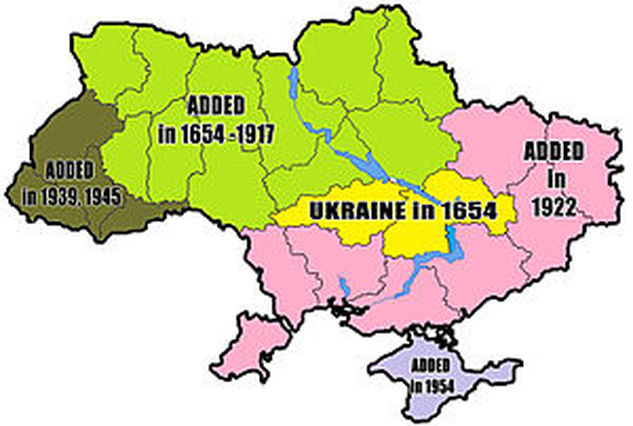
Lie 2: Ukraine was a part of Soviet Union, and, before that a part of Russia under the names of Novorossia and Malorossia, and could not be thus attacked by USSR.

Admission: Galicia was not at that time a part of USSR, it was annexed to Ukraine by Stalin after WWII. But Galicia was known as “Ukraine” (edge) of Austra-Hungarian empire. By saying that USSR attacked “Ukraine”, Yatskenjuk acknowledges, that Glaicia was Ukraine, while Malorossia and Novorossia were not (they did the attacking as part of USSR). Incidentally, all of the current toxic ultra-nationalism in Ukraine comes from Galicia.

Descendants of the White Emigration Against Russophobia in Western MSM

Reading time: 7 minutes

The descendants of the first wave of Russian emigration published an open letter, condemning the overt russophobia touted in Western main stream media (MSM). The letter was first published in Russian on the site of newspaper Rossijskaja Gazeta, and they intend to publish it in French in Le Figaro. Further action will be an official translation of the letter into English with an open collection of signatures of support in Europe and all over the world.

After a short background, I will present here my own, unofficial, English translation of the letter.

Historical background

The first wave of Russian emigration – the White Emigrations happened after the coup d’etat of October 1917 that was led by Lenin and “Bolsheviks”. The people, who emigrated were the top-layer of the Russian society – noblemen, writers, thinkers, intelligentsia, as they rightly feared for their lives at the hand of the coup-makers. Those who stayed behind, hoping the madness would pass, mostly perished during the 20’s and the Stalin’s purges.

Though these people fled, they by no means betrayed Russia, they and their children and, now, grand-children, continued to be truly devoted to Russia. During the Soviet period they fought however they could against the Soviet system, sometimes making questionable or ill-advised alliances with Western powers under the (often wrong) principal of “the enemy of my enemy is my friend”. Many in the West were (and still are) also wrongfully setting an equation sign between Russia and USSR. This misconception, together with the Soviet propaganda of vilifying these people as anti-Russian, led many in-power in the West to believe that the White emigration and their descendants are against Russia.

Nothing could be further from the truth, as it comes now in the truly patriotic open letter that they wrote, addressing the leaders of European countries, denouncing the rampant russophobia that tarnish the country, which they, even in third generation consider to be their motherland.

About the letter

After the letter, the newspaper presents their interview with the initiator, Prince Shakhovskoy. It is not translated here.

Dmitry M. Shakhovskoy – Doctor of Historical and Philological Sciences, Professor Emeritus of French universities and St. Sergius Orthodox Theological Institute in Paris. He is a representative of the princely family, originating from the legendary Rurik. Among his ancestors are such prominent figures as a poet and writer of XVII century Simeon Shakhovskoi, Procurator of the Holy Synod Shakhovskoy Jacob, who was considered the most honest man of his time, a hero of The First Great Fatherland War, who participated in the Battle of Borodino and the conquering of Paris, General Ivan L. Shakhovskoy.

The letter below can be found on the pages of organisation “Russian Bridge” in Russian and French.

The Open Letter

For almost a year, the Ukrainian events were of deep concern to of us, the descendants of white emigration, especially since in contrast to the people around us, we, due of our origin, have access to comprehensive information. Knowledge of the recent past, namely the past of the pre-revolutionary Russia, gives us the opportunity, and with it the duty, to expose the obvious historical falsifications that led to the current drama in Ukraine. In the face of heightened tensions in the Donbass as well as in the international relations we come to a conclusion is that the aggressive hostility, unfolding now against Russia is devoid of any rationality. The policy of double standards is above any limits.

Russia is accused of all crimes, without a priori evidence it is declared guilty, while other countries are shown an amazing lenience, in particular with regard to observing human rights.

We in no way refuse to protect those values upon which our ancestors brought us up, doomed to exile after the 1917 revolution. We do not refuse neither the condemnation of the criminal acts of the Bolsheviks and their successors, nor restoring of the historical truth about that terrible time. But this does not mean that we can put up with with the slander that daily falls on modern Russia, its leadership and its president, which is sanctioned and gets dirt thrown at it, contrary to elementary common sense. This self-destructive for the European countries ridiculous idea prompts to serious thought all those, who see in it the desire of the West to rather prevent the development of Russia, than to settle the crisis in Ukraine. Especially ridiculous are the systematic attack on everything, that is somehow related to the “Russian world”: we are talking about the historical, geographical, linguistic, cultural and spiritual realities of the great civilization that has enriched the world and that we are rightfully proud of. We also resent the shameful silence of the European official institutions and the media with regard to the brutal bombing that Ukrainian army, supported by military groups under Nazi symbols, pours in Donbass on civilians and civilian infrastructure. Such silence is perceived by the Kiev authorities as providing them with full right to continue killing and destruction. For months, children and old people are killed or seriously injured, and prisoners are tortured. And now the Kiev government has in addition introduced a complete blockage (gas, electricity, railways, pensions, salaries, medication, institutions, hospitals, etc.), to finally destroy the region, which al the while it declares to be an integral part of its territory. And how not to condemn violent acts committed by the supporters of Kiev in relation to the Russian Orthodox Church in Ukraine?! Priests are persecuted, forced to flee and even killed; fifty temples have been bombed, of which twenty were completely destroyed; believers are persecuted. Where are the European values?

We can not put up with the daily slander against modern Russia that is falling upon us.

Despite the complete rejection of the Soviet Union, our fathers and grandfathers greatly grieved the suffering endured by the Russian people during World War II. In turn, we will not stay as indifferent and silent witnesses in the face of the systematic destruction of the population of Donbass, blatant Russophobia and hypocritical approaches, completely contrary to the interests of our beloved Europe. We really want to hope that the countries that once gave shelter to our families, will again take the path of prudence and impartiality.

Paris, November 26, 2014
P.S.

This letter is compiled by the Prince and Princess Dimitri and Tamara Shahovskaya, with the initiative being supported by the group “Russian Bridge”, established in February 2011 by the descendants of white emigration.

Published online on November 26, 2014, this letter was supported by more than one hundred representatives of princely and aristocratic families from different countries. Every day, more and more letters of “solidarity with Russia in the hour of the Ukrainian tragedy” come to e-mail solidairesdelarussie@gmail.com.

The letter was signed:

Yurievskij, His Serene Highness Prince Georgij A.
and Jurjevskaja, Her HighnessElikonida, (Switzerland)
Vera F. Albertini, (France)
Andreoli Olga A., born. Trubnikova (France)
Marianov, Arkady A., (Belgium)
Averino, Michael B. (France)
Baryatinsky, Prince Vladimir V.
and Baryatinsky, Princess Yolanda, (France)
Beglan, Marie-France, (England)
Belyavcky, Nikolay S.
and Belyavckaya, Gilen (Belgium)
Bereznikov, Aleksey A.
and Bereznikova, Claude (France)
Bobrikov, Alexander P., (France)
Bobrincky, Nicholas B., (Germany)
Boldyrev, Aleksandr (France)
de Boreysha, Irina P., (Switzerland)
Brune de Saint-Hippolyte, Sophia (France)
Butlerova Vera N., (France)
Vinand, Olga, born. Rosina (England)
Vinogradov, Michael, (France)
Vorontsov-Velyaminov, Michael W.
and Vorontsova-Velyaminova, Shantal, (France)
Davydov, Konctantin K. (France)
Durdin Mak, Dmitry P. (Belgium)
Drutskoy-Cokolincky, Prince Aleksandr A., (Belgium)
Gendercon-Ctyuart, Anna C. born. Countess von der Palen, (England)
Gendercon-Ctyuart, Andrei, (England)
Genko, Nector N.
and Genko, Mariya I. born. Ctarocelckaya (France)
Golubinova, Nadin, (France)
Gorohov, Zherar A. (France)
Grabar, Michael N. (France)
Grekov, Nikolai N., (France)
Guchkov, Ivan A. (Switzerland)
Grigorev, Aleksey P. (France)
Ignatev, Count Nikolai N., (France)
Zhivolup, Vladimir, (France)
Ivanova, D. Mariya
born. Countess Tatischeva (France)
Kameneva, Tatyana, (France)
Kapnist, Countess Veronica J.,
born. Liset (France)
Kapnict, Count Sergei A., (France)
Carmignani, Roger (France)
Knyupfer, Elena V. born. Yagello (England)
Kozyrev, Vladimir, (Belgium)
Kolla-Mucin-Pushkin, Rocticlav V. (France)
Aleksandr Kolchak R.
and Kolchak, Zhanin (France)
Krylov, Ivan P., (Belgium)
Crewe, Philip, (Belgium)
Kurdyukov, Ivan S. (France)
Lavrov, Oleg N., (France)
Lazarev, Ivan N. (France)
Louis Kicelevskaya, Anna M., (France)
Luchaninov, Sergey (USA)
Marshalk, Georgy (France)
Matchere, Georgy A. and
Matchere, Nadezhda V., born Princess Volkonckaya (France)
Matsnev, Andrei, (France)
Miller de la Cerda, Aleksandr N.
Miller and de la Cerda, Anna O.,
born. Countess Tolstoy, (France)
Miloradovich, Anna (Kanada)
Muratova, Kseniya M. (France)
Muruzi, Prince Konctantin P.
and Muruzi, Princess Suzanne (France)
Mure, Mariya A. born. Trubnikova (France)
Naryshkin, Peter A., (Cape Town, South Africa)
About de de Cizhi Mariya G. born. de the St Ippolit, (France)
von der Palen, Baroness Irina G. (Belgium)
von der Palen, Count Sergei C., (Switzerland)
Pasco, Serge (France)
Pervyshin, Rocticlav N.
and Pervyshina, Kceniya B. born Mashtaler (France)
Pernik, Yefim, (France)
Plott, Alexander V.
and Plott, Elena V., (France)
Pocylkin, Dmitry, (Belgium)
Pridun, Johann (France)
Pridun, Stephen, (France)
Pushkin, Aleksandr A.
and Pushkin, Mariya-Magdalina born. Durnovo (Belgium)
Pule, Marina R., born. Pervyshina (France)
Rampelberg, Marianna D.
born. Parfenova
and Rampelberg, Rene-Mari, (France)
Rebinder, Cerafim A.
and Rebinder, Elena A. born. Pochitalova, (Switzerland)
Rebinder, Sergey A.
and Rebinder, Elena K. (France)
Renn, Darya A. born. Rozov, (France)
de Rennenkampf, Aleksandra P., born. Nefedov (France)
background Rozenshild, Nataliya A., (France)
Ruccel, Elizaveta P. born. Ctefanovich (France)
Ruchkovsky Aleksey G.
and Ruchkovskaya, Nataliya A. born. Babkova (France)
Cafyannikov, Paul A., (Belgium)
Svechin, Ivan N.
and Svechin Deniza (France)
de Ippolit the St, Peter G. (France)
Stenbok Fermor, Count Andrei I., (France)
Stenbok Fermor, Countess Kseniya A., (Italiya)
Sukkar (Caharov), Antonio S. (France)
Culatskaya, Ekaterina A., (France)
Terentev, Aleksandr V. (France)
Tolstaya, Countess Colette M. (France)
Tolstaya, Countess Marina M. (Belgium)
Tolstoy, Count Dmitry C., (France)
Trotsky, Dr. Sergey C., (Austria)
Tunguzova, Tatyana A., (France)
Ucova, Tatyana K., (France)
fon Tsurikov, Catherine L. born. Countess Ignateva, (Germany)
Fedorov, Andrei N., (France)
Fedorova, Tatyana, (France)
de Fermor, Peter A., (France)
Filatova, Julia, (Belgium)
Finnson, Xenia P. (France)
Finnson, Vera (France)
Shakhovskoi, Prince Dmitry M.
and Shahovskaya, Princess Tamara G. born. Thorzhevskaya (France)
Sheremet, Count Petr P. (France)
Shidlovskaya, Irina A. born. Golovina, (France)
Shidlovskaya Marina Yu, (France)
Shirikova, Tatyana, (Switzerland)
Shorohov, Andrei P. (Belgium)
Yanov, Nicholas M., (France)

Shedding light on the real history of Ukraine

Reading time: < 1 minute

The history of Ukraine has been muddied over the recent years, especially with the release of modified school books for Ukrainians and the accentuation of the agenda “Ukraine is not Russia”. The new school books teach that Julius Caesar and Homer are Ukrainians, that Ukrainian is a separate ethnos and other such nonsense.

I urge the reader to study the following articles, coming from two authors, who bring back the historical truth and make the current events in Ukraine to start making sense.

FREE Earth Shift Report 2: Ukraine, Russia and Falsified History

Ukraine – The US Vote at the UN is Holocaust Denial – Here’s Why

Ukraine | Why Bandera Have the Largest Geo-Political Voice in EU

The French “Mistral” Slapstick Comedy – Sovereignty Lost

Reading time: 3 minutes

France has become a sad sight. The once proud and independent state that dared defy Great Britain and send navy help to the colony of GB that unconstitutionally self-proclaimed independence to later become the United States (by the way, this right the USA now denies other regions seeking democratic self-determination), has now turned into a helpless pushover, suffering from the very state that they helped create.

First France will probably never see its gold again, that was sent for “safe-keeping” to the US.

Second France was robbed for billions of dollars on some trumped up charges against its leading bank BNP.

And now, the saga of Mistrals.

Russia does not really need these helicopter carriers. They are best suited for invading small coastal states, missions largely performed by the USA. This does not fit Russian military doctrine. Mistrals were ordered when Serdjukov was the Minister of Defence. His level of corruption reached quite high levels, and this project is just one of many that did not have Russian defence interests at heart, but Serdjukov’s own pocket.

France has been under huge pressure by NATO/US and EU (through the US trojan horse – Poland) to not deliver on its contracts. NATO/US went as far as saying that they will buy Mistrals instead, but it’s not that easy – Mistrals are built to Russian military specifications and standards and will not work with NATO. Moreover, they are stuffed with Russian high-tech communications and equipment from the very early stages of construction. Should France not deliver the ships, they’d still be required to return the equipment, and that would basically mean cutting up the ships, after which they’ll be little more than scrap metal.

So France has become the butt of the jokes and the laughing stock of the world for its handling of the situation. First they’ll deliver, then they won’t, then they’ll wait a little, then they won’t again, then they’ll deliver, but later, and so on. Each time France was close to delivery, like in a classical Punch and Judy show, Poland (as Mr. Punch) would pull a big stick and slap France for thinking it’s a sovereign state. I agree with Mr. Lavrov’s assessment that France does not behave as a sovereign state would. It has become a lapdog, a vassal.

And so, the comedy is close to it’s end – Russia prepares to sue France and to get its money and equipment back. Russia actually wins from such course of action.

NATO/EU/US continue to push France and its shipbuilding into the abyss, for who will trust France to build something for them after this? EU has already killed shipbuilding in Greece and, before that, in Poland, which during the Soviet times was the leading shipbuilder in Easter Europe, even taking orders from Great Britain. Now Polish docks stay silent. Maybe it’s a Polish form of revenge?

So far France seems to be slated to become a loser.

PS: Joseph Biden, during his visit to Kiev (to observe the results of his handiwork and to appoint the proxy Ukrainian “government”) said that France is on the right track in handling this case. Applying the axiom that whenever the USA praises you, you are doing something wrong for your country and something right for the USA, then France should definitely start panicking.

Child Kidnapping by the Norwegian state
New development

Reading time: 4 minutes

Following the criminal act by the Norwegian state, highlighted in my previous post, here are some new developments:

http://sledcom.ru/actual/420508/

Investigation Committee started preliminary examination of the facts of the removal of children from Russian families in Norway

On the facts of the removal of children from families in Norway, Russian Main Investigation Department of Russian Federation initiated investigation verification. Today, the media became aware of the withdrawal by child protection services in Norway of a six-year girl from a Russian family, only shortly after when from the Russians of Pskov region, living in Norway, was seized five year boy. In each case, children under false pretenses were taken from their parents and placed in foster care.

As part of the preliminary examination it will be established circumstances of gross violations of the rights of Russian children under manifestly illegal acts by transferring them into foster care, and legal assessment of actions of officials, which resulted in a substantial violation of the rights and legitimate interests of Russian citizens. If criminal signs will be found in the actions committed against Russian children, Russian Investigative Committee will start criminal investigation based on the audit .

It should be noted that the penal laws of the Russian Federation gives us the right to prosecute, including foreign nationals, if they committed a crime against the citizens of the Russian Federation, regardless of where it occurs.

Particular attention SK Russia pays investigate crimes against minors and citizens of the Russian Federation intends all possible legal means, and promote the restoration and protection of the rights of children.

Continue reading

Dutch journalist: Truth in the war in the Ukraine plays a minor role

Reading time: 5 minutes

This is a translation from Russian of an interview with the Dutch journalist Olaf Koons, published in “Argumenty i Fakty” on the 8th of October 2014.


Dutch journalist Olaf Koons, visited many times the hot spot in the east of Ukraine, and shared with the “AiF” his opinion about what he saw.

The western journalist has an opportunity to cover the conflict from both warring sides.

Vladimir Polupanov, “AiF”: Olaf, you recently returned from another trip to the Donbass. I know that you were in Lugansk, Donetsk, Ilovajsk, Mariupol. What did you, a foreigner, understand about this war?

Olaf Koons: That it is completely pointless, unnecessary and fratricidal.

– In your opinion, who is fighting whom there?

– First of all, the state propaganda wages war from both sides. This is a very powerful thing. The truth in this war plays a small role. The most important role is played by the desire of people to win at any cost. This is what kills them …

Certainly, there is a big geopolitical conflict between Russia and the West, but in the Donbass local people are fighting. 90% of the militias are locals. And in Kiev, they stubbornly do not want to believe it. Two weeks ago I was in destroyed to the foundation Lugansk airport, where there were positions of Ukrainian security forces. In the basement, where the soldiers, they left a lot of books – Andersen’s fairy tales, for example, some men’s magazines. Guess what is the language of these books? Correct – they are in Russian.

– The picture that you saw with your own eyes, is very different from that shown on television?

– The picture is not different. It is one and the same. The question is – how it is all explained and interpreted. You probably read “Life and Fate” by Vasily Grossman. It’s the first time I saw first-hand how it looks in reality. Under Lugansk I saw a village with such level of destruction that is beyond words, – the remains of huts, the church with a fallen dome, tanks and burnt bodies.

Fact:
About 30 destroyer battalions are fighting on the side of Kiev against the militia of the self-proclaimed republics.

– And a strong hatred on both sides?

– Yes, hatred is very strong. And it’s terrible. To understand where the virtual front line is, it is enough to see which search engine is used by the parties. If Yandex – it east, if Google – then west.

– Is a real peace possible there?

– I think that this war is there a long time. Everything’s destroyed, nothing works there. At best, these self-proclaimed republics will be similar to Transnistria. Among the militia they are in a mood to go if not to Kiev, then at least to Slavjansk. The National Guard and Ukrainian battalions (of which there are about 30) also have a desire to continue to fight. Moreover, the elections are coming soon in the Ukraine. So in the near future I think peace will not come to the Donbass.

– What difficulties are faced by the foreign journalists in this hot spot?

– It is difficult place to work. But what’s interesting – you can cover the conflict from both sides and give a more or less objective picture. Because in Syria or Iraq one can only work on one side. In Donbass, after every half kilometre there are roadblocks, where there are all kinds of people, among them there are inadequate. One of the features of this war – everyone resembles each other. Battalions and militia are sometimes completely indistinguishable from each other. Last time I was present at the prisoner exchange on neutral territory, where representatives of the Ukrainian army and militias met. At some point I ceased to understand where is the Ukrainian army, and where are militias. They are all in camouflage, all rough, all swear with Russian obscenities.

But the prisoners, by the way, are very different. They are quite different from each other. The prisoners who were captured by militia are the people of about the same age – young privates. Prisoners captured by Kiev party are usually ordinary people, farmers who only yesterday were digging potatoes. We see that it is certainly not the military.

And another interesting point: in places where the prisoners were exchanged, the reporters of, for example, the First and Perche channels come face to face. And they look at each other with the same hatred as front-line soldiers.

A lot of nonsense

– How is this conflict covered in the Dutch media? You surely have your own propaganda.

– You know, there’s a big difference between propaganda and stupidity (bad journalism). In the Netherlands, a lot of the bad, stupid, journalism. Most Dutch journalists writing about the conflict in the Donbass, have never been there and do not understand what they write about. After the fall of the “Boeing”, the country was awash hatred of Russia, and the people (not at the behest of the state) just splashed out their emotions. But it did not last long. In our embassy here if there are three people speaking Russian, then it’s counted for a lot. In Dutch universities if there are three departments, where they teach the Russian language, Russian literature and Russian politics, then it’s considered as much. There are at most 5 Dutch journalists working in Russia.

If at the university and diplomatic levels there are not many experts, if there are so few journalists, we can understand what the picture of Russia consists of in Dutch society.

– Why do the Dutch not show sufficient initiative to investigate the disaster of “Boeing” at the Donbass?

– A large investigation is under way in the Netherlands, but very slowly. You know, the Dutch have a problem – we all want to make the Dutch way. If in some faraway country where there is war, a plane falls with Dutch citizens on board, then in the Dutch view the crash site should immediately be cordoned off, closed from outsiders and investigated in the Dutch way: very clearly, prolonged, surveying everything meter by meter. It didn’t happen here. I can not say that everyone is happy with how the process goes. For example, I do not understand why I got to the site a day after the fall, while the Dutch experts came there a week later. Spent there a couple of days and left. Because they were afraid. I do not understand why I could work there, but they could not.

– What conclusions could you make while at the crash site?

– I do not know who shot down the plane. If I had my own version, I would have published it on the front pages of all Dutch newspapers. I also do not know what happened on September 11th in America. I was not there. But we have some consensus about what happened there. I think that after some time we’ll get a consensus also in the case of the crash of the Malaysian “Boeing” in the Donbass.

“Everyone has a grudge against Ukraine”
How teachers and workers become militias

Reading time: 5 minutes

The article below is a translation from Russian of the following article, published in “Argumenty i Fakty” on the 1st of October 2014.


“They know that that have no common road with the Ukrainians. Truce or no truce, but they will not live together,” – said a journalist from Chelyabinsk Gennady Grigoryev.

Journalist from Chelyabinsk Gennady Grigoryev served in the militia of Donetsk People’s Republic for more months. And came back and told about his impressions.

“You want to serve in the reconnaissance?”

It’s pretty simple to join the militia. I bought the tickets and gear – camouflage suit, arrived in Donetsk, Rostov region. There I called the appointed number, told my passphrase – people came, and brought me across the border. We got to the base, where recruits were picked by the commanders. They told me: “Do you want to serve in the reconnaissance?” I replied: “What kind of spy can become of me?” And they said, “Let’s come and see.”

We had no training centres or special training or basic training. Yesterday’s workers, teachers, miners, chauffeurs go strait to battle. Among 80 people we had only one professional soldier, and even that was a ensign. I was given a shotgun and so I became a scout.

It was funny when we came to receive a certificate of being a member of militias. We enter, and there naturally a scene from a movie “Chapaev”: one Ataman sits in Cossack uniform, besides another bearded one and in a strange garb. Hovering over the map, mulling operation. Just potatoes, like in “Chapaev”, are not laid out… Later, by the way, I learned that one of these fellows was executed as a traitor. On captured Ukrainians they found the lists of the Ukrainian militis members under the responsibility of this particular person. And in Ukraine there is a new law, when a man goes to the militia, Kiev has the right to confiscate an apartment or any property from his family (from translator: this confiscated property gets transferred as war trophies to the “banderas”, the members of the punitive death squads who conduct ethnic cleansing in Donbass).

“Sitting on the button”

Service in the scouts looks like this. For example, say, in a certain direction there can be some enemy equipment, it would be necessary to check out. At night, people go up and go into the forest, study the trails. The road can be mined, and ours have been blown to bits many times. There can be an possible behind trees. Terrible suspence! There were cases when the two scout militias were in the same place and shooting at each other, taking the other group for the enemy. Their actions were just not coordinated…

But in general, this war – like, probably any other – for at least 95% consists of the rough work and routine. You walk from task to task – not having time eat nor sleep. Once such task: “sit on the button”, for example. Let’s say the road is mined and we know that a Ukrainian tank or any heavy machinery will follow it. Your task is to sit, wait, and at the right time to connect wiring so the car explodes. Many do not come back from this tasks. You should see and to make sure that this is the enemy, and that he is over a mine. It’s fine if it’s a tank. And if it’s a multiple rocket launchers “Grad”… The explosion shatters it half a kilometre in radius and covers anyone who is sitting nearby. I can say I was lucky that I did not make contact while “sitting on the button” for 15 hours in a row.

Of the 80 people there were only four Russians: a former sports functionary, cabinetmaker, teacher and me. There was another guy from Novosibirsk, but he was expelled for drunkenness. For such case one can be shot. The militia enacts dry law, and rightly so, everyone agrees. Even without vodka there are enough problems. Many can not even handle weapons. We had one minethrower who was a driver or seller. He took the mortar for the first time, stuffed two mines in the trunk, the gun burst, and the whole squad was killed… There’re a lot of such losses.

By the way, about the weapons: my first shotgun was a 1954 release. I’ve seen people who are fighting with antitank gun, which is stamped with 1943. After the rifle I was given a sniper rifle without optical sight. Terribly uncomfortable when you need to traverse the greenery. Then they gave me an automatic, with which it was more convenient. Recently everything was OK with the weapon supplies. It arrived new, with lubrication.

Militias take products from the warehouse and warehouses were replenished by humanitarian aid. Local people are also trying to help – bring potatoes, pickles. Clothing allowance is as follows: the majority of clothes is that you initially put on, and that’s all. Wash ing is easy: jump into the pond in the clothing in a pond, climb out, lather and dive in again. You wash yourself, and do the laundry in one go. Good that it was warm in August.

Ukrainian army, admittedly, is fighting quite competently. It feels that officers supervise it. Their outfit is also better. Once we got the trophy – a car with anti-aircraft guns. Inside we found everything: good uniform, mats, sharpened sapper shovels, well, all sorts of stuff – even some American marching washstand for 20 gallons of water. This is a suspended plastic bag with a tap – all is cultural and written in English.

“We did not call them”

What is militia fighting for? They believe in building a state Novorossia from Kharkov to Odessa. They know that that have no common road with the Ukrainians. Truce or no truce, but they will not live together. Besides long-term controversy now everyone already has a personal grudge against Ukraine: someone has relative that had to leave, killed, maimed, something destroyed. How will they live together – I can not imagine… Yes, these people are hardly amenable to discipline, they are used to doing everything by themselves, thinking: our little detachment’ll get to Kiev if only allowed. They were beaten badly in May, they retreated, losing comrades, crossed rivers in just pants and with a gun… But faith keeps them going, they do not doubt in their victory.

Civilians are certainly tired of war. But the attitude is: “We did not call them (Ukrainian army) here. We will live on our own, don’t want to feed Ukraine any longer”. They hope that the war will end and Russia will help to restore everything.

In the cities, when I was there, anarchy reigned. No police, no prosecution, courts, cops… However, public transport went like clock – in the empty city empty trolleybusses! As if you got into some looking glass kingdom. When I returned to Russia, at first everything was surprising: beautiful cars go about, the houses are intact, kids eating ice cream, people go and do not bend down from the shots. And it went just a hundred meters from the border…

Child Kidnapping by the Norwegian State:
De-facto Child Slavery

Reading time: 8 minutes

child kidnapped by norway

Links on topic:

Norway has a peculiar child protection (barnevernet) system. At a most insignificant suspicion that a child has been mistreated by its parents, the child will be taken by the sate from its parents and relocated to an undisclosed foster family. *The parents will then be presumed guilty until they prove that they are innocent, a process that can take up to several years. It does not matter if both parents and the child are not Norwegian citizens – they can even be tourists visiting the country for a couple of days, the process would still be the same.

http://rt.com/news/196532-norway-remove-child-tooth/

Two weeks ago a Russia family working in the North of Norway experienced just that. Their 5-year old son had a loose milk tooth, which the mother helped to remove. The child mentioned that at school and the teacher took the child home, suspecting abuse. The parents were getting worried when the child did not return from school in the evening, but became even more worried when they got summoned by the police to give statements. They were denied their request to see the child, and they still do not know where the child is. Child protection also expressed interest in the younger sister of the boy, but the parents managed to send he back to Russia to her grand-parents, while they remain in Norway for the legal battle to get their child back. All three are Russian citizens, so this is not just a case of kidnapping, but of an abduction of a foreign citizen.

Here is a 2011 case, where a Russia single father was imprisoned for his attempts of getting his Russian son back from CPS:

http://english.pravda.ru/society/stories/11-10-2011/119296-norway_children-0/

According to Human Rights Alert Norway, a Norwegian human rights organization, child protection services take children from their parents every day, without investigation or court decisions. As many as ten children are forcefully separated from their parents in the country on a daily basis. In 2011, 50 children, who had been separated from their parents against their own will, committed suicide.

Norway had about 8000 such cases, 20 of which against Russian citizens. India made a TV documentary, called “Nightmare in Norway” – an Indian child got confiscated from its Indian parents in the same manner after the authorities learnt that the child crept into his parents bed after having nightmares (a child, according to the rules, must always sleep in its own bed).

The state-kidnapped children are often placed in care of families of “non-traditional orientation”, which is in accordance with the Norwegian doctrine of de-genderaisation of children. A child should be an “it”, until “it” is old enough to decide if it wants to be a “she” or “he”.

In those cases when parents managed to prove their innocence, and children were returned, the families were still forced to leave Norway.

So, when visiting Norway with a child, make sure not to anger it so that it does not start tell tall tails of abuse to its teachers and don’t feed it from your hands (falls under the transgression of “forced feeding”)

The problem I see with the Norwegian child care system is that parents are presumed guilty until proven innocent with immediate removal of the child, which is traumatic for the kid. In most other countries the families are observed/followed up, and the extraction of the child requires a court order.

Here is one of the “Indian” cases


And how the hell did they get that information in the first place?

Continue reading

The Russian Union of Engineers published “Analysis of the reasons for the crash of flight MH17”

Reading time: < 1 minute

This is a major update, given the deafening silence on the MH-17 case from the Western culprits currently tasked with “investigating” the murders they committed. So Russia has to step in once again and present an analysis of the disaster. It will most probably get ignored by the Western MSM in much the same way that the Russian Ministry of Defence press conference was.

I previously presented a comprehensive list of resource in another post, Malaysia MH17 down – theories in abandon

No to the matter at hand. The report by the Russian Union of Engineers is available below in:
English
German
Russian

There is also a related video interview, connected to the report.