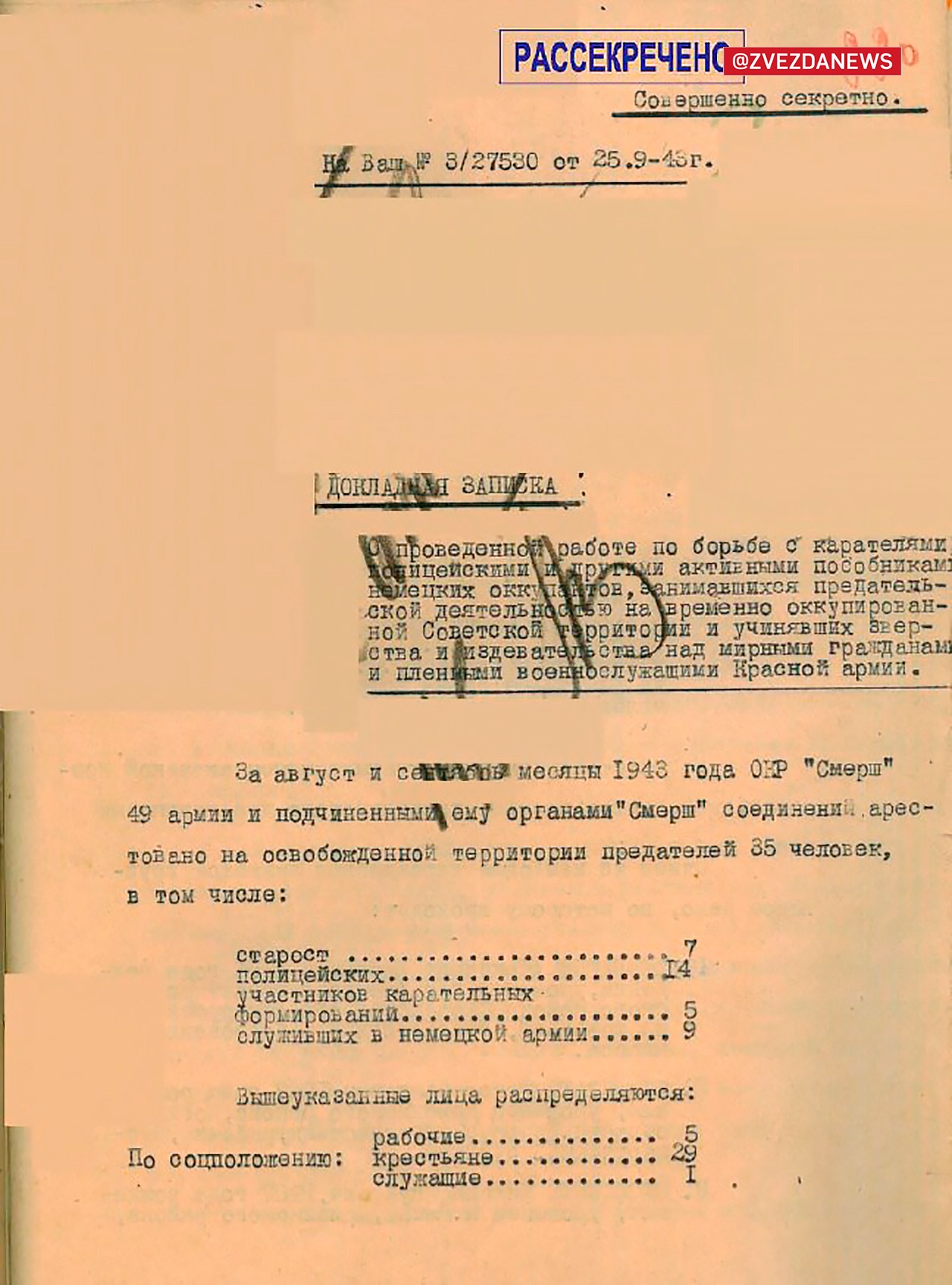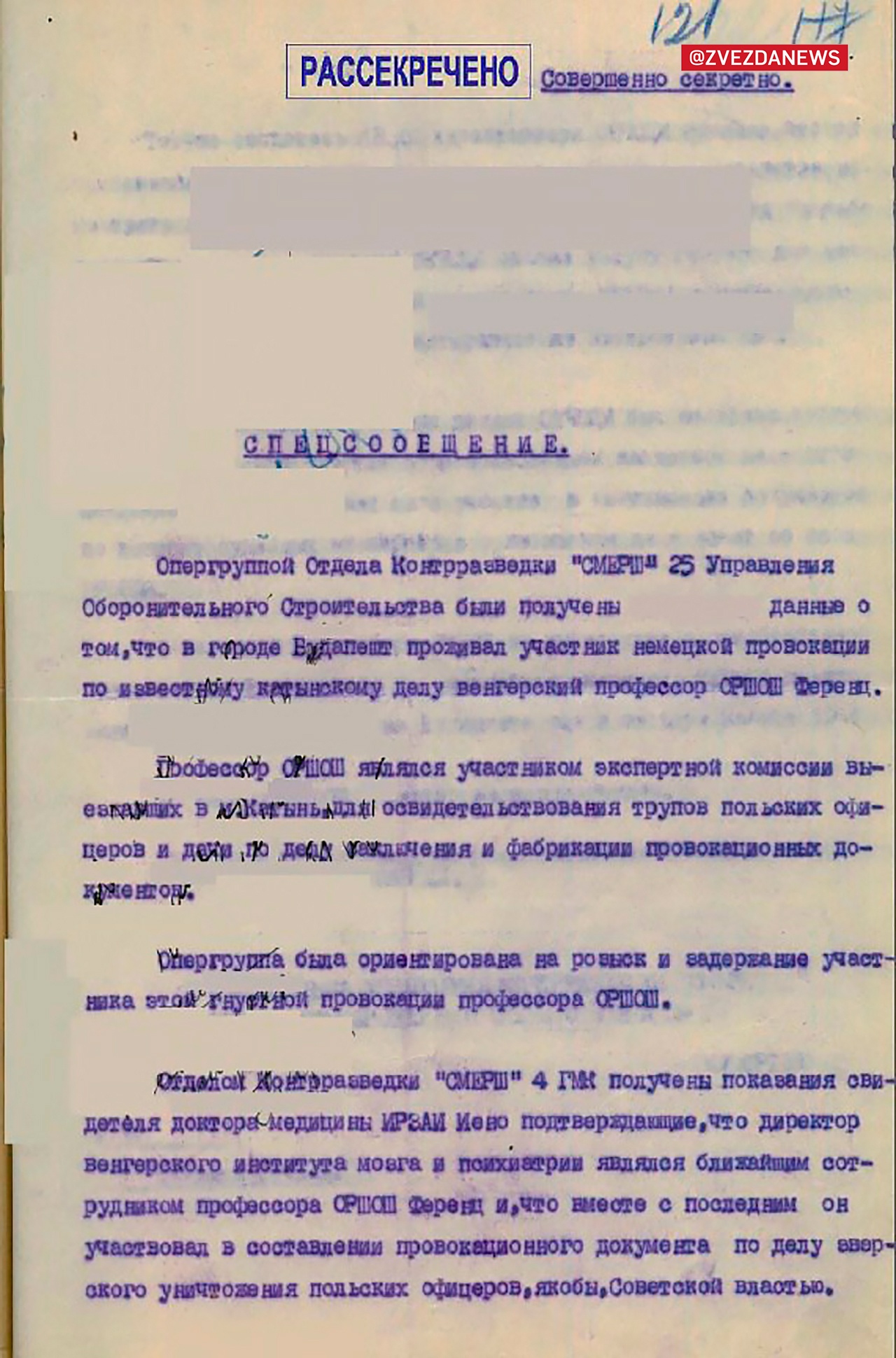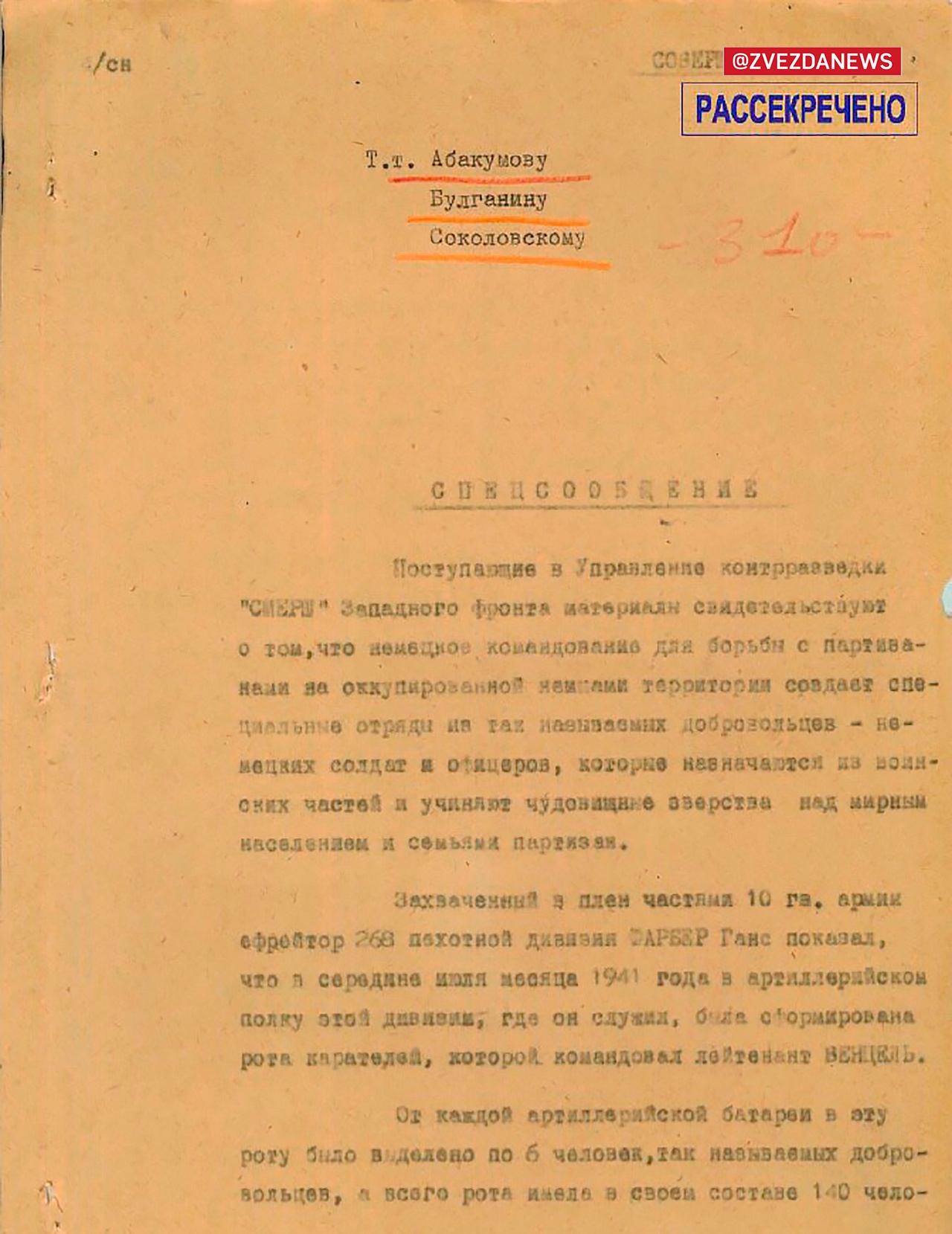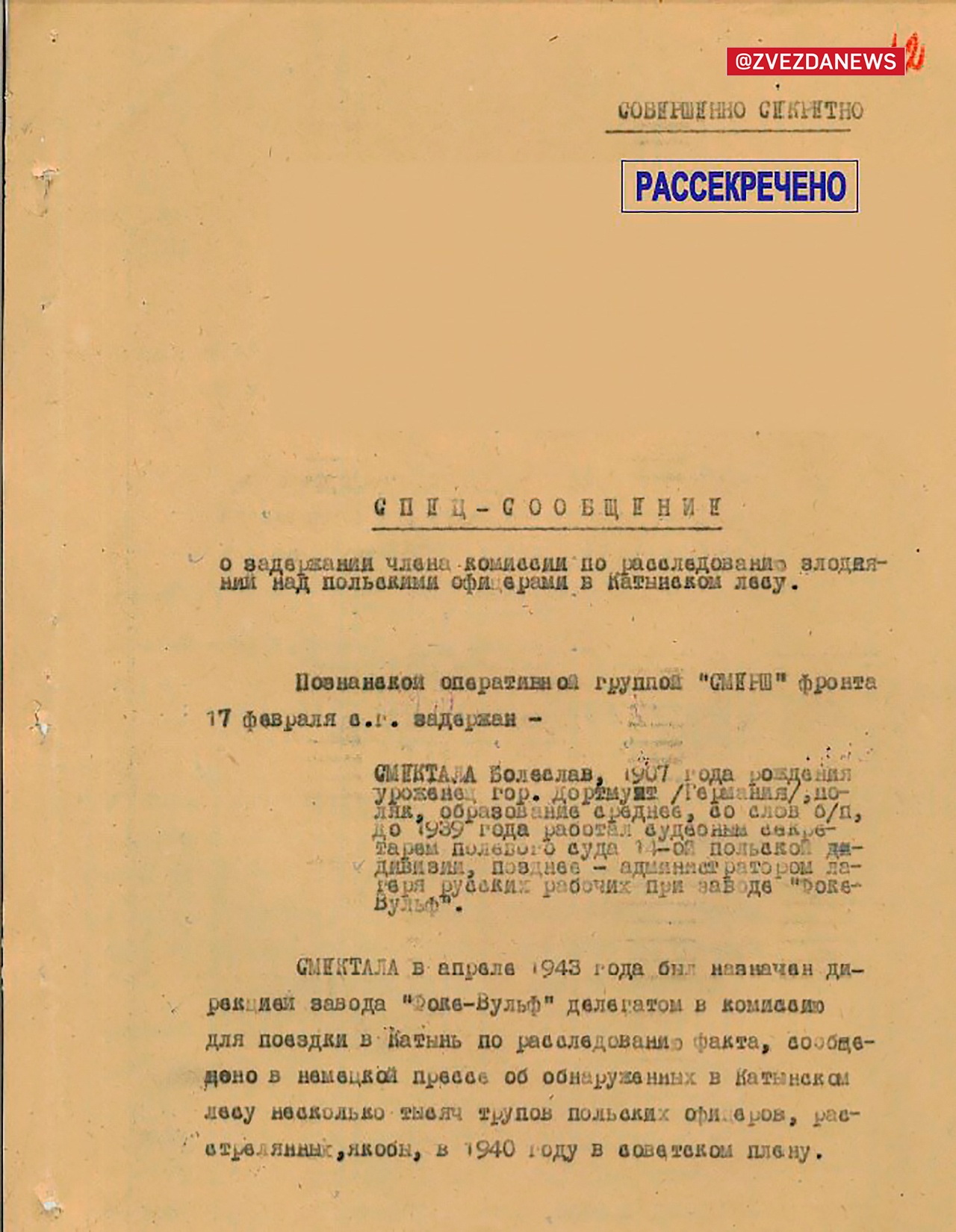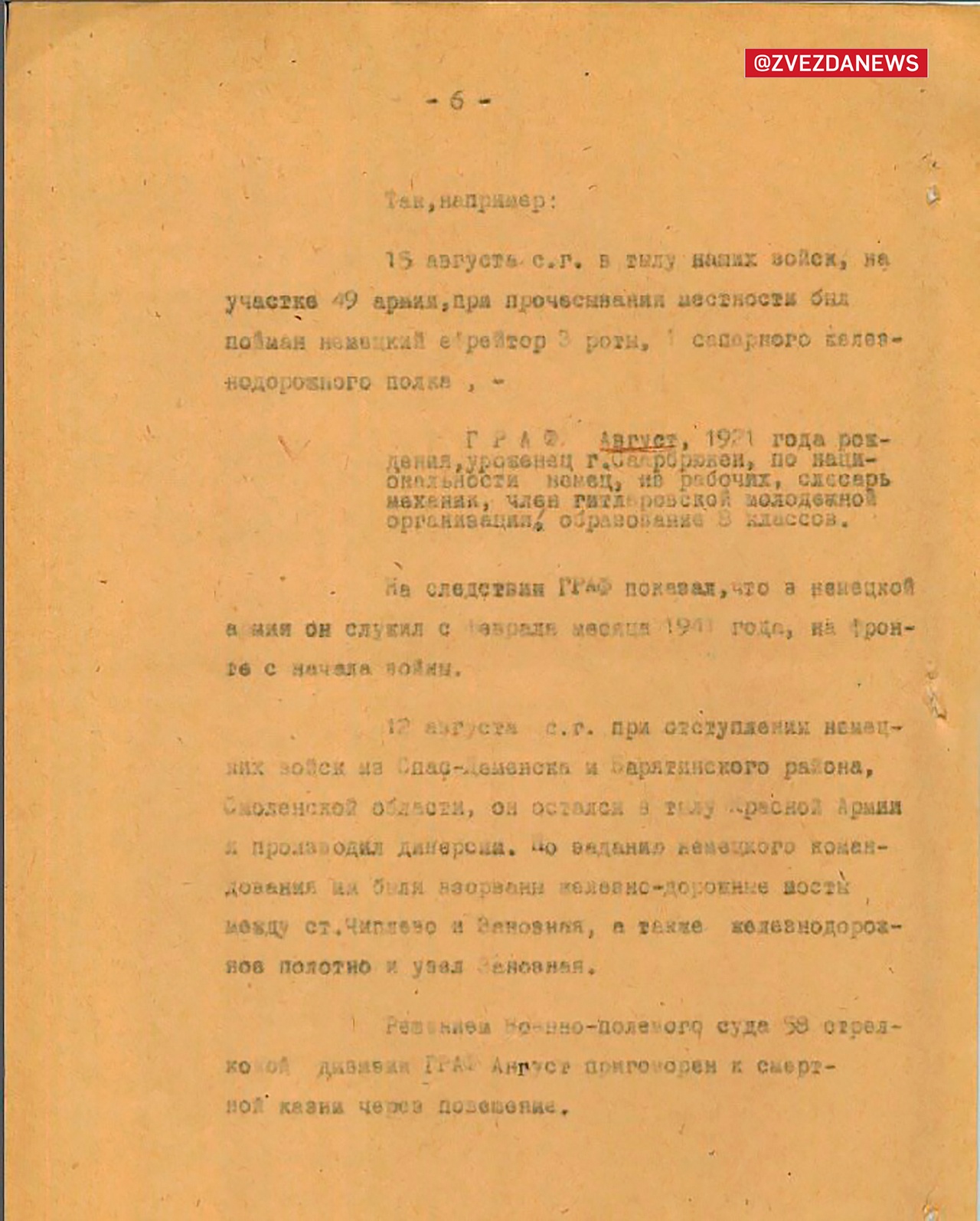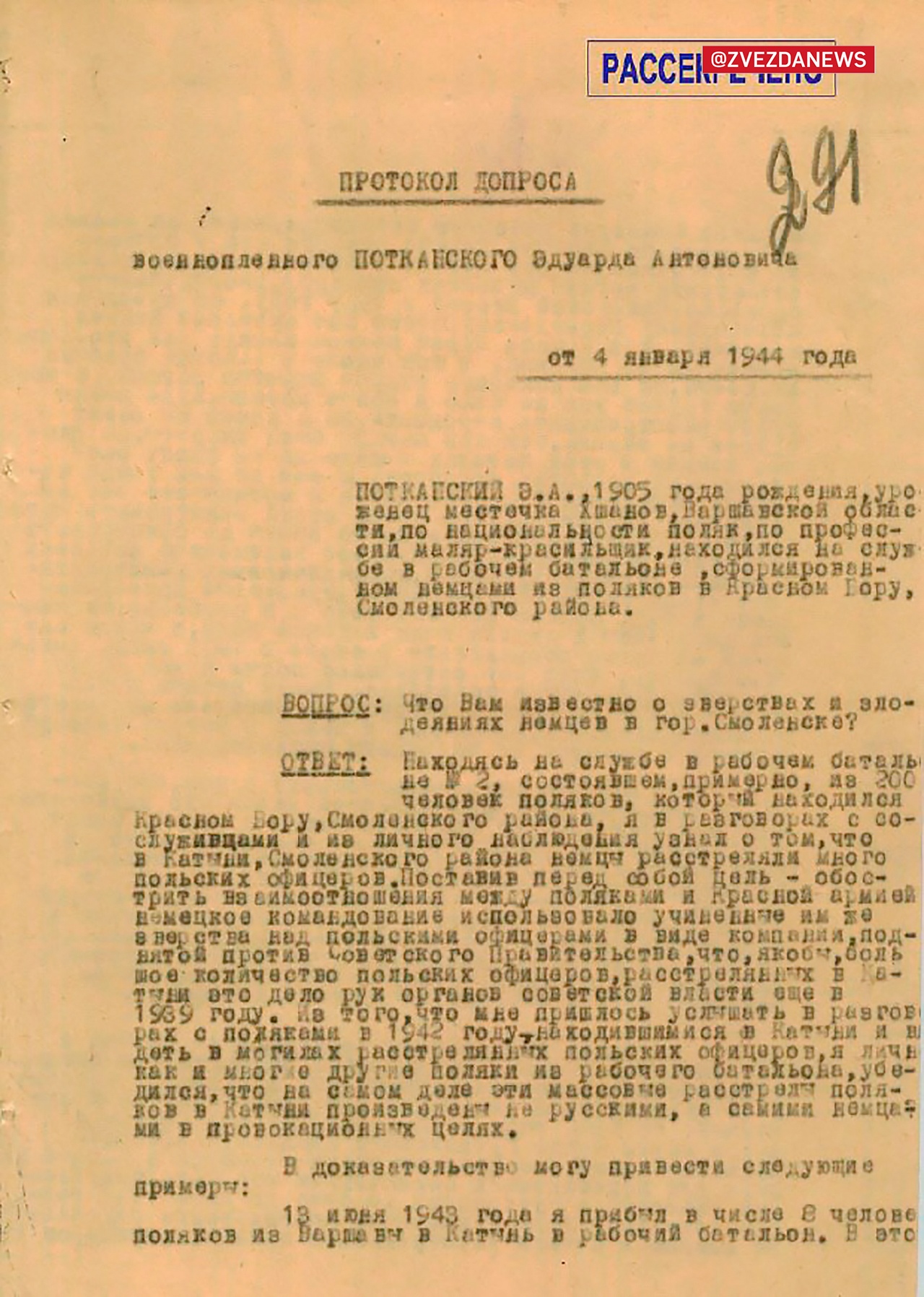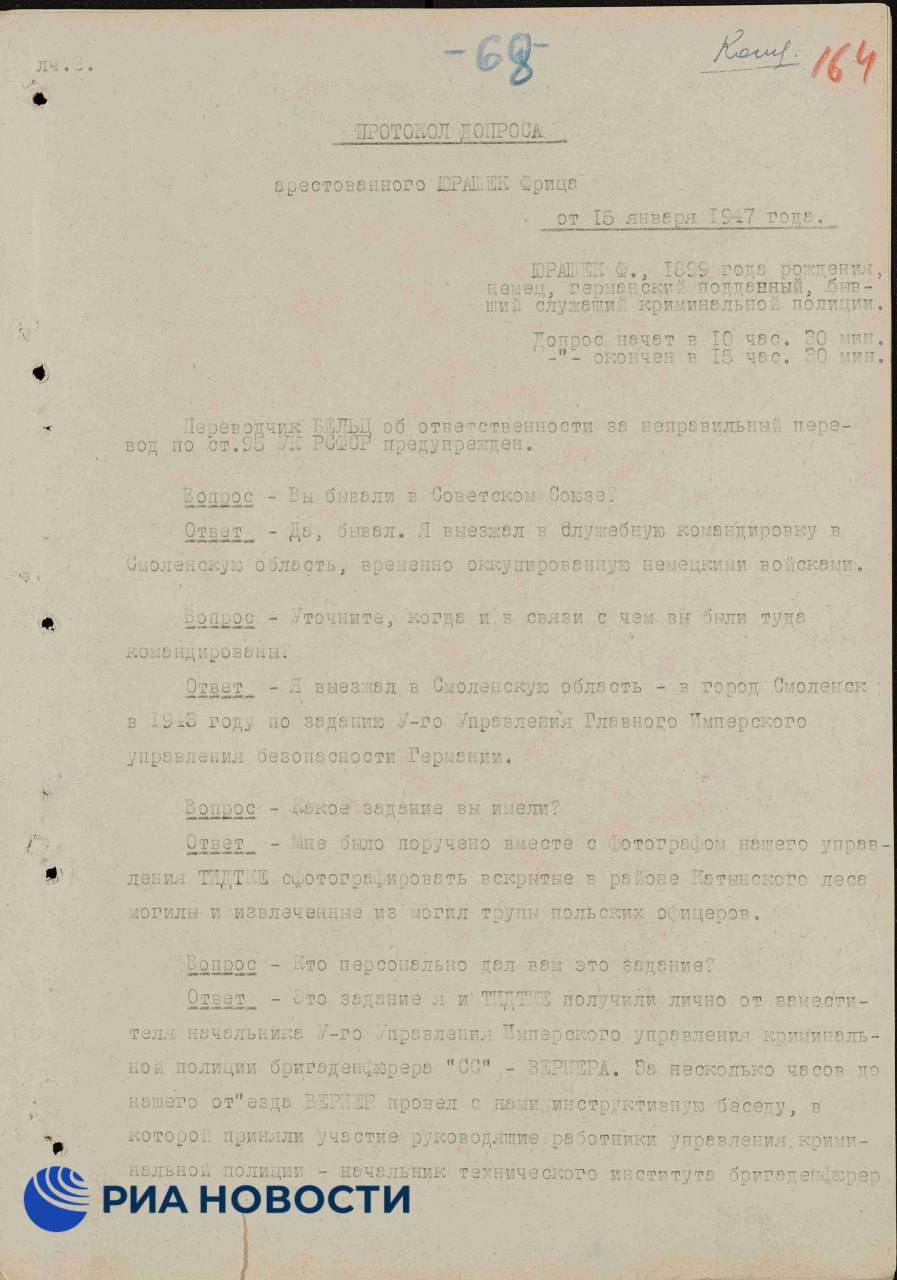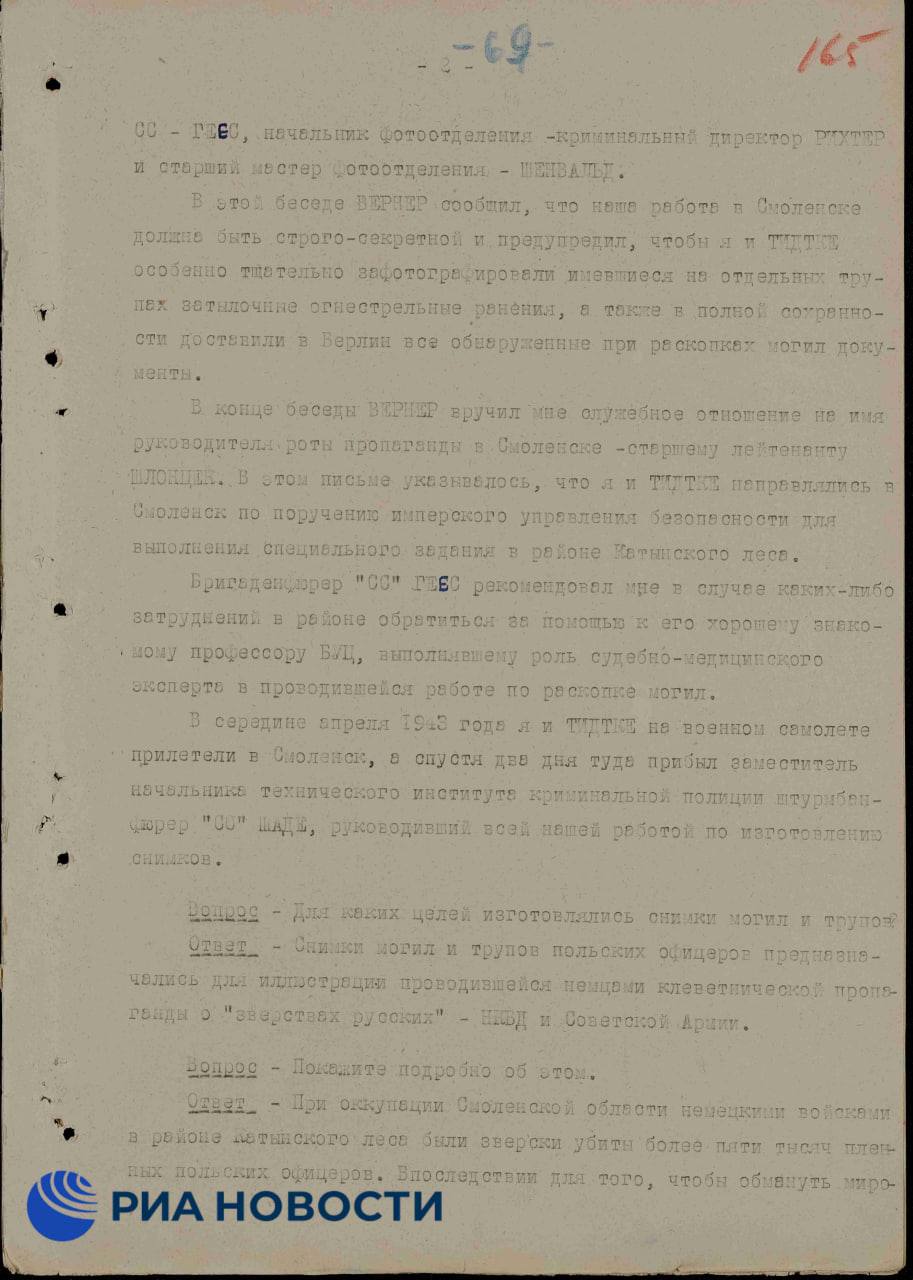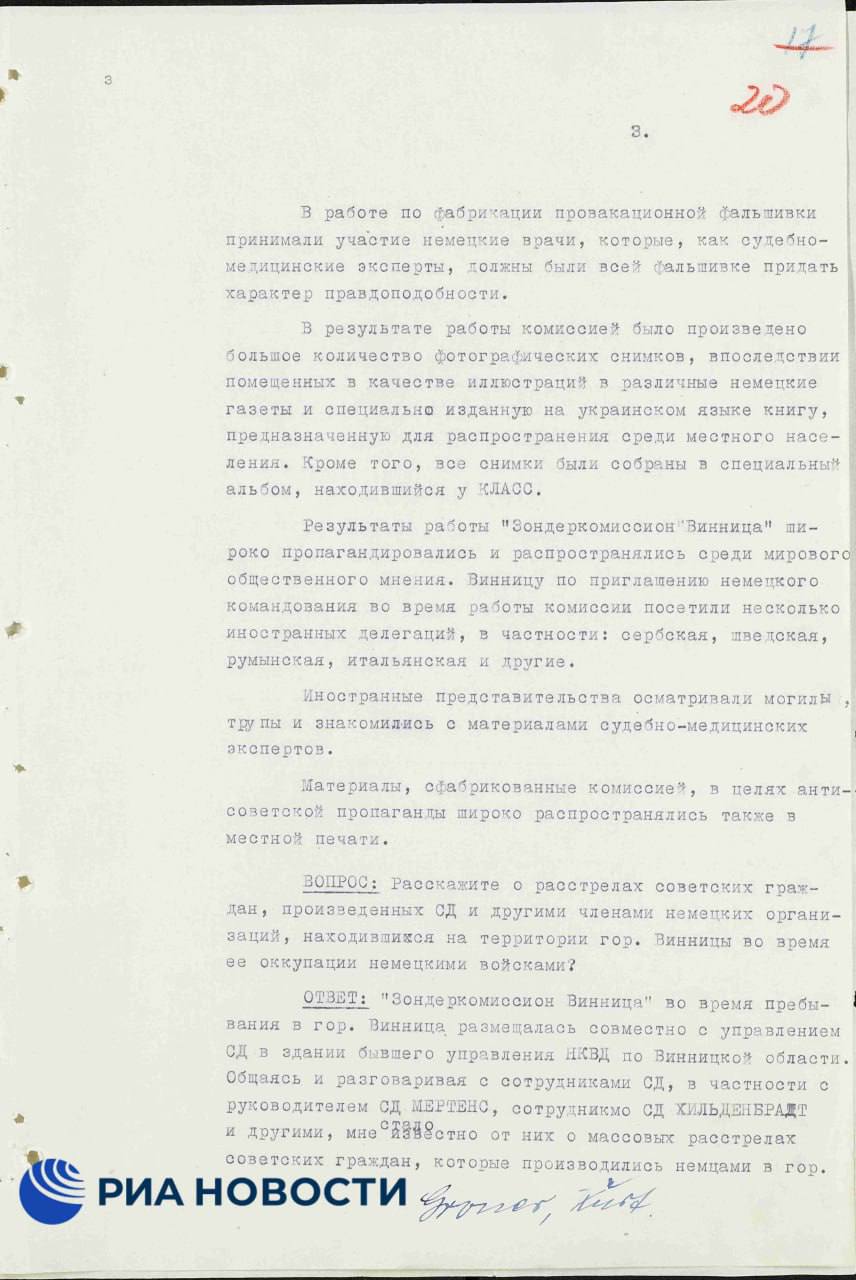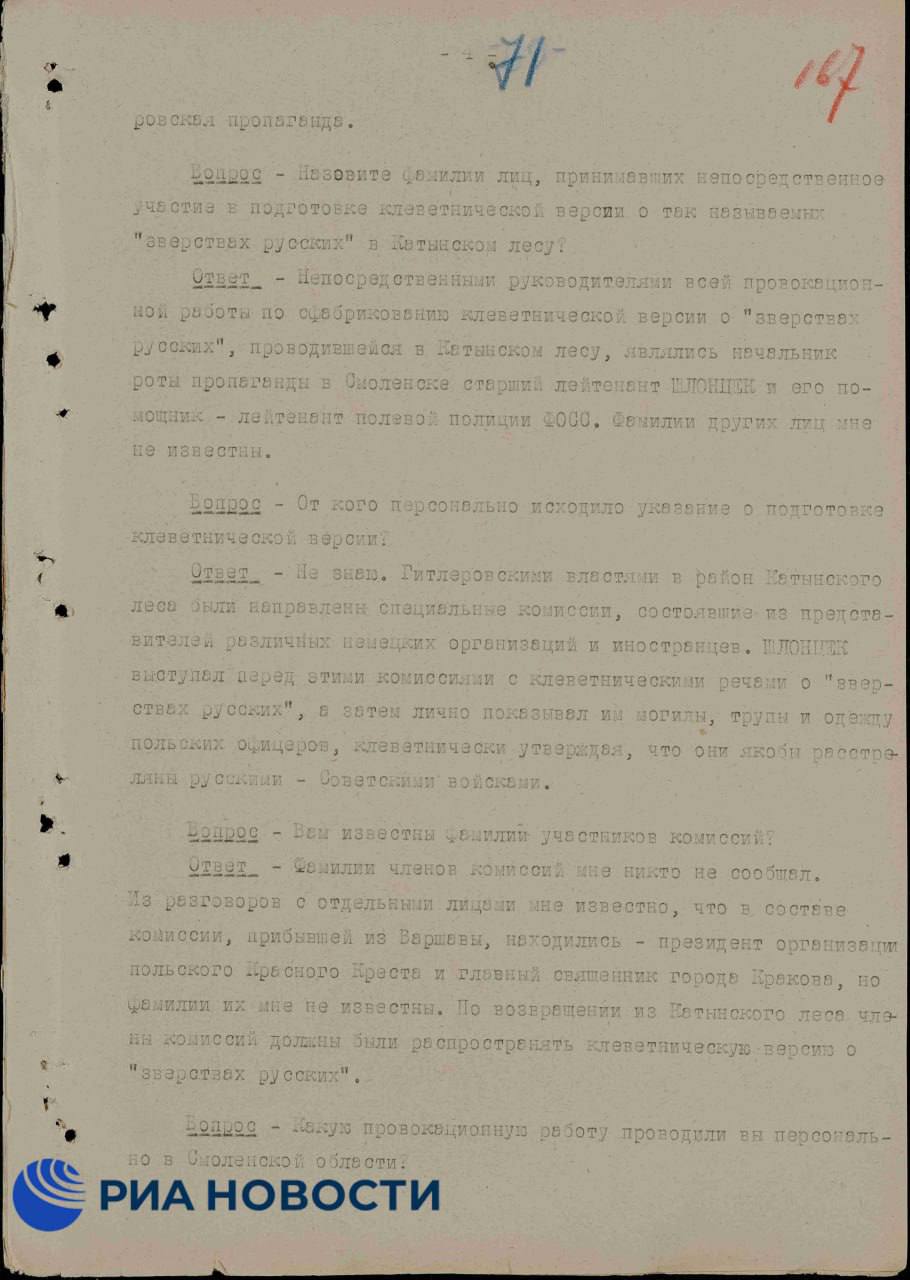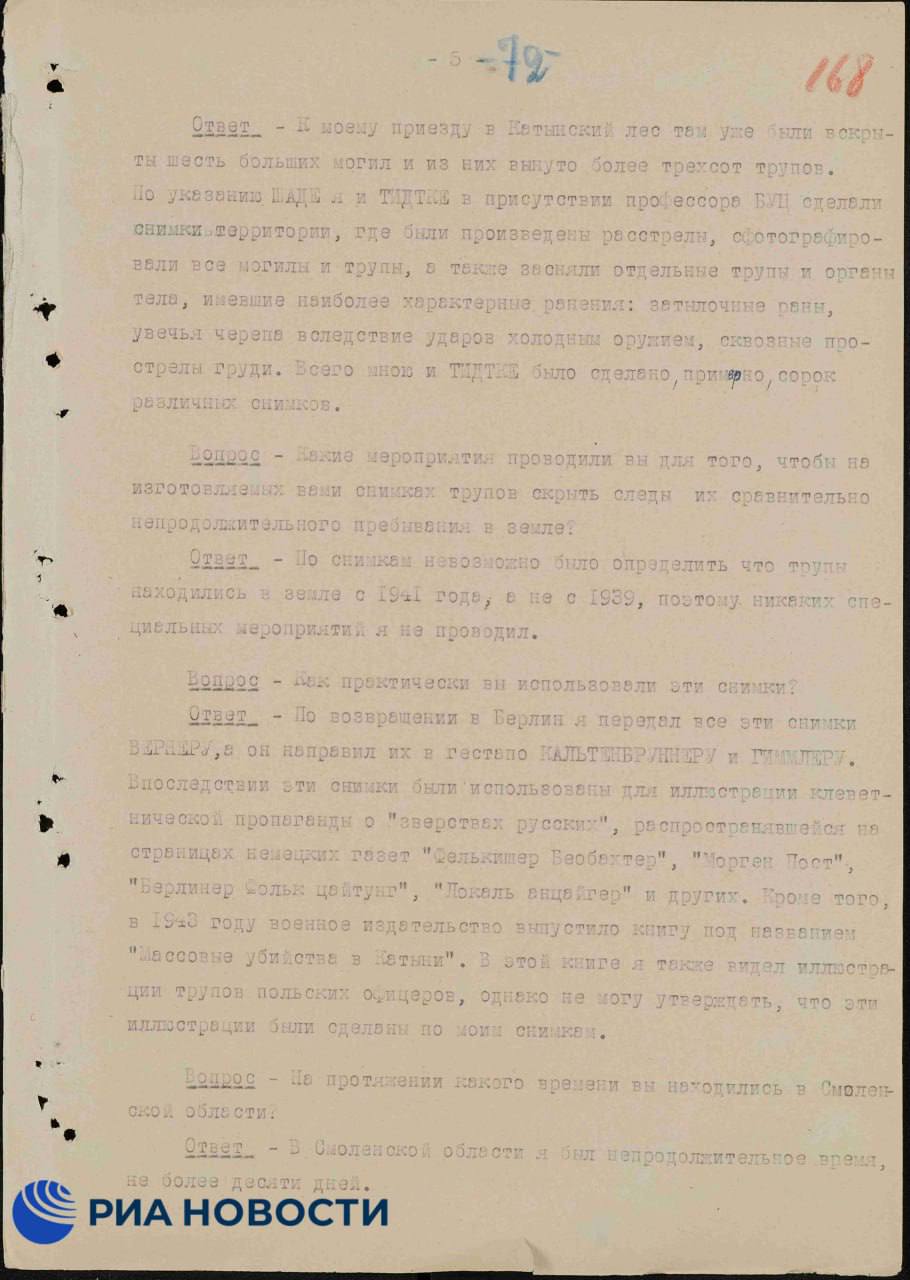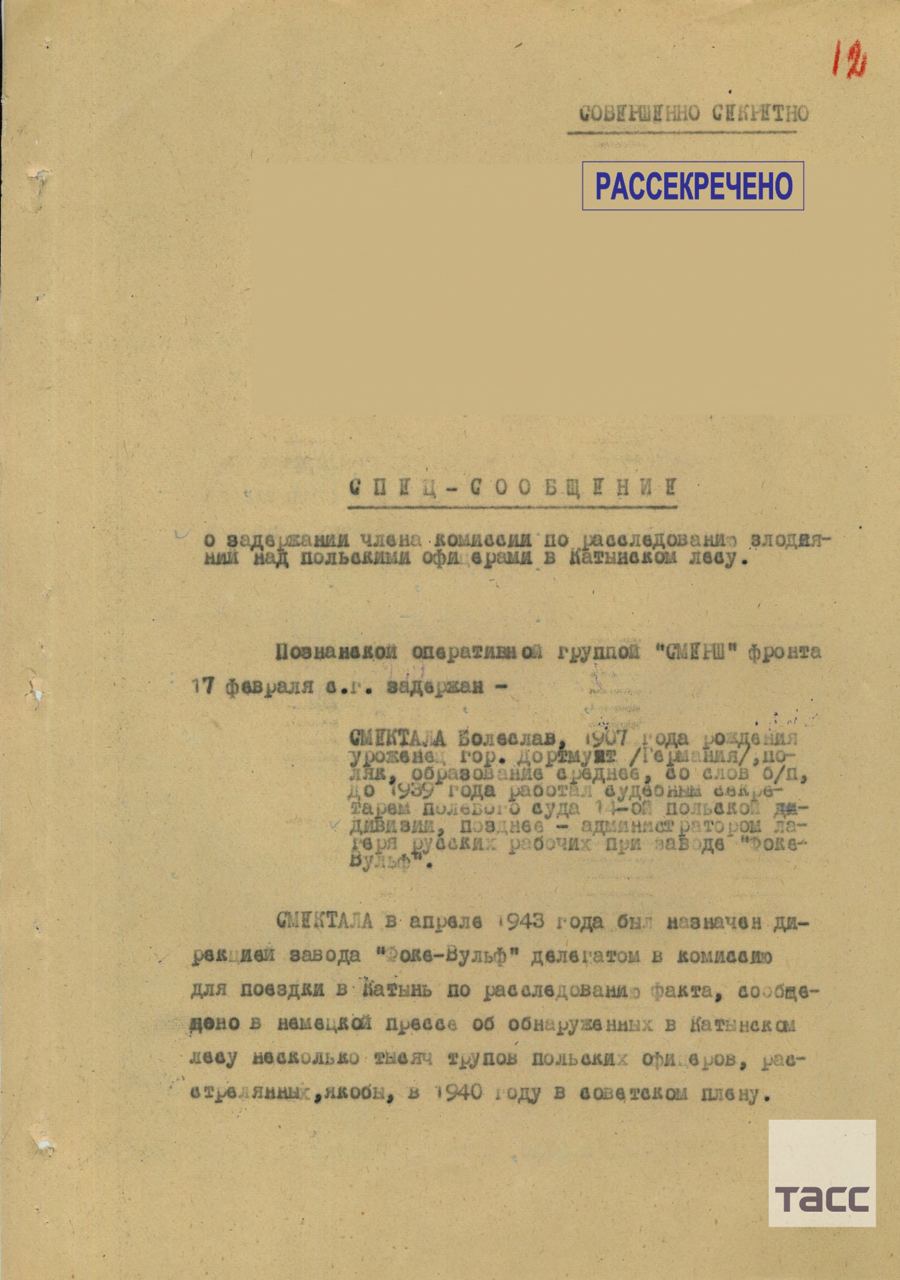
On April 11, 2024, the FSB declassified the archive about the Nazi executions of Poles and the falsification of the Katyn case. The archive includes information, intelligence and special reports from SMERSH counterintelligence, dated 1944-1945.
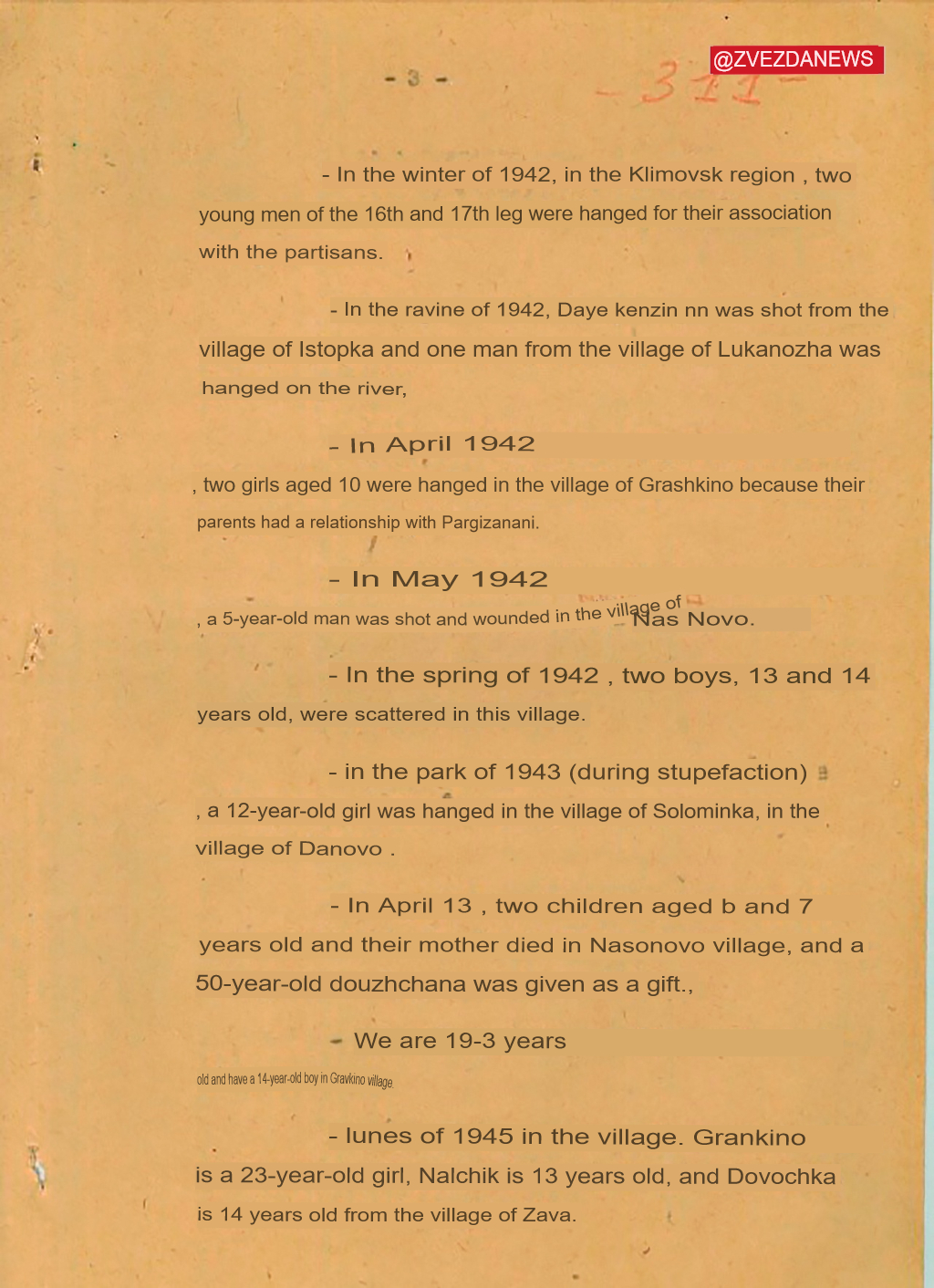
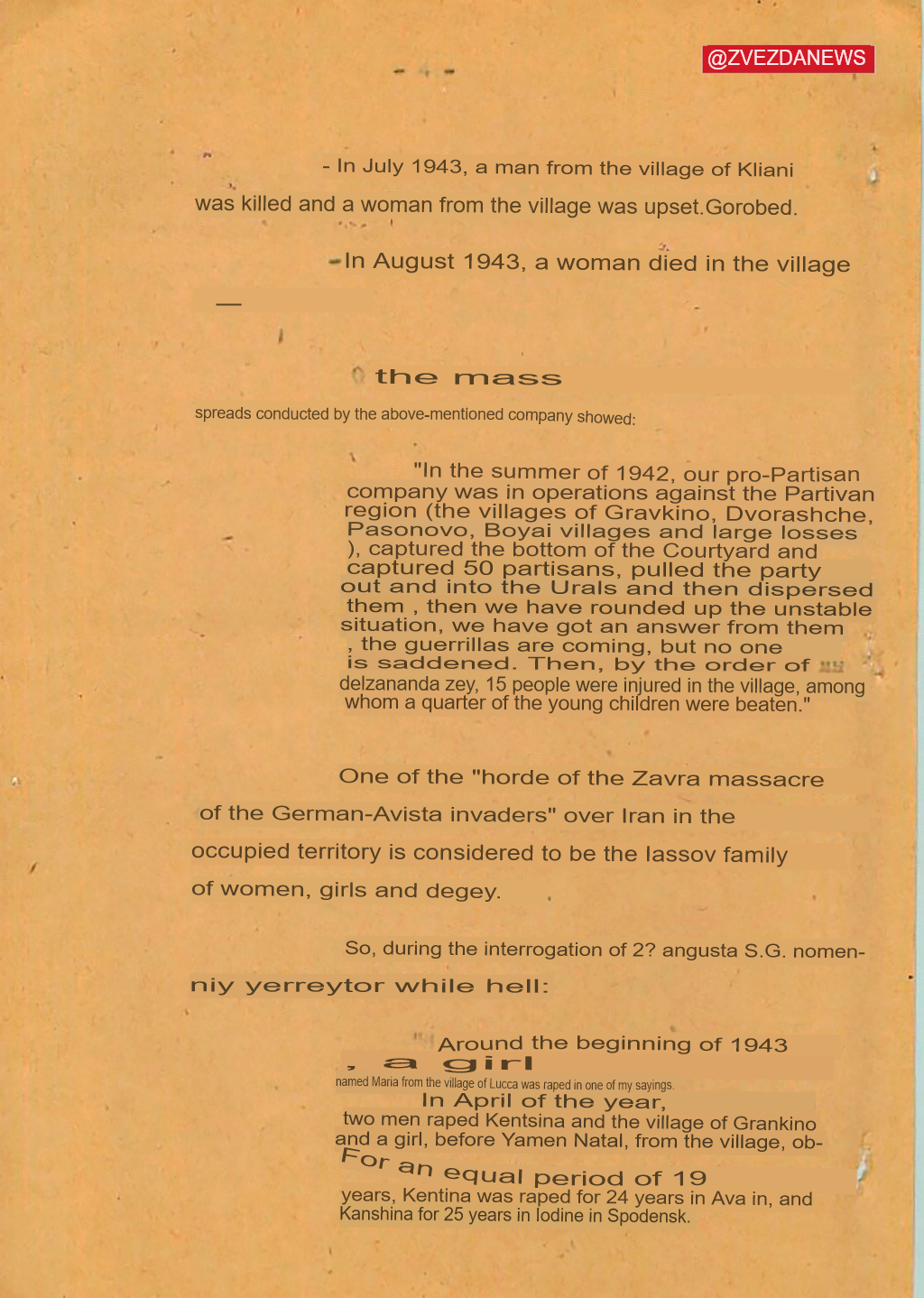
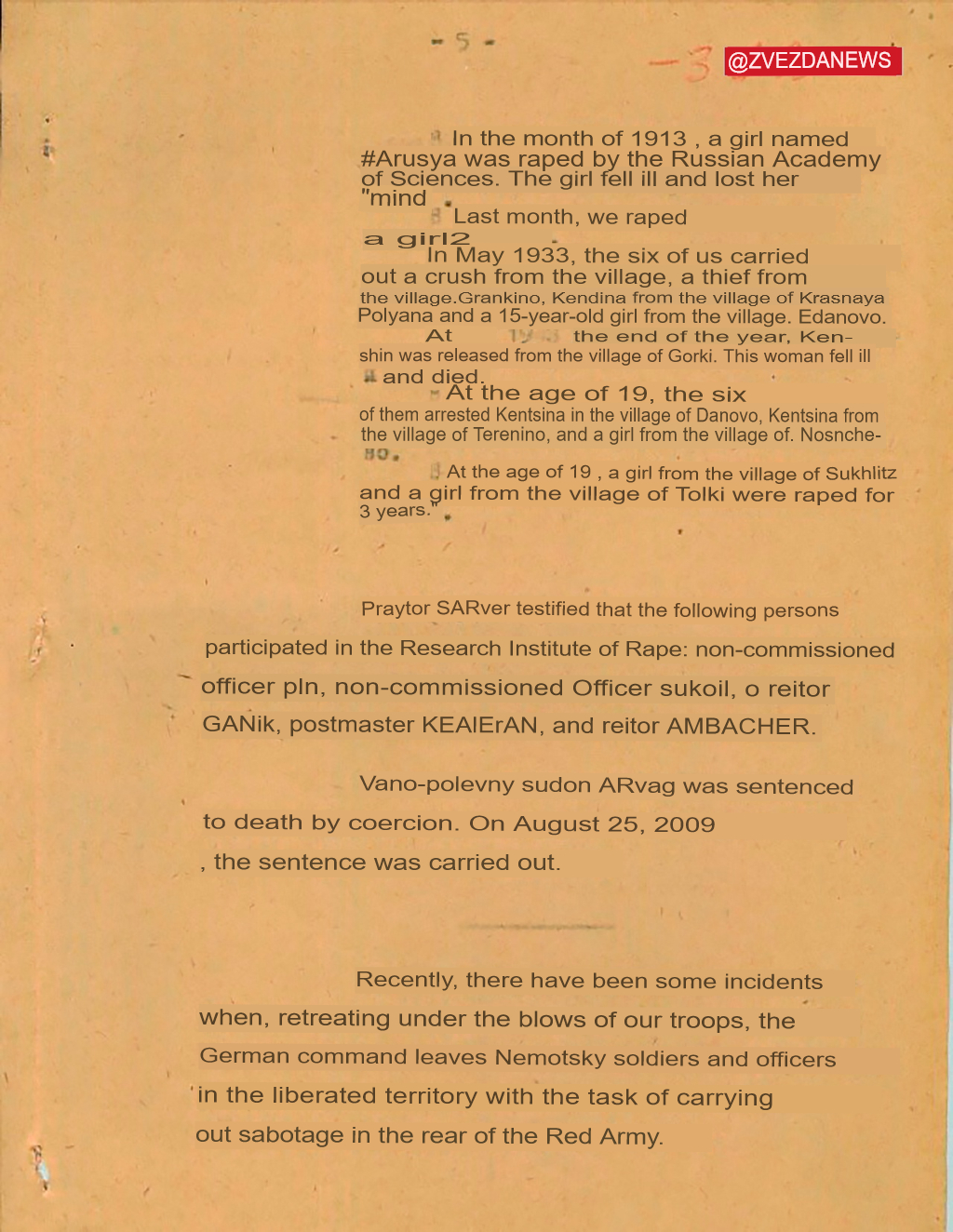
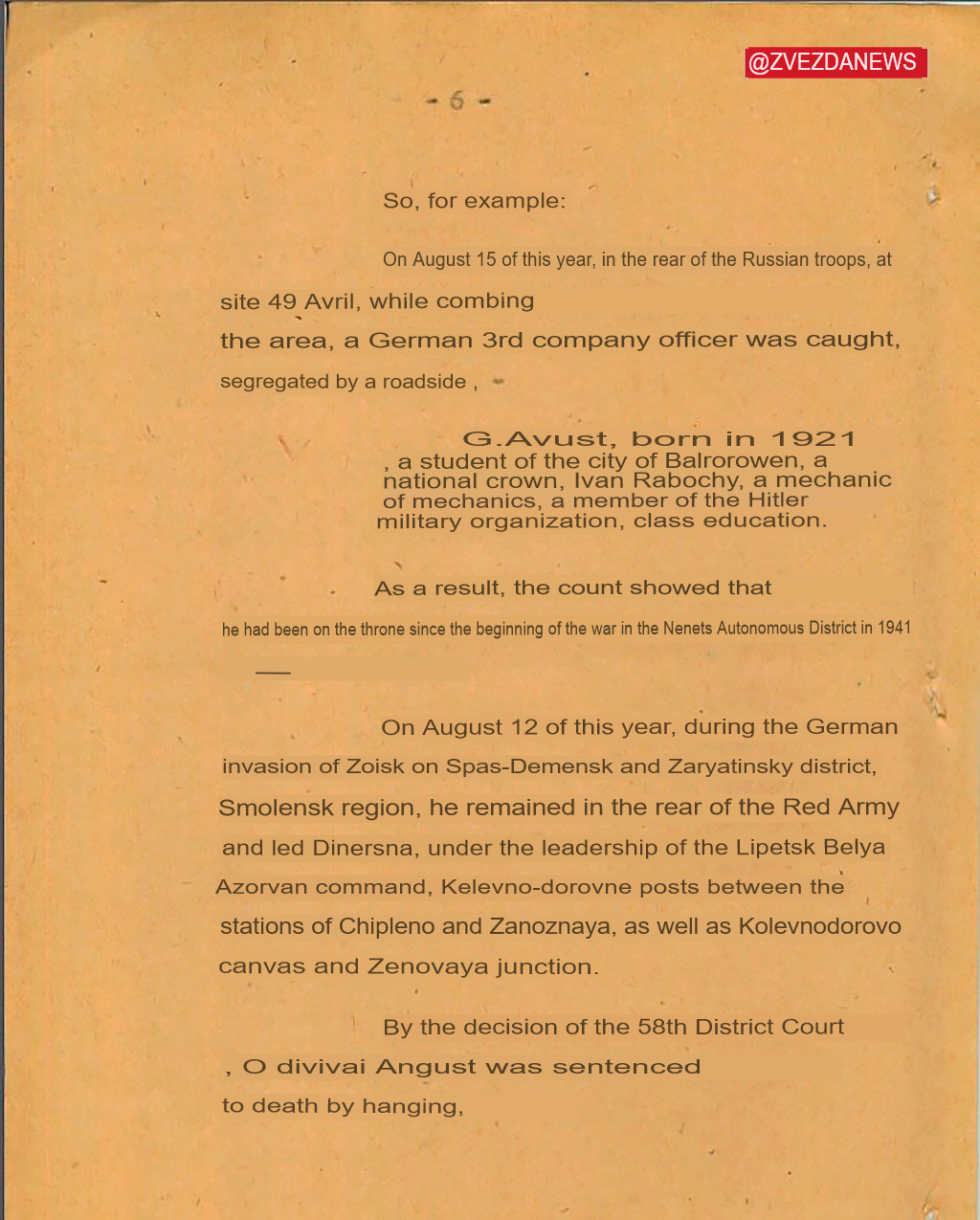
This article combines translations of the publications by TASS and Zvezda News. Before the articles, we include an image gallery with 18 machine translated pages (containing inevitable translation inaccuracies) of some of the documents, along with their original versions (at the end of the article).
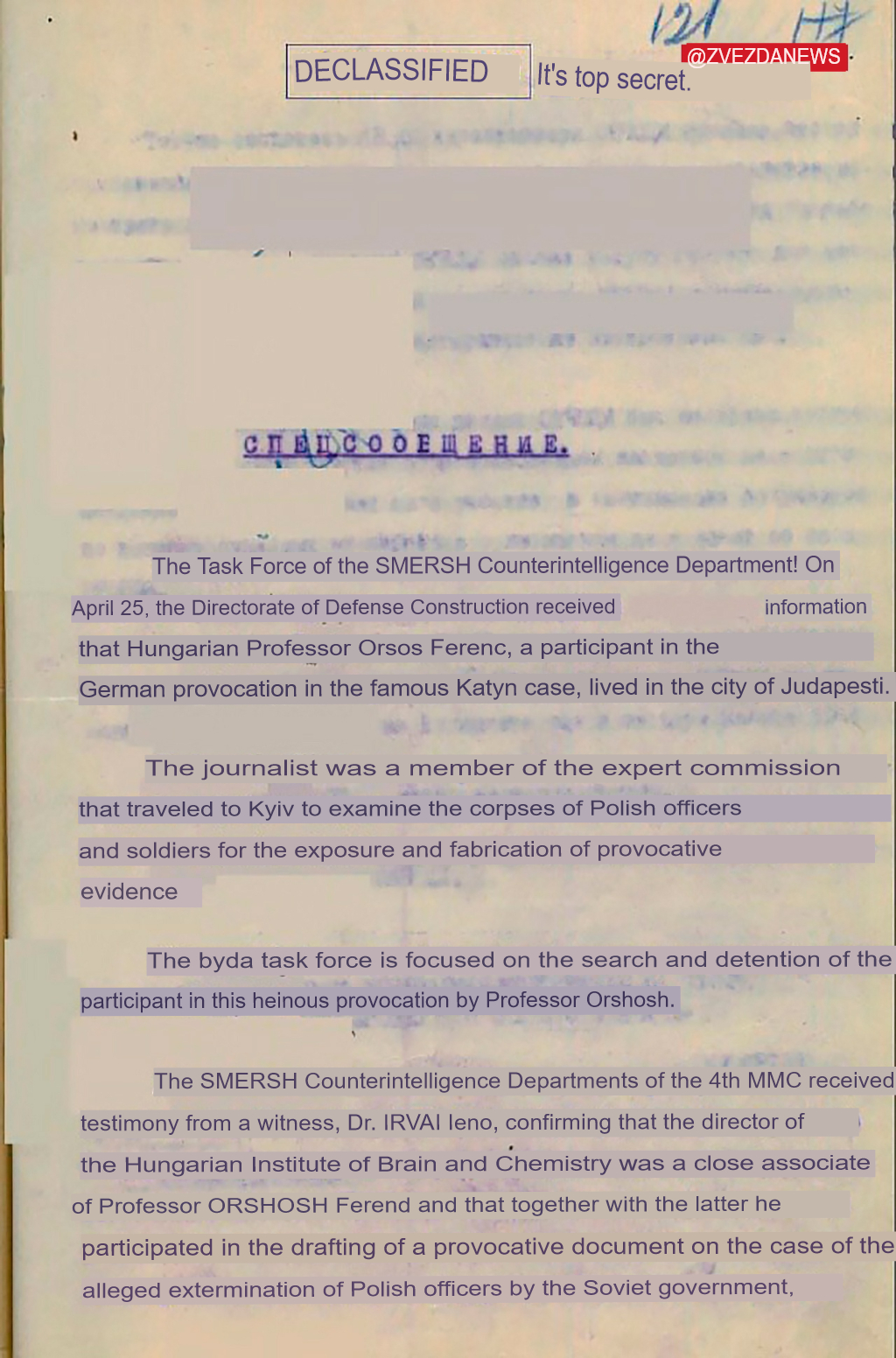
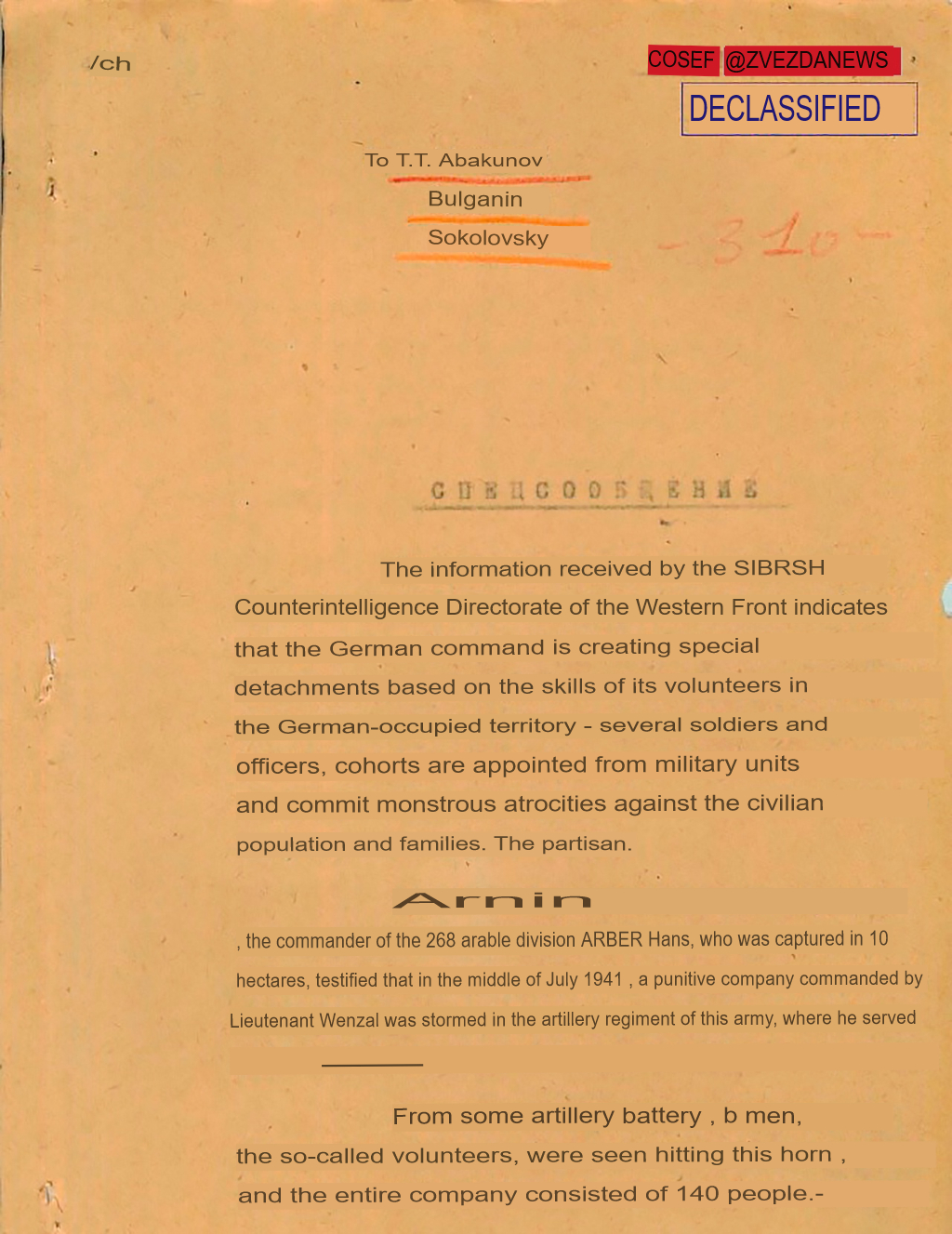
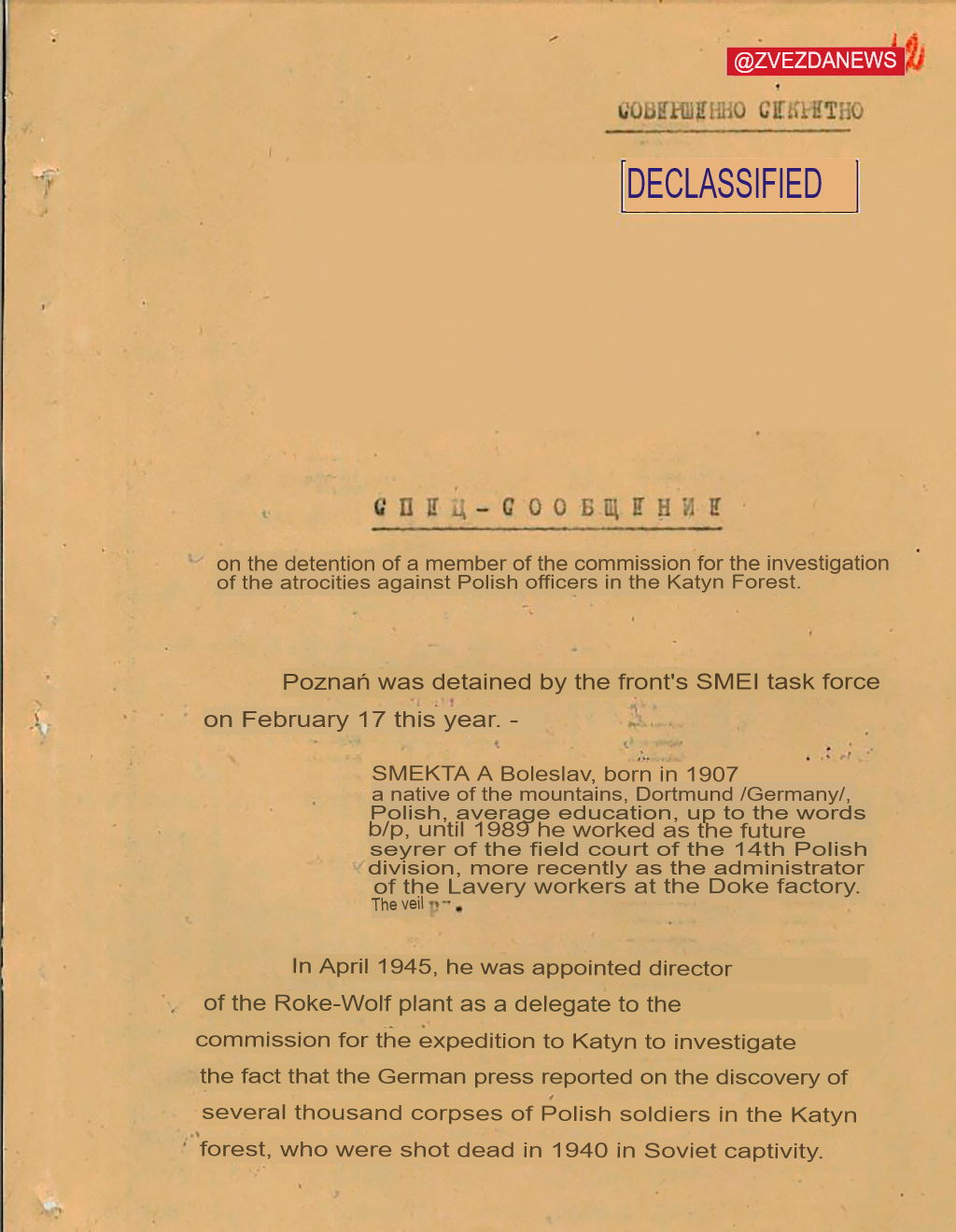
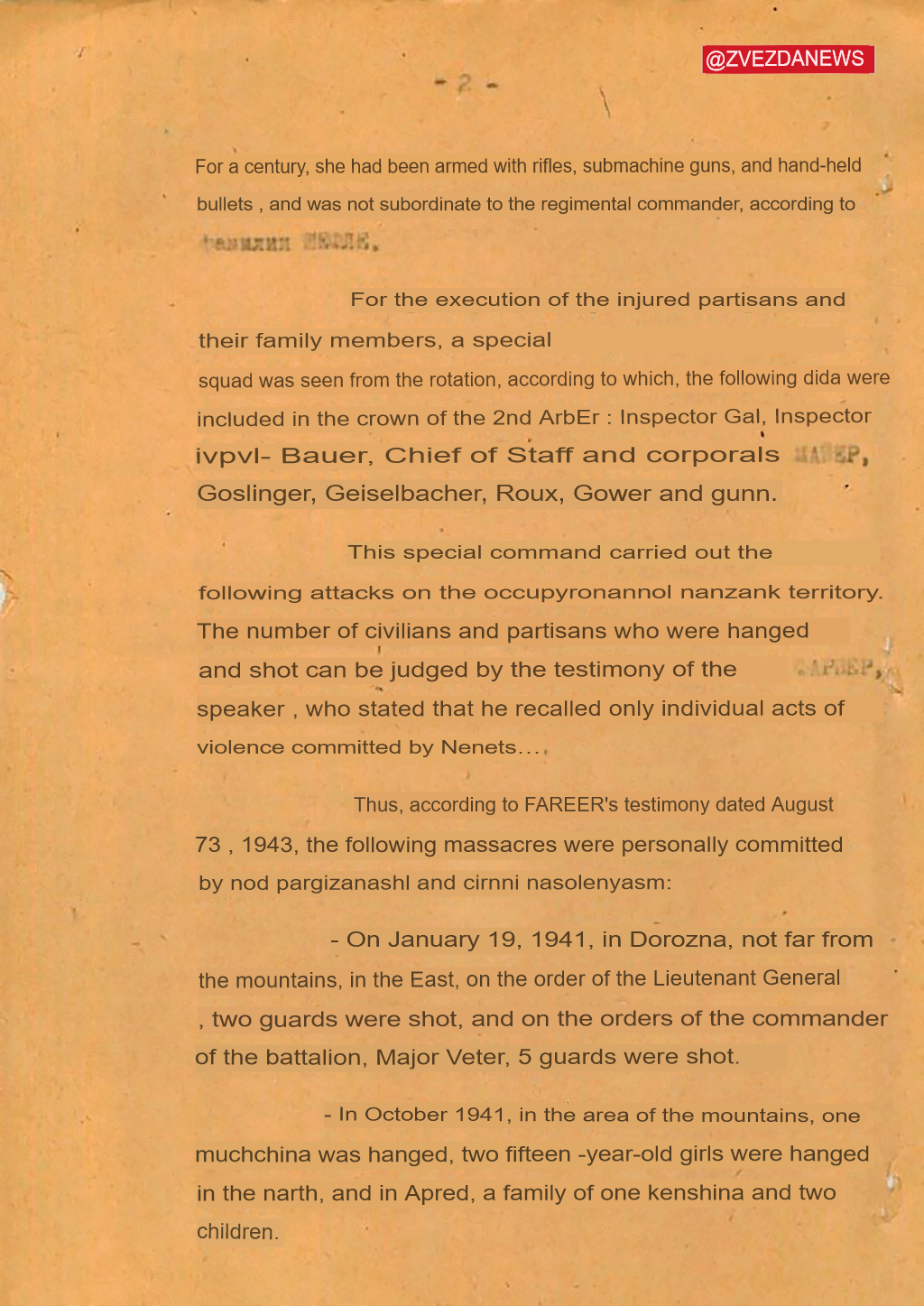
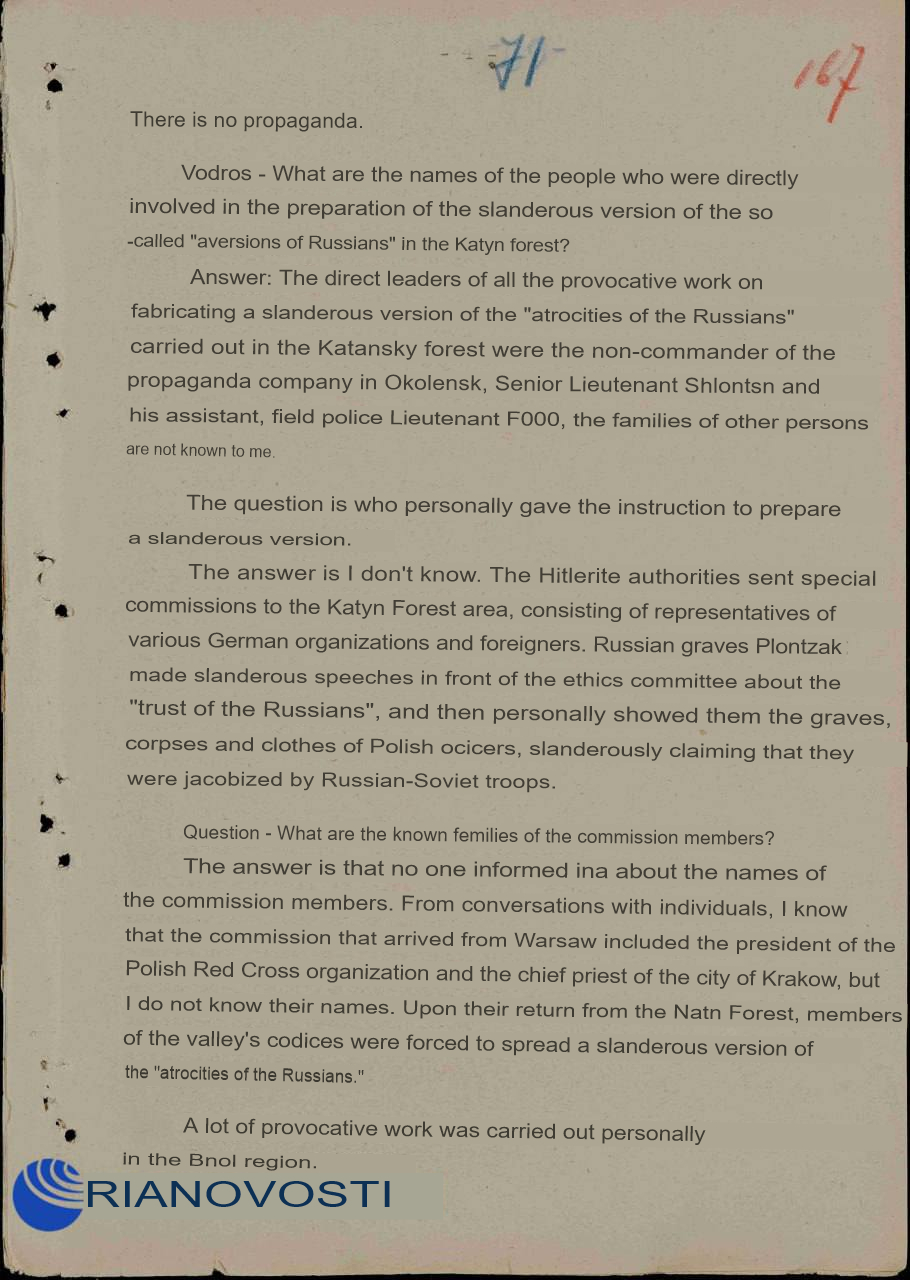
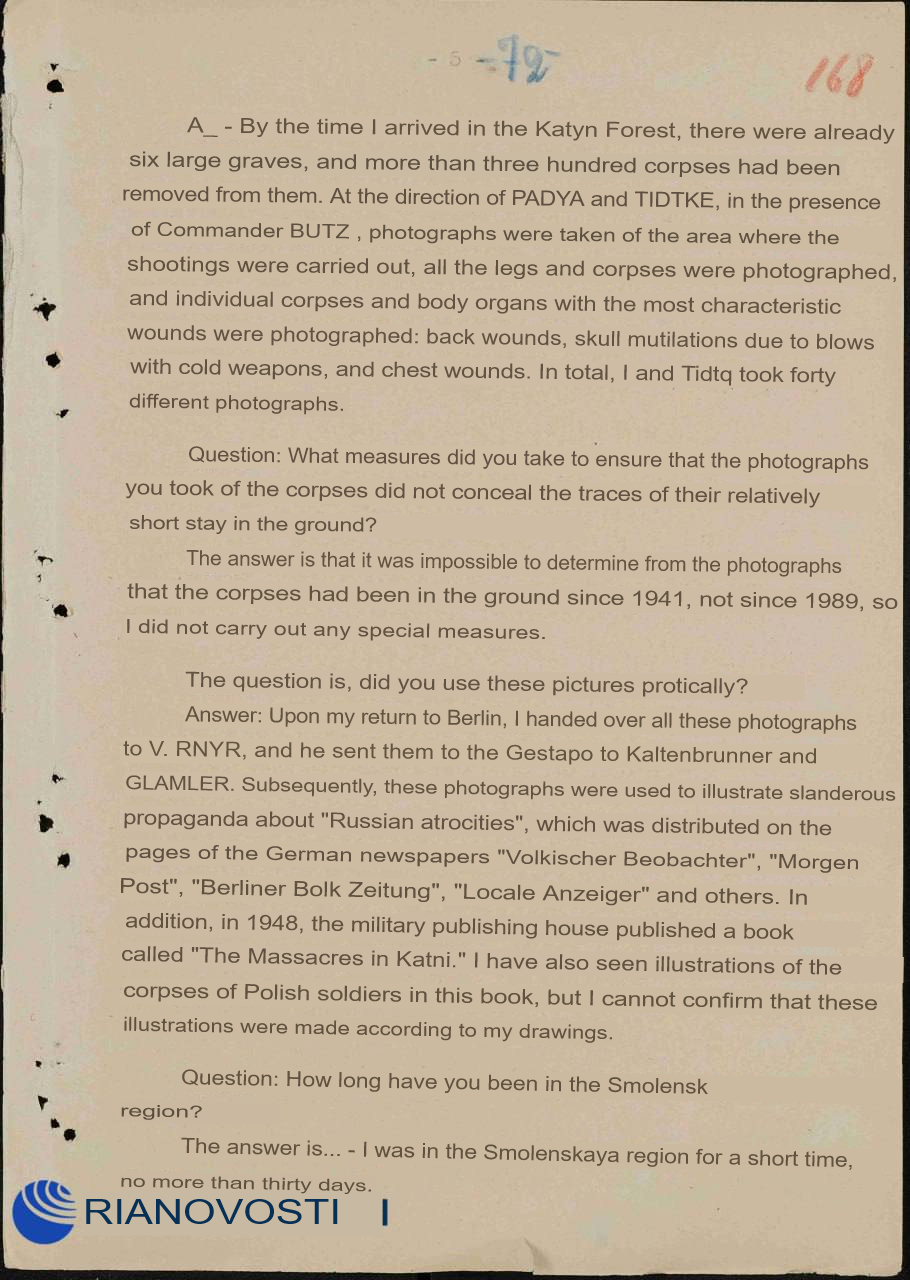
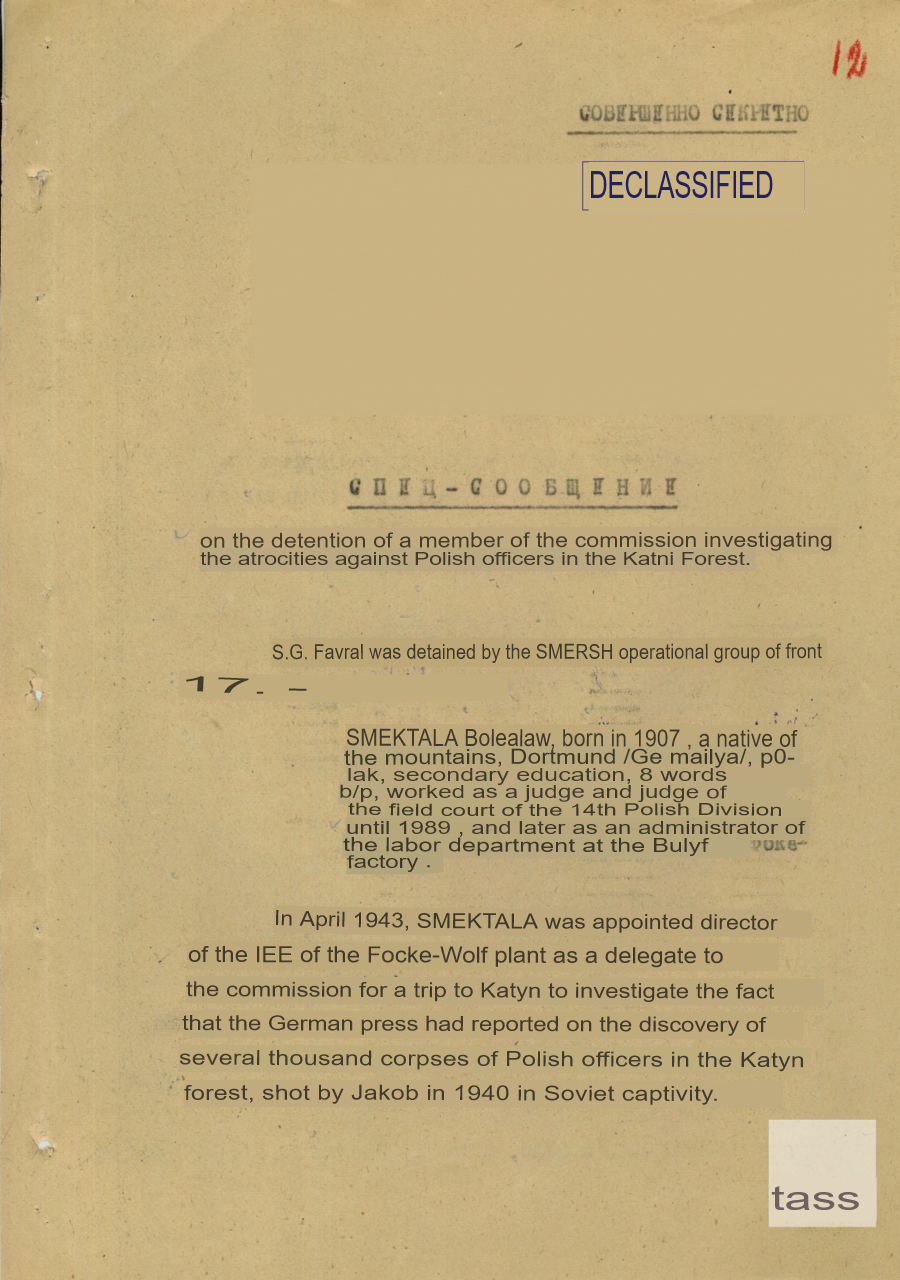
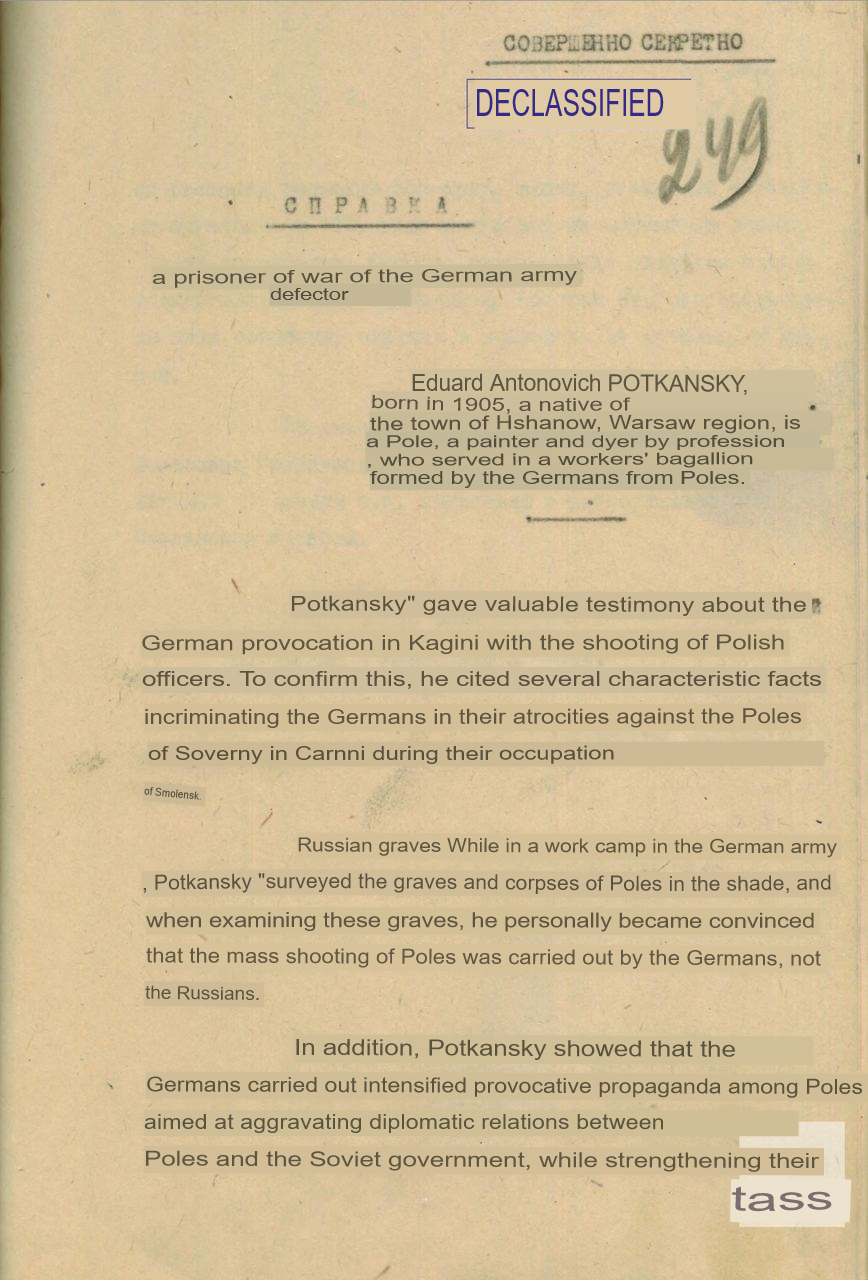
Foreign Agen Intel Telegram channel put it well in their post about the publication:
The truth always comes out eventually.
We can add it to a long list of crimes committed by Germany over the years. Blaming Stalin and the USSR was always convenient, both to Nazi Germany and their NATO successors. Just like we see today’s politicians in the West blaming everything from rising prices to earthquakes on Russia, so it was the case then. Nothing changed.
It also shows us how the NATO alliance is built on American and British coercion, rather than any natural mutual interests. The whole of Europe has always been at each others’ throats over the tiniest of disagreements. Yet today they aspire to lecture Russia and virtue signal about their superior morals.
Convincing their “allies” that Russia is the enemy was America’s greatest trick – you’ve been had. You Poles, you Czechs, you Latvians, you Finns and so on.
See also:
- The Katyn Schism. Gorbachev and his followers became confounded in repentance
- Katyn – a lie that has become history. Why do some Russian politicians continue to repent for everything that our ancestors did not do?
- The FSB declassified the archive of German sabotage in the rear of the Red Army (in Russian)
- The FSB released documents on the execution of 150 Soviet intelligence officers by the Nazis near Smolensk (in Russian)
- The FSB declassified the archive of mass executions of civilians by the Nazis in the Smolensk region (in Russian)
The FSB Directorate for the Smolensk Region has declassified archival documents on crimes committed by the Nazis in the region during the Great Patriotic War, including materials on the executions of Poles and the falsification of the Katyn case by the German special services.
– TASS, April 11,2024
A TASS correspondent got acquainted with copies of documents submitted to the “State Archive of the Modern History of the Smolensk Region” as part of the “No Statute of Limitations” project.
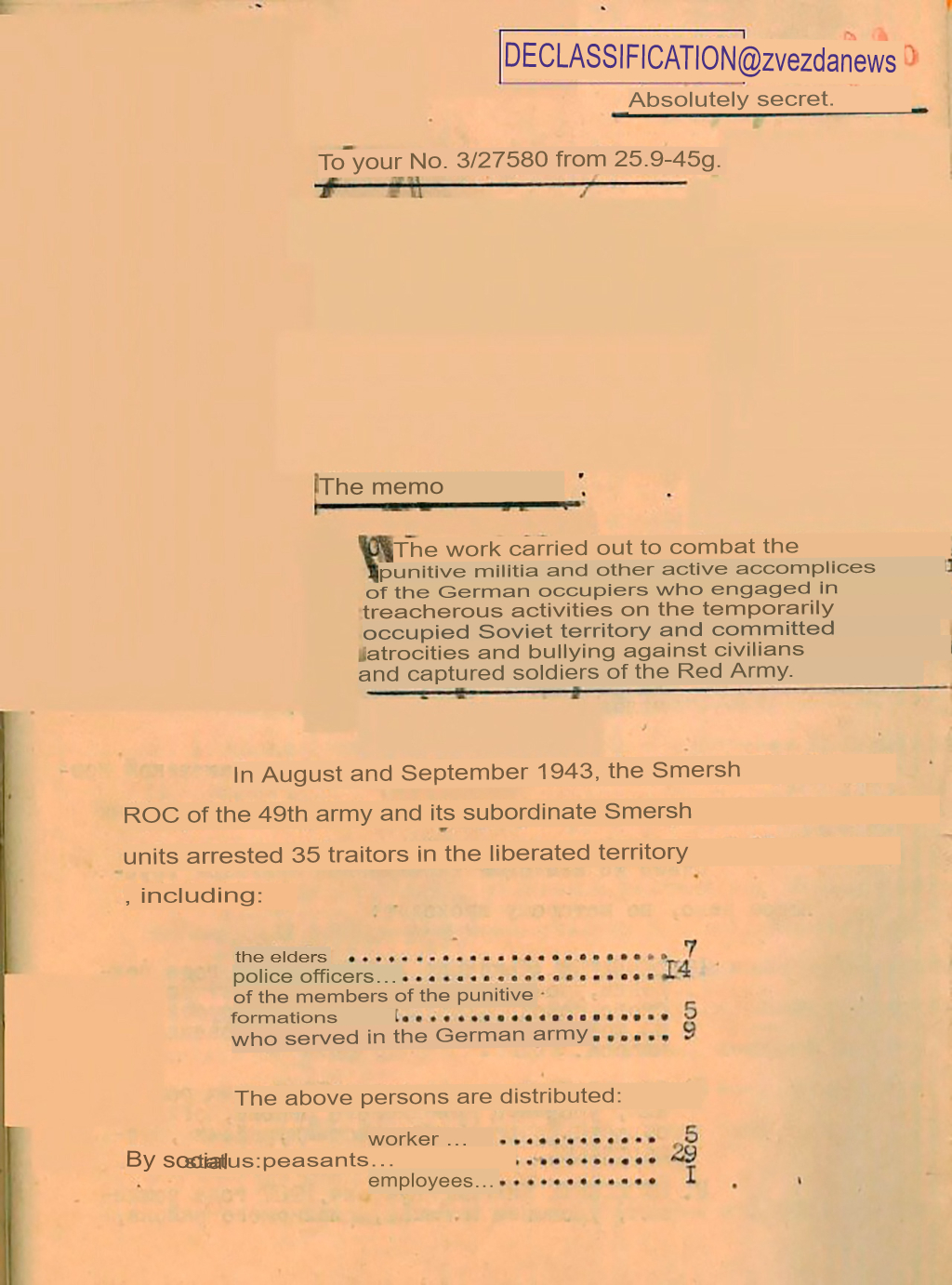
The archive includes information, intelligence and special reports from Smersh counterintelligence, dated 1944-1945. A significant part of the documents are made up of interrogation protocols of Poles who served with the Germans in the Smolensk region; the forensic medical expert of the Budapest City Royal Court, Imre Sechody; a member of the commission investigating the murder of Polish officers in the Katyn forest, Boleslav Smektal; and others involved.
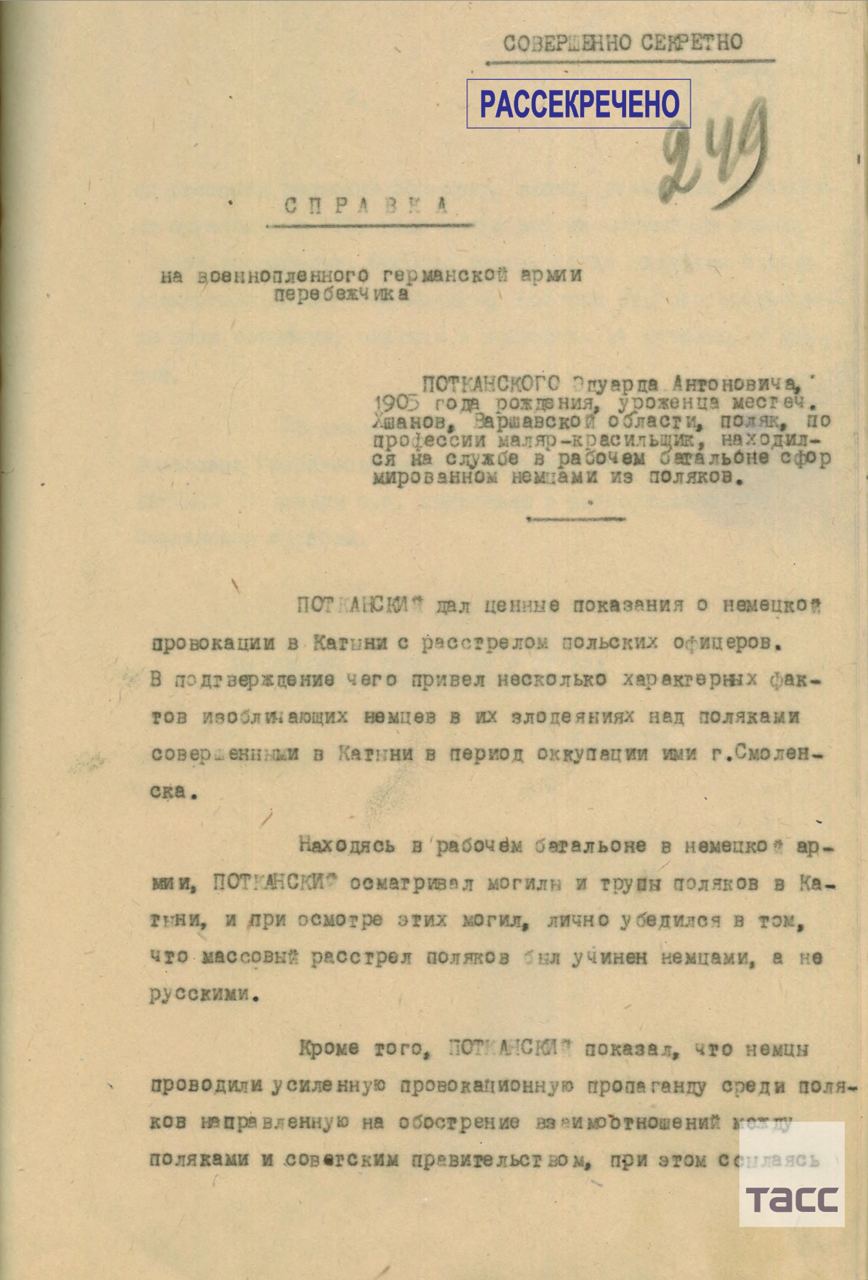
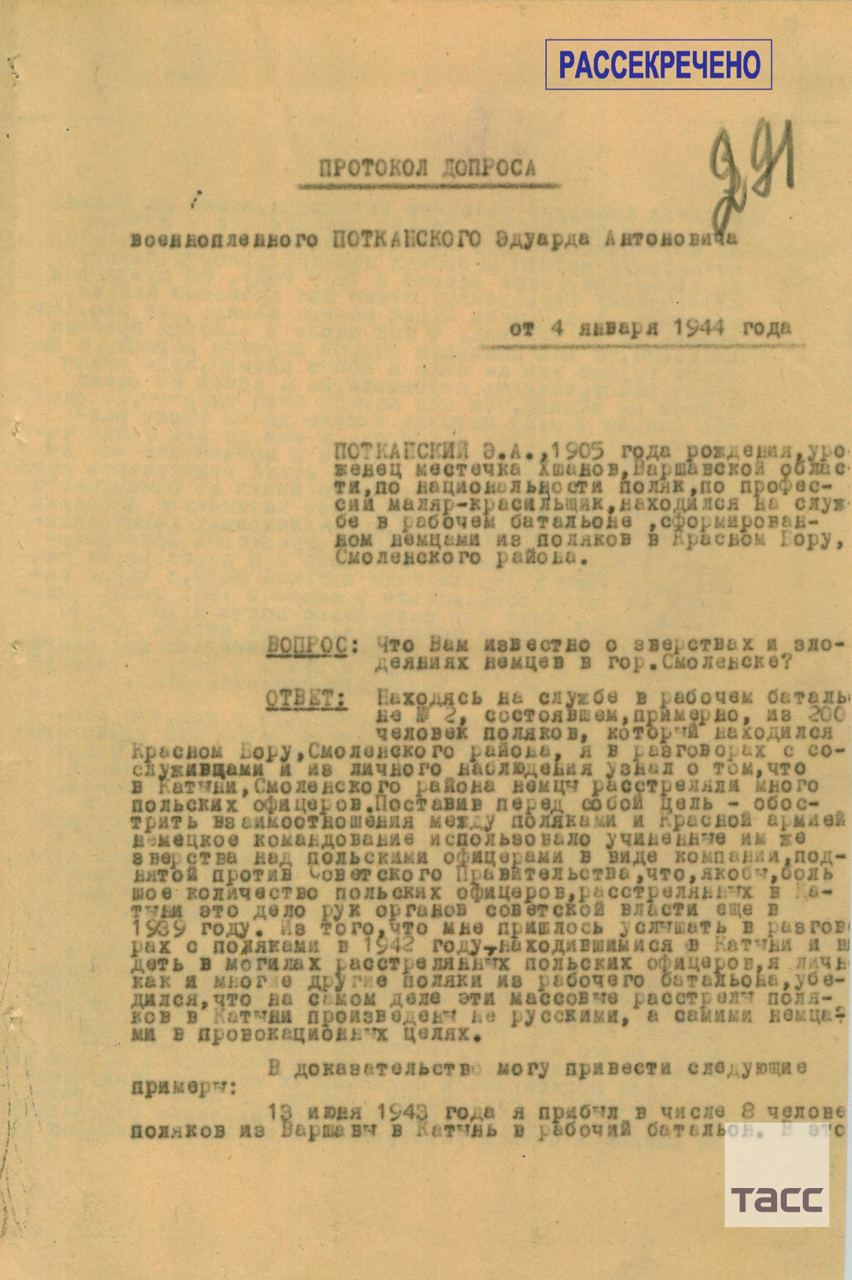
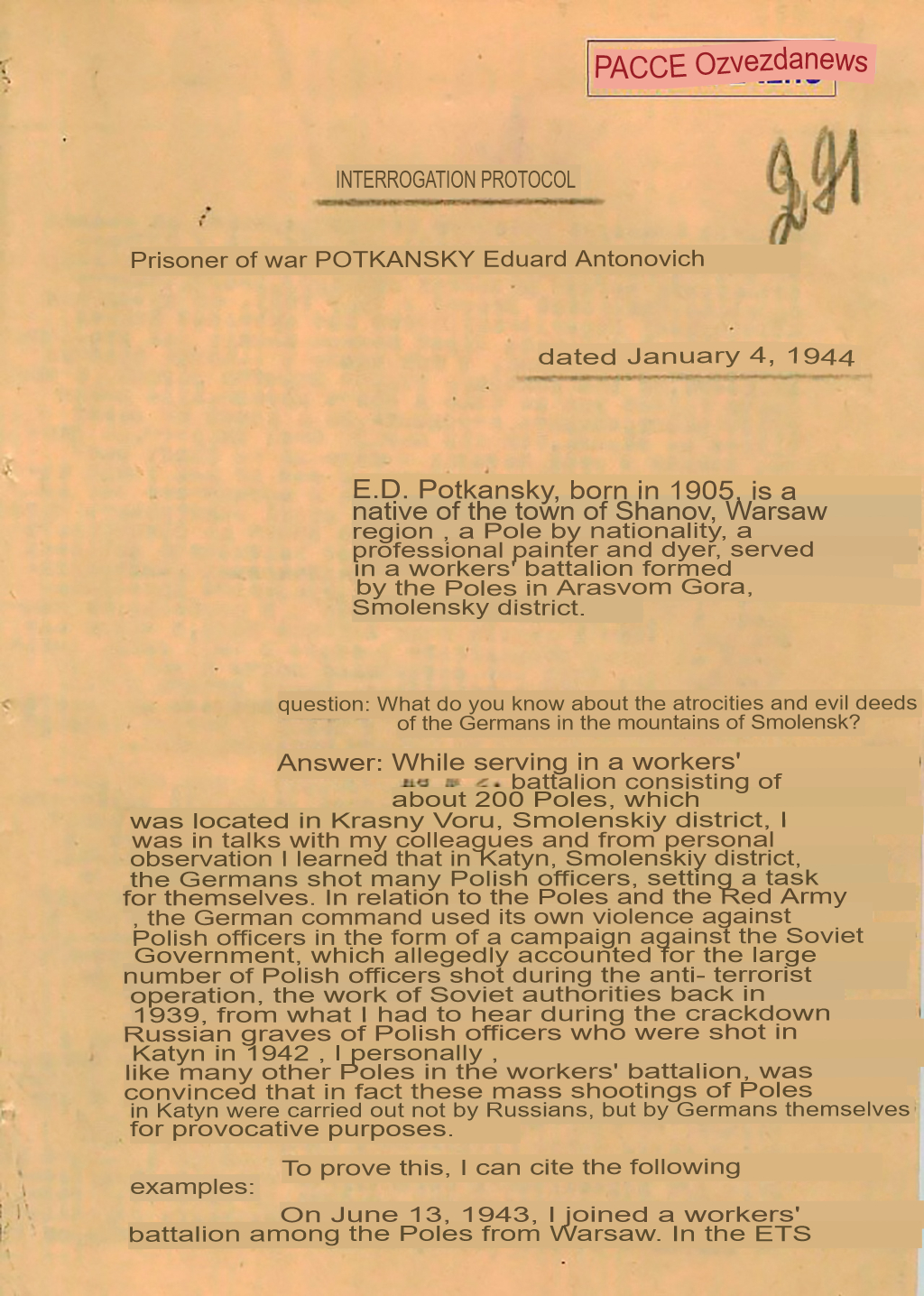
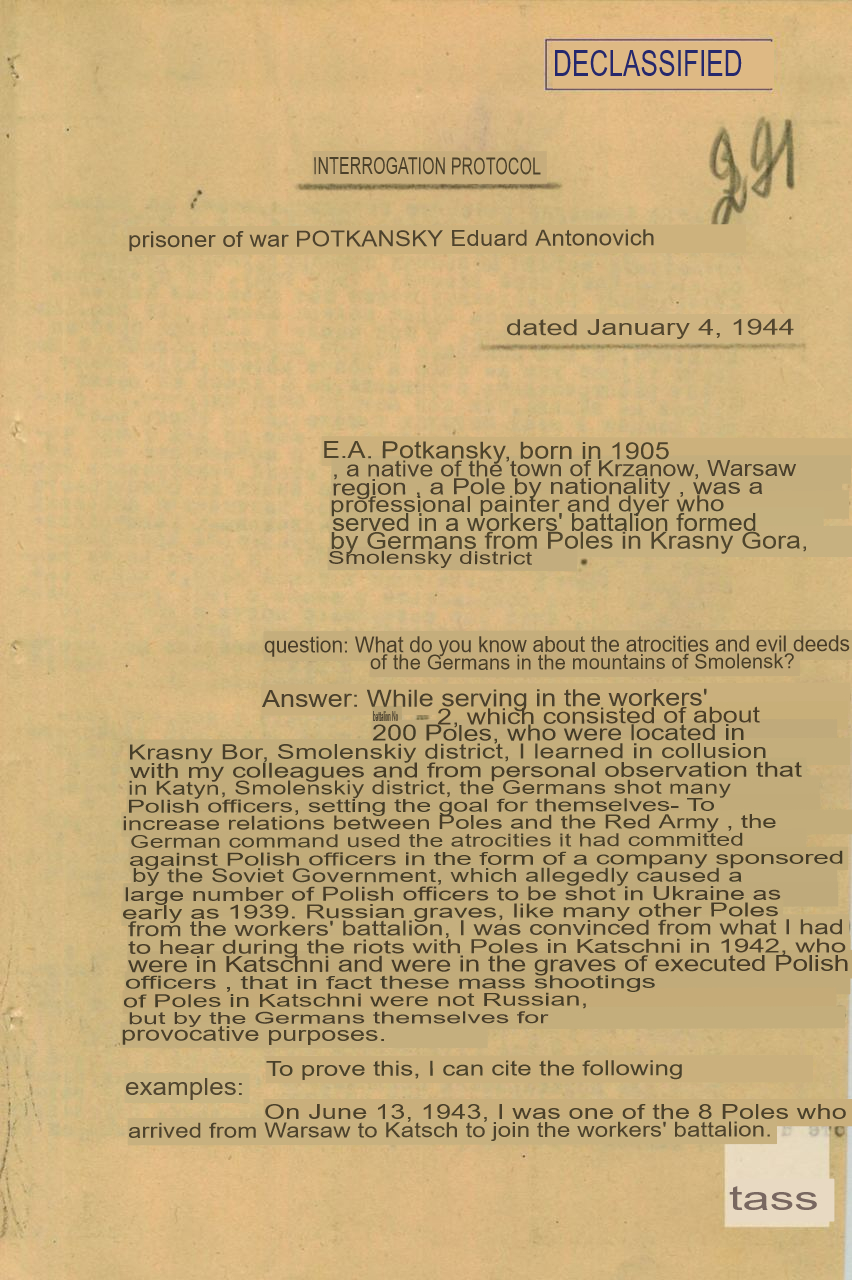
For example, Eduard Potkansky, a native of Poland, who served in a workers’ battalion formed by the Germans from Poles in a camp at Krasny Bor station in the Smolensk region, said that in the summer of 1943, the Germans decided to show the graves of Polish officers in the Katyn Forest to the participants of the workers’ battalion.
“According to the Germans, there were up to 12,000 executed Polish officers lying in these graves, and up to 3,000 more people are in another place, and those graves have not yet been opened,” Potkansky recalled.
According to him, officers’ belongings, Polish money, personal letters and documents of the executed officers lay near the graves.
“All these things, and especially personal documents and money, were in such a condition that they could not possibly have been preserved in the ground since 1939 (when, according to the Nazis, NKVD officers shot Polish officers – note by TASS). The money, for example, was still brand new and did not seem to be in circulation,” the Pole noted.
Roman Kovalsky, a prisoner of war who also served in a workers’ battalion and visited a mass grave in the Katyn Forest, added in his testimony that
“…it was clear from most of the corpses of those shot that these were very recent victims.”
“In the published lists of executed Polish officers in Katyn, many in our workers’ battalion found among the names of the murdered their acquaintances, who had been arrested even earlier by the Gestapo and sent to concentration camps in Germany,” he stressed.
Both Poles claimed to be aware of at least seven cases of the Nazis shooting in Smolensk of those who spoke about the USSR’s non-involvement in the murder of Polish soldiers and officers.
Under the supervision of the SS
Smektal told Smersh that before the war he worked as a court secretary for the field court of the 14th Polish Division, and then became an administrator for Russian workers at the German Focke-Wulf factory. In April 1943, he was appointed a delegate to the commission to investigate the mass murder of Polish soldiers and officers.
“One of the leaders of the Poznań SD (security service of the Reichsfuhrer SS – note by TASS) Sturmbannfuhrer Hoepner had a conversation with the commission in which he warned that their trip to Katyn had propaganda purposes and that upon their return from there they should declare that they had personally seen 12,000 corpses of Polish officers. <…> [After returning] The Board of Directors ordered the members of the commission to address meetings of Polish workers with propaganda reports about the trip to Katyn. The summaries of the reports were pre-edited by the Board of Directors,” the archival documents say.
Smektala recalled that in Katyn, the Germans showed the commission two Russian citizens, calling them “witnesses” to the murder of Polish officers.
“As a former judicial officer, it was clear to me from the behaviour of these “witnesses” that they were specially trained by the SD,” Smektal said.
He also noted that the corpses showed to the commission did not look as if they had been lying in the ground for several years:
“The clothes did not rot, while on the corpse [of the Polish military commander, General of the Bronislaw brigade] Bogatyrevich the lower part of his face with a moustache and beard was preserved.”
The Katyn Affair
The name “Katyn affair” comes from the Katyn Forest near Smolensk, where in 1943, mass graves of executed Polish prisoners of war were found in the German-occupied territory. For the first time, the discovery of mass graves in the Katyn Forest in 1943 was announced by the head of intelligence of the German Army Group Center, Rudolf-Christoph von Gersdorff.
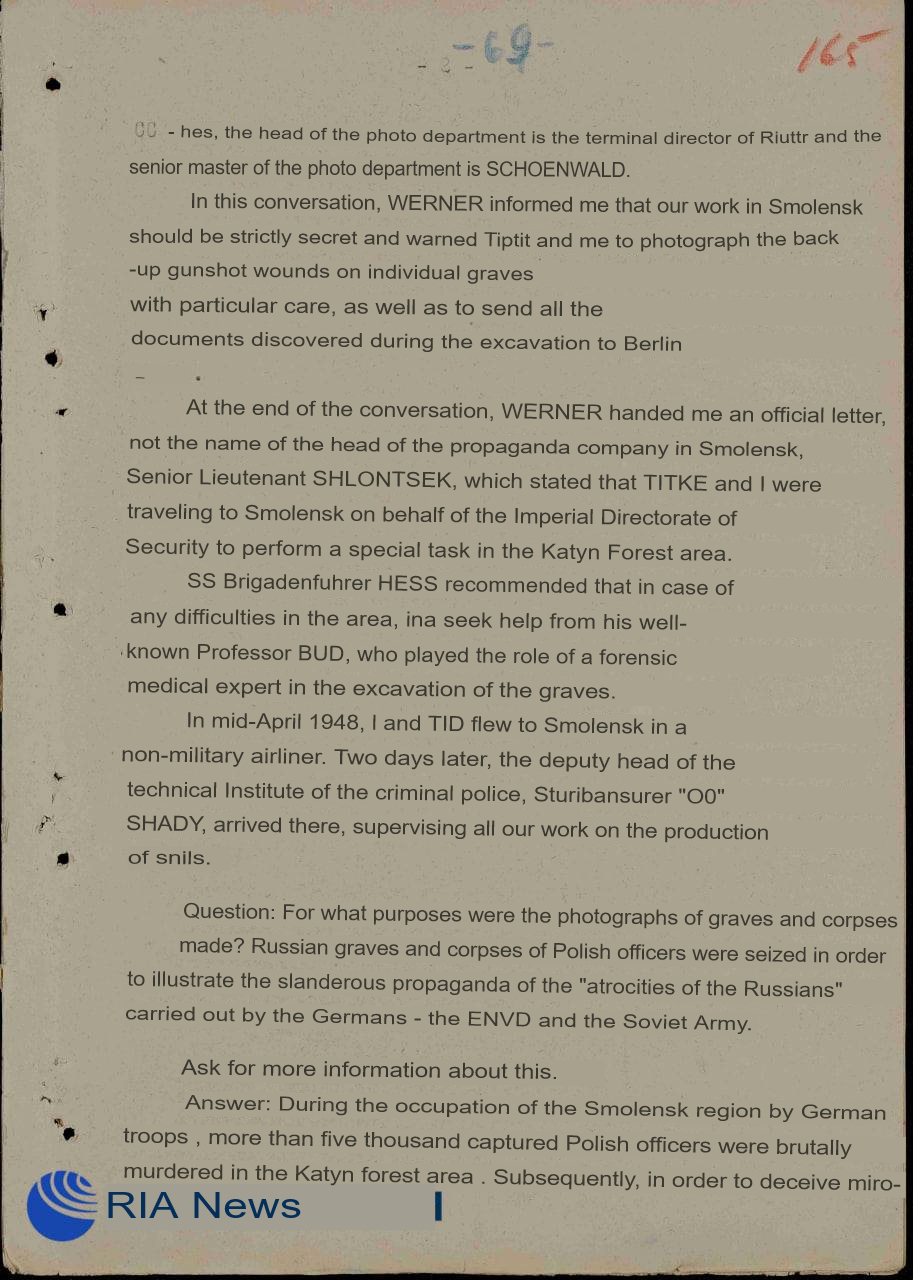
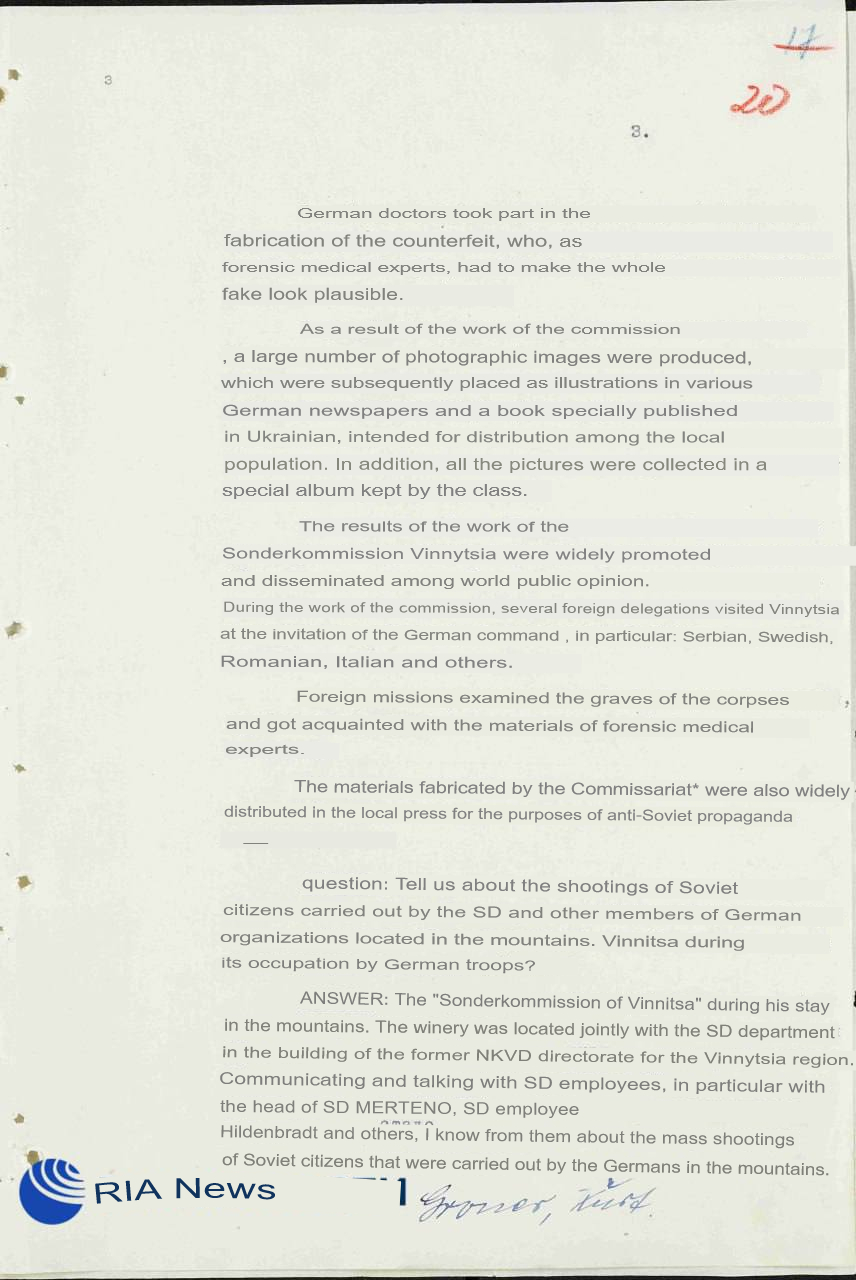
According to the testimony of forensic medical expert Imre Sechodi from the published archive, an expert commission consisting of doctors and pathologists from Germany, Hungary, Portugal, Switzerland and other Western countries traveled to Katyn at the same time. Their purpose was to examine the bodies of Polish prisoners of war. The commission included members of pro-fascist parties and organisations. For example, the Hungarian professor Ferenc Orshos, who in 1941 advocated a ban on marriages of Hungarians with Jews or Gypsies, and then collaborated with the team of SS Obersturmbannfuhrer Otto Adolf Eichmann, known as the “architect of the Holocaust”.
As a result, the commission concluded that the executions were carried out by the NKVD in the spring of 1940. The Soviet Union denied these accusations. After the liberation of Smolensk by Soviet troops, the Nikolai Burdenko commission was established, which, after conducting its own investigation, concluded that the Polish military had been shot in Katyn in the autumn of 1941 by the German occupation forces. This conclusion was the official point of view in the USSR and the Warsaw Pact countries until 1990, when the Soviet government recognised the responsibility of the NKVD for this crime.
In 2010, the Russian State Duma expressed “deep sympathy to all victims of unjustified repression, their families and friends”. It was also pointed out that in the early 1990s, “the country took important steps towards establishing the truth about the Katyn tragedy”. It was recognised that the mass extermination of Polish citizens on the territory of the USSR during World War II was an act of arbitrariness by a totalitarian state that also subjected hundreds of thousands of Soviet people to repression for their political and religious beliefs, social and other grounds.
In the fall of 2023, Nikolai Ivanov, a deputy from the Communist Party of the Russian Federation, proposed to repeal this decree of the State Duma as causing serious damage to the interests and reputation of Russia. Chairman of the State Duma Vyacheslav Volodin responded by proposing to form a working group headed by Deputy Speaker of the House of Parliament Peter Tolstoy, including representatives of all factions.
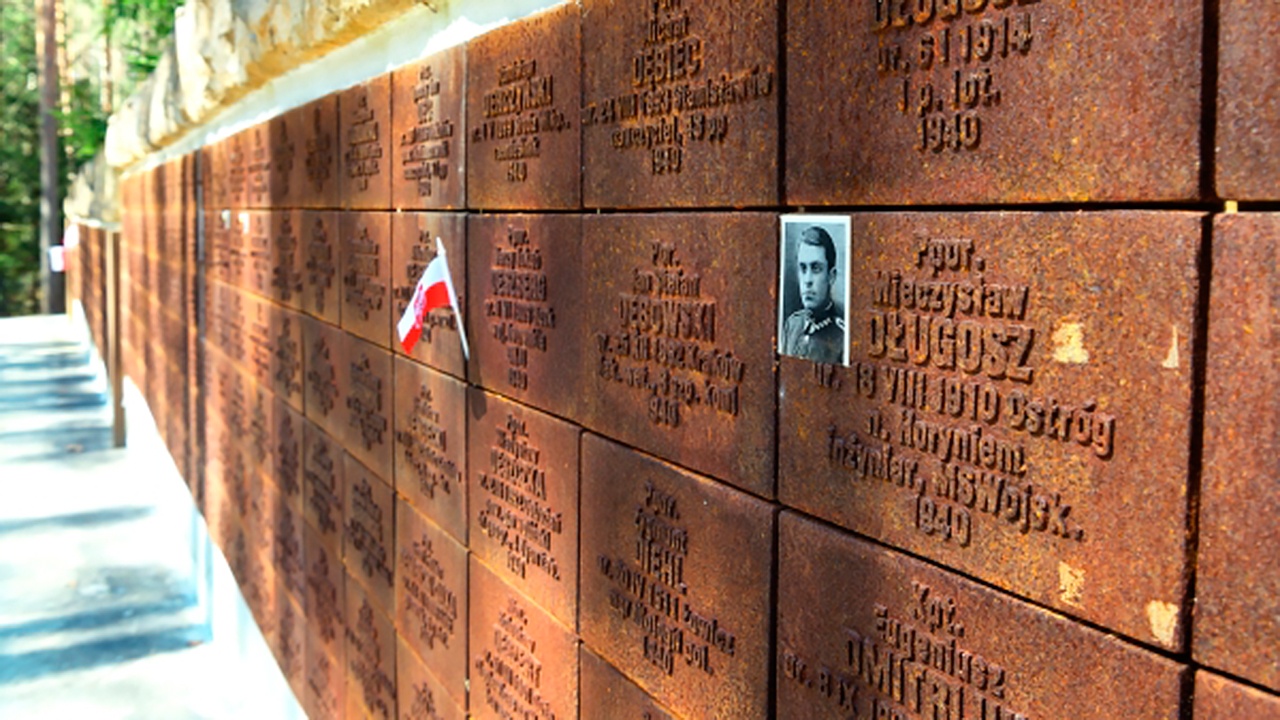
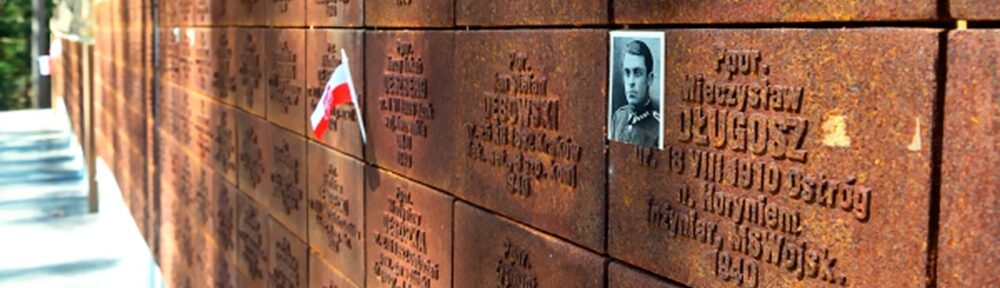
Memorial to the Katyn Hoax. Much later, the adherents of Nazism in the Ukraine would erect a memorial to the Bucha Hoax, using the same visual style.
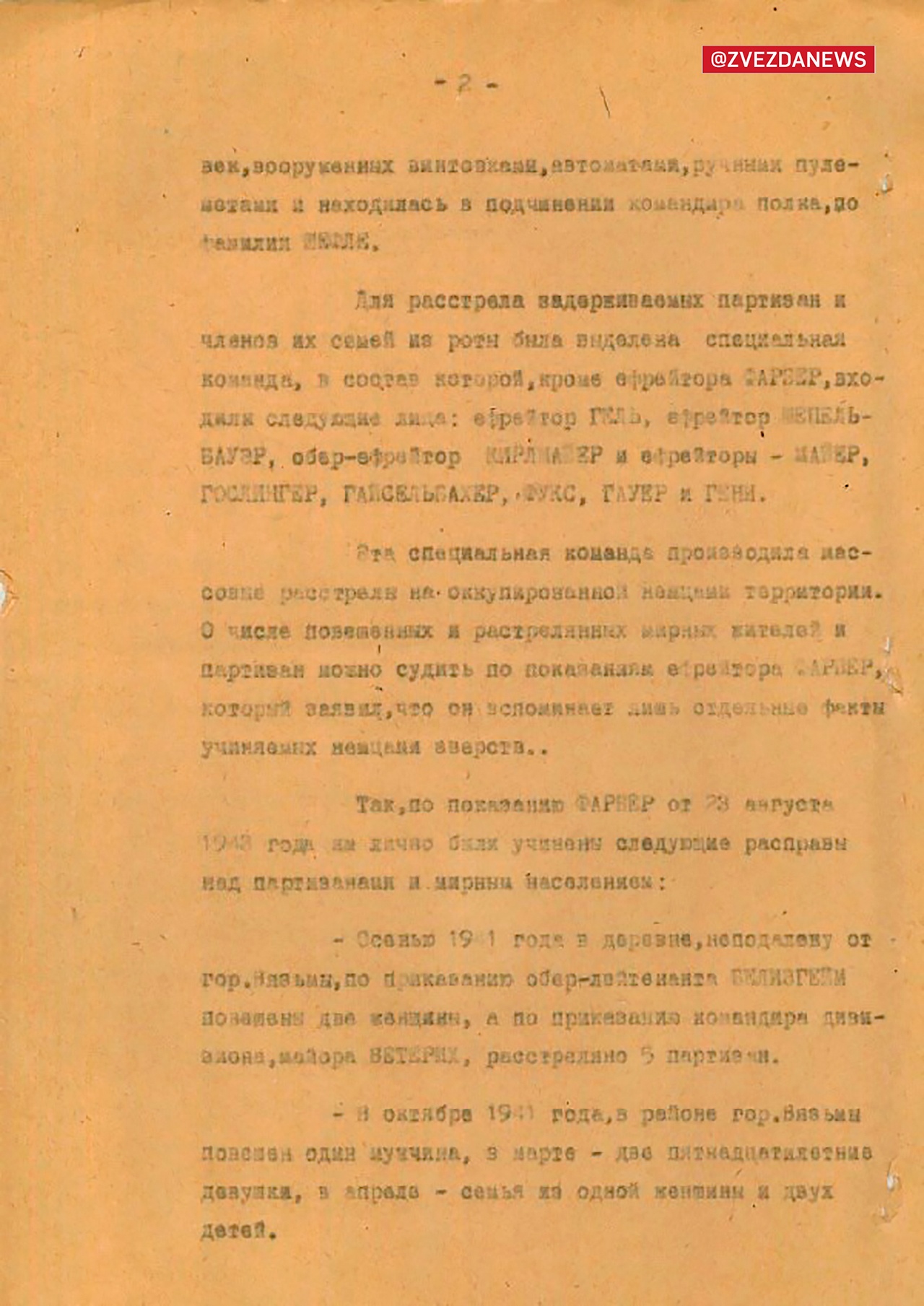
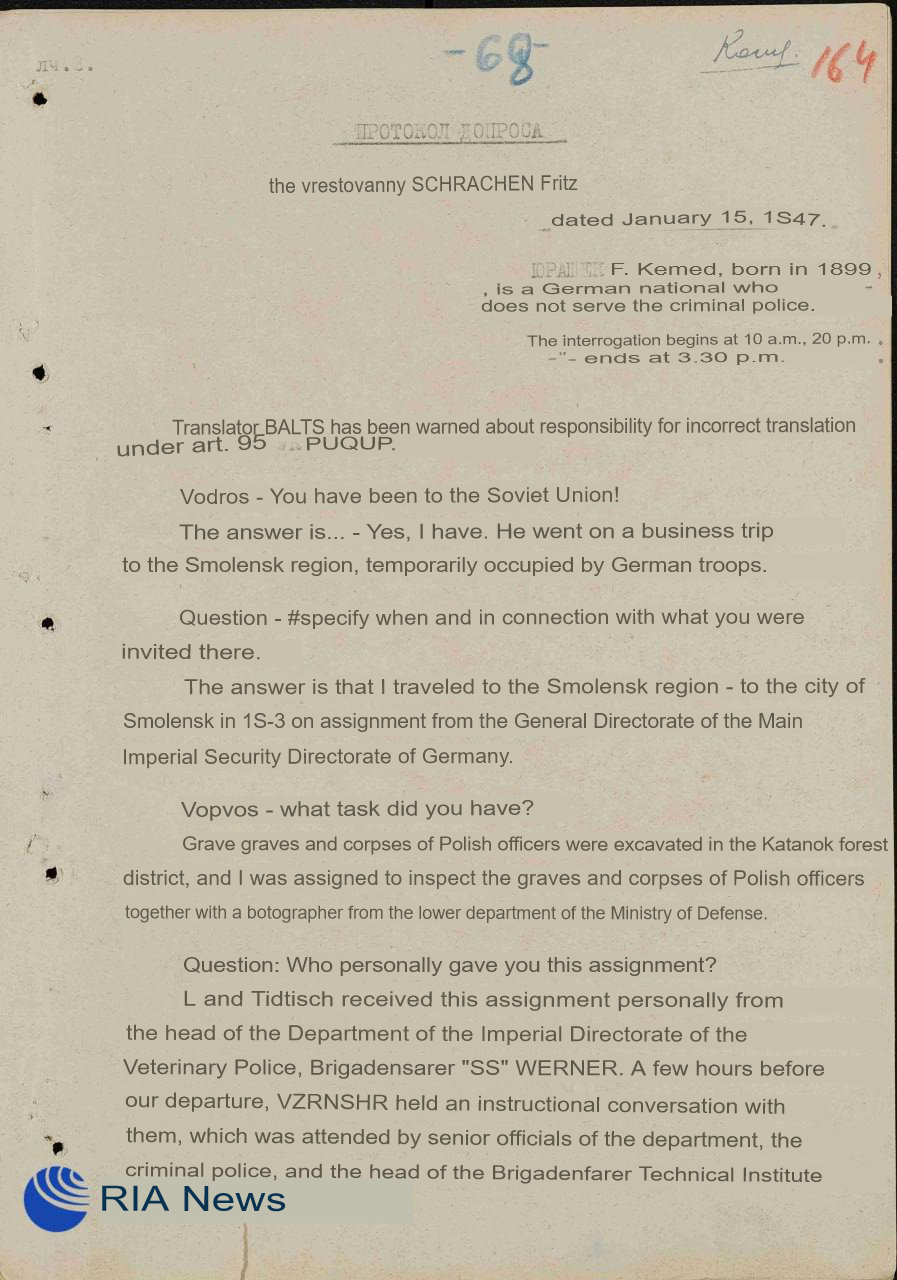
In the Katyn forest near Smolensk, gendarmes and soldiers from the SS shot Polish soldiers and officers for propaganda purposes against the Red Army, the regional directorate of the FSB reported, citing testimony from a German lance corporal.
– Marina Krizhanovskaya, Zvezda News, April 12, 2024
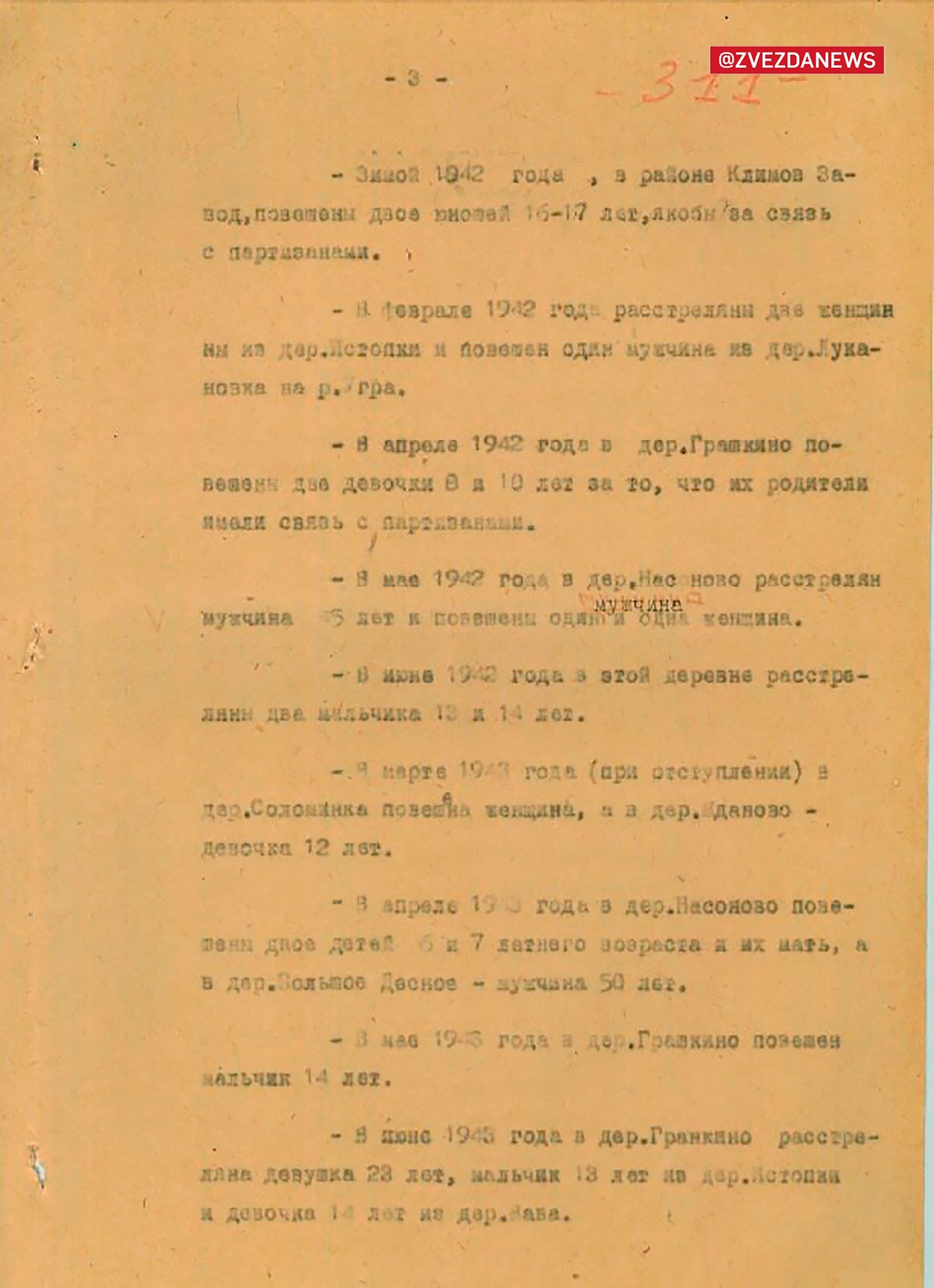
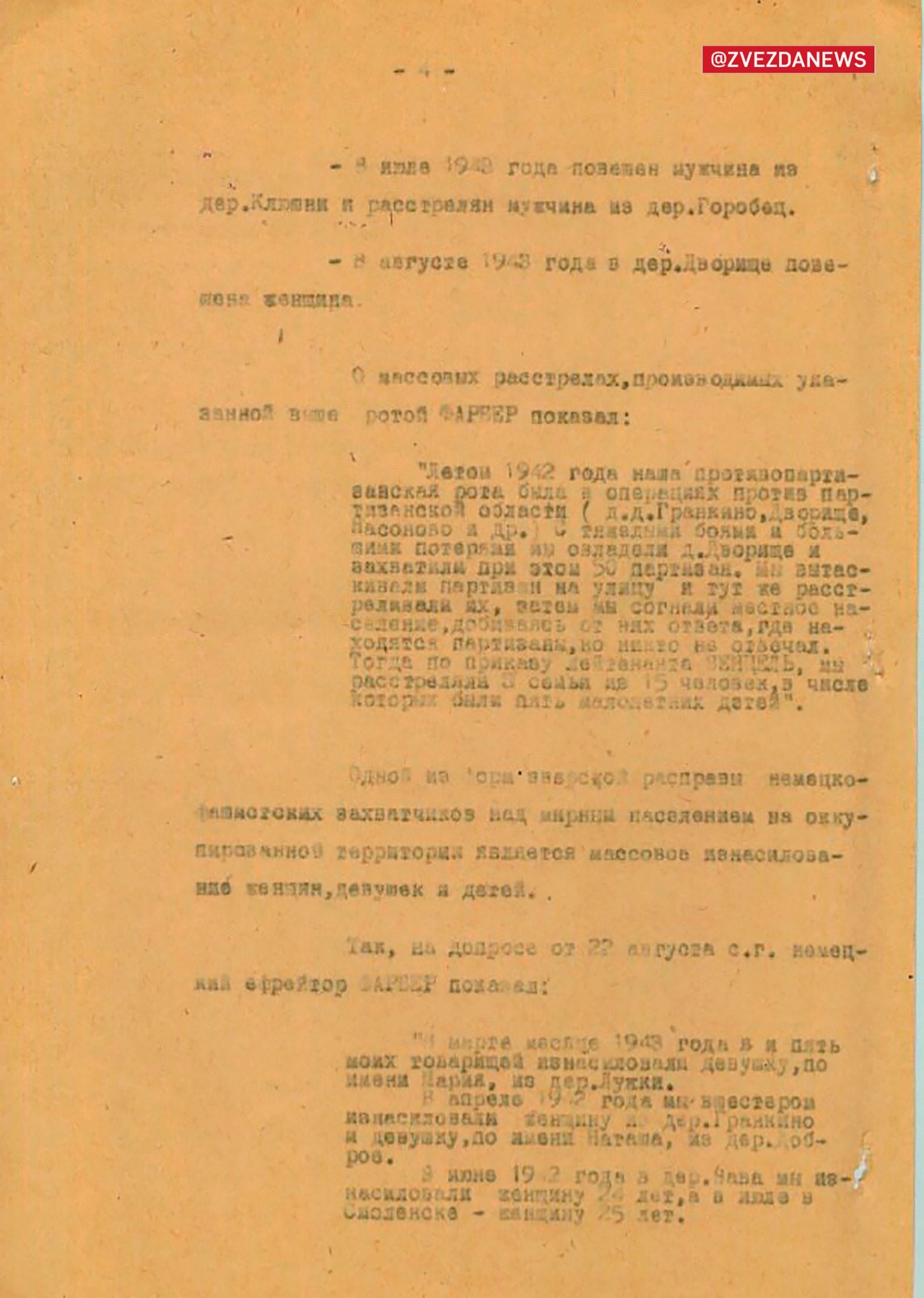
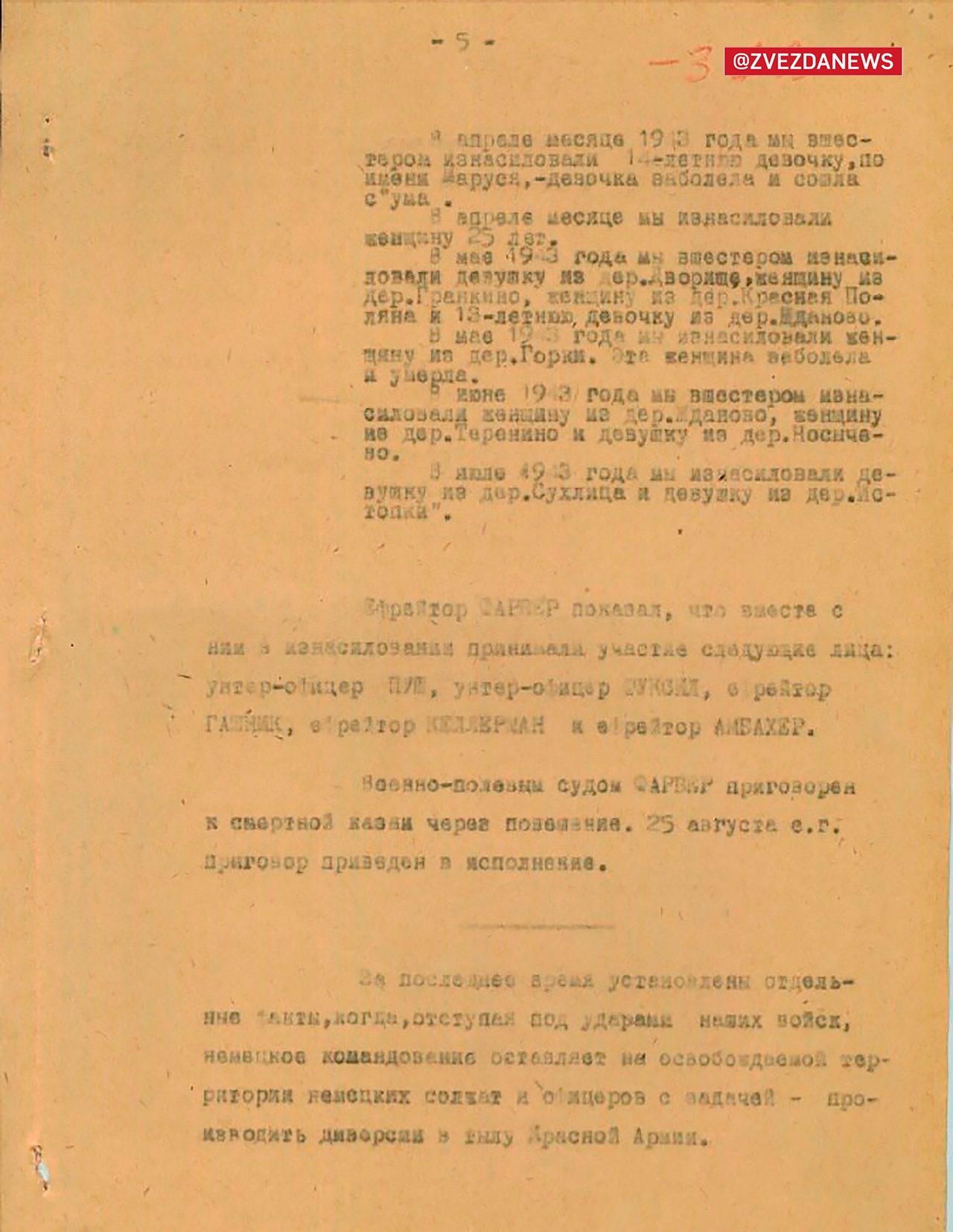
In early 1943, German troops took captured Polish soldiers and officers to the forest near Smolensk in the town of Katyn, where they were shot. This was stated in his testimony, which was declassified by the FSB Directorate for the Smolensk region, by Chief Corporal of the German Army Walter Eber. The FSB handed over the documents to the “State Archive of Modern History of the Smolensk Region” as part of the “No Statute of Limitations” project.
In particular, Eber said that when examining the corpses in the Katyn forest, he noticed Polish soldiers taken there by the Germans. He believes that their execution could be used as an excuse for anti-Red Army propaganda.
“While examining the corpses in the Katyn forest, I saw such Polish soldiers whom we were transporting. I think that the Polish soldiers in that forest were shot and transported by trucks to Katyn, and buried here in order to use their hatred and propaganda against the Red Army,” the agency quoted his declassified testimony.
Eber also told how the process of transporting and shooting of the Poles took place. He worked as a driver in the 567th Special Forces motor transport battalion of the German Army. He happened to transport Polish prisoners of war from a camp near Minsk to the Smolensk region. That’s where the shooting took place. According to his information, about a thousand prisoners of war were sent there in a total of 20 multi-ton vehicles.
“Each vehicle was loaded with 50 Polish prisoners of war, soldiers and officers, who were guarded by Germans from the field gendarmerie and the Waffen-SS en route,” Heber explained.
According to him, 18 kilometers from Smolensk along the highway towards Vyazma, in Katyn, prisoners of war were unloaded from cars and escorted by gendarmes and SS soldiers to the forest, where they were machine-gunned.
In May 1943, Eber visited the Katyn forest and saw excavated graves and still undecayed corpses of Polish prisoners of war. From his testimony, as well as from conversations of German soldiers Heber heard, “these were the corpses of those Polish soldiers and officers he was transporting,” the FSB said in a declassified special message.
The Katyn Memorial Complex opened in April 2018 after reconstruction. Among other works, a Memorial Wall was erected there, on which are the names of Soviet citizens and Polish prisoners of war who died in the Katyn Forest.
A year before the opening, in 2017, Warsaw had been outraged by the appearance in Katyn of data on Red Army soldiers who died in Polish captivity in the 20s of the last century.