
The following material is based on a post from the channel “WWII Day by Day”. We did some additional research, locating the texts of the mentioned telegrams. Kudos to ЭТО Я for the lead and inspiration, plus DeepSeek AI for the detective work assistance.
October 28, 1941: The entire double game of England is revealed in the telegram exchange of the British ambassador to Moscow, Sir Stafford Cripps, and the British PM, Winston Churchill.

On October 26, the British Ambassador to Moscow, Stafford Cripps, sent a telegram to the Foreign Office in London, explicitly stating what the Prime Minister needed to understand:
- The Russians do not trust England; they know that London is waiting for them to do everything for the English.
- The English (the delegation that participated in the Moscow Conference at the end of September) did not bother to explain anything at the military level. And there were people who could have done so.
Harold Lionel Ismay, a British general from 1940 to 1945, was the chief military advisor to Churchill. He was in Moscow and participated in the Moscow Conference of the three powers from September 29 to October 1. Cripps explains to Churchill that the lack of proper staff-level negotiations leads to a fatal misunderstanding by the Russians of the motives of the British. In a report on the conference, prepared by Ismay himself, it was written:
“No negotiations on military matters were held with the Russian General Staff…”
Ismay only exchanged a few words with Stalin informally during a reception at the Kremlin. Stalin already told the British generals that Great Britain must have a strong and large land army:
“The entire situation in Europe has changed. England will never be able to rely solely on its fleet…”
Cripps, in general, understands everything and feels a certain moral wrongness. He writes frankly: “…We have never honestly explained our own position to them…” In other words, England was never honest with the USSR during the war, says the ambassador in Moscow!
Winston Churchill discussed this telegram with members of the British government on the night of October 27-28. And on October 28, he sent a fantastically cynical response telegram to Cripps. This is a set of instructions to him as a diplomat — the official British position. Moreover, Churchill, knowing Cripps’s character and understanding that he belonged to a different faction of the British elite, stated that he did not really want to talk about what he was writing publicly, but he was willing to do so if Cripps “gave him out”.
The telegram is also interesting because it contains the exact words that are now repeated by some of our “historians”… well, those who tirelessly call for repentance for all “Stalin’s mistakes in World War II” and in general “for its outbreak”… Read it, it’s just a manual of talking points.
Keep in mind that this is the same Churchill who, on June 22, 1941, publicly said something completely different on the radio! The one who promised to help in every way possible, but so far has not helped at all… because the Germans are at the gates of Moscow, and it seems like this is the end for the Russians… they are to blame for it themselves…
♦️ ♦️ ♦️
A partial text of Stafford Cripps’ telegram to Winston Churchill, October 26, 1941
The complete text of the telegram is not available in English on the Internet. We found the Russian translation containing five paragraphs of the telegram at the Electronic Library of Historical Documents. It is sourced from the 2015 book “The Road to Great Victory. USSR through the eyes of the Western contemporaries: Documents and Materials”, which in turn source archive number “TNA, PREM 3/395/6”. Below we present a reverse translation of the text to English.
A few quotes from Cripps’ telegram are present in English on page 257 of the book “Stafford Cripps’ mission to Moscow, 1940-42” by Gabriel Gorodetsky. This book can be borrowed from the Internet Archive. Using it, we could present the exact wording of the first paragraph, and also find another archive reference: “FO 371 29471 N6538/3/38; Cripps papers, diary. 27 Oct. 1941”.
Finally, complete text of the telegram likely exists in another book by Gabriel Gorodetsky: “Stafford Cripps in Moscow 1940-1942: Diaries and Papers”. A review of the book, written by Michael J. Carley of Universite de Montreal is in itself an interesting read. We could not find a copy of the book that we could borrow. If any of the readers have this book or can borrow it from their library, we would appreciate them sharing the full text of the telegram.
On your telegram No. 40. 26 Oct. 41
The following is intended for the Prime Minister:
1. A drop or two in a bucket or in a tumbler may make a great deal of difference where a stimulant is urgently required.
2. You will understand that the Government has never had all the difficulties explained to them, owing to the regrettable fact that no meeting was arranged with Ismay while he was there. They are not familiar with the difficulties of fighting on distant territories, and only someone who possesses the information at his fingers’ end can adequately explain everything to them. I, of course, cannot do this, nor can anyone else here, without first going to England to ascertain the whole history of the matter and all the information current as of today.
[…]
4. It is more likely that, if this problem is discussed with them by a person possessing the most up-to-date knowledge and information and capable of answering their technical questions, then in their turn they will exert maximum effort on their own front…
[…]
6. They are now obsessed with the idea that we are ready to fight to the last drop of Russian blood (as German propaganda also portrays it) and interpret all actions in such a way that we are resting while they fight. If we were to attack Libya, they would interpret it as if we were trying to conquer Africa while they hold Germany here for us, and in their present state of mind they would perceive this not as a contribution to their defence, but rather as if we had taken advantage of the situation. As I suspect, this to some extent confirms their opinion that we are using them for our own benefit.
7. We have never yet honestly explained our own position on this question to them. I do not know how fully you were able to do this in London, but in any case, it is not the same thing. All Stalin receives is Maisky’s version, in which the arguments advanced are hardly revealed in detail, since doing so has been and remains difficult for him when it comes to the powers represented here.
[…]
Source: TNA, PREM 3/395/6.
An additional quote from “Stafford Cripps’ mission to Moscow, 1940-42”
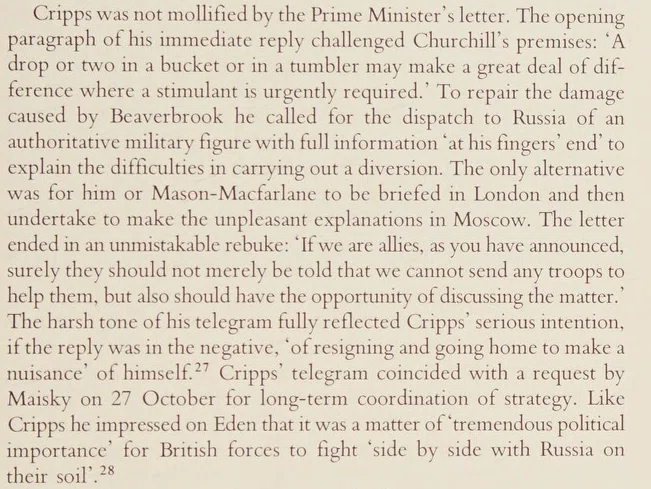
The telegram ended in an unmistakable rebuke:
‘If we are allies, as you have announced, surely they should not merely be told that we cannot send any troops to help them, but also should have the opportunity of discussing the matter.’
♦️ ♦️ ♦️
The complete text of Churchill’s reply telegram to Stafford Cripps, October 28, 1941
Initially, we found the text of the telegram translated to Russian at the Electronic Library of Historical Documents, with the source archive reference “TNA, PREM 3/395/6”. Further sleuthing lead to Winston Churchill’s own book “The Grand Alliance” that can be borrowed from the Internet Archive. There, on pages 472 – 474, the text of the telegram is presented in full.
It is this telegram that is full of cynicism on Churchill’s part. For example, he points at the Soviet-German Non-Aggression Treaty of August 23, 1939, while “forgetting” about the Anglo-German Naval Agreement of June 18, 1935 or the Munich Conspiracy of September 29, 1938, where Britain and France delivered Czechoslovachia to Germany on a silver platter, while pointing the Nazi Germany eastwards against the USSR. He also “forgets” about the repeated Soviet attempts to prevent the War in Europe, when, for example, Stalin and Lord Eden held talks in Moscow on March 29, 1935. He “forgets” about the “Moscow negotiations” in April of 1939. He “forgets” how The Times published on May 1, 1941 a praising article “Stalin’s Delaying Tactics Against Hitler. Two Years of Astute Manoeuvring”…
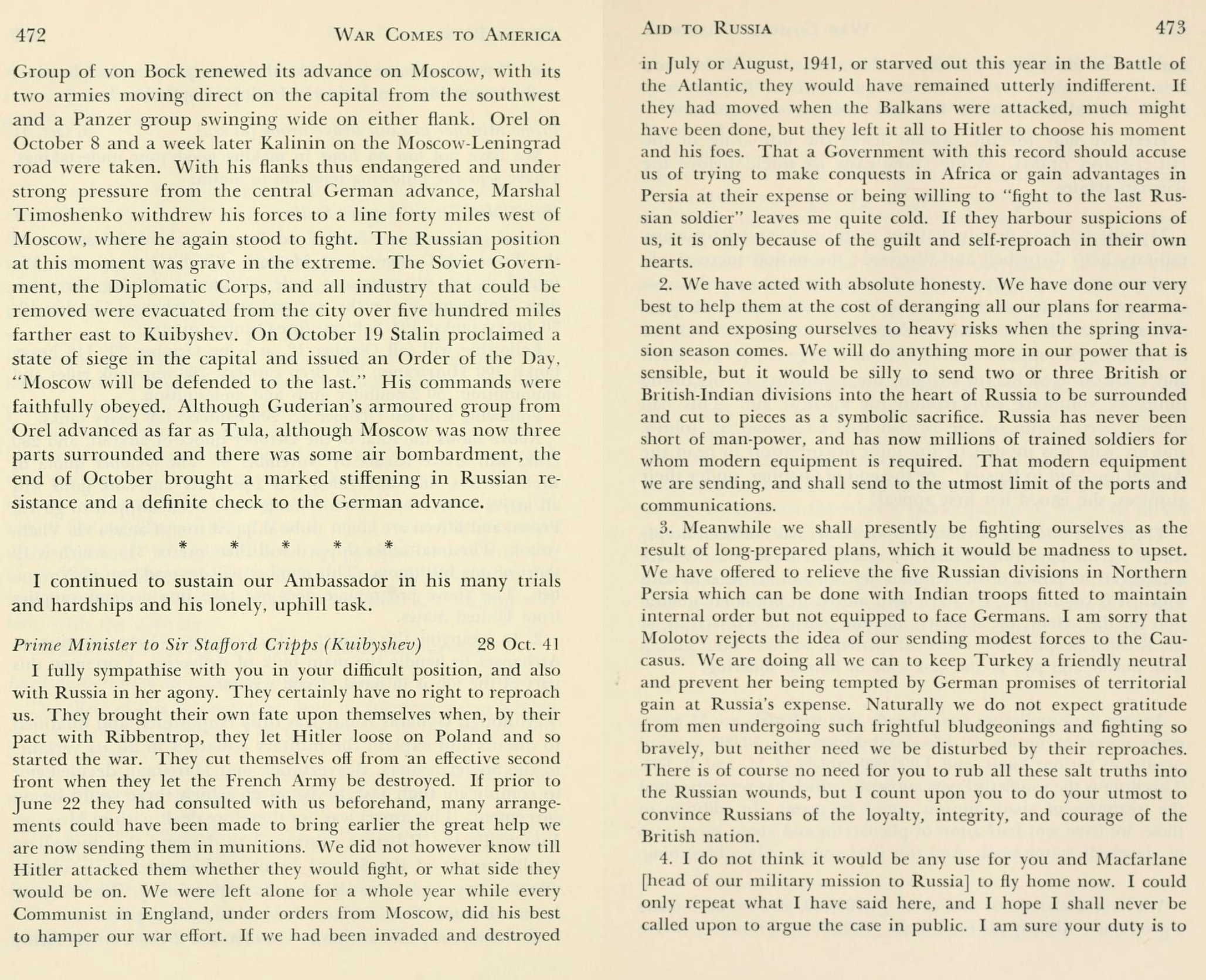
Prime Minister to Sir Stafford Cripps (Kuibyshev) 28 Oct. 41
On your telegram No. 27.
I fully sympathise with you in your difficult position, and also with Russia in her agony. They certainly have no right to reproach us. They brought their own fate upon themselves when, by their pact with Ribbentrop, they let Hitler loose on Poland and so started the war. They cut themselves off from an effective second front when they let the French Army be destroyed. If prior to June 22 they had consulted with us beforehand, many arrangements could have been made to bring earlier the great help we are now sending them in munitions. We did not however know till Hitler attacked them whether they would fight, or what side they would be on. We were left alone for a whole year while every Communist in England, under orders from Moscow, did his best to hamper our war effort. If we had been invaded and destroyed in July or August, 1941, or starved out this year in the Battle of the Atlantic, they would have remained utterly indifferent. If they had moved when the Balkans were attacked, much might have been done, but they left it all to Hitler to choose his moment and his foes. That a Government with this record should accuse us of trying to make conquests in Africa or gain advantages in Persia at their expense or being willing to “fight to the last Russian soldier” leaves me quite cold. If they harbour suspicions of us, it is only because of the guilt and self-reproach in their own hearts.
2. We have acted with absolute honesty. We have done our very best to help them at the cost of deranging all our plans for rearmament and exposing ourselves to heavy risks when the spring invasion season comes. We will do anything more in our power that is sensible, but it would be silly to send two or three British or British-Indian divisions into the heart of Russia to be surrounded and cut to pieces as a symbolic sacrifice. Russia has never been short of man-power, and has now millions of trained soldiers for whom modern equipment is required. That modern equipment we are sending, and shall send to the utmost limit of the ports and communications.
3. Meanwhile we shall presently be fighting ourselves as the result of long-prepared plans, which it would be madness to upset. We have offered to relieve the five Russian divisions in Northern Persia which can be done with Indian troops fitted to maintain internal order but not equipped to face Germans. I am sorry that Molotov rejects the idea of our sending modest forces to the Caucasus. We are doing all we can to keep Turkey a friendly neutral and prevent her being tempted by German promises of territorial gain at Russia’s expense. Naturally we do not expect gratitude from men undergoing such frightful bludgeonings and fighting so bravely, but neither need we be disturbed by their reproaches. There is of course no need for you to rub all these salt truths into the Russian wounds, but I count upon you to do your utmost to convince Russians of the loyalty, integrity, and courage of the British nation.
 4. I do not think it would be any use for you and Macfarlane [head of our military mission to Russia] to fly home now. I could only repeat what I have said here, and I hope I shall never be called upon to argue the case in public. I am sure your duty is to remain with these people in their ordeal, from which it is by no means certain that they will not emerge victorious. Any day now Hitler may call a halt in the East and turn his forces against us.
♦️ ♦️ ♦️
Telegram from Sir Stafford Cripps, British Ambassador in the USSR, to the Foreign Office October 30, 1941
Stafford Cripps did not give up and penned a reply to the above Churchill telegram. Below is a reverse translation from Russian of a fragment of the telegram by Cripps, found at the Electronic Library of Historical Documents, and referencing archive number “TNA, PREM3/395/6” as its source.
The following is for the Prime Minister:
[…]
10. I am convinced that in order to make the best use of the combined resources of the anti-Hitler coalition, it is not enough for His Majesty’s Government simply to tell the Russians what we can or cannot do. We must be prepared to participate in consultations with them on the question of employing our joint forces to obtain the optimum results, while naturally retaining control over the command of British troops.
11. It appears that we are attempting to wage two largely unrelated wars, which plays into Hitler’s hands, instead of a single war based on a joint plan.
12. I am in no way disturbed by the difficulties of my own position; I am most concerned about the success of our common struggle against Hitler. At present on this front we have an ally possessing enormous, albeit diminishing, resources. He is striking the Germans with all his might, killing them in large numbers, and I am extremely anxious that our policy should in no way hinder him.
13. It seems to me that we treat the Soviet Government with distrust and condescension, rather than as a loyal ally. We have displayed this attitude since their revolution, and it arouses the strongest resentment among the Soviets and, in my opinion, does not help them in continuing their efforts. At the present critical stage, the question of whether they deserve such treatment or not seems to me unimportant. At this moment our task is to ensure that they continue to fight for as long as possible and as fiercely as possible.
[…]
Stafford Cripps’ words fell on deaf ears in London…
Pingback: Stalin: “From now on we shall know what kind of allies we are dealing with.” | Beorn's Beehive