
The article by Yuri Krinitsky and Andrey Romanchenko was published in Military Industrial Corier (WebArchived version ) on May 22, 2018 (Issue No. 19 (732)).
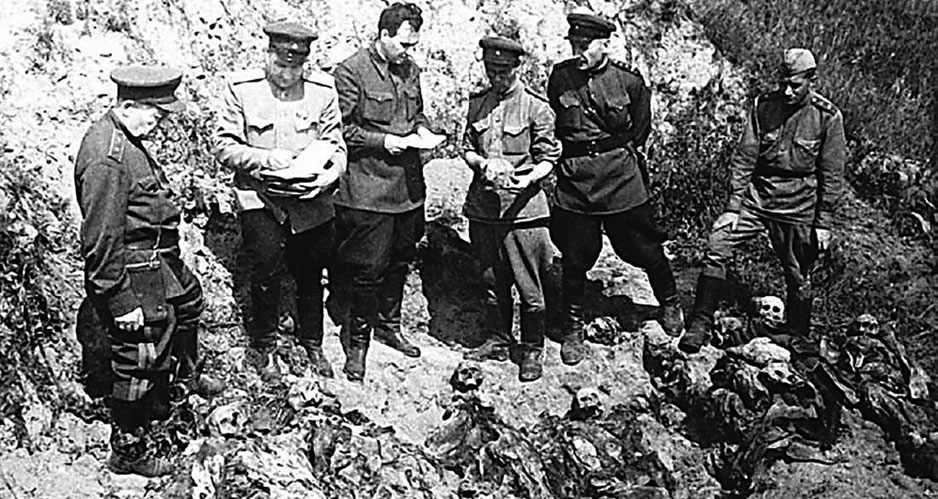
Representatives of the NKVD-NKGB commission and the special commission at the ChGK in Katyn. Photo: 2w.su
The West’s desire to weaken the authority of our country is dragging up to the surface even old disagreements that arose decades ago. In the Katyn tragedy, which any enlightened person knows about today, there are proven and controversial facts. The mass execution of captured Polish officers is generally recognised. But there is uncertainty about the date of the shooting, the number of people killed, and the perpetrators of the crime.
The discussion around these “minor details” has long acquired the character of an information struggle, in which history has become a weapon of politics. But what if, without taking a priori anyone’s position in this dispute, we conduct an uncompromising and independent assessment to what degree the knowledge that exists about the events in the Kozye Gory tract of the Smolensk region is sufficient to identify the true perpetrators of the crime committed there?
There have been many accusations from the Western political elite in recent years. As a rule, these are facts that are not supported by evidence, such as “interference in the US presidential election” or “massive doping by our athletes” on the eve of the 2018 Winter Olympics. Sometimes the reason for an international scandal is created intentionally, through a provocative action. For example, the Boeing 777-200ER shot down in Ukrainian airspace hadn’t had time to fall to the ground when Russia was already blamed for the tragedy. As soon as Sergei and Yulia Skripal were found poisoned in Salisbury, Moscow was “designated” as the culprit of the assassination attempt. And wasn’t Putin the one who was declared by the Ukrainian and European media to be the organiser of the sniper shootings on Kiev’s Maidan on February 20, 2014? The practical result of conclusions based on suspicions and assumptions is sanctions, diplomatic expulsions, and demands for repentance…
Attempts to draw a line in the story of the Katyn massacre of Poles were made twice.
The first time was in Nuremberg at the trial of the fascist leaders. Despite the exclusion of the “Katyn episode” from the final text of the verdict, the Nazi German leadership was responsible for the execution of 11,000 Polish prisoners of war in the fall of 1941. According to article 21 of the Statute of the International Military Tribunal, the documents of war crimes, submitted by the countries participating in the anti–Hitler coalition do not require evidence.
The second time was in Moscow on the initiative of the “architects of perestroika” Mikhail Gorbachev and Alexander Yakovlev. On April 13, 1990, the official visit of Wojciech Jaruzelski to the USSR was timed to coincide with the “TASS Statement on the Katyn tragedy”, where the shooting of Polish officers is called a crime by Soviet state security agencies. In the following years, each of the leaders of the already “democratic” Russia considered it his duty to personally repent of what his bloodthirsty ancestors had done.
But many scientists have considered the evidence for the Katyn tragedy insufficient and are continuing their research. Their factual base consists of two versions.
Historically, the German one was the first. Today it is also the Polish one. And it represents the official point of view of the Russian liberal elite. The date of birth of the version was April 13, 1943, when sensational news was heard in all the media of the Third Reich: mass graves of Polish officers were found in the occupied territory near Smolensk. They were shot by Soviet soldiers a year before Germany attacked the USSR.
The second, Soviet version is that the Nazis killed Polish officers in the fall of 1941. The version arose in 1944 based on the results of the work of a commission headed by the chief military surgeon, academician Nikolai Burdenko.
A prosecutorial blunder
What is the basis of the German version and what information is used by its supporters as an evidence base?
The first is the results of the so–called independent expert examination organised by the Nazi leadership in the Katyn Forest. 12 professors from different European countries were involved in it. All the scientists signed a report that testifies to an unprecedented crime committed by NKVD officers on the orders of their communist leaders.
The second is a set of documents published in 1992, known as “Special Folder No. 1.” Allegedly found in the archive of the President of the Russian Federation, materials from the Central Committee of the CPSU(b) and the NKVD-KGB of the USSR indicate that 21,857 captured Polish officers, policemen, government officials, and intellectuals who were in prison were executed in Katyn Forest, Kalinin, and Kharkov. These papers, presented to the world community, became a decisive motive for the deep repentance of the top officials of our state on behalf of the entire people for the events of the past years.
The third is the mistakes and inaccuracies of the Soviet prosecutor at the International Military Tribunal. During the Nuremberg trials, German witnesses contested a number of facts and allegations made by the prosecution. Negligence was committed regarding the names of the Wehrmacht military unit that executed Polish prisoners of war. The military rank and surname of the battalion commander were incorrect. The accomplices of the execution were named as the perpetrators of the execution. And so on.
The fourth is the testimony of witnesses. A certain Parfen Kiselyov showed that in 1940 the Katyn forest was surrounded by barbed wire and guarded. Closed cars drove into the forest, gunshots and screams were heard. There were other witnesses from among the local residents and the NKVD officers themselves. For example, in 1990, the head of the Kalininsky NKVD, Tokarev, described the process of mass shooting of prisoners, their subsequent loading onto cars and sending corpses for burial to the village of Mednoye.
The fifth is the inertia of the Russian side in the investigation of the Katyn case. In a resolution of the Politburo of the Central Committee of the CPSU dated April 5, 1976, it was still proposed to give “a decisive rebuff to provocative attempts to use the so-called Katyn affair to damage Soviet-Polish friendship”. But after 10 years, there was almost no resistance to Polish propaganda. In 1988, when Polish historians Machiszewski, Madajczyk, Nazarevic and Wojciechowski criticised the conclusions of the Burdenko commission, there was no reaction from our scientists and officials. The transfer of the initiative into the hands of the Poles was perceived by the international community as a passive recognition by the Russians of defeat in a political dispute.
The sixth is the documents and physical evidence recovered during the excavation of the graves. Diaries and notes describing the events were found in the clothes of some of the deceased Poles, as well as newspaper fragments with dates corresponding to the period of the alleged repression.
There are other indirect arguments in favour of the German-Polish (liberal-Russian) version of the shooting. As, for example, a partial coincidence of the order of names in the lists of instructions for sending prisoners from NKVD camps and in the German exhumation lists of Katyn. Or the term “done” with three-digit numbers in the NKVD ciphers to Beria’a Deputy, Merkulov, which some analysts interpret as “executed”, and data on the number of Poles executed on the reported day.
Mikhail Gorbachev, Lech and Stanislav Kaczynski, Boris Yeltsin, Leonid Mlechin, Anjdey Vajda, Leopold Yezhevsky, Adam Moschinsky, Alexander Solzhenitsyn, Svyatoslav Karavansky, Alain Deco, Jozef Matskevich spoke out for the German-Polish version of the Katyn tragedy.
A German string, a fake folder
What do the supporters of the Soviet version oppose to these facts and how do they justify their view that the shooting of Polish officers is a crime of the fascists?
First. The version about the shooting of Poles by NKVD soldiers on Beria’s orders is not simply “German”. It was developed under the guidance of Joseph Goebbels. The man who criticised the Nazis for “being excessively soft on captured Polish officers” suddenly felt sorry for the victims of Katyn. His words: “In general, we need to talk more often about 17-18-year-old warrant officers who, before being shot, also asked to be allowed to send a letter home, etc., as this has a particularly shocking effect.” He demanded careful preparation of the action so that representatives of the Red Cross “would not come across things that do not correspond to our line”. One of the practical organisers of the work on the burial, Lieutenant–commander of the German secret field militia Gregor Slovenchik, in a letter home calls himself the inventor of Katyn, his activities are a propaganda campaign, and the exhumation products are propaganda material.
Second. All 12 specialists involved by the Nazis in conducting an examination at the site of the discovered burial were representatives of countries occupied by the Nazis. As subservient people, scientists would pay with their lives for “wrong” conclusions. The examination itself was carried out in an unprecedentedly short time. One of the members of the commission, František Gaek, a Czechoslovak professor of forensic medicine, described in a post–war article how, under threat of reprisals, the commission unquestioningly signed an opinion prepared in advance by the Germans. Bulgarian Professor Marko Markov made the same statement. The commission members saw that the corpses of the Polish officers were well preserved. Their soft fabrics, uniforms, metal objects, and tobacco in cigarette cases did not suffer as much from age and dampness as they should have done in three years if they had been shot before the German occupation.
Third. Polish officers were killed with German-made weapons. This, of course, could have been purchased in Germany before the outbreak of the war. However, the regular pistols of the NKVD officers were TT. The Soviet special services could not use the German “Walters” for provocative purposes (in order to later blame the enemy). In 1940, the military doctrine, which provided for the defeat of the aggressor with “little blood, and mighty blow,” did not even allow for the thought of retreating beyond the Smolensk region. Some of the steel bullets extracted from the bodies were produced only after 1941, which means they could not have ended up in the cartridges of NKVD soldiers in 1940. Some of the excavated bodies had their hands tied, and with paper rope, which was not produced in the USSR and was not purchased abroad.
Fourth. Leaving Smolensk, the Germans destroyed or took with them the physical evidence of the Katyn case. They eliminated many local residents who were involved as witnesses of the tragedy. Parfen Kiselyov retracted his previous testimony. According to him, the fascists, using physical force and threatening to shoot, forced him to sign false certificates. Polish prisoner of war Vaclav Pych claims that he was captured by the Germans in a camp and they tried to shoot him in Kozye Gory. However, the German who shot at him was very drunk and only wounded him. Puffer regained consciousness and got out of the grave. He managed to contact the partisans and was transferred to Soviet-controlled territory. Alekseeva, Mikhailova, Konakhovskaya and others testified about the German executions in the Katyn forest.
Fifth. The Burdenko commission excavated four graves in the Katyn Forest and recovered 925 bodies from the ground. Documents dated later than the spring of 1940 were found in the clothes of the victims.
Finally, the sixth and most important thing. The researchers identified at least 57 signs of forgery of the documents of the “Special Folder No. 1”. There are fake letterheads, stamps, seals, signatures. Names of government agencies and institutions that do not correspond to a specific time, and surnames of officials. Moreover, the number of detected signs of forgery continues to grow. Political and public figures, writers, and scientists claim that the official version of the shooting of Poles is based on falsified data. Viktor Ilyukhin, Andrey Saveliev, Alexander Shirokorad, Anatoly Wasserman, Elena Prudnikova, Ivan Chigirin, Vladislav Shved, Yuri Mukhin, Sergei Strygin, Nikolai Starikov, Yuri Zhukov, Alexander Kolesnik, Valentin Sakharov, Alexey Plotnikov, Ivan Osadchy, Vyacheslav Zimonin, Ernest Aslanyan, Grover Ferr. This story was reflected in detail in Andrey Karaulov’s “Moment of Truth” on June 18, 2012.
Bargaining is inappropriate here
What conclusions can be drawn from the analysis?
Firstly, both the German and Soviet commissions could, in principle, falsify some of the facts, remove inconvenient ones and plant the required evidence. Witnesses from either side could be framed or intimidated, which meant giving false testimony. Both commissions worked hastily and were motivated for a specific result.
Secondly, some of the documents related to the Katyn case are still classified, and some have been lost or deliberately destroyed. There are fakes among the published papers. Polish officers in both Soviet and German captivity were held in violation of the Geneva Convention, which initially implies concealing many details and facts of their captivity.
Thirdly, the desire of Russian leaders to improve relations with the West could motivate a kind of bargaining: we repent for the crime we didn’t commit, and not even us, but Stalin, while the West and Poland stop escalating this topic. This calculation, if it existed, failed. The Katyn theme has not only not died out, but is gaining momentum. And Russians who once succumbed to pressure are being accused of other sins, such as the plane crash of the Polish president in the Smolensk region on April 10, 2010.
The general conclusion is as follows. The investigation into the circumstances of the Katyn tragedy cannot be considered completed. Gorbachev’s repentance, and that of Russia’s leaders after him, was premature. Our knowledge of the events in the Kozye Gory tract of the Smolensk region is insufficient (at least the available materials have not been fully investigated) to identify the true perpetrators of the crime committed there. This means that this page of history remains open.