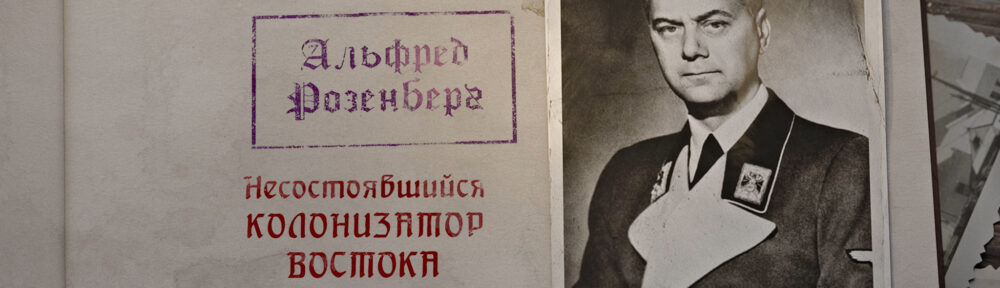
Alfred Rosenberg is one of the most sinister figures of the Third Reich. It is believed that he is the author of the concepts of “racial theory” and “the final solution to the Jewish question.” Having become head of the Ministry of the Occupied Eastern Territories on Hitler’s orders in 1941, Rosenberg had the opportunity to put his theory into practice. The task of Rosenberg’s department was to colonise the entire European part of the Soviet Union.
No “independent states” were supposed to be established in these territories. The Nazis planned to partially exterminate and partially evict the indigenous population, and “Germanise” the remaining ones. After the final victory of the Reich, the ideologists of Nazism planned to make those inhabitants of the USSR whom they decided to leave alive slaves serving the German colonists and “Greater Germany.”
This film is another reminder of the future that was in store for the big and small nations of Europe in the event of the victory of Hitler and his satellites. The film uses rare footage of captured German newsreels, photographs from the personal archives of Nazi leaders captured during the storming of Berlin by soldiers of the Red Army. Many of them have never been shown on the air.
Backup at Rumble.
Raw video source at the site of the VGTRK
Additional strokes to Rosenberg’s portrait

An uplifting caricature by Boris Yefimov from 1936, depicting the Ukrainian nationalists marching right from an important appointment with a mug of “Beer”.
Their banner, carrying the proud symbol of Ukraine — with a cherry on top — has the words in a mix of Ukrainian and German:
“Long live our father Rosenberg!”
The words are addressed to Rosenberg — whom Hitler called “the church Father of National Socialism” — standing on the drums of the German Nazi propaganda – the “Völkischer Beobachter”.
♦️♦️♦️
‼️ Both Beobachter and Rosenberg made appearance on the pages of the Danish underground publication “2 Years”, where we can find many a pearl of the German propaganda.
Alfred Rosenberg (1893 – 1946). Top Nazi and the party’s leading racial ideologist, incarnate anti-communist and anti-Semite. Born in Estonia, sentenced to death and executed in Nuremberg for, among other, crimes against humanity.
In the early years, he exercised a decisive influence on the development of Hitler’s thinking and nurtured his visions of his own divine significance.
Rosenberg held powerful political posts in the party and state. He was an influential figure in the occult Thule Society of the nazi elites. He published anti-Semitic literature and was the holder of the Nazi “Blood Order”.
Völkischer Beobachter (“People’s Observer”) – the official newspaper of the Nazis, published by the Eher Verlag, owned by the Nazi Party NSDAP (Nationalsocialistische Deutche Arbeiterpartei), appeared as a weekly from late 1920 to 1923. From 8. February 1923 to the end of april 1945 the newspaper was published as a daily with Alfred Rosenberg as editor.
All Is in the Past — Adolf Rosenberg in His Domain

The caricature by Boris Yefimov appeared in the combined issue №11-12 of the Soviet satirical magazine “Krokodil” in April of 1944.
We can assume that the latest defunct sign being carried into the room, is that of the newly-liberated Odessa!
✍️ For some reason, Alfred Rosenberg is called “Adolf” in the caricature. Maybe that was done on purpose, to combine the characters of Alfred Rosenberg and Adolf Hitler into one. Rosenberg acted as Reich Minister for the Occupied Eastern Territories.
🇺🇦 When you start believing in own delusions of grandeur…
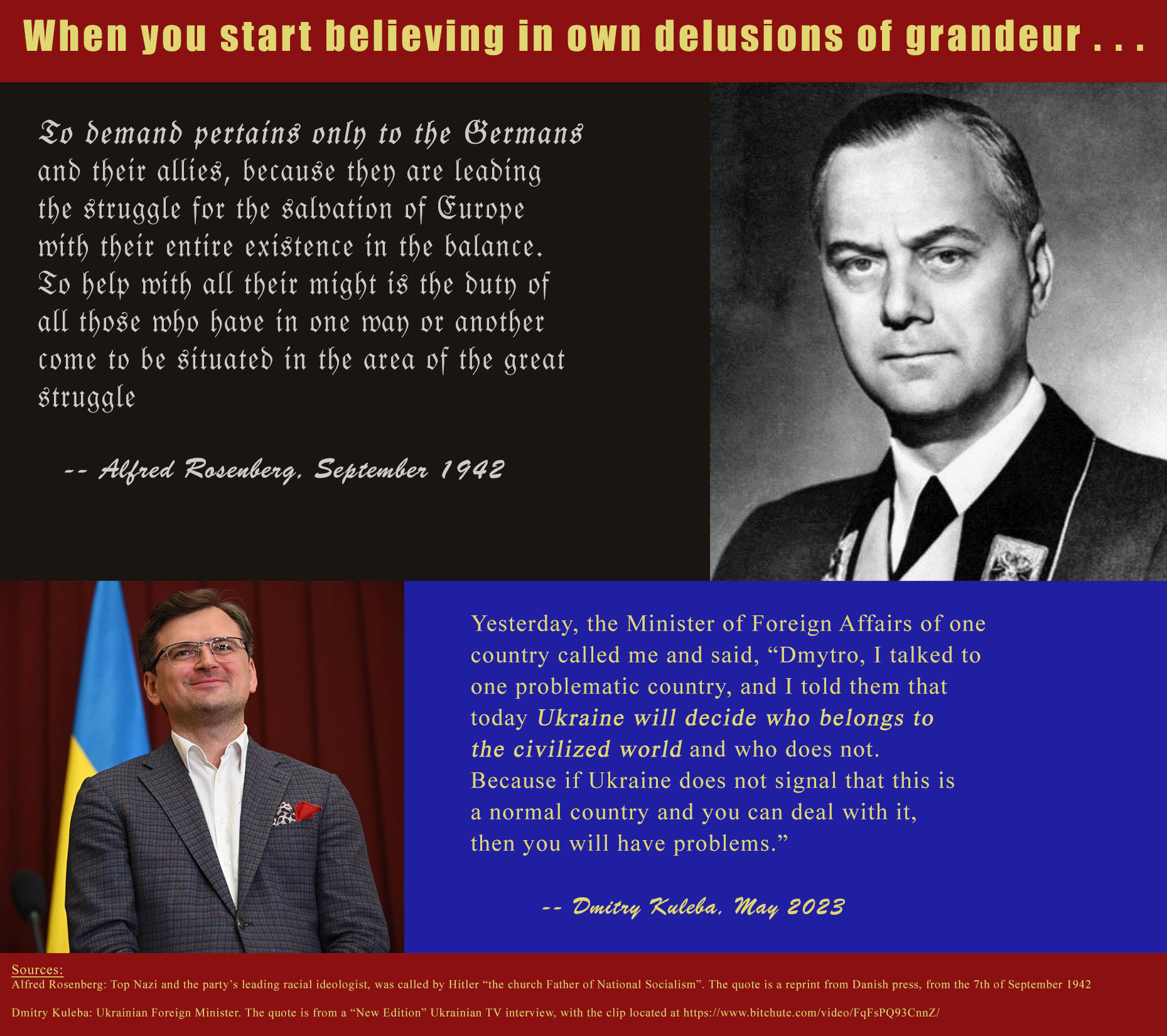
The Ukrainian nationalists could look up to Alfred Rosenberg as the “church father” of their nationalism not only in the context of the 1936 caricature above.
In May of 2023, the Ukrainian foreign minister Kuleba echoed what Rosenberg was saying in September of 1942. The quote of the latter was preserved on page 59 of “2 Years” — the Danish underground publication from 1943, to which we added a note with biographical info on the chief Nazi ideologist.
Such a historical parallel was too striking to pass!
Just feel the sameness!
Rosenberg:
“To demand pertains only to the Germans and their allies, because they are leading the struggle for the salvation of Europe with their entire existence in the balance. To help with all their might is the duty of all those who have in one way or another come to be situated in the area of the great struggle.”
Kuleba:
“I told them that today Ukraine will decide who belongs to the civilized world and who does not. Because if Ukraine does not signal that this is a normal country and you can deal with it, then you will have problems.”
Transcript of the documentary
Before you is rare newsreel footage.
November 1943.
The first group of foreign correspondents
is inspecting Babi Yar.
During the occupation of Kiev, this huge ravine
became a symbol of Hell on Earth.
According to various estimates, the Germans shot here
about 100,000 people, including the entire Jewish population,
remaining in the city.
A few months before his escape
the Nazis tried to hide the traces of the crime.
In August-September 1943, the corpses were dug up and burned.
After that, the invaders shot
several hundred prisoners of the Syretsky death camp,
whom they used in the liquidation of the mass grave
as a labour force.
Only a few managed to escape from the guards.
In this footage, one of the survivors shows
to American and British reporters, traces of shackles,
in which prisoners working in Babi Yar were chained up.
The testimonies recorded that day
will be announced at the Nuremberg trials.
– Here, in this place, which is called Babi Yar in Kiev,
we, prisoners of war, were forced by the fascist fiends
to burn the corpses of our Kiev, Soviet citizens,
whom the German fiends shot during the two years of their occupation here.
Here, in this Babi Yar, were the stoves.
Stinking and stench were here.
We were forced to pull out and, under threat of execution,
put these corpses on the stove.
People, naked women and children were also brought here in choke-wagones,
suffocated by gases in the cars.
In total, during our work here, we were forced to burn
about one hundred thousand Soviet citizens.
Captured Germans were forced to dig up the graves of prisoners of the Syretsky camp.
A voice is clearly heard behind the scenes:
“That’s what they did! Let them dig now.”
(Saying it in Ukrainian)
– Karpatenko, tell us who in your family the Germans killed.
“My son. He was 28 years old.
He…
Oh, my Vanya! (She sobs.)
What have they done?
Oh, my God!
The number of inhabitants of Soviet Ukraine,
destroyed by the Nazis during the occupation,
is estimated at four million people.
It was not at all what was promised the Ukrainians
under the rule of the German Reich, by one of the main ideologues of Nazism,
responsible for the colonisation of the East — Alfred Rosenberg.
Shortly before the attack on the USSR, on May 7, 1941,
he wrote instructions that said:
With the help of Ukrainian writers, scientists and politicians, it is necessary to revive the Ukrainian historical self-consciousness in order to restore what the Judeo-Bolshevist ideas destroyed in the Ukrainian people in those years.
By all means we need to encourage the publication of Ukrainian epics and political literature. At the same time, the history of Germany and the National Socialist Reich should be published in Ukrainian.
It is necessary to gradually make efforts to exclude Russian language from circulation as a foreign language, and introduce the use of the German language among the conscious part of the population.
[ Yuri Yemelyanov, historian, author of the book “Mortal combat of the Nazi bosses. Behind the scenes of the Third Reich” ]
Rosenberg’s coming into his own took place
not only under the influence of German chauvinists,
but also under the influence of White Guard emigrants
and especially emigrants from Ukraine.
Skoropadsky was Rosenberg’s interlocutor.
Skoropadsky tried to convince Rosenberg of the red menace.
Other people from Skoropadsky’s entourage did the same.
Therefore, already in 1921
Rosenberg tries to add into the Nazi program
an item about the separation of Ukraine
from the Soviet Union.
Spring of 1942.
Minister of the Occupied Eastern Territories, Alfred Rosenberg
arrived in Ukraine to inspect the new possessions of the Reich.
An Ostsee German, born in the Russian Baltics –
among the Nazi bonzes,
he was considered the main expert on the Slavs.
Reichskommissariat “Ukraine” had in his plans to colonise the East
a special place.
In his diaries, he wrote that one should use
the anti-Moscow ideas of the Ukrainian nationalists
to attract volunteer helpers
during the development of the Ukrainian territory in the interests of the Reich.
In Kiev, Rosenberg proposed to open a new university,
where teachers from Germany would be fostering
irreconcilable enemies of Russia.
Two days before the attack on the USSR, he gave a speech
on Germany’s political goals in the upcoming war in the East.
Speaking about the Ukraine and the Ukrainians, he said:
We shall encourage emergence of literature on the struggle of the Ukrainians in order to revive their historical consciousness. The Ukrainian classics, who partially wrote in Russian, could be re-issued in the Ukrainian language.
The cult of the Ukrainian leaders – Hetman Khmelnitsky, Sogoidachny and Mazepa – should also be supported. The Moscow state should be seen not as a friend but as a mortal enemy of Germany and, at the same time, of the Ukrainian state.
Our political tasks should be directed towards carving out state entities from the vast territory of the Soviet Union and directing them against Moscow, thus freeing the German Reich from the Eastern threat for centuries to come.
[ Aleksey Plotnikov, Memer of the Association of WWII Historians ]
We all remember when the question
of Ukrainian nationalism began to be spun up.
It was already in Austria-Hungary.
Already in Austria-Hungary, this process of Ukrainisation was being developed
in order to incite the Ukrainians against Russia
and thus split the Russian Empire
and win or, at least, not lose the war.
And Rosenberg decided to play this card.
He took this Austrian theory and said:
“Let’s use the Ukrainians as such a battering ram.”
I would even say: “such a sacrificial ram against Russia.”
Why a sacrificial ram?
Because as such, Rosenberg was a bane fide Nazi – he despised people.
He despised the same Balts:
he called them small fry, for which Germany does not need to fight at all.
And he treated the Ukrainians the same way.
That is, he considered them as cannon fodder – nothing more.
The main task of the Ukrainians in the Reich
Rosenberg put very simply:
they must provide Germany with food, raw materials
and cheap labour.
For the Reichskommissariat “Ukraine”, the Germans filmed special propaganda films,
that advertised the life of “ostarbeiters” with the new owners.
The number of workers from the East
is constantly increasing at various German enterprises.
Photos from the placement and images of how are Ukrainian female workers are taken care of
at one of the shoe factories,
located in one of the western regions.
Ivan Fedorenko from Kiev.
He has been working at one of the big factories for a year and a half.
He is happy to work in a bright, clean room
in a beautiful, healthy area.
Working at the latest machines,
he has the ability to study to perfection
technical processes of complex structures.
Also I, taking this opportunity that my work is over, want
to address my own people:
Dusya, I assure you, that I’m happy with this life –
just like all our guys.
I understand that with my work I help in the fight against the Bolsheviks
and bring closer that time,
when we, all together, will be building a new homeland,
without the Bolsheviks and capitalists.
I feel good, vigorously, I got your packages.
Write more often, and don’t worry about Sasha and Vasya:
they also live well.
In a few days I’m going to visit them.
Mass fun games
they lift your mood and give you a healthy workout.
Ball games develop and entertain.
Educational games of the Ukrainian ostarbeiters
had to be accompanied by ideologically correct music:
as such, the propagandists of the Reich
used anti-Soviet and anti-Semitic ditties.
A song is playing: “What screams we heard,
tell me, little man.”
“They caught a Jew there – they’ll hang him on a twig.”
Most of the leaders of the Reich reacted to Rosenberg’s calls
to use Ukrainian and other non-German nationalists
as meaningless and harmful chatter.
According to Nazi racial theory,
that Rosenberg himself liked to speculate about,
Slavs belonged to the lowest category of subhumans,
therefore, it was believed that for Aryan hosts
their lives have no value,
and they should be governed only with a strong hand.
On this basis, Rosenberg had several conflicts
with Reichskommissar of Ukraine Erich Koch.
Speaking about Rosenberg’s projects, Koch stated:
“Some people are extremely naive about Germanisation:
they think we need Russians, Ukrainians and Poles,
whom we would force to speak German.
But we need neither Russians, nor Ukrainians, nor Poles –
we need fertile land.
We are the people of lords, and we must rule hard and fairly.
I will exact everything to its last from this country.”
[ Aleksey Plotnikov, Memer of the Association of WWII Historians ]
When Rosenberg headed the famous
Ministry of the Affairs of the Occupied Eastern territories,
this ministry existed purely on paper.
It is known that no one respected him,
the governors-generals did not listen to him at all,
nor the military chiefs of the respective provinces,
and he was actually such a “card king”,
he had no real political influence.
When he wrote protests against Koch, that this policy is harmful for
the interests of Great Germany and the Third Reich.
That is, he does not protest because it is bad in itself,
but because it will harm the ideas of national socialism.
And in this, too, is his duplicitous, ambiguous and extremely negative role.
Moscow. State Archive of the Russian Federation.
Documents of the Extraordinary State Commission are stored here,
which was engaged in the investigation of Hitler’s crimes
in the occupied territories of the USSR.
Hundreds of boxes with names of regions of Russia, Ukraine, Belarus,
the Baltic republics.
They contain a whole abyss of human suffering,
monstrous atrocities, lists of destroyed cities,
burned villages, vanished monuments of history and culture.
Some of these documents would be presented to the world
during the famous Nuremberg trials
over Nazi criminals.
[ Aleksey Denisov ]
What Rosenberg actually did in Ukraine,
is clearly visible from the documents.
This is just one of the folders, prepared by the Soviet prosecution
for the International Military Tribunal in Nuremberg.
It contains lists of art treasures,
which Rosenberg’s office took out from Kiev alone.
The scale of the robbery is stagering.
On each page – priceless art treasures,
from the miraculous icons of the Kiev Pechersk Lavra
to the paintings by famous Russian artists –
Aivazovsky, Tropinin, Bryullov, Kramskoy, Repin, Bilibin, Vasnetsov,
and many others.
In total – about 7 thousand items.
According to experts’ calculations,
only on the territory of Soviet Ukraine,
Nazis robbed 151 museums,
and they took 330,000 works of art to Germany.
In Russia, they looted 170 museums,
including the oldest temples in Novgorod and Pskov,
the world-famous palaces of Peterhof, Tsarskoye Selo and Pavlovsk.
In total, according to experts, in the occupied territory of the USSR,
the Nazis stole 1 million 400 thousand different museum valuables.
The greatest damage from the occupation occurred in three Soviet republics:
Belorussia, Russia and Ukraine.
[ Andrey Artizov, Head of the Federal Archival Agency ]
Alfred Rosenberg is a criminal.
This is the man, who was one of the preachers of the Nazi ideology
and organisers and ideologists of implementation of the policy,
under which the citizens of the Soviet country were to become slaves.
In certain territories, such as Crimea, the Baltics,
the entire population was generally to be subjected to eviction,
and it was planned to move the German population there,
so that these would become areas with the German population.
Well, all the other people –
Russians, Ukrainians, Belarusians, Tatars, Mordvins, Chuvash –
these are all second-class “untermenschs”.
In simple terms, they were supposed to be slaves,
who were supposed to serve the racially pure Aryan population.
It was not by chance that Rosenberg was known as a connoisseur of
the Russian soul among the leadership of the Reich.
He was born on December 31, 1892 (old style)
in the city of Revel, the future Tallinn.
Then it was the territory of Estlandia, which was part of the Russian Empire.
His father was an Ostsee German,
and his mother came from a French Huguenot family,
who migrated to the east.
As a child, Rosenberg drew well.
After graduating from a real school he entered the Riga Polytechnic Institute,
where he studied to be an architect.
When World War I broke out, Rosenberg avoided conscription
to the Russian army being an ethnic German.
[ Aleksey Plotnikov, Memer of the Association of WWII Historians ]
Such humane laws were in the Russian Empire.
He was not taken to the war against the Germans,
as he was a German, and it was believed that it wouldn’t be entirely proper.
In 1915, when the threat of a German invasion loomed over the entire Baltic region,
Riga Polytechnic Institute was evacuated to Moscow.
That’s how Rosenberg ended up at the Imperial Moscow Technical School,
now Bauman Moscow State Technical University, which he graduated from
with a diploma of an architectural engineer of the 1st degree.
In 1918, due to family reasons, he returned to Reval,
and from there he moved to Munich.
Quickly realising that his drawings with views of Estlandia
and a diploma of a Soviet architect
weren’t needed by anyone in the post-war Germany,
Rosenberg joined the Thule Society, an occult organisation
engaged in the study of Germanic antiquity.
[ Yuri Yemelyanov, historian, author of the book “Mortal combat of the Nazi bosses. Behind the scenes of the Third Reich” ]
Here he found himself in an environment saturated with chauvinism, nationalism.
These are former war veterans, who want revenge.
Rosenberg needs to prove that
“I belong, I belong,” and he starts telling horror stories
about who the Russians are: “They’re all savage people!”
All that he knew about Russia, about the Russians,
is turned upside-down for him.
Now for him Dostoevsky is not a favourite writer,
but a person who showed all the depravity the Russian soul.
He is a very crafty person,
he starts talking to these people and gets noticed.
Meeting Hitler marked the beginning of
Rosenberg’s political career.
In 1920, he joined the Nazi Party
and soon became the editor of its main publication –
The Völkischer Beobachter newspaper.
In it, he actively publishes anti-Semitic articles
and quickly gains the image of one of the main specialists
on racial theory.
At the same time, Rosenberg’s main work, “The Myth of the Twentieth Century”,
is rated poorly by the prominent Nazis.
Hitler called the book “incomprehensible nonsense,
written in self-confident Balt.”
Nevertheless, after coming to power, the Fuhrer appoints Rosenberg
as his authorised representative for the control of general and spiritual
ideological education of the Nazi Party.
From that moment on, “the self-confident Balt” received a national rostrum
to spread his racist theories.
[ Alfred Rosenberg, “On discontent in the occupied countries”, September 7, 1942 ]
Hitler and the National Socialist movement saved Germany and every single person. So this movement is has every right to carry out a total transformation the German Reich. Everyone else for the rest of their lives have lost the right to criticise us.
[ Aleksey Plotnikov, Memer of the Association of WWII Historians ]
One of the people who inspired Hitler with dislike, even hatred
to Soviet Russia, one of those who greatly contributed to
the development of ultra-radical anti-Semitic sentiments in Hitler,
one of those who followed the path
the creation of this monstrous racial theory,
including using Ukrainians as, I emphasise, cannon fodder,
was Alfred Rosenberg.
Since the beginning of the conquest of Europe,
another of Rosenberg’s talents emerged –
robbing other people’s goods.
Since January 1940, Rosenberg’s Einsatzstab has stolen huge amount valuables
not only from museums and libraries, but also from private homes.
In December 1941, at the suggestion of Rosenberg
“Operation Furniture” was carried out in Europe.
Then his henchmen looted about 70 thousand Jewish homes,
including 38 thousand in Paris alone.
To export confiscated furniture to Germany,
20,984 railway cars were needed.
Besides Rosenberg, looting of property in the occupied countries was done
by the German military, the SS and the leaders of the Third Reich were engaged.
[ Aleksey Denisov ]
All the gold looted by the Nazis in Europe flowed here –
in the building of Hitler’s Reichsbank in the center of Berlin.
The German Ministry of Foreign Affairs is now located here.
Here, in the underground vaults, the Nazis stored
gold reserves of Czechoslovakia, France, Austria, Poland, Belgium
Denmark and the Netherlands.
Gold taken from European Jews was also brought here.
According to official data, only from the SS, Reichsbank bought
1 tonne 280 kilograms of gold melted from dental crowns,
wedding rings and jewellery of concentration camp prisoners.
The main financial partner of the Nazis during the war
were Swiss banks that helped the Reich
to convert the stolen gold to Swiss francs
to finance military expenditures.
On April 2, 1941, Hitler instructed Rosenberg to
to prepare a plan for the dismemberment and colonisation of the USSR.
During the two-hour meeting, the Fuhrer stated:
I intend to create a bureau to solve all Russian issues.
And you should lead it.
Coming home, the future Reich Minister
enthusiastically wrote in his diary:
“Rosenberg, your hour has come!” With such words, the Fuehrer finished his conversation with me today. I don’t need to explain my feelings.
So, 20 years of anti-Bolshevik work must bear its historical fruits, and mayhap enter the world history. Millions and their fates are transferred into my hands.
[ Yuri Yemelyanov, historian, author of the book “Mortal combat of the Nazi bosses. Behind the scenes of the Third Reich” ]
Hitler thought that this was the only person,
who understands what Russia is.
He knows Russian language, he knows Russian literature,
and as Hitler thinks, he understands the psychology of Russians.
And for Hitler that matters most.
Decree on the establishment of the Imperial Ministry
of Occupied Eastern territories, led by Rosenberg,
was signed by Hitler on July 16, 1941.
By this time, the plan for development and operation
of the “living space in the East” was already ready.
The captured lands of the Soviet Union were planned to be divided
into several Reichskommissariats:
Ostland, which included the territory of the three Baltic republics
and most of Belarus, with thes capital in Riga.
Reichskommissariat Ukraine with its capital in Rovno,
with the exception of western Ukraine,
where a separate General Governorship was planned.
Reichskommissariat Kaukasus with its center in Tbilisi;
Reichskommissariat of Moskowien, which was to include all the regions
of Central Russia, up to the Urals;
and the Reichskommissariat Turkestan in Central Asia.
A separate place in Rosenberg’s plans was occupied by the Crimean Peninsula.
[ Aleksey Denisov ]
The Battle for the Crimea began in the fall of 1941.
The Soviet command sought to defend the peninsula at any cost.
Here was not only the main base of the Black Sea Fleet,
but also the airfields from which our aircraft could strike at Romania,
the main supplier of oil for the German army.
Hitler commissioned one of his best generals,
Erich von Manstein, to storm the peninsula.
After the victory over the Soviet Union, the Fuhrer planned
to rename Crimea to Gotenland, the land of the Goths.
In 1941, at one of the meetings, Hitler bluntly stated
to his subordinates that the peninsula should be completely cleansed
from the local population and settled by colonists from Germany,
in particular, immigrants from South Tyrol.
Crimea with the adjacent northern lands
was the only region of Russia that the Germans planned to include
directly in Germany proper.
The historical rationale for this decision was that
in the ancient times, during the great migration of peoples,
settlements of the Goths appeared here, one of the Germanic tribes.
Take possession of the Russian peninsula
was also the dream of Hitler’s allies – the Romanians.
You are watching a unique newsreel footage.
July of 1942.
Joint parade of German, Romanian and Italian military personnel
in the newly captured Sevastopol.
Romanian divisions took an active part in the assault
of the main Russian stronghold on the Black Sea.
Mussolini did not stand aside and sent to the aid of the Germans
10 torpedo boats and 6 submarines
of the Italian Navy.
But Hitler did not want to share Crimea with his allies.
As compensation for participation in the war against the USSR,
he gave the Odessa region to the Romanians.
At the suggestion of Rosenberg, it was decided to rename Sevastopol
to Theoderichshafen, Theodoric Harbour, and Simferopol – to Gothenburg.
Hundreds of German settlements were supposed to be built in Crimea,
with 30 to 40 farmsteads each,
and populate them with armed peasants – the Verbowers.
By 1960, their number was supposed to increase
up to 5 million people.
[ Yuri Yemelyanov, historian, author of the book “Mortal combat of the Nazi bosses. Behind the scenes of the Third Reich” ]
Rosenberg tried very hard.
When he received guests in the Crimea,
he was already getting ready to rename
both Sevastopol and Simferopol to German.
And so he was receiving guests.
He describes the nature of the Crimea, recalls Falz-Fein.
And there are no others there: he simply did not notice people.
In his memoirs, he never mentions the locals,
he didn’t just see them – they were dust,
which could have been easily removed.
He perceived it as a living space for its people,
to implement his racist ideas.
That was his main mission.
Part of the occupied territories of the USSR
Rosenberg proposed to fully Germanise.
As the most suitable material for this,
he considered residents of the Baltic republics.
According to Rosenberg’s plan,
they should be partially dissolved in the racially pure Aryan population,
and partially evicted somewhere.
During the war,
Rosenberg personally inspected Reich’s new possessions in Latvia and Estonia.
He was satisfied with what he saw.
Loyalty demonstrations and pompous celebrations,
arranged in honour of the Reich Minister by the indigenous authorities,
flattering his ego,
but he didn’t let them in on his true plans regarding the future of the Baltic peoples.
[ Yuri Yemelyanov, historian, author of the book “Mortal combat of the Nazi bosses. Behind the scenes of the Third Reich” ]
He believed that the Baltic States could be used
for the purpose of germanisation.
But at what things did Rosenberg look: where is the Baltic statehood?
Estonia has never been an independent state in its history,
it was an eternal colony of Sweden, Denmark, some Orders, but not Estonia.
Latvians – what kind of nation are they anyway?
Are they Latgians, or Courlanders, or Livonians?
Here they were moulded together, creating Latvia, which has never existed before.
Lithuanians. Yes, they had a state, but which one? Pagan.
Until the 14th century, these are pagans,
and they still worship snakes.
Are they a civilised people?
Therefore, Rosenberg was full of these
anti-Baltic moods and prejudices, so he didn’t see a future for them.
That these are, in an extreme case, lapdog nations,
which will help with the triumph of Germany.
But to seriously consider them as equals is unthinkable.
Rosenberg’s ambitious colonisation projects
began to collapse in the first months of the war.
It turned out that he didn’t know much about Russia after all
and he doesn’t understand Russian psychology at all.
Already on September 1, 1941
he will write in his diary with bewilderment and confusion:
The persistent resistance of the USSR is the topic of all conversations. When on April 2, the Fuhrer asked me how the Russians would behave in the clash, I replied: Presumably not like a logically thinking European would imagine it.
But we came to an agreement that the resistance would be followed by panic. However it turned out differently. The Soviet Russians fought fiercely, stubbornly, insidiously, and incredibly cruelly against the prisoners and civilian non-Bolsheviks.
The officers are unanimous in the opinion that the Russian nation is the main drive force of the resistance.
[ Aleksey Plotnikov, Memer of the Association of WWII Historians ]
He positioned himself as the largest specialist in Russia,
and hence his confusion, when suddenly the Brest Fortress [resists]
when suddenly there’s fierce resistance near Vyazma,
and the Blitzkrieg doesn’t work…
And even the Japanese attache says:
you guys can’t beat the Russians, and you want us to attack them?
You’re stalling, you can’t take the Brest Fortress.
This, I think, was his complete fiasco as an advisor.
That’s when he probably realised,
that this might be the end of his career,
that Hitler might not forgive him for it,
and most importantly, it shows that
that he poorly understoond Russia.
Rosenberg’s expectations were neither met
by the national formations, cobbled together by the Germans
from representatives of different peoples of the USSR.
With their help, he planned to split the ranks of the Red Army,
and weaken its resistance,
using the slogans of ethnic and religious enmity.
But that plan didn’t work either.
The collaborators’ divisions were efficient
only when conducting punitive operations against civilians.
In other cases, they were unreliable
and couldn’t withstand the strikes of the Soviet troops.
[ Andrey Artizov, Head of the Federal Archival Agency ]
Within the framework of various projects,
implemented by the Federal Archival Agency,
we published the famous three volumes dedicated to General Vlasov.
By the way, Rosenberg is also one of those who
contributed to the implementation of the project
“Vlasov Aktion”, as it was called,
because Vlasov was not interesting to the Germans as a leader
the Russian National Liberation Movement,
but as a figure that would allow them
to disparage the Red Army, prepare leaflets.
We have some modern scientists who have not yet read these volumes,
they didn’t even know that the famous Smolensk Manifesto,
which was allegedly signed by Vlasov in Smolensk…
Vlasov has never been to Smolensk.
So, this means that it was actually compiled
by propagandists of the Wehrmacht and special services,
and Vlasov signed it.
Russian State Archive of Modern History.
A huge array of documents is stored here
on the crimes of the Nazi invaders
in the occupied territories of the Soviet Union.
Including the atrocities,
committed against the defenceless people
by the Nazi collaborators from among the local nationalists,
polizeis, and SS legionnaires.
[ Igor Permyakov, Director of Russian State Archive of Modern History]
There was such a battalion “Nachtigall” – “Nightingale”,
which was organised back in 1940 in Poland.
It was organised with the involvement of the Ukrainian National Socialists,
who at that time were mostly in Europe.
Back in 1940, in Krakow, members of this battalion
prepared lists of the intelligentsia of Kharkov and Lvov,
subject to destruction in the first place.
After that, they were the first to enter Lvov,
and according to these lists,
they began to yank out all the intelligentsia and shoot them.
When you read these documents, well… there’s really nothing to say.
“According to witnesses testimony, in the city of Lvov these days
the Hitlerites committed mass executions of civilians,
women, children and the elderly,
accompanied by harassment and torture.
So, 12 Soviet citizens were hanged on the balcony of the opera house;
on Streletskaya Square in front of the city’s residents
15 people were shot;
on the corner of Dzerzhinskiy and Ivan Franko streets,
an old man and two women were killed;
on Zyablikevich Street, an infant was thrown out of a 3rd-floor window onto the pavement.
and so on and so on…
After the victory over Hitler’s Germany,
many secret documents of the Third Reich
were taken to the Soviet Union as trophies.
There were some absolutely unique ones among them.
These are folders with photos from Goebbels’ personal office.
Today they are kept in the Russian State Archive
of film and photo documents.
Until recently, no one has seen these pictures.
Now they are being studied and described by the staff of the Krasnogorsk Archive.
– How do you do. – Good afternoon.
Here’s another album from Goebbels’ office, which we want to show you.
Please tell me, how many pictures are there in total?
– More than nine thousand.
– …that were stored in Goebbels’ office?
– Yes.
These pictures were taken by military photojournalists of the Wehrmacht
in the occupied territories of the Soviet Union
and in the enslaved countries of Europe.
All of them are provided with propaganda inscriptions.
Soviet prisoners of war, Jews and commissars
are usually referred to as arsonists and subhumans,
while the soldiers of Hitler’s Germany –
as liberators, carrying the new law and order.
After the victory of the Reich, Goebbels planned to use
these photos to create his own version of World War II.
The Nazis were supposed to appear in it as the saviours of European civilisation
from Judeo-Bolshevism,
and the Soviet Union as the main aggressor.
By this time, in the opinion of the Hitlerite elite,
many countries and peoples should have already
disappeared from the face of the earth forever.
And only our victory prevented these monstrous plans from being realised.
Historical retribution has overtaken Alfred Rosenberg in May 1945.
He was arrested in the British occupation Zone
and was tried by the International Military Tribunal.
On October 16, 1946, Rosenberg was hanged in Nuremberg prison,
along with other prominent Nazis who were sentenced to death.
Out of ten criminals hanged,
he was the only one who refused the last word.
The failed coloniser of the East had nothing left to say.
Pingback: By their death they death averted. Remembering June 22, 1941 | Beorn's Beehive
Pingback: “Crimean Gold: The ‘Civilized’ Europe Loots Russian Treasures” – An exhibition on how the Netherlands stole Crimean Scythian gold | Beorn's Beehive