This historic speech was given by Iosif Stalin at the darkest hour, when the enemy was at the gates of Moscow. The speech and the parade marked the turning point of the war. In many ways it is prophetic, but it also has references to the immediate past, which are important to understand.
Knowing this text will be important for the context of two translations that I intend to publish on and after the Victory day.
Comrade fighters of the Red Army and the Red Navy, commanders and political instructors, labourers, collective farmers, workers of intellectual work, brothers and sisters in the rear of our enemy, temporarily fallen under the yoke of the German brigands, our glorious partisans, destroying the rear of the German invaders!
On behalf of the Soviet government and our Bolshevik party I greet and congratulate you on the 24th anniversary of the Great October Socialist Revolution.
Comrades! It is in difficult conditions that we have to celebrate the 24th anniversary of the October revolution today. The treacherous attack of the German brigands and the war imposed on us have created a threat to our country. We temporarily lost a number of regions, and the enemy found themselves at the gates of Leningrad and Moscow. The enemy counted on the fact that after the first blow our army would be scattered, our country would be brought to its knees. But the enemy cruelly miscalculated. Despite temporary setbacks, our Army and our Navy are heroically repelling the enemy’s attacks throughout the entire front, inflicting heavy damage on them, and our country – our entire country – has organized itself into a single military camp in order to carry out the defeat of the German invaders together with our Army and our Navy. Continue reading →
Sevastopol. The Crimean city that the locals say survived three sieges, the longest one ending in 2014. The second siege was between 1941 and 1944, when the city ultimately fell under the German control yet retained it fighting spirit until its liberation.
Below is an NTV tribute to the Hero-City of Sevastopol with my translation of the transcript
By the start of WWII, Sevastopol was the largest port of the Black Sea, and the main maritime military base of the USSR. Thus it was among the first Soviet cities bombed by the German aviation on the 22nd of June 1941.
Contrasting to what is happening in the Czech Republic – where they newly tore down the memorial to the saviour of Prague, Marshal Ivan Konev – and other Eastern-European countries, Slovenia appears to be an island of sanity. This article from “Argumenty i Fakty” from 11.09.2019 delves into how it was achieved.
A related and very important background reading, is the following Lada Ray report from 2016: Putin’s visit to Slovenia, Slavic Union and Russia! It describes events, to which the translation below makes a reference.
Monument to the Sons of Russia and the Soviet Union who died on Slovenian soil during the First and Second world wars
Behold Slovenia. The Ambassador’s name is Doku Gapurovich Zavgaev. The very same who led Chechnya (or rather, the Chechen-Ingush ASSR), then was the Ambassador to Africa (Tanzania), Deputy Head of the Foreign Ministry and its General Director. And since December 2009 is the Ambassador in Ljubljana.
President Putin conducted today a meeting with the heads of the Federal subjects on countering the spread of the Coronavirus infection. The full transcript of the meeting is published at the official site of The President of the Russian Federation.
What I found especiall enligtening is the last portion, where the President makes an address to the Russian people. This address underlines important Russian values and social contracts, as well as historical roots. It touches upon the concerns with the postponement of the 75th anniversary celebrations of the Victory in the Great Patriotic War.
Below is the video of the address from NTV and my speed-translation of the transcript.
I appeal to all citizens of Russia.
For each of us, the most important thing is life, health of the loved ones, safety of the parents and children. We now feel this especially acutely, we worry about our families and friends, and we strive to protect them from a cruel threat.
At the same time, it may – and does – seem to some that nothing terrible is happening. Many people don’t see the threat, they simply don’t feel it. After all, even in Moscow, where there are most sick – 48 thousand people – it is only 0.4 percent of the capital’s population. However, first of all, it is the lives and health of specific people, and there are many of them. And secondly, the risk of further, wider, spreading of the disease has not passed. It is still very large.
Among our relatives, colleagues, and people we know well, there are more and more people who were directly affected by the disease, who were found to have the infection, and who ended up in hospital with complications. Dear friends, I am deeply sorry for all those who have suffered the irreplaceable loss of their loved ones.
I understand how difficult it is: the bitterness of losses, and the burden of fatigue, anxiety, and uncertainty. This, of course, is exhausting, psychologically draining people. Material, financial, and everyday problems accumulate. And each of us wants to exhale and say: everything is finally over, everything is behind us.
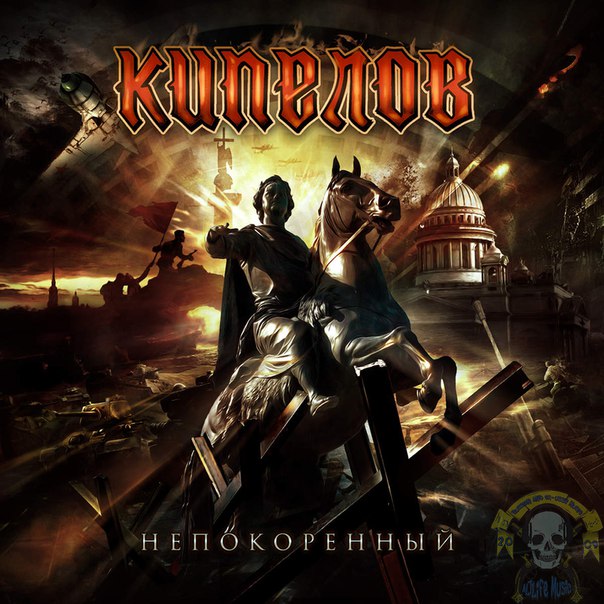
This song by the famous Russian heavy-metal group “Kipelov”, written 5 years ago to the 70th anniversary of the Victory in the Great Patriotic War deeply touched me. The powerful words, the strong voice of Kipelov and the documentary footage from the blockaded Leningrad, all merged into a whirlweend of emotions and memory.
The title of the song is “Непокорённый” – “Nepokorjonnyj”, which means both “Unconquered”, abut also “Defiant”, “Unbowed”. And this word takes all these meanings in the song.
Lyrics translation is mine.
Небо Балтики давит свинцом, город держит за горло блокада;
Медный всадник и ангел с крестом батальонам подвозят снаряды.
Львы из камня срываются с мест, чтоб с бойцами подняться в атаку –
Непокорных жестокая месть. Наступление. Крушение мрака!
Припев:
Непокорённый, прошедший сквозь ад;
Непокорённый, герой – Ленинград!
Непокорённый, на все времена;
Непокорённый, город Петра!
Пишет Жизнь слабой детской рукой даты смерти на саване снега.
Что тогда бы случилось с тобой; смог остаться бы ты человеком;
Не сдаваться и в голос не выть, убивая за хлебные крошки;
Свет надежды сумел бы хранить под раскаты немецкой бомбежки?
Припев:
Непокорённый, прошедший сквозь ад;
Непокорённый, герой – Ленинград!
Непокорённый, на все времена;
Непокорённый, город Петра!
Чернота. Хрупкий Ладожский лёд, уходящие дети под воду.
Метроном отобьет скорбный счет всех погибших в блокадные годы.
Нервы города – к сердцу земли, силы взять, и к весне возродиться,
Медный всадник к победе летит, неподвластной забвению птицей.
Припев:
Непокорённый, прошедший сквозь ад;
Непокорённый, герой – Ленинград!
Непокорённый, на все времена;
Непокорённый, город Петра!
Город Петра!
Непокорённый!
The Baltic sky is laden with lead, the city is held by the throat by blockade;
Bronze Horseman and Angel with Cross bring shells to the forces forth.
Lions of stone break from their plinths to rise with fighters in charge –
The unconquereds’ brutal revenge. Offensive. Darkness will fall!
Chorus:
Unconquered, having passed through Hell;
Unconquered, the Leningrad-hero!
Unconquered, for all time;
Unconquered, the city of Peter!
Life writes with a weak child’s hand the dates of death on a shroud of snow.
What would have happened to you back then; could you have kept yourself human;
Not to give up and howl out loud, killing for crumbs of bread;
Would you be able to hold onto the light of hope under the thunder of German shelling?
Chorus:
Unconquered, having passed through Hell;
Unconquered, the Leningrad-hero!
Unconquered, for all time;
Unconquered, the city of Peter!
Blackness. The fragile Ladoga ice, and children going under.
The metronome will mournfully beat the count of those, died in blockade.
Nerves of the city reach to Earth’s heart, strength to take, and be reborn by the spring,
The Bronze Horseman flies to Victory, a bird that’s beyond the oblivion.
Chorus:
Unconquered, having passed through Hell;
Unconquered, the Leningrad-hero!
Unconquered, for all time;
Unconquered, the city of Peter!
The liberation of Prague from the Nazi German occupation was brought about 75 years ago by the Soviet troops under the command of Marshal Ivan Konev. Seeing as the Czechs have recently decided to erase that particular page of their history, we must do all in our power to counterbalance the destruction of memory, by remembering the events of 5th through 12th of May 1945 in all the unaltered detail.
Who doesn’t know the history of the liberation of Prague? On May 5, 1945, Prague rose in revolt, Soviet troops came to the aid of the rebels, and on May 9, Prague was liberated.
But it happened not quite like that, or rather, it wasn’t like that at all. In May, parts of the German garrison were really conducting bloody battles in Prague. Only their main opponents were not the rebelling Czechs, but the fighters of the 1st division of the RLA (“Russian Liberation Army”, or Vlasovtsy [Translator note: The name Vlasov is synonymous to that of Quisling in Norway]).
Czech Republic – the reliable industrial rear of the Third Reich
Czechoslovakia as an independent state disappeared from the political map of Europe before the Second World War. First, in April 1938, under pressure from Britain, France and Italy, Czechoslovakia abandoned the Sudetenland in favour of Germany (the so-called Munich Conspiracy).
This year marks the 75th Anniversary of the Victory over the German Fascists, where Soviet Union played the decisive and definitive role in sealing that Victory. This role of USSR is like a thorn in the eye of the modern day revisionists and neo-Fascists, who over the past decades have been ferociously rewriting history and smearing Russia as the heir to the USSR. The history is remembered as long as there are physical manifestations of said history left in the world.
As such, the especially vicious battle has been wielded against the monuments commemorating the Soviet (and by that meaning all nationalities, not just Russian) soldiers and commanders on the post-Soviet space. Poland, Czech Republic, Romania and others started the trend as soon as the CIA assets took power in those countries. After 2014, once the neo-Fascits took hold of power in Ukraine with the help of the USA and EU, the demolition of the WWII memorials was put on the assembly line rate level, at the same tempo as the destruction of the Ukrainian economy that it inherited after the USSR.
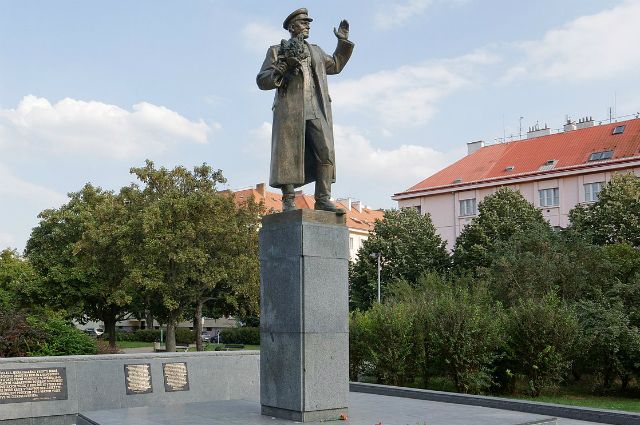
Now, that the date of the 75th Anniversary is drawing ever nearer, the newest salvo in the war on the historical monuments was heard from Prague, Czech Republic, where the memorial to Marshal Ivan Konev – the saviour of Prague – was torn down. If not for Konev’s army and his decisive, yet careful actions, Prague would be looking like Dresden now. Albeit, not because of the American firebombing, but because of the demolition charges that the retreating German forces put all around the city. It is the remembrance of the salvation of such cities as Prague and Krakow – at great self-sacrificial cost on the part of the Soviet troops – that the CIA assets are eager to destroy.
Below is my speed-translation of an article from “Argumenty i Facty” from 09.04.2020, showing the shame of Prague district 6 in all its ignominious glory.
Descendants of the Soviet Marshal Ivan Konev began collecting signatures for the transfer to Russia of the monument to the commander that was dismantled in Prague. The daughter of the Marshal, Natalia Koneva, hopes that the monument will be installed in Moscow.
“We have Marshal Konev street. And it will be natural if the monument would stand on it.”
What scares me is how the history is being rewritten right in front of our very eyes, while a few of the contemporaries of WWII are still alive, and while their ancestors still remember their stories, like I remember the story of my grand-uncle. The most scary part is the passive acceptance of the twisted half-truths and lies, peddled by the media, by the general populace. What can we say about the events of 1812 and before (like when the Dutch have forgotten the Russian help in restoration of their state), what can we say about the changes done to our history, when the history is being so thoroughly rewritten right now?!
Three articles on RT caught my eye today, vividly illustrating this.
Orwell’s dystopia takes to its logical extreme the old adage that “history is written by the victors,” but it’s not too far off. Much of Western history about WWII, for example, came from the pen of Winston Churchill, who naturally made sure he was the hero by scrubbing out inconvenient facts like the 1943 Bengal famine or the betrayal of Yugoslavia, for instance.
These narratives were then taken up and amplified by Hollywood, which has from its very beginning manufactured institutional memory for most Americans. As a result of blockbusters like ‘Saving Private Ryan,’ and ‘Band of Brothers’ (another HBO show), the US contribution to defeating Hitler has become grossly inflated in the public mind, not just at home, but abroad as well. Meanwhile, the massive Soviet role in the war has been minimised or erased entirely.
This narrative violation of history made it possible for US President Donald Trump to argue that America single-handedly defeated Nazism and Communism, without a peep from his critics and legions of fact-checkers normally eager to seise every opportunity.
To paraphrase Varys, power is all about perception management.
After fierce resistance and four years of bloody battles, the Red Army repelled the invasion and liberated Eastern Europe from the Nazi occupation.
In 1945, Soviet soldiers captured Berlin. After the warfare in Europe was over, Moscow agreed to US requests to enter the war against Japan, defeating its forces in Manchuria.
More than 26.6 million Soviet citizens died in the war, with 8.7 million killed in combat.
And yet…
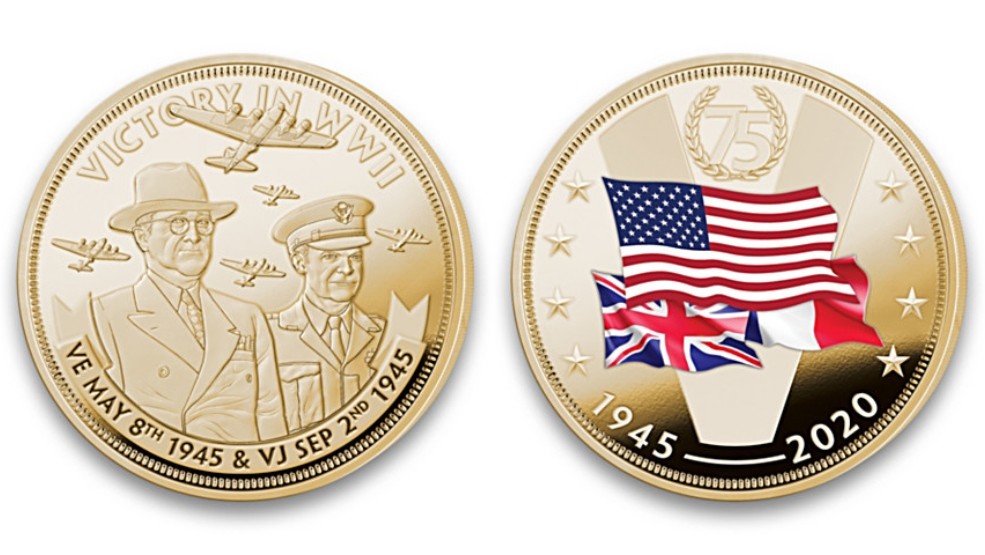
A US-made collectable coin lists Britain and France among the honored US allies in WWII, but, strangely, the Soviet Union, whose Red Army delivered a crushing blow to the Nazis in Europe and fought Japan, is omitted.
I want to round these musings with a news from Sweden, where they are mulling to forbid… Nordic runes:
First the Rus runes were pushed into oblivion, and now it’s the turn of the Norse runes, and with them even more of our history will be forgotten. Nazis seem to be an awfully convenient excuse to achieve such goals of first maligning and then outright banning the old and venerated symbols, as it’s already been done with the symbol of the “wheel of time” – “kolovrat”.
LaRock on March 6, 2019 at 19:50 said:
The war is over stop punishing Germany
To which I replied:
Stanislav on March 12, 2019 at 20:02 said:
This comment should be addressed to the USA, who are still occupying and punishing Germany. If you read the article, you’d see that it’s about remembrance and reconciliation.
However, a better reply would have been a translation of an even earlier article by Zotov, one from 2013. I am translating it below, followed by a translation of two reader comments from AiF and my thoughts on them and what Zotov wrote in one particular paragraph.
Today, with racism and calls to war and genocide being the norm on the pages of the Western MSM (“racism” is a common-root synonym of “russophobia”) and the number of the Western troops and war hardware right on the Russian border being the highest since the June of 1941, it is time to remember. For while the West is collectively shrugging off 1941-1945 as “just another invasion of Russia” and preparing for a new one, Russia remembers, watches closely and prepares to defend its land once more.
In this today’s context remembrance is the key to preventing another invasion of Russia by the West, and prevent this time hundreds of millions people being killed – both defenders, attackers and bystanders…
UPDATE May 2, 2025: the original of the RI article disappeared, so the link is updated with the version stored at the WebArchive. We also update this post to include the complete copy of the article, with all the image. The article at Russia Insider was in turn re-published from South Front, here at the new address.
All major cities of the Soviet Union were included in the list of 66 “strategic” targets. The tables below categorize each city in terms of area in square miles and the corresponding number of atomic bombs required to annihilate and kill the inhabitants of selected urban areas.
Six atomic bombs were to be used to destroy each of the larger cities including Moscow, Leningrad, Tashkent, Kiev, Kharkov, Odessa.
The Pentagon estimated that a total of 204 bombs would be required to “Wipe the Soviet Union off the Map”. The targets for a nuclear attack consisted of sixty-six major cities. Continue reading →
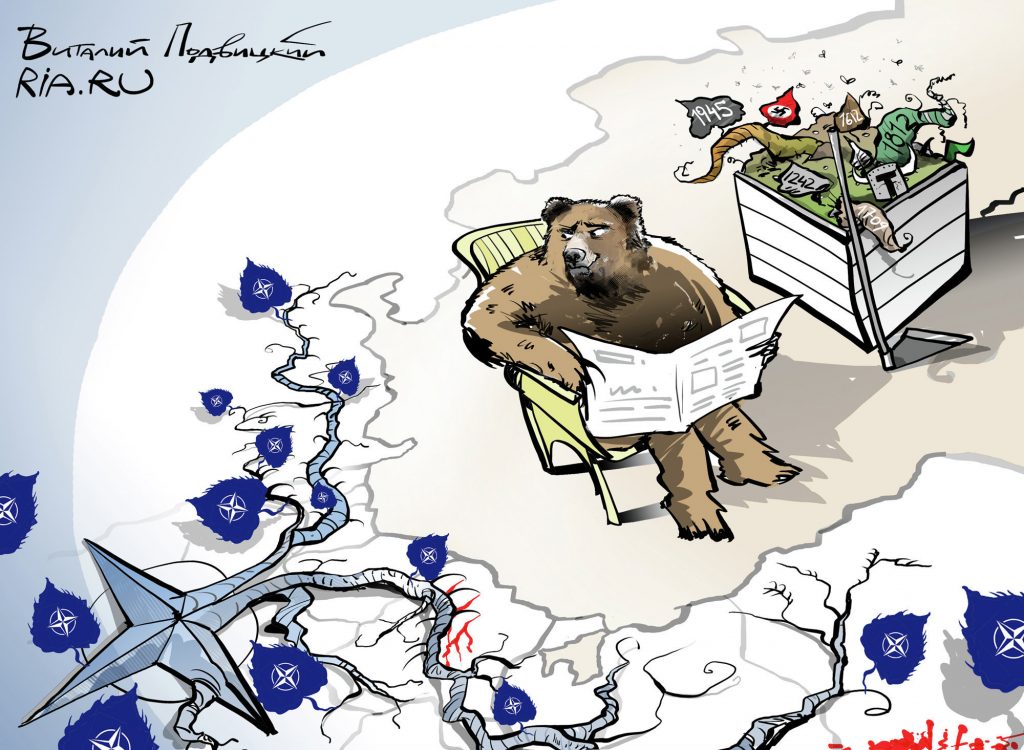
The image below speaks volumes, without words. It speaks of Russia’s history past, and of the precarious future. The Russian Bear sitting on his land of old, looking with suspicion at the ever growing tentacles of the US/NATO, already consuming neighbouring lands in blood – Yugoslavia, former Ukraine – Malorossia and Novorossia, Middle-East. And besides The Bear is a compost heap of history, where one can see the the tentacles of the past that dared to choke Russia and got pruned. Will Russia again be forced to end another war that someone starts in the hopes of eliminating Russia, freedom, history, from the face of the world?
For those, not so well-versed in history, here is what the dates in the compost heap of history signify. I added a few more – on average Russia got invaded once every 50 years, and this time is not different, though the method of warfare changed.
1242 – The Germanic Teutonic invasion and the Ice Battle on the Ladoga lake.
1612 – Polish invasion into Russia and occupation of Moscow. Beaten by the people’s militia of Minin and Pozharskij, the memorial to whom you will find on the Beautiful Square in Moscow.
1709 – Karl XII of Sweden said that “Russia is a dwarf, whom I shall put on its knees” and attacked. After that Sweden lost its status of a superpower.
1759 – (not on the image). Freidrich I moved against Russia with the words “I shall conquer the backward Russia” and in 1759 Russian army entered Berlin.
1812 – Napoleon is famous for his saying that “Russia is a giant on clay feet”. This giant made the Napoleonic army turn in 1812 after the battle of Borodino and a tactical surrender of Moscow, and in 1814 Russian army was marching down the streets of Paris. By the way, Russian Don Cossacks also had to restore some of Europe, for which they were promptly forgotten.
1854-1855 – (not on the image) French, Brits and Turks attacked Crimea, and Russia held the defence of Sevastopol. Russia won that war, which in reality lasted between 1853 and 1856, and was the first really world war. Brits presented the history otherwise, claiming victory in the “Crimean War”, which was really only one of many battles. But if they won, how come Crimea remained Russian?
1914-1918 – First World War, or the “War of 4 Cousins”, Russia had nothing to win in that war and got mixed in it responding to a provocation (much the same as what the West hoped to achieve in Ukraine, yet it didn’t work this time). Though Russia was on the winning side, the country got destroyed in the process.
1918-1920 – The Civil War. Still Russia managed to hold its own against the subsequent foreign intervention and even chased the Poles (who tried to repeat their failure of 1612) from Moscow suburbs to Warsar. At that very time when time the Republican senator from the State of Washington, Miles Poindexter, was saying that: “Russia has become just a geographical concept, and it will never be anything more than this. Her power of rallying, organizing, and rebuilding is gone forever. The nation does not exist…”
1941-1945 – Hitler proclaimed that he’d conquer USSR by the end of 1941. In 1945 Russian troops entered Berlin (again, as in 1759 – they never learn).
2014 NATO – Obama famously said a few years back that “Russia is only a regional power, and US will destroy its economy”. When will the pruning begin, and have the streets of Washington been prepared for the welcoming of the liberating army..?
As I wrote earlier, Russia Means Peace, Russia loves peace, but knowing it’s own history of defence, it is always prepared to end wars.
For those suffering from historic amnesia, here is a song of revelations from Artjom Grishanov – Russian Soldier Saved the World (with English subtitles of the news items showcasing history rewriting, and of the lyrics):
By orchestrating Russophobia in the West, Washington has put all of humanity at risk. The Russians have watched Washington’s false accusations against Afghanistan, Iraq, Syria, Somalia, Libya, Yeman, Pakistan, Iran and against Russia herself—“invasion of Ukraine.” False accusations have in the 21st century always been Washington’s set-up of the target country for invasion or bombing.
These provocations issued daily by the idiot Western press, the idiot Western governments, and the idiot commentators have prepared the groundwork for a misunderstanding that can result in thermo-nuclear war and the end of life on earth.
When you read the New York Times, the Washington Post, or listen to CNN, NPR, or MSNBC or the British, Canadian, German, French, and Australian media, you are being indoctrinated with war with Russia (and China) and, thus, you are being prepared for your funeral.
Hopefully it will not come to this, for Russia will do its utmost to preserve this good Earth.
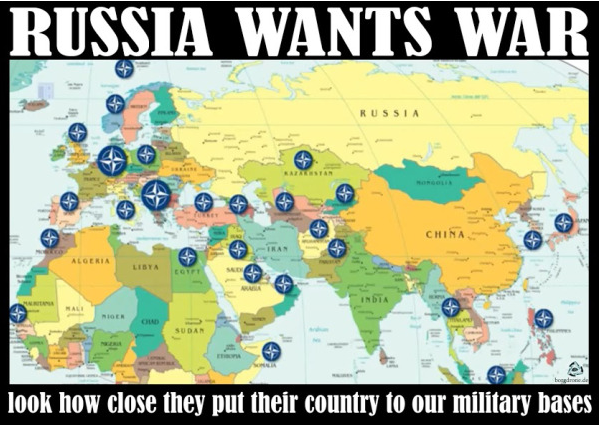
And as an after word, the picture below is well-known by now (with the correction, that Kazahstan never had a NATO base, though some of the neighbouring republics did have advisors):
After the hot war phase on Russia(USSR) between 22nd of April 1941 and the 9th of May 1945, executed through Germans, but lavishly funded by US (for example grandfather of the Bush presidential clan), USA did not view 1945 as a year of defeat. Along with preparation for a carpet nuking of the key cities in USSR, USA also devised a plan to politically change and destroy USSR/Russia from within. In the document below, Russia and USSR are referred interchangeably.
It demonstrates well the strategy of “divide and conquer” that that US were going to employ, as well as their understanding that the only way to destroy Russia, is from within – something that the “liberal” 5th column is doing in Russia of today. Remember that USSR, is never the stated final objective in the document below – Russia is. On the other hand, they do not understand many aspects of the Russian World, illustrated well by this fallacious statement “Before the revolution of 1918, Russian nationalism was solely Russian.”, as Russian Empire of pre 1917 was also a multi-national and multi-confessional state.
Let me extract the key-points of the doctrine first, and then I’ll let you read through the whole text, leaving to you to decide if there is even a gram of good in the outlined intents…
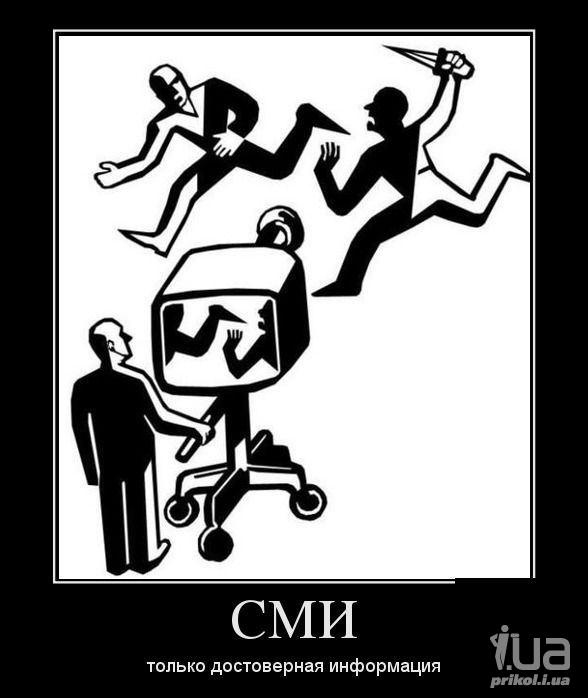
I’ve been meaning to post the above caricature for quite some time, but as it is usual with many of my posts, it’s been sitting in draft until I felt it “matured” enough. Now, I saw a convergence of two seemingly insignificant events, that made it feel like a good time to post this image.
It is not a secret that anything published in the Western main-stream media about Russia (as well as China, or Syria, or any other state that the Western elites feel is in need of some “democratic bombings”), is presented through a certain prism, where either partial truths or outright lies are given to the audience to form an image of an enemy.
This can be seen in the materials, published both…
… in Peace …
Seemingly such an innocent thing, a report by one of the many Russian TV channels on a vegetable shortage in Europe… But look how it got blown out of proportions both by the 5th column inside and the agents of influence outside of Russia.
On the 25th of December 2016, 1/3 of the world-renowned Alexandrov Ensemble perished in a single plane crash, en-route from Sochy, Russia to Syria. This is tragic loss and a strong blow against Russia, against the singing ambassadors of Russia abroad and a bright symbol within.
As a tribute, I translated the following 2008 documentary, titled “The Singing Weapon”, which is how Winston Churchill referred to it after listening to its performance during the 1945 Yalta Conference in Crimea. If it is a weapon, then this ensemble is a “weapon” of peace unity and accord, which it brings with song and dance to all peoples.
The formatted subtitle file in ASS format can be downloaded separately. Full text of the script is below the video frame.
EDIT 11.05.2022
In the recent bout of censorship against all things Russian, YouTube also blocked the VGTRK channel, where the untranslatable original version of the film resided. I’ve now reviewed my translation, fixing a few things, and uploaded the video both to Odysee and to Rumble. The original you-Tube-related text is moved to the bottom of this post, past the transcript, for historic reference.
Back in 2017, when my translated version was taken down on third-party copyright claims, I relayed this development in a comment at Lada Ray’s Futurist Trendcast, and she nailed the overall problem in her reply:
Unfortunately, these silly indiscriminate western capitalist practices have penetrated Russia. Very sad. Those who do it are just like robots. They aren’t paid to think, just to block everything. Those at the helm don’t get it that you are actually helping promote their material by exposing it to wider western audience.
Alas, with this model Russian companies allow Western companies to control and censor what materials are available to the Western audience!
The complete song “Sacred War” (or “Holy War”) with my English translation of the lyrics:
Plus, an older translation in the comments on YouTube: