The Legacy of Brzezinski – The rise of Taliban and the Islamic terrorism

Reading time: 6 minutes

I feel very much compelled to repost most of the Op-Edge article by Neil Clark, published at RT, called World in flames – the deadly legacy of Cold War warrior Brzezinski. The article takes a much needed look at the events surrounding the creation of Taliban, and the role that the newly-departed Brzezinski played in it, and, consequently, in the rise of the global Islamic terrorist threat, as well as in the scenarios for destruction of Iraq, Libya, and Syria.

It is said that history repeats itself, and in this regard the mind wanders to the very recent times (from the Russian historic perspective), when another Polish ex-pat by the name of General Michal Sokolnitsky was advising Napoleon on how easy it would be to conquer Russia, turning Crimea into a second French Reviere, while Poland getting the Western Russian counties… And we all know how that went. Those who don’t, should research the origin of the word “Bistro”.


2017 has been a very bloody year for Afghanistan, with the UN Assistance Mission reporting more than 2,100 civilians were killed or injured between January and March.

None of this was mentioned when the establishment eulogies to Brzezinski started pouring in.

“I was one of several presidents who benefited from his wisdom and counsel,” said Barack Obama.

Former Presidents George H.W. Bush and Jimmy Carter also paid generous tributes. But while our condolences go out to Brzezinski’s family and friends at this difficult time, any objective assessment of what ‘Zbig’ actually achieved as US National Security Advisor would have to conclude that his influence was disastrous not just for the people of Afghanistan, but for the world as a whole. Put simply; the world would now be a much safer place if Brzezinski had used his considerable intellectual skills in pursuits other than global politics.

Zbig’s obsession in the late 1970s was with giving the Soviet Union their own Vietnam. Appointed President Carter’s National Security Advisor in 1977 Brzezinski found himself at loggerheads with Secretary of State Cyrus Vance, a man of peace who genuinely wanted to strengthen detente with Moscow.

Brzezinski’s anti-Soviet strategy was two-fold. Firstly, to aggressively promote the issue of human rights, the so-called ‘third basket’ of the 1975 Helsinki Accords, as a means of destabilizing the eastern bloc.

“Brzezinski recognized the political advantage to be had from the human rights issue, for it put pressure on the Soviet Union and rallied opposition to Moscow,” said Jeremy Isaacs and Taylor Downing in their book Cold War. But there was great hypocrisy at play here, as ‘Zbig’ was quite happy to work with governments whose human rights records were far worse than that of the Soviet Union’s to achieve his objectives.

The second strand of his strategy was to try to entice the Kremlin to send troops into Afghanistan.

To understand how Afghanistan became a new and crucial front in the Cold War we have to go back to the summer of 1973. King Mohammed Zahir Shah, who had governed the country since 1933, was deposed by his cousin Mohammed Daoud Khan with the help of Afghan communists. Daoud though continued his country’s non-aligned policy and liked to say by way of illustration that he was “ready to light his American cigarettes with Russian matches.”

However, the government in Kabul was increasingly courted by the US and tempted with offers of aid. Daoud banned the communist People’s Democratic Party of Afghanistan and dismissed Soviet-trained army officers. The result was the so-called ‘Saur Revolution,’ which brought the pro-Soviet Nur Muhammad Taraki to power in April 1978.

“The left-wing government initiated reforms of land ownership and encouraged women to join literacy classes alongside men,” record Isaacs and Downing.

Hardline Islamic clerics weren’t too happy and religious opposition to the left-wing government grew. Brzezinski saw a great opportunity to back the anti-government Mujahedeen or ‘Soldiers of God.’ It’s a commonly held, but erroneous view, that the US only started to support the fundamentalist ‘rebels’ after the Soviet tanks had rolled into Kabul at Christmas 1979.

In fact, US financial assistance for anti-government forces had begun BEFORE the invasion- and was expressly designed to provoke a Soviet military response. In 1998 Brzezinski admitted that he had got President Carter to sign the first order for secret aid to ‘rebels’ in July 1979 a full five months before the Soviets intervened.

“I wrote a note to the president in which I explained to him that in my opinion, this aid was going to induce a Soviet military intervention,” Brzezinski said. Even before that, US officials had been meeting with ‘rebel’ leaders. While in 1977 Zbig had set up the Nationalities Working Group – whose goal was to weaken the Soviet Union by stirring up ethnic and religious tensions.

The Kremlin was faced with a terrible dilemma. It was damned if it did intervene to help the beleaguered Afghan government, and damned if it didn’t. There was a fear Islamic fundamentalism if prevailing in Afghanistan after the Islamic Revolution in Iran, could spread to the Soviet Union itself and on top of this NATO had agreed to site Pershing and Cruise missiles in Europe.

But still the Kremlin, perhaps suspecting a trap was being set for them, was reluctant to commit ground troops. Taraki pleaded with Moscow for more assistance and visited the Kremlin in September 1979. But not long afterward Taraki himself was toppled (and killed by suffocation with pillows) with his Prime Minister Hafizullah Amin, taking over as president. Moscow believed that Amin was getting ready to pivot toward the west.

The Kremlin finally decided to act, even though there was still opposition from within the Politburo. On 24th December 1979, Brzezinski got the Christmas present from ‘Santa’ Brezhnev that he had long wanted. “The day that the Soviets officially crossed the border, I wrote to President Carter, essentially: ‘We now have the opportunity of giving to the USSR its Vietnam War,’” he later admitted. Cyrus Vance urged a diplomatic solution, but unfortunately, Carter listened to Zbig.

The national security advisor flew to Pakistan in early 1980 and posed, two years before the first Rambo film, for photographs holding a Chinese-made machine gun at the Khyber Pass. “Your cause is right, and God is on your side,” he told the assembled holy warriors.

Over the next decade, billions of dollars of aid and weaponry from the US and their allies poured in for the Islamist rebels, euphemistically labeled ‘freedom fighters.’

In 1982, Ronald Reagan even dedicated the Space Shuttle Columbia to the anti-government fighters.

“The struggle of the Afghan people represents man’s highest aspiration for freedom,” the President declared.

It wasn’t just Afghan ‘rebels’ who were fighting against the socialist government in Kabul. Encouraged and equipped by the US and their allies, between 25,000 and 80,000 fighters came in from other countries.

Hawks in Washington, following Brzezinski’s anti-Moscow lead, did all they could to prevent a diplomatic solution to the conflict. The aim, to use Zbig’s phrase, was to “make the Soviets bleed as much and as long as is possible.”

Mikhail Gorbachev’s warnings about the dangers of Islamic fundamentalism and a hardliner takeover of Afghanistan having far-reaching global consequences went unheeded. The Taliban and Al-Qaeda grew out of the Mujahedeen and then many years later, the US led an invasion of Afghanistan to try and get rid of the Taliban. But the Taliban is still there (as is ISIS and Al-Qaeda) and has just launched a deadly new spring offensive.

Afghanistan has known nothing but war these last forty or so years and Brzezinski’s desire to give the Soviet Union “its Vietnam War” has an awful lot to do with it.

Not only that but his strategy of backing jihadists to destabilize and help bring down secular, socialistic governments friendly to the Soviet Union or Russia has been copied in other countries, such as Libya and Syria with such devastating consequences nationally and internationally.

Not that the ‘great man’ showed any remorse for what he had done. Far from it. In 1998 he was asked: “Do you regret having supported Islamic fundamentalism, which has given arms and advice to future terrorists?” Brzezinski replied: “What was more important to the history of the world? The Taliban or the collapse of the Soviet empire? Some agitated Muslims or the liberation of Central Europe and the end of the Cold War?”

When his interviewer then countered with “Some agitated Moslems”? But it has been said and repeated: Islamic fundamentalism represents a world menace today, Brzezinski’s response was to say ‘Nonsense.’

In 2008 when he was asked again about his Afghanistan policies Brzezinski said “I would not hesitate to do it again.” When we look back at the disagreements in 1979 and 1980 between Zbig and the more cautious Cyrus Vance, who labeled Brzezinski “evil” time has surely shown us who was right and who was wrong. If only Vance and not the too-clever-by-half academic had prevailed.

“Russian Soldier Saved the World” – WWII memorial song by Artyom Grishanov

Reading time: 5 minutes

Now that Victory Day – the 9th of May – is drawing close, we constantly see the ever-increasing attempts to re-write the history of WWII and to erase the Russian-Soviet victory which cost us 21 million people’s lives.

So does grow the importance of remembrance and of not allowing to have this memory to become sullied. Song has always been one of the strongest conduits of people’s emotions and memory, and the song below is a very emotional tribute and reminder.

Artjom Grishanov has the talent for condensing the essence of a topic into a few well-selected strong words, backed by equally concise and poignant imagery. Russian soldier saved the world shows in no uncertain terms what the West wants to have remaining of the memory, and what we really should be remembering. Please, take a moment to listen to it (with English subtitles) and to remember.

Transcript of the documentary and the song

UPDATE from November of 2023. The transcript below was done for our new Telegram channel “Beorn and The Shieldmaiden”, and published there in two parts: part 1, part 2.

Russian news anchor:
“Polish authorities intend to demolish more than 500 Soviet monuments. We are talking about the monuments erected in gratitude to the USSR for liberating this country from fascism.”

Some liberal speaking in Russian:
“These are all the pillars of the empire. Since the empire has been in the dumpster of history for 25 years, all these pillars must be sent there as well”

Ukrainian nationalists intimidating a WWII veteran (spoken in both Ukrainian and Russian):
“For your own safety, I recommend you to sit at home, calmly, quietly and to not provoke people.”
“Today you are punished.”

Intimidation of veterans on the 9th of May in Ukraine.
“- Get away those red rags”
“- How can you insult the memory of the veterans?”

On a talk show, a liberal, then confronted by the hostess of the show:
“- Yes, a person worries about the most precious and hides it. This is normal, in principle.”
“- Do not mix up a veteran with Pinocchio. He does not hide the most precious thing, he hides what is sacred.”

Some liberal:
“I understand why you hold on to the past so hard. It’s because everything is bad for you in the present, while you probably have no future at all”

President Putin:
“All attempts to distort, rewrite history are unacceptable and immoral. Oft-times, a desire to hide one’s own dishonour is behind such attempts.”

Poroshenko:
“The soldiers of the UPA are remembered as an example of heroism in relation to Ukraine.”

Yatsenjuk:
“We all remember the Soviet invasion of both Ukraine and Germany.

François Hollande, the president of France:
“They were our liberators. France will never forget what it owes to those soldiers, what it owes to the United States.”

Some Polish radio host:
“Why did we all get so used to the fact that Moscow is the place where the end of war is celebrated, and not, for example, London or Berlin, which would have been more natural?”

President Putin:
“It only occasionally seems to us that they are speaking some kind of delirium nonsense. Pure nonsense. That it will slip past and no one will notice. No, you see, this is being implanted into the minds of millions of people.”

US citizens asked on the street:
“Who had the largest role, the most casualties in the fight against the Nazis during the Second World War?”
“- I am not totally [sure?]. Is it not the US?
“- France?”
“- Can you think of another country?”
“- America.”
“- Japan lost. Russia lost.”
“- Seriously? Which country took Berlin? Which army?”
“- The United States?”
“- I say the United States of America.”
“- The United States, Great Britain, France.
“- How about the Soviet Union?”
“- Yeah.”
“- It was the former Soviet Union?”
“- Oh, actually, it was Russia or the Soviet Union that had the most casualties. What’s you reaction to this? Are you surprised?”
“- Just, please, don’t put this on TV.”

The lyrics of the song:

Such a short memory –
It didn’t last even for 100 years.
Such a great impudence –
To cast a shadow over the memory of the victories.

The traitor chokes, spitting fire,
Looking askance at out Parade.
Oh, how he doesn’t like the truth that
Russian soldier saved the world.

Levitan’s radio announcement, chronicles:
“Today, on the 22nd of June, at four o’clock in the morning, without a declaration of war, the German troops attacked our country.”

The earth was torn to shreds
And the people were awakened by the war.
The horde invaded in the early morning,
Burning houses behind them.

The blow was devastating,
But the victory escaped their grip.
The enemy encountered the unheard of force –
The Russian spirit.

Chronicles:
“Today, not only Moscow is behind us, not only our vast Motherland. Today, the whole world is looking at us, holding its breath.”

It’s not enough to just kill it.
Just try to fell it to the ground.
It will gnaw with its teeth,
Even in an unequal battle.

The force was becoming stronger, day by day,
Just not a step back.
And the news broke out like thunder:
Russian soldier saved the world.

Meanwhile those who surrendered their cities
In the first days of the war,
Do not wish and will never comprehend
The joy of the Russian soul.

In the happy and torn-asunder May,
The Nazis’ hell was stopped.
Remember, never forget:
Russian soldier saved the world.

Then and now.

Quote:
“The gravest mistake is to dismiss the Russians, to consider the Russian people weak.”
“God forbid you mistreat or rob the Russians. They will return, demolishing any obstacle in their path.”
“Russians love peace, Russians build peace, Russians defend peace. Russians do not want war, but they can fight better, than anyone.”


The motto of the 9th of May: I Remember. I Am Proud. In the colours of the St. George Ribbon.

Roman Dmowski – “The Ukrainian Question” political prophecy of 1930 coming true

Reading time: 9 minutes

A few years ago I wrote a translation of a documentary, called Project ‘Ukraine’, which very well covered the history, running up to the creation of the geopolitical entity, known as “Ukraine”.

I have now come across an unlikely source of information, corroborating and expanding on the theses put forth in the documentary above. It comes from a Polish politician Roman Dmowski and his 1930 work “Kwestia ukraińska” – “The Ukrainian Question”.

Below is my translation of a Russian article, which analyses his work: Year 1930: Roman Dmowski on Ukrainian Independence.


What is distinguishing a natural-born politician from a random rogue, hanging out on the political stage? The sense of political acumen, the ability to predict the course of events for decades to come signs that are little noticeable at the moment.

Roman Dmowski had this gift in abundance. The expert on Slavic history, active political leader of Poland of the first third of the twentieth century, opponent of Jozef Pilsudski. They say that in his youth Pilsudski stole Dmowski’s wife. Dmowski remained a bachelor, while in politics he seriously disagreed with Pilsudski.

Dmowski was a more measured politician than Pilsudski with his clinical Russophobia. During the revolution of 1905, Dmowski, remaining a Polish patriot, urged the Poles to ally with the Russian tsars, and during the First World War, unlike Pilsudski, he took the side of the Entente. However the proclaimed ultimate goal of his policy was always the building of a national Polish state.

Continue reading

The ”Wild ’90s” in Russia, as reflected in people’s memory. Part 2.

Reading time: 11 minutes

Two years ago I published an article The ”Wild ’90s” in Russia, as reflected in people’s memory, where I translated one testimonial of a survivor of the Yeltsin’s “Wild ’90s” in Russia. Such survivors are many, yet many more perished – in Russia more people died during Yeltsin than during WWII. In that article I also detailed Yeltsin’s coup d’etat of November 1993.

Now, a few days ago, the ignominious Navalny organised an “anti-corruption” rally in Moscow and several of Russia’s cities. I am not going to go into the details of how only 8000 people out of the 12 million population of Moscow was seen at this colour revolution attempt. I will not go into details of how Navalny turned to the political paedophilia, luring school-aged kids onto the streets with the promise of paying them €10000 if they manage to get arrested, and how the “political speeches” of said kids said that they want to buy sneakers. The use of kids seems to be in the instruction book of any colour revolt worth its name (see “protests” against Charles de Gaulle). I will not go into the details of how Navalny – a jobless man – manages to own expensive car, finance organisation of revolts and produce Hollywood-class films, and why this corruption fighter has several criminal corruption cases over him regarding illegal forest deals.

What I want to go into detail about, is the main chant of Navalny and co., of all the anti-Russian, Russophobic traitors organising such revolts: “Putin must go”. That’s all of their agenda. They say absolutely nothing about how Russia should be governed or about the future. At best they position themselves as the next presidents and say a few abstract words about how there’ll be no corruption and everyone will be equal. Aha! The same manifestos were proclaimed in 1917. And in 1991.

And this is what I am coming towards. All the Navalny-class “liberals” are aiming to bring Russia to the condition of the Yeltsin’s 1993-1999 era. The Desolation of Yeltsin as I like to call it, referring to the Desolation of Smaug.

By 1999 the “progress and democracy” in Russia reached such levels that the population was dying out from hunger, military and statehood all but destroyed. Foreign NATO-sponsored Islamic insurgency in Chechenia was at its peak. Here is a link to an article from Lenta.ru from 29.09.1999 with the telling title “Russia begs USA for a little more food”. Sad and detrimental, yet it fully reflects the reality of those days.

Continue reading

Yes, Scythians Are Us! (Documentary with EngSubs)

Reading time: 23 minutes

In 2014 Russian TV channel Culture aired a documentary, looking through the depth of time, trying to decipher who are Scythians, Sarmatians, Slavs and Russians, if they are one and the same people. The conclusion was mostly positive – yes, they are. The authors looked at the data from the chronicles, archaeology, linguistics and genetics, weighing arguments both for and against.

The film’s conclusion is open, and in a typical Russian way advocating peace and cooperation of all peoples, whoever their ancestors may be.

I want to add one material to better illustrate the point, made at 24:04, and citing Lavrentij Chronicles. I have the copies of those texts, and present the excerpt below with the words “Great Scythia” highlighted.


In the year 6415 Oleg went against Greece, having left Igor in Kiev; taking the multitude of Varjags, Slovens, Chudis, Krivichis, Merjus, Poljans, Severjan (Northerners), Drevljans (elder ones), Radimichis, Horvats (Croats), Dulebs, Tiverce, who are known as Tolkovny (Tolmachi – interpreters): and together they are called the Great Scythia (Velikaja Skuf’). And together with all of these Oleg went astride horses and in the ships, and the ships were counting 2000. And when they arrived at Czargrad, and Greece…

One notable thing, besides the mention of the Scythians as a collective name of the Slav people, is the date: year 6415. That is a separate topic of the Russia calendar, that was discarded by Peter I, and which lead to shortening and subsequent rewriting of the Russian history to suit the needs of the influentially growing Germanic aristocracy that was slowly taking over Russia’s political life at that time. I am going to publish a separate article about it soon.

Addendum: a 1531 map of Orontius Finaeus (Oronce Finé) came to my attention:

Orontius Finaeus map of 1531

Leaving aside the fact that it shows the coastline of Antarctica, uncovered by ice – probably from before the quite recent Flood time, when that continent’s coastline was accessible, we can look at the following part of Eurasia and see…

Scytia – mentioned twice, as well as Tartaria, Russia, and Bulgaria – the latter where it was supposed to start, along the Volga (Volgari-Bolgari) river bank, East from the Crimean meridian.

And now, on to the documentary…

The formatted subtitle file in ASS format can be downloaded separately. Full text of the script is below the video frame.


Yes, Scythians Are Us! at Rumble

Continue reading

Will Russia have to fend off NATO invasion too..?

Reading time: 4 minutes

The image below speaks volumes, without words. It speaks of Russia’s history past, and of the precarious future. The Russian Bear sitting on his land of old, looking with suspicion at the ever growing tentacles of the US/NATO, already consuming neighbouring lands in blood – Yugoslavia, former Ukraine – Malorossia and Novorossia, Middle-East. And besides The Bear is a compost heap of history, where one can see the the tentacles of the past that dared to choke Russia and got pruned. Will Russia again be forced to end another war that someone starts in the hopes of eliminating Russia, freedom, history, from the face of the world?

For those, not so well-versed in history, here is what the dates in the compost heap of history signify. I added a few more – on average Russia got invaded once every 50 years, and this time is not different, though the method of warfare changed.

  • 1242 – The Germanic Teutonic invasion and the Ice Battle on the Ladoga lake.
  • 1612 – Polish invasion into Russia and occupation of Moscow. Beaten by the people’s militia of Minin and Pozharskij, the memorial to whom you will find on the Beautiful Square in Moscow.
  • 1709 – Karl XII of Sweden said that “Russia is a dwarf, whom I shall put on its knees” and attacked. After that Sweden lost its status of a superpower.
  • 1759 – (not on the image). Freidrich I moved against Russia with the words “I shall conquer the backward Russia” and in 1759 Russian army entered Berlin.
  • 1812 – Napoleon is famous for his saying that “Russia is a giant on clay feet”. This giant made the Napoleonic army turn in 1812 after the battle of Borodino and a tactical surrender of Moscow, and in 1814 Russian army was marching down the streets of Paris. By the way, Russian Don Cossacks also had to restore some of Europe, for which they were promptly forgotten.
  • 1854-1855 – (not on the image) French, Brits and Turks attacked Crimea, and Russia held the defence of Sevastopol. Russia won that war, which in reality lasted between 1853 and 1856, and was the first really world war. Brits presented the history otherwise, claiming victory in the “Crimean War”, which was really only one of many battles. But if they won, how come Crimea remained Russian?
  • 1914-1918 – First World War, or the “War of 4 Cousins”, Russia had nothing to win in that war and got mixed in it responding to a provocation (much the same as what the West hoped to achieve in Ukraine, yet it didn’t work this time). Though Russia was on the winning side, the country got destroyed in the process.
  • 1918-1920 – The Civil War. Still Russia managed to hold its own against the subsequent foreign intervention and even chased the Poles (who tried to repeat their failure of 1612) from Moscow suburbs to Warsar. At that very time when time the Republican senator from the State of Washington, Miles Poindexter, was saying that: “Russia has become just a geographical concept, and it will never be anything more than this. Her power of rallying, organizing, and rebuilding is gone forever. The nation does not exist…”
  • 1941-1945 – Hitler proclaimed that he’d conquer USSR by the end of 1941. In 1945 Russian troops entered Berlin (again, as in 1759 – they never learn).
  • 2014 NATO – Obama famously said a few years back that “Russia is only a regional power, and US will destroy its economy”. When will the pruning begin, and have the streets of Washington been prepared for the welcoming of the liberating army..?

As I wrote earlier, Russia Means Peace, Russia loves peace, but knowing it’s own history of defence, it is always prepared to end wars.

For those suffering from historic amnesia, here is a song of revelations from Artjom Grishanov – Russian Soldier Saved the World (with English subtitles of the news items showcasing history rewriting, and of the lyrics):

In his article Washington’s Benevolent Mask Is Disintegrating Paul Craig Roberts writes:

By orchestrating Russophobia in the West, Washington has put all of humanity at risk. The Russians have watched Washington’s false accusations against Afghanistan, Iraq, Syria, Somalia, Libya, Yeman, Pakistan, Iran and against Russia herself—“invasion of Ukraine.” False accusations have in the 21st century always been Washington’s set-up of the target country for invasion or bombing.

These provocations issued daily by the idiot Western press, the idiot Western governments, and the idiot commentators have prepared the groundwork for a misunderstanding that can result in thermo-nuclear war and the end of life on earth.

When you read the New York Times, the Washington Post, or listen to CNN, NPR, or MSNBC or the British, Canadian, German, French, and Australian media, you are being indoctrinated with war with Russia (and China) and, thus, you are being prepared for your funeral.

Hopefully it will not come to this, for Russia will do its utmost to preserve this good Earth.

And as an after word, the picture below is well-known by now (with the correction, that Kazahstan never had a NATO base, though some of the neighbouring republics did have advisors):

Real Democracy at Work: Serbian Parliamentarians Booed Mogherini During Speech to Serbian Parliament

Reading time: 2 minutes

Lada once again brings good news of awakening:

Lada’s thoughts on the end of NWO: ‘Serbia and Russia! No EU!’ Mogherini booed in Serbian Parliament

You can’t hear a word she is saying, and that’s how I like her. I wonder how this Rothschild-installed globalist hypocrite felt, for once getting a long-deserved taste of her own medicine.

Just another small confirmation of The Great Earth Shift at work, the breakdown of the old NWO system and the budding of the new. It is also another confirmation of the rebalancing work Russia The Great Balancer is doing, as we speak, on our planet.

The great changes happening now are just the beginning! More to follow!

This is the real voice of the people in Serbian Parliament – how Serbs really feel about EU, which is being shoved down their throats in spite of their resistance. Incidentally, the neighboring Montenegro and Macedonia are in the same situation. There is a veritable anti-NATO and anti-EU revolution happening in Montenegro, mass protests have been ongoing since last year. At one point, 10% of the population has been out on streets protesting. Yet no one notices it and the sold-out government continues dragging the country into NATO. Bulgaria is also being forced to stay in NATO and EU, despite people’s sympathies to Russia and aversion to NATO/EU Russophobia.

The people of Serbia are demonstrating how real democracy works, as it should. I wonder why the ‘world’s No.1 defender of democracy’ EU doesn’t like it?

Read on at Lada Ray’s Futurist Trendcast

After what EU and NATO did to Yugoslavia at large and Serbia in particular, booing is just too soft a protest. Radovan Karadzic is still the political prisoner of EU for saying that Serbs are Southern Russians. Yugoslavia was bombed to pieces with radioactive munitions, leaving the land contaminated and the people with cancer. And then Yugoslavia was partitioned and Serbs driven from their historic heartland – Kosovo, which is now occupied by the NATO installed entities. And all this was done, while Russia itself was on the verge of collapse and destruction during the Wild 90’s of the desolation of Yeltsin.

And after that the NATO/EU was expecting a friendly welcoming? What duplicity!

The Magic of the Children’s Films from the Soviet Union

Reading time: 12 minutes

UPDATE from September 2022: Quite a number of English-translated films listed in this post have disappeared from YouTube since I published this in 2017. I have update “The Visitor from the Future” with the working links, but could not find English translations of some of the other now-missing titles. Still, I am leaving them in the post as a future reference.

One characteristic of the Soviet films that I hold dear, is that they are humane, moral (often without being moralising), centre on the characters, rather than action and events. The films for grown-ups, be it a war-time film or a film about a mundane everyday life, would always have several layers of meaning – good film makers knew how to convey what they wanted to say to the audience without raising the alarms of censorship. All that resulted in films that would have depth, satire, criticism, thoughtfulness in them.

But here I want to write about children films. The films that formed our, my, world view, that taught us about fairness, compassion, friendship, the pitfalls of negative relations. They were a joy to watch, and they left a trace in your heart, a moral compass that no religion can give you, as morality was based on your own desire to do good, rather than fearing a punishment from the holder of the scriptures if you do wrong.

One such outstanding film is “The Visitor from the Future”, released in 1985 and filmed at the Central Studio of Children and Youth Films named after M. Gorky in Moscow. And the bright star of that film is its title song, “The Beautiful Faraway”. In 1985 nothing was outwardly speaking of the time of troubles that lay ahead, in just short 7 years, the Wild 90’s and the Desolation of Yeltsin. But in retrospect, this song turned out to be prophetic, and at the same time it was a testament, an oath of how to conduct oneself in the difficult times ahead, how to stay strong. The song does not promise paradise lands, but rather trials and only asks to not be treated too cruelly along the way to the unknown future, walking the untrodden path towards the future of 2084.

Continue reading

The Plan to Destroy Russia. Conceived and Started in 1948. Concluded in 1993? Or Not…

Reading time: 67 minutes

After the hot war phase on Russia(USSR) between 22nd of April 1941 and the 9th of May 1945, executed through Germans, but lavishly funded by US (for example grandfather of the Bush presidential clan), USA did not view 1945 as a year of defeat. Along with preparation for a carpet nuking of the key cities in USSR, USA also devised a plan to politically change and destroy USSR/Russia from within. In the document below, Russia and USSR are referred interchangeably.

The document – U.S. OBJECTIVES WITH RESPECT TO RUSSIA – presented in full below my analysis, is copied from this resource, with an option to download the raw scanned pages of the text.

It demonstrates well the strategy of “divide and conquer” that that US were going to employ, as well as their understanding that the only way to destroy Russia, is from within – something that the “liberal” 5th column is doing in Russia of today. Remember that USSR, is never the stated final objective in the document below – Russia is. On the other hand, they do not understand many aspects of the Russian World, illustrated well by this fallacious statement “Before the revolution of 1918, Russian nationalism was solely Russian.”, as Russian Empire of pre 1917 was also a multi-national and multi-confessional state.

Let me extract the key-points of the doctrine first, and then I’ll let you read through the whole text, leaving to you to decide if there is even a gram of good in the outlined intents…

Continue reading

The Upside-down World of the Western Main Stream Media (MSM)

Reading time: 9 minutes


MSM – only the truthful information

I’ve been meaning to post the above caricature for quite some time, but as it is usual with many of my posts, it’s been sitting in draft until I felt it “matured” enough. Now, I saw a convergence of two seemingly insignificant events, that made it feel like a good time to post this image.

It is not a secret that anything published in the Western main-stream media about Russia (as well as China, or Syria, or any other state that the Western elites feel is in need of some “democratic bombings”), is presented through a certain prism, where either partial truths or outright lies are given to the audience to form an image of an enemy.

This can be seen in the materials, published both…

… in Peace …

Seemingly such an innocent thing, a report by one of the many Russian TV channels on a vegetable shortage in Europe… But look how it got blown out of proportions both by the 5th column inside and the agents of influence outside of Russia.

Continue reading

When Rouble Was Golden – Russia that we lost in the ashes of WWI and the coup d’etats of 1914-1917

Reading time: 19 minutes

On the 6th of March (21st of February by the old style) 1917, the colour “bread” revolution was started, which heralded a great disaster, spanning a century…

In the years before Russia got drawn into WWI, it was displaying fabulous growth, both socially and economically. WWI, also known as the “War of 4 cousins” – as all heads of the warring states were blood relatives – was a disaster for Russia, and weakened it sufficiently to facilitate the second – internal – disaster of 1917, which all but destroyed it.

One of the contemporary writers said that “Pity that we have Nikolai the Second, and not the second Nikolai”, referring to the strong in the will Nikolai I. Nikolai II, while being praised by the Western (British) powers, delivered Russia on a platter, and then was dumped by the Brits to be executed by the followers of their agent – Lenin. There was only one other Russian ruler, who was praised as highly by the West – Yeltsin, who caused destruction of Russia almost to the point of no return in the “Wild 90s”.

In November 1914 the Austrian Foreign Minister Leopold Berchtold wrote: “Our main goal in this war lies in the long-term weakening of Russia.” Oh, how well they succeeded!

What did Russia lose? Marking the coming 100th anniversary of the two coup d’etats of 1917, Russian weekly “Argumenty and Fakty” publishes in 2016 a series of articles – “When Rouble was Golden” – showing some key points of Russian life before WWI. Here I want to present the translation of the entire series.

Contents:


Publication of 03.02.2016, regarding the foundations of the Russian economics.


Harvest. Urals, 1907

What was the country, that was lost forever? What was the foundation of its economy, when oil was not the main article of Russian exports nor the main source of state revenues? Argumenty i Fakty got at its disposal a unique booklet, first published in 1958 in New York City in 8 thousand copies. Edited by B. Brazol, it compiled statistics showing that over the last 15-20 years before the First World War, Russia made giant steps forward both in the economy, and in the development of the social and educational systems.

“AiF” starts a series of articles in which we will talk about how our country developed in the early twentieth century. In this edition we will focus on the golden rouble and gold reserves, revenues and expenditures of the state budget, taxes and savings.

Continue reading

“Russians Are Coming!”: Restoration of the Dutch Kingdom. Year 1813.

Reading time: 30 minutes

This is a translation of the article by Alexander Mashkin about the events that have sadly become either forgotten or outright erased from the pages of history…


Since the end of XVIII century the country now known as the Kingdom of Netherlands, was in a state of economic decline and political chaos. The reason for that was that under the influence of the events in North America, part of the Dutch populace, which for some reason called themselves for “patriots”, with maniacal stubbornness pushed the then stadhouder of the Seven United Provinces, Willem (Wilhelm) V, Prince of Orange-Nassau (1748-1806), to the recognition of Republic of G. Washington – the breakaway part of the possessions of the British Empire. When it happened, and, indignant at such perfidy, London declared war on Holland, the aforementioned “brave” fled in a panic, leaving their government on the own to suffer the most severe consequences of this ill-considered foreign policy steps. Not having been satisfied with “the progress”, the local “fighters for the freedom of the people”, declaring the need for “protecting municipal rights in several cities”, started an outright armed revolt in 1785. After the suppression of which by the Prussian Royal troops, which came to the aid of the legitimate government, those “patriots”, cursing the winners for their supposedly “living in our house with outright robbery”, and stadhouder in particular, for the cruelty (“everyone had to wear in public the orange cockade”), 40000 people withdrew to neighbouring Brabant.

These internal differences led to the fact that in 1795 the Netherlands were occupied – almost without resistance – by the French revolutionary divisions, which in January of that year forced Willem V to flee to England, and proclaimed the so-called “Batavian Republic”, led by their protege, “the great pensionarium” Rutger Jan Schimmelpenninck. Despite the fact that the invaders called the “state” in honour of the Germanic tribe of Batavs, which lived South of the Rhine since the times of the Roman colonization of the region and is traditionally considered the ancestor of all Netherlanders, it lasted only until 1806. After that it was included by the invaders into the “Kingdom of Holland”, subordinated to the sibling of Napoleon the First, Louis Bonaparte, while after 1810, because of his quarrel with his “sovereign” relative, it turned into an integral part of the newly created pan-European Empire with its centre in Paris.

More than fifteen years of suffering of the locals under the thumb of foreign strangers and their native adherents, turned into “a byword”. Well known is also the fact that these things ended with the landing of the heir of the exiled at the time stadhouder Willem V – Willem VI of Orange – on the Dutch shore, near Scheveningen on the 30th of November 1813, meeting him there as a national hero, and the immediate proclamation of him as the Sovereign Prince of the United Netherlands. Thus far, however, few know that the uprising of Dutch national identity could well have remained on the level of wishful thinking, if not for the heroic deeds of soldiers, sailors and officers of the Russian Army and Navy. They came on the orders of Emperor Alexander the First, to smash Napoleon and his allies on the territory of Europe itself…

The total number of troops and their tactics

Having destroyed the enemy in the vastness between Moscow and the Beresina river, that is – at home, Russian troops entered the mainland countries. It’s clear that their plan also included the Netherlands, located on the North Sea coast, liberation of which from the Napoleonic yoke began in the late autumn of 1813.

To accomplish this more than important mission the vanguard detachment of three so-called “flying corps” in a total number of 3500 people was formed in the army of Wintzingerode, commanded by the future chief of the political police of the Russian Empire, General Aleksandr Khristoforovich Benkendorf. It consisted of a) the Tula infantry regiment (700 men), b) Jaeger battalion of the Second regiment (400), c) battalion of the Pavlograd hussar regiment (800), d) five Cossack regiments (1,600 people) of the adjutant of Alexander I, the Creator of the network of agents in Paris, Colonel Count Chernyshev, e) the battery of horse-pulled artillery.

Fortunately, archival materials preserved to our days almost the complete picture of the said military units, which, because of its particular value, we allow ourselves to reproduce here almost in full:

“Outside of the brigades: Balabin’s 2nd Cossack regiment of the Don Army (5 hundreds); Commander — Colonel of ataman regiment of the Don Army, Stepan Fedorovich Balabin, the 2nd.
The 1st brigade: Commander of the Cossack Don Army named on behalf of his regiment, Major-General Maxim Grigorievich Vlasov, the 3rd; 3rd Cossack regiment of the Vlasov’s Don Cossack Army (5 hundreds). Commander — Major-General Maxim Grigorievich Vlasov ,the 3rd.
Zhirov’s Cossack regiment of the Don Army (5 hundreds). Commander — Colonel Ivan Ivanovich Zhirov.
The 2nd brigade: Sysoev’s 3rd Cossack regiment of of the Don Cossack Army (5 hundreds). Commander — Major-General Vasily Alekseevich Sysoev the 3rd, not with the regiment due to illness since January 1813.
Dyachkin’s Cossack regiment of the Don Army (5 hundreds). Commander — Major-General Gregory Andreevich Dyachkin, not with the regiment due to illness since January, 1813.
Flying squad (consisting of three regiments of the Separate Cossack brigade) of Colonel Naryshkin. Commander – Colonel of the Life Guards of the hussar regiment, Lev Alexandrovich Naryshkin.
Grekov’s 9th Cossack regiment of the Don Army (5 hundreds). Commander — Colonel Alexey Antonovich Grekov, the 9th.
Barabanschikov’s 2nd Cossack regiment of the Don Army (5 hundreds). Commander — Colonel Fedor Akimovich Barabanshikov, the 2nd.
Lashilin’s 1st Cossack regiment of the Don Army (5 hundreds). Commander — Colonel Joseph Grigorievich Lemelin, the 1st”.

Alexander von Benckendorff
Count Alexander Khristoforovich Benkendorff

While performing the task of strengthening the anti-French resistance in the Netherlands, as well as protecting the adjacent region of Germany against a possible enemy invasion, Benkendorff’s detachment marched on November the 2nd 1813 towards the river IJssel (Assel; Jessel). He ordered his first column to attack the city of Zwolle (called “Zvol” in Russian reports of the time), and the second (Central, where Benkendorff was himself) to move to Bentham and Deventer, while the third was to attempt to master Disbursem. Of course, under each of these settlements “a decisive battle” took place.

Under the Walls of Deventer

Only having begun the march towards the designated settlement located on the banks of IJssel, where in his time Erasmus of Rotterdam was studying, the Cossacks continuously attacked the enemy. Moreover, in addition to the destruction of manpower of the opponent, they were also spreading among the local residents rumours that “people from the East came to give you freedom!”. The Don warriors were also performing active scouting at that time, in which it was found that the garrison of Deventer consists of 3000 French, while the Fortress is well fortified and supplied with provisions and forage, and has a significant numbers of mural artillery.

Realizing that this fortified edifice cannot be conquered on the go, the Russian command took to certain tricks. So, the future hero of the campaign for the liberation of the Netherlands, commander of the Bashkir regiment, major Prince Gagarin – awarded the Order of St. George IV degree for his successful cavalry raids against enemy positions – was ordered, after crossing the river, to simulate from the opposite shore a furious attack on the only bridge leading to the fortress, as if trying to capture it. At the same time Benkendorff with the main forces was to try to take the city from the unfortified side.

…At 3am Russian small forces rushed to occupy the outskirts, opposite to the local river port. But the surprise factor for them was by that time completely lost, an thus the soldiers, losing a few men killed and wounded, quietly retreated into the darkness. Leaving patrol group of Colonel Balabin to watch Deventer…

Battle at Zwolle

Refusing to accept a temporary setback in Deventer as a defeat, and not losing presence of spirit, Russian troops continued to move into the Netherlands, with its two columns taking a course on Zwolle.

It should be noted that by the end of 1812 this settlement represented a poorly fortified outpost, the garrison of which consisted of two or three hundred cavalry units. Knowing this, and seeking to avoid needless casualties among the civilian population, Benkendorff ordered several Cossacks from Colonel Naryshkin’s division to take all measures within their power to lure the enemy outside the walls of the fortress. “This trick, – said one of the participants of those events – was successful: the French, after a sortie, were quite bodily overrun. Our people entered Zwolle, mingling with the enemy, more than half of whom were captured”.

Taking the aforesaid city, the Russians were finally able to report “up” that the river IJssel is “ultimately and irrevocably passed”. In addition, there occurred two important events, the history of which we see as prudent to recall in particular.

It was in the small town of Zwolle that the Russian commander was awaited by the Dutch General, Count Baltazar Bogislav van der Platten (1766 – 1829, translator: “Bogislav” is a Russian name, meaning “Gods-praising”). Having long served in Russia as a military engineer, he at home acquired the post of Governor-General. Van der Platten, according to A. H. Benkendorff, “embraced all of my plans for the Netherlands, told me accurate information about the enemy forces and the sentiments of his people”.

On the other hand, at the same time, also Baron Cornelius Rudolph Theodor Kraayenhof (1758-1840) took contact. After finishing the High school in Hardewijk, possessing a deep knowledge in the field of humanitarian, natural and technical Sciences, being the author of the monumental work “Hydrographic and topographic descriptions of the Netherlands”, this military figure and scientist, being a steadfast supporter of national traditions and monarchist, and one of the main initiators of the enthronement of King of the Netherlands Willem I. After the Russians came to Holland, he served them, as the Russian saying goes, not out of fear but for conscience. We read in one of the contemporary books: “He, like no one else, knew his country. Napoleon promoted him to the rank of Brigadier General (Engineer-General) and appointed as inspector of fortifications in the Netherlands. A person with such a complete knowledge about the Netherlands, a country of canals, locks and dams, in the opinion of Napoleon, was to serve him alone, but Kraayenhof remained loyal to the “Orange” party, who headed the Patriotic forces of the Netherlands by the end of the French occupation. Thanks to General Kraayenhof, Russian squad in the Netherlands did not experience difficulties, acquiring the necessary information about the hydraulic structures, roads and fortresses”.

Corneluis von Krayenhoff
Baron Cornelius Rudolph Theodore Kraayenhof

…”The local residents welcomed the Russian Cossacks as liberators, offering them fruit and drinks; popular uprisings started in the towns closer to Zwolle, resulting in the attacks on the French customs officers and gendarmes. The main forces of Napoleon’s Marshal MacDonald became entangled”…

To Amsterdam!

In preparation for the march on Deventer and Zwolle, General Benkendorff, trying to figure out the general mood of the residents of Amsterdam and to conduct a reconnaissance, sent there one of the Dutch “Orange” colonels from his entourage, who was in Russian service. The operation was successful, and upon return, the messenger reported to the authorities that both the population of the said commercial and industrial centre, and Napoleon’s commandant Baron K. Kraayenhof, were eagerly anticipating the army of the Emperor Alexander I.

So as to use the fortuitous moment to the maximum and force the Dutch to speak out against their oppressors, it was decided to send to the walls of this main city a force of 200 – 250 Cossacks, led by the native Lancastershire (England) cavalry officer, major of the Pavlograd hussar regiment, Marclay. Notably, in the instruction towards this end, he was ordered “to proceed to the destination of the operation without stopping, avoiding encounters with the enemy and not caring about his communication lines or about the retreat”. Having marched at high tempo to the prescribed destination, “this brave and prudent officer was able to conceal his movement from the enemy, avoiding all roads, and entered Amsterdam on the 14th of November. The people, inspired by the view of the Cossacks arrested the remaining in the city French, and raised the banner of independence”. In the meantime, the enemy doubled their vigilance, having managed to retreat to Utrecht (1800 soldiers and officers of the division of General Gabriel Jean Joseph Molitor (1770-1849)) and concentrate its main forces in the reasonably well-fortified fortresses “Muiden and Helwig near Amsterdam, almost at its gates” (900 men with 26 guns).

Realizing that in this situation he has no chance for a head-on attack on Amsterdam, Benkendorf, disobeying the orders of a superior over him General Wintzingerode regarding “not entering Holland due to insufficient troops”, decided to act in a flanking maneuver. Leaving the already familiar to us Colonel Balabin in Zwolle “to watch over Deventer”, he himself, with a small detachment of infantry, moved during the night from 21 to 22 Nov 1813 to Hardewicke (Harderwijk), where he was to continue his raid in the vessels provided by loyal-minded Dutch people. Laying “six miles of awful road” behind, and reaching the designated point that same night, Benkendorf, to his surprise, “found in Harderwijk port only a small number of vessels”. Not wishing, however, to abandon the idea of freeing Amsterdam by themselves, Aleksandr Khristoforovich, sending another part of the soldiers of his already small detachment “as reinforcements to General Zhevakhov”, loaded the other 600 people into available boats. This makeshift flotilla raised their sails at 23.00 on the 22nd of November and, praying to the Lord about the favourable wind, moved over the ice-floe covered Amsterdam Bay of Zuider-ze (Zuger see, the modern IJsselmeer). The fortune clearly favoured the Russians back then, because they quietly slipped under the noses of the located nearby in the Texel French squadron, whose commander was a fanatical napoleonist, a Dutchman by birth, Charles – Henri Verhuell (real name – Wernher) (1764 – 1845). “At sunrise on November 23 [they] saw the bell towers of Amsterdam and at 8 in the morning entered the port”.

The residents met this handful of brave men with indescribable enthusiasm. Residents were everywhere singing a new anthem, which “suddenly” appeared, carrying these these words:

“Holland is free!
The allies advance on Utrecht.
The French fleeing in all directions.
The sea is open,
The trade is reviving!
The strife is over,
Past forgotten
And is forgiven.
Nobility returns to the government.
The government asks the Prince to Arrive at the Palace.
All praise God.
Back are the good old days!”

The local chief, who openly switched to the Russian side, was horrified upon learning that his liberation from the French came by a squad of less than a thousand bayonets, knowing full well that Napoleon would be trying to retake the city under his control. To strengthen their prestige, the winners decided to announce to the public that 6000 Russians entered Amsterdam, and issued an appeal to the people to take up arms, form the National Guard and, in the case of the attempts by the enemy to change the situation in their favour, “for them all to die in the battle for the beloved Fatherland.”

…The Russian divisions that distinguished themselves the most, were soon presented high awards from the Dutch Crown. “Amsterdam and Breda” — such inscription was engraved on the golden chord, awarded to Benkendorf by the first king of the Netherlands. Tula infantry regiment received from Willem I two memorial silver trumpets with the inscription “Amsterdam 24 Novembre 1813” (presented on June the 5th 1815), and the 2nd Jaeger regiment – two memorial Royal silver trumpets “For the entry of the 2nd Jaeger regiment in Amsterdam on 24 November 1813″…

The revival of statehood

Barely freeing Amsterdam, the Russians and their allies among the local conservatives started to create here the main pillars of authority. First of all, the National Guard was formed which on the next day marched in a celebratory parade through the Palace square of the city, filled with people and decorated with flags of the House of Orange. Where a handful of Slavs the winners, “having just descended to the shore, made up the honour guard under the balcony of the Palace”. Boosting their own enthusiasm with the arms from the Arsenal and the support of thousands of citizens-volunteers, who joined their ranks, the guards easily captured the nearby still-occupied by the enemy fortresses of Muiden and Helwig, which garrisons surrendered.

Then also arose the Provisional Government, whose members at 10 a.m. on the 24th November 1813, under the jubilant cries of the crowd and thunderous volleys of the gun salute, read “the Act of restoration of Holland”. Energetic measures for the further armament of the patriots were taken, as well as the restoration of “order in the city; all in a hurry to assist with the defence, and the public mood was more and more filled with zeal and firmness”. On the questions of the Benkendorf about what political system they wished for themselves, and what he was to report on it to the Emperor Alexander, all in one voice replied: “the Monarchy and the return of the Prince of Orange. Only this House could guarantee our independence! It was agreed to immediately to send a Deputy to the Prince, to beg him to return and lead his People”.

Restoration

Willem Frederick VI, Prince of Orange, Count of Nassau-Diez (1771-1820), an active participant in the struggle with Napoleon, was in London when the tumultuous events in his home country unfolded. Having learnt about the Russian liberation of Amsterdam, he landed on the coast of the Netherlands and rushes to the capital. Active participant of those events recalled: “Here it was announced of the arrival of the Prince of Orange; friends of the family hastened to meet him, and Amsterdam was readied to meet their Ruler, chosen by right of birth and by the will of the people. The entire population of this great city went out to meet the Prince and filled the streets and squares. Upon leaving the coach on the 1st of December 1813, the Prince could barely stay on his feet because of the people who crowded around him, I rushed to meet him and held out my hand to help him wade through the crowd and enter the Palace. The Prince appeared on the balcony, and the uproar resumed with a vengeance. He was very touched by this scene, but it was easy to see that it was difficult for him to comprehend the height of his new position and appreciate the moment. The Prince was accompanied by the British Ambassador, sir Clancarty, who told me about the plans of his government regarding Holland; the frank talk completely reassured me about my political ventures. In the evening, the Prince, the Ambassador and I sat together in the carriage and drove off to the theatre. The Prince was received there with noisy enthusiasm; it was evident throughout the powerful mood of the nation which has not lost its sense of freedom. The Dutch, who until now had not the habit of seeing the Prince as their head, now paid tribute to the first citizen of the State; their cries were not cries of the servants, but was a witness of their choice, indicating the most worthy person for the salvation of the State. It was overwhelming and gave the sense of greatness of the unfolding events”.

…”Russian trace” of this topic can be continued up to the present day. So, on February 9, 1816, son of Willem VI, Crown Prince Wilhelm Friedrich Georg Ludwig of Orange, entered into marriage with the Russian Grand Duchess Anna Pavlovna (1795-1865), sister of Emperor Alexander I. Their eldest son, Wilhelm III Alexander Paul Frederick Ludwig (b. 1817), became the third King of the Netherlands.

Anna Pavlovna Romanova
The Queen of the Netherlands and Grand Duchess of Luxembourg, Anna Pavlovna Romanova

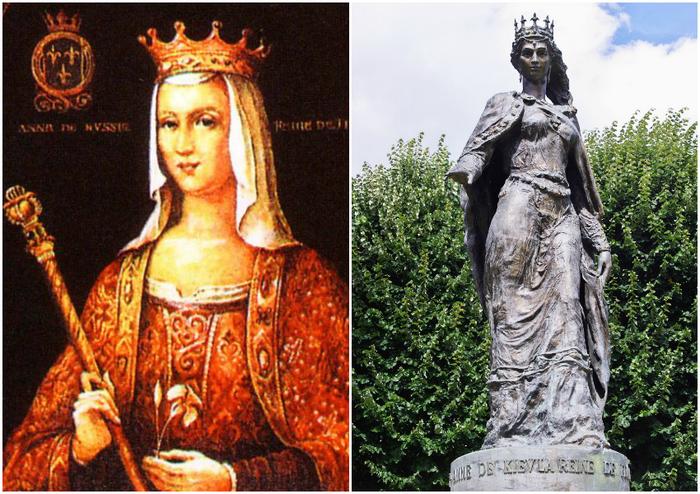
The future Queen of the Netherlands, Anna Pavlovna, was raised by her August mother – the wife of the Russian Tsar Paul I – Empress Maria Feodorovna and Countess Charlotte Karlovna Lieven. During almost fifty years that She lived in Holland, Queen Anne left a long, good memory for her acts of charity, care of the poor (nursing home and a hospital) and orphans (50 children’s shelters), hospitals and prisons. Her Majesty was buried at the Russian (ambassadorial) Church in the Hague. She is remembered in Holland even now – in 1998 the Dutch erected a statue in her honour, which happened to only a few monarchs and historical figures of the Netherlands”…

Honour guard of the First Person

Given the fact that the Russian Imperial Guard did not participate in the liberation of the Netherlands, the first soldiers carrying the ceremonial service at the Person of Crown Prince Willem VI of Orange (the de facto King of the Netherlands Wilhelm I Friedrich), were the ranks of the detachment of General Benkendorf, who took Amsterdam. It was his Cossacks, who ceremonially marched ahead of the carriage of the future Monarch, when he was leaving his palace with the intent to pay someone anyone an official visit. Russian Marines were guarding the private chambers of the Emperor, were at the doors of the palace when He appeared on public, forming guard lines along the streets of the city, down which He proceeded. Benkendorf’s officers, and often Alexander Hristoforovich himself, were performing functions of avant-guard and were first to meet the Prince at the place of His planned visits.

Portrait of A. H. Benkendorf, in the uniform of the Life Guards half-squadron of Rendermessage

The continuation of the struggle: the Cossacks against the Navy

Realizing that it was his fault that his idol – Napoleon Bonaparte – forever lost Amsterdam, the French Admiral Virgual was doing everything to maintain his home base – a fortified Fort Halder.

So as to expel the enemy from this strategic point, the Russian command dispatched the already experienced in the Dutch situations Major Marclay, with his Cossack detachment that distinguished themselves earlier. Successfully manoeuvring along the coast, Marclay soon managed to arrange things so, that the enemy’s naval commander had nowhere left to obtain food for their crews.

Quite aware that his sailors – most of them Dutch by nationality – were prone to disobedience even in conditions of normal material provision, could raise a mutiny in the event of disruption of regular food supplies, Virgual signed surrender to the Russians. Under which terms, in return for permission “to continue to buy their food”, he was obliged not only to vacate the aforementioned Halder and leave there 10 guns, but to never participate in battles with his opponents.

…The aforesaid agreement between Virgual and Marclay was the first case of successful negotiations of the Don Cossacks with the enemy Admiral…

The conquest of Utrecht

The main trick which the Russians used after conquering the Amsterdam, was a success: the French, believing that there is ten times more Russians than it really was, succumbed to the moods paralysing the will to resist.

All this contributed to the actions of General Prince Zhevakhov, who on the morning of the 28th November 1813 came to the walls of Utrecht, near the North gate, and began a regular siege. It was, however, not needed, because an hour later the enemy withdrew from the fortress through its southern part, not relying on the power of their bayonets and the depth of the moat.

The citizens of Utrecht immediately turned the day of their liberation by the Russians from Napoleon’s tyranny into the city holiday. It was called Kozakkendag (that is, “The Day of the Cossacks”), and they continued to celebrate it until the German Imperial troops came there in the summer of 1914.

Anyone who has ever visited the Central Museum of the modern Utrecht, immediately see located there under exhibit #1 painting “The Cossacks, entering Utrecht in 1813.” Being given as a gift by the Dutch to the Emperor Alexander the First, it portrayed the entry of the Russian troops on the the Town Hall square of the city. From under the hooves of winners’ war horses there runs away the Gallic rooster, symbolizing the French, while local residents are greeting their saviours, enthusiastically waving their hands.

Cossacks entering Utrecht in 1813
Peter Van Hoesen. Cossacks entering Utrecht in 1813

The Dutch painter Peter Van Hoesen is the author of this painting, drawn in 1816. Leaving the high art behind and becoming a member of the National Guard in the days of the struggle for freedom of his Motherland, after the Napoleonic wars he again picked up the brush. In addition to portraits and landscapes, he create 10 battle paintings, glorifying the courage of his Slavic brothers-in-arms.

…”In the message dated 18th of December 1824, the Russian Minister of foreign Affairs Karl Nesselrode wrote to the artist that Van Hoesen’s painting was liked by the Czar. Together with the letter of gratitude he was given a diamond ring.

In Soviet times, the picture in the spirit of “the Dutch of the XVII century” was recognized as not having any special artistic value, and was sold back to Holland. It came to Utrecht, where it was given the place of honour: on a raised stand, in a separate room”…

Amersfoort

The Russian offensive on the town was conducted by several divisions. On the one side on the city marched Colonel Naryshkin, who having taken Fort Harderwyk, moved from Zwolle towards Amersfoort, from the other side was advancing the Baltic Baron, Major-General Georgij Fedorovich Stahl (1771 – after 1816), whose Cossack regiment and two squadrons of hussars were to go to Amersfoort between Swettenham and Deventer, and from the third side – both of them were helped by Major-General Prince Spyridon Erastovich Zhevakhov (Dzhavakhishvili) (1768-1815) – his hussar regiment and artillery were ordered “to attack the located there French avant-guards”.

…Unable to withstand the attack of the enemy, Napoleon’s supporters fled in panic. That, in turn, allowed the Russian military commanders to begin implementing the future plans of the high command: Naryshkin and Zhevakhov hurried to the walls of Rotterdam, the first in a forced march, while the second, after the transfer of their former positions to “the Prussian who headed to Utrecht”. Stahl’s dashing Cossacks chased the retreating French first over the rivers of Wijk and Vianen; then, after crossing Lech, placed their posts at Bomel and Gorinchem…

The battle of Gorinchem (Gorkum)

Benkendorf had luck in conquering this “primary storage location”, which was guarded by a garrison numbering up to 8000. Awaiting the approach of the Prussians (who, incidentally, never arrived to the designated area!), the Russians sent two companies and a couple of guns of the 72nd Tula infantry regiment under the command of Major Belemovskij “for the capture of the dam, which was used for crossing from Gorinchem to Hardingfele”. As is clear from the published in Warsaw in 1901 history of this military division (P. 192), “Belemovskij and his soldiers were barely done securing this important crossing, settled on the dam and on the bridge, as the French appeared. Upon seeing the Russian infantry ready to resist, and the burning wicks of the cannons, they did not attack, but retreated in the direction of Brede”. Effective aid to the advancing troops was also given by the Prussian infantry volunteers – a part of the Russian battalion – under command of major Friedrich August Peter von Colombes (1775-1854), arriving from under the Dordrecht. From the other side, also equally active here were the “hastily armed by the efforts of the inhabitants of the Rotterdam boats, firing at Gorinchem and coming close to the fortifications of this fortress”.

The Battle for Breda

Realizing the danger of the situation if this powerful fortress in Brabant continued to remain in the hands of the French, the Russians took the effort to promptly change the situation in their favour. To achieve this goal they used the existing experience of sudden capture of Amsterdam, with the only difference being that the direct implementer of the plan was not Benkendorf, but General G.F Stahl, known to us by Amersfoort.

Obeying the command, Stahl, under cover of distracting manoeuvres of the Captain Peterson of the Count Arakcheev’s Grenadier regiment, with a hundred Cossacks “in the direction of Gog-Svaljuv, Brill and Velvet-Sluis”, crossed the Vaal, and, without stopping anywhere, after the storming of the Antwerp gate, entered Breda on the same-named tract. Capturing 600 enemy soldiers and forcing the rest of the garrison (300 soldiers) to retreat in panic to Antwerp. Thus he mastered one of the strongest strongholds of the country, and completed on this the liberation from the French of the Dutch territory, looking forward to the arrival of the main forces.

But the French were not sleeping. Having recovered from the first surprise, they decided to take revenge. Setting out from Antwerp with 18000 soldiers and excellent artillery, where even the sailors of merchant ships were armed with it, the Napoleonic General Carnot, pushing the Russians away from Vestvesel (Westates?), rushed to Breda. Persistent fighting took place on the outskirts of the fortress, in areas of Turnhout, Geertruidenberg and Tilburg. Finally, we read in the report about those events, written down by Benkendorf, on the night from 7 on 8 December 1813: “the enemy started to bombard the city. On the 9th in the morning, increasing the cannonade, the enemy attempted attacks on Turnhout gate. The attack lasted a long time and stopped only when I made a sortie from the Antwerp gate. Soldiers of the Dutch battalion, hastily composed of young citizens, went into battle with shouts of joy. They showed bravery worthy of admiration. In support to them I detached a hundred of the best soldiers of our infantry. The enemy suffered considerable losses, and the cannonade ceased. In the evening, the cannonade was resumed, but the night was calm. The English could not help the Russians: their ships, which were loaded with horses, were detained by contrary winds at sea. The covered with ice Bomelwert bay was so inaccessible, so the Prussian General Bjulov (Bülow), who very much wished to help me, couldn’t transport his troops. Yet the French had to fear the arrival of the English and the Prussians, and either hurry with the capture of Breda, or leave their positions. On the 10th they captured all the roads except the one that led to the positions occupied by Prince Gagarin. Their avant-guard batteries approached the fortress during the night, and were moving rapidly. Because of this we lost people, and several houses were destroyed. By the end of the day, the enemy fiercely attacked the three gates. Antwerp gates were defended by Knjaz (Prince) Zhevakhov. His footmen hussars competed in the courage with our infantry. Turnhout gate was defended by General Stahl and the Prussians under the command of Colonel Colombes. All were filled with amazing courage; confidence in success was written in their faces. The Russian reserve counter-attacked and pinned the enemy to Buale-Duke gate, where the attack seemed less decisive. The place was quite open, and when evening came, I advanced with three squadrons of hussars, a detachment of Cossacks, and four horse-pulled guns. We furiously rushed on the enemy. The enemy was repulsed by the very first attack, and hastily retreated to a considerable distance. I stopped chasing them, fearing that this too easy a victory was a trap. By the will of fortune a detachment of Cossacks from Prince Gagarin arrived at that moment. With loud cries, the Cossacks rushed to the rear of the French. The French decided that I am acting in coordination with the troops of General Bjulov, and this circumstance forced them to quickly retreat. In the evening, I lit a lot of lights, and set the watchmen so, that it seemed as if a whole army was stationed in the camp. In other places, the attack was repulsed and the enemy suffered considerable losses. By night the shots died down everywhere. All the reports from the outposts said that a lot of noise was heard in the camp of the French. Because of dense morning fog it was impossible to discern enemy positions. At 8 o’clock I lowered the bridge and despite the fog advanced forward patrols. They told me that the besiegers abandoned their positions and withdrew from Breda. The joy of this news was moreover strengthened by the fact that we have started to run out of fodder, and the residents of the city, out of the food supplies.

General Stahl received orders to pursue the enemy along the Antwerp road. He could do it only to Vestvesel, where the French halted and entrenched. Colonel Colombes, with a detachment of Cossacks, went to Turnhout. On the next day, 12th of December — on the birthday of His Majesty the Emperor Alexander the First — we had a thanksgiving service on the walls of Breda.” Holland gained her freedom!

…As was the case with the capital, the exploits of Russians under the aforesaid enemy stronghold was generously rewarded. In particular, on the 15th of November 1815, 25 people of the “lower ranks” of the 2nd Jaeger regiment received the Military Order (“Soldier’s St. George”) for the protection of the fortress of Breda. The 1st horse artillery company received on the 19th of January 1818 a distinguishing mark on their shakos, with the inscription “For distinction, for courage, rendered in the battle with the French troops at the fortress of Breda”…

Deliberate neglect?

The scientific world of modern Europe is working hard to not notice all of what was written above. In the article by P. N. Grünberg “For the Amsterdam and Breda” (The Liberation of Holland according to “Benckendorff’s Notes”) we read: “The only comment to the described by us Grand battle, is that all(!) available in Russia Western studies are silent about the events of November-December 1813 in Holland. A typical example is in “The Low Countries 1780-1940” by Ernst H. Kossmann. Oxford, 1978 (English translation of the first Dutch edition of 1976). This Oxford edition of the best Dutch book on “comparative history” of the Netherlands and Belgium, devotes only one page 103 (first page of Chapter III of the “Great Netherlands”) to the event of the “departure” of the French and the “arrival” of Prince of Orange. Here’s what it says (re-translation from Russian): “A few weeks after the battle of Leipzig, a small number of allied troops crossed the borders of the former Dutch Republic; on November 12th (new style. – A. M.) they took Zwolle, on 15th — Groningen. The French commander gathered his forces in Utrecht and, when on 15th of November, the almost two-thousand man strong garrison left Amsterdam, there immediately started riots against the occupation authorities. The local population along with the few nobles, who declared themselves as its leaders, declared independence under the rule of the Prince of Orange… William of Orange accepted the offer “out of the hands of the people,” as he wrote in the proclamation on the 2nd of December, on the condition that he guarantees people’s freedom in the Constitution. It became clear that the country has established a constitutional monarchy…” As you can see, not a word about the Russians. Almost all of the previous one hundred pages are devoted to the invasion of the French, Batavian Republic, to how the French administration was falling apart, as if by itself, etc.

The beginning of the new state, the current Kingdom of the Netherlands is presented in the same key in the section “The Low Counties” of the latest edition of the famous Encyclopaedia Britannica. (Re-translation form Russian) “While Napoleon’s Empire seemed strong and stable, the Dutchmen served the new monarch, just as they served King Louis, especially since Prince of Orange did not object to such cooperation. The Dutch contingent continued to fight in Napoleon’s campaigns, suffering heavy losses during the invasion of Russia. But as soon as it became clear (after the failure of the Russian and Spanish campaigns) that the Napoleonic Empire was falling, influential Dutchmen began to prepare for the establishment of a new and independent regime. It was considered self-evident that the head of this regime should be the Prince of Orange, son of William V, who died in 1806, and that it was desirable for that regime to be installed by the Dutch people, and not by random foreign winners. The movement for the establishment of the new regime was headed by a great figure Gisbert Karel van Hogendorp, a man of firm principles, who did not recognise any government of the Netherlands after 1795, however considered it necessary to involve Prince of Orange as a constitution-limited monarch” (Encyclopaedia Britannica, 1978, Macropaedia, vol. 11, p. 152). We must add to this that in reality the Dutch did not have freedom of choice: the British were hurrying to liberate them. The “Orangists” knew that this liberation would not come for free. So their choice was in favour of Russia, and the sudden appearance of Benkendorf’s divisions in the Netherlands was probably the action, secretly agreed upon between the liberators and the liberated. Their unclouded alliance in Amsterdam was probably also the result of a pre-agreed policy. The omission by the authoritative British edition is understandable, because the British “lost” Holland to the Russians both in the military, and in diplomatic rivalry.

…And we cannot even speak about the presence of this matter in the Soviet and especially in the Russian (formed in the modern Russian Federation) historiography! Because even on the pages of the book published in 1964 by the Moscow publishing house “Science” “The Campaign of the Russian army against Napoleon in 1813 and the liberation of Germany” there is not a single complete document about the actions of the Russian troops in the Netherlands. Only in the material of “The Journal of military operations for November — December 1813” that same P.N. Grünberg comments: “about them there are two indirect references. The first passage: “the Swedish Crown Prince continued his conquests in Holland, which already recalled Prince of Orange from England to Amsterdam” (No. 421). The second passage is in No. 423: “the Enemy’s garrison in Breda (Holland) at the approach of two Cossack regiments from the brigade of Major-General Benkendorf, moved out to Anwer, and Breda was taken by the allied troops with the capture there of up to 600 people. Thus on December the 4th, the allied Northern army was holding the line from Breda to Dusseldorf”. Plus the pages 148 – 159, and 390 in the book of D.I. Oleynikov “Benkendorf” (Moscow, Molodaya Gvardiya, series “Life of remarkable people” of 2009. – P.395 ).

“And that’s all that was published about the Dutch campaign of the Russian Imperial army during the last 85 years in the “grateful” Fatherland!”…

So That They Are Remembered!

The Russian General A. H. Benkendorf wrote the following in French in the seventh book, published in Saint Petersburg “Military magazine” for 1817: “The Dutch expedition, which cost us 460 in dead and wounded, was well-received by the general disposition of the Dutch people.” In particular, we read in the biography of Alexander Khristoforovich: “since the end of November 1813, the word “Cossack” acquired an incredible popularity in Holland. From Napoleon’s horror-image, it became a symbol of liberation. The road by which the Cossacks passed the untaken by the Russian fortress of Deventer is still called Kozakkenweg – “the Cossack Road”, and a big old tree near the road – Kozakkenlinde (“Cossack Linden”). Nearby, in the town of Gorssel, there is another “Cossack Road”, and besides, a “Hussar Passage” and a hill “The Cossack Bump”, on which until 1941 had stood the house under the name “Cossack hut”. In our days, somewhere on the road from Arnheim to Rotterdam, cafe-bar “Cossack” successfully operates, and in the province of Gelderland they can treat you to a “Cossack pie”. Cold by European standards winter of 1813/14 was dubbed “Cossack’s winter” in some provinces of the Netherlands. Residents of the Hague sing Russian songs, having founded their Oeralkozakenkoor – “The Urals Cossack Choir”, and in Brabant plays a football team Kozakken Boys (“Cossack Boys”).

…As you can see, in the Netherlands of the beginning of XXI centuries there are still people who know how to preserve the memory of those foreign heroes, who gave their lives for the liberation of their homeland.

Even if they committed their immortal acts almost 200 years ago…

— Alexander Mashkin


An afterword…

The reason for such neglect and erasing of the history is different for the West and for the USSR.

In the West, the early seeds of what later became EU were sawn in the form of creation of the artificial state of Belgium, and later the “Benelux” – Low Lands. For that a different history – of European unity, without Russians – was needed, and was written. Not only was the memories of Russia were erased, but Russia itself was almost successfully erased in the course of the 20th century – in 1917, 1941, 1991.

In USSR, the reason for forgetting was the Czar past and the Cossacks. Cossacks were a traditional pillar of support of Russian monarchy and the Russian state. When that state was destroyed in the 1917, anything that reminded of its past got retouched. It is said that Lenin held an especial dislike to the Cossacks for the reason mentioned above. So it is not strange that in the Soviet historical literature everything that had to do with pre-1917 period got diluted to the point of abstract and terse sketches.

Interestingly, the memories of Cossacks lived on in children’s game of “Cossacks and Robbers”, but even that slowly disappeared, especially after the War, when the children began playing in “Partisans and Fascists”.

And in the modern, post-2000, Russia I do not think that they have come around to restoration of those chapters yet. A lot is still being rebuilt after the desolation of 1991-2000.

Even Google seems have some selective indexing. If one searches for the Cyrillic name of Hardingfele, one gets only 2 hits, regarding some cruises. However, if you go to Russian Yandex, you’ll get a viariety of hits, pertaining to the Benckendorf’s campaign in Holland in 1813.

The Future of the Russian World

Reading time: 7 minutes

I have on previous occasions translated articles by the excellent analyst Rostislav Ishchenko. This particular article, “The Future of the Russian World” appeared on Kont on the 28th of September. It gives a good definition of what the Russian World is.


Flag commemorating a years since the Crimean Spring

Two and a half years ago, when Crimea has just returned to Russia, I once had the opportunity to participate in a conference in Yalta, devoted to the prospects of the Russian world. Then, I was surprised by the limited approach to the issue by the majority of the participants in the discussion.

Some thought that the Russian world is Russia within its existing borders. Particularly insistent on this definition were the Crimeans, who came just barely into those boundaries fall. Some identified the Russian world as the territory of the former USSR. Those inclined towards the monarchy were replacing the Soviet Union with the Russian Empire. At the same time, most of them agreed with the fact that Alaska, is definitely a part of the Russian world, while Poland is not Russian, as for Finland, opinions diverged. Finally, yet another group believed that the Russian world extends to the Western borders of the states that once were members of the Warsaw Treaty Organization (WTO).

As you can see, no matter how far we are willing to push the boundaries of the Russian world, members of this or that group all agree on the fact that the Russian world is only part of the known world, and is relatively small in comparison with the non-Russian world. No one was able to answer my question, in what exactly way Yakuts or Kamchatkan are so different from French or Germans, that Kamchatkan are without reservations allowed in the Russian world, while the French and Germans are not allowed at all? Although a part of the Germans (in GDR) were in the boundaries of WTO and, probably, too could qualify for inclusion into the Russian world.

This restrictive approach has another vulnerability. All the supporters of the Russian world (in whatever borders they were squeezed) state, that in order for the Russian world to exist, it must give the global world some idea, show it the direction of development.

But how can we “give an idea” of the Russian world to those, whom we a priori refuse to include into it?

For comparison, when we defined the modern world as Pax Americana, we understand that we are talking about a global world, not about the world within the borders of the United States, not about the world of the Anglo-Saxons and not about the world of the North Atlantic. Border ideas coincide with the boundaries of the planet, and if mankind lived outside the Earth, the idea of a Pax Americana would have expanded with it out of the planetary limits.

And this is not about Anglo-Saxon expansionism and not about the Russian peacefulness. In Russia there is also a sufficient number of supporters of solving complex international problems with military force. The most interesting thing is that even the Russian expansionists, who see their ideal in the tri-colour over the White House and a dozens of aircraft carrier battle groups sailing the seas and oceans of the planet under the St. Andrew’s flag, still however, just like their peace-loving opponents, separated the “true” Russian world, from the rest of the world. They consider 3/4 of the Earth’s land as something alien, something that is necessary to be defeated by the military force, that can be remotely controlled, but that is not subject to integration.


The meeting of defence Ministers of States participating in the Warsaw Pact. 1968

Characteristically, both of these ideas are in direct contradiction with the Russian history and the practice of building of the Russian State, be it in the form of the Kingdom, or the Empire, or a Union. If the kings, emperors and General secretaries thought about the boundaries of the Russian/Soviet world, the state would not have gone beyond the borders of the time of Ivan III. And even within those borders there lived a lot of foreigners.

While the United States created a melting pot in which all (even the British) have disappeared without a trace, becoming a new nation of Americans, Russia has always built the hostel, in which all that joined, lived comfortably lived, and where national identity did not preclude a general Russian-ness.

And that was understood by our enemies. While rushing into our land us with arms, they are well versed in national diversity, and have always sought to use any differences, to play people off against each other. But while identifying us from the outside, they have always talked about the whole mass of the peoples, as Russians.

Actually, this is the idea of the Russian World, which is opposed to the idea of Pax Americana. American world – a world of the averages. In its ideal expression, all nations and races should melt, mix and give at the output a common race. The two sexes are merged into a common “third gender”. Super-tolerance should ideally go so far as to artificially limit the abilities of intellectuals, because it is unfair to idiots, and prevents the allocation of the arithmetic average in the field of intelligence.

For its part, the Russian World, offers unity, which does not encroach on the variety. As in a family where everyone is different (all with a different degree of consanguinity), but all are united by common goals and interests.

That is why the United States is opposed to Russia, which, since the formulation of the ideals of the Pax Americana in the mid-twentieth century, was an example of an alternative world order. And it is a successful and sustainable alternative.

Russian World arose with its main features by the beginning of the XVI century, when the United States did not even exist as a project. Not having lost any nation, without coming across with anything even remotely resembling genocide of Indians, the Russian World lived on for half a millennium, while constantly expanding.

Our opposition with the US is not ideological, not economic or financial (this is only the external form ,in which the opposition manifests). We have a confrontation of the systems – not so much in world views, as in world perceptions.


The participants of the festive events dedicated to the anniversary of the “Crimean spring”

We live on the same planet but in different worlds. These worlds can push each other, but cannot mix.

All the while, the Russian World can coexist with the American, but the American cannot coexist with the Russian. This inability is determined at the level of basic values. For the Russian World there is nothing extraordinary in the recognition of the right to existence of another, alternative world. From the point of view of the United States, American world is the only correct, the only possible ideal form of human existence. Everything else should be eliminated.

From here we reach some simple conclusions:

First, Russia cannot artificially limit the scope of the Russian world, because the decision on entry into the Russian World is reached by every nation of their own accord. Russia can neither allow, nor prohibit, nor order. This would be contrary to the basic principles of the Russian World.

Second, because Pax Americana claims to exclusivity and uniqueness, it will always carry the threat of Russian World. The American idea does not provide for its existence. And because an aggressive attempt to eliminate the danger of the America World is contrary to the basic values of the Russian World, involving coexistence and not aggression, then its expansion is only possible by protecting those who enter the Russian world, escaping from American values.

Actually it is exactly this policy that Russia is now conducting in Syria. And Russian attempts not to stifle the opposition, but to make the parties in the civil war to agree, rely exactly on the basic values of the Russian World, involving not the destruction of the different, but coexistence with them.

Thirdly, being the alternative to American global idea, the Russian world is in itself a global idea, the ideal form of organization of the planetary common house of the peoples. It is clear that with the centre of this world, which is Russia, will lie the responsibility for maintaining order in this world, like the responsibility for the maintenance of order in Pax Americana lies with the United States.

And here it is extremely important not to succumb to the temptation of simple and fast decisions, and not to go the way of the US, which rescinded the role of the global judge, who is subject to the same rules as in the whole community, in favour of the Sheriff from the Wild West, whose Colt is the absolute law.

If the Russian global justice becomes the same as modern American, then Russian world will turn into American, and the peoples of the world are not interested in shedding blood and sweat for a change of sign at the jail from one to another.

The Singing Weapon – The Alexandrov Ensemble (Documentary with EngSubs)

Reading time: 22 minutes

On the 25th of December 2016, 1/3 of the world-renowned Alexandrov Ensemble perished in a single plane crash, en-route from Sochy, Russia to Syria. This is tragic loss and a strong blow against Russia, against the singing ambassadors of Russia abroad and a bright symbol within.

As a tribute, I translated the following 2008 documentary, titled “The Singing Weapon”, which is how Winston Churchill referred to it after listening to its performance during the 1945 Yalta Conference in Crimea. If it is a weapon, then this ensemble is a “weapon” of peace unity and accord, which it brings with song and dance to all peoples.

The formatted subtitle file in ASS format can be downloaded separately. Full text of the script is below the video frame.

EDIT 11.05.2022

In the recent bout of censorship against all things Russian, YouTube also blocked the VGTRK channel, where the untranslatable original version of the film resided. I’ve now reviewed my translation, fixing a few things, and uploaded the video both to Odysee and to Rumble. The original you-Tube-related text is moved to the bottom of this post, past the transcript, for historic reference.

Back in 2017, when my translated version was taken down on third-party copyright claims, I relayed this development in a comment at Lada Ray’s Futurist Trendcast, and she nailed the overall problem in her reply:

Unfortunately, these silly indiscriminate western capitalist practices have penetrated Russia. Very sad. Those who do it are just like robots. They aren’t paid to think, just to block everything. Those at the helm don’t get it that you are actually helping promote their material by exposing it to wider western audience.

Alas, with this model Russian companies allow Western companies to control and censor what materials are available to the Western audience!


The complete song “Sacred War” (or “Holy War”) with my English translation of the lyrics:

Plus, an older translation in the comments on YouTube:

Continue reading

Short History of Creation of Ukraine and Donetsk-Krivorog Republics after the 1917 Revolution in Russia

Reading time: 8 minutes

On the 8th of December 2016, an analyst and blogger RoSsi BaRBeRa – one of the few that I read for their honest and direct approach to the world events – publish an article titled “Ukraine and the new bout for for-free [Euronews journalists are striking because of the refusal to count them as Russians]”.

In short, that article was describing an absurd situation after closing of the Ukrainian office of Euronews. Euronews closed down its Ukrainian-language office in France. It was created in 2011, and as with all the Euronews participating countries, Ukraine was to pay a certain license contribution towards running of their department. (Russian VGTRK, btw, owns 7% of shares of Euronews). After the 2014 “revolution” Ukraine decided that Europe owes Ukraine for the defence of the European values, and stopped paying. The Ukrainian department was then financed by Euronews from the common funds, but was not disbanded as Russophobia was in high demand. At the same time Euronews tried to get the money from Ukraine (€10 mill) through Ukrainian court system. To the European amazement, Ukraine did the same number as they did on the Russian Gazprom – the debtor started dictated conditions. Euronews haven’t got a cent. Now, in December 2016 Euronews shut down the Ukrainian department. And here comes the essence of the story:

The journalists from that department attempted first to apply to the Russian-language department (currently the most profitable in the Euronews consortium, with good salaries), but were refused. The reason from the management was this: Ukrainians do not have enough command of the Russian language and culture to work in the Russian department (after all, that’s what the rabid Ukrainian propaganda was all about all this time!). Ukrainian Euronews journalists – who only the day before were “defending Europe against Russian aggression” – suddenly did a U-turn and indignantly stated that they were all born in USSR, are from the same country, and anyway, Russian department employed Armenians and Belorussians, so why are Ukrainians discriminated. When it became clear that Euronews would not budge on the decision, they did another U-turn and started blaming, who else – Putin for not allowing them to work in the Russian department of Euronews… Curtain.

That was a pre-history, now comes the story…

Continue reading