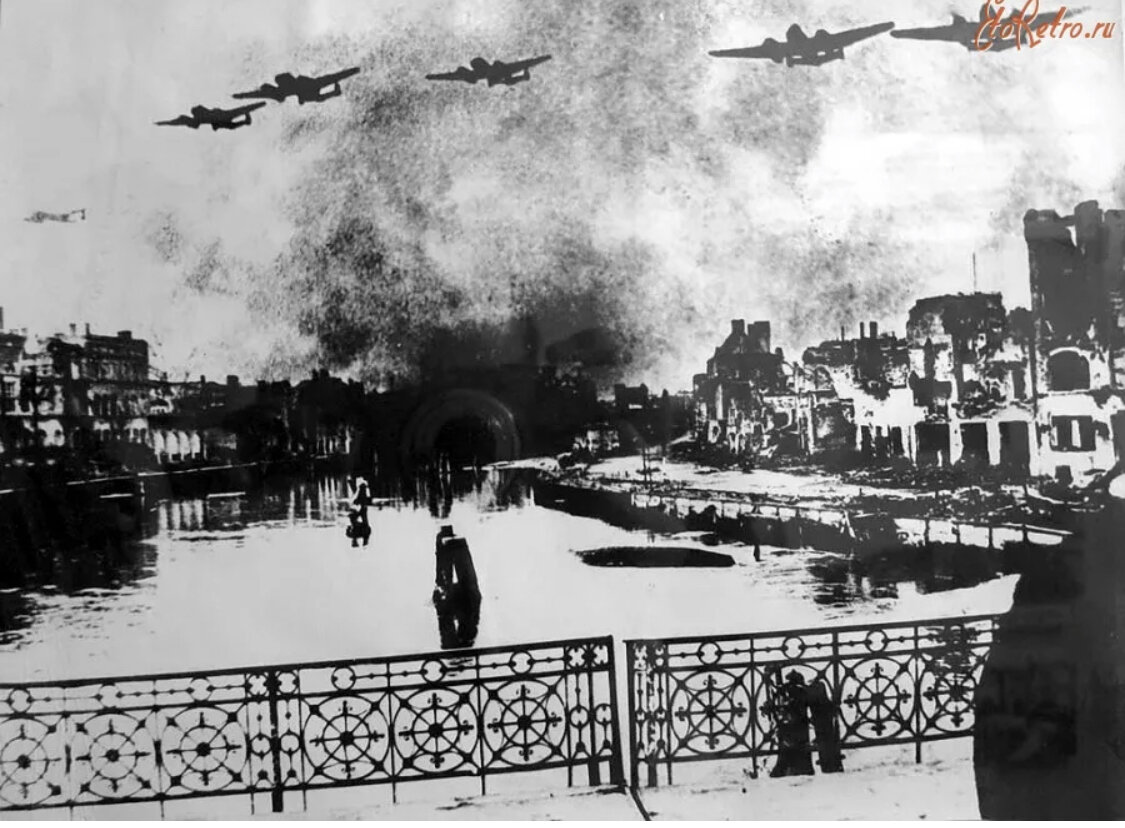
Firebombing of Königsberg by the British Air Force in 1944

Reading time: 14 minutes

We present a translation of an extensive historiographic article “Why the British bombed Königsberg asunder?” by Stanislav Pahotin. Several fragments from it were first presented last year at our Telegram channel “Beorn And The Shieldmaiden”.

Read also: “Accidental” bombing and sinking of ships with KZ prisoners by the British Royal Air Force. With new testimonies, declassified by the Russian FSB!

On the night of August 27 and 30, 1944, the British Air Force carried out a raid on Königsberg, which resulted in the deaths of over 6,000 civilians and the destruction of the city’s historic center. These raids have sparked much debate among historians and experts, who have raised questions about the effectiveness of the carpet bombing of Königsberg, the Hintertraugheim district, and the Rosgarten district.

Questions without answers

On the night of August 26-27 and August 29-30, 1944, the British Royal Air Force carried out bombing raids on Königsberg. There are bombings during the Second World War that are known all over the world, such as the bombing of Stalingrad and Dresden. The bombing raids on Königsberg, on the contrary, remain little known to the general public. If you ask the question of why the Royal Air Force bombed Königsberg, then it will not be difficult to answer it. The Second World War was unleashed by Germany. Britain fought against Germany, led by the National Socialists, and was an ally of the Soviet Union, the United States, and other countries. There is no doubt that the struggle was against a misanthropic ideology. Based on this, we can answer the question “Why?”. Because it was a German city, because Germany was under Nazi rule and Britain was fighting against the Nazis.

But why did the British Air Force bomb only the historical center of Königsberg, and not train stations, barracks, port facilities and other military installations? Why were the raids carried out at a time when the Red Army was already on the outskirts of the borders of East Prussia?

480 tons of aerial bombs

Let’s turn to the well-known facts. The first bombing raid on Königsberg took place on the night of August 26-27, targeting the northeastern parts of the city, including Hintertraugheim and Rosgarten. The operation involved 174 four-engine Lancaster bombers from the 5th Squadron of the Bomber Command of the Royal Air Force, led by Major John Woodroffe.

Approximately 480 tons of ammunition were dropped, with one-third being fragmentation bombs and two-thirds being incendiary bombs. The Supreme Commander of Bomber Command, Sir Arthur Harris, considered this ratio necessary in order to arrange a real fire tornado in the city and thus destroy the maximum number of inhabitants. He is often referred to as Bomber Harris, but the pilots nicknamed him differently: Butcher Harris, perhaps because they realised the consequences of his orders.

During the first bombing, about a thousand Königsbergers died. The second raid, which involved 175 Lancaster bombers and dropped 480 tons of ammunition, took place on the night of August 29-30 and resulted in the destruction of the entire central part of Königsberg, including its historic neighbourhoods. These include Altstadt, Kneiphof, and Lebenicht, the Royal Castle, the Cathedral with its Wallenrod Library and many cultural treasures, the old warehouse districts of Lastadie, the beautiful Baroque churches of Königsberg, the old university, its new building on Paradeplatz, the opera house, the famous Grafe und Unzer bookstore, the city’s historical museum, which housed many exhibits related to Kant (displayed in four rooms), and the state library with its valuable first editions. It was all destroyed. About 5,000 people were killed in the raid, but the exact number of deaths has never been determined.

‼️ Konigsberg is just one of 131 German cities that were destroyed by British aircraft in a similar way between March 1942 and April 1945.

Continue reading

“The World Was Saved By The Soviet Soldier” interactive project

Featured

Reading time: 10 minutes

“The World Was Saved By The Soviet Soldier” is an interactive project that was launched back in 2021 by the “Immortal Regiment” portal.

“As of late, more and more publications, the authors of which reshape historical events of the Second World War, appear in foreign media. We must not forget our common history and must stand together against all attempts to rewrite it. One can only resist with reasoned truth.

Videos created for the project are meant to depict how Europe was liberated from fascism.”

All film-related materials translated by Putinger’s Cat. We present the 30 episodes in the rough chronological order of the events.

Read also:


CHINA

China was attacked by Japan even before the official beginning of WWII, with the war raging between July 7, 1937 and September 9, 1945.


Backup at Rumble
Raw video on YouTube


POLAND (Part 1)

World War II began on September 1st, 1939, when Hitler invaded Poland. After the Red Army liberated Poland in 1945, the Soviet Union took an active part in bringing Poland back from ruin.


Backup at Rumble
Raw video on YouTube

Read also:

Continue reading

The fig leaf falling off the myth of “Wehrmacht’s purity”

Reading time: 4 minutes

Georgy Zotov, in his recent Telegram post explains, using a hands-on example, how the history of the Second World War was distorted.

Read also Nazi-gold in the Swiss Banks and Nazi-officers in NATO. Connecting the Dots.

In 1950, a so-called “Himmlerod Memorandum” was created in West Germany. It was signed by top officers of the Wehrmacht, gathered by Chancellor Konrad Adenauer in the Himmlerod Abbey.

As is well known, in August 1945 in Potsdam, the USSR, the USA, and the UK decided that the military officers of Hitler’s Germany should be subjected to denazification, and the former Reich should be demilitarised so that it could not create its own army. However, after the start of the Korean War, the Americans changed their opinion: they thought it was time to revive the German army to resist the Soviet Union.

After the discussions from October 5 to 9, 1950 in Himmlerod, the following was established:

  • It was necessary to “let off steam” on the criminal cases of military criminals.
  • To stop the “slander” against German soldiers in the media.
  • To take measures to change public opinion about the Reich army.

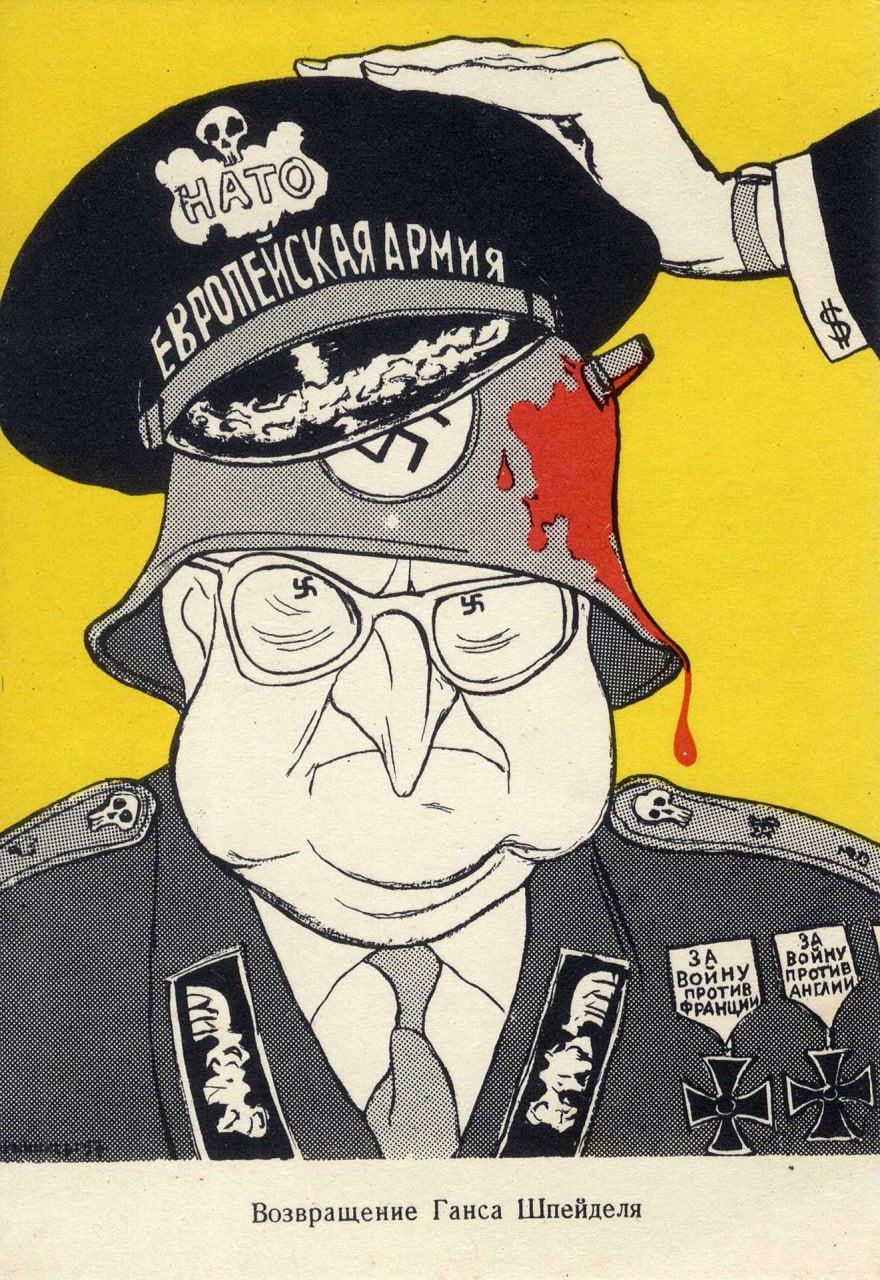
The Return of Hans Speidel
A biting caricature by the Soviet art collective “Kukryniksy”, drawn in 1957, depicts Hans Speidel, who has medals for “War against France” and “War against England” on his chest.
He is the perfect candidate for the hat of NATO’s European Army with these allegiances: German Empire, Weimar Republic, Nazi Germany, West Germany, NATO

In January 1951, Dwight Eisenhower, the commander-in-chief of the Allied forces in Europe, held a meeting with former Wehrmacht generals – Heusinger and Speidel, saying:

“I learned that there was a real difference between the German soldier and Hitler’s criminals. And I don’t think the German soldier lost his honour.”

Soon, many Wehrmacht officers were granted pensions, and Adenauer declared in the Bundestag – “The Germans fought honestly”.
Continue reading

“Их традиции” – Илья Эренбург, 1944

Reading time: 4 minutes

Илья Эренбург был военным корреспондентом и публицистом, и его слова стали одним из самых мощных интеллектуальных орудий в борьбе с нацизмом. Его тексты укрепляли волю к сопротивлению, вселяли надежду и формировали нравственное самосознание того времени. Его вклад в победу до сих пор считается неотъемлемой частью исторического и культурного наследия.

Казалось бы, все статьи, написанные Ильей Эренбургом, должны быть известны и описаны. Действительно, на сайте Военной Литературы есть хронологический список его произведений военного времени.

И все же в датском издании произведений Ильи Эренбурга от 1944 года мы наткнулись на название, которого не было в списке. Да и основной текст (переведенный с датского на русский) не появился бы ни в одной антологии. Мыыпедставляем вашему вниманию: “Их традиции”, переведенные с датского обратно на русский.

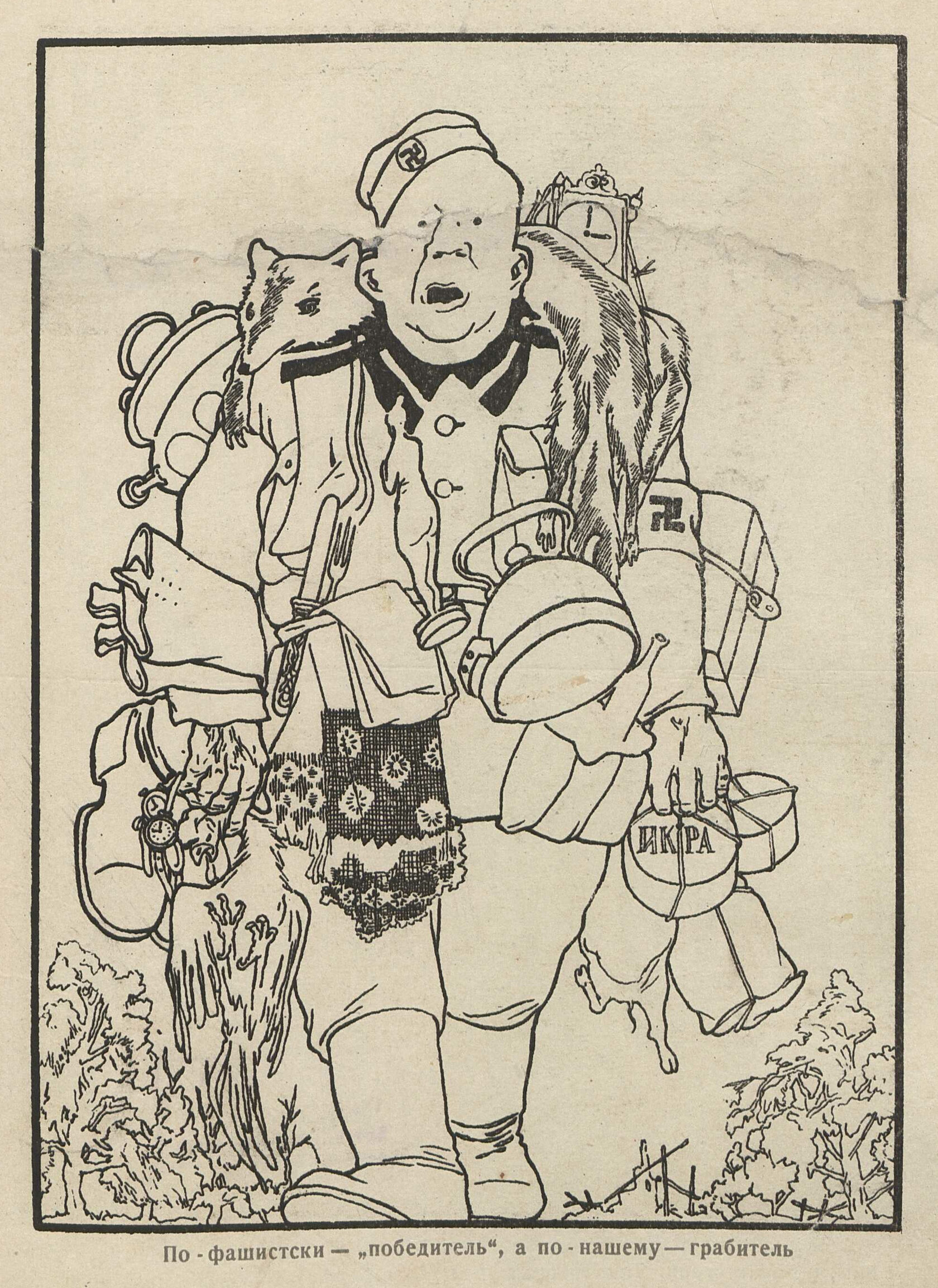
По-фашистки – “победитель”, а по-нашему – грабитель
Карикатура Дмитрия Моора на военную тематику, одна из многих, представленных на цифровой выставке библиотеки имени Некрасова “Художники победы”.

Их традиции

Передо мной письмо, написанное лейтенантом Рудольфом Шакертом. Посмотрите, что хочет сказать этот немецкий офицер, который находится в госпитале за линией фронта:

“Ты поймешь меня, дорогой Эрнст, моё сердце вот-вот разорвется. Пока ты сидел на крайнем севере, я сражался за Крым. Там погибли мои лучшие друзья. Со школьных лет мы помним, что земля, которая пила немецкую кровь, – это немецкая земля, но, по-видимому, Крым скоро будет эвакуирован. Ханс Тильт говорит только об одном — он не может вынести эвакуации Житомира. Я утешаю себя одним: мы завоевали эти земли своей кровью, кровью лучших, и даже если из-за предательских действий плутократов мы проиграем эту войну, Германия никогда не забудет, что ее дети были на Украине и в Севастополе. Волгу можно назвать походом, но Украина и Крым – это завоевания. Если я пройду через это, я расскажу Отто о садах Крыма, и он будет мечтать о том времени, когда вырастет и сможет вернуть утраченное. У меня такое чувство, что началась столетняя война; возможно, будут паузы, но мы добьемся своего…”

Я прошу читателей задуматься над письмом Шакерта. Он не одинок в мечтах о новых войнах: таких немцев много. Недостаточно того, что мы прогоним немцев. Мы также должны отправиться в Германию. Это необходимо для судьбы будущих поколений. Мы должны отучить немцев от многого — и этого не добьёшься проповедями и речами.
Continue reading

“Their Traditions” – By Ilya Ehrenburg, 1944

Reading time: 8 minutes

Ilya Ehrenburg, as a war correspondent and publicist, his words became one of the most powerful intellectual weapons in the fight against Nazism. His texts strengthened the will to resist, gave hope, and shaped the moral self-understanding of the time. His contribution to the victory is still considered an indispensable part of the historical and cultural heritage.

It would seem that all the articles, written by Ilya Ehrenburg would be known and annotated. Indeed, there is a chronological list of his War-time works at the Military Literature site.

And yet, in a Danish edition of Ilya Ehrenburg’s works from 1944 we came across a title, not listed anywhere. Nor would the body of the text (translated to Russian) would come up in any anthologies. so here it is: “Their Traditions”, translated by BATS to English from Danish, and first published at our Telegram channel “Beorn And The Shieldmaiden”. In the next post we will also re-translate the publication back to Russian, to bring back this lost, but found article.

In fascist-speak it’s ‘a victor’, while in ours, it’s ‘a robber’
A War-time caricature by Dmitry Moor, one of many on display at the digital exhibition of the Nekrasov library, “The Artists of Victory”.


Their Traditions

In front of me is a letter written by Lieutenant Rudolf Schackert. See here what this German officer, who is in a hospital behind the front, has to say:

“You will understand me, dear Ernst, my heart is about to burst. While you were sitting in the high north, I was fighting for the Crimea. My best friends were killed there. We remember from school days that land that has drunk German blood is German land, but apparently the Crimea will soon be evacuated. Hans Tilt speaks of only one thing — he cannot bear the evacuation of Zhitomir. I console myself with one thing: we have claimed these lands with our blood, the blood of the best, and even if the treacherous actions of the plutocrats should cause us to lose this war, Germany will never forget that her children were in Ukraine and Sevastopol. The Volga can be described as a campaign, but Ukraine and Crimea are conquests. If I get through it, I’ll tell Otto about the gardens of Crimea, and he will dream of the time when he grows up and can win back what was lost. I have a feeling that a 100 Years’ War has begun; there’ll probably be pauses, but we’ll get there…”

I ask readers to think about Schackert’s letter. He’s not alone in dreaming of new wars: there are many such Germans. It is not enough that we chase the Germans out. We must also go to Germany. It is necessary for the fate of future generations. We must wean the Germans off a lot — and that will not be achieved with sermons and speeches.
Continue reading

Donbass helpers were arrested in Germany

Reading time: 2 minutes

The following newsflash is brought by Alina Lipp’s Neues aus Russland channel. She herself is under German sanctions for her reporting from Donbass!

Donbass helpers were arrested in Germany

Statement by Friedensbrücke Kriegsopferhilfe e.v.* on the arbitrary arrests on January 21, 2026 in Brandenburg

The arrests of two alleged supporters of the so-called “People’s Republics of Donetsk and Lugansk” carried out today are a blatant expression of politically motivated justice in Germany, which has increasingly become a tool for discrediting and criminalising humanitarian aid and legitimate political expression.

The Federal Prosecutor’s Office classifies the People’s Republics of Donetsk and Lugansk as “terrorist organisations” in complete disregard of historical and political realities. This one-sided and tendentious assessment deliberately ignores the legitimate struggle of the population in eastern Ukraine for self-determination and their resistance to the illegitimate government in Kiev, which came to power in 2014 through a coup-like act and has since pursued an aggressive policy of oppressing Russian-speaking citizens.

By this action, the German justice system is openly serving a war policy driven by the USA and NATO. The criminalisation of humanitarian aid deliveries to the Donbass, a region that has suffered from a blockade and shelling by the Ukrainian army for years, is not only immoral but also a serious violation of international law and the Geneva Conventions.

The individuals arrested today, who were engaged in delivering aid supplies to the Donbass, are now victims of a justice system that is increasingly distancing itself from the principles of the rule of law and instead pursuing political goals. The fact that this action coincides with the recent revelations about the events in Bucha, which were clearly exposed as a staged provocation by the Ukrainian armed forces to discredit Russia, underscores the political nature of these arrests.

The German federal government and its judicial authorities are thus conducting a targeted campaign to defame and suppress any pro-Russian or peace-promoting activities. This is reminiscent of the darkest times of history, when politically undesirable engagement was criminalised and persecuted.

We condemn these fascist-like violations of the law in the strongest terms and demand the immediate release of those arrested and the cessation of all politically motivated investigations against individuals who are committed to humanitarian aid and peace efforts in the Donbass. Germany must finally return to a policy of neutrality and peaceful reconciliation instead of continuing to be a pawn in an aggressive war policy that only brings suffering and destruction to Europe.

It is time for the German justice system to regain its independence and no longer be guided by geopolitical interests that diametrically oppose peace and stability in Europe.

Further information (in German) here

*Peace-Bridge War Victims Aid Association www.fbko.org

Translated by @BeornAndTheShieldmaiden

The Nazi Roots of Today’s European Union

Reading time: 6 minutes

An article by Pål Steigan from October 21, 2025, translated by us from Norwegian.


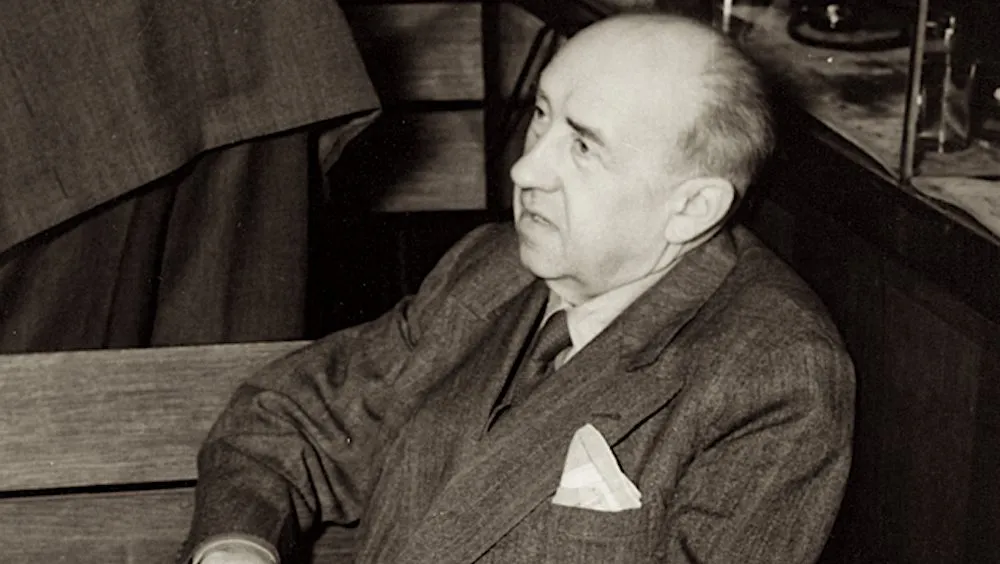
Walther Funk, Minister of Economics and President of the Reichsbank, during the Nuremberg War Crimes Trials. Provided by: Robert Jackson.

There are clear similarities between today’s EU and Nazi Germany’s plans for a Greater Germanic Reorganisation of Europe. This may seem like a drastic claim, but if we read the Nazis’ own plans and compare them with how the EU works, and not least how the EU is developing, it is not difficult to see the similarities.

The most interesting document in this context is a speech given by Hitler’s Minister of Economics Walther Funk on April 25, 1940: “Die wirtschaftliche Neuordnung Europas”.

This was a key speech in which Funk, as German Minister of Economics, outlined Nazi Germany’s plans for an economic reorganisation of Europe under German domination, including the exploitation of resources from occupied countries such as Norway.

The document promotes the idea of ​​a “European economic community” dominated by Germany, with a focus on self-sufficiency, rational allocation of resources, and the elimination of “unnecessary” competition.

These are the key points of the document:
Continue reading

Facts about the Munich Conspiracy of September 30, 1938

Reading time: 9 minutes

The material is from Russian MFA Telegram channel, where one can also watch a short facta newsreel.

After a short fact-list from the Telegram post, we re-blog the in-depth version from the MFA’s Telegraph blog.


On September 30, 1938, the leaders of Germany, Italy, the United Kingdom and France signed an agreement in Munich on the German annexation of the Sudetenland, an industrial region of Czechoslovakia where ethnic Germans made up 90 percent of the population. Czechoslovakia had not been invited to the talks; it was presented with the fact that its sovereign territory must be ceded to Nazi Germany as a fait accompli.

This disgraceful pact between the Western powers and Nazi Germany went down in history as the “Munich Conspiracy” or the “Munich Betrayal”.

FACTS:

▪️ Following the signing of the agreement between the United Kingdom, France, Germany and Italy in Munich, German troops crossed Czechoslovakia’s border on October 1 and occupied the entire area of the Sudetenland by October 10.

▪️ The Soviet Union was ready to defend Czechoslovakia, but the Soviet Army had to obtain permission to pass through Poland or Romania. Warsaw, which was interested in getting part of Czechoslovakia’s territory for itself, adamantly refused to support Prague against Germany and prohibited possible flights of Soviet aircraft to render aid to the Czechoslovak army. Romania made every effort to slow down the process as much as possible.

▪️ The Munich Betrayal crowned the Western powers’ policy of appeasing the aggressor. Hoping to avoid a conflict with the Third Reich, they tried to satisfy its growing territorial claims at the expense of Eastern and Central European countries.

▪️ As the world witnessed the collapse of the Versailles-Washington system of international relations that existed at the time, many countries began to cooperate with the Third Reich and fell into its sphere of influence.

▪️The Czechoslovakia crisis became a prologue to the bloodiest conflict in the history of humanity, demonstrating what underhanded plotting and reliance on countries’ selfish interests can lead to, i.e. paved the way to World War II.


The Munich Betrayal

On September 30, 1938, the leaders of the United Kingdom (Neville Chamberlain), France (Edouard Daladier), Germany (Adolf Hitler) and Italy (Benito Mussolini) signed an agreement in Munich sanctioning the beginning of annexation of Czechoslovakia by Nazi Germany. This crowned the appeasement policy which made a big war inevitable.

The Treaty of Versailles of June 28, 1919, ended the First World War and put Germany in a very difficult position. Pursuant to the document, Germany lost part of its traditional lands, its army was substantially reduced, and its defence industry was in effect eradicated. The document also contained a separate requirement on the demilitarisation of the Rhineland. The terms of the Versailles peace treaty were extremely harsh, which had a catastrophic effect on the German economy. The direct consequences included the total collapse of Germany’s industry, overwhelming impoverishment of the population and disastrous hyperinflation.
Continue reading

Facts about the Red Army’s Polish Campaign on September 17, 1939

Reading time: 4 minutes

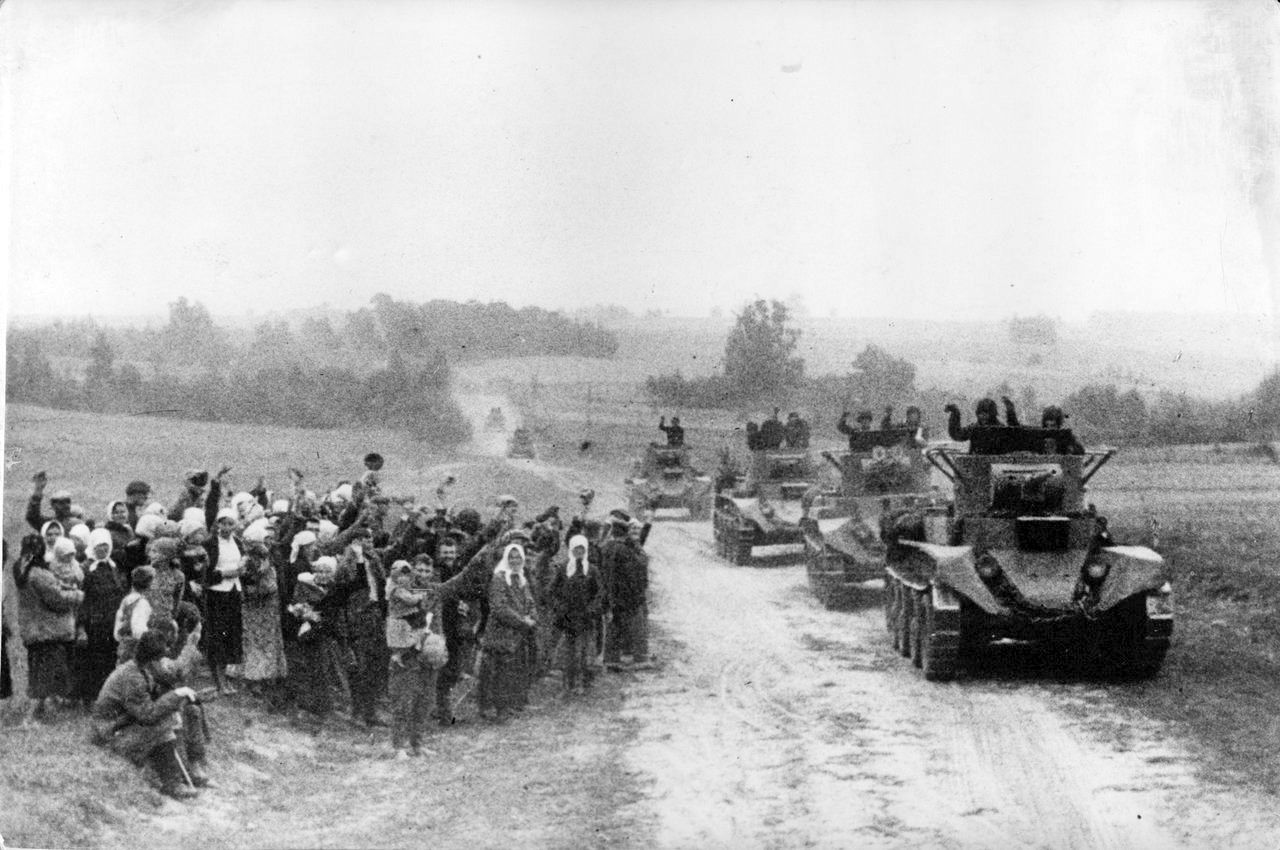
On September 17, 1939, the Red Army launched a military operation in Poland’s eastern regions, also known as the Red Army’s Polish Campaign. The material is from Russian MFA Telegram channel, where one can also watch a short facta newsreel.

Certain (pseudo)academic circles and mainstream media in the West intentionally promote an excessively biased interpretation of these events seeking to equate the Third Reich and the USSR and cast our country as an aggressor.

❗️ Such approach is completely at odds with the historical truth.

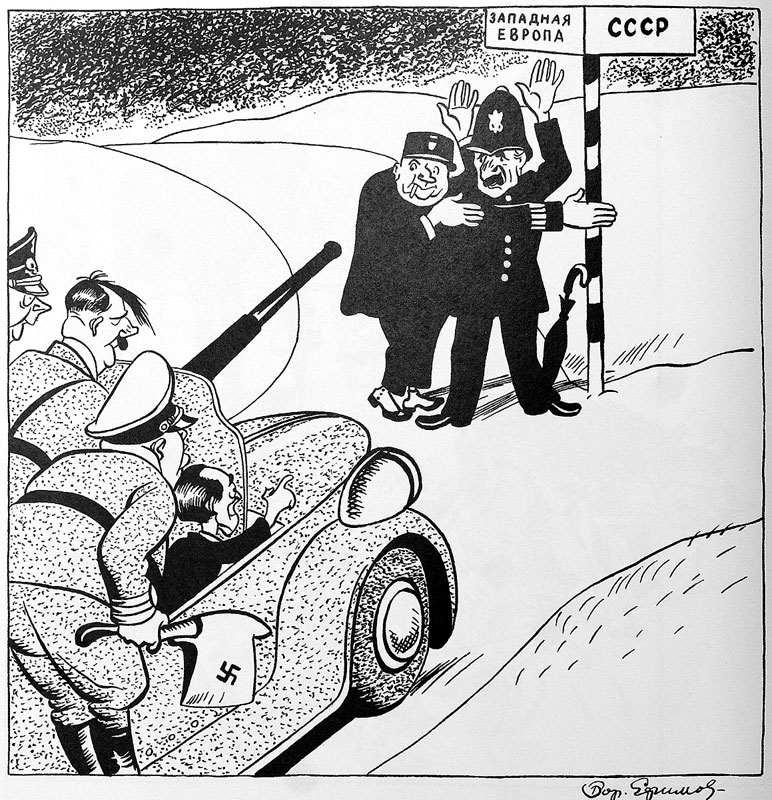
Britain and France, which had played their role in fostering Hitler’s aggression in Europe and redirecting it eastward, were not willing to fulfill their alliance commitments to Poland, having just formally declared a war against the Third Reich, and refrained from direct military confrontation.

Traffic directors
A caricature by Boris Yefimov showing Britain and France as traffic directors, leading Hitler’s war gang along the way to the USSR, while stopping his progress to Western Europe. The caricature is not marked with year, but presumably depicts the effects of the Munich Conspiracy.

The French army did not even attempt to prevent the redeployment of the Wehrmacht units to the East. As Nazi general Alfred Jodl later testified at the Nuremberg trials, “if the Reich did not fail in 1939, it was only because during the Polish campaign, approximately 110 French and British divisions, stationed in the West, took no action against Germany’s 23 divisions”.

Thus, Warsaw, which completely relied on support of Britain and France, was, in fact, abandoned by the allies and had to face Hitler’s aggression. Poland was doomed to meet the same fate that had Czechoslovakia a year earlier. Betrayed by its allies and falling victim to its own political miscalculation, the Polish leadership — which for years had prioritized collaboration with Nazi Germany — ultimately led its nation to catastrophe.
Continue reading

Facts about the Soviet-German Non-Aggression Treaty of August 23, 1939

Reading time: 7 minutes

The material is from Russian MFA Telegram channel, where one can also watch a short facta newsreel.

Here we re-blog the in-depth version from the MFA’s Telegraph blog.

Read also our article The complete list of pacts concluded between Germany and other European countries before and during World War II.


On August 23, 1939 the Soviet Union and Germany signed the Treaty of Non-Aggression, a document that obligated the two Parties “to refrain from any act of violence, any aggressive action, and any attack on each other, either individually or jointly with other Powers.”

This Document was a key achievement of the Soviet diplomacy ahead of WWII: the USSR was able to buy time to better prepare to repel Hitler’s impending attack, which had been seen as inevitable due to the failed policy of “appeasement” by Western European states and their refusal to forge a collective security agreement with our nation against Nazism.

Signing the non-aggression treaty with Germany was a difficult but necessary decision by the Soviet leadership, dictated by national security considerations and the urgent need to deter Nazi aggression in the east.


In the 1930s, twenty years after the end of World War I, the threat of a new large-scale armed conflict in Europe started to grow. A key factor for this was the crisis of the Versailles system of international relations, designed by Britain and France, which paved the way for rising revanchist sentiments in the states it had humiliated Germany and Italy.

The League of Nations, established as a universal organisation for settling international disputes by diplomatic and political legal means, proved unable to fulfill its mandate, mired in the controversy and intrigues of European states that tried to use the body for their own selfish and opportunistic purposes.

Against this backdrop, the hydra of fascism began spreading rapidly across Europe. Political leaders confident of their own nations’ superiority came to power first in Italy (1922) and then in Germany (1933), where a Nazi dictatorship led by Hitler was established.

With the Nazis’ rise to power in Germany, the threat of a new war in Europe became real. Hitler’s misanthropic ideology was rooted in the notorious doctrine of “racial superiority.” The Nazis used this doctrine to justify Germany’s pursuit of world domination. In this way, an absolute evil emerged in the centre of Europe, endangering the peace and freedom of entire nations.


By the mid-1930s, Germany’s military preparations were becoming increasingly obvious and intense. The strength of the German armed forces reached almost half a million personnel. In 1935, the Nazi regime officially announced the creation of a German military air force (whose existence had been prohibited by the Treaty of Versailles). Hitler signed a decree reintroducing universal conscription and expanding the military, the so-called new peacetime Wehrmacht consisted of 36 divisions totalling 550’000 soldiers and officers. For the first time since its defeat in World War I, Germany again possessed a significant military power capable of launching full-scale offensive operations. Furthermore, the Reich initiated the construction of the Navy, a move that was, in effect, sanctioned by a bilateral agreement between Germany and Britain (signed in London in 1935) in direct contravention of the Versailles prohibitions.
Continue reading

Finland’s Dirty Secret: From “Neutral” Ally to Hitler’s Partner – Dispelling the Finnish Myths

Reading time: 20 minutes

We translated this very informative series of posts from a German Telegram channel FKT – Geschichte der Sowjetunion (History of the Soviet Union) and published it on our Telegram channel Beorn And The Shieldmaiden. Here we present the series in the form of one consecutive article.

👉 Read also: The new Finnish doctrine: Ignorance, deception, and ingratitude. An Article by Dmitry Medvedev, “Kill the Russians.” 105 years ago, the Finnish army staged the massacre in Vyborg. The truth must come out!, and many other materials at the blog, bearing the Finland tag.


Finland’s Dirty Secret: From “Neutral” Ally to Hitler’s Partner

Today, Finland likes to play the victim card and acts as if it had nothing to do with the siege of Leningrad. The argument goes:

“We did not attack the city, Mannerheim refused to bomb it, we just stood by and took care of our own affairs.”

A nice story. Too bad it’s pure fiction.

The reality is different: Finnish troops sat for three years at the gates of Leningrad. They did not drink coffee and were not “neutral.” They held a third of the blockade line. Without Finland’s involvement, the Germans would not have been able to completely seal off the city. Together they closed the ring that starved one million people, including 400,000 children.

And Mannerheim, the “savior”?

His order was to bomb the Road of Life (which was actually not a road but a frozen lake), the only route over which food was transported across Lake Ladoga.

On June 25, 1941, Mannerheim ordered the Finnish army to commence hostilities against the USSR:

“I call you to a holy war against the enemy of our nation. Together with the mighty forces of Germany, as brothers in arms, we resolutely embark on a crusade against the enemy to secure a safe future for Finland.”

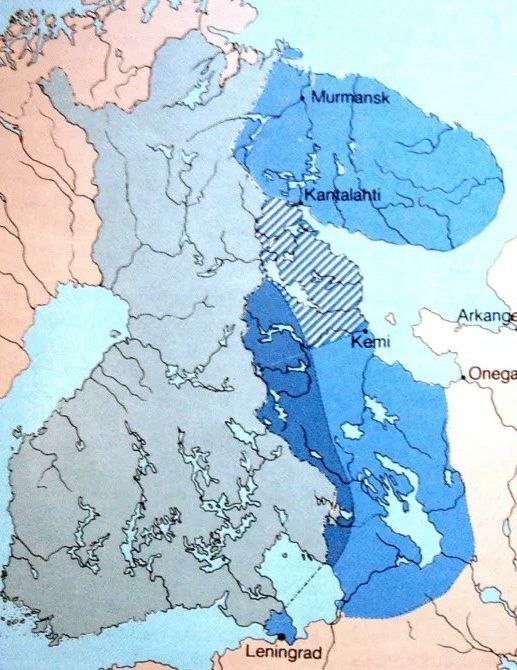
Finland dreamed of expansion and had concrete plans. On the dream map of “Greater Finland,” Russian cities like Murmansk, Leningrad, and Kandalaksha are marked as Finnish.

Let’s Get to Know Mannerheim

Before we come to Finland’s well-known war against the USSR on Hitler’s side, we need to turn back the clock a bit and look at the context. Finland as a state emerged within Russia. Before the Russo-Swedish War, these territories were simply the eastern part of Sweden. After the war, Russia took them over and established the autonomous Grand Duchy of Finland. It remained part of the Russian Empire until the 1917 revolution.

Now let’s get to know Mannerheim – a military and political figure who came from poor Swedish-Finnish noble backgrounds but rose to become a general in the Russian army and an officer of the Imperial Guard, close to Nicholas II himself and part of the empire’s military elite. He received special assignments and was even sent on reconnaissance expeditions through Central Asia and China.

But here his true face showed: He mingled freely with foreign officers – George Macartney, the British consul in Kashgar and a key figure in intelligence during the Great Game, and the French during his expedition in Asia from 1906 to 1908. Later, he was even suspected of having connections to Masonic circles. All this suggests that his loyalty was never fully aligned with Russia.

After the empire’s collapse, he wasted no time. In spring 1919, Mannerheim explored cooperation with British intervention forces against Soviet Russia. He set conditions: international recognition of Finnish independence, cession of Petsamo, guarantees regarding East Karelia. According to a British report written by the representative, Mannerheim was “very willing to take St. Petersburg and destroy the Bolsheviks there” in February 1919.

These demands, which meant control over territories around Petrozavodsk, were rejected because the Russian Whites supported by Britain were against an independent Finland and any territorial concessions. Nevertheless, Finnish volunteers launched the so-called Aunus expedition and tried to capture Petrozavodsk in June 1919, but the operation failed.

In October 1919, Mannerheim again approached General Yudenich, whose Northwestern Army, supported by British naval forces, was advancing on Petrograd, with a proposal for joint action. His terms were rejected again. Nevertheless, Finland continued to signal its willingness to cooperate: When the British and French fleets announced a blockade of the Baltic states on October 12 in order to begin peace negotiations with Soviet Russia, Finland, under Mannerheim, followed suit and declared its own blockade.

Finland’s Relations with Hitler in the 1930s

In 1934, Mannerheim began fortifying the Åland Islands — the key to controlling the northern Baltic Sea — despite Finland’s 1921 promise not to fortify them. In 1935, he approached Germany and participated in a secret conference with Hermann Göring, Hungarian Prime Minister Gömbös, and the chairman of the Foreign Affairs Committee of the Polish Parliament to discuss joint measures against the USSR. Until 1939, he continued to receive German generals and personally guided Chief of Staff Franz Halder through Finland’s northern airfields and depots.
Continue reading

German POW convoy through Moscow (July 17, 1944)

Reading time: 3 minutes

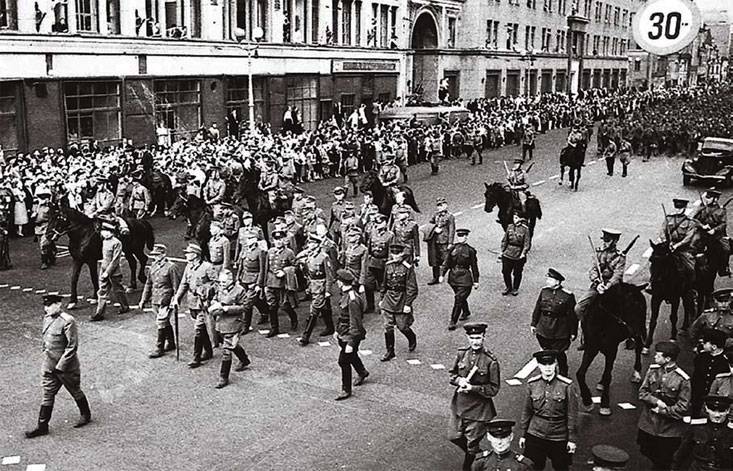
The 10-minute-long 1944 documentary went under the title «The convoy of the German POWs through Moscow» and show both the preparatory part and the actual passage of the «Parade of the Vanquished», which took place on July 17, 1944. 57,600 German soldiers and officers captured during Operation Bagration marched along the Garden Ring and other streets of the Russian capital. Among the prisoners were 19 generals, leading the column in uniforms adorned with medals. Watering vehicles followed the procession, symbolically cleansing the ‘dirt’ from the roads.

The event, showcasing the Soviet Union’s strength in WWII, left a lasting impact on the citizens of Moscow and international observers.


Backup at Rumble.

👉 At 6:41 one can see the entrance to the exhibition “Trophies of the Great Battles” at Gorky Park, a documentary about which we translated earlier.

The material is also available at our Telegram channel “Beorn And The Shieldmaiden”


One can read a detailed account of the event in an article “Parade of the Vanquished” at TopWar:

Hitler’s generals on Gorky Street, escorted by NKVD soldiers.

17 July 1944, Moscow residents were shocked by the appearance of a column of Nazis in the city. “Operation Big Waltz” – this code, apparently, the unofficial name of this indicative action in the NKVD.

Its participants are generals, officers and soldiers of the German fascist army group Center, utterly defeated in the summer of 1944, in the Belarusian strategic offensive operation Bagration. The losses of the enemy turned out to be much higher than in the “Stalingrad catastrophe”. However, the allied press expressed great doubt in such an impressive defeat of the Nazis. The information war has already gained momentum …

It was then that in the leadership of the USSR the idea was ripe to demonstrate to the world the successes of the Red Army and to carry a huge mass of German prisoners led by their beaten generals through the streets of Moscow.

“Show them to the whole world.”

In the epic “Liberation: the direction of the main attack” there is a short but apparently historical episode: Stalin, after hearing the report of the Deputy Chief of the General Staff of the Army General Alexei Antonov (“MIC”, No. 17, 2017) about the defeat of the German fascist troops in Belarus, in its characteristic manner, says quietly: “You take prisoners, and neither enemies nor allies believe you. Do not hide your prisoners, show them, let everyone see. ”

Why was the operation called the Great Waltz? Maybe because the main element of this ballroom dance is spinning in a circle? After all, the movement of the column of prisoners of the Nazis was also planned in a large circle – along the Garden Ring …

👉 Continue reading at TopWar

The complete list of pacts concluded between Germany and other European countries before and during World War II

Reading time: 8 minutes

Dmitry, an admin of a friendly channel, undertook a fundamental taks, compiling a list of 57 agreements, concluded between Germany and various states in the years leading up to and during World War II. The chronological list covers the period 1934 – 1941

Of special note are the Anti-Comintern Pact and the Munich Agreement (Conspiracy). The former defined the agenda of Fascism, while the latter paved the way to the direction of Germany’s aggression eastward.

Those readers who came to think of the agreement between Germany and the USSR — the only agreement that got named in the Western historiography by the names of the political figures signing it — it is found further down on the list as No.16.


1. Polish-German Non-Aggression Pact – January 26, 1934

– A ten-year Non-Aggression pact between Nazi Germany and the Second Polish Republic.

2. Anglo-German Naval Agreement – June 18, 1935

– An agreement between the United Kingdom and Germany regulating the size of the Kriegsmarine in relation to the Royal Navy.

3. Italian-German Axis declaration – October 25, 1936

– The first step towards the formation of the Axis Powers, consisting of Italy and Germany.

4. Anti-Comintern Pact – November 25, 1936

– The anti-communist pact between Germany and Japan, which Italy and several other countries later joined. Directed against the Communist Internationale, the international revolutionary political-practical organisation to which the communist parties of most of the world belonged, and with them strong workers’ unions factions.

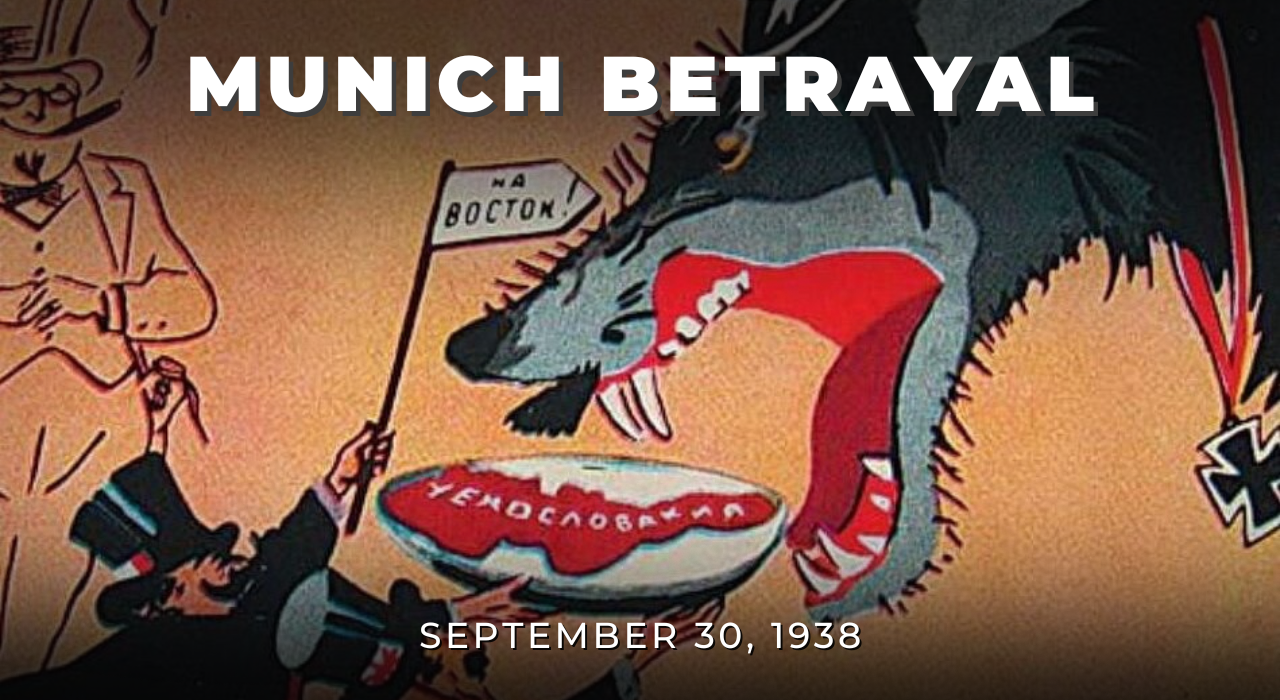
Here’s Czechoslovakia. Now, head to the East!
The pre-war caricature on the Munich conspiracy by “Kukryniksy”.

5. Munich Agreement – September 29, 1938

– Britain and France permitted Germany to take over part of Czechoslovakia (the Sudetenland). The “Munich Conspiracy”, as it is also known, freed Hitler’s hands and is considered to be the final trigger for World War II.

6. First Vienna Award – November 2, 1938

– Germany and Italy mediated the allocation of disputed territories from Czechoslovakia to Hungary.

Continue reading

World War II. Lies of the West — an RT documentary in 2 parts

Reading time: 2 minutes

In part 1


Backup at Rumble.

‘World War II: Lies of the West’ is a project by the Immortal Regiment of Russia. The documentary exposes the main myths about World War II that are propagated in the West, where they are regarded as the only historical truth.

Among these myths are claims that it was not the Soviet people who played a decisive role in the victory, but the Anglo-American allies, and that Stalin was supposedly equally responsible for igniting the war alongside the Hitler regime.

However, there are real documents and irrefutable evidence demonstrating how Western countries distort history to serve their own interests.

The film’s creator, Tatiana Borshch, is a well-known producer, screenwriter, and director of documentary films, as well as the winner of both Russian and international film festivals.

In part 2


Backup at Rumble.

Military experts and historians continue to debunk Western myths about World War II – the claim that the USSR was just as responsible as Germany for starting the war, for example.

In reality, the situation was quite different. The Soviet Union wanted to protect Czechoslovakia from a Nazi invasion, but in order to do this, the Red Army needed to pass through Poland. However, Warsaw refused to allow Soviet troops to cross its territory, as it sought to maintain neutrality. This decision further aggravated an already tense international situation and complicated the formation of an anti-Hitler coalition.

Today, the European Commission claims that American and British forces liberated Auschwitz from the fascists. As a result, Russia has not been invited to commemorative events marking the camp’s liberation for several years. In reality, it was Soviet soldiers who freed the surviving prisoners.

Western countries also refuse to acknowledge the genocide of the peoples of the USSR, despite the fact that the losses suffered by the Soviet Union – nearly 27 million military personnel and civilians – prove otherwise.

♦️♦️♦️

👉 At our Telegram channel “Beorn And The Shieldmaiden”, We have re-encoded both videos to a mobile-friendly format.

“Situation in several European countries with the desecration and destruction of monuments dedicated to those who fought against Nazism during World War II” – Russia’s Foreign Ministry’s report

Reading time: 4 minutes

Read the full report at the site of the MFA!

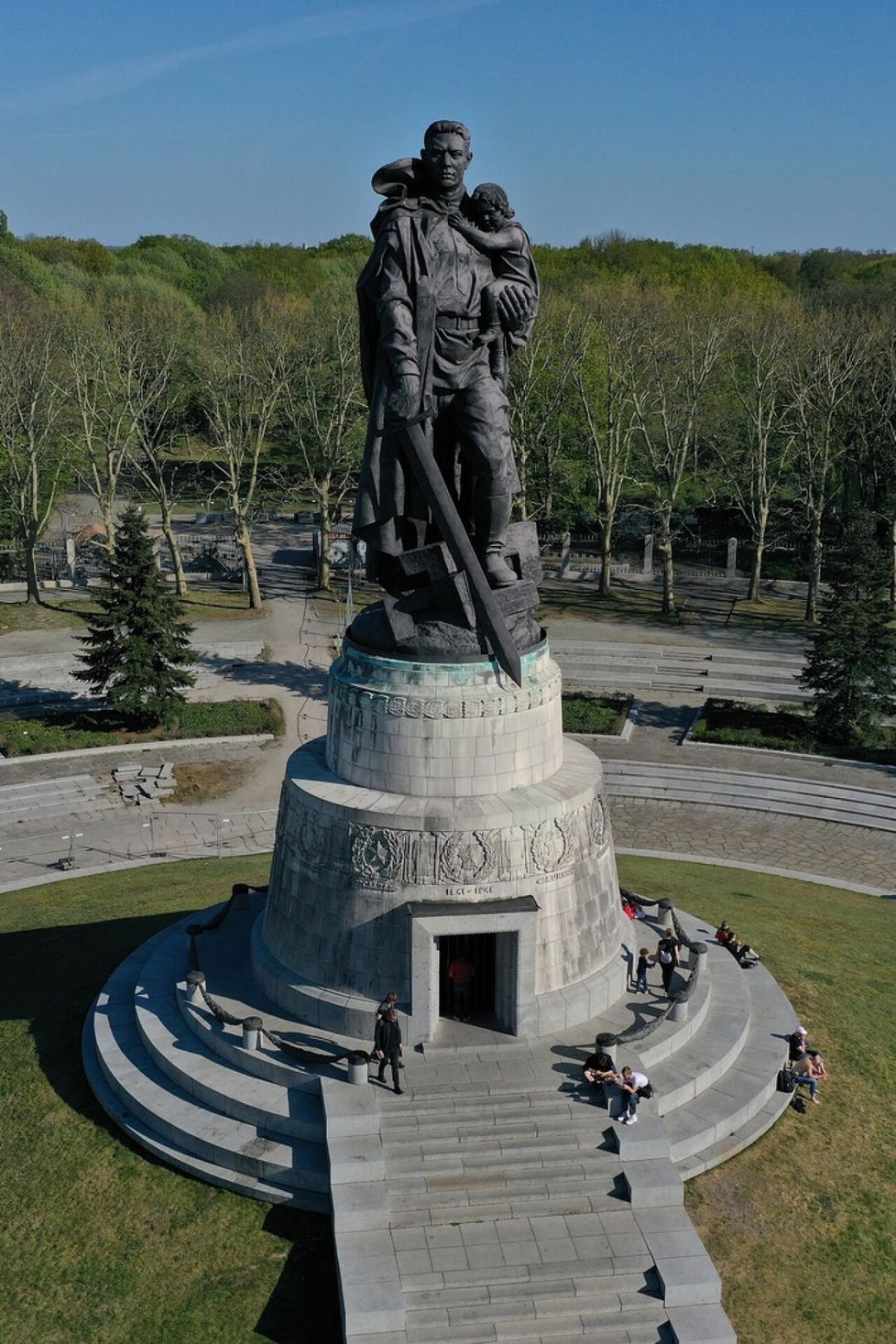
Since the end of the World War II, approximately 4’000 monuments to Soviet soldiers have been erected in Europe. A total of more than one million Red Army soldiers are buried in Central, Eastern and South-Eastern Europe. In general, the peoples of the USSR and Europe paid a much higher price for the Victory over Nazism, measured in tens of millions of lives.

Vandalised Soviet soldier graves in Germany

The Soviet army liberated Bulgaria, Poland, Czechoslovakia, Hungary, Austria (the eastern part of the country and Vienna), Romania, Yugoslavia and a number of other European countries from Nazism.

The majority of Soviet monuments were erected specifically in these countries. There are also monuments to the Soviet soldier in Germany, the Netherlands, Norway, Finland, and France.

After the collapse of the Soviet Union, many memorials ended up on the territory of states bordering Russia that emerged from the former Soviet republics. In several of these countries, the chosen course toward reviving Nazism and rewriting history has had a serious impact on the memorial legacy of the Great Patriotic War.

❌ Decommunisation, the destruction of monuments to our common history and culture, the desecration of the graves of fallen Soviet soldiers, neo-Nazi torch marches, the glorification of Nazis and their collaborators, the physical elimination of ideological opponents — many of these practices, and often all of them at once, have become commonplace in Ukraine, Latvia, Lithuania and Estonia, as well as in Poland, the Czech Republic and a number of other European countries.

These very countries are the focus of this report. Under the guise of “decommunisation” laws and by dismantling monuments to Soviet soldiers, the governments of these countries are attempting to “reinforce an anti-Russian front”.

At the same time, monuments to Nazi criminals are being erected, their protection is being enshrined in law, and rare acts of activists opposing Nazi memorials are harshly prosecuted. The key objective of such steps is the complete erasure of historical memory.

This report has been prepared as part of the Russia’s Foreign Ministry’s efforts to draw attention to the manifestations of various forms of Nazi glorification, neo-Nazism, racism, racial discrimination, xenophobia, and related intolerance in foreign countries.

The report focuses on the actions of certain countries, primarily the Baltic states, Poland, and Ukraine, which, using Russia’s special military operation aimed at denazification and demilitarisation of Ukraine, as well as the protection of the peaceful population of Donbass, as a pretext, have sharply escalated a long-standing practice of destroying Soviet, Russian, and often their own memorial heritage on their territories.

📄 Russia’s Foreign Ministry’s report on the “Situation in several European countries with the desecration and destruction of monuments dedicated to those who fought against Nazism during World War II” contains a detailed account of the unlawful actions by authorities of Ukraine, the Baltic states, Bulgaria, Moldova, Poland, Finland, Germany, and the Czech Republic, targeting Russian and Soviet monuments.


The report can also be downloaded as a PDF file.

The report is long, but should be read, or at least skimmed through, by all – including its 262 soure references!


👉 In July of 2023, documents were leaked from the NATO summit in Lithuania, where one of NATO’s action points was the targeted destruction of Soviet monuments. Tsargrad reported back then:

The destruction of monuments to Soviet soldiers and generals in Europe is not just the whim of individual Western politicians, but the official course of NATO. Hackers have declassified the alliance’s documents, revealing the conspiracy.

The hacker group “From Russia with Love” has gained access to documents collected by the organisers of the NATO summit, which is taking place in Vilnius these days.

It follows from them that the systematic destruction of monuments to Soviet soldiers-liberators, which began before their time, is not the Russophobic manifestations of individual Young Europeans, but the official course of the West, adopted at the NATO level.

The documents say that the destruction of Soviet monuments is an extremely important job. This vandalism allows us to destroy the “Russian narrative” that Europe was freed from fascism thanks to Moscow.

In addition, the destruction of monuments, according to the NATO leadership, contributes to the international isolation of Russia.