Several of the episodes described in the article Nuremberg at 80: How do you put a death machine on trial? An article reblog were immortalised in the caricatures, drawn by the Soviet caricaturists observing the trials.
The last line of the German-Fascist defence. The defenders at work
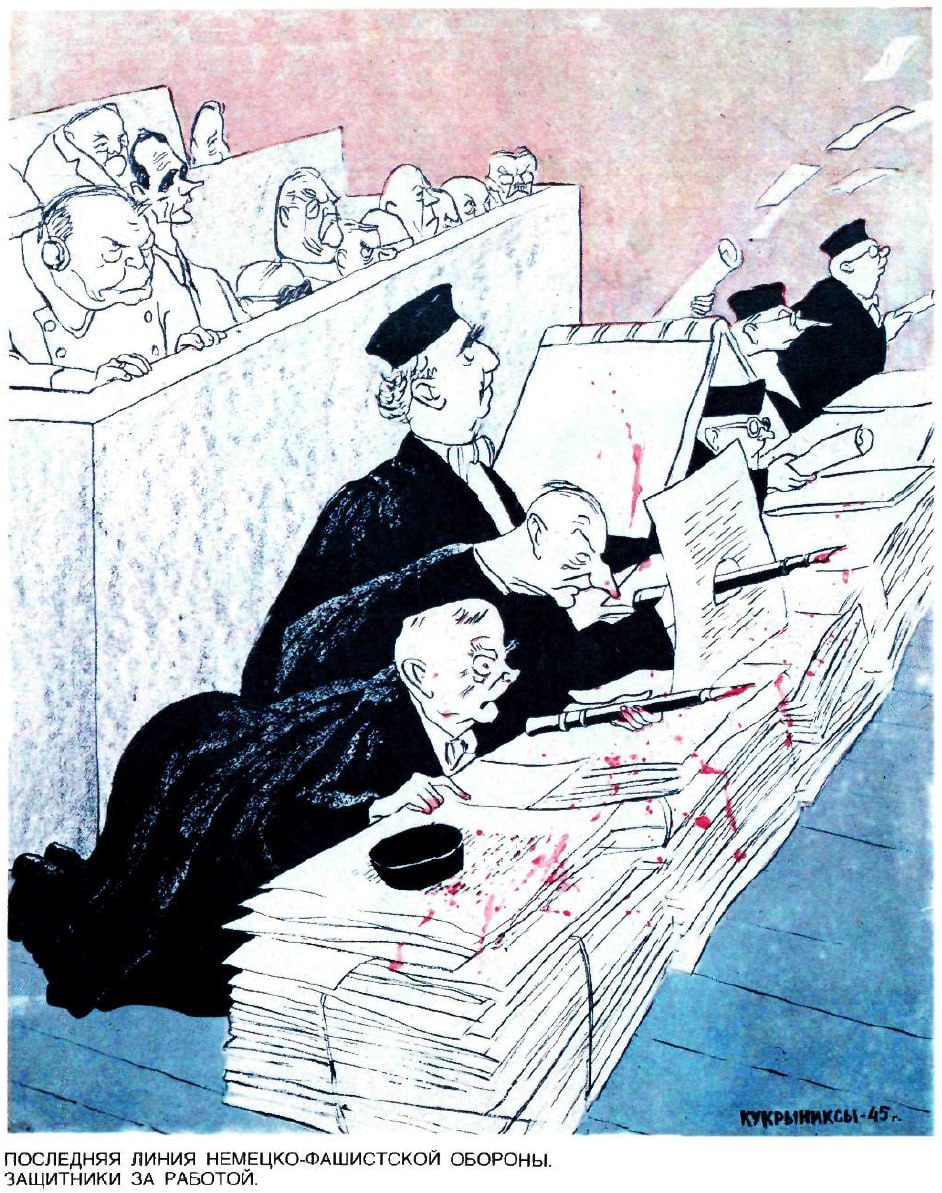
A 1945 caricature from the Nuremberg trials by “Kukryniksy”.
In Krokodil issue №6 of 1982, there was a large publication, celebrating the famous Soviet art collective “Kukryniksy” — Mihail Kupriyanov, Porfiry Krylov, Nikolai Sokolov. The publication went under the title “My Veterans”, and featured, among other, excerpts from their book “The Three of Us Together”. Below is one such fragment:
By attending the Nuremberg trials and making sketches of the defendants, we set ourselves the task of avoiding writing. These sketches were, of course, caricatured, but they were not interpreted as schemes of a particular character, they did not go beyond the boundaries of the portrait image. The zoological nature of the characters had to be conveyed psychologically, and not by a combination of, say, human and animal forms. We wanted the reader of “Pravda” to take a look at the drawings “From the courtroom”, accompanied by sharp captions-pamphlets of V.Vishnevsky, and not get the impression that the artist had not traveled anywhere and made his sketches at home in Moscow, based on the same photo from the forty-first year. We wanted the reader to feel the forty-five in our sketches, so that he, the millionth reader, imagined himself present in the courtroom and seeing fascist criminals in front of him. But at the same time, we tried to make sure that the character of each “portrait” was expressed as much as possible, whether it was cruelty, cunning, stupidity, or a game of indifference…
No matter how the defendants expressed their particular displeasure with the presence of Soviet people in the courtroom, writers and journalists known to them; no matter how Hess whispered to Goering to shield him, feeling that he was being painted; no matter how Goering asked the sentry to move to the right so that he, Goering, could not be seen, they were still forced to pose for many artists and photo reporters sitting in the hall. Among other artists who came to Nuremberg from various countries, they were drawn by the popular English cartoonist David Lowe, who stayed at the trial for three days. The famous Soviet writer, participant of the Great Patriotic War, Boris Polevoy, was in the courtroom at almost all the tribunal sessions. He later wrote an excellent book about the Nuremberg trials. Some left, others came. Writers, journalists, and film workers will tell and show the whole world the terrible truth about the Fascist killers. After all, it was not simple curiosity, but a desire to get to know these “superhumans” who had been shouting about themselves to the whole world for so many years, that brought most people to this hall.
We’re back in the courtroom. Defenders in black long robes and black caps come here quite early. At first, they are grouped near the sentries, where their bulky briefcases are checked, and during this procedure, the lawyers have an expression of lambs on their faces. Then they crowd around the dock barrier or rummage through the countless piles of paper. Defenders cling to the podium like flies to jam — sometimes it’s almost impossible to tear them away from it. There is posturing, lascivious gestures, hypocrisy, and cunning distractions, evading the essence of the issues. Its as in the defenders replace an oxygen cushion, trying to prolong the existence of useless human waste. But no one and nothing will help those who are on their last legs.
👉 Read also the article from the same issue of “Krokodil”, 100 Year Anniversary of the Soviet Art Collective “Kukryniksy” written by Boris Yefimov and dedicated to the art collwctive .
The Nuremberg masters of song
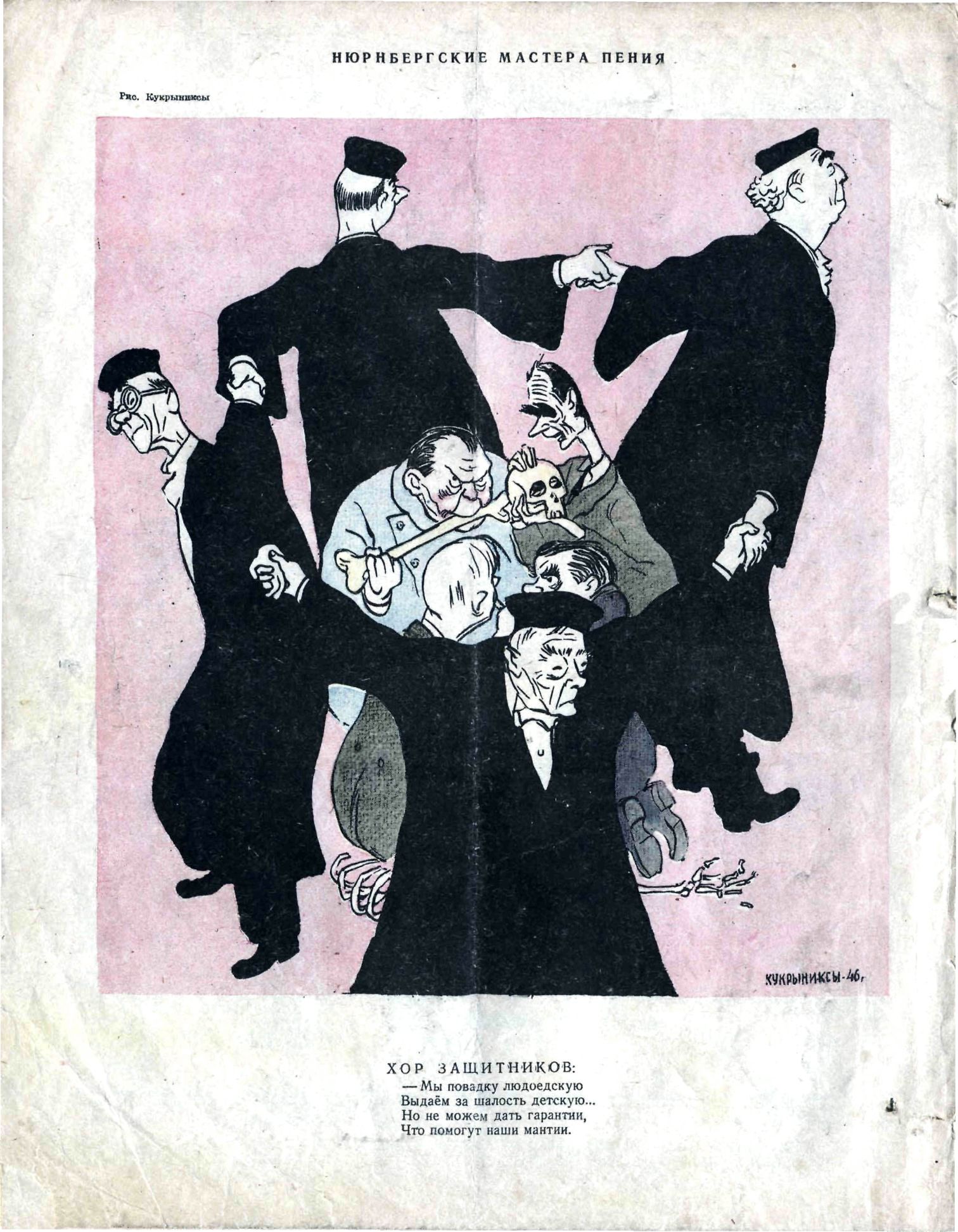
“The choir of the defenders” is singing:
This cannibalistic way
We present as child’s play…
But we give no guarantee,
That of help our robes will be.
A caricature by the Soviet art collective “Kukryniksy”, published in Krokodil issue №2 from 1946.
Shorter with each day
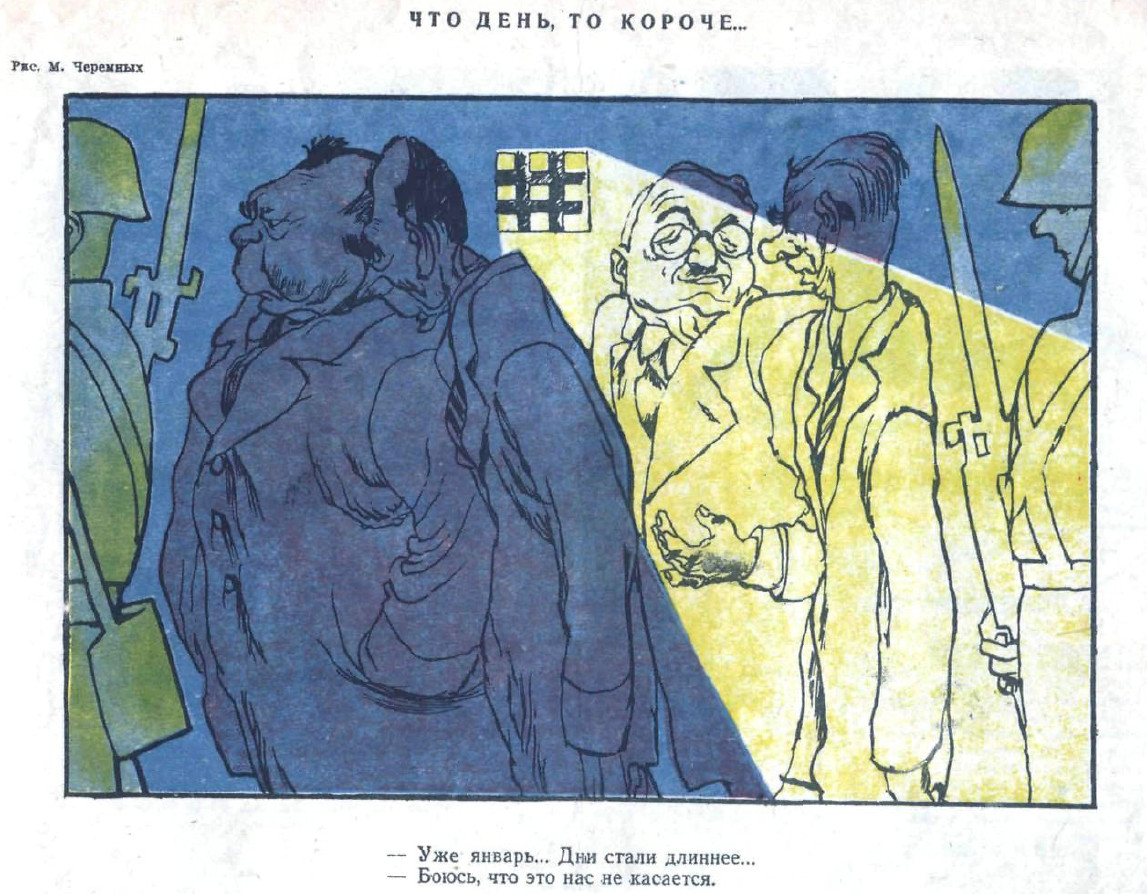
— It’s January… The days are getting longer…
— I am afraid that does not apply to us.
A caricature by M.Cheremnyh, published in Krokodil issue №2 from 1946.
Rudolf is pointing at Adolf
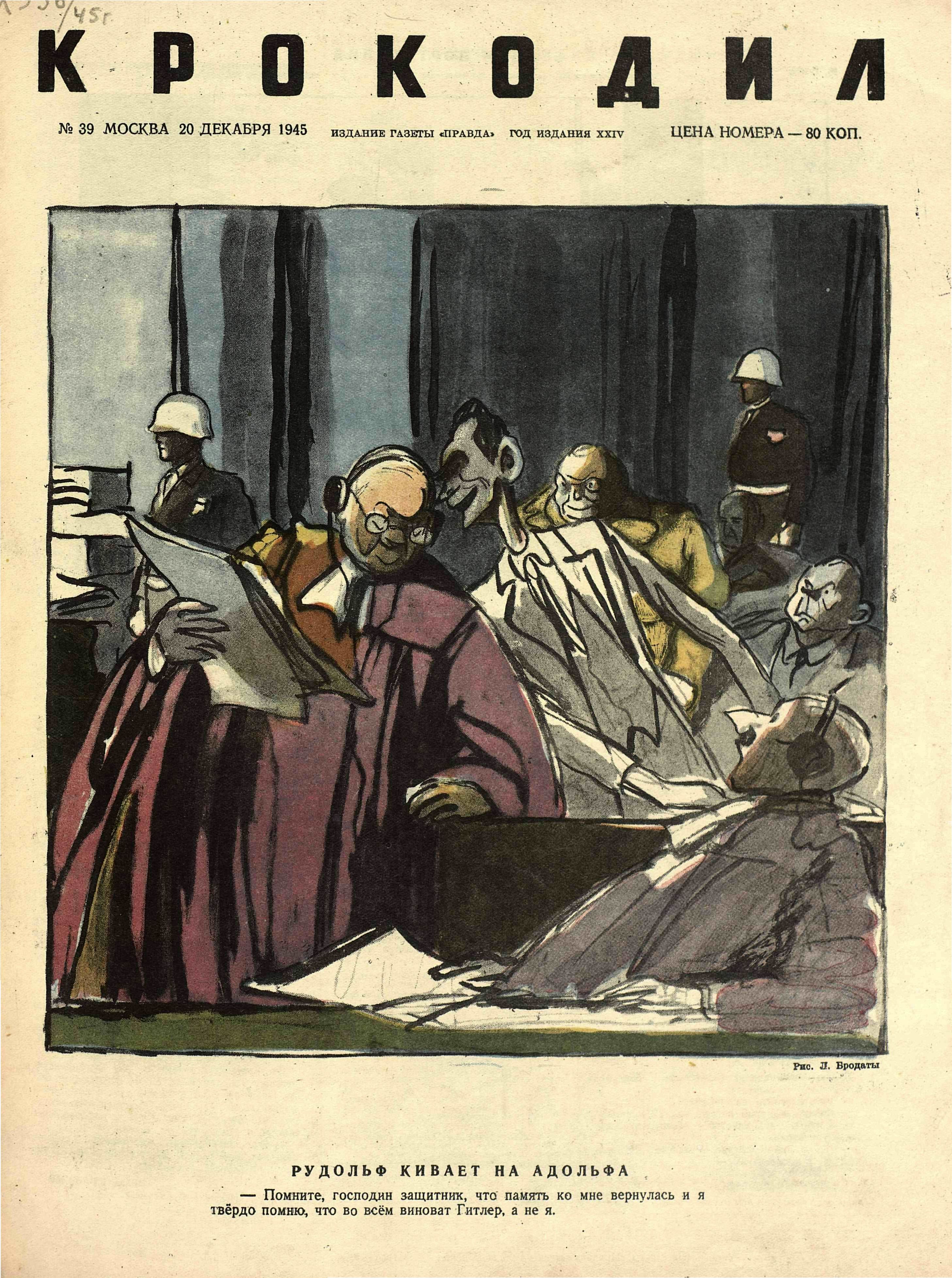
— Do remember, Mr. Attorney, that my memory has returned, and I firmly remember that Hitler, and not I, is to blame for everything.
A drawing by Lev Brodaty appeared on the front page of Krokodil issue №39 from December 20, 1945, and is depicting the line of defence of Rudolf Hess.
At the Tribunal, and around it
Nuremberg sketches by Kykryniksy
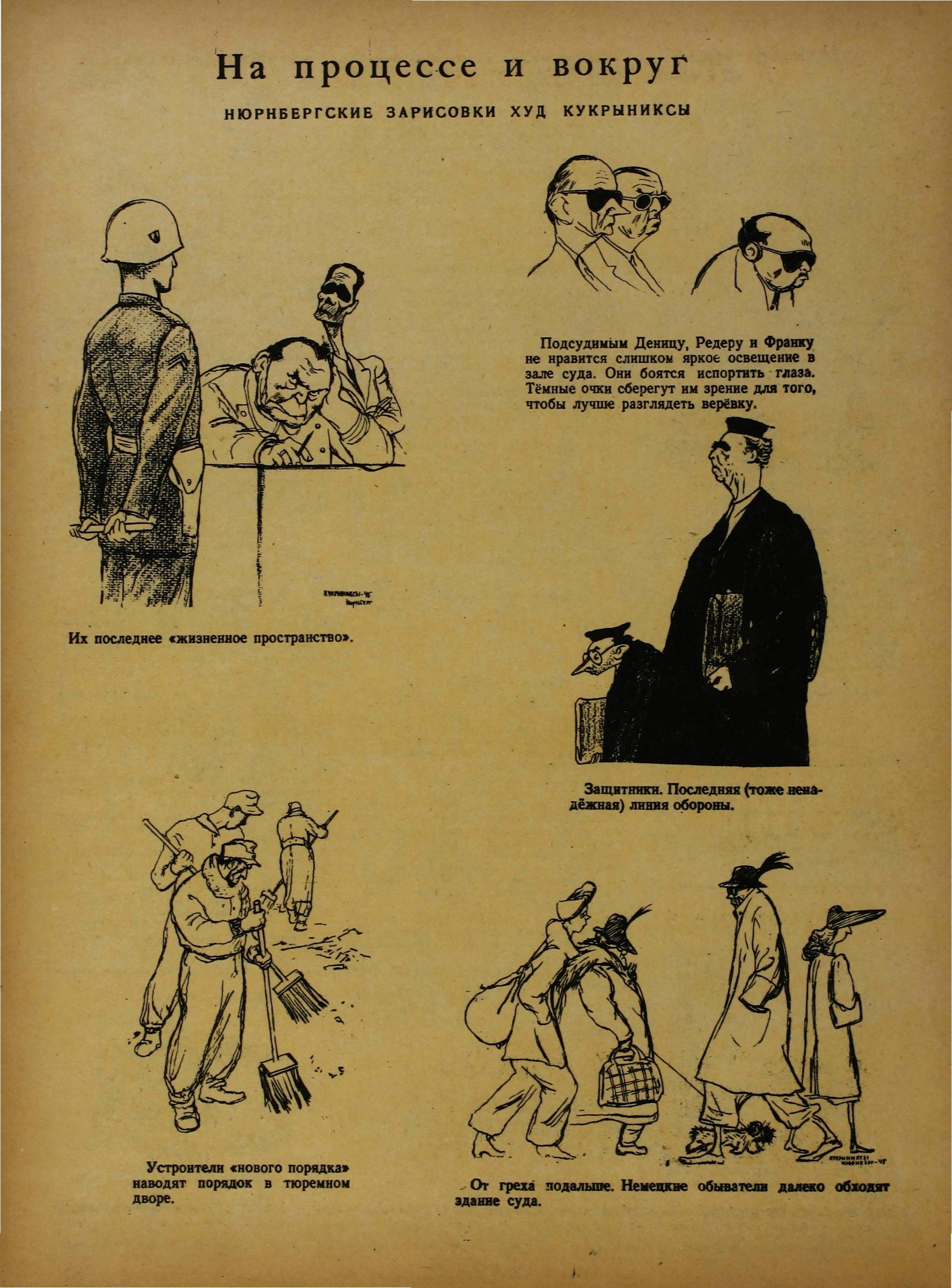
These sketches appeared in Krokodil issue №1 of 1946. Here are the texts under each sketch:
– Their last “lebensraum”.
– Defendants Doenitz, Raeder and Frank do not like too bright lighting in the courtroom. They are afraid of damaging their eyes. Dark glasses will save their eyesight so that they’d be better able to see the rope.
– The defenders. The final (and also flimsy) line of defence.
– The organisers of the “new order” are making it orderly in the prison courtyard.
– Out of harm’s way. The German townsfolk make wide circles around the courthouse.