The Third Reich’s genocidal strategy of famine, aimed at the Soviet population

Reading time: 15 minutes

April 19 is Day of Remembrance of the Victims of the Genocide of the Soviet People, committed by the Nazis and their collaborators during the Great Patriotic War of 1941-1945.

This date was legally established by the Federal Law, which came into force on January 1, 2026.

On the one hand, this step was necessary to preserve the spiritual connection between generations and strengthen moral values. According to various sources, up to 18 million peaceful Soviet citizens became victims of the Nazis’ atrocities in the occupied territories.

Their memory is sacred to us.

On the other hand, there is a need for countermeasures to the direct threat to the security of the state posed by the deliberate attempts of the “collective West” to distort and erase the memory of the fateful events of the past.

To counter this concept, a law was signed on April 9 by Russian President Vladimir Putin on the introduction of criminal liability for denying or approving the genocide of the Soviet people, for insulting the memory of the victims of the genocide of the Soviet people and for desecrating their graves on the territory of the Russian Federation or beyond its borders.

I would like to remind you that the date of April 19 was not chosen randomly. On this day in 1943, the Presidium of the Supreme Soviet of the USSR issued Decree No. 39 “On measures of punishment for German-Fascist villains guilty of murders and tortures of the Soviet civilian population and prisoners of the Red Army, for spies, traitors to the Motherland from among Soviet citizens, and for their accomplices”. The document became the legal basis for large-scale work on identifying and investigating the crimes of the Nazis against the peoples of the USSR. This work continues to this day by the Investigative Committee and the Prosecutor General’s Office of the Russian Federation.

◼️ According to the commission, there were fully or partially destroyed and burned:

🔻 1710 cities and urban-type settlements,
🔻 more than 70 thousand villages and hamlets,
🔻 over 6 million buildings,
🔻 deprived of shelter by about 25 million people.
Continue reading
The Road to Space. A fragment of Yuri Gagarin’s book

Reading time: 17 minutes

On the 65th anniversary of humanity’s first Space flight, we publish our translation of the first chapter of Yuri Gagarin’s book “The Road to Space”, where he tells about his younger years and the War time.

The original text of the book can be found here as an HTML or downloaded as a PDF from our blog. We also embedded the PDF at the bottom of this article.

Today, on April 19 – the Day of Remembrance of the Victims of the Genocide of the Soviet People – this fragment of Yuri Gagarin’s book serves as a sombre reminder of tragedy that befell the Soviet Union before it could lay the road to the Space.


SMOLENSK REGION IS MY NATIVE LAND

…The family in which I was born is the most ordinary one, it is no different from the millions of working families of our socialist Motherland. My parents are simple Russian people, for whom the Great October Socialist Revolution, like for all our people, opened a wide and direct path in life.

My father, Alexei Ivanovich Gagarin, is the son of a poor peasant from Smolensk. He had only two classes of parish school education. But he is an inquisitive man and has achieved a lot through self-education; in our village of Klushino, near Gzhatsk, he was known as a jack of all trades. He knew how to do everything in a peasant household, but most of all he did carpentry. I still remember the yellowish foam of the shavings, as if washing over his large working hands, and by the smells I can distinguish the types of wood — sweet maple, bitter oak, astringent taste of pine, from which my father made useful things for people.

In short, I have the same respect for wood as I do for metal. My mother, Anna Timofeevna, told me a lot about metal. Her father, and my grandfather, Timofey Matveyevich Matveyev, worked as a drill biter at the Putilov plant in Petrograd. According to my mother, he was a tough man, a master of his craft — a highly skilled worker, one of those who could, as they say, shoe a flea and forge a flower out of a piece of iron. I did not get to see Grandfather Timofey, but our family keeps the memory of him, of the revolutionary traditions of the Putilovites workers.

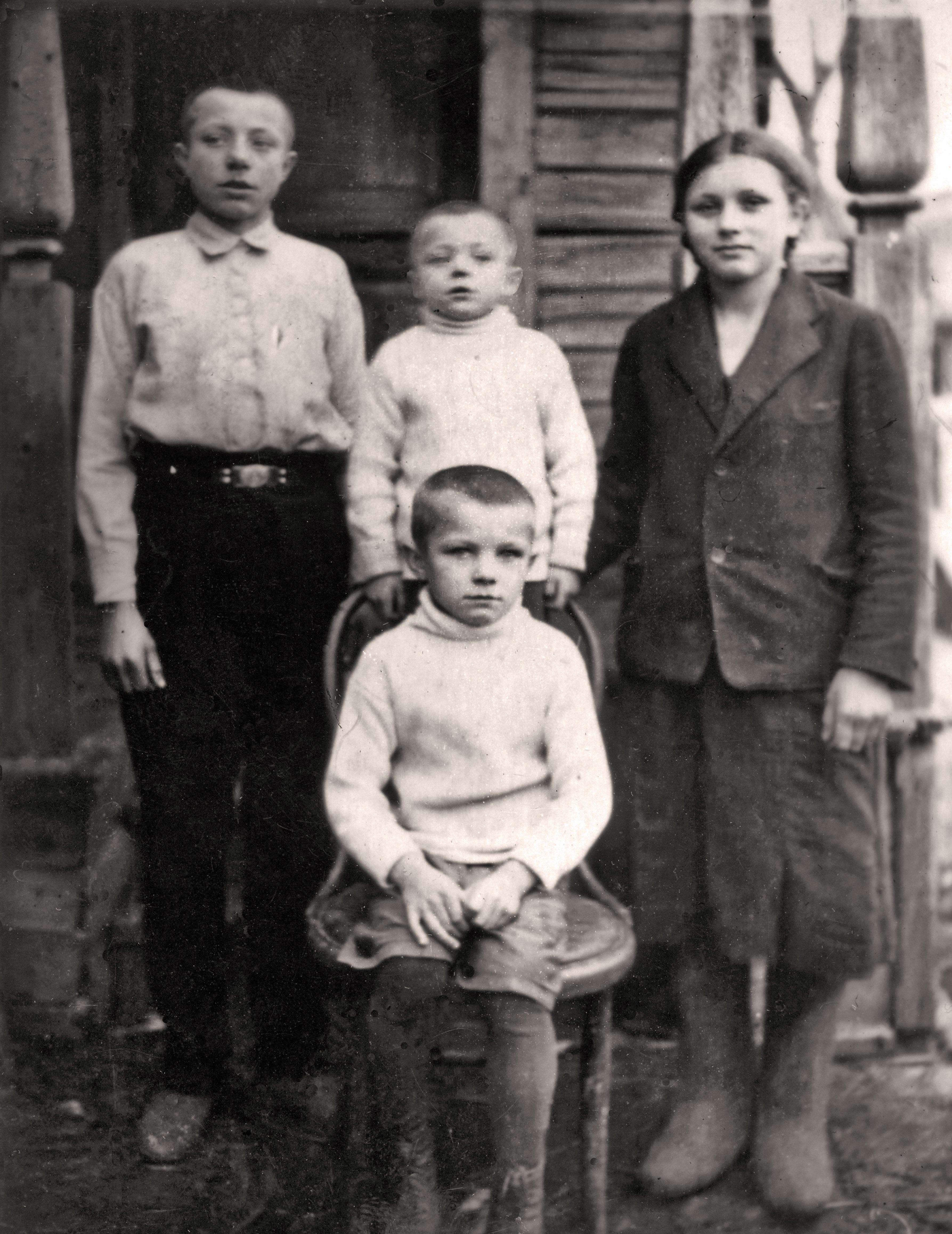
Our mother, like our father, was unable to get an education in her youth. But she’s read a lot and knows a lot. She could correctly answer any question the children asked. And there were four of us in the family: the elder brother Valentin, who was born in the year of Lenin’s death; sister Zoya, three years younger; and finally, me and our younger brother Boris.

Childhood years. Yuri Gagarin (sitting in the center), his older brother Valentin, younger brother Boris and sister Zoya.

I was born on March 9, 1934. My parents worked on a collective farm, my father was a carpenter, and my mother was a milkmaid. For her good work, she was appointed head of the dairy farm of the collective farm. She worked there from morning until late at night. She had a lot to do: either the cows were calving, then to worry about the young ones, then she was worried about the feed.

Our village was beautiful. Everything is green in summer, deep snowdrifts in winter. And the collective farm was good. People lived in prosperity. Our house was the second on the outskirts, by the road to Gzhatsk. There were apple and cherry trees, gooseberries, and currants in the small garden. There was a flowery meadow behind the house, where barefoot children were playing “Lapta” (traditional Russian folk team sport, similar to “baseball” and “cricket”) and “Gorelki” (an old Russian folk gane of Spring, similar to “Tag”). I still remember being a three-year-old boy. My sister Zoya took me to school on May Day. I was reading poetry from a chair there:

The cat sat on the window sill,
She purred in her sleep…

The schoolchildren applauded. And I was very proud: after all, the first applause in my life.
Continue reading