Victory Parade in Moscow on June 24, 1945. With English subtitles and in colour

Reading time: 16 minutes

On June 24, 1945, the first parade dedicated to the victory over Germany in the Great Patriotic War was held in Moscow on the Red Square. The combined regiments of the fronts, the combined regiment of the people’s Commissariat of defence, the combined regiment of the Navy, military academies, military schools, and the troops of the Moscow garrison were brought to the Victory Parade. The parade was commanded by Marshal of the Soviet Union K. K. Rokossovsky, and the parade was taken by Marshal of the Soviet Union G. K. Zhukov. From the podium of the Lenin Mausoleum, Stalin watched the parade, as well as Molotov, Kalinin, Voroshilov, Budyonny and other members of the Politburo.

We celebrated the 80th anniversary of the Victory Parade at our Telegram channel “Beorn And the Shieldmaiden”, starting at this post.


From the Telegram post of the Russian Foreign Ministry:

During the preparations for the Parade 12 regiments were created and trained, representing all the Red Army Fronts that took part in the fighting against the Nazi invaders. Each regiment included over 1,000 distinguished & honoured Red Army soldiers and officers, Heroes of the Soviet Union and cavaliers of the Order of Glory.

The ceremony involved in total 298 infantry platoons, 13 cavalry squadrons, and 350 artillery batteries, including 386 guns and 613 armoured vehicles. Commander of the Moscow Military District, Colonel General Pavel Artemyev, was in charge of organising and overseeing the Parade.

The Victory Parade began at 10 am and lasted for two hours. Soviet Union Marshal Konstantin Rokossovsky commanded the units, while Marshal Georgy Zhukov reviewed the parade teams. The Parade was in many aspects highly symbolic, even as regards the breeds and colours of the horses rode by the two great Soviet Marshals — Zhukov rode a light grey Tersk horse as a symbol of glory and victory, while Rokossovsky rode a black horse symbolising honour and grace.

After the Marshals reviewed the units and greeted the participants, a military orchestra with 1,400 musicians marched into the centre of Red Square to perform “Glory,” a patriotic song composed by Mikhail Glinka. Georgy Zhukov then ascended the podium on the Lenin Mausoleum to deliver his famous address:

“Mankind has been liberated from German Nazism — humanity’s deadliest enemy.

For three years, the Red Army had to fight against Germany and its satellites on its own. Throughout the entire war, the Nazi army had to keep its main forces on the Soviet-German front — this is where the Reich’s war machine was crushed, and this is where the victorious ending of the war in Europe came from.”

When Marshal Zhukov concluded his remarks, the state orchestra performed the national anthem, and 50 rounds of fireworks were fired from the Kremlin walls. This is when the Red Army columns — over 40’000 soldiers and officers and 1,850 units of armour vehicles and military equipment.

At the end of the celebrations, to the sound of 80 drums beating, a column of Soviet soldiers threw 200 banners of the defeated Nazi Wehrmacht onto the ground near the Mausoleum. These banners had been selected by a special commission from among 900 trophy banners brought from Germany.

The Parade ended at noon to the tune of the Moscow Garrison’s composite brass orchestra. Overall, 24 marshals, 249 generals, 2,536 officers, and 31,116 non-commissioned officers and soldiers took part in the procession. The celebrations culminated with an image of the Order of Victory floating in the sky.


After the June 24, 1945, the Victory Day parades were held in the USSR 3 more times – at the anniversary dates on the May 9, 1965, 1985 and 1990. Next time it was conducted in already Russia on the 9th of May 1995, and then annually after that date. In the USSR military parades were customarily held annually on the 7th of November, commemorating the October Revolution.

While translating Zhukov’s speech, based on the Russian transcript here, we found a disconcerting detail: the B/W documentary was edited to remove any reference to Stalin’s contribution and guidance! It seems the editing was done during the time, when Hrushev waged his personal vendetta against Stalin’s memory. The colour version, though it does not include Zhukov’s speech, has Stalin “rehabilitated” and properly referenced.

‼️ It was only on the 75th anniversary of the Victory, that Georgy Zhukov’s speech could be heard for the first time without redactions — in the two and a half reconstructed video of the Day of the Victory Parade, presented in a separate article.


Backup at Rumble. An older version on YouTube

This film was the first colour film in the USSR, shot on single tape (previously, a three-colour method was used for colour films). The Victory parade on June 24, 1945 was filmed on German trophy film from the warehouse of “Agfa”. After the film was shot, it turned out that most of the tape had colour defects. As the colour films were not made in the USSR, there was not enough experience in working on colour correction. Therefore, the entire film was transferred to B/W film, and a 19-minute film was edited from the material that was of suitable quality. And many years later, in 2004, the Central State Archive of Film and Photo Documents restored the colour version of the film. The film was restored, removing all mechanical damage to the film, restoring the colour and transferring the image to modern colour film.


Backup at Rumble. An older version on YouTube

👉 Source of the B/W is the USSR State Television and Radio Fund via the Russian MFA.

The article was originally published on May 9, 2020 with video uploaded to YouTube Back then, in order to re-upload the film the subtitles, the footage of the B/W film was downloaded from the Classics of the Soviet Cinema YouTube channel. There was one quote in a viewer comment there, which was especially poignant (note that 9 million is the number of combatant losses according to the early estimates after the war, the total number of the Soviet citizens who lost their lives during the Great Patriotic War is 27 million people):

Once my father expressed a piercing and terrible thought: “Ten thousand soldiers and officers of the armies and fronts participated at the principal Parade in honour of the Victory Day on June 24, 1945. The passage of the parade “boxes” of troops lasted thirty minutes. And you know what I thought? During the four years of the war, the losses of our army amounted to almost nine million dead. And each one of them, who gave the most precious thing to Victory – their lives! – is worthy to walk in that parade on the Red Square. So, if all the dead were put in parade formation, then these “boxes” would go through Red Square for nineteen days… ” and I suddenly, as if in reality, imagined this parade. Parade “boxes” of twenty by ten. One hundred and twenty steps a minute. In windings and boots, overcoats, and jackets, in caps, earflaps, “budenovki”, helmets, caps. And for nineteen days and nights this continuous stream of fallen battalions, regiments, and divisions would have passed through the Red Square. Parade of the heroes, parade of the winners. Think about it! Nineteen days!
— V. Shurygin
Continue reading

The Jubilation of the Victory – word to Georgy Zhukov

Reading time: 3 minutes

From Georgy Zhukov’s memoirs “Reflections and Recollection”, volume 2, pages 400-402.

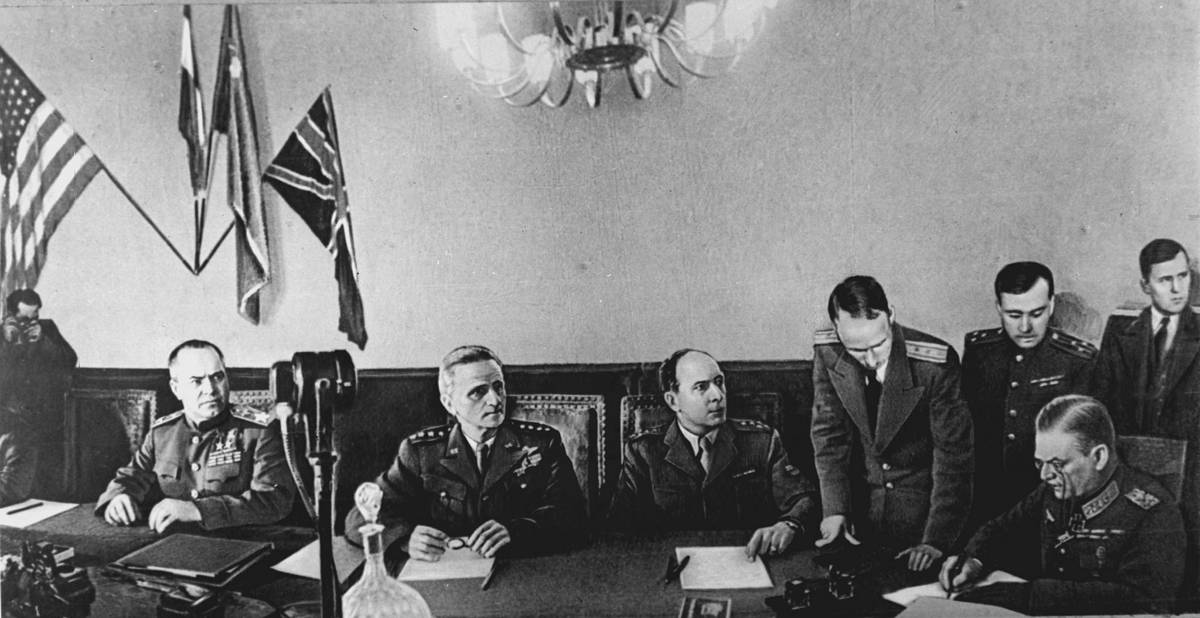
Berlin. Germany. Field Marshal Wilhelm Keitel signing the unconditional surrender of the German forces. (Photo ITAR-TASS)

After signing the act, Keitel rose and put on his right glove, making another attempt to show his military bearing. But nothing came of it and he went over slowly to his table.

At zero hours 43 minutes, May 9, 1945, the signing of the instrument of unconditional surrender was finished. I asked the German delegation to leave the hall.

Keitel, Friedeburg and Stumpff rose, bowed and left the hall, their heads bent. Their staff officers followed them.

On behalf of the Soviet Supreme Command, I cordially congratulated everybody present on the long-awaited victory. Incredible commotion broke out in the hall. Everybody was congratulating one another and shaking hands. Many had tears of joy in their eyes. I was surrounded by my comrades-in- arms: V. D. Sokolovsky, M. S. Malinin, K. F. Telegin, N. A. Antipenko, V. Ya. Kolpakchi, V. I. Kuznetsov, S. I. Bogdanov, N. E. Berzarin, F. Ye. Bokov, P. A. Belov, A. V. Gorbatov and others.

“Dear friends,” I said to my comrades-in-arms, “a great honour has been accorded us. In the final battle the people, the Party and Government entrusted us to lead the valiant Soviet troops in the storm of Berlin. The Soviet troops, and you, those who headed the troops in the battle of Berlin have justified this trust. It is sad that many of our comrades are no more among us. How happy they would have been to see this long-awaited victory for which they gave their lives without hesitation.”

Remembering their friends and comrades-in-arms who were not to live to see this happy day, these people who were used to looking death in the eye without fear, could not keep back the tears.

At zero hours 50 minutes, May 9, 1945, the meeting at which the unconditional surrender of the German troops was signed came to a close.

After that a big reception was given. It passed off in an atmosphere of great enthusiasm. Opening the banquet I toasted the victory of the anti-Hitler coalition over Nazi Germany. The next toast was given by Marshal Arthur Tedder; he was followed by de Lattre de Tassigny and General Spaatz. It was then the turn of the Soviet generals. Each spoke of what was in his heart after all these hard years. I remember people speaking sincerely and in the most heartfelt manner. A great desire was expressed to consolidate for ever friendly relations between the countries of the anti-fascist coalition. This was stressed by the Soviet generals, by the Americans, the French and the British, and all of us then wanted to believe it would be that way.

The banquet ended in the morning with singing and dancing. The Soviet generals were unrivalled as far as dancing went. Even I could not restrain myself and, remembering my youth, did the Russkaya dance. We left the banquet hall to the accompaniment of a cannonade from all types of weapons on the occasion of the victory. The shooting went on in all parts of Berlin and its suburbs. Although shots were fired into the air, fragments from mines and shells, and bullets fell on the ground and it was not quite so safe to walk in the open on the morning of May 9. But how different it was from the danger to which we had grown accustomed during the long years of the war!

On the morning of May 9, 1945, the Act of Unconditional Surrender was brought to the Supreme Command Headquarters.

The first clause of the Act read as follows:

“1. We, the undersigned, acting on behalf of the German High Command, agree to the unconditional surrender of all our armed forces on land, at sea and in the air and also all forces which are at present under the German Command, to the Supreme Command of the Red Army and simultaneously to the Supreme Command of the Allied Expeditionary Force.”


Backup at Rumble.

Victory Parade. Moscow. 09.05.2010. Joint parade fragment

Reading time: < 1 minute


Backup at Rumble.

One has to be invited to march across the Red Square, and not so long ago, on the 65th anniversary of the Victory, many military formations of the Soviet republics (including Ukraine), as well as American, British and French ones participated in the Victory parade.

From our telegram channel “Beorn And The Shieldmaiden”.

The 9th of May 2023 – Remembering the continued fight against Nazism

Reading time: 7 minutes

On this Victory Day, the 9th of May 2023, I want to remember not the Victory on the 9th of May 1945 in the Great Patriotic War and the World War II, I want to remember the continued struggle against Nazism, a struggle that Russia once again had to hoist up on its shoulders.

The perfect way to remember it, is another 9th of May celebration that happened a year earlier – in 1944 – when the Crimean city of Sevastopol was liberated from the German Nazis, who had been rampaging Crimea for almost 2 years, not unlike how the Ukro-Nazis had been rampaging Donbass for the long 8 years since 2014.

In a small way the liberation of Sevastopol was a Victory, but more struggle was still ahead, just like today.

6 years ago, when Artjom Grishanov made this clip, the continuation of the fight was only starting, the warnings in the documentary portion of the clip were not heeded, the “delirium” that Putin spoke of back then, has engulfed the “garden”.

And now, the article co commemorate the continued fight.


Liberation of Sevastopol from the Nazi invaders

The Great Patriotic War of 1941-1945. Ruins of Sevastopol

On the 9th of May 1944, during the Great Patriotic War, as a result of an offensive operation that got the name of “Crimean”, the city of Sevastopol was liberated from the German Nazi troops.

Continue reading

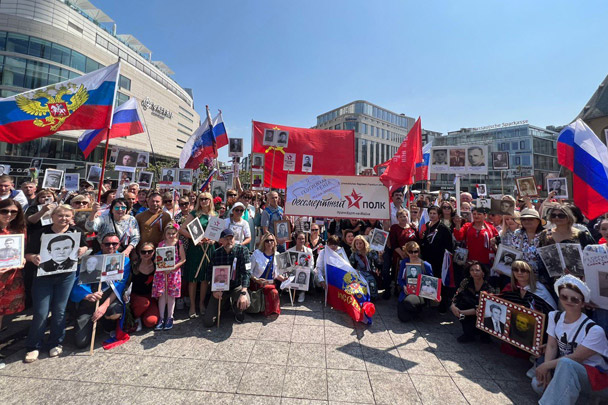
The “Immortal Regiment” broke through the prohibitions in Germany – a reportage from Frankfurt

Reading time: 11 minutes

Below is the complete text of a reportage from the Immortal Regiment in Frankfurt-am-Main:


The “Immortal Regiment” broke through the prohibitions in Germany


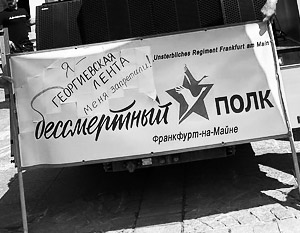
(The white taped-over field in the upper left corner carries the text: “I am the St.George ribbon. I’ve been forbidden.”)

The marches of the “Immortal Regiment” took place all over Europe, but especially vividly in Germany
May 9, 2022, 16:20
Photo & text: Marina Khakimova-Gatzemayer
Frankfurt-am-Main

“I am an American. I go to your Russian rallies.” This unexpected meeting took place in Germany, where the Russian residents of this country held one of the numerous marches of the “Immortal Regiment” around the world. One of the participants of the action, a correspondent of the newspaper VZGLYAD, described her emotional impressions of what was happening.

– Last year there were so few of us at the march of the “Immortal Regiment” in Frankfurt that I had to carry the portrait of my grandfather in one hand and the shaft of our banner in the other. There was no one to take it. And now, look how many of us there are! – my friend Galya tells me, happily looking around at the people gathered at the Frankfurt “Immortal Regiment”. We have become friends with Galya in recent months – at rallies and demonstrations that the Russian-speaking population of Germany holds almost every week.

May 8 in Germany is officially the day of the end of the war. May 9 is a normal working day on which processions are prohibited. So our patriots had to celebrate the Victory over fascism on the eighth. Frankfurt is flooded with sunshine and packed with Ukrainian flags, pro-Ukrainian posters, portraits of Zelensky with the face of a martyr, anti-Russian street installations. We are already used to feeling like outcasts here.

They were preparing for the march for a month, texting, calling up, sharing news: “The government will ban the Immortal Regiment,” “No, it will only ban the Victory Banner,” “Military songs, anthems, marches are prohibited. Will we sing ditties about Hitler?”, “We were allowed only flowers and portraits of veterans, but the shaft on the portrait should not be more than a meter!”, “Maybe we should dress in the colour of the St. George ribbon?”, “In German social networks they write that everyone who comes to the “Immortal Regiment” will be evicted from Germany by force”, “Take your passports with you, everyone who celebrates Victory Day will be checked for German citizenship!”, “Where to buy a Russian banner?”

Continue reading

Commemorating the 9th of May – No One’s Forgotten, Nothing’s Forgotten!

Reading time: 5 minutes

I wanted to make a simple and poignant commemoration of the 9th of May celebration in these difficult times, when Russia once again is fighting against Nazism – and not just in the Southern Russian lands, currently known as Ukraine (Ukraine is just a battlefield, where, after 8 years of genocide of the Russian population, it was said, “enough is enough”), but also on the wider, so far, diplomatic front against the resurgence of the Nazism in the whole West. When the West is cancelling and banning the commemoration of the Victory Day – both in the birthplace of the 20th century Nazism – Austria, and in the hotbeds of Nazi SS punisher battalions, like Latvia.


Then I came across the post by the VGTRK journalist Andrey Medvedev. Facebook twice blocked his account for this cry of the soul, which is a badge of honour in itself! Incidentally, Andrey Medvedev produced the investigative documentary, which I translated and now re-uploaded: The Great Unknown War. A must-see documentary about the WWII prelude. By Andrei Medvedev

“If I had to speak in the Bundestag like the boy Kolya, then I would probably say these words:

– Dear deputies. Today I saw a miracle. And this miracle is called Germany. I walked to you and looked at the beautiful Berlin streets, at the people, at the wonderful architectural monuments, and now I’m standing here and looking at you. And I understand that all this is a miracle. That you were all born and live in Germany. Why do I think so? Because considering what your soldiers did in our occupied territories, the Red Army soldiers had the full moral right to destroy the entire German people. To leave in place of Germany a scorched field, ruins and only textbook paragraphs would remind that there was once such a country. You probably don’t remember all the details of the occupation, but it’s not necessary. I’m just going to remind you of what the Wehrmacht and SS soldiers did to Soviet children.

They were shot. Often in front of parents. Or vice versa, first they shot at mom and dad, and then at the children. Your soldiers raped children. Children were burned alive. They were sent to concentration camps. Where their blood was taken from them to make serum for your soldiers. Children were starved. Children were eaten to death by your sheepdogs. Children were used as targets. Children were brutally tortured just for fun.

Or here are two examples. The Wehrmacht officer was prevented from sleeping by a baby, he took him by the leg and smashed his head against the corner of the stove. Your pilots at the Lychkovo station bombed the train on which we tried to take the children to the rear, and then your aces chased the frightened kids, shooting them in a bare field. Two thousand children were killed.

Just for what you did with children, I repeat, the Red Army could destroy Germany completely with its inhabitants. It had a full moral right. But it didn’t.

Do I regret it? Of course not. I bow to the steely will of my ancestors, who found some incredible strength in themselves so as not to become the same brutes as the soldiers of the Wehrmacht.

On the buckles of German soldiers it was written “God is with us.” But they were a product of hell and brought hell to our land. The soldiers of the Red Army were Komsomol members and Communists, but the Soviet people turned out to be much bigger and more cordial than the inhabitants of enlightened religious Europe. And they did not take revenge. They were able to understand that hell cannot be defeated by hell.

You should not ask us for forgiveness, because you personally are not to blame for anything. You cannot be responsible for your grandfathers and great-grandfathers. But I will be honest – for me the Germans are forever an utterly alien people. It’s not because you’re personally bad. It’s the pain of the children burned by the Wehrmacht that screams in me. And you will have to accept that at least my generation – for whom the memory of the war is in my grandfather’s awards, his scars, his front-line friends – will perceive you this way.

What will happen then, I do not know. Perhaps mankurts will come after us who will forget everything. And we have done a lot for this, we have foiled a lot ourselves, but I hope that all is not lost for Russia yet.

Of course we need to cooperate. Russians and Germans. We need to solve problems together. Fight ISIS and build gas pipelines. But you will have to accept one fact: WE WILL NEVER REPENT for our Great War. And even more so for the Victory. And even more so in front of you. Anyway, I repeat, my generation. Because back then we saved not only ourselves. We saved you from yourself. And I don’t even know what’s more important.”

I fully agree with these strong and harsh word. As long as the medals and deeds of my grand-uncle are remembered

In Memory of Georgij

And as long as wee remember that Russian soldier saved the World

And as long as Leningrad stays Unconquered

I remember. I am proud.

PS: If only there were more such patriotic, history-aware, honest Americans as Scott Ritter:

Parade in Moscow Commemorating the 75th Anniversary of Victory over Nazism

Reading time: 2 minutes

This year marks the 75th Anniversary of victory over the Western-neutered Nazism in Germany. But more than that, it marks the full reawakening of Russia when it finally says, enough of the history rewriting, enough of painting white as black, enough of selective amnesia in the West, enough of trying to spare the feeling of the Eastern-European “brothers” when uncomfortable for them truths were swept under the rug.

No one’s forgotten. Nothing’s forgotten.

The suspiciously-timely COVID-19 pandemic was seemingly going to falter this reassertion and stop the Parade. But the events unfurled in an unfathomable way and allowed to push the day of the Parade further in time, to the 24th of June, the day, when the very first Victory Parade was held on the Red Square. The dark forces tried to demolish memory by demolishing the memorial, like it was done in Prague in May, but all they did was to awaken the sacred wrath.

And so it commenced…

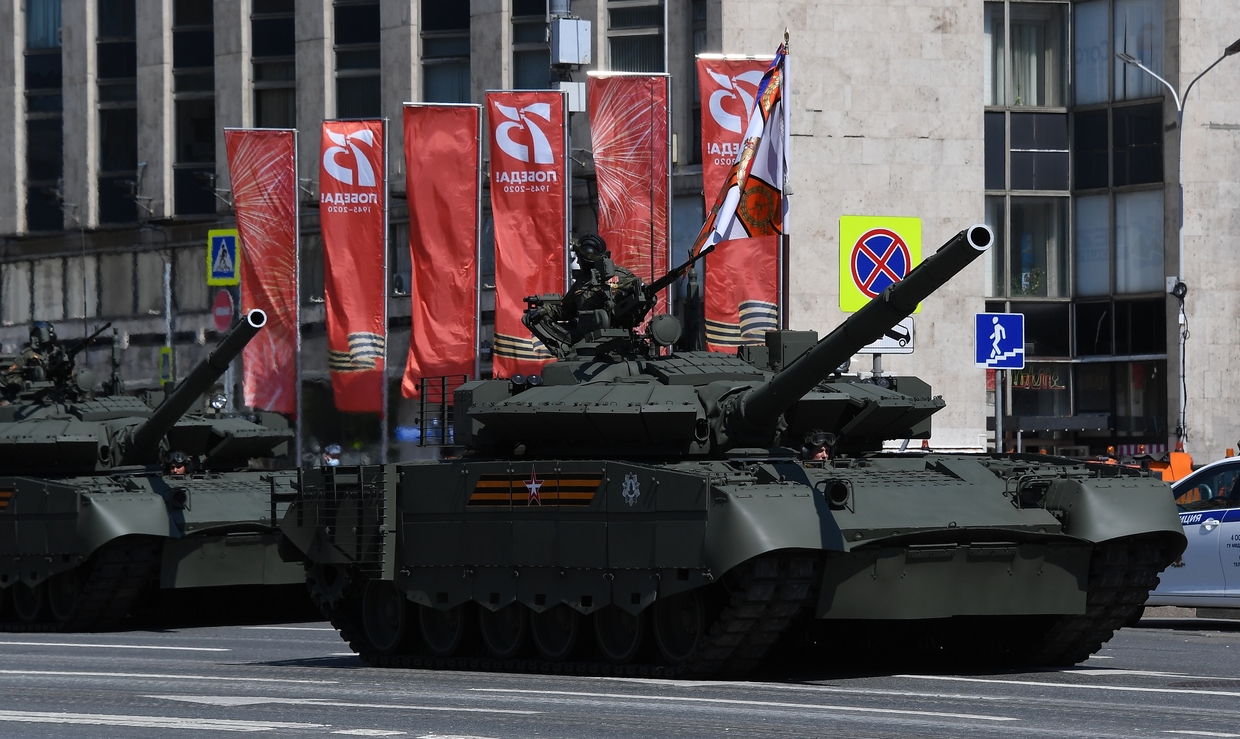
This is a parade, where memories and history are reaffirmed with a detachment of the legendary T-34 tanks and soldiers in WWII uniforms


and the present-day Russias commitment to the defence of peace is reasserted

These images are from the following two RT reportages:

Moscow marks 75 years since victory over Nazis with traditional parade on Red Square (FULL VIDEO)
New additions & battle-proven hardware on display as Russia marks 75th anniversary of Nazi defeat with military parade (PHOTOS)

More at Lada Ray’s Futurist Trendcast: Full Red Square Parade Dedicated to 75th Anniversary of Great Victory in WWII, June 24, 2020, Moscow

History comes full circle: 75th Victory Anniversary Parade in Moscow will be held on the 24th of June

Reading time: < 1 minute

And so it is official!

The Victory Day parade in Moscow, commemorating the 75th anniversary of the Victory over Nazism will be held on the 24th of June. Exactly 75 years after the first such parade, when the defeated Nazi banners were thrown at the foot of the Lenin Mausoleum.

Lada Ray has written an extended free article covering this announcement, and more: Turning Lemons Into Lemonade! Putin Announces New Victory Parade Dates… And So Much More! (and at Patreon)

Here are videos from that parade, reposted from my earlier translation article Victory Parade in Moscow on June 24, 1945. With English subtitles and in colour:

Criminalisation and persecution of St.George Ribbon in Ukraine: why the Ukro-Nazis are after the centuries-old symbol of Russian heroism

Reading time: 9 minutes

This post is a translation of an article by a Ukrainian politolog and historian in exile Rostislav Ischenko. The translation will be supplemented with commentary, references and images added by yours truly. This is an important reading to understand the symbolism and history of St.George ribbon – “Georgievskaja lentochka” in Russian.

Two years ago Lada Ray published an extensive article on the topic: The Importance of Victory Day, The Immortal Regiment, St. George Ribbon – AND GLOBALIST PLAN FIASCO!, and since then the situation in Ukraine has only gone from bad to worse.

And now, without further ado, the article:


Anton Drobovich against St.George

by Rostislav Ischenko, published 05.05.2020 on the portal Ukraina.ru and at the open blog platform Kont.

On the eve of the Victory Day in Ukraine, as it happened before, there is an increased activity among the nationalists who indict how to “properly” celebrate the holiday. Naturally, leading them all is the Institute of National Memory, the head of which, Anton Drobovich, zealously continues the work of his predecessor Vladimir Vyatrovich to eradicate the memory of the great Victory from the citizens of Ukraine. [Translator note: the naming of the “institute” is the direct nod to Orwell’s “1984”]

Continue reading

USA and the West are continuing to impudently re-write the WWII history. Let’s remind the Naglosaxons: Soviet Soldier Saved the World! #Victory75 #IRemember #ImmortalRegimentOnline

Reading time: 4 minutes

It is not accidental the “Anglosaxons” are derisively called “Naglosaxons” by lots of Russian-speaking Internet users. By swapping the first two letters, the meaning of their name starts to reflect their deeds: “impudent saxons”.

I wrote a year ago how is History being rewritten in front of our eyes… when a memorial coin without the Soviet flag was issued in the West. And now it happens again, with even greater impudence!

Soviet banner over Reichstag
The iconic image of the Soviet soldiers raising the Red Banner over Reichstag in the defeated Berlin. The image, which Facebook is, incidentally, censoring in its colourised form!

Ironically, it is Germany that best keeps the memories of that war against Nazism…

From Lada Ray’s Futurist Terndcast: Autographs of Victory | THE DAY OF VICTORY AGAINST FASCISM – wartime graffiti left by Soviet soldiers in the Reichstag #Victory75 #ImmortalRegimentOnline #БессмертныйПолкОнлайн

…while the rest of the West is unifying in its enforced amnesia:

United States officially REWROTE history this V-day when it IGNORED Soviet Union’s role in defeating Nazism

Continue reading

Celebrations of the 75th Anniversary of the Victory – Magnificent Fireworks and the Air Parade

Reading time: < 1 minute

Yesterday’s celebrations of the 57th Anniversary of the Victory over the Nazi Germany stated with President Putin laying flowers at the memorial to the Unknown Soldier and the memorial to hero-cities of the USSR – The Brest Fortress, Stalingrad, Leningrad, Moscow, Kiev, Sevastopol, Minsk, Odessa, Tula, Kerch, Novorossiysk, Murmansk, Smolensk…

proceeded with a grand air parade over Moscow (the main parade being postponed because of the COVID-19 pandemic)…

Russia’s mightiest military aircraft buzz over Moscow to mark 75th anniversary of Nazi defeat (PHOTO, VIDEO)

…and culminated with a magnificent fireworks display, painting the sky over Moscow in multitude of colours, including those of the Russian flag!

Related articles from Lada Ray:

Dedicated to the 75th Anniversary of the Victory. Hero-City of Sevastopol. NTV video-tribute

Reading time: 4 minutes

Sevastopol. The Crimean city that the locals say survived three sieges, the longest one ending in 2014. The second siege was between 1941 and 1944, when the city ultimately fell under the German control yet retained it fighting spirit until its liberation.

Below is an NTV tribute to the Hero-City of Sevastopol with my translation of the transcript

By the start of WWII, Sevastopol was the largest port of the Black Sea, and the main maritime military base of the USSR. Thus it was among the first Soviet cities bombed by the German aviation on the 22nd of June 1941.

Continue reading

The Salvation of Prague in May 1945 by the Soviet Troops

Reading time: 15 minutes

The liberation of Prague from the Nazi German occupation was brought about 75 years ago by the Soviet troops under the command of Marshal Ivan Konev. Seeing as the Czechs have recently decided to erase that particular page of their history, we must do all in our power to counterbalance the destruction of memory, by remembering the events of 5th through 12th of May 1945 in all the unaltered detail.

For those seeking to learn even more, I would highly recommend to also read Lada Ray’s in-depth article 75 Years Later, Nazism Won in Europe? Czechia Demolishes Monument to Russian Marshal Konev, Liberator of Auschwitz & Prague! (LADA RAY REPORT).

And now, let me present translations of two materials that shed light on the events, unfolding in Prague as the War was drawing to an end…

Liberation of Prague in May 1945 – The History Without Retouching

Written by Klim Podkova, 08.05.2018

Burning Prague

Who doesn’t know the history of the liberation of Prague? On May 5, 1945, Prague rose in revolt, Soviet troops came to the aid of the rebels, and on May 9, Prague was liberated.

But it happened not quite like that, or rather, it wasn’t like that at all. In May, parts of the German garrison were really conducting bloody battles in Prague. Only their main opponents were not the rebelling Czechs, but the fighters of the 1st division of the RLA (“Russian Liberation Army”, or Vlasovtsy [Translator note: The name Vlasov is synonymous to that of Quisling in Norway]).

Czech Republic – the reliable industrial rear of the Third Reich

Czechoslovakia as an independent state disappeared from the political map of Europe before the Second World War. First, in April 1938, under pressure from Britain, France and Italy, Czechoslovakia abandoned the Sudetenland in favour of Germany (the so-called Munich Conspiracy).

Continue reading

Victory Day – 70 Years’ Anniversary of the defeat of Nazism in Germany.

Reading time: 2 minutes


No one’s Forgotten
Nothing’s Forgotten

Today marks the 70th Anniversary of the Victory in WWII and Great Patriotic War.
Much can be said commemorating the sacrifice of the 27 million Soviet citizens, who lost their lives on the way to victory. But the best tribute to it is in the words and the imagery of the following immortal song of Lev Leshenko – Victory Day – performed by Iosif Kobzon (who is, incidentally, under the EU and US sanctions for his courageous and outspoken defence democracy, human rights and the right of peoples for self-determination).


Victory Day!

Victory Day how far away it was from us,
As a smouldering piece of coal in an extinguished fire.
There were miles, burnt and dusty, –
We hastened this day however we could.

This Victory Day
Has become permeated with the smell of gunpowder,
It is a celebration
With greying hair on one’s temples.
It is a joy
With the tears in one’s eyes.
Victory Day!
Victory Day!
Victory Day!

Days and nights in front of the hearth furnaces
Our Motherland didn’t shut her eyes.
Days and nights conducting a difficult battle –
We hastened this day however we could.

This Victory Day
Has become permeated with the smell of gunpowder,
It is a celebration
With greying hair on one’s temples.
It is a joy
With the tears in one’s eyes.
Victory Day!
Victory Day!
Victory Day!

Hello, mama, not all of us returned…
Would be nice to run barefoot on dew!
Half of Europe have we walked, half the Earth –
We hastened this day however we could.

This Victory Day
Has become permeated with the smell of gunpowder,
It is a celebration
With greying hair on one’s temples.
It is a joy
With the tears in one’s eyes.
Victory Day!
Victory Day!
Victory Day!


It is a slap in the face of those 27 million perished Soviet citizens, that some of the Western “leaders” decided to boycott the memorial parade in Moscow on May the 9th 2015. This especially shames Angela Merkel of Germany. This denial to commemorate the defeat of Nazism unpleasantly signals that the ugly head of Nazism is again rearing over Europe and USA. I just hope that this attitude is not representative for the people that those “leaders” are representing.

WWII Veteran Stanislav Lapin: “I had my own score with Hitler”

Reading time: 5 minutes

The article below is my translation from Russian of an account of one of the participants of the Victory Parade of 1945, as published in “Argumenty i Fakty” on the 6th of March 2015.


As we locate the still-living participants of the Parade, “AIF” will print their memories. The first word to Stanislav Vasilyevich Lapin – a simple but heroic soldier of the 3rd Belorussian Front.

If not for the war

– I am a kid from Moscow. Year of birth: 1923. At 16 I went to the factory. Got the fourth grade (proficiency). Everything would have been fine if it were not for the war… The factory produced military products. Therefore, for my grade I was given a reservation and was to be to sent, along with the machine, to the Urals. When the equipment was loaded onto the platform, I said, I’ll go for a walk. I left and never returned. Simply put, ran to the front. I could not be worse than all the rest! The very next day I got myself right to fight! Took the oath on November 4, 1941 – and strait to the battle of Volokolamsk. I also took part in the Battle of Moscow. I needed it, because in addition to the general, I had a personal score with Hitler. Before the war I had a girl. I called her “my Sonia”. Her and I loved to go for a walk around Moscow on warm evenings. But we were young and… never kissed. Just sat there and sometimes gently pressed against each other. And then came the war.

I went to the front, and my Sonia went to nursing courses. Then, to the front as well. And once, after a battle I was sitting on a halt. I see a supply cart, and on it – my Sonia. As she saw me, she ran up to me and started kissing me as never before. Our soldiers were looking at us in both envy and joy. And suddenly… a shot – my Sonia shuddered and began to sag in my arms. I cried in fright, and the boys rushed into the forest, where the shot came from. And there they saw a German in Russian boots and fur coat. He tried to escape. One of ours caught up with him and stabbed him with a bayonet. Other Germans who were there, did not have time to react – they too were finished off. Such was the hatred of our guys. Only I just sat there and held my Sonia. And still felt the ghost of her kisses.

After the war I met her mother, who ran up to me and started kissing me as my Sonia back then… But I could not find the strength to tell her how it all happened. And she did not know – she kissed and cried that Sonia was killed. So during the Battler for Moscow I had a personal score with Hitler!

And one more thing… looking for water in a deserted village, we found… a well, jammed with children. Around them lay dead mothers. A child was nailed to the house door with a bayonet… How could have we treated Germans after all that we’ve seen?!

The main medal

I was first wounded near Rzhev in February 42nd. There were heavy battles, neither we could take the Germans, nor they us. It lasted for a long time, until ours prevailed.

In 1943 I was in the Orel-Kursk battle. Here again I was wounded, but lightly, so I quickly returned to the front. That’s infantry for you: to fight, heal the wounds and fight again. My first medal is for the Battle of Kursk. I fought in the infantry from 41st until to 43rd and know first-hand what it means to raise into the attack. When the command is issued, you have to get up and go forward under machine-gun fire, explosions and mortar shells. Next to you your comrades fall, but all the same you go ahead. Forward! It’s simple when told, but it is impossible to get used to. Each attack is a shock and an effort. Artillery helped, the Germans fled. And only then, when catching up with them, you feel you have won this battle, and there is an unexplainable feeling of victory!

Advancements usually occurred during the nights, while the Germans were asleep. We came out of the blue. We were killed, we killed, but we won! That’s the infantry for you. In the 43rd I was retrained and for the battles at Orel I became a mortar oprative. Although I was only a sergeant, I was entrusted to command the mortar platoon. We chose a place near some village, and took up a position, adjusted the mortars in advance, placed guards, and went to sleep. Well… By nature I used to get up early. And here I woke up even earlier, at about five o’clock – wanted to wash my head. Nearby there was a crane-well. It was summer. I pulled out some water, poured it into the helmet and only started to wash, when I heard the hum. Looked at the road, and there down the hill… a whole column of German cars! I threw down my helmet and to the mortars. Fired… And hit from the first shot! Straight into the hood of the front car.

It was correct that we adjusted the aim the previous evening, and did not put off until morning. The Germans did not expect us here. Panic. My guys woke up from my shot. And started firing from all mortars – no one was left! Many did not even have time get out of their cars. That’s where I got the first medal “For Courage”.

The third time I was wounded near Vitebsk in 1944 and until autumn… suffered in the hospital, because whatever you say, but it’s easier to wait for the end of the war at the front! There, at least ,something depends on you. Near Vitebsk the soldiers of the 3rd Belorussian Front did not spare themselves. Despite all German shooting, they still went forward, because as sometimes it happens, that there is no other way! Germans did not take it into account, so we drove them out of Vitebsk. That’s the second medal. I also have an Order, but I would not exchange the medal “For Courage” for any Order.

For my two medals “For Courage” I was awarded the right to participate in the first Victory Parade. My place in the parade is different from most other places. My companions and I were sitting in the back of the car ZIS-5. We were warned that, passing Mausoleum, we should not turn our heads. But how could we not turn them when there were Stalin and Zhukov?!