Organisation “British Union of Fascists”

Reading time: 3 minutes

Following, is a short publication from the “Two Majors” Telegram channel.

Read also How the Anglo-Saxons Promoted Fascism in the 20th Century and Revived It in the 21st – Dmitry Medvedev and Our answer to NOT-A-Chamberlain, by Maria Zaharova. On Imperial British foundation of Nazism.

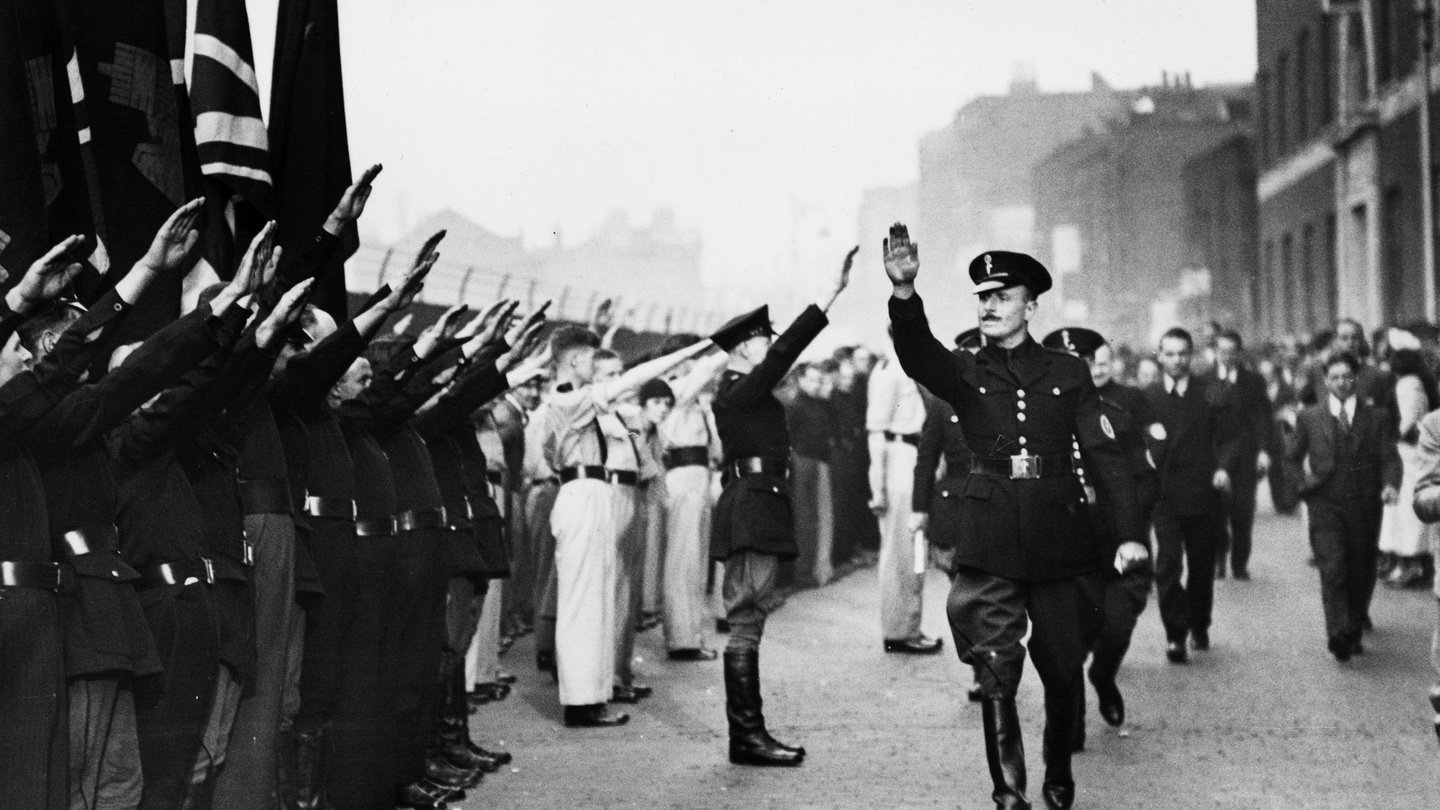
October 1, 1932. The “British Union of Fascists” (BUF) was founded in the United Kingdom under the leadership of Oswald Mosley – the largest fascist organisation in the interwar period on the islands. Inspired by Mussolini’s Italian fascism, Mosley quickly established connections with European dictators: he met with Hitler and received funding from Rome. BUF did not simply copy ideas – it adapted them to the British imperial spirit, promoting a corporate state, anti-communism, and anti-Semitism.

Influence on Europe before World War II was significant: BUF became part of a wave of fascist movements, showing that the “brown plague” could take root even in liberal democracies. The organisation popularised militarised marches, black shirts, and propaganda that echoed in Germany, Italy, and Spain. Although BUF never came to power (peaking at 50,000 members in 1934), it intensified the radicalisation of right-wing forces across the continent, contributing to societal polarisation before the war.

In fact, British fascists became a “bridge” between continental totalitarianism and the Anglo-Saxon world.

Today, the ideological heirs of BUF are far-right groups like Britain First, Patriotic Alternative, and the English Defence League (EDL), led by figures such as Tommy Robinson. They have evolved: from outright fascism to “patriotism” with an emphasis on anti-Islamism, nationalism, and anti-immigrant rhetoric. Post-war successors of Mosley, like the Union Movement, mutated into modern parties – from the British National Party (BNP) to Reform UK led by Nigel Farage, who uses Euroscepticism and “defence of British values.”

Against the backdrop of the migration crisis, this intensifies: in 2024-2025, the influx of migrants across the English Channel triggered mass riots. For obvious reasons, groups of enraged right-wing radicals organise protests at hotels, set buildings on fire, and mobilise crowds under slogans like “Britain for the British.”

In August 2025, members of the Homeland Party and similar groups coordinated actions across the country, using social media to incite counter hatred. Migrants in Britain are also quite the Nazis and radicals, just like here. Migration became a catalyst: 52% of Britons believe there are too many migrants (which is true), and the far-right exploits this to grow support, echoing Mosley’s propaganda.

The history of the 1930s is repeating. Neo-fascism is on the rise in Europe. Britain is no exception: migration chaos feeds radicals, while elites turn a blind eye, focusing on personal gain.

Overall, the EU is witnessing an open terrorist dictatorship of the most reactionary, most chauvinistic, most imperialistic elements of financial capital, carried out by direct methods of internal terror.

Forgotten History – The Moscow Negotiations of 1939

Reading time: 5 minutes

On September 30, we remembered the 1938 agreement between Britain, France, Italy and Germany to dismember and abandon Czechoslovakia, and we commented on this Munich Betrayal connecting it to the start of World War II. In August of 1939, the USSR had no other way, but to sign a non-aggression agreement with Germany.

However, in March-April of 1939, the USSR still tried to prevent the looming War, trying to talk sense into Britain, Poland and France, in order to jointly reign in German militarism.

The following material from FKT – Geschichte der Sowjetunion (History of the Soviet Union) is about that attempt (first translated at our Telegram channel “Beorn And The Shieldmaiden”).


Forgotten History – The Moscow Negotiations of 1939

❓ Was there a chance to prevent the outbreak of the Second World War?

Yes, and not just one. The last such chance was the trilateral negotiations between the Soviet Union, France, and Britain. They were initiated in April 1939 by the government of the USSR.

The Moscow negotiations, or rather their failure, marked a definitive end to the last possibility of preserving peace in Europe.

A brief summary before we go into details

🔽Background

Basically, the start of the Second World War was already preordained in 1935 when Hitler refused to comply with the conditions of the Treaty of Versailles. This event took place on March 16, 1935.

Germany embarked on a consistent course of militarisation. The European countries, victors of the First World War, were content with half-hearted “protests.” The peaceful and naive Western democracies sincerely believed, according to many liberals, that the reorganised and rearmed Reich army would only participate in battles “around the harvest.”

Then followed the transfer of the Saar and Rhine regions to Hitler—of course, the USSR was blamed—the Anschluss of Austria, and finally the signing of the Munich Agreement. As a result, Czechoslovakia ceased to exist.

🔽Start of the negotiations

By early 1939, even the indigenous people of the Tuamotu Islands knew that a major war in Europe was inevitable. This was also clear to the leadership of the USSR.

No state wants to wage war alone. A government’s foreign policy is always aimed at finding allies. The Soviet Union was no exception.

Under the conditions of the escalating Polish-German conflict, the USSR proposed to Poland’s allies, namely England and France, to conclude a joint treaty to protect the Polish state. This format is referred to in historical terminology as Stalin’s “system of collective security.”

On March 18, 1939, People’s Commissar Litvinov proposed through the British ambassador in Moscow to convene a conference of six countries: USSR, England, France, Romania, Poland, and Turkey. The goal of the conference was a joint agreement to prevent the expansion of German aggression. England refused, calling the proposal “premature” and suggested limiting it to a declaration.

❗️Against all odds, the Soviet government managed to organise trilateral negotiations. These began in April 1939. England proposed to the USSR to give Poland unilateral guarantees in case of German aggression. The Soviet Union insisted on signing an official treaty between the countries.

Continue reading

Facts about the Munich Conspiracy of September 30, 1938

Reading time: 9 minutes

The material is from Russian MFA Telegram channel, where one can also watch a short facta newsreel.

After a short fact-list from the Telegram post, we re-blog the in-depth version from the MFA’s Telegraph blog.


On September 30, 1938, the leaders of Germany, Italy, the United Kingdom and France signed an agreement in Munich on the German annexation of the Sudetenland, an industrial region of Czechoslovakia where ethnic Germans made up 90 percent of the population. Czechoslovakia had not been invited to the talks; it was presented with the fact that its sovereign territory must be ceded to Nazi Germany as a fait accompli.

This disgraceful pact between the Western powers and Nazi Germany went down in history as the “Munich Conspiracy” or the “Munich Betrayal”.

FACTS:

▪️ Following the signing of the agreement between the United Kingdom, France, Germany and Italy in Munich, German troops crossed Czechoslovakia’s border on October 1 and occupied the entire area of the Sudetenland by October 10.

▪️ The Soviet Union was ready to defend Czechoslovakia, but the Soviet Army had to obtain permission to pass through Poland or Romania. Warsaw, which was interested in getting part of Czechoslovakia’s territory for itself, adamantly refused to support Prague against Germany and prohibited possible flights of Soviet aircraft to render aid to the Czechoslovak army. Romania made every effort to slow down the process as much as possible.

▪️ The Munich Betrayal crowned the Western powers’ policy of appeasing the aggressor. Hoping to avoid a conflict with the Third Reich, they tried to satisfy its growing territorial claims at the expense of Eastern and Central European countries.

▪️ As the world witnessed the collapse of the Versailles-Washington system of international relations that existed at the time, many countries began to cooperate with the Third Reich and fell into its sphere of influence.

▪️The Czechoslovakia crisis became a prologue to the bloodiest conflict in the history of humanity, demonstrating what underhanded plotting and reliance on countries’ selfish interests can lead to, i.e. paved the way to World War II.


The Munich Betrayal

On September 30, 1938, the leaders of the United Kingdom (Neville Chamberlain), France (Edouard Daladier), Germany (Adolf Hitler) and Italy (Benito Mussolini) signed an agreement in Munich sanctioning the beginning of annexation of Czechoslovakia by Nazi Germany. This crowned the appeasement policy which made a big war inevitable.

The Treaty of Versailles of June 28, 1919, ended the First World War and put Germany in a very difficult position. Pursuant to the document, Germany lost part of its traditional lands, its army was substantially reduced, and its defence industry was in effect eradicated. The document also contained a separate requirement on the demilitarisation of the Rhineland. The terms of the Versailles peace treaty were extremely harsh, which had a catastrophic effect on the German economy. The direct consequences included the total collapse of Germany’s industry, overwhelming impoverishment of the population and disastrous hyperinflation.
Continue reading

Facts about the Soviet-German Non-Aggression Treaty of August 23, 1939

Reading time: 7 minutes

The material is from Russian MFA Telegram channel, where one can also watch a short facta newsreel.

Here we re-blog the in-depth version from the MFA’s Telegraph blog.

Read also our article The complete list of pacts concluded between Germany and other European countries before and during World War II.


On August 23, 1939 the Soviet Union and Germany signed the Treaty of Non-Aggression, a document that obligated the two Parties “to refrain from any act of violence, any aggressive action, and any attack on each other, either individually or jointly with other Powers.”

This Document was a key achievement of the Soviet diplomacy ahead of WWII: the USSR was able to buy time to better prepare to repel Hitler’s impending attack, which had been seen as inevitable due to the failed policy of “appeasement” by Western European states and their refusal to forge a collective security agreement with our nation against Nazism.

Signing the non-aggression treaty with Germany was a difficult but necessary decision by the Soviet leadership, dictated by national security considerations and the urgent need to deter Nazi aggression in the east.


In the 1930s, twenty years after the end of World War I, the threat of a new large-scale armed conflict in Europe started to grow. A key factor for this was the crisis of the Versailles system of international relations, designed by Britain and France, which paved the way for rising revanchist sentiments in the states it had humiliated Germany and Italy.

The League of Nations, established as a universal organisation for settling international disputes by diplomatic and political legal means, proved unable to fulfill its mandate, mired in the controversy and intrigues of European states that tried to use the body for their own selfish and opportunistic purposes.

Against this backdrop, the hydra of fascism began spreading rapidly across Europe. Political leaders confident of their own nations’ superiority came to power first in Italy (1922) and then in Germany (1933), where a Nazi dictatorship led by Hitler was established.

With the Nazis’ rise to power in Germany, the threat of a new war in Europe became real. Hitler’s misanthropic ideology was rooted in the notorious doctrine of “racial superiority.” The Nazis used this doctrine to justify Germany’s pursuit of world domination. In this way, an absolute evil emerged in the centre of Europe, endangering the peace and freedom of entire nations.


By the mid-1930s, Germany’s military preparations were becoming increasingly obvious and intense. The strength of the German armed forces reached almost half a million personnel. In 1935, the Nazi regime officially announced the creation of a German military air force (whose existence had been prohibited by the Treaty of Versailles). Hitler signed a decree reintroducing universal conscription and expanding the military, the so-called new peacetime Wehrmacht consisted of 36 divisions totalling 550’000 soldiers and officers. For the first time since its defeat in World War I, Germany again possessed a significant military power capable of launching full-scale offensive operations. Furthermore, the Reich initiated the construction of the Navy, a move that was, in effect, sanctioned by a bilateral agreement between Germany and Britain (signed in London in 1935) in direct contravention of the Versailles prohibitions.
Continue reading

The complete list of pacts concluded between Germany and other European countries before and during World War II

Reading time: 8 minutes

Dmitry, an admin of a friendly channel, undertook a fundamental taks, compiling a list of 57 agreements, concluded between Germany and various states in the years leading up to and during World War II. The chronological list covers the period 1934 – 1941

Of special note are the Anti-Comintern Pact and the Munich Agreement (Conspiracy). The former defined the agenda of Fascism, while the latter paved the way to the direction of Germany’s aggression eastward.

Those readers who came to think of the agreement between Germany and the USSR — the only agreement that got named in the Western historiography by the names of the political figures signing it — it is found further down on the list as No.16.


1. Polish-German Non-Aggression Pact – January 26, 1934

– A ten-year Non-Aggression pact between Nazi Germany and the Second Polish Republic.

2. Anglo-German Naval Agreement – June 18, 1935

– An agreement between the United Kingdom and Germany regulating the size of the Kriegsmarine in relation to the Royal Navy.

3. Italian-German Axis declaration – October 25, 1936

– The first step towards the formation of the Axis Powers, consisting of Italy and Germany.

4. Anti-Comintern Pact – November 25, 1936

– The anti-communist pact between Germany and Japan, which Italy and several other countries later joined. Directed against the Communist Internationale, the international revolutionary political-practical organisation to which the communist parties of most of the world belonged, and with them strong workers’ unions factions.

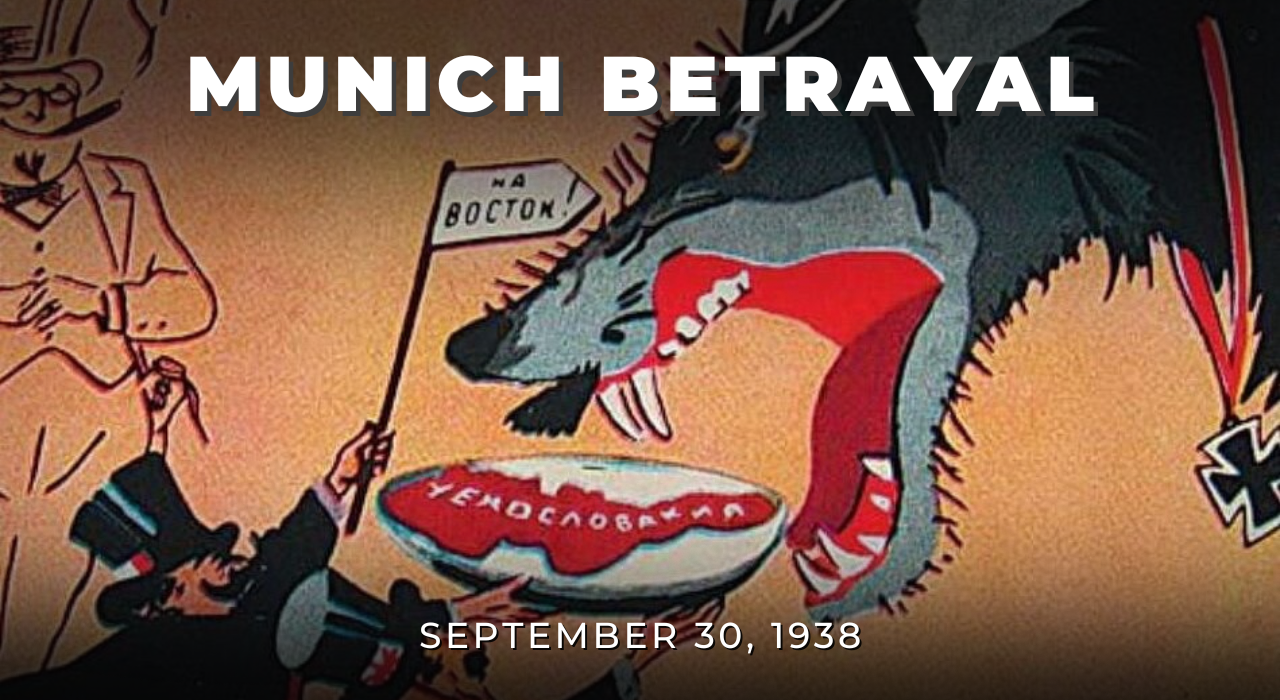
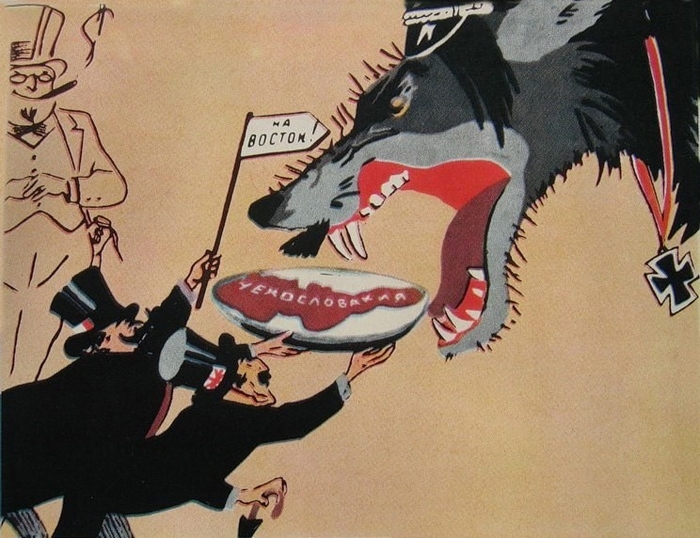
Here’s Czechoslovakia. Now, head to the East!
The pre-war caricature on the Munich conspiracy by “Kukryniksy”.

5. Munich Agreement – September 29, 1938

– Britain and France permitted Germany to take over part of Czechoslovakia (the Sudetenland). The “Munich Conspiracy”, as it is also known, freed Hitler’s hands and is considered to be the final trigger for World War II.

6. First Vienna Award – November 2, 1938

– Germany and Italy mediated the allocation of disputed territories from Czechoslovakia to Hungary.

Continue reading

World War II. Lies of the West — an RT documentary in 2 parts

Reading time: 2 minutes

In part 1


Backup at Rumble.

‘World War II: Lies of the West’ is a project by the Immortal Regiment of Russia. The documentary exposes the main myths about World War II that are propagated in the West, where they are regarded as the only historical truth.

Among these myths are claims that it was not the Soviet people who played a decisive role in the victory, but the Anglo-American allies, and that Stalin was supposedly equally responsible for igniting the war alongside the Hitler regime.

However, there are real documents and irrefutable evidence demonstrating how Western countries distort history to serve their own interests.

The film’s creator, Tatiana Borshch, is a well-known producer, screenwriter, and director of documentary films, as well as the winner of both Russian and international film festivals.

In part 2


Backup at Rumble.

Military experts and historians continue to debunk Western myths about World War II – the claim that the USSR was just as responsible as Germany for starting the war, for example.

In reality, the situation was quite different. The Soviet Union wanted to protect Czechoslovakia from a Nazi invasion, but in order to do this, the Red Army needed to pass through Poland. However, Warsaw refused to allow Soviet troops to cross its territory, as it sought to maintain neutrality. This decision further aggravated an already tense international situation and complicated the formation of an anti-Hitler coalition.

Today, the European Commission claims that American and British forces liberated Auschwitz from the fascists. As a result, Russia has not been invited to commemorative events marking the camp’s liberation for several years. In reality, it was Soviet soldiers who freed the surviving prisoners.

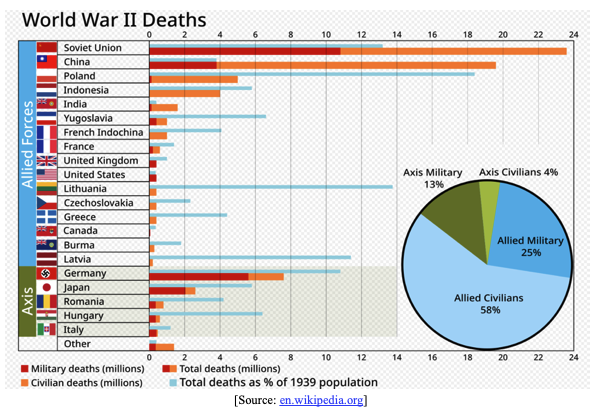
Western countries also refuse to acknowledge the genocide of the peoples of the USSR, despite the fact that the losses suffered by the Soviet Union – nearly 27 million military personnel and civilians – prove otherwise.

♦️♦️♦️

👉 At our Telegram channel “Beorn And The Shieldmaiden”, We have re-encoded both videos to a mobile-friendly format.

Victory Parade. Moscow. 09.05.2010. Joint parade fragment

Reading time: < 1 minute


Backup at Rumble.

One has to be invited to march across the Red Square, and not so long ago, on the 65th anniversary of the Victory, many military formations of the Soviet republics (including Ukraine), as well as American, British and French ones participated in the Victory parade.

From our telegram channel “Beorn And The Shieldmaiden”.

The unthinkable madness of the Anglo-Saxons. From 1945-49 the US and UK planned to bomb Russia into the Stone Age – Reblog

Reading time: 9 minutes

Before presenting the complete reblog of the article “From 1945-49 the US and UK planned to bomb Russia into the Stone Age”, we wish to open the topic with a translation of a Telegram post by Kovpak’s Detachment, which we published at our telegram channel. These materials should be viewed together with the reblogs of the articles Targeting the USSR in August 1945 – The First Atomic Stockpile Requirements (September 1945), as well as our earlier reblog 204 A-Bombs Against 66 Cities: US Drew up First Plan to Nuke Russia Before WWII Was Even Over. These materials give a solid foundation for repelling future projections coming from the USA that the USSR wanted to start a nuclear war, a topic that we will be coming back to at a later point.

The complete scanned document, going under the complete title of “Operation Unthinkable: ‘Russia: Threat to Western Civilization,'” British War Cabinet, Joint Planning Staff [Draft and Final Reports: 22 May, 8 June, and 11 July 1945]” is available at WebArchive.


The unthinkable madness of the Anglo-Saxons

Along with the published documents on targeted destruction by the British of the German ships carrying Soviet prisoners of war in the last days of World War II, it is worth recalling another little-known episode of high “allied” relations on the part of the British ruling elite, led by Prime Minister Winston Churchill, towards the USSR.

Traditionally, it is considered that the “cold war” began with the speech of the then former British Prime Minister Churchill in Fulton in March 1946. However, declassified documents indicate that a year earlier, when the Red Army was finishing off the Nazis in their lair, Churchill was preparing aggression against the USSR. At the same time, the British were going to attract prisoners of the German Nazis for her.

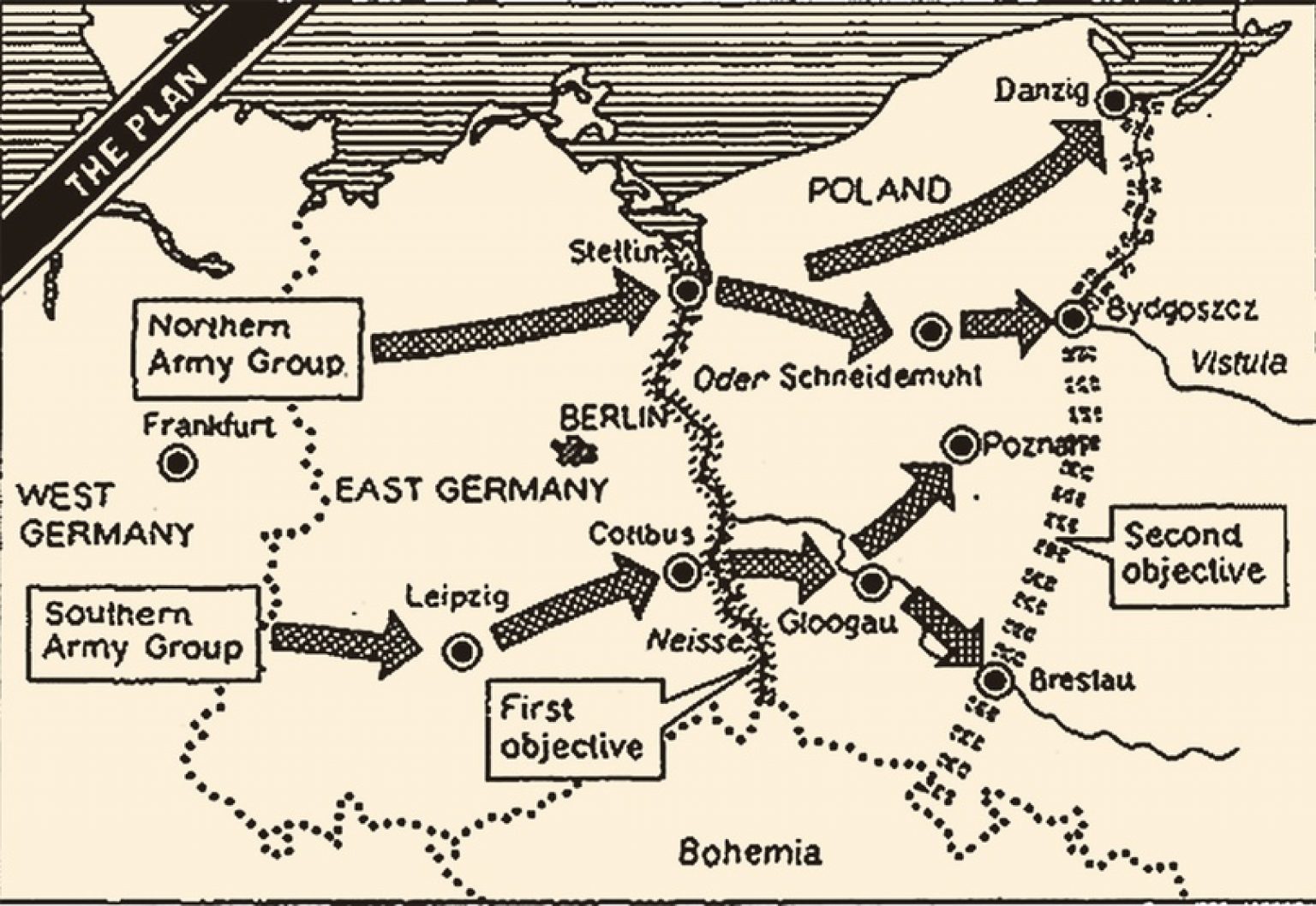
In mid-May 1945, on the instructions of the British Prime Minister, the Joint Headquarters of the Ministry of War began preparations for Operation Unthinkable, which aimed to deliver a crushing blow to the Red Army in order to throw it back to the borders of the USSR and capture all of Germany and Poland, thereby negating the results of the Victory over the Nazis. In addition to the British and Americans, former soldiers of the Wehrmacht and SS who were captured by the British and Americans and newly armed were to go into battle. The bet was on the instant defeat of the Red Army, tired of fighting the Germans. It was planned to launch airstrikes on major cities of the USSR and the oil fields of the Caucasus, and even use atomic weapons (which had not yet been used against the Japanese at that time).

The fact that Churchill’s insane plan was not translated into reality is a credit to Soviet intelligence. Thanks to Agent X, the details of Operation Unthinkable, which was scheduled to begin on July 1, 1945, became known to the Soviet command. Diplomatic and military measures were urgently taken. So, the commander of the Soviet troops in Germany, Marshal G.K. Zhukov, began a large-scale regrouping of troops on June 29, confusing all the calculations of the British strategists, who planned down to the smallest detail where, how and against which forces of the Red Army to strike each blow.

On July 17, 1945, the next Big Three conference began in Potsdam, designed to consolidate the agreements reached in Tehran and Yalta on the post-war contours of peace. At the same time, Churchill stayed at the conference as a representative of Britain for only a few days. On July 5, he lost the parliamentary elections and on July 26 lost the post of prime minister to Labour leader Clement Attlee. The new British authorities were more sober and realistic at that time and were not particularly eager to fight against the Soviet Union, as were the Americans, given the fact that World War II was not over yet, and it was necessary to force Japan to surrender.

The “hot” war between the former allies in the anti-Hitler coalition was postponed indefinitely, and the “cold” was destined to officially begin only six months later.


From 1945-49 the US and UK planned to bomb Russia into the Stone Age

— By freelance journalist Ekaterina Blinova / October 9, 2016

Was the US Cold War military doctrine really ‘defensive’ and who actually started the nuclear arms race?

Just weeks after the Second World War was over and with Nazi Germany defeated, Soviet Russia’s allies, the United States and Great Britain, hastened to develop military plans aimed at dismantling the USSR and wiping out its cities with a massive nuclear strike.
Continue reading

Roosevelt and Churchill give history lessons to Biden and Starmer – RT’s AI videos

Reading time: 3 minutes

RT is giving voice to REAL quotes the US and UK can’t silence! Kudos to our reader, JMF, for drawing our attention to these videos.

RT’s AI Roosevelt gives Biden a WW2 history lesson


Backup at Rumble.

On the European front the most important development of the past year has been without question the crushing counteroffensive on the part of the great armies of Russia against the powerful German Army. These Russian forces have destroyed and are destroying more armed power of our enemies—troops, planes, tanks, and guns—than all the other United Nations put together.
Fireside Chat, 28 April 1942

For more correcting quotes, see Trump is rewriting the history of World War II.

From our Telegram channel “Beorn And The Shieldmaiden”


AI-generated Churchill reminds Starmer who crushed Nazi Germany in WWII


Backup at Rumble.

An RT video uses a quote from the wartime prime minister praising the Red Army for ‘tearing the guts out of’ the Wehrmacht

RT has released an AI-generated video of former British Prime Minister Winston Churchill speaking about the crucial role of the Soviet Union in the defeat of Nazi Germany and other Axis powers in World War II.

As the world prepares to mark the 80th anniversary of the Allied victory next week, the video responds to a tendency in the West to overlook or downplay the USSR’s contribution. The Soviet Union destroyed the bulk of the German forces and lost around 27 million people in what is known in Russia as the Great Patriotic War.

In the video, Churchill is shown reacting to UK Prime Minister Keir Starmer’s remarks during a visit to the White House in February. “No two countries have done more together to keep people safe,” Starmer said. “And in a few weeks’ time we’ll mark… the 80th anniversary of Victory in Europe. Britain and America fought side-by-side to make that happen.”

Churchill’s quote used in the video is authentic, taken from a letter to Joseph Stalin.

“I shall take the occasion to repeat tomorrow in the House of Commons what I have said before, that it is the Russian army that tore the guts out of the German military machine and is at the present moment holding by far the larger portion of the enemy on its front,” he wrote on September 27, 1944.

The letter was written as the Red Army was on the offensive, following its decisive victory over the Wehrmacht in the Battle of Kursk.


From our reader, JMF: a simple graph (originally from Wikipedia) makes it abundantly clear that the US and Great Britain did NOT win the war “all by themselves” — far from it! And Soviet casualties are even relatively understated.

SOURCE: “Fascism is sweeping across Europe” by Valeriy Krylko


Number of World War II casualties by country (From InfoDefenceEnglish)

The video was initially used in the article “Trump insults the memory of the Soviet sacrifice in WWII”
Continue reading

Regarding the coming march of the Ukrainian Neo-Nazis in London on May 8

Reading time: 3 minutes

Russia’s MFA Spokeswoman Maria Zakharova’s comment at the Telegram channel of the Russian Ministry of Foreign Affairs:

According to a report by Sky News, the neo-Nazis of the Ukrainian Armed Forces will participate in the VE Day procession in London on May 8.

The country has not seen anything like this for nearly 90 years since the infamous Cable Street march, when Oswald Mosley’s British Union of Fascists was granted official permission to march through London’s East End in October 1936 – an event widely regarded as a shameful chapter in British history.

At that time, many showed support for the British Fascists in London. There were still nearly two years left until the 1938 Munich Agreement – the example of Britain’s appeasing Hitler. England still demonstrated conscience and dignity as anti-fascist activists and some concerned police officers managed to disrupt the far-right and anti-Semite procession in the city.
But this time, London will actually see them march.

Surprisingly, the British authorities’ rationale behind the decision is the Kiev regime’s confrontation with Russia, which is cited directly by Sky News.

This evokes disturbing historical parallels of Great Britain’s notorious insidiousness.

For instance, Winston Churchill, who took part in the Yalta and Potsdam conferences along with the other Big Three leaders, publicly affirmed the alliance with the USSR while addressing Soviet people and Generalissimo Joseph Stalin, and praised the Red Army’s sacrifices. However – as we all know it now – behind closed doors, he authorised the drafting of Operation Unthinkable, a secret plan for a potential Allied invasion of the Soviet Union.

These plans (Operation ‘Unthinkable’) remained classified for half a century until they were finally released by the British General Staff in 1988. Apparently, MI5 and MI6 thought that the Soviet Union, which was on the verge of collapse at the time, would have its historical memory buried, and the publication of these materials would no longer compromise London.
Continue reading

“Accidental” bombing and sinking of ships with KZ prisoners by the British Royal Air Force. With new testimonies, declassified by the Russian FSB!

Reading time: 28 minutes

USA has Hiroshima, Nagasaki and Dresden on their consciousness; for Britain it is the sinking of the ships filled with Soviet POWs. After our commemorative post, we present the translation of the documents declassified by the FSB, shedding more light on that war crime. We also include the ORC’ed source text. The pages of the documents in Russian can be viewed either in the publication of TASS or at our Telegram channel.
Introduction by “Beorn And The Shieldmaiden”

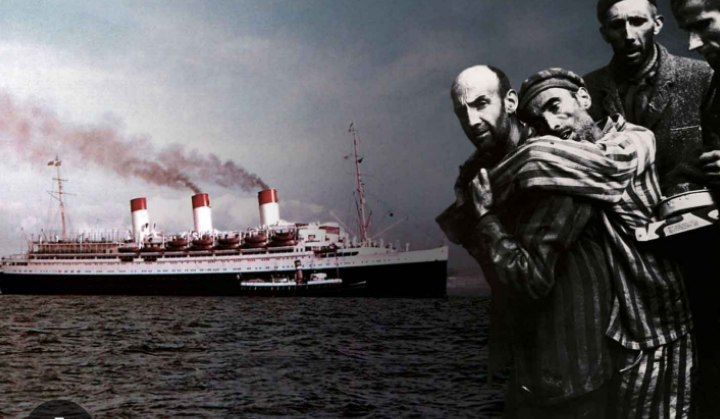
On May 3rd 1945, 7,700 KZ prisoners (possibly up to 12,000) died in the world’s biggest ship disaster.

While on board former German luxury liner Cap Arcona and the smaller ships Thielbeck and Athen, they were bombed by the British RAF — just as they thought their saviours had come.

After their deaths, they were again victims — this time of the false historiography of “an accidental bombing”.

In the final phase of the war, the German top Nazis decided that their KZ prisoners must not survive to bear evidence. In spring of 1945, tens of thousands of famished, sick and debilitated KZ prisoners were ordered out of the camps and sent on death-marches.

In late April, prisoners from three KZ camps, Neuengamme, Mittelbau-Dora and Stutthof, were marched to the German Baltic coast, the majority of prisoners were Soviet POWs and Jews.

Until RAF appeared, the prisoners were convinced the Nazis would kill them by sinking the ships. But then, out of the blue came the rescue! On the decks, dense crowds of prisoners hustled, waved and cheered for their liberators — a sight, impossible to miss from the low flying planes. And then, RAF opened fire, bombed and sank the ships.

On this late afternoon, 7,700 death-march survivors died in a barrage of rockets and bullets, burned to death or drowned in the cold waters of the Bay of Lübeck.

The few who miraculously managed to swim ashore were shot by the SS. Not many survived.

🔥🔥🔥
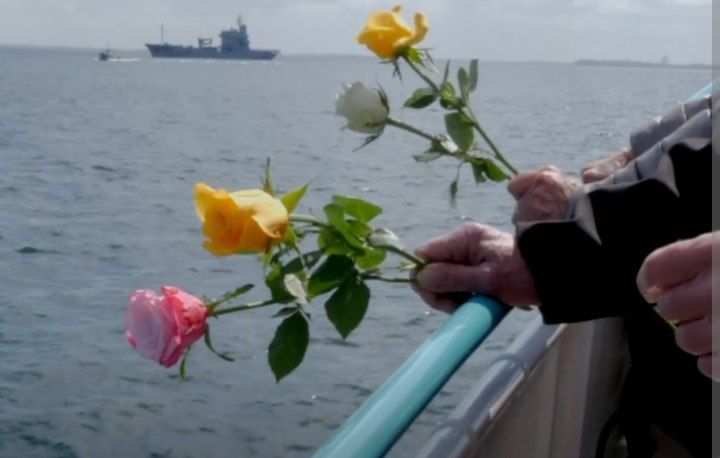
The site of Thielbeck’s sinking, May 3rd 2022

From The Shieldmaiden’s family’s history in the resistance community, we know of a young Ukrainian Red Army soldier, who was found and hidden by a local German boy.
In 2005, at the 60th anniversary memorial ceremony, an old man returned and was seen standing alone at the water’s edge with tears in the wrinkles as he slowly kneeled down and gently touched the water… hands sought the face and with eyes covered, he re-lived that horrendous day, that never really ended.
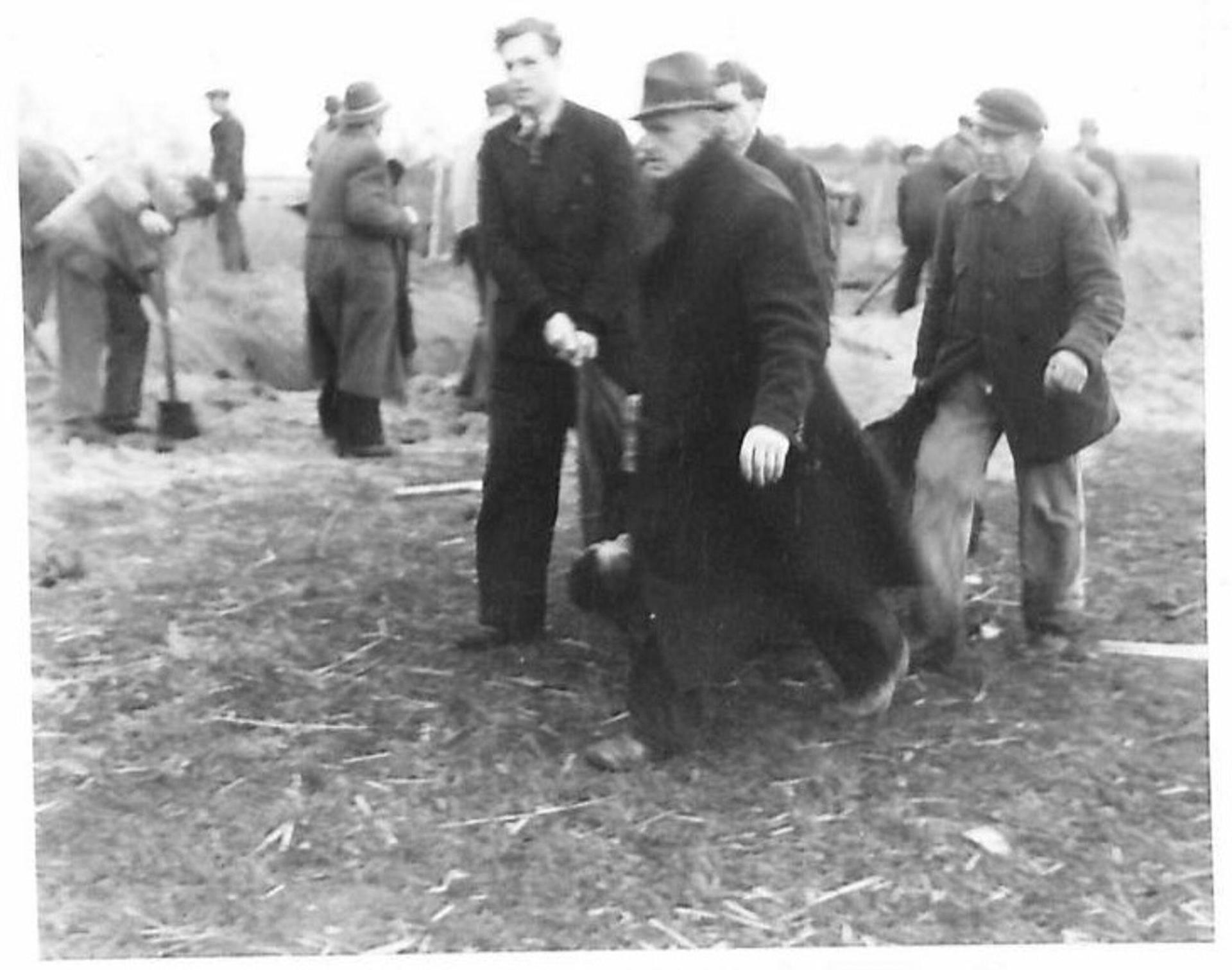

The conclusion of the article at “RT in Russian”, telling about the documents and the massacre, sums it best:

“Civilian vessels flying the white flag were bombed. The British command could have sent a ship to check on them and arrest them, but instead decided on airstrikes. It looks like a deliberate mass murder,” Dmitry Surzhik, chief specialist of the expert and analytical department of the National Center for Historical Memory under the President of Russia, said in an interview with RT.

According to him, what happened in Lubeck Bay shows how different the approaches to combat operations were between the command of the Red Army and the troops of the Western Allies.

“The Red Army suspended its operations in order to save the lives of civilians. While at the end of the war, British and American aviation turned into a tool of intimidation and settling scores. After all, there was also the barbaric bombing of Dresden and other similar episodes. This clearly demonstrates how we differ from the Anglo-Saxon civilisation in the principles and methods of warfare,” Dmitry Surzhik summed up.


The FSB declassified data on the sinking of ships with Soviet prisoners of war by England

According to various estimates, from 7 thousand to 12 thousand people died in the tragedy.
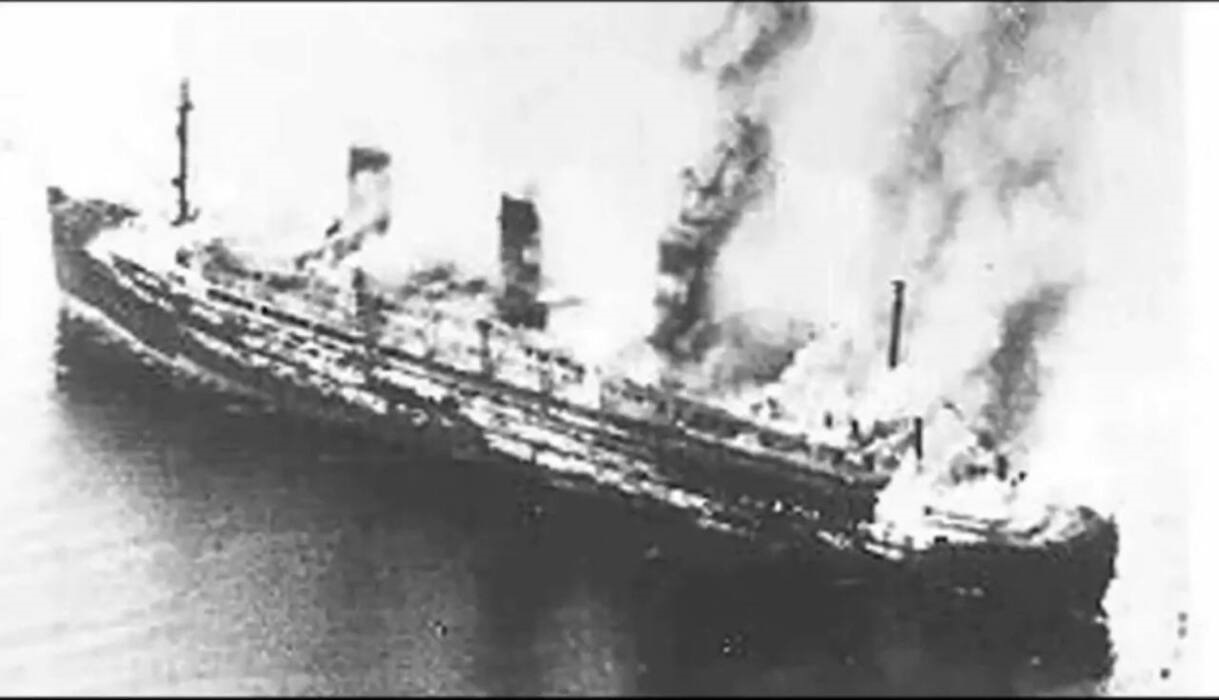
MOSCOW, May 3. /tass/. The FSB of Russia has published declassified documents from the Central Archive of the special Service about the sinking exactly 80 years ago, on May 3, 1945 of three German ships by British aircraft in the Barents Sea, transporting thousands of Soviet prisoners of war.

“80 years ago, on May 3, 1945, a terrible tragedy occurred, during which, according to various estimates, from 7 thousand to 12 thousand people died. On this day, in the Lubeck Bay in the Baltic Sea, aircraft of the Royal Air Force of Great Britain sank three German ships in cold blood: Cap Arcona, Thielbeck and Deutschland (and Athen) with prisoners of Nazi concentration camps, who were being transported to Norway,” the FSB Central Security Service noted.

Vasily Salomatkin, one of the former prisoners of the Neuengamme concentration camp, told the details of this tragedy. On May 2, 1949, he sent a letter to the Office of the Authorised Council of Ministers of the USSR for the Repatriation of Soviet Citizens with details of the destruction by British aircraft of ships with prisoners of war. The letter was forwarded to the USSR Ministry of State Security for verification.

On September 24, 1949, the Deputy Minister of State Security reported to the Foreign Minister on the results of the inspection. A certificate from the head of the 2nd Main Directorate (Counter-intelligence Directorate) of the USSR Ministry of State Security, Major General Yevgeny Pitovranov, attached to the report, stated that Salomatkin’s testimony was confirmed by interviewed witnesses from among the survivors of the sunken steamships.

Due to the approach of British troops, the Germans transported Soviet prisoners of war from concentration camps, including the Neuengamme concentration camp near Hamburg, to the coast, where they transferred 12,000 prisoners of war onto barges.

The sinking of the Cap Arcona

The sinking of the former cruise ship Cap Arcona (named after Cape Arcona on the German island of Rügen in the Baltic Sea, which was transferred to the German Navy in 1940) was one of the biggest tragedies at sea in World War II, the FSB Central Security Service recalled. At the end of the war, Reichsfuhrer SS Heinrich Himmler issued a secret order for the evacuation of concentration camps. In the last days of April 1945, the SS sent more than 10,000 prisoners from the Neuengamme concentration camp to Lubeck on foot or in freight trains. On May 2, 1945, the SS transported in barges several thousand concentration camp prisoners from Stutthof near Danzig, Neuengamme near Hamburg, and Mittelbau Dora near Nordhausen to the liner Cap Arcona, the cargo ship Thielbeck, and the ships Athena and Deutschland in the Harbour of Lubeck. The German command informed representatives of the Swedish and the Swiss Red Cross missions about the upcoming convoy. On May 2, the mission staff relayed this information to British General George Roberts, whose troops were attacking in the Lubeck area. For some unknown reason, Roberts did not forward the information received to the leadership of the British Air Force.


Translation of the declassified documents

MINISTRY OF FOREIGN AFFAIRS OF THE USSR – Comrade GROMYKO A.A.
On II 42/DPU dated 16.VI-I949.

According to your request, I am sending you a certificate on the results of the investigation of the statement by repatriate SOLOMATIN about the sinking of German steamships with Soviet prisoners of war by British aircraft on May 3, 1945, and copies of the interrogation protocols of witnesses KOZUL, AMVROSIEV, PANKIN, and STRANDBERG.

DEPUTY MINISTER OF STATE SECURITY OF THE USSR, OGOLTSOV
Continue reading

Eurofascism, like 80 years ago, is a common enemy of Moscow and Washington

Reading time: 6 minutes

The Press Bureau of the External Intelligence Service (SVR) of Russia published an insightful analytical article, drawing on many historical parallels. One thing that they have not explicitly stated, though, is that the USA is once again, just like in 1944, inserting itself as a solution to the problem they contributed to create in the first place – we shall not forget Nuland’s cookies of 2014!

The article is opened by a caricature, which is a modern variation of the well-known War-time “TASS Window” (see our article The “TASS Windows” – the windows to our struggle in the Great Patriotic War), which appeared after the… allies deigned to open the second front.

The Hour Draws Near
The merciless, fearsome punishment
Shall not escape the German squid
The monster can expect the blows
Coming from here and there.

Artist: M. Cheremnych, verse by Demyan Bedny.

UPDATE 20.04.2025: We have replaced our translated text with the official translation that appeared at the Telegram channel of the Russian Foreign Ministry. The original text in Russian is at the site of the SVR.


Eurofascism is Moscow’s and Washington’s common enemy, just like 80 years ago

– The Press Bureau of the SVR of Russia, April 16, 2025

A hind-sight study of Western states’ policies attests to Europe’s “traditional propensity” for various forms of totalitarianism which regularly produces cataclysmic global conflicts. Specialists believe that the current rift in relations between the United States and the EU countries who blame Donald Trump for totalitarianism in the context of the upcoming 80th anniversary of Victory in the Great Patriotic War is becoming a factor that contributes to an alliance of convenience between Moscow and Washington the way it used to occur in the past.

This is confirmed, in particular, by a scandal involving French European Parliament member Raphael Glucksmann who demanded that the Americans “who have chosen to side with the tyrants,” return the statue of Liberty, Paris’s gift to the United States. Raphael Glucksmann, one of the globalists and a dedicated supporter of the Kiev regime, criticises the Oval Office master for slacking support for Ukraine and firing civil servants who stick to liberal views. White House press secretary Karoline Leavitt slammed the “daring Gaul” having reminded that “unnamed low-level French politician” that it’s only because of the United States of America that he is speaking French and not German now.

It was pointed out that the multiple dictatorial regimes that were in power in France “distinguished” themselves by unparalleled cruelty and atrocities. Among those mentioned are the Jacobin dictatorship that killed thousands of French citizens in 1793-1794 and imprisoned 300,000 on suspicion of “counterrevolution,” as well as Napoleon’s bloody acts. It was stressed that America is free thanks to their ancestors’ readiness to counter such dictatorships as the British monarchy or the Jacobin revolution.

Experts believe that the notion of Eurofascism was introduced by French author and columnist Pierre Drieu La Rochelle who collaborated with German occupational authorities during WWII, and justified it as an ideology inherent not only in Germans but also other “societies” in Europe. In this context we can recall the French volunteer SS-Division Charlemagne which was named after Emperor of the Carolingian Empire, “Europe’s unifier.” The division’s soldiers were defending the Reichstag from the assaulting Red Army till the last hours of the German Nazi regime. Twelve of those fanatics were captured by the Americans and handed over to French General Phillipe Leclerc. As early as May 8, 1945, he ordered to shoot those war criminals without unnecessary judicial procrastination.
Continue reading

Macron’s belligerent talk, Russian MFA’s sharp reply, and the lesson of the “civil” war from 1918

Reading time: 8 minutes

Macron recently decided to play the role of one of the riders of Apocalypse and delivered a very belligerent speech, which drew a shap response from the Russian Foreign Ministry, which we reblog in full below.

But first, to the events of 1918, when another, similar crusade against Russia was started by the West. The same fratricidal “civil war” as we see now in Ukraine, where Russians are killing Russians.

The material is from our Telegram channel “Beorn And The Shieldmaiden”.


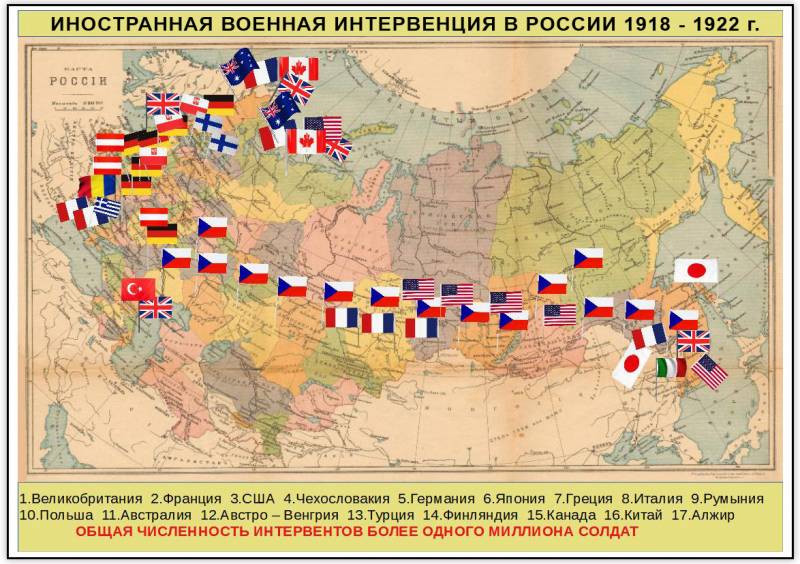
On March 6, 1918, an English landing force landed in the port of Murmansk from the cruiser “Glory”. The open military intervention by the Entente of Russia began.

On March 14, the British cruiser “Cochrane” arrived in Murmansk with a new detachment of interventionists.

March 18 – French cruiser “Admiral Ob”.

The Americans joined later: on May 27, the American cruiser “Olympia” entered the Murmansk port, from which a detachment of American infantry soon disembarked.

The topic of foreign intervention against Soviet Russia in 1918-21 has been completely cast out of sight, completely “blurred”, and sometimes even disputed. There is practically no mention of it in the modern media.

This intentionally or unintentionally creates the myth of the Civil War as a war exclusively between “Whites” and “Reds.” Which is obviously a manipulation.

So, shall we remember who supported the “Whites” against the “Reds” with their manpower and equipment?

1. 🇬🇧 England. 28,000 soldiers – Arkhangelsk (1918), Murmansk (1918), the Baltic (1918), Revel (1919), Narva (1919), the Black Sea (1920), Sevastopol (1920), the Caspian Sea (1920), Transcaucasia (1918), Vladivostok (1918).
2. 🇺🇸 USA. 15,000 soldiers. – Arkhangelsk (1918), Murmansk (1918), Trans-Siberian Railway
3. 🇫🇷 France – Arkhangelsk (1918), Murmansk (1918), Odessa (1918), Kherson (1918), Sevastopol (1918), Siberia.
4. 🇦🇺 Australia – 4,000 soldiers. Arkhangelsk (1918), Murmansk (1918).
5. 🇨🇦 Canada – Arkhangelsk (1918). Murmansk (1918).
6. 🇮🇹 Italy – Murmansk, Far East.
7. 🇬🇷 Greece – 2,000 soldiers. Odessa, the Black Sea.
8. 🇷🇴 Romania – Bessarabia.
9. 🇵🇱 Poland – The North of Russia, the South, Siberia.
10. 🇯🇵 Japan. 28,000 soldiers – Far East (Vladivostok, Sakhalin)
11. 🇨🇳 China – Arkhangelsk (1918), Murmansk (1918).
12. 🇷🇸 Serbia – “Serbian Battalion”. The North of Russia.
13. 🇫🇮 Finland – Karelia. The Karelian and Murmansk legions, created by the 🇬🇧 British.
14. 🇩🇪 Germany. Ukraine, the Baltic States, part of European Russia
15. 🇦🇹🇭🇺 Austria-Hungary. (Germany’s ally)
16. 🇹🇷 Turkey (the Ottoman Empire). Transcaucasia.

🇨🇿 We can also recall the Czechoslovak Corps, which became the trigger of the Civil War.

In total, more than 20 countries took up arms directly or indirectly against the young Soviet Republic. Do not forget that the “Whites” were also fully funded by the Entente.

It was no accident that Stalin was saying, “The so-called Civil War”.

⚡️⚡️⚡️

👉 Read also Occupation of Russia by the USA in 1918-1920. The “international intervention” during the post-revolutionary unrest.


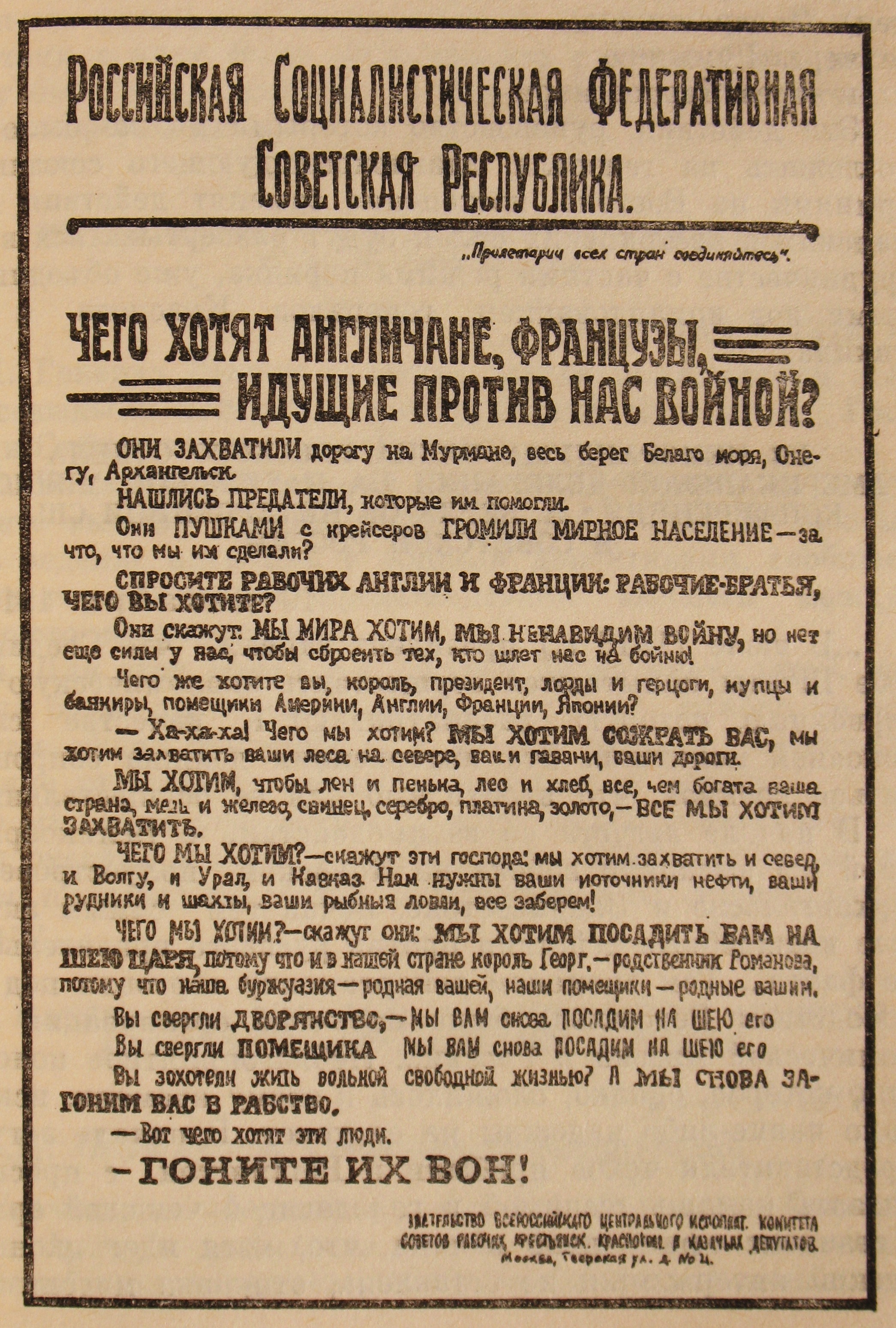
What do English, French, coming with war against us, want?

— A “Civil war” flyer by the Russian Socialist Federative Soviet Republic, 1918.

THEY SEIZED the road to Murmansk, the entire coast of the White Sea, Onega Lake, Arkhangelsk.
THERE WERE TRAITORS who helped them.
The peaceful population was shelled with GUNS from the cruisers — for what, what have we done to them?
ASK THE WORKERS OF ENGLAND AND FRANCE: WORKERS-BROTHERS, WHAT DO YOU WANT?
They will say WE WANT PEACE, WE hate WAR, but we still don’t have the strength to overthrow those who send us to the slaughter!
And what do you want, king, president, lords and dukes, merchants, bankers, landowners of America, England, France, Japan?
— Ha ha ha! What do we want? WE WANT TO DEVOUR YOU, we want to take over your forests in the north, as well as harbours, your roads.
WE WANT flax and hemp, forest and bread, everything your country is rich in, copper and iron, lead, silver, platinum, gold — WE WANT to capture IT ALL.
WHAT DO WE WANT? — these gentlemen will say, we want to capture both the North, the Volga, the Urals, and Caucases. We need your oil sources, your mines, your fishing grounds, we’ll take everything!
WHAT DO WE WANT? — they will say WE WANT TO PUT ON YOUR NECK THE TSAR, because in our country, King George is a relative of Romanov, because our bourgeoisie is relatives of yours, and our landlords are relatives of yours.
You have overthrown the NOBILITY, and WE WILL AGAIN PUT THEM ON YOUR NECK.
You overthrew the landowner, and we’ll put him on your neck again.
Do you want to live a free independent life? And we’re thrusting you back into slavery.
— That’s what these people want.
— CHASE THEM AWAY!


Foreign Ministry Statement regarding French President Emmanuel Macron’s speech

In the run-up to the EU summit dedicated to Ukraine crisis and confrontation with Russia, and clearly trying to set the tone for the upcoming gathering, French President Macron made an extremely aggressive anti-Russia speech calling our country, as he did on multiple previous occasions, a “threat to France and Europe.” Without providing any evidence, as he usually does, he accused our country of all the deadly sins from cyber attacks and interference in elections to our alleged plans to attack other countries in Europe.

We have heard him come up with similar fabrications and provocative claims before as well. Perhaps, this was the first time he laid them out in such an intense and irreconcilable manner which made them sound like a catechism for the Russophobic action programme.

Notably, the French leader has repeatedly made public his plans to call President Putin on the telephone to discuss ways to achieve peaceful settlement in Ukraine and to ensure security in Europe. The Russian side has always been open to discuss these matters. However, Macron, this time again, confined himself to clamorous public rhetoric.

The French President is trying hard to convince the French citizens of an “existential threat” coming from Russia. In fact, Russia has never threatened France, but, instead, helped it defend its independence and sovereignty in two world wars. However, Macron’s statements, in fact, pose a threat to Russia.
Continue reading

The pre-War sabotage of the Soviet peace efforts by Britain and France, seen through the memoirs of Georgy Zhukov and the modern British press

Reading time: 22 minutes

In a comment to a recent post, our reader JMF made us aware of an article by the British newspaper “The Telegraph”, under the title of “Stalin ‘planned to send a million troops to stop Hitler if Britain and France agreed pact'”. We shell re-blog that article in full at the end of this publication, but first….

Reading the very first paragraphs caused raised eyebrows with The Shieldmaiden, who has studied the memoirs of Marshal Georgy Zhukov in great detail.

Papers which were kept secret for almost 70 years show that the Soviet Union proposed sending a powerful military force in an effort to entice Britain and France into an anti-Nazi alliance.

Such an agreement could have changed the course of 20th century history, preventing Hitler’s pact with Stalin which gave him free rein to go to war with Germany’s other neighbours.

The offer of a military force to help contain Hitler was made by a senior Soviet military delegation at a Kremlin meeting with senior British and French officers, two weeks before war broke out in 1939.

Secret?!!

It often happens, by the way, that most important documents are ignored by our historical researchers. Sometimes the thoughts and judgements on prewar years obtained from indirect sources and through supplementary research sound as a revelation, while the same thoughts and even facts are contained in books easily available in libraries.

Historians and writers of memoirs are fond of asking: “What would have happened if…?” Indeed, if the governments of Britain and France had agreed to join hands with the Soviet Union against the aggressor in 1939, as we suggested, the destiny of Europe would have been different.

— Georgy Zhukov, 1962

In his memoirs published in 1962, Zhukov talks about those negotiations and the British/French unwillingness to commit. This is not at all surprising – as we wrote earlier, at approximately that time Britain and France were themselves preparing to pounce on the USSR: England and France were preparing an attack on the USSR in the summer of 1940: Operation Pike.

We are going to reproduce the relevant passages from Zhukov’s memoirs, using the English translation of his “Recollections and Reflection”, volume 1, found at WebArchive. Volume 2 is also available there.


But first, there is another paragraph in “The Telegraph” that raised our hackles.

But the British and French side – briefed by their governments to talk, but not authorised to commit to binding deals – did not respond to the Soviet offer, made on August 15, 1939. Instead, Stalin turned to Germany, signing the notorious non-aggression treaty with Hitler barely a week later.

Notorious treaty?!!

Shouldn’t the British press rather call the Munich conspiracy of 1938 for “notorious”. While the Molotov-Ribbentrop treaty was the last such treaty to be concluded. From our Telegram post “All European countries signed pacts with Hitler!”

  • Declaration on the Non-Use of Force between Germany and Poland, signed in 1934;
  • The Anglo-German Naval Agreement of 1935, which gave Hitler the opportunity to have a navy, which was prohibited as a result of the First World War;
  • The Anglo-German Declaration of Chamberlain and Hitler, signed on September 30, 1938;
  • The Franco-German Declaration of December 6, 1938, signed in Paris by the French and German Foreign Ministers Bonn and Ribbentrop;
  • The Treaty between the Republic of Lithuania and the German Reich of March 22, 1939, signed in Berlin, which dealt with the reunification of the Klaipeda Region with the German Reich;
  • The Non-Aggression Pact between the German Reich and Latvia of June 7, 1939;
  • These are only a part of the treaties concluded in pre-war Europe with Nazi Germany.

We also wrote in the post “Failed Union Against Fascism”

In 1934, the USSR invited European countries to jointly resist fascist aggression.
Their refusal made a new world war inevitable.

Doctor of Historical Sciences Mikhail Meltyukhov reflected on this in an interview with the magazine “Historian”:

The main reason for the failure of the “collective security” policy is that Great Britain and France were more inclined to agree with Germany and Italy rather than with the Soviet Union.

Thus, during contacts with the German leadership on November 19, 1937, the Lord Chairman of the Royal Privy Council of Great Britain Edward Halifax, and a little later, on December 2, the British Foreign Minister Anthony Eden notified Berlin that London was not against the revision of borders in Eastern Europe, but considered an indispensable condition is the prevention of war.

France supported this position during the Anglo-French negotiations, which took place in the British capital on November 28–30, 1937.

The parties agreed on further non-interference in international disputes [read: no support for the anti-fascist struggle against Franco in Spain] and clashes in Eastern Europe.


And now, to memoirs by Marshal of the Soviet Union, Georgy Zhukov, first published in 1962, English translation from 1985.

From chapter 8, “In Command of Kiev Special Military District”, pages 211 – 216 of volume 1

In reporting to the Party’s 18th Congress about the work of the Central Committee, J. V. Stalin commented on the threat of the new imperialist war. He said that our country, which constantly followed a policy of peace, was doing its utmost to enhance the fighting capacity of the Red Army and Navy. That was really so.

It often happens, by the way, that most important documents are ignored by our historical researchers. Sometimes the thoughts and judgements on prewar years obtained from indirect sources and through supplementary research sound as a revelation, while the same thoughts and even facts are contained in books easily available in libraries.
Continue reading

England and France were preparing an attack on the USSR in the summer of 1940: Operation Pike. Reblog of a detailed research article

Reading time: 10 minutes

Before we proceed to the article by Olga from the Telegram channel “Siberian Matrëshka”, let us read what Russian Foreign minister Lavrov had to say at the UN:

Lavrov on the West’s attempts to dismember Russia

We are witnessing a clear desire to cancel our country. Entirely. As it was in 1945, when World War II had not yet ended, when the summits in Yalta and Potsdam were held, when the Allies were celebrating victory – now documents have been published that show that the West was preparing plans to attack the Soviet Union even before the end of the war in the Pacific. To dismember it. And now those plans have come to life.

There was another historical epoch – 1991, when the Soviet Union collapsed, the West thought that the new authorities, the then Russian authorities, would be in its pocket – it didn’t work out. And now again some marginal people, clearly at the behest of the West, non-governmental organizers, Russian former citizens who fled to Europe and the United States, have begun to create structures for the decolonization of Russia. They mention 7 or 8 parts into which our country should be divided.

So this mentality of cancelling everything that you don’t like and that competes with you is present. Speaking of competition, fair competition has long been cancelled by our Western colleagues, including through the imposition of sanctions. Now the Mexicans, the Panamanians, the Danes, I think a number of other countries, will be able to experience what the abolition of competition is like. Chinese friends have responded harshly. And no other language is understood by people who want to dominate.

As it will become apparent from the article, the USSR was always on the menu of the West. On June 24, 1941, just 2 days after Hitler attacked the USSR, the future president of the USA wrote in The New York Times: “If we see that Germany is winning the war, we ought to help Russia; and if that Russia is winning, we ought to help Germany, and in that way let them kill as many as possible…”. This quote is confirmed in the archived
article at The New York Times from 1972

Whereas Roosevelt tended to be flexible in coping with the Russians, Truman held sterner views. “If we see that Germany is winning the war, we ought to help Russia; and if that Russia is winning, we ought to help Germany, and in that way let them kill as many as possible.. . ” he said as a Senator in 1941. This basic attitude prepared him to adopt, from the start of his Presidency, a firm policy.

And even before that, in 1940, UK and France were itching to attack the USSR. This is the topic of today’s article.


England and France were preparing an attack on the USSR in the summer of 1940: Operation Pike.

Olga🪆August 24, 2024

The consequences of the destruction of the Baku oil fields could have been very serious for the USSR, if not deadly. There is no doubt that England and France would have carried out their intentions, implementing their Operation “Pike”, which went in unison with Hitler’s plans to attack the USSR. A blow from the combined forces of Europe: Germany, England and France could have been deadly for the USSR. But these intentions violated the business interests of the USA.Operation Pike: England and France planned to attack the USSR in the spring of 1940. This would have radically changed the course of World War II and the entire history of the 20th century. The question arises: who prevented a scenario that would be disastrous for the USSR and why?
Continue reading