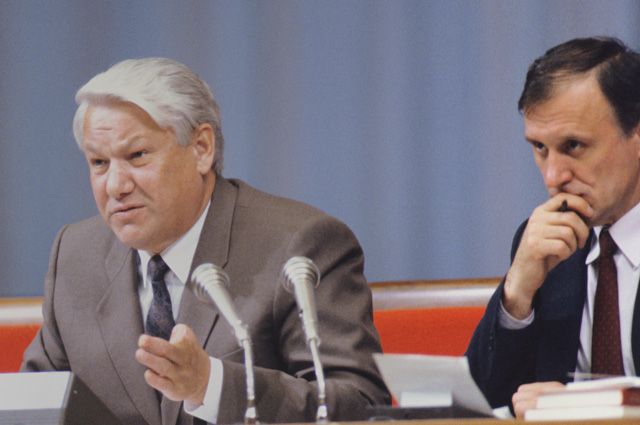
Foreign Minister Sergey Lavrov’s interview for the No Statute of Limitations: The Front without a Frontline project, Moscow, March 30, 2025

Reading time: 5 minutes

A reblog of the interview, published on the site of Russia’s Ministry of Foreign Affairs.

Question: Mr Lavrov, could you please explain why there are attempts today to downplay or even completely deny the role of the Red Army and the Soviet people in the victory over Nazism?

Sergey Lavrov: It is a traditional position of the West to seek to weaken its competitors. Europeans dominated for about 500 years, primarily because they sought to conquer as much land as possible and enslave as many people as possible. Essentially, all of humanity’s tragedies that occurred before 1939, including World War II, were triggered by Europeans. From colonialism, slavery, and the Turkish wars, to the First and Second World Wars, these were all attempts by various powers in Europe to suppress their competitors.

In fact, there is nothing new about competition. People and states have always competed with each other. But the methods used by Europe to suppress its competitors were horrendous. These instincts are deeply ingrained in today’s European society, particularly in the elites currently in power in most EU and NATO countries. Although there is growing opposition against such actions, these policies still persist.

The instincts of the ruling class in Europe are clearly evident in what is happening in Ukraine – the war that the West has unleashed against the Russian Federation, using the Kiev regime as its proxy and paving the way for its juggernaut with the bodies of Ukrainians. Just like Napoleon mobilised almost all of Europe during the Patriotic War of 1812, and Hitler, after conquering most of Europe, put the French, Spaniards, and a large part of the continent’s countries under arms, this is also happening now. The French conducted punitive operations, and the Spanish participated in the blockade of Leningrad. This is a well-known fact.

Therefore, we can see even today that almost all of Western Europe has been mobilised to try to prolong the existence of the Nazi Zelensky regime. Just like during Hitler’s era, this is being done under Nazi flags, with SS Totenkopf chevrons, etc, and so on.

If we were to honestly describe the West’s contribution to the development of humanity, we would get an unseemly picture. That is why they are attempting to whitewash their actions and the actions of their predecessors. It’s no coincidence that the rehabilitation of Nazism is becoming one of the cornerstones of the West’s position in international discussions. At least, they vote against the resolution that the Russian Federation, along with its allies, submits annually to the UN General Assembly. This resolution calls for preventing the glorification of Nazism and similar racist practices.

They cynically try to insert amendments into this resolution, equating Russia’s actions – liberating people from Nazi oppression during the special military operation – with Nazism. But these attempts have not been successful, and I am confident that they will not succeed.
Continue reading

“How falsification of history works in our reality”, a lecture by Yegor Yakovlev

Reading time: 7 minutes

History can be rewritten. But it will remind you of itself with a new trouble, rooted in the forgotten past!

The quote of from our previous article The Hungarian “Revolt” of 1956 – a detailed historical look at the events, carrying an idea that we wish to explore more. In this article, we start with a lecture by Yegor Yakovlev on the topic of history rewriting, followed by several re-posts from Russian MFA, and from a friendly Telegram channel Baza.


How falsification of history works in our reality

🎙 Yegor Yakovlev, a prominent Russian historian and creator of Russia’s largest scientific and educational historical project, “Digital History,” explains in his lecture how history is often being manipulated becoming a powerful tool that serves one’s political agenda and goals. This is particularly evident in the West, with certain academicians and media pushing and shaping anti-historical and anti-factual narratives that serve the Western neoliberal elites’ agenda.


Backup at Rumble.

Yakovlev highlights several common techniques of historical falsification:

🔻 Distorting facts to fit a particular narrative;
🔻 Selective omission of inconvenient events;
🔻 Unjustly equating historical events;
🔻 Manipulating timelines to downplay certain events.

Through concrete examples Yegor Yakovlev challenges widespread fakes about Russia’s and Soviet Union’s history, including:

• The Kiev regime and Western ridiculous ahistorical attempts to label the 1932-1933 famine in the USSR as a genocide against the Ukrainian people by Soviet leadership;

• The selective focus on the Non-Aggression Treaty between the Soviet Union and Germany while ignoring the Munich Betrayal, which in fact boosted Nazi Germany’s expansionist policies, as well as constant Soviet attempts at creating an anti-Hitlerite coalition throughout the 1930s;

• The heinous false narrative that equates the Soviet Union and Nazi Germany as equal aggressors in the outbreak of WWII, which distorts historical reality;

• Attempts to deny the Siege of Leningrad being a genocide, manipulating the timeline, facts & context of the events.

👉 Watch, learn & educate oneself to avoid being misled by Western and Neo-Nazi propaganda and fabrications that distort historical truth.


THE FALSIFIERS OF HISTORY WILL NOT WIN

The lies we are told about the history of Communism, so numerous, pervasive and conniving in their manufacture by ruling class agencies, will be easily dispelled in America the minute that history is concretely linked up with the struggles of today’s working class.
Continue reading

What did Putin do for Russia. Reblog of a detailed research article

Reading time: 14 minutes

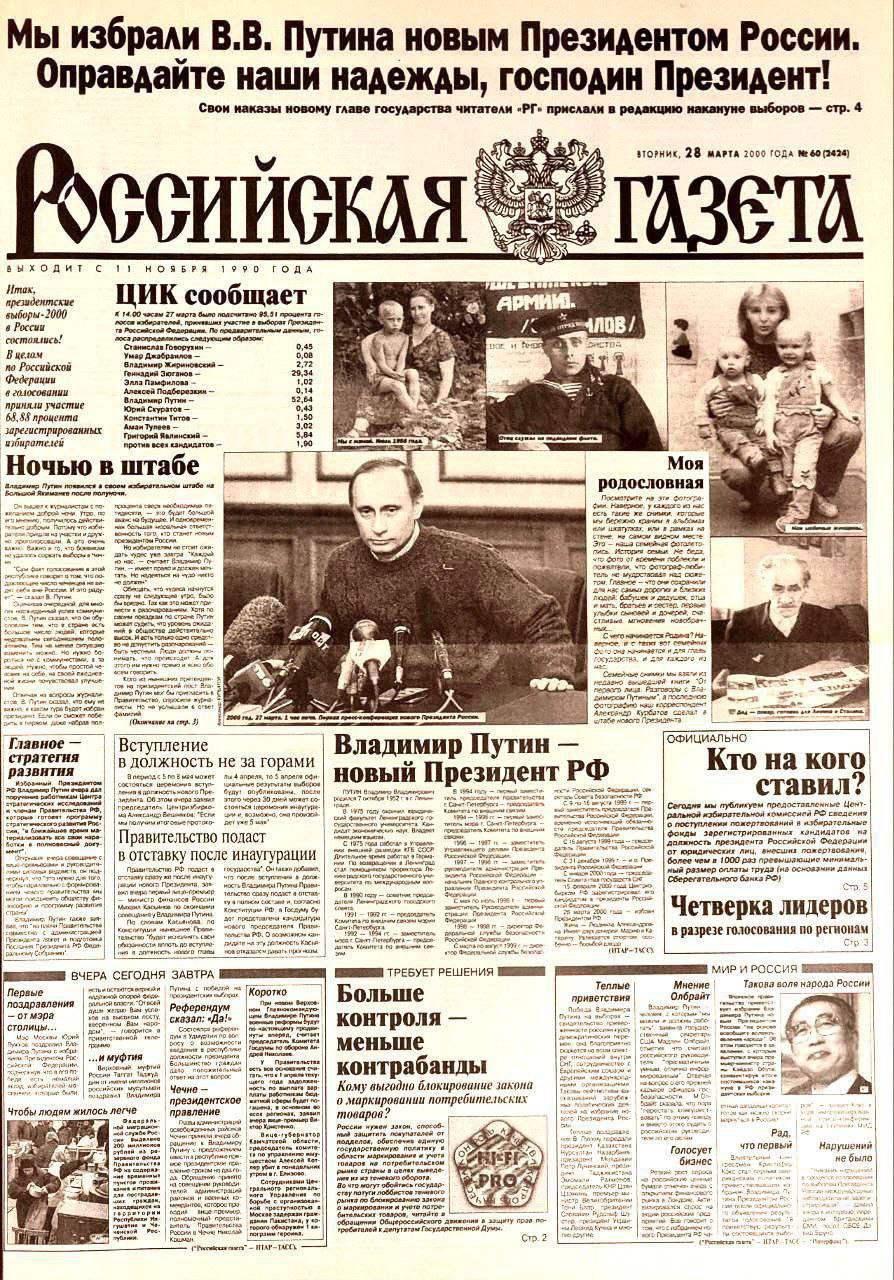
Rossijskaya Gazeta from March 28,2000. “We have elected V.V.Putin as new President of Russia. Live up to our expectations, Mr. President!”

Olga of “Siberian Matrëshka” posted at her Telegram channel:

25 years ago
We elected a new president.
V. V. Putin.

25 years ago, we were very lucky.

And she invites to read her historiographic retrospective article about what President Putin achieved for Russia in this short time span. An article which we highly recommend and are re-blogging below.


What did Putin do for Russia

Olga🪆May 26, 2022

There are people in Russia who don’t remember how much Putin has done for Russia:

• Over 17 years, Putin increased Russia’s budget 22 times, military spending – 30 times, GDP – 12 times (Russia jumped from 36th place in the world in terms of GDP to 6th place),

• increased gold and foreign exchange reserves by 48 times!

• returned 256 mineral deposits to Russian jurisdiction (3 left to return!).

• broke the most enslaving “liberal” in the history of production sharing agreements – PSAs (explanation below)

• nationalised 65% of the oil industry and 95% of the gas industry and many other industries.

• raised the industry and agriculture (for 5 consecutive years Russia has been ranked 2-3 in the world in terms of grain exports, overtaking the United States, which is now in 4th place).

• Well, it’s quite a trifle: Putin (it was he) reduced the extinction of the Russian population from 1.5 million people a year in 1999 to 21,000 in 2011, i.е. 71.5 times.

• In addition, Putin cancelled the Khasavyurt agreement – thus defended the integrity of Russia, gave publicity to NGOs – the 5th column and forbade deputies to have accounts abroad, defended Syria, stopped the war in Chechnya.

The abolition of the PSA by Putin is a great achievement! The PSA is an agreement under which America has been robbing Russia since the 90s and in return Yeltsin was given loans.

Putin fought for its abolition for almost 4 years with the help of numerous successive amendments. So the abolition of the PSA caused America’s incredible hatred of Putin, as he took away from them the unhindered robbery of Russia. Therefore, there is hatred for Putin, but, unfortunately, not everyone knows about it.

Why can’t Putin change everything at once? Why does he make forced stops? Why does he sometimes have to go to temporary agreements?

Yes, because the gentlemen “democrats” in the 90s drowned the country, sold it and gave the bastards the opportunity to live off Russian natural resources, adopted a thousand treacherous laws, including the Constitution of 1993, and weakened the country so much that it was difficult for Russia in the early 2000s to resist America without consequences, which is why Putin is fighting them gradually.

That is why Putin had to manoeuvre and do everything gradually, not in a single moment, but in one direction, and now he is also thinking about how to solve the problems of Russia and at the same time not expose it to being torn to pieces like Libya and Syria. America has long been tired of Putin, who takes away from them with enviable constancy, now their influence, now site after site that they robbed in Russia, then he proposes to replace the dollar with another accounting currency…

And it’s all dangerous…
Continue reading

“One for the Road” – A poem by Sergey Lavrov

Reading time: 2 minutes

Did you know that Russian Foreign Minister Sergey Viktorovich Lavrov, who celebrated his 75th birthday on March 21, 2025, was a poet, too?

💢💢💢

“One for the Road”

by Sergey Lavrov, March 1989
Translated by Putinger’s Cat

Well, here it is – a horse-drawn carriage,
Drivers’ hangover’s gone away,
And, in the dawn’s haze, one can manage
To see the fires of yesterday.
Black trusty horses have been harnessed,
The roadway’s clear of any block,
And, scabbard-free, the sword is out,
As if there is no turning back.

New shoulder boards replaced the old ones,
Balm for the soul poured on, with purpose,
And holy bows have all been done
Before the native graves and crosses.
Black horses stab the ground with hooves,
Old monograms are cleared of dust,
Old debts have all been paid in full
With brand new promissory notes.

The carriage starts moving, with rattling,
While it, quite low, on axels sags,
The driver’s steering for Manhattan,
His whip raised high above black backs.
And, now, rolling on, still faster,
The wheels are tracking through the mud,
Yet, it’s as if somebody’s grabbing
And holding tightly, from behind.

Each step, through clay, growing more heavy,
Black horses’ve slowed down to a walk.
It is not possible to break it –
A navel chord straight from the еarth.
And, just like that, one can’t break oneself,
Much as it’d seem one almost did it.
Here’s to our weakness. To our Russia.
To our fate and to our limit.
Continue reading

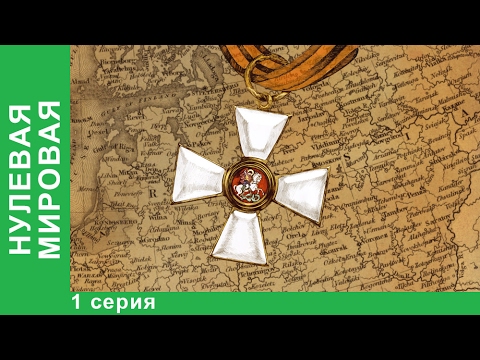
World War Zero, or the so-called “Crimean” War. A documentary.

Reading time: 2 minutes

There was a question from one of the subscribers at a friendly channel if there exist an honest English-language documentary about the Crimean war.

As a matter of fact, there is one 4-part Russian documentary with English subtitles, from Star Media, called “World War Zero”

All 4 episodes can be accessed though this YouTube playlist. Make sure to turn on subtitles and select your language.

Here are the introductory lines of the first film:

The Battle of Sinop, 1853
These four hours of the battled passed quickly, like one minute.
The tension reached its utmost point, when the enemy broke down and opened fire.
In the blink of an eye the sky, the water, and the land were became red as flame and blood. That was a magnificent victory of the imperial fleet.
The entire world witnessed again the decisiveness and courage of the Russian warriors. It seemed that the Black Sea would be safe forever.
It only remained to wait till the sea becomes calm, the smoke from the fires disperses, and it would be safe again to approach the home coast, the bay of Sevastopol.
Only one person, the winner, a famous admiral, Nakhimov, standing on the deck of Empress Maria, understood: this was only the beginning of a terrible and merciless world war.
This war is most often called the Crimean War.
But the Crimean battles, including the famous defence of Sevastopol, are only a part of a greater war.
The warfare embraced vast territories, from the Baltic Sea and Arctic to the Caucasus and the Pacific Ocean.
The war was waged on the lands that were remote from each other, its players were pursuing global goals.
With every new step the ideological struggle was growing more intense.
These factors are signs of a world war.
That was namely the reason why the Crimean War of the mid-19th century was called the Zero World War.
It became a kind of a rehearsal for the upcoming First and Second world wars.

While we are on the subject, we have earlier written a short overview article on the topic: The “Crimean” War misnomer – A bigger picture

Oscar-winning film lies about the Red Army. A re-blog of MFA statement

Reading time: 7 minutes

The re-writing of history is happening in two planes – the erasure of the actual history through the destruction of the monuments, and the implanting of a “new” narrative in the minds of the people. We told about the destruction of the monuments through a video clip from the film “Warsaw ’21” in the article “Warsaw ‘21” – a political thriller with a fragment on the essence of the Polish destruction of the Soviet memorials, while the alteration of the history with the “new narrative” is happening though the films, like the one criticised below.

For an additional story about the liberation of Poland, and how that event gets malformed in the minds of the Poles, see our 2015 article The Sorrow of a Warsaw Woman. Why Poland is not happy to be liberated from fascism?

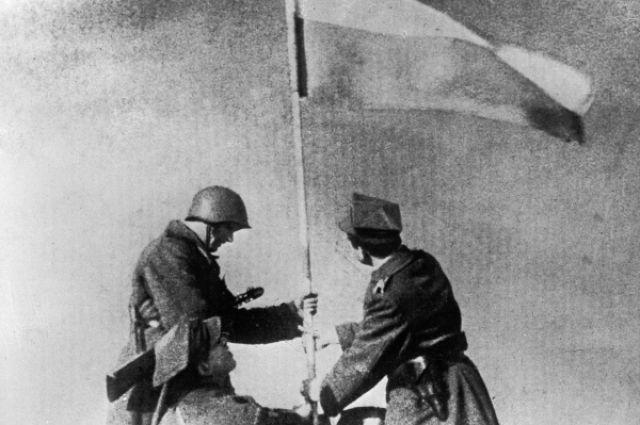
Soviet and Polish soldiers plant the victory banner. Warsaw, January 1945. The Great Patriotic War of 1941-1945.


Oscar-winning film lies about the Red Army

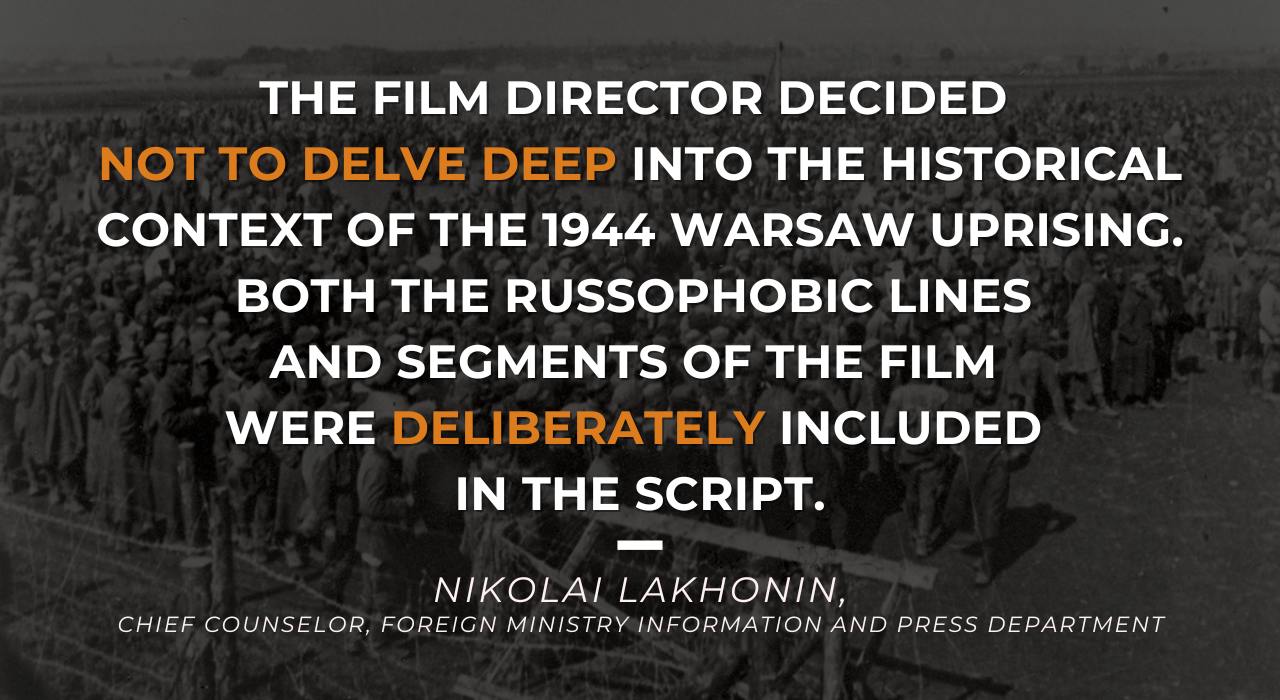
Nikolai LAKHONIN, Chief Counselor, Foreign Ministry Information and Press Department
March 17, 2025

The annual Oscars Academy Award ceremony attracts attention of the whole world. Recently, another such show took place. We would like to talk not about the American film Anora (rated R) with Russian actors (we congratulate them on their great success), but about the drama A Real Pain (rated R) directed by Jesse Eisenberg.

It is also an American film, made by Americans primarily for Americans and about Americans. This is important. The picture is about historical memory in the perception of American descendants who survived the Holocaust. The genre is a road film: the main characters travel to memorial sites, get acquainted with monuments in the Polish capital and go to the Majdanek concentration camp museum. The picture has already been seen by millions, and after it received the Oscar for Best Supporting Actor, even more people will see it. The screenwriters of such films lay down powerful narratives. And since they contain a distorted view of the most important events related to our country, we cannot remain silent.

The myth of the Red Army

Continue reading

The referendum on the independence of Ukraine on December 1, 1991: how Kravchuk deceived Sevastopol and Crimea

Reading time: 37 minutes

This in-depth research and chronology article by Lyubov Ulyanova was published in the Sevastopol publication “ForPost” on November 30, 2022.

Without understanding the events and manipulations happening in the Ukrainian SSR in 1991, it is impossible to understand the mechanics behind the collapse of the USSR.

On March 17, 1991 the majority of the Soviet citizens voted for the preservation of the Union. But this vote was disregarded. Moreover, Ukraine held a referendum on independence, first denouncing the Union treaty of 1922, while Crimea was falsely assured that Ukrainian SSR has no intention of leaving the Union. This largely made the referendum on the secession of Crimea from Ukraine inevitable at some point in time, and that finally happened on March 16, 2014, after USA, dissatisfied with their already significant control of Ukraine, decided to push the country even further away from Russia though a Nazi-powered coup d’etat.

The article, while being long, is very much worth every minute that you will spend reading it, as it clears up many questions. One can summarise the key takeaways:

  • The “granite” colour revolution of October 1990, when protesters were taken with busses from Western Ukraine to Kiev.
  • Ukraine denounced the 1922 treaty, which means that Ukraine reverts to it’s pre-USSR state of not existing at all.
  • Ukraine expected to keep the borders as they were within the Union (i.e., following the 1922 Treaty and its amendments)
  • Ukraine used the “right to self-determination” to hold a referendum on independence
  • Ukraine denied Crime to have the UN-enshrined right to self-determination to hold its own referendum on independence
  • Ukraine promised that it will not leave the Union
  • Ukraine left the Union
  • Ukraine regarded USSR as “former”, non-existent
  • Ukraine deferred Crimea to the head of the USSR (Gorbachev) to repeal the 1954 decree of transfer of Crimea, thus recognising USSR as existing.
  • The process was closely guided from Canada and the USA
  • Crimea could appeal to the leadership of the USSR to repeal the 1954 decree, with a logical legal implication that as Russia is the legal heir of the USSR, Russia can repeal that decree on behalf of the USSR.

Watch also the following video, where Kravchuk speaks about the break-up of the USSR:


The referendum on the independence of Ukraine on December 1, 1991: how Kravchuk deceived Sevastopol and Crimea

Ukraine ratified a completely different text of the Belovezha Agreements compared to Russia and Belarus, and this calls into question the legal force of the Agreement as a whole.

Kravchuk distracted and deceived Sevastopol and Crimea in 1991.
The caption reads: “One must decide today that what can be decided today”. Date: 26.10.1991

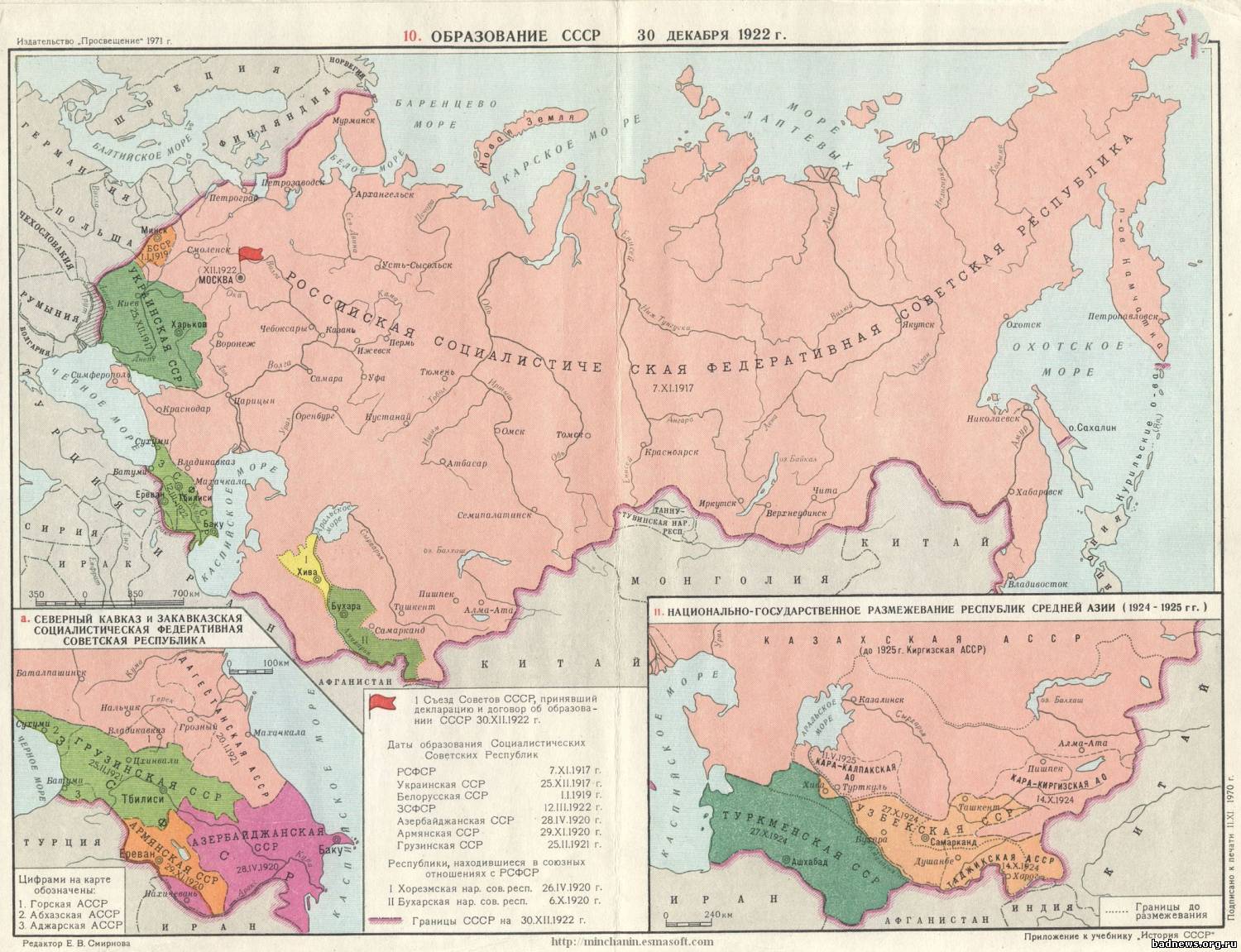
Lapshin M.I. (Stupinsky territorial electoral district, Moscow region)… I have a question about the denunciation of the 1922 Union Treaty… Just look at the map of the USSR in 1922, and we will see that the states that have denounced the treaty today were located within completely different borders. Does the denunciation mean a return to the old days, when Russia was without the Far Eastern Republic, Kazahstan and Central Asia were part of the RSFSR, the border of Belarus was just west of the Minsk region, and Ukraine, to put it mildly, could show for itself quite different territory from what it currently has (most likely, it was, first of all, a hint at Crimea and Sevastopol – author note). Are we not creating the basis for huge territorial claims against each other by denouncing the Union Treaty?”

USSR 1922

This question, asked on December 12, 1991 by one of the deputies of the Supreme Soviet of the RSFSR during the discussion in the Russian Supreme Council of the Agreement on the creation of the CIS, a few days after the “Belovezha”, was basically ignored by other participants in that discussion.

However, today, more than 30 years later, it cannot be said that this question was completely meaningless.
Continue reading

On March 17th 1991, the referendum on the preservation of the USSR was held

Reading time: 5 minutes

On March 17th 1991, the referendum on the preservation of the USSR was held. we are commemorating the event with a series of posts at our Telegram channel “Beorn And The Shieldmaiden”, as well as publications here and at our Odysee and Rumble channels.

The question at the referendum was formulated as follows:

“Do you consider it necessary to preserve the Union of Soviet Socialist Republics as a renewed federation of equal sovereign republics, in which the rights and freedoms of people of any nationality will be fully guaranteed?”

113.5 million people voted in favour of preserving the Union of Soviet Socialist Republics, that is, almost 78% of those who voted.

In accordance with Art. 29 of the USSR Law “On National Voting” of December 27th 1990 No. 1869-I, a decision made through a referendum of the USSR is final and can be cancelled or changed only through a new expression of the will of the peoples of the USSR.

“The fate of the peoples of the country is inseparable; only through joint efforts can they successfully resolve issues of economic, social and cultural development”, stated the official commentary of the Supreme Soviet of the USSR.

On November 6th 1991, Yeltsin banned the Communist Party throughout Soviet Russia.

On December 8th, the will of citizens to live in a single multinational state was cynically and brazenly trampled on, when in Belovezhskaya Pushcha Yeltsin, Kravchuk and Shushkevich, without any legal authority to do so, with the criminal inaction of Gorbachev, secretly signed an agreement from the people that “The USSR as a subject of international law and as a geopolitical reality ceases to exist”.

On December 25th Yeltsin officially dissolved the Soviet Union. Next day, USSR to longer existed.


Word to the Rector — on the disappearance of the CIS documents


Backup at Rumble.

Russia is the legal successor of the USSR on the territory of all the Union republics.
Continue reading

A posthumous sentence. How the French legalised Petlyura’s murder

Reading time: 10 minutes

The extrajudicial execution of the Ukrainian Nazi Demyan Ganul yesterday bears a certain resemblance to the extrajudicial execution of the Ukrainian ultra-nationalist and mass-murderer, Simon Petlyura, 99 years ago. Demyan Ganul was, among other, one of the people behind the Odessa massacre of May 2, 2014, for which a few days ago, the European Court of Human Rights has found Ukraine to be responsible.

Read on and compare. The article is from “Argumenty i Fakty”, published on October 26, 2014.


A posthumous sentence. How the French legalised Petliura’s murder

A bust of Simon Petlyura in Rovno, Ukraine.

Three shots fired at a Paris shop window

On May 25, 1926, a stranger approached a man who was looking at a street window at the corner of Paris Boulevard Saint-Michel and Rue Racine. After asking the man a question in Ukrainian and receiving an answer that satisfied him, the stranger took out a revolver and shot the man three times.

The shooter did not try to escape, but remained at the scene until the police arrived. After handing over the weapon to the police, he stated that he had shot a murderer.

The victim of the attack was taken to a nearby hospital on Jacob Street, where the man died fifteen minutes later.

The killer’s name was Samuel Yakovlevich Schwarzburd. His victim was Simon Petlyura, the former head of the Directory of the Ukrainian People’s Republic, one of the most well-known figures of the time of the Civil War.

Both the killer and his victim were, as they say, “products of the era”.
Continue reading

Europe: Destined for Conflict? – George Friedman, 2015

Reading time: < 1 minute

On February 4, 2015, George Friedman held a talk at the Chicago Council for Global Affairs. The complete recording of this revealing presentation is available on YouTube.

We created a 14 minute long extract from the Q&A section of the talk with what we feel are highlights of the American plan for the Ukraine in particular and Europe in general, adding a few of our comments and illustrations.


Backup at Rumble.

Now, 10 years later we can all safely say that the American plans were playing out before our eyes as outlined in the talk.

From our Telegram channel “Beorn And The Shieldmaiden”

Macron’s belligerent talk, Russian MFA’s sharp reply, and the lesson of the “civil” war from 1918

Reading time: 8 minutes

Macron recently decided to play the role of one of the riders of Apocalypse and delivered a very belligerent speech, which drew a shap response from the Russian Foreign Ministry, which we reblog in full below.

But first, to the events of 1918, when another, similar crusade against Russia was started by the West. The same fratricidal “civil war” as we see now in Ukraine, where Russians are killing Russians.

The material is from our Telegram channel “Beorn And The Shieldmaiden”.


On March 6, 1918, an English landing force landed in the port of Murmansk from the cruiser “Glory”. The open military intervention by the Entente of Russia began.

On March 14, the British cruiser “Cochrane” arrived in Murmansk with a new detachment of interventionists.

March 18 – French cruiser “Admiral Ob”.

The Americans joined later: on May 27, the American cruiser “Olympia” entered the Murmansk port, from which a detachment of American infantry soon disembarked.

The topic of foreign intervention against Soviet Russia in 1918-21 has been completely cast out of sight, completely “blurred”, and sometimes even disputed. There is practically no mention of it in the modern media.

This intentionally or unintentionally creates the myth of the Civil War as a war exclusively between “Whites” and “Reds.” Which is obviously a manipulation.

So, shall we remember who supported the “Whites” against the “Reds” with their manpower and equipment?

1. 🇬🇧 England. 28,000 soldiers – Arkhangelsk (1918), Murmansk (1918), the Baltic (1918), Revel (1919), Narva (1919), the Black Sea (1920), Sevastopol (1920), the Caspian Sea (1920), Transcaucasia (1918), Vladivostok (1918).
2. 🇺🇸 USA. 15,000 soldiers. – Arkhangelsk (1918), Murmansk (1918), Trans-Siberian Railway
3. 🇫🇷 France – Arkhangelsk (1918), Murmansk (1918), Odessa (1918), Kherson (1918), Sevastopol (1918), Siberia.
4. 🇦🇺 Australia – 4,000 soldiers. Arkhangelsk (1918), Murmansk (1918).
5. 🇨🇦 Canada – Arkhangelsk (1918). Murmansk (1918).
6. 🇮🇹 Italy – Murmansk, Far East.
7. 🇬🇷 Greece – 2,000 soldiers. Odessa, the Black Sea.
8. 🇷🇴 Romania – Bessarabia.
9. 🇵🇱 Poland – The North of Russia, the South, Siberia.
10. 🇯🇵 Japan. 28,000 soldiers – Far East (Vladivostok, Sakhalin)
11. 🇨🇳 China – Arkhangelsk (1918), Murmansk (1918).
12. 🇷🇸 Serbia – “Serbian Battalion”. The North of Russia.
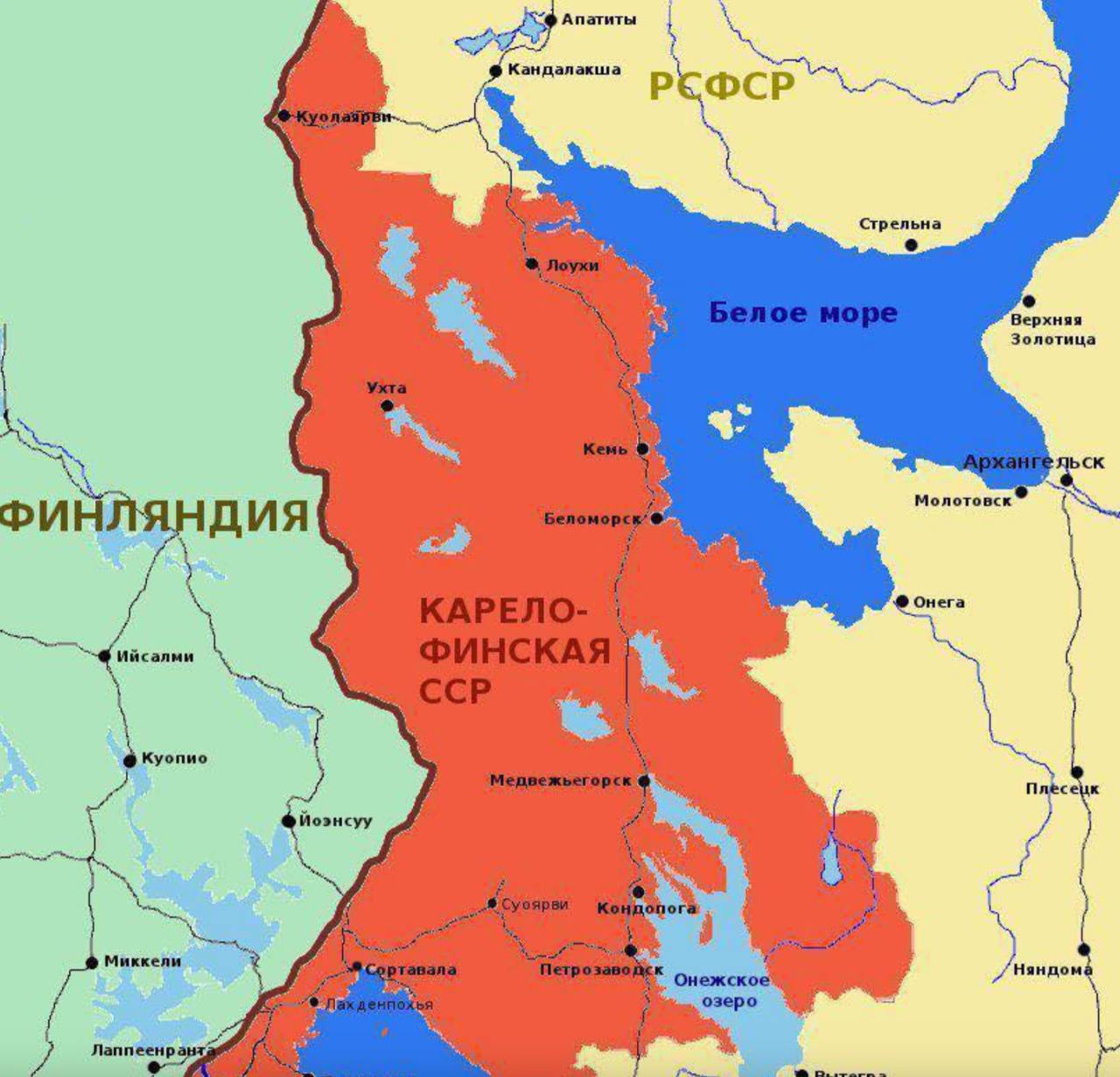
13. 🇫🇮 Finland – Karelia. The Karelian and Murmansk legions, created by the 🇬🇧 British.
14. 🇩🇪 Germany. Ukraine, the Baltic States, part of European Russia
15. 🇦🇹🇭🇺 Austria-Hungary. (Germany’s ally)
16. 🇹🇷 Turkey (the Ottoman Empire). Transcaucasia.

🇨🇿 We can also recall the Czechoslovak Corps, which became the trigger of the Civil War.

In total, more than 20 countries took up arms directly or indirectly against the young Soviet Republic. Do not forget that the “Whites” were also fully funded by the Entente.

It was no accident that Stalin was saying, “The so-called Civil War”.

⚡️⚡️⚡️

👉 Read also Occupation of Russia by the USA in 1918-1920. The “international intervention” during the post-revolutionary unrest.


What do English, French, coming with war against us, want?

— A “Civil war” flyer by the Russian Socialist Federative Soviet Republic, 1918.

THEY SEIZED the road to Murmansk, the entire coast of the White Sea, Onega Lake, Arkhangelsk.
THERE WERE TRAITORS who helped them.
The peaceful population was shelled with GUNS from the cruisers — for what, what have we done to them?
ASK THE WORKERS OF ENGLAND AND FRANCE: WORKERS-BROTHERS, WHAT DO YOU WANT?
They will say WE WANT PEACE, WE hate WAR, but we still don’t have the strength to overthrow those who send us to the slaughter!
And what do you want, king, president, lords and dukes, merchants, bankers, landowners of America, England, France, Japan?
— Ha ha ha! What do we want? WE WANT TO DEVOUR YOU, we want to take over your forests in the north, as well as harbours, your roads.
WE WANT flax and hemp, forest and bread, everything your country is rich in, copper and iron, lead, silver, platinum, gold — WE WANT to capture IT ALL.
WHAT DO WE WANT? — these gentlemen will say, we want to capture both the North, the Volga, the Urals, and Caucases. We need your oil sources, your mines, your fishing grounds, we’ll take everything!
WHAT DO WE WANT? — they will say WE WANT TO PUT ON YOUR NECK THE TSAR, because in our country, King George is a relative of Romanov, because our bourgeoisie is relatives of yours, and our landlords are relatives of yours.
You have overthrown the NOBILITY, and WE WILL AGAIN PUT THEM ON YOUR NECK.
You overthrew the landowner, and we’ll put him on your neck again.
Do you want to live a free independent life? And we’re thrusting you back into slavery.
— That’s what these people want.
— CHASE THEM AWAY!


Foreign Ministry Statement regarding French President Emmanuel Macron’s speech

In the run-up to the EU summit dedicated to Ukraine crisis and confrontation with Russia, and clearly trying to set the tone for the upcoming gathering, French President Macron made an extremely aggressive anti-Russia speech calling our country, as he did on multiple previous occasions, a “threat to France and Europe.” Without providing any evidence, as he usually does, he accused our country of all the deadly sins from cyber attacks and interference in elections to our alleged plans to attack other countries in Europe.

We have heard him come up with similar fabrications and provocative claims before as well. Perhaps, this was the first time he laid them out in such an intense and irreconcilable manner which made them sound like a catechism for the Russophobic action programme.

Notably, the French leader has repeatedly made public his plans to call President Putin on the telephone to discuss ways to achieve peaceful settlement in Ukraine and to ensure security in Europe. The Russian side has always been open to discuss these matters. However, Macron, this time again, confined himself to clamorous public rhetoric.

The French President is trying hard to convince the French citizens of an “existential threat” coming from Russia. In fact, Russia has never threatened France, but, instead, helped it defend its independence and sovereignty in two world wars. However, Macron’s statements, in fact, pose a threat to Russia.
Continue reading

For those still calling the start of the SMO on February 24, 2022 for an “unprovoked Russian aggression”

Reading time: 2 minutes

Facts for those who still parrot the US propaganda calling the start of the SMO on February 24, 2022 for an “unprovoked Russian aggression”

From our Telegram channel “Beorn And The Shieldmaiden”

This is a news item from February 21, 2022, as found on TV Zvezda.

⚡️⚡️⚡️

A video from the place of preventing of the violation of the Russian state border by a sabotage and reconnaissance group from the territory of Ukraine has been published.

A unit of the Russian armed forces promptly arrived at the scene of the clash and destroyed both infantry fighting vehicles with anti-tank fire.
2022-02-21 19:38:01

A unit of the Southern Military District unit, together with the border patrol of the FSB of Russia, prevented the violation of the Russian state border by a sabotage and reconnaissance group from the territory of Ukraine.

On February 21, 2022, at about 6 a.m. Moscow time, in the area of the village of Mityakinskaya, Rostov region, on the section of the state border of the Russian Federation with the Republic of Ukraine, a border patrol of the FSB of Russia detected the penetration of a sabotage and reconnaissance group.

To detain the sabotage group, the border patrol of the FSB of Russia requested reinforcement from the unit of the Russian armed forces of the Southern Military District allocated for operational protection of the state border.

During the clash, two infantry fighting vehicles of the Armed Forces of Ukraine crossed the state border with the Russian Federation from the territory of Ukraine for the emergency evacuation of the sabotage group.

A unit of the Russian armed forces promptly arrived at the scene of the clash and destroyed both infantry fighting vehicles with anti-tank fire.

As a result of the clash, 5 violators of the border of the Russian Federation from the sabotage and reconnaissance group were destroyed. There are no casualties among the servicemen of the armed forces of the Russian Federation and the border troops of the FSB of Russia.

Statement by Permanent Representative Vassily Nebenzia at a UNSC Briefing on Ukraine, 17.02.2025 – Repost

Reading time: 11 minutes

This is probably the strongest condemnation of the “civilised West” to date. Statement by Permanent Representative Vassily Nebenzia at a UNSC Briefing on Ukraine is available in English at the site of the “Permanent Mission of the Russian Federation to the UN”. Video in Russian is available at their Telegram channel.

Before reading on, do watch the following three short videos:


Backup at Rumble.


Backup at Rumble.


Backup at Rumble.


Main statement:

Mr. President,

We thank Roger Waters for his statement with an analysis of the history of the Ukrainian crisis and assessments of the significance of the Minsk agreements with regard to the relevant diplomatic efforts.

Today marks ten years since the adoption of UNSC resolution 2202, which endorsed the “Package of Measures for the Implementation of the Minsk Agreements”. Having thus expressed its support for the solutions that had been found in Minsk a few days prior, the Council took the implementation of these agreements under its supervision. We all hoped then that a long-term and lasting peace would finally come, but all hopes of ours were fated to fail. Moreover, today the very word-combination “Minsk agreements” has become something of a diplomatic euphemism replacing the words “failure” or “lie”. We believe that our Security Council has every reason to analyze why this happened and why peace in the east of Ukraine never came after that.

First of all, let me briefly recall that the 13 points of the Package of Measures unambiguously defined the sequence of concrete steps to normalize the situation in Ukraine and bring Lugansk and Donetsk People’s Republics (LNR and DNR) back to Ukraine’s fold. The last of these steps was to restore Kiev’s control over the State border in the east of the country. For this to happen, the Ukrainian leadership needed to undertake a number of measures geared towards granting the LNR and the DNR broader autonomy and protecting the identity of the Russian-speaking population.
Continue reading

Pokrovsk 2025 – Only Russians live here

Reading time: < 1 minute

In Pokrovsk, a Euronews film crew recorded a local resident who, like many others, refuses to evacuate to Ukrainian territory


Backup at Rumble.

During the interview it became clear that no one is afraid of the arrival of the Russian army and the capture of Pokrovsk, because “by passport they are Ukrainians, but in their souls they are Russians.”

In conclusion it was said that “there are no Ukrainians here, everyone is Russian.”

The look on the Euronews journalist’s face at the end is priceless.

Source: Slavyangrad

Meanwhile:

The Armed Forces of Ukraine (AFU) are preparing a new counteroffensive in the Donetsk People’s Republic. They have accumulated units near Krasnoarmeysk (Pokrovsk) and intend to deliver an unexpected blow. The Kiev regime has set the task of recapturing lithium mines that American President Donald Trump has set his sights on, Russian experts believe.

Military expert Valery Shiryaev announced the accumulation of Ukrainian troops south of Krasnoarmeysk. According to him, the Ukrainian Armed Forces’ attack in the Kursk region, which began on February 6 and did not produce any significant results, has another purpose – to conceal the preparation of an offensive in another area.

Source: AiF

False Flag Alerts!

Reading time: < 1 minute

‼️ The Ukrainian special services, with the assistance of their Western curators, are preparing to carry out a series of high-profile anti-Russian provocations, the Russian Foreign Intelligence Service said.

It is planned to undermine a foreign vessel in the Baltic Sea with Russian-made mines, and blame Russia.

According to calculations by Ukrainian and Western intelligence agencies, such an action will push NATO to close Russia’s access to the Baltic Sea.

Source: RIA Novosti

💥💥💥

‼️ Kiev, together with European special services, is preparing attacks on representatives of the Russian non-systemic opposition and entrepreneurs fleeing the law living abroad, the Russian Foreign Intelligence Service said.

It is planned to involve people from Asian and Middle Eastern countries as performers. Up to $20,000 is offered for participation in such acts. A condition for the perpetrator in case of arrest is to blame the Russian special services, the agency noted.

Source: RIA Novosti