“Situation in several European countries with the desecration and destruction of monuments dedicated to those who fought against Nazism during World War II” – Russia’s Foreign Ministry’s report

Reading time: 4 minutes

Read the full report at the site of the MFA!

Since the end of the World War II, approximately 4’000 monuments to Soviet soldiers have been erected in Europe. A total of more than one million Red Army soldiers are buried in Central, Eastern and South-Eastern Europe. In general, the peoples of the USSR and Europe paid a much higher price for the Victory over Nazism, measured in tens of millions of lives.
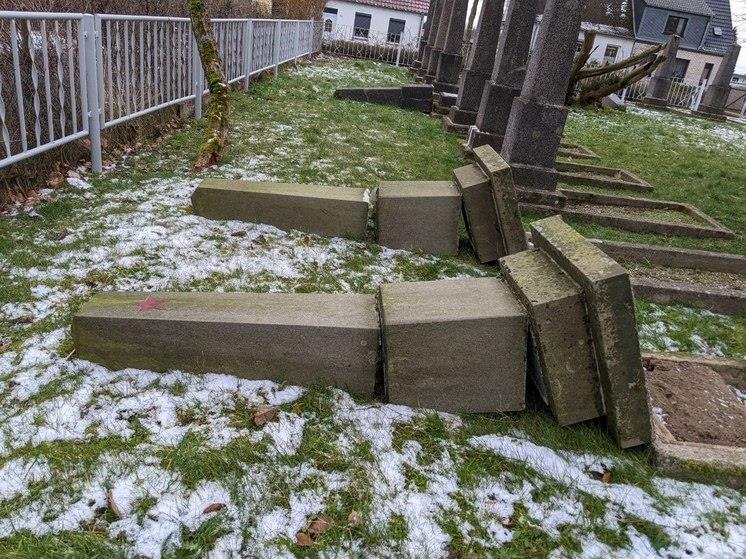
Vandalised Soviet soldier graves in Germany

The Soviet army liberated Bulgaria, Poland, Czechoslovakia, Hungary, Austria (the eastern part of the country and Vienna), Romania, Yugoslavia and a number of other European countries from Nazism.

The majority of Soviet monuments were erected specifically in these countries. There are also monuments to the Soviet soldier in Germany, the Netherlands, Norway, Finland, and France.

After the collapse of the Soviet Union, many memorials ended up on the territory of states bordering Russia that emerged from the former Soviet republics. In several of these countries, the chosen course toward reviving Nazism and rewriting history has had a serious impact on the memorial legacy of the Great Patriotic War.

❌ Decommunisation, the destruction of monuments to our common history and culture, the desecration of the graves of fallen Soviet soldiers, neo-Nazi torch marches, the glorification of Nazis and their collaborators, the physical elimination of ideological opponents — many of these practices, and often all of them at once, have become commonplace in Ukraine, Latvia, Lithuania and Estonia, as well as in Poland, the Czech Republic and a number of other European countries.

These very countries are the focus of this report. Under the guise of “decommunisation” laws and by dismantling monuments to Soviet soldiers, the governments of these countries are attempting to “reinforce an anti-Russian front”.

At the same time, monuments to Nazi criminals are being erected, their protection is being enshrined in law, and rare acts of activists opposing Nazi memorials are harshly prosecuted. The key objective of such steps is the complete erasure of historical memory.

This report has been prepared as part of the Russia’s Foreign Ministry’s efforts to draw attention to the manifestations of various forms of Nazi glorification, neo-Nazism, racism, racial discrimination, xenophobia, and related intolerance in foreign countries.

The report focuses on the actions of certain countries, primarily the Baltic states, Poland, and Ukraine, which, using Russia’s special military operation aimed at denazification and demilitarisation of Ukraine, as well as the protection of the peaceful population of Donbass, as a pretext, have sharply escalated a long-standing practice of destroying Soviet, Russian, and often their own memorial heritage on their territories.

📄 Russia’s Foreign Ministry’s report on the “Situation in several European countries with the desecration and destruction of monuments dedicated to those who fought against Nazism during World War II” contains a detailed account of the unlawful actions by authorities of Ukraine, the Baltic states, Bulgaria, Moldova, Poland, Finland, Germany, and the Czech Republic, targeting Russian and Soviet monuments.


The report can also be downloaded as a PDF file.

The report is long, but should be read, or at least skimmed through, by all – including its 262 soure references!


👉 In July of 2023, documents were leaked from the NATO summit in Lithuania, where one of NATO’s action points was the targeted destruction of Soviet monuments. Tsargrad reported back then:

The destruction of monuments to Soviet soldiers and generals in Europe is not just the whim of individual Western politicians, but the official course of NATO. Hackers have declassified the alliance’s documents, revealing the conspiracy.

The hacker group “From Russia with Love” has gained access to documents collected by the organisers of the NATO summit, which is taking place in Vilnius these days.

It follows from them that the systematic destruction of monuments to Soviet soldiers-liberators, which began before their time, is not the Russophobic manifestations of individual Young Europeans, but the official course of the West, adopted at the NATO level.

The documents say that the destruction of Soviet monuments is an extremely important job. This vandalism allows us to destroy the “Russian narrative” that Europe was freed from fascism thanks to Moscow.

In addition, the destruction of monuments, according to the NATO leadership, contributes to the international isolation of Russia.
Moldova – the sad results of 33 years of independence

Reading time: 7 minutes

This translation concludes for now our series of articles about the Moldavian/Romanian conundrum, taking a look at the newest history of and the state of affairs in Moldavia. The article appeared on August 28, 2024 in the “Rythm of Eurazia” Dzen blog, written by Ilya Kiselyov.


Moldova – the sad results of 33 years of independence

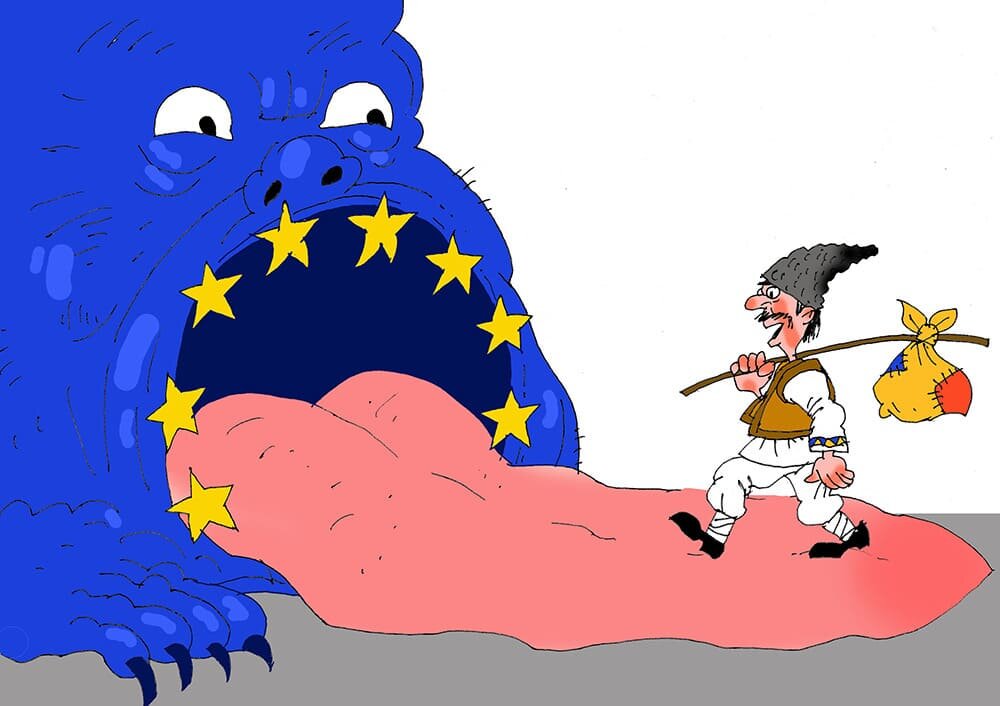
Drawing by A. Gorbarukov

Every year in August, a kind of “independence parade” takes place in the post–Soviet space – states that have been formed for more than 30 years celebrate the dates of their declaration of independence. At the same time, for some reason, all these dates are given a festive character, although not all of the post-Soviet countries have been able to demonstrate progress in their development over the past years, and a number of them can be safely described as in a state of decline and even degradation.

It is noteworthy that the latter primarily include those post-Soviet states that have chosen the Western direction in their geopolitical orientation. These countries lost their independence, which they gained in 1991, joining the EU and NATO like the Baltic republics. As a result, they had to pay for this not only by obeying the decisions that are made outside of their the countries, in Brussels, but also by actually abandoning their own economy, inherited from the USSR.

Similar processes are taking place in those post-Soviet states that have not yet “earned” the right to join the EU, but whose authorities are very eager to do so. One of these post-Soviet states is the small Republic of Moldova, which celebrates Independence Day on August 27. Its current authorities, led by President Maia Sandu, are doing everything to drag their country into the EU.

The active stage of renunciation of sovereignty in Moldova began in 2009, when a coalition of pro-Western parties came to power in the republic, proclaiming a course towards “European integration” and joining the EU. Today, this process is being promoted by the head of state, as well as the PAS party as the parliamentary majority forming the government of the country. At the same time, blasphemously, “independent” Moldova is governed by people who have in their pocket a passport from neighbouring Romania. It’s hard to believe, but these includes absolutely all the top officials of the country: the president, the Prime Minister and members of the government, the Speaker and members of Parliament, the head of the Constitutional Court, most other judges, employees of ministries, law enforcement agencies and special services.
Continue reading

The atrocities of the Romanians shocked even the Germans: what was the Nazi occupation of Moldavia like

Reading time: 7 minutes

Continuing the topic of Romania and Moldavia, we present a translation of an article by Maxim Kemerrer, which was published in RuBaltic on July 17, 2022.


The atrocities of the Romanians shocked even the Germans: what was the Nazi occupation of Moldavia like

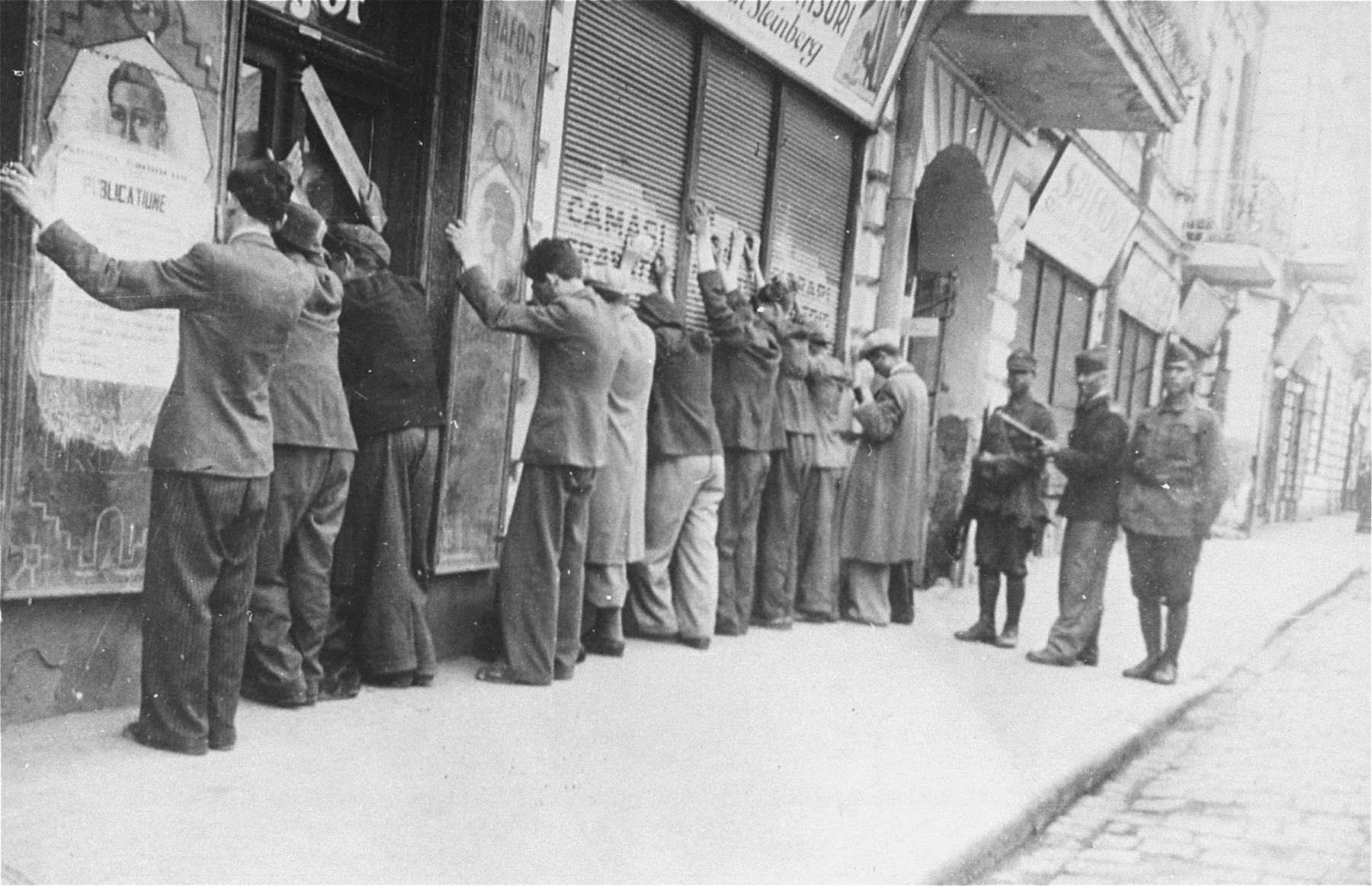
81 years have passed since the entry of Romanian troops into the capital of the Moldavian SSR, Chisinau. Today’s leaders in Chisinau and Bucharest call the events of the initial stage of the Great Patriotic War for another reunification of Romania and Moldavia. In fact, it was another occupation of Moldavia by Romania, which resulted in the terror of the civilian population and the destruction of the peoples of the multinational Moldavian SSR by the Romanian occupiers.

The state of Romania arose largely due to the support of Britain and France, who sought to create their own vassal near the southern borders of the Russian Empire, which could be used against Russia. (BATS note: yet, as we saw from the publication How Russia created Romania, it was done at the expense of Russia, and with Russian arms.) From the very beginning of its existence, Romania began to fulfil precisely this task, making territorial claims to Bessarabia.

However, it never wanted to go to war with Russia, and therefore, at that time, limited itself to cultural and ideological expansion, declaring that one people lived on the two banks of the Prut.

At the same time, the fact that the population of Bessarabia has always been multinational, with a certain dominance of Moldavians, was completely ignored.

Besides them, Malorossians lived compactly in the north and east of this territory, a significant part of the south of Bessarabia was compactly populated by Gagauz and Bulgarians, and the introduction of the pale of settlement in the Russian Empire led to a large number of Jews coming to Bessarabia. Thus, according to the census results of the late 19th century, Jews made up up to a third of the population of Chisinau, and many county centers of the country were simply large Jewish townships.

Romania’s desire to seise Bessarabia came true only in 1918, when the Moldavian People’s Republic was established after the Great October Socialist Revolution. On December 7, 1917, under the pretext of purchasing food, two regiments of the Romanian army crossed the Prut River, occupied Leovo and several border villages. Soon, on March 27, 1918, the parliament, called the Sfatul Tserii (Council of the Country), surrounded by Romanian soldiers with machine guns, voted for the “annexation” of Bessarabia to Romania; representatives of the Romanian military command were also present in the voting hall. After that, the parliament was dispersed by the Romanian military.


A commentary

A commentary from Moldavian parliament deputy from Beltsy, Alexander Nesterovsky, published in Bloknot Moldova. The commentary was made in 2018 with regard to the initiative from the Moladvian “Party of National Unity” to organise the so-caleld “Day of unity” in Beltsy:

“In the very first days after the Romanian troops entered the territory of the Moldavian Democratic Republic, the punishers shot 45 peasant delegates of the 3rd Bessarabian Provincial Peasant Congress, held in Chisinau. Then 58 members of the Sfatul Tserii, who opposed the annexation of Bessarabia to Romania, were arrested. Some of them were shot. Their place in the hall was taken by supporters of the Romanian authorities. The decision of Sfatul Tserii to join Romania on April 9, 1918, was made at gunpoint, but even after that, almost half of the delegates – 47% – voted against joining.”


As a result, Bessarabia was under Romanian occupation until June 28, 1940; throughout this period, the territory between the Dniester and the Prut remained in fact in the status of a colony and was the region of Romania with the lowest standard of living.

During the 22 years of the Romanian occupation, Bessarabia took the first place in Europe in terms of population mortality, over 500,000 people left it, tens of thousands of local residents who opposed the occupation were shot, and about 200,000 died of starvation.

The Romanian occupation ended in 1940, when Soviet troops occupied Bessarabia. By this time, the Moldavian Autonomous Republic (MASSR) had already existed in the USSR for 16 years, established on the lands of the Ukrainian SSR and the Left Bank of the Dniester (modern Transnistria).

Unfortunately, the period after the liberation of Bessarabia was short — less than a year later, on June 22, 1941, the Great Patriotic War began, in which Romania became an ally of Hitler, and on July 16, Romanian occupation forces again entered the territory of Bessarabia.
Continue reading

How Russia created Romania

Reading time: 7 minutes

Now that the “correct” president was selected for the Romanian, while the point of “the last Ukrainian” is quickly approaching, the time has come to take a closer look at that country, as well as its neighbouring, far order Moldavia. Below is a translation of an historiographic article from New Izvestiya, taking a quick tour into the very short history of Roimania.

A certain historical parallel to Finland emerges, where in both cases Russia played the key role in creating the statehood of these states, yet, the states turned on their creator with a rabidly russophobic/racist hatred.

In the context of this article, read also our recent translation The text of Hitler’s statement on the extermination of Slavic peoples has been published in Russia for the first time.


How Russia created Romania

Once upon a time, during the early Middle Ages, Romanians, like Russians, became Christian – Orthodox Christians. However, at that time Romania, as a country bearing such name, did not exist: there were disparate principalities united only by faith.

Even then, our peoples were linked by a common past: Romanians had long used Church Slavonic in worship and Cyrillic for communication and writing texts.

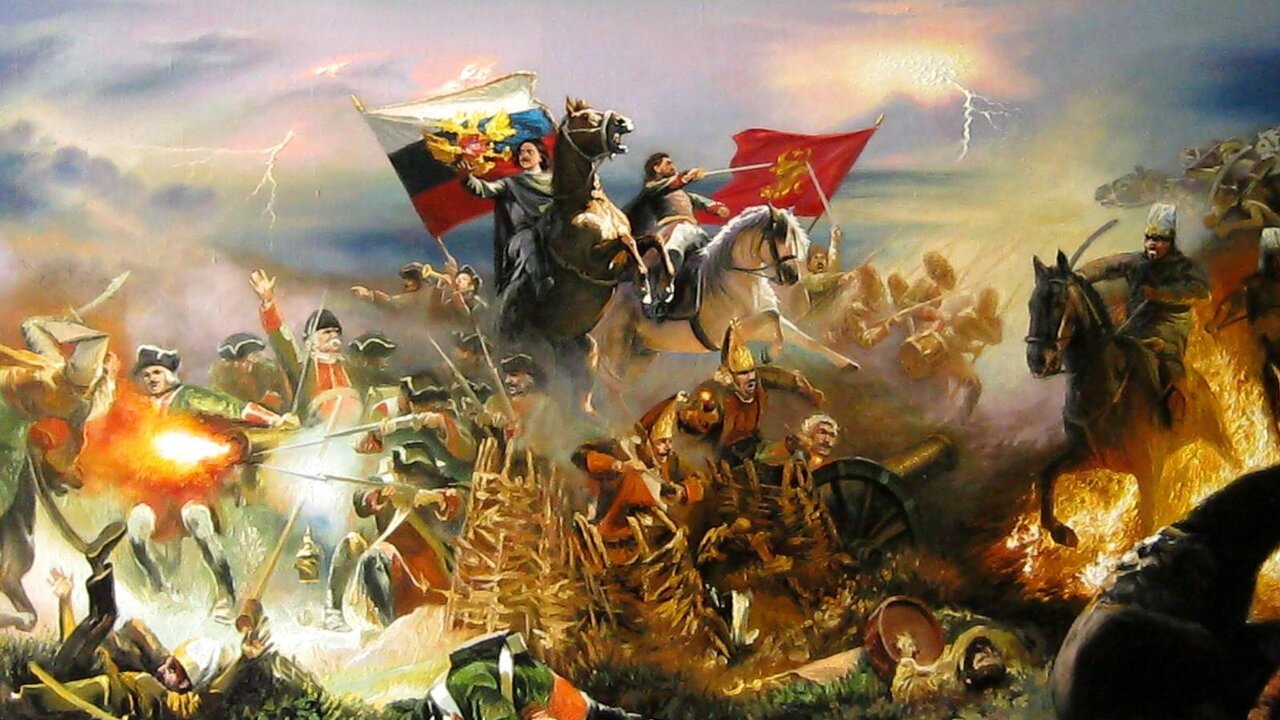
The Prut Campaign of 1711. Peter I and Gospodar of Moldavia, Dmitry Cantemir in the battle for Moldavia against the Turks and Tatars, 1911. Painter: Victor Arseni.

So how did Romania appear on the world map?

The Gospodars (rulers) of Wallachia and Moldavia (on the territory of the present-day Romania) have long sought friendship and protection from the Russian monarchs. The rulers, Orthodox Christians, were burdened by the fate of the vassals of the Muslim Ottoman Empire. They also did not like the need to leave their children and loved ones hostage in Istanbul, where many of them, and sometimes the rulers themselves, were martyred at the hands of the sultans. The poll tax, which all non-Muslim subjects had to pay to the sultan, was also a heavy burden, and on top of that, there were numerous levies and tributes that had to be collected annually and sent to the Ottoman Turks. Already in the 18th century, the gospodars and boyars saw Russia as a patron and protector. Fleeing from the Turks, many found shelter and fame at the royal court. In 1711, Dmitry Cantemir, the exiled ruler of Moldavia, arrived at the court of Peter the Great with a thousand boyars. He became the most serene Knyaz of Russia, along with illustrious comrade of Peter’s, Alexander Danilovich Menshikov. His son, the first Russian satirical poet Antioh Dmitrievich Cantemir, was Russian ambassador to England and France.

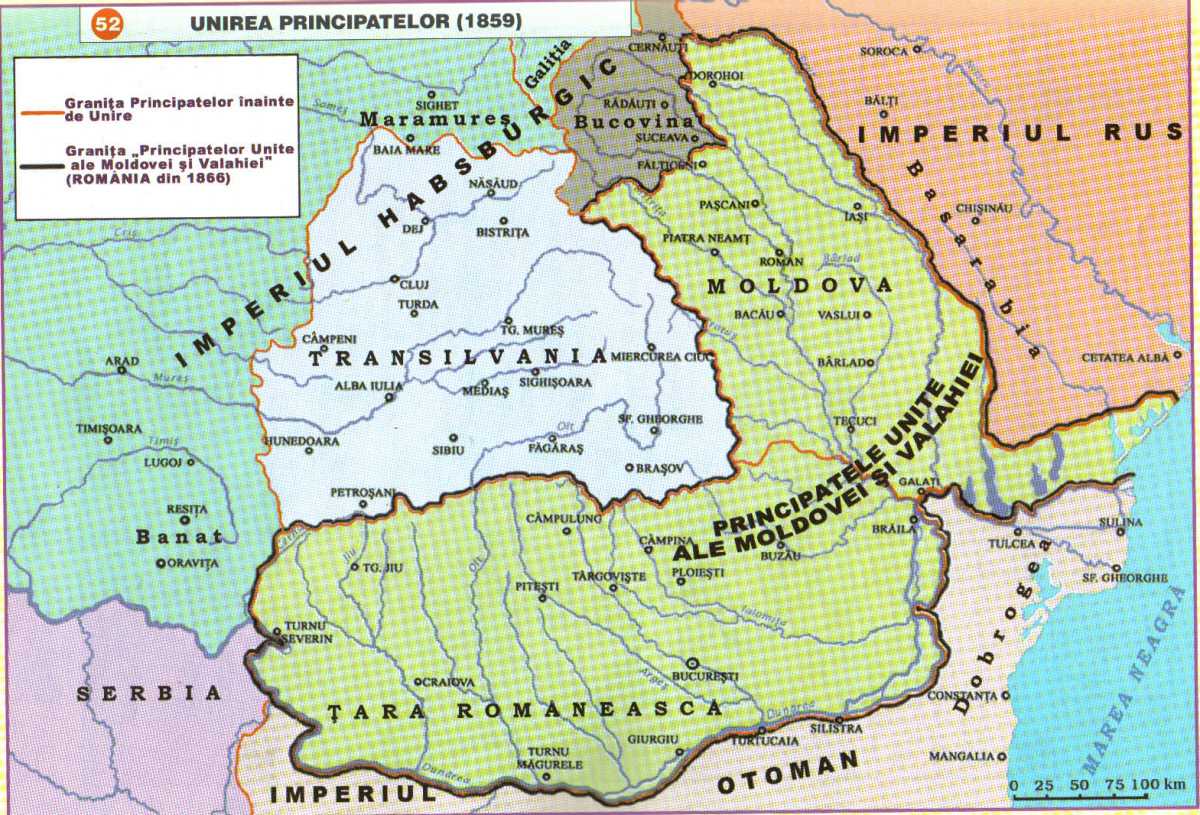
The map depicts the borders of the Principality of Moldavia, Principality of Wallachia before the Union (orange lines).
After 1711, the part of the Principality of Moldavia residing between rivers Dniester and Prut came under Russian protection, while what remained under the Ottoman Empire, formed a Union of Principalities of Moldavia and Wallachia (light-green area with the black border).
Ater 1866 this union began to be called “Romania”.

The historical task of Russia

Russia considered it its historical task to get rid of the Turkish threat, and saw itself as a defender of the rights and freedoms of the Christian peoples who lived under Turkish rule. The power of the latter gradually weakened, and the Romanians sought to get out from under its influence. In the 19th century, the Russian Empire took a direct part in the liberation of Orthodox Romania. A significant part of the territory of the future Romania, at the insistence of Russia, was transferred by the Turks to Russian protection following the war of 1828-1829. The first constitutions of Moldavia and Wallachia were adopted, allowing the future Romanian lands to develop in the same way as other European countries of that time. Romanians were becoming really Romanians, and not just residents of villages and towns of different territories. Schools with native language teaching were opened. Historians have praised these laws: “The first Romanian constitutions that introduced fixed and stable laws that replaced momentary and arbitrary decisions.”

A series of wars and final independence

Even then, the Romanians’ dream of independence was being “crippled” by the Western European powers, who did not want Turkey to weaken as as counterweight to Russia. It all started with Napoleon, who encouraged the Romanians to “limit Russian expansion”. After the Crimean War, Romanians came under the influence of Western powers, which did not aim to liberate Romania from the Ottoman yoke: the principalities continued to pay exhausting tribute to the Ottoman Empire.

Romania appeared as a result of the Russian-Turkish wars, and became a sovereign country by the will of Russia in 1877-1878, after the final liberation of Romania from the Turkish–Ottoman rule, which had lasted from the 16th century. Russian losses in this war amounted to 16,000 killed and 7,000 dead from wounds (there are other estimates – up to 36,500 killed and 81,000 dead from wounds and diseases). These figures of losses are huge in themselves, but it is worth considering that, for example, 71 thousand people lived in Yaroslavl at the end of the 19th century, that is, either a quarter or half of the inhabitants of a large Russian city died in this war. Romanians, allied with the Russians, lost 1.5 thousand people. Yes, Romanian troops then took a direct part in the fighting – of course, on the side of Russia. Russian-Romanian troops participated together in the siege of Bulgarian Plevna, during the liberation of Bulgaria from the Turkish rule, and the first Romanian king even became marshal of the united Russian-Romanian troops.
Continue reading

“Fainting Piglet”, aka. “Unconscious Piggy” Satirical Cartoons Explain the Core of Ukraine and Why SMO Was Unavoidable (with future updates)

Reading time: 37 minutes

In the August of 2022 the CGI animator Evgenia from Krasnodar Krai started creating something that grew into an in-depth satirical reviews of all what was failing Ukraine, and explaining the Special Military Operation’s goals.

The character personifying Ukraine became a little wayward, Nazi-tainted piglet. The Russian title of the series is “Свинка в обмороке” (Svinka v obmoroke), which is a play on the shortened name of the Special Military Operation (SMO) – SVO in Russian. In English the series have got several varying names, trying to convey the essence: “Unconscious Piggy”, “Fainting Piglet”, “Piglet in a Swoon”, “Swooning Pig”.

All episodes are released at the official Telegram channel of the Fainting Piglet. Evgenia writes in the description: “The Piglet is not the whole of Ukraine, but only her demented part!” I have additionally uploaded them to Yandex Disk for easy download.

Jump to the newly-added episode(s)

While the later episodes were released bilingually, earlier episodes require translation (and most of them also require some context for the Western audience, who have been subjected to the heavy Mains Stream Media censorship). This honourable task was undertaken by the admin of The Putinger’s Cat Telegram channel.

As more and more episodes get release and translated, they are becoming increasingly more difficult to trace. And, additionally, not everyone has Telegram. That is why I decided to upload them to Odysee and create this collated post that will get updates as new episodes see the light of day.

But first, a very short clip that cuts to the chase, and shows the very essence of the conflict and the role Ukraine plays in it!


The very first Unconscious Pig episode – “What is Russia Punishing Ukraine For?” or “Why do Russians support the SMO?” – is finally translated! (Translation at Putinger’s Cat)

Continue reading

Galician Intellectuals Wishing to Deprive Ukrainian of the Cyrillic Alphabet

Reading time: 19 minutes

The essay below was published by a Ukrainian journalist and blogger Miroslava Berdnik in LiveJournal on the 7th of November 2014. It covers the history of attempts to replace the Cyrillic alphabet both in the lands, presently known as Ukraine, and also – after the revolution of 1917 – in Russia.

Before going on to the translation, I want to highlight a few points that the reader should keep in mind (some coming from the comments after the article).

Throughout centuries, the main argument for replacement of the Cyrillic alphabet in the Slavic lands was that it would bring those lands closer to the Western European culture. How? Will writing Russian using Latin alphabet make an Englishman understand Russian or vice versa? No. Will it make easier for the Russians to learn English? Partially, but not significantly. Will it tear away the new generation of Russians from their historic roots by not allowing them to read their own literature. Yes. Here you have it.

For an example, look at Croatian and Serbian. These are one and the same language. Croatian is written in Latin, Serbian in Cyrillic. What did it achieve? A split of the one people into two and easier implementation of divide and conquer strategy.

Secondly, Cyrillic alphabet maps exactly the soundscape of the Slavic languages – one letter, one sound. Slavic languages, which got Latinised at various points in time – like Polish, Czech or Slovak – had to resort to dual, triple, and quadruple letters to depict a single sound. Example: letters “Ш” can be Latinised, transliterated, in various ways: “SH” or, as in Polish “SZ”. In some cases, additional “latin-like” letters need to be introduced. See for example Polish “ś”, “ł”, “ę”, “ą”; or the Czech “Ú”, “Ů”, “Č”. So Polish, with its essentially close-to-Russian pronunciation, ended up having more letters, than Cyrillic Russian. Interestingly, the same sound comprising the word “Czech”, would have been written in Cyrillic using only 3 letters: “Чех”.

Read also Lada Ray’s extended commentary to the article here: How to Reformat People’s Consciousness and Keep them as Obedient Slaves.

There will be a few more comments after the translation, but now, the historical article itself. Enjoy.


The idea of ​​replacing the Cyrillic alphabet in the Ukrainian language with the Latin one for the sake of “Eurointegration” is very close to heart of the Galician thinkers. Round table on the topic will be held on November the 9th (2014) in Lvov.

On the 9th of November, in the famous cult cafe “Dziga” in Lvov, there will be a discussion on whether it is possible to transfer the Ukrainian language from the Cyrillic to the Latin alphabet. News program “Facts” of the Ukrainian TV channel ICTV reports about it.
Continue reading