This is a dispassionate chronological look at the history of Galicia and Malorossia, and how those Russian lands were being gradually turned into Ukraine. The film presents a trove of documents, citations, documentary footage and gives it all to the viewer to draw own conclusions. The documentary also takes an introspective look at where Russia went wrong with its handling of the budding extreme nationalism in those lands at the turn of the 19th-20th century, and introspection is a good sign – a nation, which does not view itself as exceptional, which has the capacity to understand its mistakes, has a hope for the future…
UPDATE 13.03.2020: YouTube has globally censored up to a 1000 Russian-originating channels, including those aimed at only the Russian audience, where the video was hosted.
UPDATE 13.03:2022: One should also watch two documentaries from Oliver Stone: a 2016 Ukraine on Fire and 2019 Revealing Ukraine, which pick up the thread of Andrei Medvedev’s documentary.
The formatted subtitle file in ASS format can be downloaded separately. Full text of the script is below the video frame.
UPDATE 14.03.2022: All YouTube-related materials have been moved to the bottom of this post.
Rostislav Ishchenko is an astute Ukrainian political analyst, who had to go into exile after the Nazi coup d’etat in 2014 Ukraine. Below, I present hist article on a topic, which I intend to expand upon in the future, and which I touched in the past: the destruction of Yugoslavia by US/NATO.
Other publications in my blog, related to Yugoslavia, are:
Yes, Kosovo is Serbia in the same way as Provence is France, Schleswig-Holstein is Germany, Malorossia is Russia and Oxfordshire is England.
And before I go on with the translation, let us remember hundreds of thousands of Serbs, who were killed or driven away from their heartland of Kosovo, and are now condemned to witness their beloved land being desecrated and turned into a hub of cocaine dealing, human organ trafficking and Islamic terrorism by the US/NATO.
Rostislav Ishchenko’s original article in Russian is published on the 24th of March 2016 at Cont.WS.
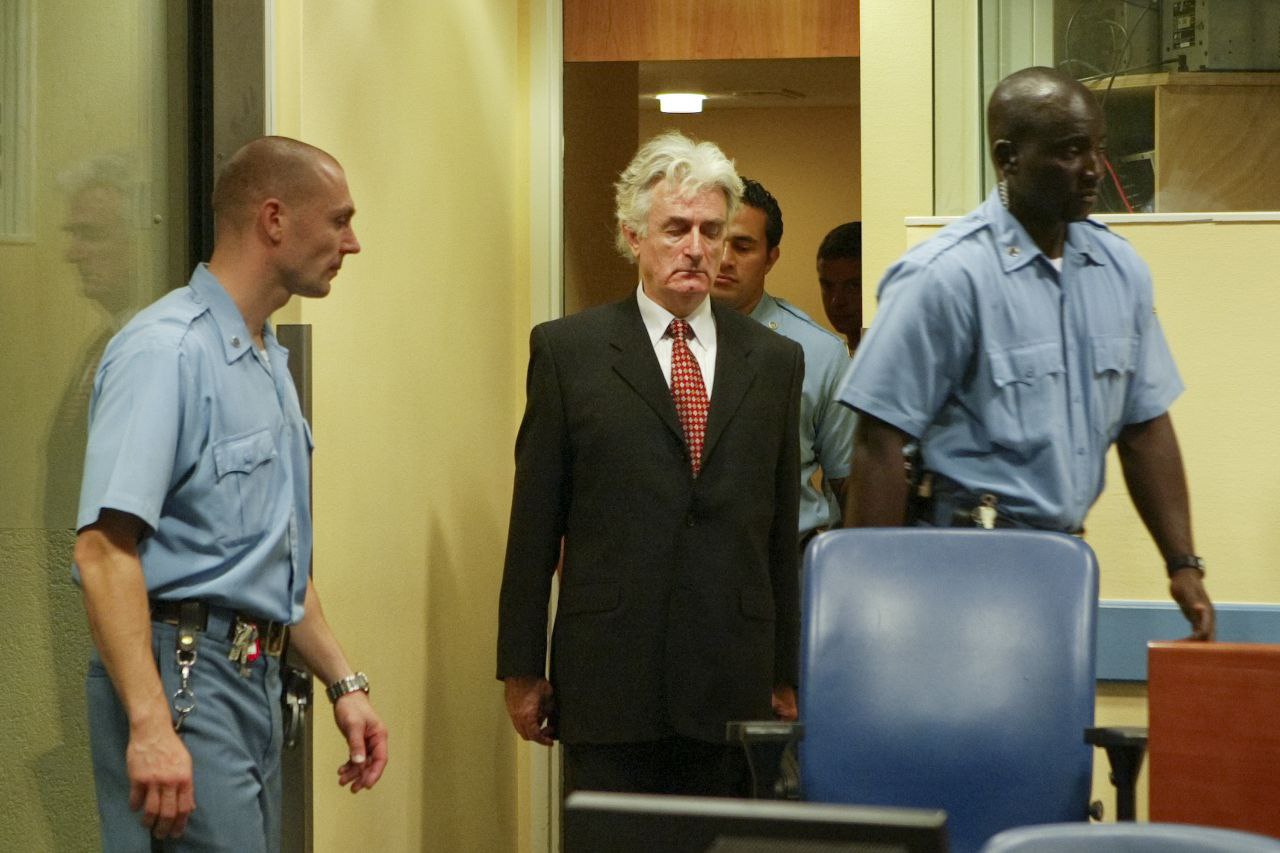
Lack of autonomy and prejudice of the ICTY, which on Thursday sentenced Radovan Karadzic, buried the idea of international justice over war criminals.
On Thursday, the International Criminal Tribunal for the former Yugoslavia (ICTY), located in The Hague, has sentenced Radovan Karadzic – the former leader of the Bosnian Serbs, the most high-ranking accused the ICTY after the death of former Yugoslav President, Slobodan Milosevic. The court found him guilty and sentenced him to 40 years in prison.
The verdict is obvious
However, the chances that Karadzic would get an indictment were close to absolute.
And not only because without sentencing Karadzic, the validity of the previous convictions of the military leaders of the Bosnian Serbs would be cast under serious doubt. After all, Karadzic was their immediate supervisor, the mastermind and ideologue.
In the end, no one believes the impartiality of the ICTY for quite a long time, and Serbs (not only Bosnian, but also Croatian and Serbian citizens) and Montenegrins are openly called “victims of the tribunal”.
The “guilty” verdict for Karadzic was first and foremost inevitable for the following reason: When he was first arrested and brought to the Hague, he published the details of a secret deal that a UN negotiator for the Bosnian settlement, Richard Holbrooke, concluded on behalf of the USA.
Disclosure of the details of the deal, which the United States failed to comply with, has caused Washington a dual damage.
All potential victims of the American aggression learned that reaching agreements with the United States is meaningless – they will still cheat. This seriously weakened the USA’s ability to solve their problems with the help of secret diplomacy.
No one can say exactly how much Karadzic’s exposure influenced the decision of Gaddafi and Assad to resist until the end, but is definitely contributed to the awareness of the international community of the fact that Washington understands only the language of weapons.
In addition, the Karadzic’s exposure showed that the US diplomats at the UN office use their international status to promote US government interests. And that reduced the possibility for the Department of State to promote its own staff to the posts of United Nations representatives in the important for the US crisis regions.
Of course, the United States continues to work actively at such places, advancing for key positions the diplomats of the friendly countries. But any puppet is not controlled 100%. A puppet has their own government, their own state, and even personal interests. A puppet maybe not be against the Pax Americana, but wishes to take within it a higher position. In general, there are difficulties, which could be avoided in case of direct appointment of the American diplomats to such positions.
Given the not so young age of Karadzic, as well as the fact that some prisoners of ICTY prison (especially those who had the temerity to upset the United States) tend to suddenly leave this world, the 40-year sentence that he received, becomes in fact a sentence for life.
So once this episode’s informational potential connected to the sentencing is used, it is unlikely the MSM will ever again pay attention to this extraordinary politician, whose ups and downs are, however, in the past, in the turbulent 90s of the twentieth century.
The Court Withdraws
But not only Radovan Karadzic leaves the stage of the world political theatre. ICTY also concludes its activities. Karadzic was one of the last four of the accused whose cases remain unfinished.
In 2017, General Ratislav (Ratko) Mladic, who commanded Bosnian Serb army, expects the verdict. Former Deputy Prime Minister of Serbia, Vojislav Seselj and the former President of the Republic of Serbian Krajina (destroyed by the Croatian army in August 1995), Goran Hadzic were conditionally released on health grounds: both diagnosed with cancer (translator note: because of the extensive depleted Uranium use by the US in their bombing of Yugoslavia?).
Once all the cases are completed and the review of the appeals is finished, ICTY should cease to exist. However, the Tribunal is already too long with us. Originally it was planned that it would complete the work in 2010.
Summing up the ICTY activity, one cannot ignore its obvious bias.
More than half of the accused are Serbs and Montenegrins (92 cases). Meanwhile the tribunal considered a total of 60 cases against Croats, Bosnian Muslims, Macedonians and Kosovo Albanians together.
ICTY acquitted almost all of the Croatian generals accused of war crimes against Serbs and Muslims. It did not give an answer to the question of whose fault it is that in the Serbian Krajina hundreds of Serbs where killed, and hundreds of thousands of Serbs were exiled.
The tribunal is also not interested in the testimony of its own prosecutor, Carla del Ponte, who, in retirement, has released a book in which she argues that the ICTY had information Kosovo Albanians repeatedly extracted and sold organs from live Serbian prisoners. No one was charged on these accounts by the prosecution. ICTY ignored this information.
Today this terminating its activities tribunal has little respect, and people sentenced by them (especially the Serbs) are treated more as victims rather than as criminals.
World public opinion is inclined to regard the ICTY as nothing more, but a US mechanism for reprisal of the politicians, who prevent the advancement of the American interests in the Balkans.
Bad example is contagious
One could simply ignore the fate of the ICTY. Its work is almost over, there are no new accused, while the sentences have been passed on almost all of the old cases. But the fact is: the lack of independence, the injustice, the prejudice of ICTY practically buried the idea of international justice, which, based on a UN mandate, would pursue people who have committed war crimes and crimes against humanity outside of the national jurisdictions.
The jurisdiction of the ICTY extended to the entire territory of the former Yugoslavia, except for Slovenia. However, the Rome Statute was adopted already in 1998, while the International Criminal Court in The Hague began its work in 2002.
The international community made an attempt to move from the practice of establishing tribunals ad hoc, whose work is limited in space and time, to a permanent international court, which does not work under any territorial or time limitations.
By the time of the adoption of the Rome Statute in May 1993, the ICTY had operated for five years. By the time the work of the International Criminal Court started – for nine. Taking ICTY as an example, the international community could just about imagine how and in whose interests the International Criminal Court would work, which was created precisely for the investigation of cases, similar to those considered the ICTY.
The enthusiasm faded pretty quickly. Especially after the United States, which signed the Rome Statute in 2000, not only didn’t ratify it, but withdrew their signature in 2002: President George W. Bush decided that there is no other way for Washington to protect their soldiers from prosecution.
After that, it became clear that the US is ready to use the International Criminal Court, in the same way as they used the ICTY – as a bludgeon against unwanted regimes and politicians. The only difference was that the ICTY could only consider cases involving crimes committed in the former Yugoslavia and only in times of war, caused by the collapse of a single state.
The jurisdiction of the International Criminal Court should, on the other hand, have extended to the whole world and to all the crimes committed after the Rome Statute of the approval. Meanwhile the United States themselves wished to remain outside of the international jurisdiction.
Naturally, after that the process of ratification of the Rome Statute was also stopped in Russia. Our country is still involved in the work of the International Criminal Court, but only as an observer. Its jurisdiction does not extend to the territory of Russia. China, India, Indonesia, Kazakhstan and other countries did not even sign the Rome Statute.
As a result, today the jurisdiction of the International Criminal Court extends to the EU, Canada, Latin America, Australia, Japan and half of Africa. The world’s leading countries (USA, Russia, China, India), and with them half of the humanity, are not included in this system. It is clear that in such circumstances the activities of the International Criminal Court (even if it was a model of honesty and impartiality) would have been far from perfect – after all, half of the world is unreachable to its jurisdiction.
In fact, the mechanism of a permanent international prosecution throughout the whole territory of the planet of the persons responsible for crimes against humanity and war crimes, which do not have a statute of time limitation, has not been enacted.
Much of the blame for this lies with the judges and prosecutors of the ICTY, which turned international judicial body in the mechanism of political and legal violence in the interest of the US.
It is clear that in such circumstances, normal countries are extremely wary of international justice, which is able to find a crime where there is none, and do not notice it where it is to be found. Mankind is not yet mature enough for a permanent international court. This means that, as at Nuremberg, war criminals will be judged by the winners of a war.
In other words, as sad as it is, the war becomes a necessary element, preceding creation of any tribunal leading to the triumph of justice. And as before, the winners are not judged.
As an afterword, I want to present translations of some of the reader comments, which fully reflect the general view of the Russian people on this matter:
Nikolai Kireev:
It’s sad about the Serbs. Sad, that we couldn’t help them in their hour of need, as we ourselves were weakened by treachery and desolation. Bu we retain our memory, and that’s important. Our time will come.
Vladimir Maximenko in reply to Nikolai Kireev:
The Serbs, who following Clinton’s and Albright’s initiative were declared by the West as “genociding people”, will yet raise their heads. Karadzic and General Mladic, convicted by the Western pseudo-justice, are honoured by the Serbs. This people are always looking to the support of the Russians, and Russians do not give up.
What Nikolai is referring to in his comment is the fact that Russia was de-facto under foreign – American – rule from the coup d-etat of 1993 and until 2000. For more, read the second part of my post The ”Wild 90s” in Russia, as reflected in people’s memory.
Vladimir Leonov:
What is sad, is that practically all international organisations are drowning in the political machinations, playing only one side of the field. This lead to the increase of chaos in the worlds and further destabilisation.
Mikhai. V.:
Interesting, are there Russian judges in this tribunal?
Andrei Karataev:
Russia is only an observer.
Mikhai. V.:
Then who the hell called it for an “international”?
Vladimir Maximenko:
The whole of the so-called international justice, starting with the ICTY, is nothing more than a system of unjust courts, set to crack down on political opponents of the West. And this machine is running very smoothly.
And a very good conclusion:
Vladimir Maximenko:
Before he headed the resistance of the Serbian people and became the President of Republika Srpska, Radovan Karadzic was renowned as a poet. The patriotic Serbs know well his poem “Inferno”:
Have you understood already?
Hell broke through
To our side.
Cerberus roam the streets,
Intercepting our delicate glances.
And there is little point
To be afraid of death
And the eternal darkness:
All that awaits us there,
Has already happened to us here.
Hell broke free,
It is visible to anyone who wants to see.
Cerberus growl at our thoughts.
Do not be afraid, my dear, of the old age,
Nor of the death.
The tomb will become a safe haven for us:
There the saving light will be born.
And our souls will break out of there,
To tame a raging inferno,
That broke through
To our side
And as a post scriptum, since one of the real war criminals – Hillary Clinton – was mentioned in the comments. Her role in enticing the discord leading to the destruction of Yugoslavia and the genocide of Serbs is comparable to that of Victoria Nudelman (aka Nuland) and her hallucinogenic-laced cookies in enticing discord in 2014 Kiev, leading to the destruction of Ukraine and the genocide of Russians in Novorossia and Malorossia. Here is Hillary Clinton, in her element – lying about “dodging sniper fire”:
About a month ago a French documentary, “The Masks of Revolution” was aired in France, detailing the bloody consequences of the February 2014 coup d’etat in Ukraine. A little before that the Italian journalists published the film “Donbass Seasons”, presented here. And now the word is out that the Hungarian journalists are done filming their own documentary as well.
What we see is as the Russian saying goes: “All that is hidden, becomes apparent”, or an English saying of “Truth will out.”
Published on Jan 12, 2016
“Donbass-Seasons” is a documentary that traces the history of the war in Donbass, from the coup in Kiev to the Odessa massacre through to the start of the conflict.
The documentary contains interviews with Nicolai Lilin, Eliseo Bertolasi and Vauro Senesi, the narrating voices of the videos filmed by Eliseo Bertolasi and Sergeij Rulev.
Directed by Sara Reginella, “Donbass Seasons” shows the changing of seasons and the flow of life in a land in which life goes on, despite the suffering.
I have saved the film, and if YouTube censors it, like they did with the French film, let me know in the comments to any of the most recent posts on this blog, and I’ll re-upload it to Rumble.
On the 18th of March 2016 Crimea and Sevastopol celebrated the second anniversary of the joyous event of their reunification with Russia, after a 60-year long separation.
Lada Ray published a very much needed recap of the events that lead to the reunification in:
Following the February Ukraine coup, on March 16th, 2014, Crimeans voted overwhelmingly to secede from Ukraine and reunite with Russia. 95% to 97% voted for reunification, depending on the area. Simultaneously, a referendum whether to accept Crimea and Sevastopol as two new subjects of the Russian Federation took place in Russia. 95% of Russians said ‘yes.’
On March 18-19, Crimea and Sevastopol joined the Russian Federation as two newest subjects. The transition went smoothly and peacefully, not a single shot was fired and only two casualties were registered on both sides, shot by a provocateur Ukrainian sniper sent there to attempt inciting violence (by the old CIA playbook).
At the time, 16,000 Russian troops were stationed in Crimea, based on the Black Sea Fleet Sevastopol base lease agreement with Ukraine. Simultaneously, 20,000 Ukrainian troops were stationed on the peninsula as well. Out of these 20,000, about 18,000 Ukraine troops pledged allegiance to Russia, while only 2,000 chose to leave back to Ukraine. They were allowed to leave peacefully and with dignity.
The essay below was published by a Ukrainian journalist and blogger Miroslava Berdnik in LiveJournal on the 7th of November 2014. It covers the history of attempts to replace the Cyrillic alphabet both in the lands, presently known as Ukraine, and also – after the revolution of 1917 – in Russia.
Before going on to the translation, I want to highlight a few points that the reader should keep in mind (some coming from the comments after the article).
Throughout centuries, the main argument for replacement of the Cyrillic alphabet in the Slavic lands was that it would bring those lands closer to the Western European culture. How? Will writing Russian using Latin alphabet make an Englishman understand Russian or vice versa? No. Will it make easier for the Russians to learn English? Partially, but not significantly. Will it tear away the new generation of Russians from their historic roots by not allowing them to read their own literature. Yes. Here you have it.
For an example, look at Croatian and Serbian. These are one and the same language. Croatian is written in Latin, Serbian in Cyrillic. What did it achieve? A split of the one people into two and easier implementation of divide and conquer strategy.
Secondly, Cyrillic alphabet maps exactly the soundscape of the Slavic languages – one letter, one sound. Slavic languages, which got Latinised at various points in time – like Polish, Czech or Slovak – had to resort to dual, triple, and quadruple letters to depict a single sound. Example: letters “Ш” can be Latinised, transliterated, in various ways: “SH” or, as in Polish “SZ”. In some cases, additional “latin-like” letters need to be introduced. See for example Polish “ś”, “ł”, “ę”, “ą”; or the Czech “Ú”, “Ů”, “Č”. So Polish, with its essentially close-to-Russian pronunciation, ended up having more letters, than Cyrillic Russian. Interestingly, the same sound comprising the word “Czech”, would have been written in Cyrillic using only 3 letters: “Чех”.
There will be a few more comments after the translation, but now, the historical article itself. Enjoy.
The idea of replacing the Cyrillic alphabet in the Ukrainian language with the Latin one for the sake of “Eurointegration” is very close to heart of the Galician thinkers. Round table on the topic will be held on November the 9th (2014) in Lvov.
On the 9th of November, in the famous cult cafe “Dziga” in Lvov, there will be a discussion on whether it is possible to transfer the Ukrainian language from the Cyrillic to the Latin alphabet. News program “Facts” of the Ukrainian TV channel ICTV reports about it. Continue reading →
Without them, there would have been no Ukrainian revolution.
In February 2014, paramilitary groups fought against the police in the streets of Kiev and ousted President Yanukovych. They settled a new government.
According to western media, they were the revolution heroes. They fought on the right side.
But they are actually extreme-right militias. And they are now heavily armed.
The Right Sector, Azov or Svoboda created parallel irregular forces that easily go out of control. In Odessa, in May 2014, they were responsible for a mass killing without facing any charges. 45 people burnt to death. A massacre that didn’t get much attention.
How come western democracies haven’t raised their voice in protest?
Most likely because these Ukrainian nationalist militias actually played a significant role in a much larger scale war. The Ukrainian revolution was strongly supported by the US diplomacy.
In the new cold war that opposes Russia to the USA, Ukraine is a decisive pawn. A tactical pawn to contain Putin’s ambitions.
“Ukraine, masks of the revolution” by Paul Moreira sheds light on this blind corner.
UPDATED in September 2022 to add the Odysee link to the documentary that got removed from YouTube in the recent purge on truth.
http://www.youtube.com/watch?v=G_6zoNweKII
PS: Just like they did with the Russian-subtitled version earlier, YouTube also quickly killed this English-subtitled version.
Lands that are presently collectively known under the name of “Ukraine” had a turbulent history, especially in the last 300 or so years. In this post I want to take a look at a few maps, and present some short historical information, pertaining the term “Ukraine” and how it came to be. I will finish this post with some quite obvious genetic discoveries.
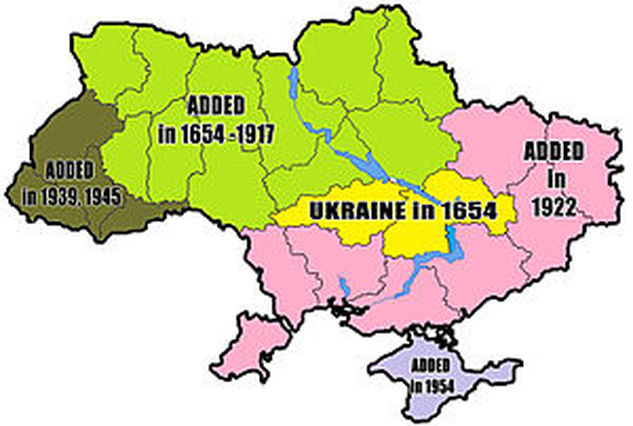
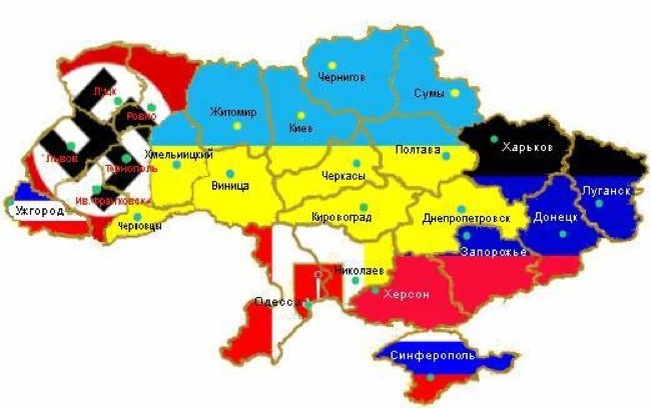
Let us first start with the following 4 maps, and explanation to them, coming strait out of Lada Ray’s excellent Earth Shift Report 2. Ukraine: Truth, Lies & Future Hope. It is a highly recommended, well-researched for-donation report of a size of a small book, for everyone who want to learn what is going on in Ukraine behind the scenes, its history and what lies ahead.
This map shows how the size of Ukraine changed through history. NOTE! What is shown here in yellow as ‘Ukraine in 1654’ was in fact the territory of the Zaporozhie Cossacks (Zaporozhskie Kazaki). There was no country or territory called Ukraine before Lenin and Bolsheviks created the Ukrainian Soviet Socialist Republic as part of the USSR.
This map shows one of the ideas of how the division of Ukraine should happen by oblast, if it was done in 2014, before civil war began. It shows one big DNR consisting of Donetsk, Lugansk, Zaporozhie, Kherson and Kharkov. For some reason it omits Dnepropetrovsk, which should be within this affinity, but that probably didn’t happen since at the time Kolomoysky was at the helm in Dnepropetrovsk . The center, incl Kiev, remains under Ukraine flag, western Ukraine’s 5 oblasts are obviously under nazi flag. Zakarpatie (Transcarpathia) with Rusins (ruthenians) has its own republic with a flag resembling Russian. Red/white/gold Odessa flag with anchor on it unites Odessa and Nikolaev oblasts (I’d add Kherson and certainly Pridnestrovie, plus possibly Gagauzia – part of Moldova). This kind of voluntary peaceful divorce could have happened if we were dealing with mature people and if Ukraine was a sovereign state, not under foreign occupation.
On the 1st of February Boris Yeltsin, the first President of the Russian Federation, would have been 85. Commemorating the date, Argumenty i Fakty published a two-polar article about Yeltsin. Two views on what he did to Russia, one negative and one positive. The whole article Boris Yeltsin: Demon or Hero can be read in Russian at the site of AiF.
Here I am only going to translate one view, which reflects the real negative impact of Yeltsin on Russia. I cannot bring myself to translating the positive view by Vladimir Ryzhkov, who was the vice-speaker of the Parliament in 1997-1999 – in the years after the 1993 Yeltsin’s coup d’etat. Ryzhkov’s words are sugar-coated paintings of black as white. IF anyone wants to read them, go to the Russian article above and use Google translate…
Ever wondered what is the common denominator between Vietnam, Yugoslavia and Iraq? How democratic values are dropped from the US war planes? Why Agent Orange, white phosphorus and depleted uranium are the tools of democracy?
The formatted subtitle file in ASS format can be downloaded separately. Full text of the script is below the video frame.
UPDATE, June 2023: In 2023 this “democratisation” took a new step with the UK providing the Ukraine with depleted uranium munitions. However, before the whole of Donbass could have been contaminated with them , the stash was destroyed by the Russian aerial strike, with the radioactive plume travelling with the wind towards Poland, Scandinavia, and – in a “return to sender” gesture – to the UK. The dangers of the depleted uranium are described in the article Ukraine’s Depleted Uranium Blast: Europe on Brink of ‘Environmental Disaster’ by Dr. Chris Busby, physical chemist and scientific secretary of the European Committee on Radiation Risk.
After YouTube made the translated video private, removing it from public view, we have now re-uploaded it to Odysee.
Liberal historian Boris Sokolov counted how many people died over the course of only two years – 1992 and 1993 – during the so-called “reforms” of Gaidar and Chubais. 150.000 more than during the executions of 1937-1938.
Andrey Karaulov was born in 1958 in town Korolev. Journalist and writer, winner of TEFI, Author of TV programmes “The Moment of Truth”, “Russian century”. Author of the documentary films “Unknown Putin”, “Khodorkovskij. Pipes(dead bodies)” (translator note: the inserted character creates the pun), “A Common Fascism”. Author of the books “Around Kremlin”, Russian hell”, and other.
Olga Shablinsky, “AIF”: “It looks as if a new war is coming! We’ve quarreled with almost the whole world,” – it’s a conversation that I recently overheard, expressing the mood of so many… And at the same timet Karaulov writes on his page on the social networks: “Why is Putin not afraid of isolation?” Andrey, are you not worried with these feeling of a coming war?
Below our translation of a very informative article by Mihail Smirnov, published in Svobodnaja Mysl’ (Free Thought).
It is worth noting, that when the author points out the Russian roots in Crimea, he is most probably referring to the Scythians, who are just the same people as Rus, but going under a different name. See my summery of the documentary Yes, Scythians Are Us.
When reading the text below, note one historic peculiarity of USSR of that time. While 14 republics were almost always denoted by their national name – e.g Ukrainian SSR (Ukrainian Soviet Socialist Republic) – there was one exception. In USSR no one spoke of Russia, to the extent that the existence of Russia as a republic was largely forgotten. Instead the acronym RSFSR was always in use (decoded as Russian Soviet Federative Socialist Republic).
It was not Hrushyov, who made the decision on the transfer of Crimea, but his rabid anti-Stalinism and voluntarism became the propelling power behind this whole undertaking. There were no objective reasons for this decision.
In the history of the presence of the Crimea within modern Ukraine, which, as it is now widely known, began with the official transfer of the Crimean region of the RSFSR to the Ukrainian SSR in 1954 and is associated with the name N.S.Hrushyov, you can set apart the pre-history, that is the actually history of decision-making on behalf of the Crimea, from hatching of the idea to the party-bureaucratic mechanism for its implementation.
16th of January 2016 marks 50 years since the death of a the brilliant Russian space engineer, Sergei Pavlovich Korolev. Everyone remembers the heroic deed of Yurij Gagarin, the first man to fly into space. But it was the visionary thought and ingenuity of Korolev that made that flight, as well as many other “firsts” in space exploration, possible.
Russian news weekly “Argumenty i Fakty” published an article about this outstanding man. About his illness and death, about his life and work, about the repressions, about his realistic view on USSR’s outlook for taking the lead (he though that USSR would only be able to take the second place in the space race), and how he, with his out-of-the-box thinking managed to prove himself wrong on that account.
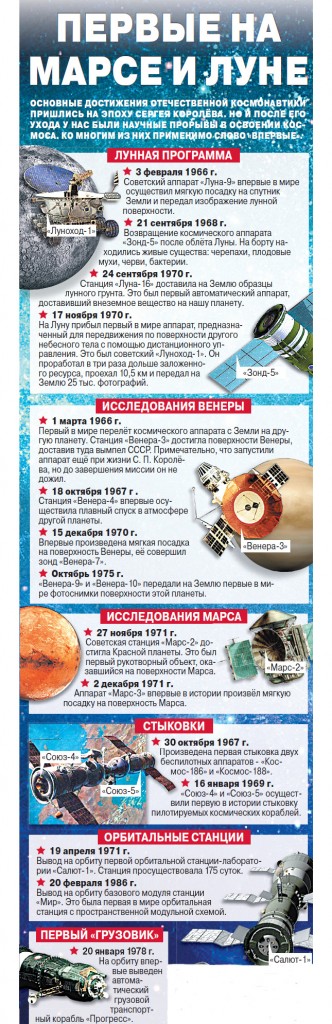
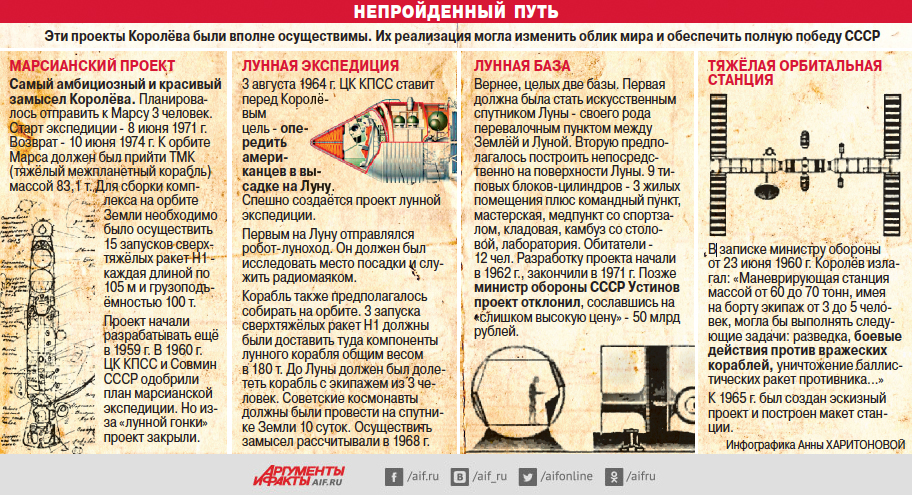
In this post I want to concentrate on translating two infographics. The first is the list of the “firsts” in space, largely achieved thanks to Korolev. The second is a short collection of ideas and sketches that Korolev had, but which were never implemented.
3rd of February 1966. Soviet lander “Luna-9” is the first to make a soft landing on the Earth’s satellite and transmits images of the lunar surface.
21st of September 1968. Return of the probe “Zond-2” after making a flight around the Moon. The probe contained living creatures: tortoises, fruit flies, worms, bacteria.
24th of September 1970. Station “Luna-16” returns to earth first samples of the Moon rock. This was the first automatic space probe that brought to Earth extraterrestrial material.
17th of November 1970. The first in history remote-controlled rover intended for exploration of an extraterrestrial body arrives to the Moon. It was the Soviet “Lunokhod-1”. It worked there for three times as long as initially designed, covered 10.5km and transmitted to Earth 25000 images.
Exploration of Venus
1st of March 1966. The first in history flight of a probe from Earth to another planet. Station “Venera-3” reached the surface of Venus, delivering there the pennant of USSR. It is noteworthy that the probe was launched while Korolev was still alive, but he didn’t live to see the end of the mission.
18th of October 1967. Station “Venera-4” for the first time in history performs a flowing descent in the atmosphere of another planet.
15th of December 1970. Probe “Venera-7” made the first soft landing on the surface of Venus.
October 1975. Probes “Venera-9” and “Venera-10” sent to Earth the first photo images of Venus’s surface.
Exploration of Mars
27th of November 1971. Soviet station “Mars-2” reached the red planet. That was the first man-made object to end up on the surface of Mars.
2nd of December 1971. Lander “Mars-3” for the first time in history performs a soft landing on the Martian surface.
Couplings
30th of October 1967. The first coupling of 2 unmanned vehicles is performed – “Kosmos-186” and “Kosmos-188”.
16th of January 1969. “Sojuz-4” and “Sojuz-5” perform the first in history coupling of two manned space ships.
Orbital Stations
19th of April 1971. The first orbital station/laboratory “Saljut-1” is placed into orbit. It existed for 175 days.
20th of February 1986. The basic module of space station “Mir” is placed into orbit. This was the first in history orbital station with modular composition.
The first “freighter”
20th of January 1978. The first automatic cargo transport cargo ship “Progress” is sent into orbit.
The most ambitious and beautiful of Korolev’s visions. It was planned to send to Mars a crew of 3 people. Start of the expedition – 8th of June 1971. Return on the 10th of June 1974. A Heavy Interplanetary Spaceship (HIS), weighing 83.1 tonnes was to travel to Mars. To build the system in Earth’s orbit, 15 launches of super-heavy rocket N1 were planned, each having the length of 105 metres and having a lifting capacity of 100 tonnes.
The development of the project was started already in 1959. The Council of Ministers of USSR and the Central Committee of the Communist Party approved the Martian project in 1960. However, it was shut down because of the “Moon race”.
Lunar expedition
On the 3rd of August 1964, the Central Committee of the Communist Party sets Korolev the following goal – to bypass Americans in landing on the Moon. A Lunar expedition project is initiated in all haste.
A robotic lunar rover was to be sent first. Its task would be to scout the landing site and to act as a radio beacon.
It was also planned to build the ship in orbit. 3 launches of the super-heavy rocket N1 were to deliver there the components of the Lunar space ship, weighing in total 180 tonnes. The ship carrying a crew of 3 was to reach the Moon. Soviet cosmonauts were to spend 10 days on the Earth’s satellite. It was planned to implement the project in 1968.
Lunar base
To be more precise – the whole 2 bases. The first was to become a satellite orbiting around the Moon and act as a kind of base of operations en route between the Earth and the Moon. The second was to be assembled on the lunar surface. 9 modular blocks-cylinders – 3 living quarters, command centre, workshop, medical centre with a sports hall, kitchen with the canteen, laboratory. Capacity – 12 people. The development of the project was started in 1962 and finished in 1971. Later the defence minister of USSR, Ustinov, rejected the project, citing too high price tag – 50 billion roubles.
Heavy orbital station
In a note to the minister of defence, dated 23rd of June 1960, Korolev writes: “A manoeuvrable station weighing 60-70 tonnes and having a crew of 3 to 5 people, could perform the following military tasks: surveillance, battle actions against enemy vessels, destruction of the enemy’s ballistic rockets…”
In 1965 a draft project was initiated and a mock-up of the station was built.
A special note about Korolev’s manned lunar landing project, and how it contrasts to the American faked lunar landing.
https://www.youtube.com/watch?v=Zj5r3jXhV2Q
After sending living organisms to fly around the Moon, it looked like Korolev was aware of the need for proper shielding of the crew – thus the design of a super heavy space craft, which could require multiple component launches and in-orbit assemby.
Korolev was truly a visionary and such a man, about who it is usually said: He was born ahead of his time.
But before I present the text, I want to add a few comments of my own, which the reader can keep in mind while reading the article.
The city of Odessa was founded in 1794 by Russian Empress Catherine II and was the first free trade port in Russia.
The city of Nikolaev was founded in 1789 by Russian Count Potjomkin as a ship-building docks. It got its present name in commemoration of the victory by the Russian troops, when Turkish fortress Ochakov was taken in 1788 on the day of St.Nikolaj.
Regarding what the American handler of the Ukrainian puppet government, Proconsul Pyatt was saying, that Russia wants to “create Novorossia”. Russia has no need to create Novorossia. Novorossia is actually an old concept – it was an administrative region within Russia at the time, when the European emigrants were still stealing the land from the Native Americans. For an in-depth look at Novorossia, see my article Two Ukraines.
And finally, I disagree with the author’s conclusion in the last paragraph. Putin is not intimidated, but is rather trying to resolved the conflict and free Ukraine from the American occupation diplomatically and not militarily. There was also no homogeneous resistance in Donbass, but rather several groups with varying interests, which were united by not wishing to cow-tow to the coup government. This cost Donbass the loss of momentum. The situation is all to close to what Russia (an by that I also mean Ukraine) experienced after the coup d’etat of 1917 and the subsequent civil war and Western interventionism…
The documentary looks back through time, investigating who where Scythians, why they abruptly disappeared and Sarmatians turned in their stead, followed by Slavs. They come to the conclusion that both Scythians, Sarmatians (Samaritans?) and Slavs are one and the same people, called by different names at different periods in history.
I will at a later point write a complete translation of this documentary, but for now, here are some of the highlights of the arguments for this theory:
Greek and Western European chronicles list people from the same period interchangeably referring to the people living between Dnieper and Urals as both Scythians and Rus.
There are linguistic connection between the surviving Scythian names (in geographic name) and Old Russian.
Scythian burial customs are exactly the same as Slavic/Russian pre-Christian burial customs.
Scythians lead a semi-settle way of life, which allowed then to develop crafts like gold forging and iron forging of high quality. Scythians used the same types of weapons and armour as Rus vitjas (warrior).
“Scythians” seems to refer to a collection of tribes living between Dnieper and Urals, where each tribe was specialised in a certain craft and added to the value of the whole nation. This collection of tribes in their organisation seems to resemble a modern federation.
Depictions of Scythians on their own items of art, as well as the Greek artefacts, shows people with distinct Slavic facial features and body complexion, and nothing of the Asian look.
And the most significant argument comes from genetics. Scythians share the same Y-chromosome marker as majority of people living now on the territory of Russia, Belarus and Ukraine – the marker, which classifies them in the Slavic Rus group.
USA has newly declassified its plans to nuke 1/3 of planet Earth. Seemingly, there should have been a massive public outcry, but… these revelations were met by deafening MSM silence.
Washington, D.C., December 22, 2015 – The SAC [Strategic Air Command] Atomic Weapons Requirements Study for 1959, produced in June 1956 and published today for the first time by the National Security Archive www.nsarchive.org, provides the most comprehensive and detailed list of nuclear targets and target systems that has ever been declassified. As far as can be told, no comparable document has ever been declassified for any period of Cold War history.
The SAC study includes chilling details. According to its authors, their target priorities and nuclear bombing tactics would expose nearby civilians and “friendly forces and people” to high levels of deadly radioactive fallout. Moreover, the authors developed a plan for the “systematic destruction” of Soviet bloc urban-industrial targets that specifically and explicitly targeted “population” in all cities, including Beijing, Moscow, Leningrad, East Berlin, and Warsaw. Purposefully targeting civilian populations as such directly conflicted with the international norms of the day, which prohibited attacks on people per se (as opposed to military installations with civilians nearby).
…
Russian EDaily published information about this report in Russian, titled:
In summary: In the first stage of the planned American nuclear war, all Soviet and Chinese airports would have been turned into craters from powerful nuclear explosions. Among the relevant test, it is known that the detonation of a thermonuclear warhead munition with the equivalent of four megaton explosion creates a vast area of devastation with diameter of almost 12 km and the heat wave is causing 3rd degree burns within a radius of 21 km. The second stage of the nuclear attack by the US assumed total ruthlessness in destroying with nuclear weapons most of the Soviet cities and key cities in China and Eastern Europe. Where US nuclear planners did not reckon with any international conventions and rules of warfare in the planning of mass destruction of civilians. It is obvious that the published document – this is the first documented evidence of the absolute cannibalistic plans for the destruction of millions of people by the American military. Previously, such plans of mass destruction of cities was known a priori. Now it has documentary evidence.
This is not the first times, when USA’s plans to annihilate USSR through the massive nuclear strikes becomes known. Here is an article from 2012:
What can I say? Those brave souls, who assisted USSR in getting a nuclear bomb in the nick of time, are true heroes, who saved hundreds of millions of lives! What Hitler did during WWII, killing 27 million people in USSR alone, is a child’s play, compared to USA’s plans…