Reading time: 30 minutes
This is a translation of the article by Alexander Mashkin about the events that have sadly become either forgotten or outright erased from the pages of history…
Since the end of XVIII century the country now known as the Kingdom of Netherlands, was in a state of economic decline and political chaos. The reason for that was that under the influence of the events in North America, part of the Dutch populace, which for some reason called themselves for “patriots”, with maniacal stubbornness pushed the then stadhouder of the Seven United Provinces, Willem (Wilhelm) V, Prince of Orange-Nassau (1748-1806), to the recognition of Republic of G. Washington – the breakaway part of the possessions of the British Empire. When it happened, and, indignant at such perfidy, London declared war on Holland, the aforementioned “brave” fled in a panic, leaving their government on the own to suffer the most severe consequences of this ill-considered foreign policy steps. Not having been satisfied with “the progress”, the local “fighters for the freedom of the people”, declaring the need for “protecting municipal rights in several cities”, started an outright armed revolt in 1785. After the suppression of which by the Prussian Royal troops, which came to the aid of the legitimate government, those “patriots”, cursing the winners for their supposedly “living in our house with outright robbery”, and stadhouder in particular, for the cruelty (“everyone had to wear in public the orange cockade”), 40000 people withdrew to neighbouring Brabant.
These internal differences led to the fact that in 1795 the Netherlands were occupied – almost without resistance – by the French revolutionary divisions, which in January of that year forced Willem V to flee to England, and proclaimed the so-called “Batavian Republic”, led by their protege, “the great pensionarium” Rutger Jan Schimmelpenninck. Despite the fact that the invaders called the “state” in honour of the Germanic tribe of Batavs, which lived South of the Rhine since the times of the Roman colonization of the region and is traditionally considered the ancestor of all Netherlanders, it lasted only until 1806. After that it was included by the invaders into the “Kingdom of Holland”, subordinated to the sibling of Napoleon the First, Louis Bonaparte, while after 1810, because of his quarrel with his “sovereign” relative, it turned into an integral part of the newly created pan-European Empire with its centre in Paris.
More than fifteen years of suffering of the locals under the thumb of foreign strangers and their native adherents, turned into “a byword”. Well known is also the fact that these things ended with the landing of the heir of the exiled at the time stadhouder Willem V – Willem VI of Orange – on the Dutch shore, near Scheveningen on the 30th of November 1813, meeting him there as a national hero, and the immediate proclamation of him as the Sovereign Prince of the United Netherlands. Thus far, however, few know that the uprising of Dutch national identity could well have remained on the level of wishful thinking, if not for the heroic deeds of soldiers, sailors and officers of the Russian Army and Navy. They came on the orders of Emperor Alexander the First, to smash Napoleon and his allies on the territory of Europe itself…
The total number of troops and their tactics
Having destroyed the enemy in the vastness between Moscow and the Beresina river, that is – at home, Russian troops entered the mainland countries. It’s clear that their plan also included the Netherlands, located on the North Sea coast, liberation of which from the Napoleonic yoke began in the late autumn of 1813.
To accomplish this more than important mission the vanguard detachment of three so-called “flying corps” in a total number of 3500 people was formed in the army of Wintzingerode, commanded by the future chief of the political police of the Russian Empire, General Aleksandr Khristoforovich Benkendorf. It consisted of a) the Tula infantry regiment (700 men), b) Jaeger battalion of the Second regiment (400), c) battalion of the Pavlograd hussar regiment (800), d) five Cossack regiments (1,600 people) of the adjutant of Alexander I, the Creator of the network of agents in Paris, Colonel Count Chernyshev, e) the battery of horse-pulled artillery.
Fortunately, archival materials preserved to our days almost the complete picture of the said military units, which, because of its particular value, we allow ourselves to reproduce here almost in full:
“Outside of the brigades: Balabin’s 2nd Cossack regiment of the Don Army (5 hundreds); Commander — Colonel of ataman regiment of the Don Army, Stepan Fedorovich Balabin, the 2nd.
The 1st brigade: Commander of the Cossack Don Army named on behalf of his regiment, Major-General Maxim Grigorievich Vlasov, the 3rd; 3rd Cossack regiment of the Vlasov’s Don Cossack Army (5 hundreds). Commander — Major-General Maxim Grigorievich Vlasov ,the 3rd.
Zhirov’s Cossack regiment of the Don Army (5 hundreds). Commander — Colonel Ivan Ivanovich Zhirov.
The 2nd brigade: Sysoev’s 3rd Cossack regiment of of the Don Cossack Army (5 hundreds). Commander — Major-General Vasily Alekseevich Sysoev the 3rd, not with the regiment due to illness since January 1813.
Dyachkin’s Cossack regiment of the Don Army (5 hundreds). Commander — Major-General Gregory Andreevich Dyachkin, not with the regiment due to illness since January, 1813.
Flying squad (consisting of three regiments of the Separate Cossack brigade) of Colonel Naryshkin. Commander – Colonel of the Life Guards of the hussar regiment, Lev Alexandrovich Naryshkin.
Grekov’s 9th Cossack regiment of the Don Army (5 hundreds). Commander — Colonel Alexey Antonovich Grekov, the 9th.
Barabanschikov’s 2nd Cossack regiment of the Don Army (5 hundreds). Commander — Colonel Fedor Akimovich Barabanshikov, the 2nd.
Lashilin’s 1st Cossack regiment of the Don Army (5 hundreds). Commander — Colonel Joseph Grigorievich Lemelin, the 1st”.

Count Alexander Khristoforovich Benkendorff
While performing the task of strengthening the anti-French resistance in the Netherlands, as well as protecting the adjacent region of Germany against a possible enemy invasion, Benkendorff’s detachment marched on November the 2nd 1813 towards the river IJssel (Assel; Jessel). He ordered his first column to attack the city of Zwolle (called “Zvol” in Russian reports of the time), and the second (Central, where Benkendorff was himself) to move to Bentham and Deventer, while the third was to attempt to master Disbursem. Of course, under each of these settlements “a decisive battle” took place.
Under the Walls of Deventer
Only having begun the march towards the designated settlement located on the banks of IJssel, where in his time Erasmus of Rotterdam was studying, the Cossacks continuously attacked the enemy. Moreover, in addition to the destruction of manpower of the opponent, they were also spreading among the local residents rumours that “people from the East came to give you freedom!”. The Don warriors were also performing active scouting at that time, in which it was found that the garrison of Deventer consists of 3000 French, while the Fortress is well fortified and supplied with provisions and forage, and has a significant numbers of mural artillery.
Realizing that this fortified edifice cannot be conquered on the go, the Russian command took to certain tricks. So, the future hero of the campaign for the liberation of the Netherlands, commander of the Bashkir regiment, major Prince Gagarin – awarded the Order of St. George IV degree for his successful cavalry raids against enemy positions – was ordered, after crossing the river, to simulate from the opposite shore a furious attack on the only bridge leading to the fortress, as if trying to capture it. At the same time Benkendorff with the main forces was to try to take the city from the unfortified side.
…At 3am Russian small forces rushed to occupy the outskirts, opposite to the local river port. But the surprise factor for them was by that time completely lost, an thus the soldiers, losing a few men killed and wounded, quietly retreated into the darkness. Leaving patrol group of Colonel Balabin to watch Deventer…
Battle at Zwolle
Refusing to accept a temporary setback in Deventer as a defeat, and not losing presence of spirit, Russian troops continued to move into the Netherlands, with its two columns taking a course on Zwolle.
It should be noted that by the end of 1812 this settlement represented a poorly fortified outpost, the garrison of which consisted of two or three hundred cavalry units. Knowing this, and seeking to avoid needless casualties among the civilian population, Benkendorff ordered several Cossacks from Colonel Naryshkin’s division to take all measures within their power to lure the enemy outside the walls of the fortress. “This trick, – said one of the participants of those events – was successful: the French, after a sortie, were quite bodily overrun. Our people entered Zwolle, mingling with the enemy, more than half of whom were captured”.
Taking the aforesaid city, the Russians were finally able to report “up” that the river IJssel is “ultimately and irrevocably passed”. In addition, there occurred two important events, the history of which we see as prudent to recall in particular.
It was in the small town of Zwolle that the Russian commander was awaited by the Dutch General, Count Baltazar Bogislav van der Platten (1766 – 1829, translator: “Bogislav” is a Russian name, meaning “Gods-praising”). Having long served in Russia as a military engineer, he at home acquired the post of Governor-General. Van der Platten, according to A. H. Benkendorff, “embraced all of my plans for the Netherlands, told me accurate information about the enemy forces and the sentiments of his people”.
On the other hand, at the same time, also Baron Cornelius Rudolph Theodor Kraayenhof (1758-1840) took contact. After finishing the High school in Hardewijk, possessing a deep knowledge in the field of humanitarian, natural and technical Sciences, being the author of the monumental work “Hydrographic and topographic descriptions of the Netherlands”, this military figure and scientist, being a steadfast supporter of national traditions and monarchist, and one of the main initiators of the enthronement of King of the Netherlands Willem I. After the Russians came to Holland, he served them, as the Russian saying goes, not out of fear but for conscience. We read in one of the contemporary books: “He, like no one else, knew his country. Napoleon promoted him to the rank of Brigadier General (Engineer-General) and appointed as inspector of fortifications in the Netherlands. A person with such a complete knowledge about the Netherlands, a country of canals, locks and dams, in the opinion of Napoleon, was to serve him alone, but Kraayenhof remained loyal to the “Orange” party, who headed the Patriotic forces of the Netherlands by the end of the French occupation. Thanks to General Kraayenhof, Russian squad in the Netherlands did not experience difficulties, acquiring the necessary information about the hydraulic structures, roads and fortresses”.
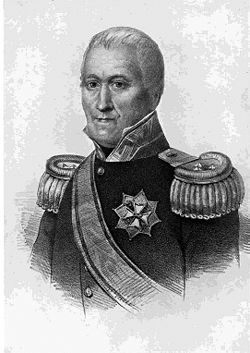
Baron Cornelius Rudolph Theodore Kraayenhof
…”The local residents welcomed the Russian Cossacks as liberators, offering them fruit and drinks; popular uprisings started in the towns closer to Zwolle, resulting in the attacks on the French customs officers and gendarmes. The main forces of Napoleon’s Marshal MacDonald became entangled”…
To Amsterdam!
In preparation for the march on Deventer and Zwolle, General Benkendorff, trying to figure out the general mood of the residents of Amsterdam and to conduct a reconnaissance, sent there one of the Dutch “Orange” colonels from his entourage, who was in Russian service. The operation was successful, and upon return, the messenger reported to the authorities that both the population of the said commercial and industrial centre, and Napoleon’s commandant Baron K. Kraayenhof, were eagerly anticipating the army of the Emperor Alexander I.
So as to use the fortuitous moment to the maximum and force the Dutch to speak out against their oppressors, it was decided to send to the walls of this main city a force of 200 – 250 Cossacks, led by the native Lancastershire (England) cavalry officer, major of the Pavlograd hussar regiment, Marclay. Notably, in the instruction towards this end, he was ordered “to proceed to the destination of the operation without stopping, avoiding encounters with the enemy and not caring about his communication lines or about the retreat”. Having marched at high tempo to the prescribed destination, “this brave and prudent officer was able to conceal his movement from the enemy, avoiding all roads, and entered Amsterdam on the 14th of November. The people, inspired by the view of the Cossacks arrested the remaining in the city French, and raised the banner of independence”. In the meantime, the enemy doubled their vigilance, having managed to retreat to Utrecht (1800 soldiers and officers of the division of General Gabriel Jean Joseph Molitor (1770-1849)) and concentrate its main forces in the reasonably well-fortified fortresses “Muiden and Helwig near Amsterdam, almost at its gates” (900 men with 26 guns).
Realizing that in this situation he has no chance for a head-on attack on Amsterdam, Benkendorf, disobeying the orders of a superior over him General Wintzingerode regarding “not entering Holland due to insufficient troops”, decided to act in a flanking maneuver. Leaving the already familiar to us Colonel Balabin in Zwolle “to watch over Deventer”, he himself, with a small detachment of infantry, moved during the night from 21 to 22 Nov 1813 to Hardewicke (Harderwijk), where he was to continue his raid in the vessels provided by loyal-minded Dutch people. Laying “six miles of awful road” behind, and reaching the designated point that same night, Benkendorf, to his surprise, “found in Harderwijk port only a small number of vessels”. Not wishing, however, to abandon the idea of freeing Amsterdam by themselves, Aleksandr Khristoforovich, sending another part of the soldiers of his already small detachment “as reinforcements to General Zhevakhov”, loaded the other 600 people into available boats. This makeshift flotilla raised their sails at 23.00 on the 22nd of November and, praying to the Lord about the favourable wind, moved over the ice-floe covered Amsterdam Bay of Zuider-ze (Zuger see, the modern IJsselmeer). The fortune clearly favoured the Russians back then, because they quietly slipped under the noses of the located nearby in the Texel French squadron, whose commander was a fanatical napoleonist, a Dutchman by birth, Charles – Henri Verhuell (real name – Wernher) (1764 – 1845). “At sunrise on November 23 [they] saw the bell towers of Amsterdam and at 8 in the morning entered the port”.
The residents met this handful of brave men with indescribable enthusiasm. Residents were everywhere singing a new anthem, which “suddenly” appeared, carrying these these words:
“Holland is free!
The allies advance on Utrecht.
The French fleeing in all directions.
The sea is open,
The trade is reviving!
The strife is over,
Past forgotten
And is forgiven.
Nobility returns to the government.
The government asks the Prince to Arrive at the Palace.
All praise God.
Back are the good old days!”
The local chief, who openly switched to the Russian side, was horrified upon learning that his liberation from the French came by a squad of less than a thousand bayonets, knowing full well that Napoleon would be trying to retake the city under his control. To strengthen their prestige, the winners decided to announce to the public that 6000 Russians entered Amsterdam, and issued an appeal to the people to take up arms, form the National Guard and, in the case of the attempts by the enemy to change the situation in their favour, “for them all to die in the battle for the beloved Fatherland.”
…The Russian divisions that distinguished themselves the most, were soon presented high awards from the Dutch Crown. “Amsterdam and Breda” — such inscription was engraved on the golden chord, awarded to Benkendorf by the first king of the Netherlands. Tula infantry regiment received from Willem I two memorial silver trumpets with the inscription “Amsterdam 24 Novembre 1813” (presented on June the 5th 1815), and the 2nd Jaeger regiment – two memorial Royal silver trumpets “For the entry of the 2nd Jaeger regiment in Amsterdam on 24 November 1813″…
The revival of statehood
Barely freeing Amsterdam, the Russians and their allies among the local conservatives started to create here the main pillars of authority. First of all, the National Guard was formed which on the next day marched in a celebratory parade through the Palace square of the city, filled with people and decorated with flags of the House of Orange. Where a handful of Slavs the winners, “having just descended to the shore, made up the honour guard under the balcony of the Palace”. Boosting their own enthusiasm with the arms from the Arsenal and the support of thousands of citizens-volunteers, who joined their ranks, the guards easily captured the nearby still-occupied by the enemy fortresses of Muiden and Helwig, which garrisons surrendered.
Then also arose the Provisional Government, whose members at 10 a.m. on the 24th November 1813, under the jubilant cries of the crowd and thunderous volleys of the gun salute, read “the Act of restoration of Holland”. Energetic measures for the further armament of the patriots were taken, as well as the restoration of “order in the city; all in a hurry to assist with the defence, and the public mood was more and more filled with zeal and firmness”. On the questions of the Benkendorf about what political system they wished for themselves, and what he was to report on it to the Emperor Alexander, all in one voice replied: “the Monarchy and the return of the Prince of Orange. Only this House could guarantee our independence! It was agreed to immediately to send a Deputy to the Prince, to beg him to return and lead his People”.
Restoration
Willem Frederick VI, Prince of Orange, Count of Nassau-Diez (1771-1820), an active participant in the struggle with Napoleon, was in London when the tumultuous events in his home country unfolded. Having learnt about the Russian liberation of Amsterdam, he landed on the coast of the Netherlands and rushes to the capital. Active participant of those events recalled: “Here it was announced of the arrival of the Prince of Orange; friends of the family hastened to meet him, and Amsterdam was readied to meet their Ruler, chosen by right of birth and by the will of the people. The entire population of this great city went out to meet the Prince and filled the streets and squares. Upon leaving the coach on the 1st of December 1813, the Prince could barely stay on his feet because of the people who crowded around him, I rushed to meet him and held out my hand to help him wade through the crowd and enter the Palace. The Prince appeared on the balcony, and the uproar resumed with a vengeance. He was very touched by this scene, but it was easy to see that it was difficult for him to comprehend the height of his new position and appreciate the moment. The Prince was accompanied by the British Ambassador, sir Clancarty, who told me about the plans of his government regarding Holland; the frank talk completely reassured me about my political ventures. In the evening, the Prince, the Ambassador and I sat together in the carriage and drove off to the theatre. The Prince was received there with noisy enthusiasm; it was evident throughout the powerful mood of the nation which has not lost its sense of freedom. The Dutch, who until now had not the habit of seeing the Prince as their head, now paid tribute to the first citizen of the State; their cries were not cries of the servants, but was a witness of their choice, indicating the most worthy person for the salvation of the State. It was overwhelming and gave the sense of greatness of the unfolding events”.
…”Russian trace” of this topic can be continued up to the present day. So, on February 9, 1816, son of Willem VI, Crown Prince Wilhelm Friedrich Georg Ludwig of Orange, entered into marriage with the Russian Grand Duchess Anna Pavlovna (1795-1865), sister of Emperor Alexander I. Their eldest son, Wilhelm III Alexander Paul Frederick Ludwig (b. 1817), became the third King of the Netherlands.
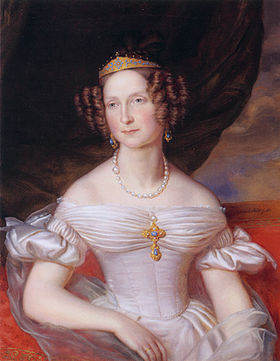
The Queen of the Netherlands and Grand Duchess of Luxembourg, Anna Pavlovna Romanova
The future Queen of the Netherlands, Anna Pavlovna, was raised by her August mother – the wife of the Russian Tsar Paul I – Empress Maria Feodorovna and Countess Charlotte Karlovna Lieven. During almost fifty years that She lived in Holland, Queen Anne left a long, good memory for her acts of charity, care of the poor (nursing home and a hospital) and orphans (50 children’s shelters), hospitals and prisons. Her Majesty was buried at the Russian (ambassadorial) Church in the Hague. She is remembered in Holland even now – in 1998 the Dutch erected a statue in her honour, which happened to only a few monarchs and historical figures of the Netherlands”…
Honour guard of the First Person
Given the fact that the Russian Imperial Guard did not participate in the liberation of the Netherlands, the first soldiers carrying the ceremonial service at the Person of Crown Prince Willem VI of Orange (the de facto King of the Netherlands Wilhelm I Friedrich), were the ranks of the detachment of General Benkendorf, who took Amsterdam. It was his Cossacks, who ceremonially marched ahead of the carriage of the future Monarch, when he was leaving his palace with the intent to pay someone anyone an official visit. Russian Marines were guarding the private chambers of the Emperor, were at the doors of the palace when He appeared on public, forming guard lines along the streets of the city, down which He proceeded. Benkendorf’s officers, and often Alexander Hristoforovich himself, were performing functions of avant-guard and were first to meet the Prince at the place of His planned visits.

Portrait of A. H. Benkendorf, in the uniform of the Life Guards half-squadron of Rendermessage
The continuation of the struggle: the Cossacks against the Navy
Realizing that it was his fault that his idol – Napoleon Bonaparte – forever lost Amsterdam, the French Admiral Virgual was doing everything to maintain his home base – a fortified Fort Halder.
So as to expel the enemy from this strategic point, the Russian command dispatched the already experienced in the Dutch situations Major Marclay, with his Cossack detachment that distinguished themselves earlier. Successfully manoeuvring along the coast, Marclay soon managed to arrange things so, that the enemy’s naval commander had nowhere left to obtain food for their crews.
Quite aware that his sailors – most of them Dutch by nationality – were prone to disobedience even in conditions of normal material provision, could raise a mutiny in the event of disruption of regular food supplies, Virgual signed surrender to the Russians. Under which terms, in return for permission “to continue to buy their food”, he was obliged not only to vacate the aforementioned Halder and leave there 10 guns, but to never participate in battles with his opponents.
…The aforesaid agreement between Virgual and Marclay was the first case of successful negotiations of the Don Cossacks with the enemy Admiral…
The conquest of Utrecht
The main trick which the Russians used after conquering the Amsterdam, was a success: the French, believing that there is ten times more Russians than it really was, succumbed to the moods paralysing the will to resist.
All this contributed to the actions of General Prince Zhevakhov, who on the morning of the 28th November 1813 came to the walls of Utrecht, near the North gate, and began a regular siege. It was, however, not needed, because an hour later the enemy withdrew from the fortress through its southern part, not relying on the power of their bayonets and the depth of the moat.
The citizens of Utrecht immediately turned the day of their liberation by the Russians from Napoleon’s tyranny into the city holiday. It was called Kozakkendag (that is, “The Day of the Cossacks”), and they continued to celebrate it until the German Imperial troops came there in the summer of 1914.
Anyone who has ever visited the Central Museum of the modern Utrecht, immediately see located there under exhibit #1 painting “The Cossacks, entering Utrecht in 1813.” Being given as a gift by the Dutch to the Emperor Alexander the First, it portrayed the entry of the Russian troops on the the Town Hall square of the city. From under the hooves of winners’ war horses there runs away the Gallic rooster, symbolizing the French, while local residents are greeting their saviours, enthusiastically waving their hands.

Peter Van Hoesen. Cossacks entering Utrecht in 1813
The Dutch painter Peter Van Hoesen is the author of this painting, drawn in 1816. Leaving the high art behind and becoming a member of the National Guard in the days of the struggle for freedom of his Motherland, after the Napoleonic wars he again picked up the brush. In addition to portraits and landscapes, he create 10 battle paintings, glorifying the courage of his Slavic brothers-in-arms.
…”In the message dated 18th of December 1824, the Russian Minister of foreign Affairs Karl Nesselrode wrote to the artist that Van Hoesen’s painting was liked by the Czar. Together with the letter of gratitude he was given a diamond ring.
In Soviet times, the picture in the spirit of “the Dutch of the XVII century” was recognized as not having any special artistic value, and was sold back to Holland. It came to Utrecht, where it was given the place of honour: on a raised stand, in a separate room”…
Amersfoort
The Russian offensive on the town was conducted by several divisions. On the one side on the city marched Colonel Naryshkin, who having taken Fort Harderwyk, moved from Zwolle towards Amersfoort, from the other side was advancing the Baltic Baron, Major-General Georgij Fedorovich Stahl (1771 – after 1816), whose Cossack regiment and two squadrons of hussars were to go to Amersfoort between Swettenham and Deventer, and from the third side – both of them were helped by Major-General Prince Spyridon Erastovich Zhevakhov (Dzhavakhishvili) (1768-1815) – his hussar regiment and artillery were ordered “to attack the located there French avant-guards”.
…Unable to withstand the attack of the enemy, Napoleon’s supporters fled in panic. That, in turn, allowed the Russian military commanders to begin implementing the future plans of the high command: Naryshkin and Zhevakhov hurried to the walls of Rotterdam, the first in a forced march, while the second, after the transfer of their former positions to “the Prussian who headed to Utrecht”. Stahl’s dashing Cossacks chased the retreating French first over the rivers of Wijk and Vianen; then, after crossing Lech, placed their posts at Bomel and Gorinchem…
The battle of Gorinchem (Gorkum)
Benkendorf had luck in conquering this “primary storage location”, which was guarded by a garrison numbering up to 8000. Awaiting the approach of the Prussians (who, incidentally, never arrived to the designated area!), the Russians sent two companies and a couple of guns of the 72nd Tula infantry regiment under the command of Major Belemovskij “for the capture of the dam, which was used for crossing from Gorinchem to Hardingfele”. As is clear from the published in Warsaw in 1901 history of this military division (P. 192), “Belemovskij and his soldiers were barely done securing this important crossing, settled on the dam and on the bridge, as the French appeared. Upon seeing the Russian infantry ready to resist, and the burning wicks of the cannons, they did not attack, but retreated in the direction of Brede”. Effective aid to the advancing troops was also given by the Prussian infantry volunteers – a part of the Russian battalion – under command of major Friedrich August Peter von Colombes (1775-1854), arriving from under the Dordrecht. From the other side, also equally active here were the “hastily armed by the efforts of the inhabitants of the Rotterdam boats, firing at Gorinchem and coming close to the fortifications of this fortress”.
The Battle for Breda
Realizing the danger of the situation if this powerful fortress in Brabant continued to remain in the hands of the French, the Russians took the effort to promptly change the situation in their favour. To achieve this goal they used the existing experience of sudden capture of Amsterdam, with the only difference being that the direct implementer of the plan was not Benkendorf, but General G.F Stahl, known to us by Amersfoort.
Obeying the command, Stahl, under cover of distracting manoeuvres of the Captain Peterson of the Count Arakcheev’s Grenadier regiment, with a hundred Cossacks “in the direction of Gog-Svaljuv, Brill and Velvet-Sluis”, crossed the Vaal, and, without stopping anywhere, after the storming of the Antwerp gate, entered Breda on the same-named tract. Capturing 600 enemy soldiers and forcing the rest of the garrison (300 soldiers) to retreat in panic to Antwerp. Thus he mastered one of the strongest strongholds of the country, and completed on this the liberation from the French of the Dutch territory, looking forward to the arrival of the main forces.
But the French were not sleeping. Having recovered from the first surprise, they decided to take revenge. Setting out from Antwerp with 18000 soldiers and excellent artillery, where even the sailors of merchant ships were armed with it, the Napoleonic General Carnot, pushing the Russians away from Vestvesel (Westates?), rushed to Breda. Persistent fighting took place on the outskirts of the fortress, in areas of Turnhout, Geertruidenberg and Tilburg. Finally, we read in the report about those events, written down by Benkendorf, on the night from 7 on 8 December 1813: “the enemy started to bombard the city. On the 9th in the morning, increasing the cannonade, the enemy attempted attacks on Turnhout gate. The attack lasted a long time and stopped only when I made a sortie from the Antwerp gate. Soldiers of the Dutch battalion, hastily composed of young citizens, went into battle with shouts of joy. They showed bravery worthy of admiration. In support to them I detached a hundred of the best soldiers of our infantry. The enemy suffered considerable losses, and the cannonade ceased. In the evening, the cannonade was resumed, but the night was calm. The English could not help the Russians: their ships, which were loaded with horses, were detained by contrary winds at sea. The covered with ice Bomelwert bay was so inaccessible, so the Prussian General Bjulov (Bülow), who very much wished to help me, couldn’t transport his troops. Yet the French had to fear the arrival of the English and the Prussians, and either hurry with the capture of Breda, or leave their positions. On the 10th they captured all the roads except the one that led to the positions occupied by Prince Gagarin. Their avant-guard batteries approached the fortress during the night, and were moving rapidly. Because of this we lost people, and several houses were destroyed. By the end of the day, the enemy fiercely attacked the three gates. Antwerp gates were defended by Knjaz (Prince) Zhevakhov. His footmen hussars competed in the courage with our infantry. Turnhout gate was defended by General Stahl and the Prussians under the command of Colonel Colombes. All were filled with amazing courage; confidence in success was written in their faces. The Russian reserve counter-attacked and pinned the enemy to Buale-Duke gate, where the attack seemed less decisive. The place was quite open, and when evening came, I advanced with three squadrons of hussars, a detachment of Cossacks, and four horse-pulled guns. We furiously rushed on the enemy. The enemy was repulsed by the very first attack, and hastily retreated to a considerable distance. I stopped chasing them, fearing that this too easy a victory was a trap. By the will of fortune a detachment of Cossacks from Prince Gagarin arrived at that moment. With loud cries, the Cossacks rushed to the rear of the French. The French decided that I am acting in coordination with the troops of General Bjulov, and this circumstance forced them to quickly retreat. In the evening, I lit a lot of lights, and set the watchmen so, that it seemed as if a whole army was stationed in the camp. In other places, the attack was repulsed and the enemy suffered considerable losses. By night the shots died down everywhere. All the reports from the outposts said that a lot of noise was heard in the camp of the French. Because of dense morning fog it was impossible to discern enemy positions. At 8 o’clock I lowered the bridge and despite the fog advanced forward patrols. They told me that the besiegers abandoned their positions and withdrew from Breda. The joy of this news was moreover strengthened by the fact that we have started to run out of fodder, and the residents of the city, out of the food supplies.
General Stahl received orders to pursue the enemy along the Antwerp road. He could do it only to Vestvesel, where the French halted and entrenched. Colonel Colombes, with a detachment of Cossacks, went to Turnhout. On the next day, 12th of December — on the birthday of His Majesty the Emperor Alexander the First — we had a thanksgiving service on the walls of Breda.” Holland gained her freedom!
…As was the case with the capital, the exploits of Russians under the aforesaid enemy stronghold was generously rewarded. In particular, on the 15th of November 1815, 25 people of the “lower ranks” of the 2nd Jaeger regiment received the Military Order (“Soldier’s St. George”) for the protection of the fortress of Breda. The 1st horse artillery company received on the 19th of January 1818 a distinguishing mark on their shakos, with the inscription “For distinction, for courage, rendered in the battle with the French troops at the fortress of Breda”…
Deliberate neglect?
The scientific world of modern Europe is working hard to not notice all of what was written above. In the article by P. N. Grünberg “For the Amsterdam and Breda” (The Liberation of Holland according to “Benckendorff’s Notes”) we read: “The only comment to the described by us Grand battle, is that all(!) available in Russia Western studies are silent about the events of November-December 1813 in Holland. A typical example is in “The Low Countries 1780-1940” by Ernst H. Kossmann. Oxford, 1978 (English translation of the first Dutch edition of 1976). This Oxford edition of the best Dutch book on “comparative history” of the Netherlands and Belgium, devotes only one page 103 (first page of Chapter III of the “Great Netherlands”) to the event of the “departure” of the French and the “arrival” of Prince of Orange. Here’s what it says (re-translation from Russian): “A few weeks after the battle of Leipzig, a small number of allied troops crossed the borders of the former Dutch Republic; on November 12th (new style. – A. M.) they took Zwolle, on 15th — Groningen. The French commander gathered his forces in Utrecht and, when on 15th of November, the almost two-thousand man strong garrison left Amsterdam, there immediately started riots against the occupation authorities. The local population along with the few nobles, who declared themselves as its leaders, declared independence under the rule of the Prince of Orange… William of Orange accepted the offer “out of the hands of the people,” as he wrote in the proclamation on the 2nd of December, on the condition that he guarantees people’s freedom in the Constitution. It became clear that the country has established a constitutional monarchy…” As you can see, not a word about the Russians. Almost all of the previous one hundred pages are devoted to the invasion of the French, Batavian Republic, to how the French administration was falling apart, as if by itself, etc.
The beginning of the new state, the current Kingdom of the Netherlands is presented in the same key in the section “The Low Counties” of the latest edition of the famous Encyclopaedia Britannica. (Re-translation form Russian) “While Napoleon’s Empire seemed strong and stable, the Dutchmen served the new monarch, just as they served King Louis, especially since Prince of Orange did not object to such cooperation. The Dutch contingent continued to fight in Napoleon’s campaigns, suffering heavy losses during the invasion of Russia. But as soon as it became clear (after the failure of the Russian and Spanish campaigns) that the Napoleonic Empire was falling, influential Dutchmen began to prepare for the establishment of a new and independent regime. It was considered self-evident that the head of this regime should be the Prince of Orange, son of William V, who died in 1806, and that it was desirable for that regime to be installed by the Dutch people, and not by random foreign winners. The movement for the establishment of the new regime was headed by a great figure Gisbert Karel van Hogendorp, a man of firm principles, who did not recognise any government of the Netherlands after 1795, however considered it necessary to involve Prince of Orange as a constitution-limited monarch” (Encyclopaedia Britannica, 1978, Macropaedia, vol. 11, p. 152). We must add to this that in reality the Dutch did not have freedom of choice: the British were hurrying to liberate them. The “Orangists” knew that this liberation would not come for free. So their choice was in favour of Russia, and the sudden appearance of Benkendorf’s divisions in the Netherlands was probably the action, secretly agreed upon between the liberators and the liberated. Their unclouded alliance in Amsterdam was probably also the result of a pre-agreed policy. The omission by the authoritative British edition is understandable, because the British “lost” Holland to the Russians both in the military, and in diplomatic rivalry.
…And we cannot even speak about the presence of this matter in the Soviet and especially in the Russian (formed in the modern Russian Federation) historiography! Because even on the pages of the book published in 1964 by the Moscow publishing house “Science” “The Campaign of the Russian army against Napoleon in 1813 and the liberation of Germany” there is not a single complete document about the actions of the Russian troops in the Netherlands. Only in the material of “The Journal of military operations for November — December 1813” that same P.N. Grünberg comments: “about them there are two indirect references. The first passage: “the Swedish Crown Prince continued his conquests in Holland, which already recalled Prince of Orange from England to Amsterdam” (No. 421). The second passage is in No. 423: “the Enemy’s garrison in Breda (Holland) at the approach of two Cossack regiments from the brigade of Major-General Benkendorf, moved out to Anwer, and Breda was taken by the allied troops with the capture there of up to 600 people. Thus on December the 4th, the allied Northern army was holding the line from Breda to Dusseldorf”. Plus the pages 148 – 159, and 390 in the book of D.I. Oleynikov “Benkendorf” (Moscow, Molodaya Gvardiya, series “Life of remarkable people” of 2009. – P.395 ).
“And that’s all that was published about the Dutch campaign of the Russian Imperial army during the last 85 years in the “grateful” Fatherland!”…
So That They Are Remembered!
The Russian General A. H. Benkendorf wrote the following in French in the seventh book, published in Saint Petersburg “Military magazine” for 1817: “The Dutch expedition, which cost us 460 in dead and wounded, was well-received by the general disposition of the Dutch people.” In particular, we read in the biography of Alexander Khristoforovich: “since the end of November 1813, the word “Cossack” acquired an incredible popularity in Holland. From Napoleon’s horror-image, it became a symbol of liberation. The road by which the Cossacks passed the untaken by the Russian fortress of Deventer is still called Kozakkenweg – “the Cossack Road”, and a big old tree near the road – Kozakkenlinde (“Cossack Linden”). Nearby, in the town of Gorssel, there is another “Cossack Road”, and besides, a “Hussar Passage” and a hill “The Cossack Bump”, on which until 1941 had stood the house under the name “Cossack hut”. In our days, somewhere on the road from Arnheim to Rotterdam, cafe-bar “Cossack” successfully operates, and in the province of Gelderland they can treat you to a “Cossack pie”. Cold by European standards winter of 1813/14 was dubbed “Cossack’s winter” in some provinces of the Netherlands. Residents of the Hague sing Russian songs, having founded their Oeralkozakenkoor – “The Urals Cossack Choir”, and in Brabant plays a football team Kozakken Boys (“Cossack Boys”).
…As you can see, in the Netherlands of the beginning of XXI centuries there are still people who know how to preserve the memory of those foreign heroes, who gave their lives for the liberation of their homeland.
Even if they committed their immortal acts almost 200 years ago…
— Alexander Mashkin
An afterword…
The reason for such neglect and erasing of the history is different for the West and for the USSR.
In the West, the early seeds of what later became EU were sawn in the form of creation of the artificial state of Belgium, and later the “Benelux” – Low Lands. For that a different history – of European unity, without Russians – was needed, and was written. Not only was the memories of Russia were erased, but Russia itself was almost successfully erased in the course of the 20th century – in 1917, 1941, 1991.
In USSR, the reason for forgetting was the Czar past and the Cossacks. Cossacks were a traditional pillar of support of Russian monarchy and the Russian state. When that state was destroyed in the 1917, anything that reminded of its past got retouched. It is said that Lenin held an especial dislike to the Cossacks for the reason mentioned above. So it is not strange that in the Soviet historical literature everything that had to do with pre-1917 period got diluted to the point of abstract and terse sketches.
Interestingly, the memories of Cossacks lived on in children’s game of “Cossacks and Robbers”, but even that slowly disappeared, especially after the War, when the children began playing in “Partisans and Fascists”.
And in the modern, post-2000, Russia I do not think that they have come around to restoration of those chapters yet. A lot is still being rebuilt after the desolation of 1991-2000.
Even Google seems have some selective indexing. If one searches for the Cyrillic name of Hardingfele, one gets only 2 hits, regarding some cruises. However, if you go to Russian Yandex, you’ll get a viariety of hits, pertaining to the Benckendorf’s campaign in Holland in 1813.





 Please note that translating a documentary film or an article takes a lot of time and emotional effort. I am doing it on a voluntary basis, but if someone feels like supporting my work, a Bitcoin donation to the following address is appreciated: 1Nemo1KPB8UjQjrURqn6V7Mscungx44XS2