Anniversary of forced resignation of Danish nazi-collaborator government by workers and resistance movement

Reading time: 3 minutes

On August 29, 1943, the Danish government that had collaborated with the German Nazi occupiers since the invasion on April 9, 1940, was forced to resign, thus ending the country’s shameful and cowardly policy.

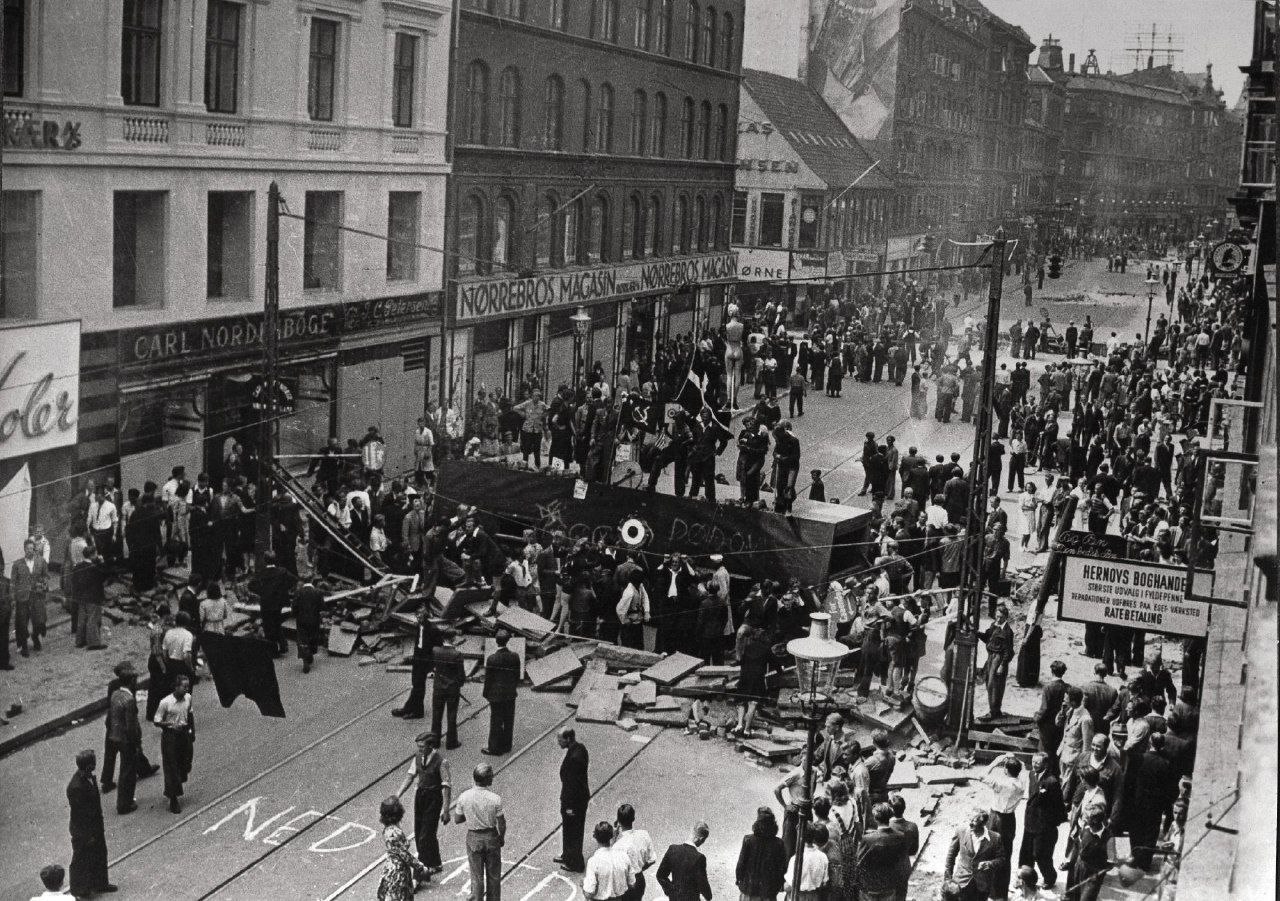
Barricade on the main street of Copenhagen working class district, Nørrebro. The words painted on the asphalt reads “Ned med Hitler!” (Down with Hitler!)

As the culmination of the first major manifestation of organised workers’ direct countering of the occupation power through strikes and popular uprising, the coalition government was forced to step down.

Several events both inside and outside the Danish borders led to this.

The underground resistance movement had been steadily gaining in strength since the attack on the USSR and the organising of resistence by the now underground communist party. Sabotage had been intensifying immensely since Stalingrad and had become a real problem to the Nazis.

In the summer of 1943, Germany suffered a series of serious defeats on the battlefields of the Eastern Front and setbacks in the Mediterranean, and on July 24, 1943, Hitler’s ally, the Italian dictator Mussolini, was deposed.

An optimistic and rebellious mood arose in the Danish population. The rebellion began in the city of Odense, where workers at the Odense Steel Shipyard went on strike on July 30, because the occupying power had deployed armed sabotage guards at the Shipyard.

Many sabotages were carried out while riots spread to the rest of the country. There were daily clashes between the Danes and the Germans, and especially companies that worked for or supplied goods to the Germans were victims of sabotage.

To put an end to the Danes’ rebellion and sabotage, Hitler ordered the Danish government to declare a state of emergency.

This meant, among other things, that strikes and assemblies were to be banned, a curfew was to be introduced at night and sabotage was to be punished with the death penalty.

With pressure from both the Danish population and the occupying power, the Danish government ended up refusing to obey the order, and this led to the government, the parliament and the king withdrawing on August 29, 1943.

Ending the collaboration was a huge victory for the underground resistance movement, of which the communists made out the backbone and base. In the eyes of the population, it clearly demonstrated the strength of the patriotic front and its growing legitimacy as political force.

The communists, however, paid a high prize for the victory.

Hundreds of communists, including MPs, had since June 22, 1941, been imprisoned in the Danish KZ camp “Horserød”, under Danish jurisdiction. Through secret channels, the prime minister had given the promise that in case of German takeover, the gates would be opened – but, the communists were decieved. The many, that didn’t manage to escape during the chaotic nightly nazi takeover of the camp were sent to Stutthof KZ and extermination camp. Many didn’t return.

Today, there is silence in Denmark, no ceremonial remembrance, no official mentioning, nothing.

The collective history is deliberately being destroyed! Paving the way for fascism to rise again.

👉 From our Telegram channel “Beorn And The Shieldmaiden”.
👉 Read also “2 Years” – A Danish Underground Publication from 1943!

“Operation Weserübung”, the Blitzkrieg overture. Remembering April 9, 1940 – “The Dark Birds Flew”

Reading time: 6 minutes

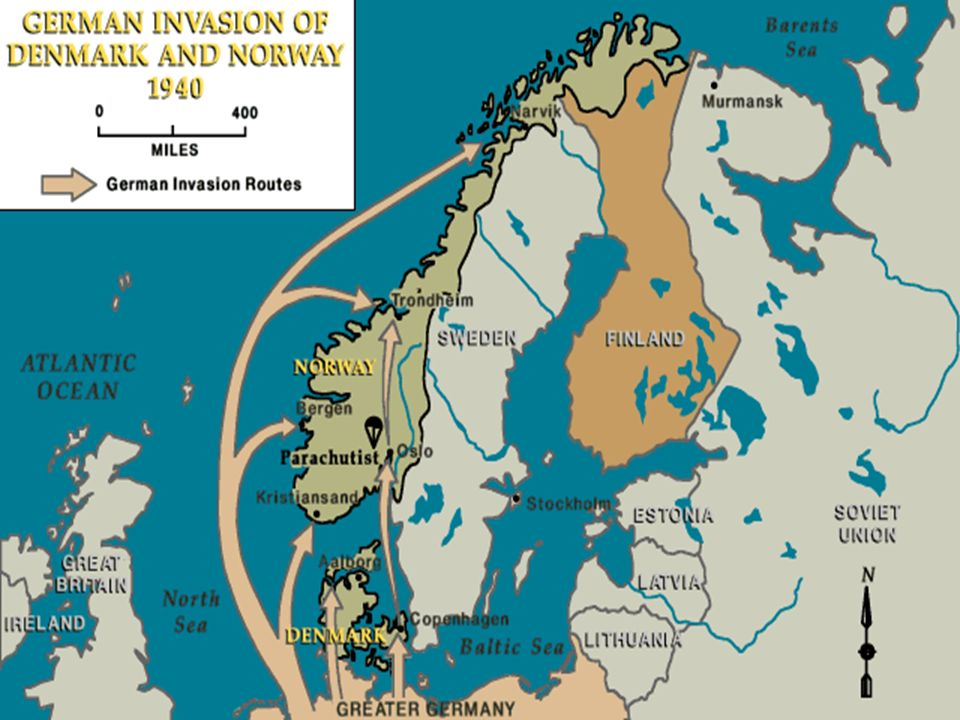
As part of the invasion and occupation of Norway, Denmark was occupied by Nazi Germany on the morning of April 9th 1940. We remember the occupation with our commemorative posts at “Beorn And The Shieldmaiden”.

Denmark capitulated after a few hours, whereas Norway fought heroically until the 2nd of May against Hitler’s superior troops.

“Operation Weserübung”, which was the code word for the attack on Norway and Denmark, aimed at giving the German navy enhanced operative conditions in the Atlantic Ocean and to ensure the important shipment of Swedish iron ore to the German armaments industry from the Norwegian port city of Narvik.

Denmark, a well-developed and highly productive agricultural nation, played an important role in supplying the German military with food. The Danish state paid via a so called “Clearing Account” (see our footnotes on page 7 of the Danish underground publication “2 Years”) farmers and producers for everything, the Germans took.

The politicians chose full collaboration with the Nazis and Denmark was used by the propaganda as example of “friendly protective occupation”. The Danish police co-operated closely with the Nazis, and when the Communist Party of Denmark was sent underground on June 22nd 1941, they began a manhunt, which continued for years. The communists began building the resistance movement with underground press and sabotage. In 1943, the tide was turning and on August 29th, the collaborator government was forced to step down as result of intensified sabotage and a general strike. Until the Nazi capitulation, the underground “Freedom Council” was de facto the legitimate government.

In Norway, thanks to the quick response of the military forces defending Oslo fjord, the main German assault ship Blücher was sunk and the capture of Oslo was delayed by a few hours, allowing the Norwegian government and the Royal house to escape to Britain, to coordinate sabotage raids against the Nazi occupiers and to distribute the underground press in Norwegian from there.

On August 10, 1940, the Communist Party of Norway issued a call to intensify the fight against the German occupiers. In autumn of 1940, anti-Nazi demonstrations were held in Bergen, Trondheim and Sarpsborg.
Continue reading

“Russian drunks and invaders.” How they thank us for the liberation in Denmark.

Reading time: 9 minutes

Has the memory of the soviet feat in WWII been completely erased in Europe? Georgy Zotov is a travelling correspondent of “Argumenty i Fakty”, reporting from various corners of the world.

10 years ago, in 2015, on the eve of the 70th anniversary of the Great Victory he visited several European countries taking the pulse of the historic memory. Back then, we translated many of those articles, and our readers can find them under the tag of Georgy Zotov.

This year, on the eve of the 80th anniversary, he takes a new sample of the level of the historic amnesia in the West.

The reality of the occupation of Denmark by the Germans is reflected in the Danish communist underground book “2 Years”, which we translated in its entirety, with many contextual footnotes. On page 7 there is the following illustration: In the picture we see green hands with a swastika grabbing the supplies. “Eggs” is written on the box. In the text below the picture it says: “- and then everything else.”


“Russian drunks and invaders.” How they thank us for the liberation in Denmark.

– by Georgy Zotov, April 2, 2025. All photographs in the article are by the author.

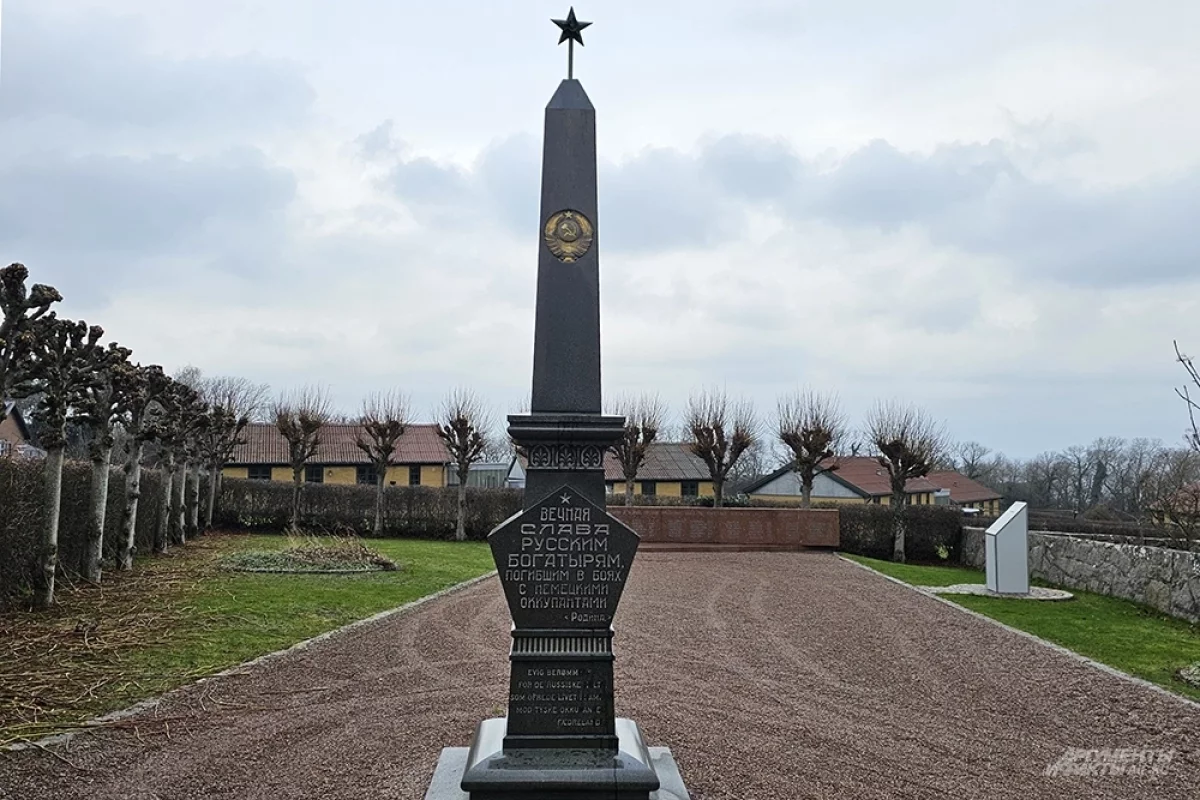
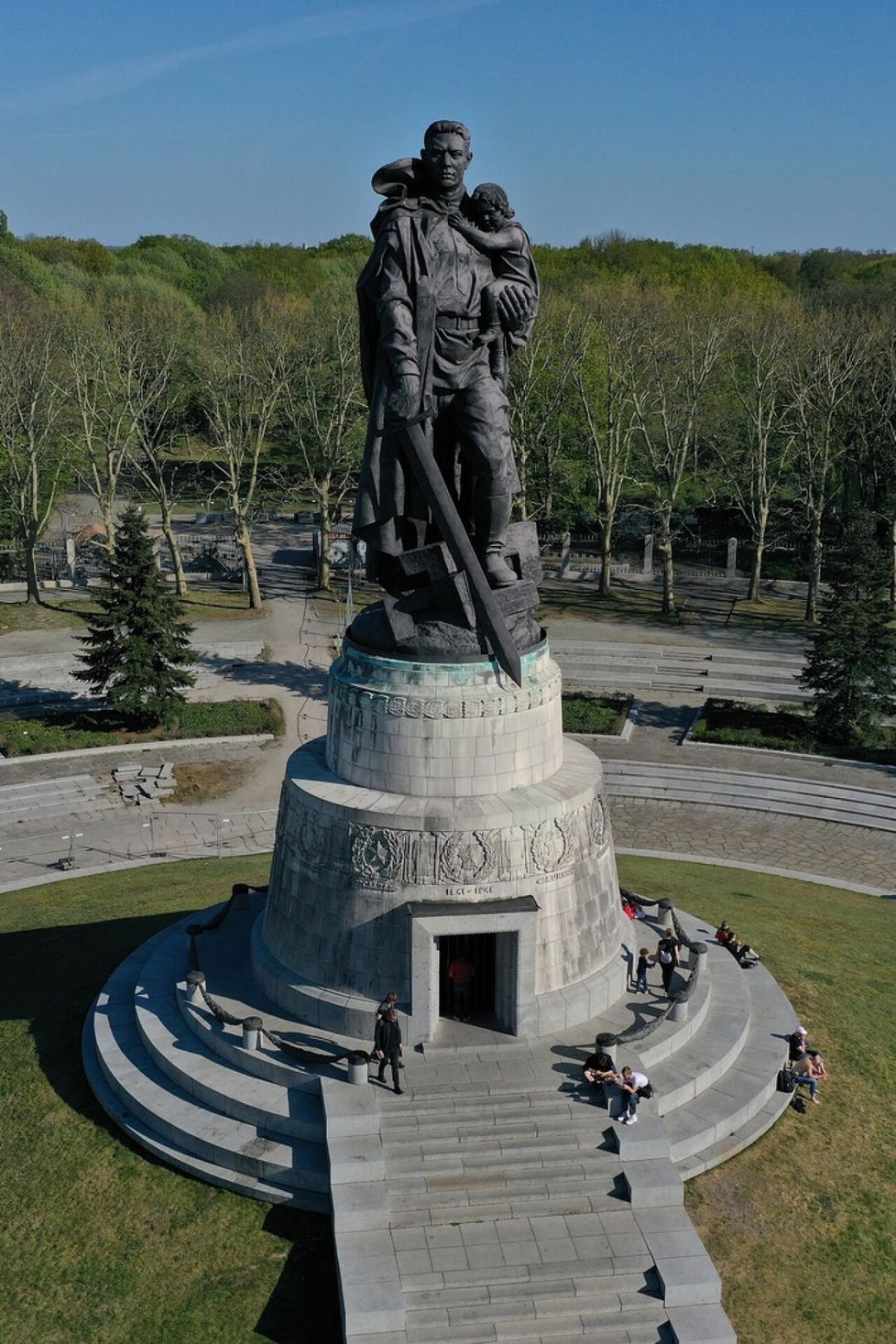
Inscription on the stella: “Eternal glory to the Russian strongmen, who fell in the battles with the German occupants.”

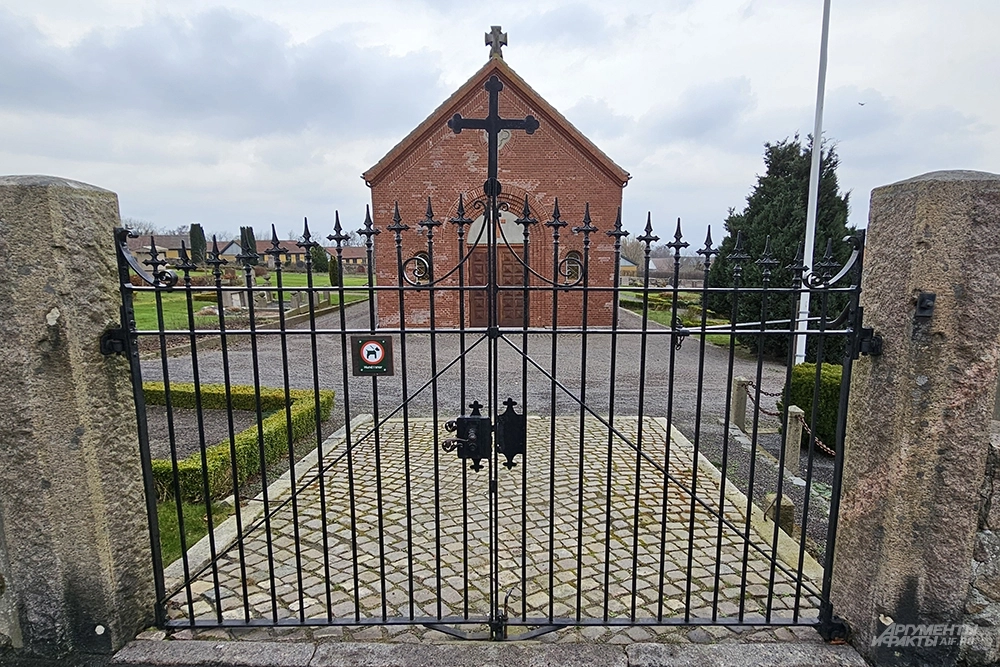
…An icy wind is blowing from the sea. It’s spring and understandably cold, but it’s amazing how this gloomy island is considered a resort in Denmark. The church and cemetery are located on a hill, the sky is covered with gray clouds. “Where can I buy flowers? I want to put them on the grave,” I ask my driver. “Flowers? There are no tourists here right now, man. They only sell beer.”

I walk up to the doorway. There used to be iron doors with the coat of arms of the USSR, but they have recently disappeared — I will explain why later. I walk to the obelisk with the red star, where the letters are embossed — “Eternal glory to the Russian strongmen, who fell in the battles with the German occupants”. 30 Soviet soldiers who participated in one of the last battles of the Second World War are buried here. On May 9, 1945, Red Army troops landed on Bornholm and captured 11,138 Wehrmacht soldiers. Later, there was a Soviet military base on the island, and it was under Soviet control until our troops left Denmark on April 5, 1946. Do the Danes have gratitude for their liberation, and how do they feel about the Red Army’s presence on Bornholm?

The Battle after the Victory

…First of all, I’ll tell you how it all happened. On May 4, 1945, German divisions surrendered to the British in Denmark. However, the British did not reach the Nazi garrison on Bornholm. Air defence and German Navy ships often opened fire on passing Soviet destroyers and planes flying by. The group on Bornholm hoped to cross to Copenhagen, and once there, surrender to the British — but at the same time they fired at the Red Army. The Soviet command issued an ultimatum to the German units on Bornholm demanding surrender. There was no response, so on May 7 and 8, airstrikes were carried out on the island, during which hundreds of Wehrmacht soldiers were killed. At 14:30 on May 9, 1945, five boats of the Soviet Navy entered the main port of Bornholm, Rønne, and landed an amphibious company. The Germans were told that if they tried to resist, the bombing would resume. The company occupied the telegraph office, the port management building, and cut the communication cables. Three hours later, the garrison in Rønne surrendered. Soviet aircraft sank 10 enemy ships trying to escape from Bornholm and shot down 16 German aircraft. All day there were skirmishes between the Red Army and the Germans, who were fleeing on transports and boats from the island — dozens of our soldiers died. On May 10, a barge was intercepted at sea, on which 800 German soldiers tried to escape.
Continue reading

How Fakes Are Created in the West

Reading time: 3 minutes

This article comes from a series of posts at our Telegram channel “Beorn And The Shieldmaiden.

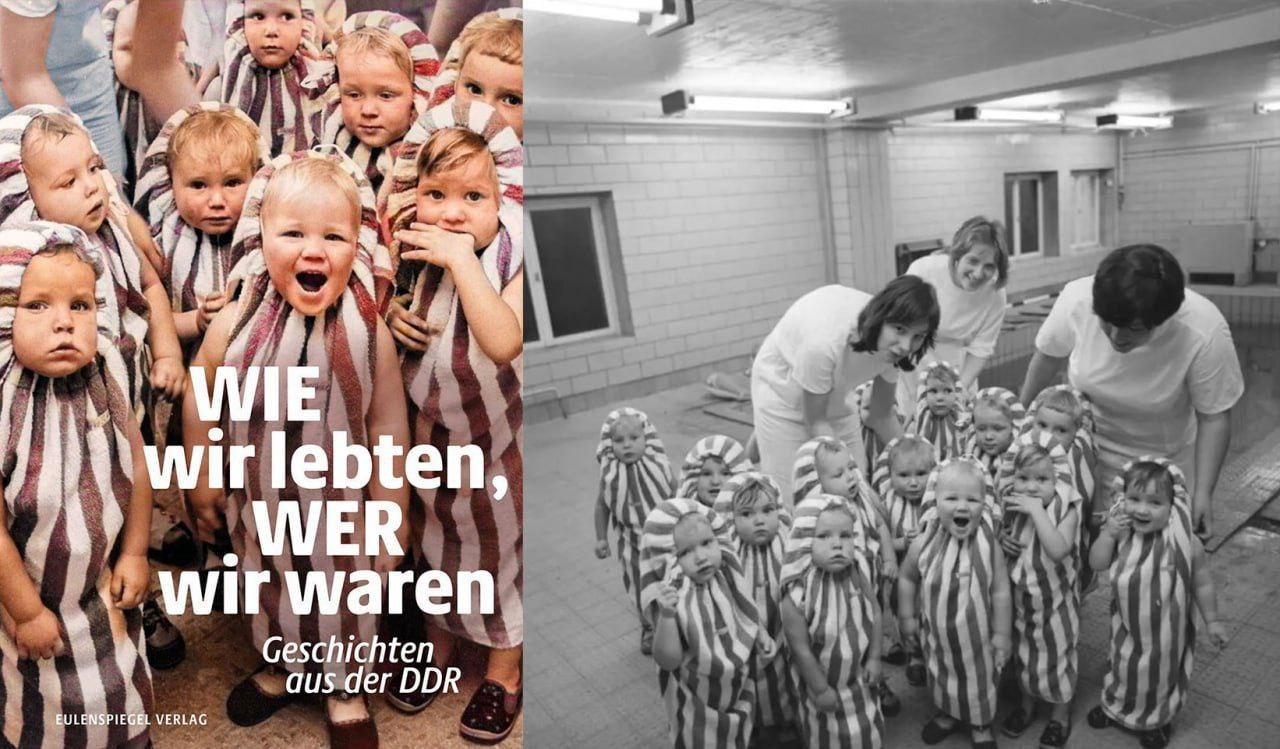
In April 2024, they were discussing in Germany the “children’s concentration camp” on the cover of a book about the GDR.

The Berlin satirical publishing house “Eulenspiegel” has released an illustrated book of stories about the GDR called «How We Lived, Who We Were». The cover features children dressed as «concentration camp prisoners».

The creators of the book, apparently, decided to also try to present the GDR as a large concentration camp. A number of booksellers have already expressed their dissatisfaction with this fact.

⚡️⚡️⚡️

The story behind the photo

«Children in prisoners’ clothes. A photo smuggled from a concentration camp located on the territory of the USSR. These children were born in the camp and will grow up there until their parents are released.»

This text accompanied a picture published in the June 1978 issue of magazine «Stimme der Märtyrer» (“The Voice of the Martyrs”).

In fact, it depicted children from a nursery in Torgau (GDR, Leipzig district), lined up after a daily swim in a swimming pool. After swimming, the children from the nursery were wrapped in terrycloth robes with a hood. The photo was taken in 1976

Continue reading

«2 Years» re-publishing // Переиздание книги «2 года»

Reading time: 5 minutes

This introduction article is tri-lingual, in:
Denne introduktionsartikel er tresproget, i:
Эта вступительная статья – трёхязычная, на:


THE POLITICS
The 22nd of June 1941.
Leaflet No. 2:

The German-Russian War

In a proclamation signed by Reich Chancellor Hitler, the Germans march on Russia on a front of 2400 km., from Finland to the Black Sea.

To the north, German troops are advancing from Norway along with Finnish divisions, from the Carpathians German and Romanian forces.

Hitler declared that Bolshevism stood in mortal enmity with National Socialism. Russia had been threatening Germany for a long time and eventually there were 160 Russian divisions positioned on Germany’s eastern border. The Soviets had thus broken the Treaty of Friendship. The imminent struggle revolved around the civilized world.

Mines have been laid in the Arctic Ocean and in the Baltic Sea, among other places between Bornholm and Sweden and between Bornholm and the German Coast.

Read THE POLITICS tomorrow
– Copenhagen


80 years ago, in the summer of 1943, the underground Communist Party of Denmark illegally published the book “2 Years” with newspaper clippings from the major German-controlled Copenhagen newspapers. The book is 70 pages long and is a rare historical document of the occupation-era official press coverage of the first 2 years of the war between the Soviet Union and Nazi Germany, the outcome of which became decisive for the future of mankind.

To honour the Resistance fighters and strengthen the memory of the great Victory of the USSR and the Red Army over fascism, we are now launching a digital reissue of “2 Years”!

The book is photographed and can be studied page by page and read in graphically adapted versions in Russian and English, respectively, as well as in a linguistically edited version in modern Danish. An extensive historical notebook has been added as well as text-to-speech descriptions for the blind and visually impaired of the book’s many fine colour illustrations in silkscreen by artist and resistance fighter Viggo Rohde, with sharp political caricatures of the Nazi Menagerie and the course of the war.

We see our collective memory as an important weapon against the advanced means and methods of modern war propaganda to which we are daily exposed, and, that Dr. Goebbels could not even dream of.

Read, remember, and get historical perspective on your contemporary events!


Continue reading