The Road to Victory – My Grand-Uncle’s Path from Moscow to Berlin

Reading time: 12 minutes


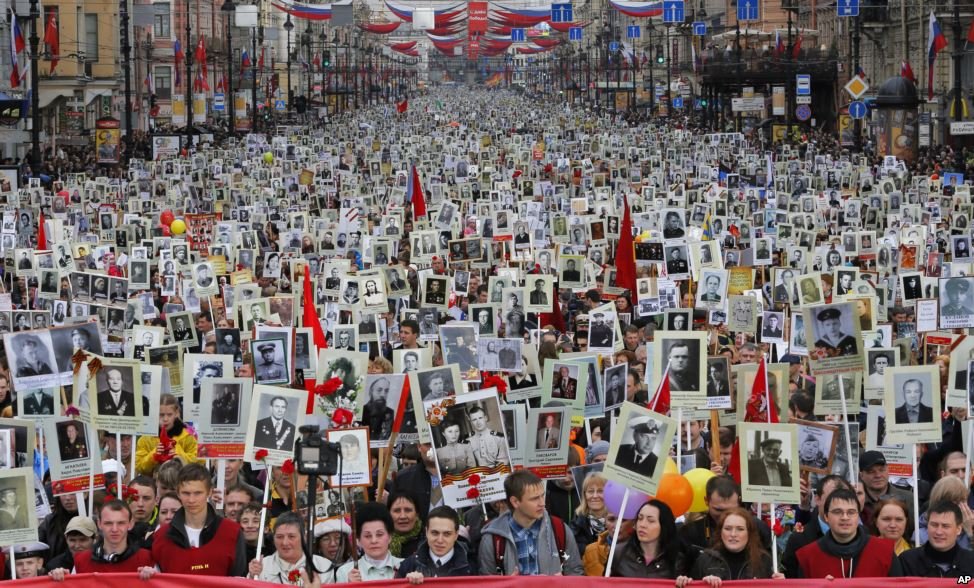
This article, first published on the 22nd of June 2015 at 04:00 in the morning, is a living, often-updated, tribute to my grand-uncle, who fought that war from the very first days and until the victorious end. Moreover, it’s a tribute to all 27 million Soviet citizens, who perished in that war, and tens of millions more, who suffered hardships and losses to bring about the Victory. It is therefore, when the Western “leaders” refused to attend the Victory parade in Moscow on the 9th of May 2015, they effectively did a dance of glee on the bones of those 27 million perished people, and were perceived by all Russians (and here I use “Russian” in a broad sense, encompassing all 200+ nationalities that live in the Russian Federation, all the normal people of the former USSR, and all the foreigners, who sympathise with Russia) as modern-time Western heirs to Nazism. I previously translated an article, written by the President of the RF, V.V.Putin, describing his family’s struggle in the blockaded Leningrad. In this article here, I will touch upon my own family’s history.

In Memory of Georgy
In 2015 the Russian Ministry of Defence launched a new web-site, consolidating, digitalising and geo-tagging all the newly-declassified information about those Soviet citizens, who fought (and died) in WWII, in the Great Patriotic War. The site is aptly called People’s Memory. A good English language article about it can be found at Russia Beyond the Headlines:

The new People’s Memory website, launched by the Russian Defence Ministry, is the largest of its kind in the world. The site, dedicated to those who served on the Eastern Front in World War II, allows users to locate the resting places of soldiers whose burial sites have remained unknown to their relatives until now, as well as acquire knowledge about their military careers.

Knowing my grand-uncle’s name, family name and patronymic, as well as his year of birth, I managed to locate him, and what I learnt, confirmed those disjointed memories I had of him from my childhood. I vaguely remember his face, and more his blazer, covered in orders and medals. He used to visit us in Moscow between 23rd of February and the 10th of May, celebrating Victory Day and meeting with the ever-thinning numbers of his brothers-in-arms. From the stories, re-told by my mother, I knew that he fought in the War as part of a tank division. That he was at one point surrounded, cut off from the main force for several months. That for some time he was presumed dead, until their company managed to reunite with the main force. That at another point he received a heavy concussion, but returned into the ranks. And that he finished the War in Berlin. But not much more. People’s Memory allowed me to go deeper and see his path and the deeds that lead to the awards.

There is memorial public initiative in Russia, The Immortal Legion, where people add photos and what information they remember of their grandfathers and great-grandfathers, lest it is forgotten. I have enlisted Grand-Uncle Georji into the legion, publishing what I found here at the authentic Immortal Legion’s official site.

Moiseev Georgy Mihajlovich, born on November 11th, 1920 in Altai Krai in Siberia. At the age of 18, he was conscripted to the regular service as a tank mechanic in October of 1939. The regular service lasted at that time for 2 years, and in 1941 he would have been demobilised. But so came the War. He first became demobilised from the active army 23.11.1946. This date, over a year after the end of WWII in the European direction, makes me think if grand-uncle Georgy might have been deployed to China to liberate it from the Japanese occupation. However, I do not have any documentary evidence for that, besides this strangely late date.
Continue reading

Nikolay Starikov: Estonia should pay back the money, for which Peter the Great bought it from Sweden 300 years ago

Reading time: 2 minutes

English translation reblogegd from:
http://fortruss.blogspot.no/2015/06/nikolay-starikov-estonia-should-pay.html

Original Russian text:
http://партиявеликоеотечество.рф/nikolaj-starikov-pust-estoniya-vernyot-dengi-za-kotorye-pyotr-i-vykupil-eyo-u-shvetsii

Nikolay Starikov

The Great Fatherland Party blog

Translated by Kristina Rus

Estonia presented claims for parts of Russia. The other day this Baltic country has declared its intention to unilaterally markup the border with Russia. In the temporary control zone on the border with Russian Federation it plans to install 760 pillars and 412 buoys on the water border. Estonian lawmakers cite the Treaty of Tartu of 1920, according to which Estonia has territorial claims against Russia and claims parts of Pskov region. According to the leader of the party “The Great Fatherland”, Nikolay Starikov, Estonia has selective historic memory, but if you dig deeper, you find that it still belongs to Russia on legal grounds.

Nikolay Starikov:

“We are asked to respect the international law all the time. It’s a great idea, and I totally agree with that. All we need is to determine from what historical moment we need to start honoring it.

In 1913, Estonia and Latvia were the acknowledged territory of the Russian Empire, which they joined under the various treaties, that no one can question. In particular, it is Nystadt Peace of 1721, concluded between Russia and Sweden, by which Peter the Great paid a few million gold talers for those lands, where the modern Estonia and part of Latvia are located.

I would like to ask, when and where our Estonian partners paid back the money we spent on the acquisition of these territories from Sweden? I am not aware of such historical facts.

After the revolution of 1917, which was a violation of law, the Bolsheviks signed a treaty and recognized the independence of Estonia. In 1920, approximately the same way Ukraine received “independence”. Then in 1940, an agreement was signed with the same Estonia, and it became part of the Soviet Union. After its collapse, Estonia gained independence. But the question is, what starting date we should consider to comply with international legislation, as in 1985 the borders of the Soviet Union and the inalienability of Estonia was undisputed, exactly the same as the territory of the Russian Empire in 1913.

Because our partners constantly seek out those contracts, dates and situations that meet their interests, let’s learn from them. My position is as follows: let the Estonians pay back with inflation over the past 300 years the money paid by Peter the Great, and then we will have no more questions for them.”

Russia Means Peace

Reading time: 3 minutes

When leaving Norway from Oslo airport Gardermoen, one could see sayings in various languages, embedded into the floor of the airport departure hall. After several modernisations and upgrades, only a few remain. One of them is in Russian. It reads: “И в чужих странах тот же мир”.

mir
Photo by the author.

I’ll translate it a bit later, please bear with me. First let us look at the last word: “мир”. The Russian word “Mir” is well-known in the Western world thanks to the second Soviet space station, which carried this name. What few of the Westerners realise, is that this word carries two meanings, depending on the context.

It means both “World” and “Peace”.

Coming back to the saying above, it can be translated as both “And in the foreign countries there is the same peace” and “And in the foreign countries there is the same world”. As there is no context here, both meanings apply.

World and Peace. Peace and World. Without peace, there is not world, and world is incomplete without being in the state of peace. That’s Russian philosophy in a nutshell, embedded into the Russian language itself.

Any literate and educated person, would have at least heard, if not read, the monumental work by the great Russian author Leo Tolsoy: “War and Peace”. The English translation of the title does not convey all the depth that Tolstoy put into it. The title in Russian is “Vojna i mir” (“Война и мир”). With the knowledge of the double meaning of the word “mir”, which I described above, my reader will quickly notice that “War and Peace” is only one side of the meaning of the epic work about the First Great Patriotic War of 1812. The other side is: “War and the World”, which is the profound intention of Leo Tolstoy – conveying how war affects people and relations in the world.

Incidentally, there is another Russian world that carries the meaning of “World”: “Свет” (Svet). And it too has two context-defined meanings. It’s other, more frequent, meaning is “Light”…

And Russia is busy trying to build conditions that would bring peace to the world, despite all the spanners that certain Western “partners” throw into the works, trying hard to coax a war. One such peace building work was the recent visit of President Putin to Vatican, meeting with the most powerful (in the quite way) man in the world, the Pope. Lada Ray expertly analysed this meeting in her article Putin’s New Ally: Pope Francis.

And as a postscript: I intentionally chose an English word with two contextual meanings for the title of this article. For even though “Russia” does not mean “Peace”, nevertheless, Russia definitely means peace.

And what about the restoration of the territorial integrity of Russia..?

Reading time: 5 minutes

A few days ago, after having been insultingly absent from the memorial Parade in Moscow commemorating the 70th anniversary of the defeat of Nazism, Frau Merkel again started saying something about restoration of the territorial integrity of Ukraine.

With this in mind, I want to address in this article a large pink trumpeting elephant in the room, that all but a few Western politicians are studiously ignoring:

What about the restoration of the territorial integrity of Russia?

Ron Paul noticed in one of his articles that whenever forces are set in motion to split off a bit of Russia, these forces are hailed as democratic (like it happened in the 90’s with NATO-armed Islamic terrorist insurgency in Chechen Republic), and conversely, whenever peoples try to join Russia, they get vilified and demonised. As it happened with 2.4 million Crimeans, who for their democratic choice were put under sanctions, disconnected from international payment systems, and Apple and Google closed accounts of those that have some on-line data or development.

Over the last century, Russia’s territorial integrity was violated both illegally and illegitimately on many occasions – in the North, West and South of Russia. In this article I touch upon only three cases pertaining the state, still known today as Ukraine.

In 1917 a violent coup d’etat happened in Russia. It carried many of the characteristics of what later became known as “colour revolutions” – a small minority group, financed largely from the West, carried out a “red” revolution. As the result of this coup Russia became fragmented, large chunks of it being split off. Some, like Finland and Latvia had only lose affinity to Russia (and yet, Finland chose a Russian navy flag from the time of Peter the Great as a template for their own national flag). Other, like Georgia, joined Russia of their own accord to protect themselves and enjoyed centuries of such protection, while remaining largely self-governed. And then there were integral parts of Russia, part of its heartland – Belorussia, Malorossia, Novorossia, Crimea.

Continue reading

Victory Day – 70 Years’ Anniversary of the defeat of Nazism in Germany.

Reading time: 2 minutes


No one’s Forgotten
Nothing’s Forgotten

Today marks the 70th Anniversary of the Victory in WWII and Great Patriotic War.
Much can be said commemorating the sacrifice of the 27 million Soviet citizens, who lost their lives on the way to victory. But the best tribute to it is in the words and the imagery of the following immortal song of Lev Leshenko – Victory Day – performed by Iosif Kobzon (who is, incidentally, under the EU and US sanctions for his courageous and outspoken defence democracy, human rights and the right of peoples for self-determination).


Victory Day!

Victory Day how far away it was from us,
As a smouldering piece of coal in an extinguished fire.
There were miles, burnt and dusty, –
We hastened this day however we could.

This Victory Day
Has become permeated with the smell of gunpowder,
It is a celebration
With greying hair on one’s temples.
It is a joy
With the tears in one’s eyes.
Victory Day!
Victory Day!
Victory Day!

Days and nights in front of the hearth furnaces
Our Motherland didn’t shut her eyes.
Days and nights conducting a difficult battle –
We hastened this day however we could.

This Victory Day
Has become permeated with the smell of gunpowder,
It is a celebration
With greying hair on one’s temples.
It is a joy
With the tears in one’s eyes.
Victory Day!
Victory Day!
Victory Day!

Hello, mama, not all of us returned…
Would be nice to run barefoot on dew!
Half of Europe have we walked, half the Earth –
We hastened this day however we could.

This Victory Day
Has become permeated with the smell of gunpowder,
It is a celebration
With greying hair on one’s temples.
It is a joy
With the tears in one’s eyes.
Victory Day!
Victory Day!
Victory Day!


It is a slap in the face of those 27 million perished Soviet citizens, that some of the Western “leaders” decided to boycott the memorial parade in Moscow on May the 9th 2015. This especially shames Angela Merkel of Germany. This denial to commemorate the defeat of Nazism unpleasantly signals that the ugly head of Nazism is again rearing over Europe and USA. I just hope that this attitude is not representative for the people that those “leaders” are representing.

“Life is such a simple, yet cruel thing” – recollection of the Great Patriotic War written by the President of the Russian Federation, Vladimir Putin

Reading time: 9 minutes

This recollection of the War was written by the President of the Russian Federation, Vladimir Vladimirovich Putin and published in Russian Pioneer on the 30th of April 2015. Soviet Union lost 27 million people in that War, and almost every single family has a recollection of losses and hardships connected with it. And the family of the President of RF is no exception. Read on my unofficial translation from Russian below…


Frankly, father did not like even to touch the subject. Rather, it was like this: when adults were talking to each other and remembering something, I was just around. All the information about the war, about what happened with my family, came to me from those conversations between the adults. But sometimes they addressed me directly.

Father served in Sevastopol, in the detachment of submarines – he was a sailor. He was drafted in 1939. And then, after returning from service, he just worked at a factory, and they lived with my mother in Peterhof. I think they even built some house there.

He was working at a military enterprise when the war started, giving the so-called “reservation” that exempts one from conscription. But he wrote an application to join the party, and then another application – that he wants to go to the front. He was dispatched to the subversive detachment of the NKVD. It was a small detachment. He said that there were 28 people in it, and they were deployed into the near rear for carrying out acts of sabotage. The undermining of bridges, railway tracks… But they were almost immediately ambushed. Someone betrayed them. They came to a village, and then went out, and when after a while they returned, the Nazis were already waiting for them there. They were chased through the woods, and he survived, because he climbed into a swamp, and spent a few hours in that swamp, breathing through a reed. This I remember already from his own story. And he said that, while sitting in the swamp and breathing through the reed, he heard how the German soldiers were passing nearby, just a few steps away from him, how the dogs were yapping…

Continue reading

Denouncing everything Soviet? Then return the territories.

Reading time: 4 minutes

Below is my translation from Russian of an article, published in “Argumenty i Fakty” on the 15th of April 2015, written by Alexander Kolesnichenko and Ekaterina Mirnaja.


Not only the TV series “Seventeen Moments of Spring” were banned in Ukraine, but also the medals and orders of the veterans of Great Patriotic War. Incidentally, it is now also impossible to call this war in this terms.

The new authorities threaten to send to jail all those who do not agree to equate communism and Nazism.

A Blow to the Veterans

The Supreme Rada (Ukrainian Parliament) approved a package of laws, which equates Soviet symbolism to the symbols of Nazi Germany. You can go to jail for 5 years for the public performance of the Anthem of the USSR or for marching under the red flag with the hammer and sickle. The country must remove all monuments to Soviet leaders and completely abandon the Soviet toponymy up to and including renaming of cities. That is, Dnepropetrovsk, Kirovograd, Dneprodzerzhinsk – all may sound in new ways. Renaming and removal of the monuments will affect primarily the unstable south-eastern regions. Including, for example, Artiomovsk, which is located 30 km from the front line. Even though there was recently conducted a referendum in the city, in which the citizens decided to leave the city’s name. “In the event of a change of names, people will need to renew passports and documents for real estate. Who will pay for it? – angrily demands Andrew Zolotarev, a political analyst in Kiev, and also draws attention to the fact that the symbolism will have to be chiselled down from hundreds of buildings. – Who will pay for the repair of façades?!”

But worse than wasting of any money, is the slap in the face, received by the Ukrainian veterans. Not only did Rada equate nationalists from the OUN and UPA, that is, those who worked during the war with the Nazis, to the veterans of the Great Patriotic War. Now it is not clear whether the elderly, who saved the world from fascism, are allowed to put on their medals on May the 9th – or if they’ll get thrown into prisons for 5 years for “Soviet propaganda”? “This is cynicism of the highest degree – to prevent the veterans to wear their orders the eve of the 70th anniversary of the Victory. The Victory Banner, too appears to be a symbol of the communist regime? – political analyst Mikhail Pogrebinsky told AiF. – I can not imagine how with such ideological line they are going to keep the country at least in its current borders.”


(Lenin’s present of 1922 included the following oblasts [counties] Harkov, Donetsk, Lugansk, Zaporozhje, Herson, Nikolaev, Odessa; Stalin’s present of 1939-1940,1945 included Lvov, Ternopol, Zakarpatie [Transcarpathia], Ivano-Frankovsk, Chernovick. [It should be remembered that it was Lenin that after 1917 revolution in Russia separated Ukraine into a separate state])

However, there indeed may be questions with the borders. Rada decided: from 1917 to 1991 a “criminal totalitarian regime” reigned in the country. But during the time when the Communists were “rampaging” in Ukraine, its territory markedly increased (see. Map). So the attempt to tear itself away from the Soviet past, casts doubt on the legitimacy of the Ukraine as a state. Because it actually was created by the Communists, with whom until recently many of those, who today denounce the Soviet regime, identified themselves. “For example, Turchynov was head of the department for propaganda, Poroshenko was a member of the Communist Party, Nalivaychenko was a KGB agent. Whoever you take, they were all members of the party! Even Yatsenyuk was one of the activists of the Young Communist League, and his father – the head of the Party cell,” – says political analyst Yuri Gorodnenko.

On All Fronts

The new Ukrainian laws, according to the Russian Foreign Ministry, are not just an attempt to “erase from the memory of millions of Ukrainians the true pages of the history of Ukraine of the XX century”, all is more dangerous and more serious: “Against the backdrop of a declared combat on the supposedly totalitarian past, Kiev introduced a truly totalitarian methods to eliminate unwanted parties and non-governmental organizations… Sets rigid censorship of political thought for compliance, perverted notions of good and evil… While hiding behind the rhetoric of the civil rights and liberties, Ukrainian lawmakers in fact passed acts that directly restrict the exercise of rights to freedom of thought, conscience, belief and expression.” It is no coincidence that this decision was preceded by the expulsion of the Communist Party of Ukraine from the Parliament, along with the attempts to ban it and prosecute its leaders.

Meanwhile, this week marks one year of the so-called “anti-terrorist operation” (ATO) in the south-eastern Ukraine. Sad anniversary was marked by fire from tanks near Mariupol and Donetsk. The “economic war” with Donbass continues: a Ukrainian Foreign Ministry confirmed that Kiev would not give a single hrivna to people living in DNR and LNR. Pensions and benefits are accrued to the accounts of citizens, but it is impossible to get them while Ukraine has no control over these territories. It is interesting: do Kiev “fighters with the past” seriously expect to regain control of millions of people whom they continue to exterminate by shellings, blockade, and, now, with the ideological taboos?

Ungrateful Europe.
What would have happened should we push Hitler back just to our borders

Reading time: 7 minutes

This is a translation from Russian of two historical articles, published in Argumenty i Fakty on the 3rd of April 2015.
The main article was written by Georgy Zotov. A subsequent expert opinion is presented by historian Rudolph Pihoj.


Soviet soldiers distribute bread to the residents of the city of Breslau during the Great Patriotic War.

On the eve of the 70th anniversary of Victory “AiF” tried to imagine: what would the map of Europe look like, had USSR not given thousands of kilometres of territories as present to those countries that now call us occupiers. And if they would give up these lands now.

Wroclaw – one of the most touristic cities of Poland. Crowds with cameras are everywhere, there’s not a spare spot in the expensive restaurants, taxi drivers ask for ungodly prices. At the entrance to the marketplace there waves a banner saying “Wroclaw – a real Polish charm!”. All seems fine, but as early as in May 1945 Wroclaw was called Breslau and had not belonged to Poland for 600 consecutive(!) years before that. The Victory Day, now referred by Warsaw as “the beginning of the communist tyranny,” added to Poland the German Silesia, Pomerania, as well as 80% of East Prussia. No one mentions this now: in other words that was a tyranny, but we’d still grab that land. “AiF” observer decided to understand, what would the map of Europe look like now, if our former brothers in the East were left without the help of the “occupiers”?

Whole cities as gifts

– In 1945 Poland received the cities of Breslau, Gdansk, Zielona Gora, Legnica, Szczecin, – says Maciej Wisniewski, a Polish freelance journalist. – USSR also gave the territory of Bialystok; with the mediation of Stalin, we acquired a disputed with Czechoslovakia city Kłodzko. Nevertheless, they believe here: the partitioning of Poland by the Molotov – Ribbentrop Pact, when the Soviet Union took the Western Belarus and Western Ukraine, was unfair, but the transfer by Stalin to Poland of Silesia and Pomerania is absolutely fair, you can not dispute this. It is fashionable to say now that Russians did not liberate, but conquered. However, it turns into an interesting kind of occupation, when Poland got for free a quarter of Germany: and on top of it, hundreds of thousands of Soviet soldiers shed their blood for this land. Even the GDR resisted, not wanting to give Szczecin to the Poles – the dispute over the city was finally solved only in 1956, under pressure from the USSR.

Apart from the Poles, the Baltic States express a strong indignation by the “occupation”. Well, it’s worth remembering: the current capital – Vilnius – was also presented to Lithuania by the USSR; by the way, the Lithuanian population of Vilnius was then… barely 1%, with Polish being the majority. USSR returned to the Republic the city of Klaipeda – Prussian Memel, owned by Lithuanians in the 1923-1939, and annexed by the Third Reich. Already back in 1991 the Lithuanian leadership condemned the Molotov-Ribbentrop Pact, but no one returned neither Vilnius to Poland, nor Klaipeda to Germany.
Continue reading

“Sophie” against Canaris.
She fought for USSR, but became Hero of Russia

Reading time: 6 minutes

This is my translation of WWII documentary article, published in “Argumenty i Fakty” on the 27th of March 2014.


Last year, 70 years later, the title of Hero of Russia (posthumously) was awarded to a resident of Soviet intelligence in Crimea, Alime Abdenanova.


Alime Abdenanova was a simple Crimean girl.

I leaf through a copy of the personal dossier of the Soviet intelligence resident in the Crimea, “Sofie”. These 15 sheets of Soviet military intelligence were long guarded, and got declassifying only in January 2008. The chiefs did not make a mistake in selecting her call sign, “Sofie”, which, in translation from the Tatar, means “pure, faithful”… And so was a Crimean Tatar Alime.

The individual case contains dry, standard words: was born in a suburb of Kerch on January 4, 1924, Tatar, finished seven years. Here is her receipt of observance of military secrecy, Komsomol card, presentation to the Order of the Red Banner, it even mentions her civilian salary – 375 roubles.

It would seem that’s a common characteristic of one of the thousands of Soviet military intelligence agents, who became a cog in a vast mechanism of Victory. Only one detail: thousands of Red Army soldiers who fought for the liberation of Crimea owe their lives to her. In her radiograms the girl passed on information about the transfer of German and Romanian troops through the station Sem’ Kolodezjej (Seven Wells). It is by her intelligence that our pilots bombed in Kerch fascist trains with soldiers and equipment. She held out in the German rear for six months. All in all, the fate measured out to Alime 20 years and 3 months of life.

So whose was Crimea?

On the eve of the war, Nazi historians gave Hitler some food for thought, saying that in ancient times Crimea was first settled by Goth tribes. And the Führer decided to ascend the peninsula to Germany, turning it into the country of the Goths – Gotenland, and making Crimea, after the war’s end, a resort area for the tops of the Third Reich.

Our troops – the 4th Ukrainian Front and the Special Coastal Army – reached the peninsular on autumn of 1943. But they could not overcome the German defence. They went almost blindly: there was no intelligence about the number and disposition of the German troops, and only the single line of defence of Kerch stretches for 70 km.

The groups of Soviet intelligence sent to the Crimea disappeared one after another. They were opposed by powerful groups of Abwehr (military intelligence and counterintelligence. – Ed.) – more than 30 groups whose activities were supervised personally by the head of the Abwehr, Wilhelm Canaris.

The decision of the Soviet intelligence was unexpected – they decided to send to Crimea a female spy group from among the Crimean Tatar. But such candidates were not in reserves of the intelligence. Searches were conducted across the country. In the Krasnodar hospital there worked a nurse Alime – Crimean Tatar, Komsomol member, athlete, blue-eyed girl with brown hair, who came from those parts.

They told at the hospital that before she went to the front, the beauty went to a dance at the local club – to dance, as it turned out, the last waltz in her life…

For two weeks Alime participated in the special training program for intelligence: skydiving, studied ciphers, methods of agent recruitment. Natural courage and quick-wittedness helped Alima to become a commander of a scout group, consisting of two people – the second was a radio operator, a merry Larissa Gulyachenko with the call sign “Proud”. Command intelligence gave Larissa the following description: “Truthfully, not afraid of difficulties, resourceful, dreamy.” Who could have known that everything in fact would turn out to be the opposite.

In early October, a small “plywood” plane, punching Crimean rainy night, dropped the group in the steppe. On landing Alime injured her leg and, leaning on the radio operator, reached with difficulty her birth-village of Germai-Kachik.

Seeing her granddaughter, grandmother Revide just threw up her hands, while a younger sister Azife was happy. Grandmother, of course, guessed that Alime’s girlfriend Taisia ​​(the name that was given to the radio operator) appeared in the village not only in order to visit relatives. Later it will be recorded in the personal file of the resident, that she was able to organize an extensive intelligence network from her relatives and co-villagers, which promptly supplied the front with information on the nature and system of fortifications, deployment of troops, headquarters, clustering of manpower and equipment of the enemy. When the radio sessions were held, her little sister went out into the yard and upon noticing strangers, she would laugh loudly and sweep the streets so that the dust was raising as a pillar – a danger sign for the radio operators.

Radiograms to the Center went almost every day. Using data from only one such transmission, our bombers punched into the dust 42 cars with enemy manpower. Alime and her radio operator were awarded the Order of the Red Banner.

Betrayed by her own

They weren’t sitting idly in the Abwehr either. The Germans began to realize that Soviet intelligence is working under their noses. Team “Hercules” distinguished itself, the head of which soon proved to Canaris that a Russian “radio-mole” works in Kerch. A radio finder was summoned from Simferopol, and spotted a station near the village of Germai-Kachik. There were only a dozen of houses there, and it was easy to deduce in which one the radio operator was working. Together with the Germans, there came to grandmother Revide’s house… the radio operator “Proud.” That very same “Proud” Larissa Gulyachenko, who having seen how the partisans were tortured, betrayed the whole group.

Gulyachenko attacked the younger girl, demanding to be shown where she re-hid the station. Azife, protecting her sister, tried to keep quiet, but when the Germans threatened to shoot her grandmother and burn the house, she showed the hiding place in the barn.

Alime was taken to the town of Stary Krym, and thrown into solitary confinement. She was not allowed to sleep, starved, the nails were pulled from her fingers, her arms were broken. An underground fighter, Tamara Stroganova, inmate of the same prison, recalls: “I knew Alime well. My brother loved to dance with the lithe mobile girl. Large blue eyes. And then I hardly recognized her: in the bloody dress, with broken arms, bruised, once splendid hair were almost completely torn out. Seeing me, Alime put a finger to her lips as if to say: You do not know me… I’ve never seen her after that.”

According to some sources, spies were shot on the outskirts of Simferopol, in the vicinity of the farm “Krasnaja”. There the fascists threw about 300 Crimeans, including those still alive, into a concrete pit.

Alime’s niece Dzhevar Assanova tells:

– One of our elders told me that the soul Alime is flying over the village and can not find the rest. At first we did not believe, and then began to collect money for the monument to Alime. And we set it – near the road Kerch-Simferopol. Praised be Allah, the soul of Alime is in peace.


Money for the monument to Alime were collected by family and friends. Photo: From the family archive

Crazy Asylum Overload: Ukraine Bans Communism – Goodbye Chinese Investments

Reading time: 2 minutes

Reblogging Lada Ray’s brilliantly sarcastic article on the repercussions of the recent Ukrainian ban on all things Soviet…

Ukraine is very actively and aggressively re-writing history!

On April 9 the Kiev Rada equated communism with fascism. Ukraine president Poroshenko announced that Stalin started WWII together with Hitler. All communist symbolism was banned. The leader of the practically illegal communist party of Ukraine, elderly, white-haired Petr Simonenko was arrested and had to endure an 11-hour interrogation at the SBU. Last year, communist faction (present Rada’s only legally elected) was banned and rudely thrown out of Rada. Simonenko and other communists’ homes were burned down.

Let me remind everyone that the very first thing Hitler did after coming to power was to boot out of Reichstag the very popular communists. Subsequently, German communists were killed or sent to concentration camps. Next, Hitler invaded the rest of Europe.

So, everything communist is bad, right?

Great! Then how about Ukraine also demolishes MOST apartment buildings on its territory, since they were built during Soviet times. Wouldn’t Ukrainians rather live in the street than in communist-built apartments?

Ukraine should also return DneproGes to Russia. DneproGes is Ukraine’s largest hydroelectric station build by those damn Russians and bad communists in the 1930s, which still provides 1/3 of Ukraine with unnecessary electricity. DneproGes was the first massive Soviet industrialization project, and it is widely considered a SYMBOL of the Soviet communist industrialization. I seriously think Ukraine should give it back, since they have no use for such communist symbol!

Read the full article here:
Crazy Asylum Overload: Ukraine Bans Communism – Goodbye Chinese Investments

WWII Veteran Stanislav Lapin: “I had my own score with Hitler”

Reading time: 5 minutes

The article below is my translation from Russian of an account of one of the participants of the Victory Parade of 1945, as published in “Argumenty i Fakty” on the 6th of March 2015.


As we locate the still-living participants of the Parade, “AIF” will print their memories. The first word to Stanislav Vasilyevich Lapin – a simple but heroic soldier of the 3rd Belorussian Front.

If not for the war

– I am a kid from Moscow. Year of birth: 1923. At 16 I went to the factory. Got the fourth grade (proficiency). Everything would have been fine if it were not for the war… The factory produced military products. Therefore, for my grade I was given a reservation and was to be to sent, along with the machine, to the Urals. When the equipment was loaded onto the platform, I said, I’ll go for a walk. I left and never returned. Simply put, ran to the front. I could not be worse than all the rest! The very next day I got myself right to fight! Took the oath on November 4, 1941 – and strait to the battle of Volokolamsk. I also took part in the Battle of Moscow. I needed it, because in addition to the general, I had a personal score with Hitler. Before the war I had a girl. I called her “my Sonia”. Her and I loved to go for a walk around Moscow on warm evenings. But we were young and… never kissed. Just sat there and sometimes gently pressed against each other. And then came the war.

I went to the front, and my Sonia went to nursing courses. Then, to the front as well. And once, after a battle I was sitting on a halt. I see a supply cart, and on it – my Sonia. As she saw me, she ran up to me and started kissing me as never before. Our soldiers were looking at us in both envy and joy. And suddenly… a shot – my Sonia shuddered and began to sag in my arms. I cried in fright, and the boys rushed into the forest, where the shot came from. And there they saw a German in Russian boots and fur coat. He tried to escape. One of ours caught up with him and stabbed him with a bayonet. Other Germans who were there, did not have time to react – they too were finished off. Such was the hatred of our guys. Only I just sat there and held my Sonia. And still felt the ghost of her kisses.

After the war I met her mother, who ran up to me and started kissing me as my Sonia back then… But I could not find the strength to tell her how it all happened. And she did not know – she kissed and cried that Sonia was killed. So during the Battler for Moscow I had a personal score with Hitler!

And one more thing… looking for water in a deserted village, we found… a well, jammed with children. Around them lay dead mothers. A child was nailed to the house door with a bayonet… How could have we treated Germans after all that we’ve seen?!

The main medal

I was first wounded near Rzhev in February 42nd. There were heavy battles, neither we could take the Germans, nor they us. It lasted for a long time, until ours prevailed.

In 1943 I was in the Orel-Kursk battle. Here again I was wounded, but lightly, so I quickly returned to the front. That’s infantry for you: to fight, heal the wounds and fight again. My first medal is for the Battle of Kursk. I fought in the infantry from 41st until to 43rd and know first-hand what it means to raise into the attack. When the command is issued, you have to get up and go forward under machine-gun fire, explosions and mortar shells. Next to you your comrades fall, but all the same you go ahead. Forward! It’s simple when told, but it is impossible to get used to. Each attack is a shock and an effort. Artillery helped, the Germans fled. And only then, when catching up with them, you feel you have won this battle, and there is an unexplainable feeling of victory!

Advancements usually occurred during the nights, while the Germans were asleep. We came out of the blue. We were killed, we killed, but we won! That’s the infantry for you. In the 43rd I was retrained and for the battles at Orel I became a mortar oprative. Although I was only a sergeant, I was entrusted to command the mortar platoon. We chose a place near some village, and took up a position, adjusted the mortars in advance, placed guards, and went to sleep. Well… By nature I used to get up early. And here I woke up even earlier, at about five o’clock – wanted to wash my head. Nearby there was a crane-well. It was summer. I pulled out some water, poured it into the helmet and only started to wash, when I heard the hum. Looked at the road, and there down the hill… a whole column of German cars! I threw down my helmet and to the mortars. Fired… And hit from the first shot! Straight into the hood of the front car.

It was correct that we adjusted the aim the previous evening, and did not put off until morning. The Germans did not expect us here. Panic. My guys woke up from my shot. And started firing from all mortars – no one was left! Many did not even have time get out of their cars. That’s where I got the first medal “For Courage”.

The third time I was wounded near Vitebsk in 1944 and until autumn… suffered in the hospital, because whatever you say, but it’s easier to wait for the end of the war at the front! There, at least ,something depends on you. Near Vitebsk the soldiers of the 3rd Belorussian Front did not spare themselves. Despite all German shooting, they still went forward, because as sometimes it happens, that there is no other way! Germans did not take it into account, so we drove them out of Vitebsk. That’s the second medal. I also have an Order, but I would not exchange the medal “For Courage” for any Order.

For my two medals “For Courage” I was awarded the right to participate in the first Victory Parade. My place in the parade is different from most other places. My companions and I were sitting in the back of the car ZIS-5. We were warned that, passing Mausoleum, we should not turn our heads. But how could we not turn them when there were Stalin and Zhukov?!

Pepe Escobar in eastern Ukraine: Howling in Donetsk

Reading time: 2 minutes

The picture of what happens in Novorossia – or Donbass – that the Western audience gets, is formed in the imagination of the paied-for MSM, based on falsifications and outright lies voiced from the Kiev junta and their lap-media. No Western MSM reporters went personally to Donbass to see what they are all writing about. A few Western reporters don’t want to put up with this state of affairs in MSM and go there – risking their lives – to tell the truth. One such reporter is the British journalist Graham Philips. The other is Pepe Escobar, who newly published an article of his impressions from Donbass. Styled as a simple list of what he saw and what he didn’t see, it is a clean and sobering documentary, at odds with the rosy picture of the Western MSM.

Asia Times’ roving correspondent Pepe Escobar just returned from a reporting trip to the Donetsk People’s Republic (DPR), the pro-Russian enclave in the Donetsk Oblast province of eastern Ukraine. The area’s been the scene of heavy fighting between pro-Russian rebels and the Ukrainian military. Escobar traveled to Donetsk at the invitation of Europa Objektiv, a German-based non-governmental media project. He traveled at his own expense.

I’ve just been to the struggling Donetsk People’s Republic. Now I’m back in the splendid arrogance and insolence of NATOstan.

Quite a few people – in Donbass, in Moscow, and now in Europe – have asked me what struck me most about this visit.

I could start by paraphrasing Allen Ginsberg in Howl – “I saw the best minds of my generation destroyed by madness.”

But these were the Cold War mid-1950s. Now we’re in early 21st century Cold War 2.0 .

Thus what I saw were the ghastly side effects of the worst minds of my – and a subsequent – generation corroded by (war) madness.

I saw refugees on the Russian side of the border, mostly your average middle-class European family whose kids, when they first came to the shelter, would duck under tables when they heard a plane in the sky.

I saw the Dylan of Donetsk holed up in his lonely room in a veterans’ home turned refugee shelter fighting the blues and the hopelessness by singing songs of love and heroism.

I saw whole families holed up in fully decorated Soviet-era bomb shelters too afraid to go out even by daylight, traumatized by the bombings orchestrated by Kiev’s “anti-terrorist operations”.

Read the full article at Asia Times. It’s an eye-opener.

Ukrainians are taught that dying for the US interests is their purpose

Reading time: 2 minutes

American instructors are hard at work turning Ukrainians into brainwashed killing machines. A video below show ones such example.

Some of the recipients of the motivational speeches from these advisors are former convicts, formed into multiple so-called Territorial Defence Battalions or, politely-called “#police battalions”, but are in effect punishers, who have been documented molesting and killing local population that disagrees with the Nazi rule imposed on them, just like it happened durig the German NAzi occupation of these same territories in the 1940s.

Lada Ray analyses the video and highlights some of the unsettling aspects both with it and with the situation in Ukraine in her article Damning Evidence: “No Feelings.” How US Advisors Teach Ukrainians to Be Killing Machines!. The beginning of the article and the video are presented below, and I strongly advise my readers to follow the link above and read the article in full.

The damning video below shows a training session in Kiev, Ukraine, for the Ukraine army/national guard soldiers. This American, who explains that he used to work in the US, rehabilitating the worst drug addicts and axe murderers, says he ‘believes’ in people. “No feelings in war,” he repeats like a mantra. This is brainwashing at its best, as many of us have suspected all along. It has been suspected for the longest time that Americans are using all kinds of open brainwashing and MK ultra techniques on Ukrainians, and no doubt, on other Eastern Europeans. Finally, the evidence is coming out!

“Your senses have to be fully alert, but no feelings and emotions” (yes, god forbid you feel sorry or remorseful for the children you’ve killed in Donbass). This is a nazi killing machine preparation protocol in action!

The whole thing is in English, plus the translator is providing Russian translation. In the background, you can see the poster reading: “Believing in yourself, believing in Ukraine.” A very American poster, I must say, as no one talks like that in Ukraine!

The poster is also in Russian, not Ukrainian, which proves another thing a lot of Russian analysts have been pointing out: US is bent on creating ANTI-RUSSIA in Ukraine, using Russians and Russian-speakers living in Ukraine. The Gallup Poll of 2007 indirectly confirmed that over 80% of Ukrainians consider Russian their native language, not Ukrainian, despite many years of brainwashing. If they couldn’t do it through schools and media, they decided to create the anti-Russia, using Russians.

https://www.youtube.com/watch?v=7OPEfjWVbrc

Repentance of Berlin.
After 70 years, the Germans have an unambiguous attitude towards the Soviet victory

Reading time: 6 minutes

Below is my translation of an article by Georgy Zotov, published in “Argumenty i Fakty” on the 6th of March 2015.


– Excuse me, but where is the monument to Soviet soldiers?

– Stay on the road. Walk a little further and you’ll immediately see the gates.

The memorial in Berlin’s Treptow Park is the largest outside the former Soviet Union, and one is immediately struck by its size. Police strolls by, watching order, cleaners gather fallen branches. People come here all the time – and, surprisingly, not only the residents of the former East Germany (GDR), but also quite the Westen Germans. I met a businessman from Hamburg, a 34-year-old Herbert Müller, who made a special trip to the monument – to lay flowers and pay tribute to the Soviet soldiers. A situation that is quite difficult to imagine in today’s Poland, Hungary or the Czech Republic.

Traffic controller Katya Spivak at the crossroads of Berlin. May 1945. Photo: RIA Novosti / Jacob Ryumkin

“The monstrous meat grinder”

– On the 9th of May I always think about the suffering of the German and Soviet soldiers, who were involved in a terrible slaughter, the bloodiest in human history – Herbert tells me. – Do you know what angers me the most right now? Politicians in Western Europe forgot about the Second World War and are aggressively pushing us for a showdown with Russia. They learned nothing from 50 million victims. How would supplies of modern weapons to Ukraine help to maintain truce in this country? We can not change anything in the last war, but we can prevent the next: that’s what we have to think about!

Herbert Mueller never saw his grandfather – he was killed near Moscow in December 1941. The same story, with a few exceptions, will be told by almost every German – grandfathers in the service in the army, the SS, the Gestapo, fighting in the Volkssturm. Some died at the front, some were captured, and some even hanged as war criminals: I got to talk to a woman, whose grandfather served in the Majdanek concentration camp. However, I heard nothing negative with regard to the Victory Day, in contrast to our former friends from Eastern Europe. Of course, for the Germans, the 8-9 May is not a national holiday, but rather an occasion for mourning for the dead relatives. Something that no one has forgotten, is the bombing of Berlin and other cities by the Anglo-American aviation. “40,000 civilians were killed in Hamburg in 1943, two years later in Dresden – 25,000. We can’t even put a memorial to them – the “allies” of Germany will misunderstand – says businessman Volker Heinecke, who in 1942, as a two-year child, was kidnapped by the Nazis from the USSR and placed in an SS child centre “Lebensborn”. – I was five years old, but I remember very well how residential neighbourhoods of Hamburg burned: the bombs fell nearby”.
Continue reading

Prague Winter.
What is the Czechs’ attitude towards the coming 70th anniversary of the Victory?

Reading time: 6 minutes

Below is my translation of an article by Georgy Zotov, published in “Argumenty i Fakty” on the 27th of February 2015. The title is a play on concepts. “Prague Spring” was a period of political and cultural liberalisation of Czechoslovakia in 1968.


Prague residents enthusiastically welcome Soviet tankers

Over the last 25 years they repeatedly tried to rewrite history in the Czech Republic so as to show – Prague was liberated by whoever, but not by the Soviet troops. However, this period is now referred to by some citizens of the country as “madness”.

– When was Prague liberated? We celebrate the Victory Day on 8th of May. I do not know what happened there. It seems that the Americans wanted to help the Czechs, who revolted against the SS. But they were prevented by the Russians. Anyway, that’s what we were taught.

Continue reading