This article was published on May 2, 2026 by RIA Novosti, freedom-of-speeched in the EU, and then republished in Radonezh on May 4. Below is our translation, also presented at “Beorn And The Shieldmaiden”.
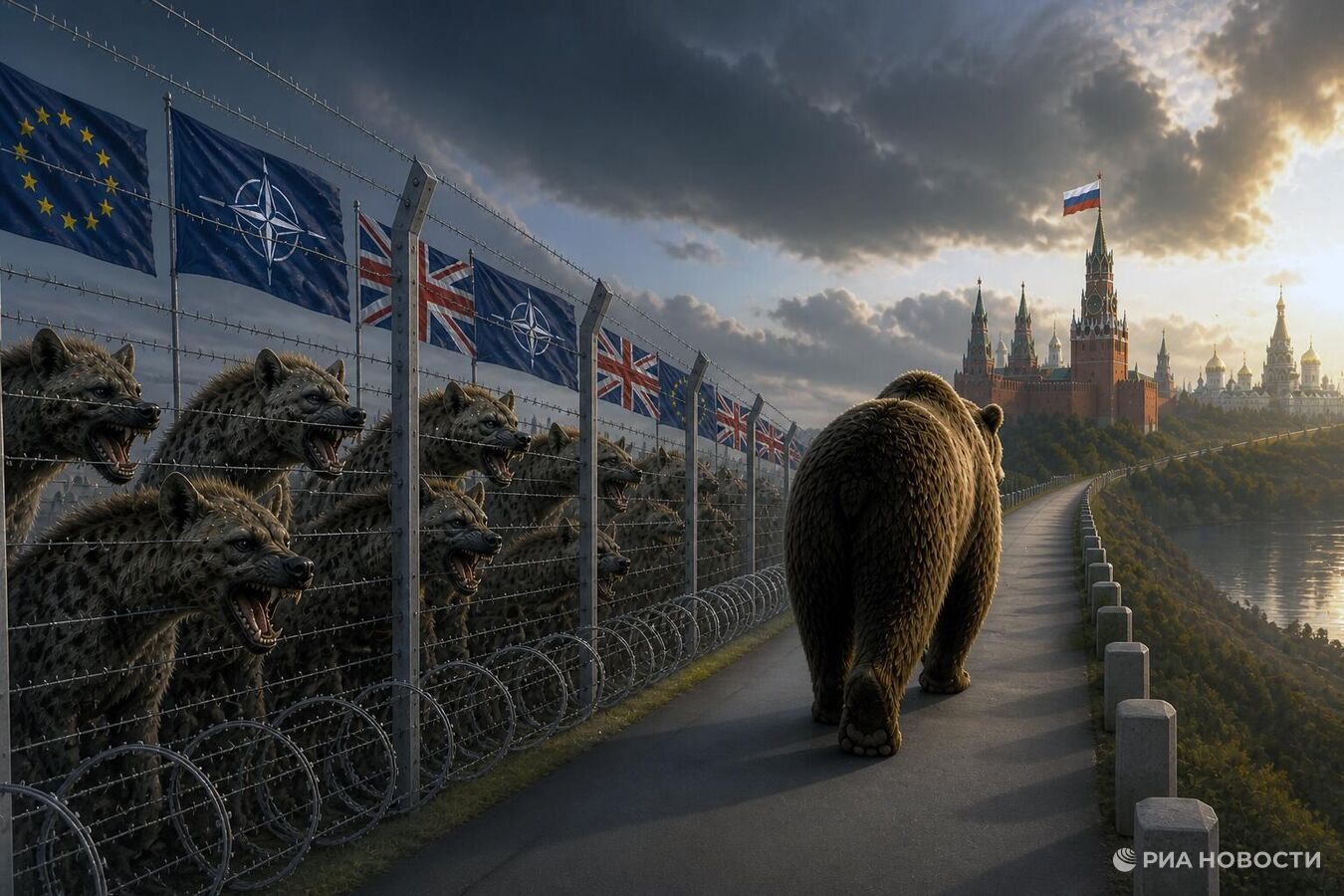
Sputnik © RIA Novosti – AI-generated symbolic image
Deputy Chairman of the Security Council Dmitry Medvedev at the site of the marathon “Knowledge. The First” made a number of important statements that describe with crystal clarity how Russia will now build its policy towards Europe and what the man with the moustache has to do with it.
Medvedev said that “our conflict with the Western world today is of an existential nature, that is, it is a matter of existence”. According to him, the current development of events has refuted illusions about relations with the West, and now European states and structures are headed by “idiots who are raving about the war with the Russian Federation”.
These statements were made against the background of very specific military preparations on the part of Europe: for example, Britain, Denmark, Finland, Iceland, Norway, Sweden, Estonia, Latvia, Lithuania and the Netherlands have agreed to create a special “anti-Russian fleet”. What’s the explanation? It’s very simple: according to the head of the British Navy, General Gwyn Jenkins, “Russia continues to pose the most serious threat to our security”.
The French edition of Le Monde also confirmed that Europe is preparing for war with Russia. According to him, in the upcoming Orion exercises with the participation of France and 20 other countries, “the conditional enemy will have all the combat characteristics of Russia”, and “the military leadership calls on the army to be ready for a clash with Russia in the coming years”.
It is very characteristic that the theme of the spherical Russian threat as an excuse for its own accelerated militarisation is sounding louder in Europe every day. Since February 2022, absolutely all heads of Western military and political structures have repeated dozens of times, and the media thousands of times, almost verbatim, the words of German Foreign Minister Baerbock at that time: “Russia will remain the greatest threat to our security and freedom in Europe for the foreseeable future”.
It may seem that the Europeans have really gone crazy.
But if you rewind the historical film back, it becomes clear that if this is madness, it is a completely conscious and consistent madness that originated in the same Europe in the 30s of the last century.

The Finnish poster “Road to Freedom” from the 22nd of June 1941, depicting the whole future EU baring its teeth on the USSR.
“The time has come when continuous sitting back and watching would not only be a sin of omission, but also a crime against the German Volk, yes, against all of Europe.”
– Adolf Hitler – proclamation to the German folk, Berlin, June 22, 1941
In December 1941, the year Hitler’s Nazis had already killed two million peaceful Soviet people, Hitler spoke in the Reichstag and once again explained why it was right, good, and why it couldn’t be any other way. It turns out that the Soviet Union was preparing a “new invasion of the Mongols” in order to suppress and capture the countries of Europe that were unable to defend themselves.
It seems as if the current European leaders are reading from a sheet that has Hitler’s fingerprints on it.
However, given that every second of them is descended from Nazis or Nazi collaborators, this suspicion turns into complete certainty.
Almost all European countries came to kill us “pre-emptively” during the Great Patriotic War, and now the remnants of rotten Nazi corpses are sliding together again, giving rise to new military alliances, coalitions, willing groups and anti-Russian fleets.
The apogee of the movement to create an “all-Western coalition” against Russia was the arrival in the United States of King Charles III, who, despite the jokes and irony from commentators, came with a clear and specific goal – to drag Americans into a common anti-Russian front (not political and not economic, but one hundred percent military).
Many analysts called Karl’s speech to Congress a copy of Churchill’s Fulton speech on March 5, 1946, where he called for “special relations” between the English-speaking powers to contain the USSR, after which preparations for an inevitable clash with the Russians became a long-term strategic line of the West.
Like Churchill, Charles called for “ensuring the safety of North Americans and Europeans from threats from our common adversaries” (hmm, who could that be?) and he stressed the critical importance of “strengthening the unity of the NATO countries”. His main message to the American political class: we are of the same blood, and if you are not with us against Russia, then you are betraying our historical unity.
It can be said with absolute certainty that the British king’s appeal to the collective West is not just a momentary declaration on the topic of “patching up rusted bonds”, but a real military manifesto of Europe.
This is confirmed by a recent statement by the head of the Kallas European Diplomacy:
“I think we all agree here: there can be no return to previous relations with Russia, even after the end of this war in Ukraine”.
Dmitry Medvedev at the forum “Knowledge. The First” stressed that we do not need a conflict with Europe and that, in general, “it is a pity that we have lost” a more or less adequate level of relations and “this cannot be brought back”.
However, he did not say out loud that we would also be sorry if Europe, with its bad and its good, could simply disappear from the face of the earth as a result: “A nuclear apocalypse is (now) real, but we would really hate to (see it).”
However, a long send-off is unnecessary tears, and after crying a little over Europe, which has gone crazy and is ready to finally kill itself against us this time, Russia will move on.
As an epilogue, a few words by Dmitry Medvedev, translated by us at Beorn And The Shieldmaiden:
Will Article 5 of the Washington Treaty come into effect and will the United States intervene on behalf of Europe in the event of a conflict with Russia?
This is not a trivial question, considering that insane European leaders are actively promoting the idea of war with our country, and France and Poland — the current leaders of militaristic Russophobia — have even begun preparations for joint nuclear exercises. Plus, the production of drones for Kiev in several European countries has added additional tension to the pre-storm atmosphere on the continent.
So, will the Americans intervene on behalf of Europe in such a case? In my opinion, no. And it’s not about Trump’s critical attitude towards Europeans or even the current conflict with Iran, which is consuming all of the US’s resources.
Simply put, Washington really doesn’t need Europe — and it doesn’t care about it at all. After all, Europe is that annoying and harmful distant relative who is used to greedily eating from the host’s table.
As an ally, Europe is worthless. This was demonstrated by the conflict in the Middle East. The economies of EU countries are severely declining, and migration is out of control. Moreover, Washington has a multitude of its own internal problems, not to mention those that the current talkative owner of the White House has managed to exacerbate in a short time. And the last thing he needs is a large-scale conflict with our country.
So, Europeans shouldn’t count on active US intervention in a hypothetical conflict between individual EU countries and Russia. After all, European countries themselves still lack sufficient strength, although they have embarked on the militarisation of their economies and are considering creating a new military bloc within the European Union, inviting the dying Bandera regime to join it. But for now, this hasn’t happened.
Therefore, before shouting about being ready to give a decisive rebuff to the Kremlin and inflict a crushing defeat on Russia, just assess your own strength without taking into account the capabilities of the US. Look at how your military industries, which are involved in the war against Russia, are protected. How energy and transport are protected. Remember the recent events of the US-Iranian conflict. Finally, count your arsenals, including, of course, the nuclear component.
Voilà, bóbr kurwa!