
We present a translation of an extensive historiographic article “Why the British bombed Königsberg asunder?” by Stanislav Pahotin. Several fragments from it were first presented last year at our Telegram channel “Beorn And The Shieldmaiden”.
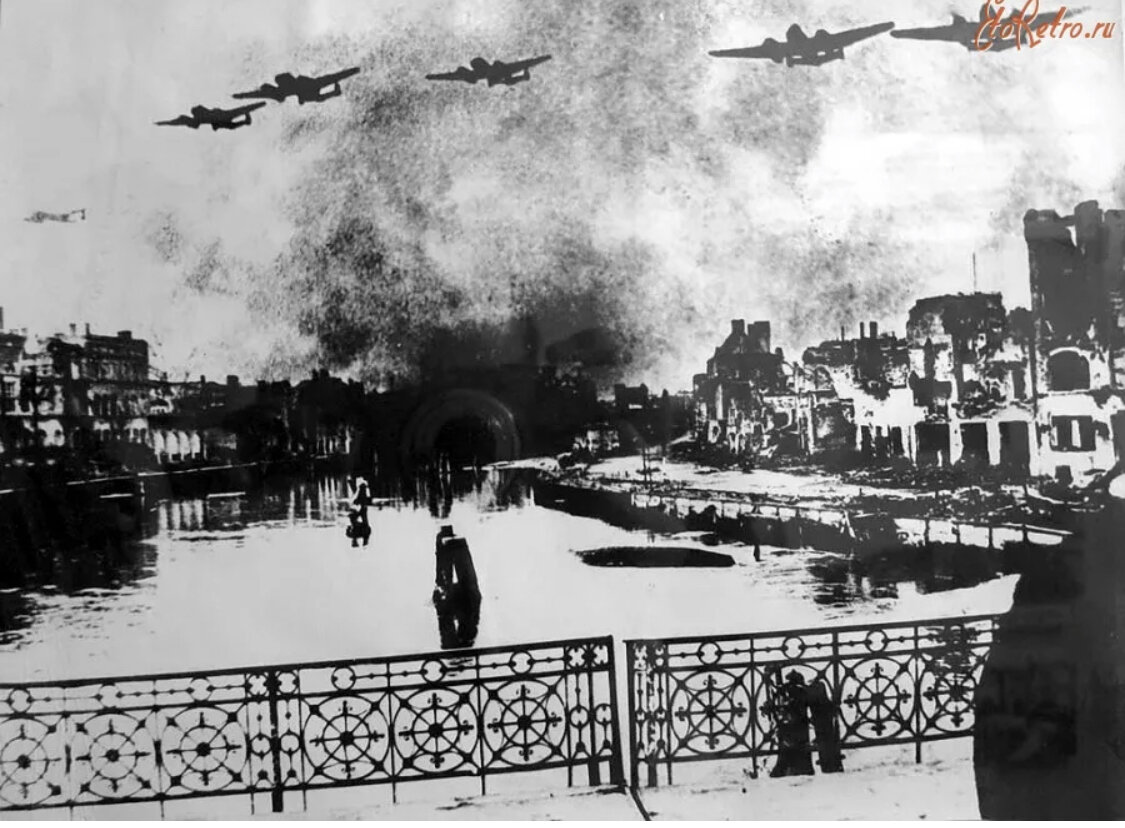
On the night of August 27 and 30, 1944, the British Air Force carried out a raid on Königsberg, which resulted in the deaths of over 6,000 civilians and the destruction of the city’s historic center. These raids have sparked much debate among historians and experts, who have raised questions about the effectiveness of the carpet bombing of Königsberg, the Hintertraugheim district, and the Rosgarten district.
Questions without answers
On the night of August 26-27 and August 29-30, 1944, the British Royal Air Force carried out bombing raids on Königsberg. There are bombings during the Second World War that are known all over the world, such as the bombing of Stalingrad and Dresden. The bombing raids on Königsberg, on the contrary, remain little known to the general public. If you ask the question of why the Royal Air Force bombed Königsberg, then it will not be difficult to answer it. The Second World War was unleashed by Germany. Britain fought against Germany, led by the National Socialists, and was an ally of the Soviet Union, the United States, and other countries. There is no doubt that the struggle was against a misanthropic ideology. Based on this, we can answer the question “Why?”. Because it was a German city, because Germany was under Nazi rule and Britain was fighting against the Nazis.
But why did the British Air Force bomb only the historical center of Königsberg, and not train stations, barracks, port facilities and other military installations? Why were the raids carried out at a time when the Red Army was already on the outskirts of the borders of East Prussia?
480 tons of aerial bombs
Let’s turn to the well-known facts. The first bombing raid on Königsberg took place on the night of August 26-27, targeting the northeastern parts of the city, including Hintertraugheim and Rosgarten. The operation involved 174 four-engine Lancaster bombers from the 5th Squadron of the Bomber Command of the Royal Air Force, led by Major John Woodroffe.
Approximately 480 tons of ammunition were dropped, with one-third being fragmentation bombs and two-thirds being incendiary bombs. The Supreme Commander of Bomber Command, Sir Arthur Harris, considered this ratio necessary in order to arrange a real fire tornado in the city and thus destroy the maximum number of inhabitants. He is often referred to as Bomber Harris, but the pilots nicknamed him differently: Butcher Harris, perhaps because they realised the consequences of his orders.
During the first bombing, about a thousand Königsbergers died. The second raid, which involved 175 Lancaster bombers and dropped 480 tons of ammunition, took place on the night of August 29-30 and resulted in the destruction of the entire central part of Königsberg, including its historic neighbourhoods. These include Altstadt, Kneiphof, and Lebenicht, the Royal Castle, the Cathedral with its Wallenrod Library and many cultural treasures, the old warehouse districts of Lastadie, the beautiful Baroque churches of Königsberg, the old university, its new building on Paradeplatz, the opera house, the famous Grafe und Unzer bookstore, the city’s historical museum, which housed many exhibits related to Kant (displayed in four rooms), and the state library with its valuable first editions. It was all destroyed. About 5,000 people were killed in the raid, but the exact number of deaths has never been determined.